
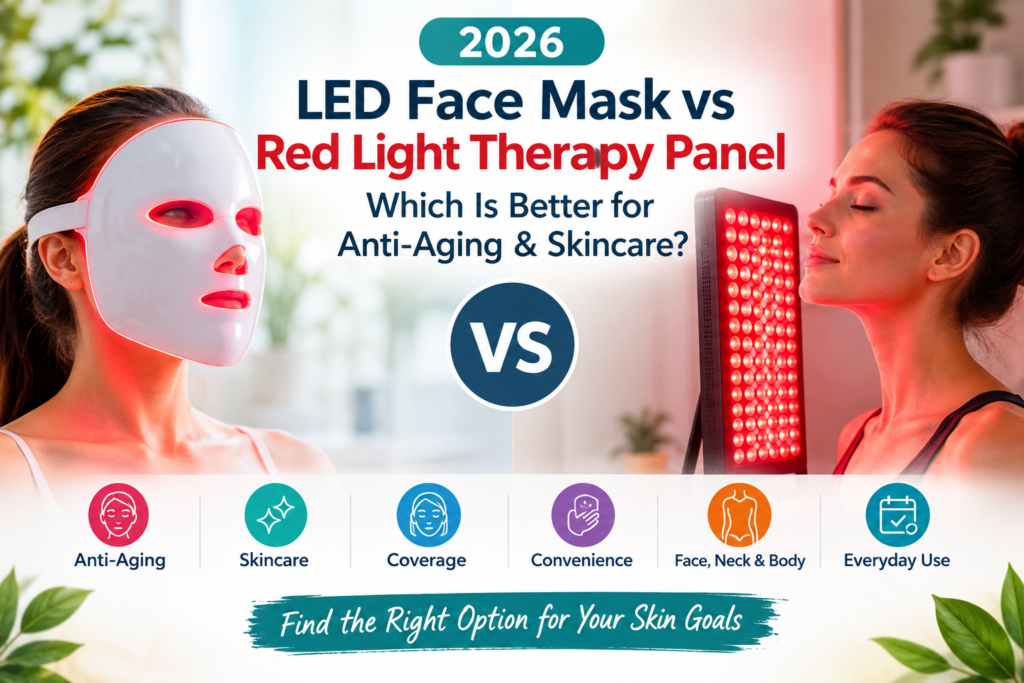
LED Face Mask vs Red Light Therapy Panel 2026: Compare benefits, coverage, convenience, anti-aging results, and skincare uses to find the best option for you.
LifeCareBalance.com is reader-supported. When you buy through links on our site, we may earn an affiliate commission at no extra cost to you. As an Amazon Associate, we earn from qualifying purchases.

- RED LIGHT THERAPY MASK: CryoGlow is an at-home LED face mask combining red, blue & deep infrared light with under-eye co…
- MOST AWARDED LED MASK IN THE U.S.*: Real people. Real results. Clinically tested on 119 participants by an independent t…
- EXPERTLY DEVELOPED: Developed by Shark Beauty alongside optical light experts and engineers, bringing MedSpa-inspired re…

- 4-in-1 Multi-Wavelength Light Therapy — XSSNVV LED face mask combines 620nm red light and 850nm near-infrared to support…
- Cordless & Remote-Free Convenience — Built-in on-mask controls let you start each 10-minute session with one touch. No w…
- 272 Precision LEDs for Balanced Full-Face Coverage – Gentle Enough for Daily Use: Engineered with 272 carefully position…
If you’re weighing an LED face mask vs red light therapy panel, the honest answer is: it depends on what you’re treating and how you want to use it. Both devices rely on the same underlying technology — red and near-infrared light aimed at photobiomodulation, the process by which light energy interacts with skin cells to support cellular activity. The real differences come down to form factor: coverage area, treatment distance, portability, and how the device fits into your routine.
A face mask is built specifically to hug the contours of your face for hands-free, consistent facial treatment. A panel is a flat, stand-mounted light source that treats a larger surface area — face, neck, chest, or body — but requires you to position yourself in front of it. Neither is automatically “better.” One isn’t universally superior to the other; the right pick depends on your goals, your space, and how you actually want to use a light therapy device day to day.
This guide compares LED face masks and red light therapy panels across anti-aging potential, facial skincare, coverage, convenience, and buying considerations, based on current dermatology and photobiomodulation research — not marketing claims.
LED Face Mask vs Red Light Therapy Panel: What’s the Difference?
An LED face mask is a curved, wearable device — often silicone or rigid plastic — with LEDs arranged to sit close to (or flush against) the face. Because it’s worn rather than positioned, distance and coverage are largely fixed by the mask’s design. Most are used hands-free for a set session length, typically while doing something else.
A red light therapy panel is a flat panel of LEDs mounted on a stand or tripod, or leaned against a wall or mirror. You position yourself in front of it at a set distance for the treatment area you want — face, neck, chest, back, or larger body zones. Panels range from small handheld units to large full-body units.
Key practical differences:
- Positioning: Masks conform to the face; panels require you to sit or stand at a specific distance, which affects the light dose your skin receives.
- Facial coverage: A well-fitted mask can expose most of the face fairly evenly. A panel’s facial coverage depends on panel size and how far you sit from it.
- Body coverage: Panels can treat areas well beyond the face — neck, chest, arms, back — simply by repositioning. Masks are generally limited to the face (some models extend to the neck).
- Portability: Masks are lightweight and easy to store or travel with. Panels take up more space and are less portable, though smaller panels exist.
- Treatment flexibility: Panels let you angle light at different areas in the same session; masks are fixed to their built-in shape.
For background on LED face masks specifically, see our LED Face Mask Review 2026 and our roundup of the Best LED Face Masks 2026.
LED Face Mask vs Red Light Therapy Panel — Quick Comparison
| Feature | LED Face Mask | Red Light Therapy Panel |
|---|---|---|
| Facial skincare | Purpose-built for the face; consistent fit each use | Effective for the face, but coverage depends on panel size and distance |
| Anti-aging focus | Common focus of facial masks; wavelength and dose still matter most | Can target the face and neck together in one session |
| Face coverage | Generally full, even facial coverage by design | Depends on panel width and how close you sit |
| Neck coverage | Limited to none, unless the mask extends to the neck | Good — you can angle the panel toward the neck separately |
| Body coverage | Minimal to none | Strong — face, neck, chest, back, limbs are all possible |
| Portability | High — lightweight, easy to store or travel with | Lower — needs space and often a stand |
| Setup | Put it on and go | Requires positioning at the correct distance each session |
| Hands-free use | Yes, typically | Only if mounted on a stand; otherwise requires staying in position |
| Treatment distance | Fixed by mask design (usually close to skin) | Variable — set by the user, which affects dose |
| Flexibility | Low — one fixed treatment zone | High — can reposition for different body areas |
| Best for | Focused, low-effort facial routines | Broader coverage and multi-area use |
Actual performance still comes down to the specific product’s verified wavelength, irradiance, and how consistently it’s used — not the category alone.
Which Is Better for Anti-Aging?
Photobiomodulation research on red and near-infrared light for skin aging is genuinely encouraging, but it’s not a guarantee of dramatic results, and it doesn’t clearly favor masks over panels or vice versa — the light source’s specifications and dose matter more than its shape.
A randomized controlled trial published in Photobiomodulation, Photomedicine, and Laser Surgery found that red (660 nm) light delivered over 10 sessions across four weeks produced a significant reduction in periocular wrinkle volume of roughly 31.6%, though the same study found no improvement in skin hydration or viscoelasticity. A separate clinical study using an LED face mask at 630 nm reported improvements in wrinkle depth and skin firmness measures after twice-weekly sessions over three months, based on a controlled study of 20 healthy women.
That said, a 2025 narrative review of 59 studies on red LED therapy in dermatology found that the strongest evidence supports acne treatment, with skin rejuvenation and anti-aging showing more variable results across the literature. In other words, red light shows real, published promise for skin aging, but the evidence base is stronger for some uses (like acne) than for wrinkle reversal, and results vary by study design, wavelength, dose, and skin type.
What this means practically: neither a mask nor a panel has a documented anti-aging advantage over the other in the research. What matters is whether the specific device delivers an effective wavelength and dose consistently to the treatment area, and whether you use it as directed over weeks to months — most published protocols use multiple sessions per week for several weeks or longer.
Which Is Better for Facial Skincare?
If your only goal is facial skincare, an LED face mask has a practical edge: it’s designed to sit close and evenly across the face without you having to think about angle or distance, which supports consistent, easy use — and consistency is one of the more reliably important factors across the research above.
A panel can deliver comparable results to the face, since it’s the same underlying light mechanism, but you’re responsible for positioning yourself correctly and at a consistent distance every session, which introduces more room for user error. The upside of a panel is flexibility: if you want to treat the face one day and the neck or chest the next, a panel adapts without needing separate equipment. For someone whose skincare goals extend beyond the face, that flexibility can outweigh the mask’s simplicity.
Which Provides Better Coverage?
Coverage depends heavily on the specific product, not just the category, but general patterns hold:
- Face: Masks are purpose-built for full facial coverage; panels can cover the face too, but coverage narrows or widens depending on panel size and distance.
- Neck: Most masks stop at the jawline; a small number of newer designs extend to the neck. Panels can treat the neck simply by repositioning.
- Chest/decolletage: Rarely covered by masks. Panels handle this area well.
- Arms, legs, body: Not a realistic use case for a face mask. This is where panels — especially larger or full-length ones — have a clear structural advantage.
If your interest is strictly facial, this difference may not matter to you. If you’re considering a device for broader skin or recovery use (e.g., body, joints, or larger treatment areas), a panel’s coverage is the more versatile choice.
Wavelengths, Irradiance, Treatment Distance, and Dose
This is the part of the comparison that matters more than “mask vs panel,” and it’s often glossed over in marketing.
- Wavelength is measured in nanometers (nm) and determines how deeply light penetrates and which biological processes it interacts with. Red light (roughly 620–700 nm) and near-infrared light (roughly 800–1000 nm) are the ranges most associated with skin and tissue effects in the research above.
- Irradiance (measured in milliwatts per square centimeter, mW/cm²) describes how intense the light is at a given distance. A dermatologist quoted by CTV News described it as being like water pressure from a shower — and recommended looking for facial devices with irradiance in the range of roughly 40–100 mW/cm², with red LED masks around 630 nanometers.
- Treatment distance changes irradiance dramatically. A panel rated for a certain output at 6 inches will deliver much less energy to skin at 18 inches. This is precisely why panels require attention to positioning that masks don’t.
- Dose (energy density), measured in joules per square centimeter (J/cm²), is the product of irradiance and exposure time. It’s the number most closely tied to outcomes in clinical studies — for example, the wrinkle-volume study above used a dose of roughly 3.8 J/cm² per session, while the mask study used about 15.6 J/cm² over 12 minutes.
More LEDs, higher wattage, or a higher marketed irradiance number does not automatically mean a better device. What matters is the verified irradiance at the actual distance you’ll use the device, and whether that translates into an appropriate dose over your session length. Many manufacturer irradiance figures are measured at the LED surface, not at a realistic treatment distance — so a spec sheet number alone can be misleading. Where possible, look for third-party verified measurements or manufacturer data that specifies distance.
LED Face Mask Pros and Cons
Pros
- Convenient, hands-free, and easy to build into an existing routine
- Purpose-built for even facial coverage
- Portable and simple to store
- Fixed design removes guesswork around positioning
Cons
- Coverage is essentially limited to the face (occasionally the neck)
- Not practical for larger body areas
- Fit, comfort, and light coverage vary significantly between brands and face shapes
- Wavelength and irradiance specifications differ substantially across products, so “mask” alone doesn’t guarantee performance
Red Light Therapy Panel Pros and Cons
Pros
- Larger treatment area in a single session
- Flexible positioning for face, neck, chest, or body
- One device can serve multiple use cases (skin, recovery, larger areas)
- Useful if you want a single tool instead of several targeted devices
Cons
- Takes up more physical space
- Less portable — not something you’d travel with easily
- Requires correct positioning and distance each session, which affects dose
- Can be less convenient for a quick, low-effort facial routine
LED Face Mask vs Panel: Which Is More Convenient?
For day-to-day convenience, masks generally win on simplicity: put it on, start the session, and go about something else. There’s no setup beyond charging or plugging in, and nothing to angle or measure.
Panels ask more of you — finding space, setting up a stand, and sitting at a consistent distance for the right amount of time. Some panels support hands-free use once mounted, but you’re still positioned and stationary in a way a mask doesn’t require.
Neither convenience factor determines results on its own. Across the research on photobiomodulation for skin, session frequency and consistency over weeks matter more than which device shape you use — a device you’ll actually use several times a week, correctly, is more valuable than a more “powerful” one that ends up gathering dust.
Which Should You Choose?
Choose an LED Face Mask If:
- Your main goal is facial skincare specifically
- You want a portable, easy-to-travel-with option
- You have limited space at home
- You want the simplest possible routine — no setup or positioning
- You’d rather have a device designed only for the face than a general-purpose one
Choose a Red Light Therapy Panel If:
- You want to treat areas beyond the face — neck, chest, or body
- You want flexibility to reposition for different areas or angles
- You have the space for a stand-mounted device
- You want one versatile device instead of several targeted ones
- Broader home light-therapy coverage matters more to you than pure convenience
How to Choose the Best LED Face Mask or Red Light Therapy Panel
Whichever category you lean toward, the specific device matters more than the category. Before buying, check:
- Exact wavelengths the device emits (not just “red light” — look for the nm figures)
- Irradiance data, ideally measured at the actual treatment distance, not just at the LED surface
- Recommended treatment distance for the stated specifications
- Recommended session length and frequency
- Actual coverage area — check dimensions or photos rather than relying on marketing copy
- Fit and design — for masks, check reviews on comfort and facial coverage for different face shapes
- Eye-safety instructions and included eye protection, especially for devices that include blue light
- Warranty length and terms
- Return policy, particularly important for wearable devices where fit varies by person
- Manufacturer transparency — companies that publish verified specs and testing data are generally more trustworthy than those relying on vague claims
- Independent testing or third-party verification, where available, rather than manufacturer-only data
- Regulatory status, understood accurately (see below)
A Note on FDA Terminology
Marketing language around FDA status is frequently misleading, so it’s worth understanding the actual categories:
- FDA registration/listing means a company and its device are listed in an FDA database. It does not mean a submission was reviewed for a specific claim, and a device can be registered without being cleared.
- FDA clearance (510(k)) applies to most red light therapy and LED devices. It means the device was found “substantially equivalent” to an already-legally-marketed device for a stated use — this is a real regulatory step, but it’s not the same as full FDA “approval.”
- FDA approval is reserved for high-risk, Class III devices (like pacemakers) and requires extensive clinical trial data. Nearly all red light therapy devices fall under clearance, not approval.
“FDA registered” and “FDA cleared” are not interchangeable, and neither should be casually described as “FDA approved.” If a listing uses these terms loosely, treat it as a red flag rather than a guarantee of efficacy.
Red Light Therapy Safety Tips
Red and near-infrared light are non-ionizing and don’t carry UV radiation’s skin-cancer risk, and current safety research on photobiomodulation for skin is reassuring: a systematic review found no clinical trial data linking photobiomodulation with significant adverse events, including new or recurrent malignancy, and concluded that current evidence suggests photobiomodulation is oncologically safe for skin rejuvenation. That said, sensible precautions still apply:
- Always use the eye protection included with your device, especially for masks or panels that include blue light. At least one case of retinal damage has been reported in association with a blue LED face mask when eye protection was used improperly, and blue light in particular carries documented risk for eye damage without proper protection.
- Never look directly at the LEDs, even with red or near-infrared-only devices.
- Follow the manufacturer’s recommended distance and session time. Using a panel closer than intended, or for longer than recommended, changes the dose your skin receives and can increase the chance of skin irritation or discomfort.
- Watch for low-quality devices. Poorly made lamps can generate excess heat, which has been flagged as a potential cause of skin burns.
- If you’re pregnant, breastfeeding, taking photosensitizing medication, have a history of skin cancer, or have any other medical concern, talk to a healthcare professional or dermatologist before starting light therapy. Manufacturer FAQs and safety data are not a substitute for personalized medical advice.
Frequently Asked Questions
Is a red light therapy panel better than an LED face mask? Not universally. Panels offer more coverage and positioning flexibility; masks offer more convenience and consistent facial fit. The better choice depends on whether your goal is facial-only skincare or broader coverage.
Are LED face masks good for wrinkles? Clinical studies on red LED light, including devices used in mask form, have shown measurable reductions in wrinkle depth or volume in controlled trials. Results vary by study and device, and evidence for anti-aging specifically is described as more mixed than evidence for conditions like acne.
Can a red light therapy panel be used on the face? Yes. Panels are commonly used for facial treatment; you simply position yourself at the recommended distance rather than wearing a fitted device.
Which is better for anti-aging, a mask or a panel? Neither category has a documented anti-aging advantage over the other in the research. What matters more is the device’s verified wavelength and dose, and how consistently it’s used.
Can red light therapy help improve skin appearance? Photobiomodulation research shows promising results for skin texture, fine lines, and some markers of skin aging, though outcomes vary across studies and are not guaranteed for every user.
Do red light masks and panels use the same wavelengths? Many devices in both categories use similar red light wavelengths (commonly in the 620–700 nm range), sometimes combined with near-infrared. Actual wavelengths vary by specific product, so check the listed specifications rather than assuming based on device type.
Does higher irradiance mean better results? Not automatically. Irradiance needs to be considered alongside treatment distance and session length to determine actual dose. A device with a high irradiance rating measured at the LED surface may deliver much less light to your skin at a realistic treatment distance.
Can I use a red light panel on my neck? Yes — this is one of the practical advantages of a panel over most face masks, which typically don’t extend past the jawline.
How often should red light therapy be used? Published clinical protocols vary, but many studies use sessions two to three times per week over several weeks to months. Follow your specific device’s instructions, since recommended frequency depends on its wavelength and dose.
What should I check before buying a red light therapy device? Verified wavelength and irradiance data, recommended treatment distance and session length, accurate (not exaggerated) regulatory claims, eye-safety features, warranty, and return policy.
Final Verdict
There’s no universal winner in the LED face mask vs red light therapy panel comparison — and any article claiming otherwise is oversimplifying the evidence. If your priority is a focused, low-effort facial anti-aging and skincare routine, an LED face mask’s convenience and consistent fit make it easier to use regularly, which matters given how much the research emphasizes consistent use over time. If you want broader coverage — face, neck, chest, or body — and don’t mind the extra space and setup, a red light therapy panel offers more flexibility for the same underlying technology.
What consistently matters more than the category is the individual device: its verified wavelength, its real-world irradiance at your treatment distance, transparent (not exaggerated) regulatory claims, and whether you’ll actually use it consistently. Choose the form factor that fits your goals and your routine, then evaluate the specific product on its actual specifications — not on whether it’s labeled a “mask” or a “panel.”
For more on specific LED face mask options, see our LED Face Mask Review 2026 and Best LED Face Masks 2026 guides.
Medical disclaimer: This article is for informational purposes only and is not a substitute for professional medical advice. Consult a dermatologist or qualified healthcare provider before starting any light therapy device, especially if you are pregnant, breastfeeding, taking photosensitizing medication, or have a pre-existing skin or eye condition.
Sources
- Mota, L.R. et al. “Photobiomodulation Reduces Periocular Wrinkle Volume by 30%: A Randomized Controlled Trial.” Photobiomodulation, Photomedicine, and Laser Surgery, 2023. PubMed
- “Reverse skin aging signs by red light photobiomodulation.” PubMed, 2023. PubMed
- “Photobiomodulation and Photodynamic Therapy Using Red LED Light in Dermatology: A Narrative Review.” Bratislava Medical Journal / Springer Nature, 2025. Springer Link
- “Photobiomodulation: A Systematic Review of the Oncologic Safety of Low-Level Light Therapy for Aesthetic Skin Rejuvenation.” PMC, National Institutes of Health. NIH PMC
- CTV News. “Everything you need to know about LED face masks from a dermatologist.” CTV News
- “How to Buy FDA-Cleared Red Light Therapy Devices in 2026” (overview of FDA 510(k) clearance vs. registration terminology). youlumi.com
- “FDA Approved Red Light Therapy: What It Really Means.” lumivisage.com
- Boulder Medical Center. “At-Home Light Therapy Masks: Are They Effective and Safe?” bouldermedicalcenter.com