
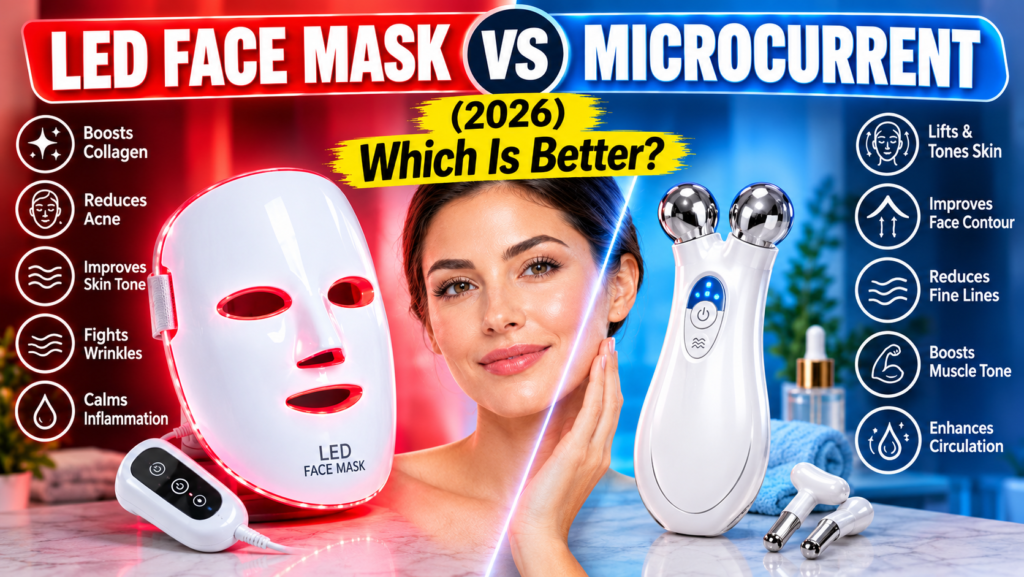
Compare LED face masks vs microcurrent devices for wrinkles, skin texture, facial contour, safety, and value. Find the right device for your skincare goals.
LifeCareBalance.com is reader-supported. When you buy through links on our site, we may earn an affiliate commission at no extra cost to you. As an Amazon Associate, we earn from qualifying purchases.
LED face masks and microcurrent facial devices are often marketed as at-home anti-aging tools, but they work differently and are intended to address different skincare goals. An LED mask uses light to target skin-related concerns, while a microcurrent device delivers a low-level electrical current and is marketed primarily for facial toning and contour.
The quick answer: An LED face mask is generally the more relevant option if you want to target the appearance of fine lines, skin texture, or certain types of acne. A microcurrent device may appeal to you if you want a temporary change in facial definition or a toning-focused routine. Neither device guarantees results, and neither should be considered a substitute for professional medical care.
This guide compares the technologies, the available evidence, practical differences, safety considerations, and the factors worth checking before you buy.

- Enhanced collagen production capability significantly reduces fine lines, wrinkles and redness, for younger-looking skin…
- Upgraded light coverage provides our famous instant glow, for a healthier, brighter and smoother complexion.
- An all-new, exclusive layout of 236 LED bulbs emits three clinically recognised wavelengths: red (633nm), near-infrared …
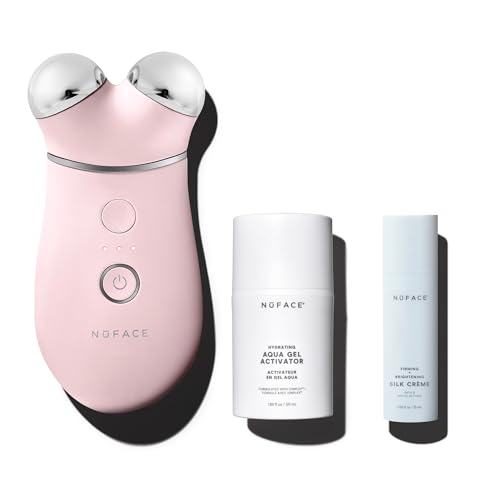
- The Original Lift Authority: TRINITY+ is the most advanced FDA-cleared microcurrent facial device, delivering 3 customiz…
- Face Lift Device & Skin Tightening: Microcurrent supports collagen and elastin production. Sculpts cheeks, lifts brows, …
- 3 Frequencies, 3 Intensities: Targets sagging jowls, tech neck, and sagging skin. Improves skin firmness, contour, and r…
Quick Verdict: LED Face Mask vs Microcurrent
| Feature | LED Face Mask | Microcurrent Device |
|---|---|---|
| Technology | Light-emitting diodes | Low-level electrical current |
| Main focus | Skin appearance | Facial toning and contour appearance |
| Fine lines | Some clinical evidence supports potential benefits | Direct evidence for consumer microcurrent devices is more limited |
| Skin texture | More directly relevant | Not the primary purpose |
| Acne | Certain blue-light devices may help selected types of acne | Not a standard acne treatment |
| Jawline appearance | Not designed primarily for contouring | Marketed for temporary toning and definition |
| Treatment experience | Often hands-free | Usually requires movement and correct contact |
| Conductive gel | Usually not required | Often required |
| Results | Generally assessed over repeated sessions | Any immediate visible change may be temporary |
| Best fit | Skin-focused skincare goals | Contour-focused routines |
These are general distinctions, not guarantees. Products differ in their output, design, treatment instructions, and evidence. A device’s advertised purpose should not be confused with proof that it delivers a particular result.
How LED Face Masks Work
LED stands for light-emitting diode. An LED face mask places light sources across a face-shaped surface and exposes the skin to specified wavelengths. Some masks use red light, some include near-infrared light, and others combine red light with blue light.
This approach is commonly called photobiomodulation when light is used to influence biological processes in tissue. Researchers have studied it for skin rejuvenation and other applications, but the results depend on the wavelength, delivered dose, treatment schedule, and device being tested.
Red light
Red light is frequently used in devices marketed for the appearance of fine lines and signs of skin aging. Some clinical studies have reported improvements in wrinkle measurements following particular red-light treatment protocols.
For example, a 2023 randomized split-face trial studied red light at 660 nm and amber light at 590 nm in 137 women. After ten sessions over four weeks, researchers reported reductions in periocular wrinkle volume. However, the results came from a specific study protocol and should not be assumed to apply equally to every consumer mask.
Read the 2023 clinical trial on photobiomodulation and periocular wrinkles for the study methods and findings.
Near-infrared light
Some masks combine red light with near-infrared light. The wavelengths and output vary by device, so the presence of near-infrared light alone does not establish effectiveness.
Check the manufacturer’s specifications and treatment instructions rather than relying on phrases such as “advanced light technology” or “professional-strength results.”
Blue light
Blue-light devices are commonly marketed for acne-related concerns. Evidence and suitability depend on the specific device and type of acne being treated. A red-light-only anti-aging mask should not automatically be treated as an acne device.
The American Academy of Dermatology explains the evidence and limitations of light-based acne treatments in its guide to lasers and light treatments for acne.
What can you realistically expect?
An LED mask may be worth considering if you want a non-invasive addition to a skincare routine. However, visible improvements are not guaranteed, and the quality of evidence varies by concern and device.
A 2025 randomized, sham-controlled study of a home-use LED and infrared mask reported improvements in crow’s-feet assessments over a 16-week treatment period. That is encouraging evidence for the particular device and protocol studied, not proof that all LED masks produce the same outcome.
The important takeaway is to evaluate the actual device and its evidence rather than assuming every mask will produce equivalent results.
For a product-focused overview, see our Best LED Face Masks of 2026 guide.
How Microcurrent Facial Devices Work
Microcurrent devices deliver a low-level electrical current through contact points such as metal probes, rollers, or electrodes. Many consumer devices require a conductive gel or another manufacturer-approved conductive product to support consistent contact.
These products are commonly marketed for facial toning, a more defined-looking jawline, and a temporarily lifted appearance. However, marketing claims should be separated from the strength of the clinical evidence.
Microcurrent should not be confused with LED light therapy, radiofrequency, or other electrical stimulation technologies. Devices that use different forms of energy may have different mechanisms, treatment protocols, and evidence. Research on one technology cannot automatically establish the effectiveness of another.
What might you notice?
Some users report that their face looks more defined immediately after a session. However, an immediate visual change does not establish that a device has permanently lifted skin, changed facial anatomy, or produced a lasting reduction in wrinkles.
The duration and consistency of any visible effect can vary. Results also depend on the device, the technique used, and whether the user follows the recommended routine.
Why conductive gel matters
Many microcurrent devices require a specific conductive gel or serum. This is part of the intended method of use, not an optional step to skip for convenience.
Before purchasing, check whether the required gel is included, whether it needs to be replaced regularly, and whether the manufacturer permits alternatives. Do not substitute an ordinary skincare product unless the device instructions explicitly allow it.
What Does the Research Say About Microcurrent?
Evidence for at-home facial devices is mixed and varies by technology. A 2024 review of home beauty devices examined clinical research involving technologies such as LED, microcurrent, and radiofrequency. The authors found that some home-use devices showed potential benefits, but the available studies were limited by factors including small samples and short follow-up periods.
The review does not establish that all microcurrent products work equally well, nor does it prove that a particular device produces a permanent facial lift.
You can read the 2024 review of home beauty devices for facial rejuvenation to understand the limitations of the evidence.
When evaluating microcurrent, look for research on the exact technology and device you are considering. A study of a combination device that uses several forms of energy cannot tell you how much benefit came from microcurrent alone.
This is especially important when a product promises dramatic jawline definition, substantial lifting, or results comparable to an in-office procedure. Strong marketing language is not a substitute for independent evidence.
LED vs Microcurrent for Fine Lines and Wrinkles
If your main concern is the appearance of fine lines, an LED mask is generally the more directly relevant starting point because red-light photobiomodulation has been studied specifically for certain skin-aging outcomes.
That does not mean every LED mask will reduce wrinkles. Clinical findings depend on the treatment protocol, and researchers continue to investigate how device specifications and application schedules affect results.
Microcurrent devices are more commonly positioned around facial toning and contour. Some products also advertise anti-aging benefits, but those claims should be assessed against evidence for the particular device rather than inferred from the technology’s name.
Which should you choose?
- Choose LED if your priority is skin-focused care and you are comfortable with gradual, uncertain results.
- Consider microcurrent if your priority is a toning-focused routine and you understand that any visible contour change may be temporary.
- If deep wrinkles, significant skin laxity, or another persistent concern is your main issue, ask a qualified dermatologist about options with evidence appropriate to your situation.
Neither home device should be presented as equivalent to a surgical facelift or a proven clinical skin-tightening procedure.
LED vs Microcurrent for Skin Firmness and Facial Contour
The word “firmness” can mean different things. It may refer to skin texture and elasticity, or it may describe how defined the cheeks and jawline look.
LED devices are studied for changes in skin appearance, including certain wrinkle and texture measurements. Microcurrent devices are marketed more around facial toning and contour.
These are not interchangeable outcomes. A temporary difference in facial appearance is not proof of a structural change in the skin, and a change in a wrinkle measurement does not necessarily mean a device creates a lifted jawline.
If you want a more defined-looking face for a short-term occasion, a microcurrent device may fit your preferences. If you want to focus on skin quality over time, LED may be more relevant. In both cases, keep expectations realistic and judge the specific device rather than the category.
Which Is Better for Acne, Redness, and Skin Texture?
Acne
Some LED masks include blue light or a combination of blue and red light and are marketed for acne. Not every mask includes these wavelengths, and light-based treatment is not suitable for every acne type or severity.
Microcurrent is not generally the first choice for acne treatment. If breakouts are persistent, painful, or scarring, seek advice from a qualified healthcare professional rather than relying on a home device alone.
Read our focused guide to LED Face Masks for Acne in 2026 if acne is your main concern.
Redness
LED devices are sometimes marketed for the appearance of redness, but persistent redness may have many causes. A home mask should not be treated as a diagnosis or as a guaranteed treatment for rosacea or another skin condition.
Microcurrent is not primarily designed to target redness. If you experience persistent flushing, irritation, or worsening symptoms, consult a dermatologist.
Skin texture
LED is the more directly relevant category when your goal is to address the appearance of uneven texture or fine lines. Nevertheless, results vary, and a device should not be assumed to improve every texture concern.
Microcurrent devices focus more on facial toning and contour appearance than on surface texture.
Which Gives Faster Results?
The two technologies are often marketed with different expectations.
Microcurrent: Some users report noticing a temporary difference in facial definition after a session. The size and duration of that change are not guaranteed, and an immediate effect does not prove a lasting lift.
LED: Skin-related changes are generally assessed after repeated sessions over time. Clinical studies often use structured schedules and objective measurements rather than relying only on immediate before-and-after impressions.
Neither technology has a universal timeline. The device, treatment protocol, individual characteristics, and consistency of use all matter.
Be cautious of claims promising a dramatic transformation after one session or guaranteed wrinkle removal within a fixed number of days.
Can You Use LED and Microcurrent Together?
Some people may choose to use both technologies because they have different intended purposes. However, combining devices does not automatically produce better or faster results.
Before using both:
- Read the instructions for each device.
- Check whether the manufacturers provide guidance on sequencing or combined use.
- Use the required conductive product for microcurrent.
- Avoid exceeding the recommended treatment time or frequency.
- Stop if you experience unexpected irritation, pain, or other concerning symptoms.
If you have a pacemaker or another implanted electronic device, a seizure disorder, are pregnant, or have a relevant medical condition, seek advice from a qualified healthcare professional and review the specific device contraindications before using microcurrent. Contraindications differ between products.
For example, NuFACE’s published contraindications apply to its devices and should not be assumed to cover every brand. Follow the instructions for the exact product you own.
Pros and Cons of LED Face Masks
Pros
- Designed for skin-focused treatment
- Some clinical evidence supports potential benefits for certain wrinkle-related outcomes
- Many models offer hands-free sessions
- Some devices include blue light for acne-related use
- Can fit into a routine with relatively little setup
Cons
- Results are not guaranteed
- Evidence varies by device and skin concern
- Wavelengths and output differ between products
- Eye-safety instructions must be followed
- Masks may be expensive relative to the uncertainty of individual results
Pros and Cons of Microcurrent Devices
Pros
- Designed for a toning-focused facial routine
- May appeal to users seeking a temporarily more defined appearance
- Portable options are available
- Can be used without light exposure, which may suit people who prefer not to use an LED device
Cons
- Evidence for consumer products is limited and device-specific
- Correct technique and consistent electrode contact may be important
- Conductive gel may add ongoing cost
- Any immediate visual change should not be mistaken for a permanent lift
- Contraindications and precautions require careful review
Buying Guide: What to Check Before You Purchase
Before buying an LED face mask
- Wavelengths: Check which wavelengths the mask actually uses.
- Intended use: Confirm whether the product is designed for wrinkles, acne, or another specific concern.
- Evidence: Look for clinical research relevant to the device or its technology.
- Treatment schedule: Read the recommended session length and frequency.
- Eye safety: Understand the precautions and eye protection required.
- Fit and comfort: Check whether the mask suits your face shape and can be used comfortably.
- Warranty and returns: Review the terms before spending money.
- Regulatory claims: Verify any stated clearance for the exact device and intended use.
Our LED Face Mask Review 2026 covers additional product-evaluation considerations. If you are comparing mask styles and red-light options, our Best Red Light Therapy Face Masks of 2026 guide provides a more focused comparison.
Before buying a microcurrent device
- Intended treatment areas: Check which parts of the face the manufacturer permits you to treat.
- Conductive gel: Confirm what product is required and whether it is sold separately.
- Technique: Read the instructions to understand the movement and contact required.
- Intensity settings: Check whether the device offers settings appropriate to your comfort level.
- Contraindications: Review medical exclusions and precautions before purchase.
- Evidence: Look for studies on the actual device or a closely matching technology.
- Warranty and replacement costs: Consider the long-term cost of accessories and consumables.
- Return policy: Make sure you understand the conditions before opening or using the product.
Do not choose a device solely because it advertises “professional,” “clinical,” or “medical-grade” technology. Those phrases do not independently establish effectiveness.
Common Mistakes to Avoid
- Expecting an LED mask to erase wrinkles permanently.
- Assuming microcurrent creates a permanent facelift.
- Treating every LED wavelength as interchangeable.
- Assuming a study of a multi-energy device proves the effectiveness of microcurrent alone.
- Skipping the required conductive gel.
- Ignoring contraindications or eye-safety instructions.
- Using either device more often than the manufacturer recommends.
- Buying based on dramatic before-and-after photos without checking the evidence.
- Assuming a more expensive device must produce better results.
- Treating a home beauty device as a substitute for professional evaluation of a persistent skin problem.
Frequently Asked Questions
Is LED or microcurrent better for fine lines?
LED is generally the more directly relevant option because red-light photobiomodulation has been studied for certain wrinkle-related outcomes. Results vary by device and treatment protocol, so improvement is not guaranteed.
Does microcurrent really lift the face?
Some users report a temporarily more defined appearance after a session. This should not be interpreted as a permanent lift or a lasting change in facial anatomy.
Is microcurrent better for the jawline?
Microcurrent devices are marketed for facial toning and contour, making them a more relevant fit for this goal than a standard LED mask. However, the size and duration of any visible effect are uncertain.
Can LED face masks help acne?
Certain LED masks include blue light and are designed for acne-related use. Suitability depends on the device and the type of acne. Persistent or severe acne warrants professional advice.
Can I use LED and microcurrent in the same routine?
Possibly, but check both manufacturers’ instructions and contraindications. Combining devices does not guarantee better results, and medical concerns may make one or both unsuitable.
Do I need conductive gel for microcurrent?
Many microcurrent devices require a specific conductive gel or serum. Follow the instructions for the exact device and do not substitute another product unless the manufacturer permits it.
How often should I use an LED mask?
Follow the manufacturer’s schedule. Recommended frequency differs by device, and more frequent or longer sessions are not automatically more effective.
How often should I use a microcurrent device?
Follow the instructions for your specific product. Do not assume a schedule recommended by one brand is appropriate for another device.
Which is better for overall anti-aging?
There is no universal winner. LED is more directly associated with skin-focused outcomes, while microcurrent is marketed primarily for facial toning and contour. Your goals and the evidence for the individual device should guide the choice.
Final Verdict: LED Face Mask vs Microcurrent
An LED face mask and a microcurrent device address different goals, so the best choice depends on what you want to improve.
Choose an LED face mask if your main priority is skin appearance, such as certain fine-line concerns or acne-related care with a suitable blue-light device.
Consider microcurrent if you prefer a toning-focused routine and understand that any visible contour change may be temporary and product-dependent.
Consider both only if appropriate for your needs and health situation, and if the manufacturers’ instructions permit your intended routine.
Neither device guarantees permanent wrinkle removal or a lasting facelift. Compare the actual specifications, available evidence, safety guidance, and total cost before buying. A realistic approach will help you choose a device that fits your skincare goals without relying on exaggerated promises.
Medical disclaimer: This article is for informational purposes only and is not a substitute for professional medical advice, diagnosis, or treatment. Consult a qualified healthcare professional if you have a skin condition, take medication that affects light sensitivity, have an implanted electronic device, or are unsure whether either technology is appropriate for you.