
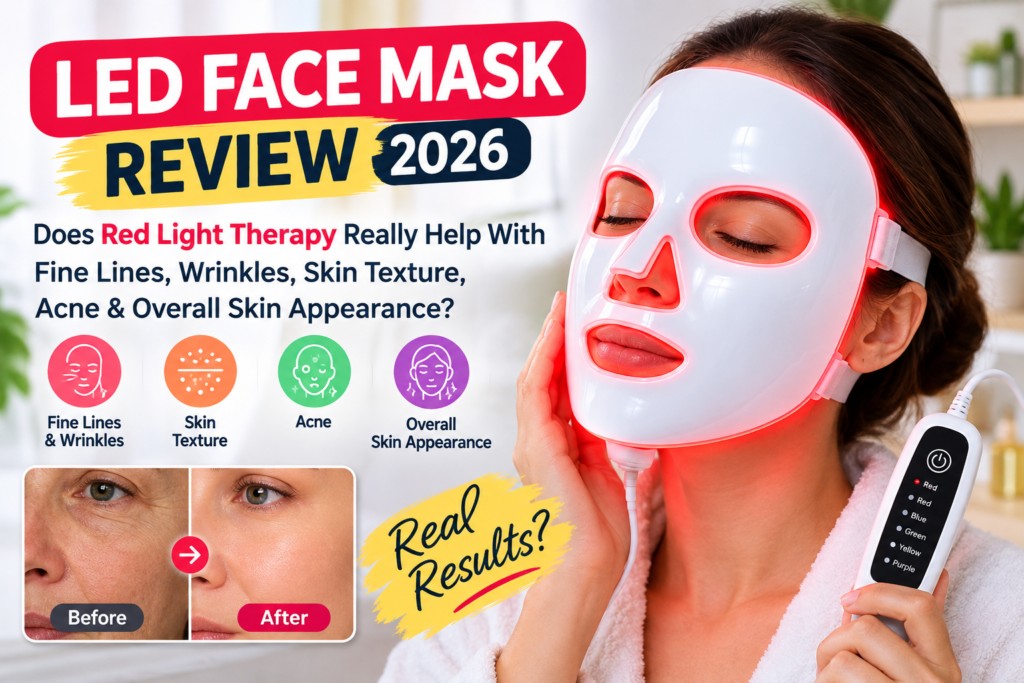
LED Face Mask Review 2026: Discover whether red light therapy can help reduce fine lines, wrinkles, acne, uneven texture, and improve overall skin appearance.
LifeCareBalance.com is reader-supported. When you buy through links on our site, we may earn an affiliate commission at no extra cost to you. As an Amazon Associate, we earn from qualifying purchases.
Do LED face masks actually work? Based on the current body of clinical research, the honest answer is: yes, but with real limits. Red and near-infrared light therapy has reasonable clinical support for modestly improving fine lines, skin texture, and collagen density over several weeks of consistent use, and combined red-and-blue light has evidence for reducing mild-to-moderate acne. What it can’t do is replace sunscreen, retinoids, or a dermatologist for serious skin concerns — and results depend heavily on which specific device you buy, not just on “LED light therapy” as a category.
This LED face mask review 2026 breaks down what the science actually says, how to separate real evidence from marketing, and how to decide whether a mask is worth the money for your skin.
Quick Answer (Featured Snippet)
LED face masks use red and near-infrared light to trigger photobiomodulation — a process where skin cells absorb light energy and increase collagen production and cellular repair. Peer-reviewed trials show measurable but moderate improvements in wrinkle depth, skin texture, and mild acne after 4–12 weeks of consistent use, several times per week. Results vary by device wavelength, light output, and how closely you follow the recommended routine. LED masks are not a replacement for sunscreen, retinoids, or professional dermatology treatment, but they can be a reasonable, low-risk addition to a skincare routine for people with realistic expectations.
If you’re deciding between specific models, our comparison of the best LED face masks for 2026 breaks down pricing and specs side by side once you’ve read the evidence below.
Quick Verdict: Are LED Face Masks Worth It?
| Concern | Evidence Level | Notes |
|---|---|---|
| Fine lines & wrinkles | Moderate evidence | Multiple RCTs show measurable reduction in wrinkle depth/volume with red and near-infrared light |
| Skin texture | Moderate evidence | Supported by clinical trials measuring skin roughness and profilometry |
| Overall skin appearance | Moderate evidence | Improvements in tone, radiance, and perceived firmness reported in trials and user studies |
| Acne (mild-to-moderate) | Moderate evidence | Combined red + blue light reduces inflammatory lesions in controlled studies |
| Redness/inflammation | Moderate evidence | Red light’s anti-inflammatory effect is well documented in photobiomodulation research |
| Collagen support | Moderate to strong evidence (in vitro/clinical) | Red and near-infrared light stimulate fibroblast activity in lab and clinical settings |
| Convenience | Depends on device | Hands-free masks (10 minutes) are more convenient than handheld wands |
| Value for money | Depends on device | Price does not always track with wavelength quality or evidence base |
None of these ratings should be read as “clinically proven to erase wrinkles” — they reflect what’s realistic to expect, not a guarantee.
What Is an LED Face Mask?
An LED face mask is a wearable device studded with light-emitting diodes that bathe the skin in specific wavelengths of visible or near-infrared light. Unlike lasers, LEDs emit non-coherent, low-intensity light, which is why they don’t burn or ablate skin the way in-office laser treatments do.
The underlying mechanism is called photobiomodulation (PBM) — sometimes called low-level light therapy. In simple terms, mitochondria (the energy-producing structures inside skin cells) absorb certain wavelengths of red and near-infrared light, which appears to boost cellular energy production and trigger downstream effects like increased collagen synthesis and reduced inflammation.
The three light types most common in consumer masks are:
- Red light (roughly 630–660 nm): associated with collagen stimulation, fine lines, and general skin rejuvenation
- Near-infrared (NIR) light (roughly 800–870 nm, with some masks now offering “deep NIR” around 1072 nm): penetrates deeper into skin tissue, associated with firmness and deeper structural support
- Blue light (roughly 405–420 nm): primarily marketed for acne, since it interacts with acne-causing bacteria near the skin’s surface
Wavelength matters because different wavelengths penetrate skin to different depths and interact differently with skin cells. A mask’s marketing claims are only as credible as its actual, disclosed wavelength specifications — which is why buying decision-makers should always check the spec sheet, not just the box copy.
Does Red Light Therapy Actually Work?
What Research Suggests
The clinical evidence for red and near-infrared photobiomodulation on skin is genuinely encouraging, though modest rather than dramatic. A randomized, split-face clinical trial recruited 137 women aged 40–65 with mild-to-moderate photoaging and found that red (660 nm) and amber (590 nm) LED light, delivered over 10 sessions across four weeks at a dose of 3.8 J/cm², reduced periocular (crow’s feet area) wrinkle volume by approximately 30% (PubMed).
A separate controlled trial comparing two polychromatic light sources in 136 volunteers found that treatment groups experienced significant improvements in skin complexion, roughness, and collagen density, as confirmed by blinded clinical evaluations, when treated twice weekly over several weeks.
More broadly, reviews of red and near-infrared light therapy research indicate that most clinical trials show measurable improvements in collagen production, skin elasticity, and wrinkle reduction with roughly 10–12 minutes of treatment a few times per week, typically appearing within 4 to 12 weeks. Mechanistically, red light is understood to stimulate fibroblast activity, which enhances collagen and elastin production and can improve skin texture and reduce the appearance of fine lines.
A double-blind, sham-controlled, multicenter clinical study on a home-use LED and near-infrared LED mask for crow’s feet compared light at wavelengths of 630 nm (LED) and 850 nm (near-infrared), delivering a maximum output of around 10 mW/cm², against a sham device with reduced intensity — a well-designed model for testing whether an at-home mask genuinely outperforms a placebo device, rather than just outperforming “no treatment.”
What Manufacturers Claim
Brand marketing often cites internal or brand-sponsored studies showing high satisfaction rates or dramatic-sounding percentages (for example, a specific number of users reporting “firmer” or “brighter” skin). These figures can be genuine, but they’re frequently drawn from small, unblinded, or brand-funded studies rather than independent, peer-reviewed research. That doesn’t make them worthless — but it does mean they should be read as supporting evidence for one specific product, not as proof that photobiomodulation as a category delivers guaranteed results.
What Is Still Uncertain
Several open questions remain in this field:
- Most rigorous RCTs use professional-grade or research-grade devices with disclosed, calibrated irradiance — not necessarily the exact specifications of any given $300 consumer mask
- Long-term studies (beyond several months) on at-home LED mask use are limited
- Optimal dosing (wavelength, irradiance, and session frequency) hasn’t been standardized across the industry
- Individual variation in skin type, age, and baseline collagen density affects outcomes significantly
The key distinction: evidence for red/near-infrared photobiomodulation in general is not automatically proof that every consumer LED mask produces the same results. A mask’s specific LED count, wavelength accuracy, and light output all affect whether it can replicate what’s shown in published trials.
LED Face Masks for Fine Lines and Wrinkles
Fine lines and wrinkles form as collagen and elastin production slow with age, combined with cumulative sun damage and repeated facial movement. Red and near-infrared light appear to support this process by stimulating fibroblasts — the skin cells responsible for producing collagen — and by improving microcirculation to the treated area.
Realistic expectations matter here. LED therapy is not comparable to injectables, lasers, or microneedling in terms of speed or intensity of results. It’s a cumulative, maintenance-style treatment rather than a one-time fix.
| Concern | Evidence | What Users May Notice | Expected Timeline |
|---|---|---|---|
| Fine lines (periorbital/crow’s feet) | Moderate — supported by RCTs | Slightly softened depth of fine lines | 4–8 weeks of consistent use |
| Deeper wrinkles | Limited to moderate | Subtle improvement in appearance, not elimination | 8–12+ weeks |
| Skin firmness/elasticity | Moderate | Skin may feel slightly more supple or “bouncy” | 6–12 weeks |
| Overall collagen density | Moderate (clinical + ultrasonographic measures) | Gradual, not dramatic, densification over time | 8–12+ weeks with maintenance |
LED Face Masks for Skin Texture
Rough or uneven texture, enlarged-looking pores, and a dull complexion are common concerns LED masks are marketed against. The mechanism here overlaps with the anti-aging pathway: better collagen support and improved microcirculation can contribute to smoother-looking, more even skin over time.
However, LED therapy cannot replace the tools most dermatologists consider foundational for texture improvement:
- Exfoliation (chemical or gentle physical) directly removes dead skin cells that LED light doesn’t address
- Retinoids accelerate cell turnover through a completely different mechanism and have a much larger body of long-term clinical evidence
- Daily sunscreen prevents the UV damage that causes much of what we perceive as “textured” or aged skin in the first place
Think of an LED mask as a supportive, low-risk addition to a texture-focused routine — not a substitute for it.
LED Face Masks for Acne
Red Light vs. Blue Light
Acne involves two main components: bacteria (primarily Cutibacterium acnes) and inflammation. Blue and red light address these differently.
Blue light around 415 nm penetrates the skin’s surface and targets the bacteria responsible for acne breakouts, while red light around 633 nm penetrates more deeply to reduce inflammation, calm redness, and support healing. Blue light is understood to work because porphyrins produced by acne-causing bacteria absorb its energy, triggering a reaction that helps destroy the bacteria.
A review pooling data across six controlled studies involving 216 participants found that LED light therapy produced roughly a 45% improvement in acne lesions and symptoms compared to control conditions using white light, no light, or a sham light. Dermatologists frequently note that blue and red light used in combination tend to be more effective for acne than either wavelength used alone.
What This Means for Buyers
If acne is your primary concern, look specifically for a mask that includes a true blue light setting, not just red and near-infrared. Some premium anti-aging masks (like certain Omnilux and CurrentBody models) are red/NIR-only and won’t address active breakouts the way a blue-light-inclusive device will.
When Professional Treatment Is More Appropriate
LED masks should not be relied on for moderate-to-severe or cystic acne, acne that is scarring, or acne that hasn’t responded to over-the-counter treatments. In those cases, a board-certified dermatologist can offer prescription-strength options (topical retinoids, oral medications, in-office treatments) that work faster and more reliably than at-home light therapy.
Red vs. Blue vs. Near-Infrared Light
| Light Type | Typical Purpose | Common Skin Goal | Important Notes |
|---|---|---|---|
| Red (~630–660 nm) | Collagen stimulation, anti-inflammatory | Fine lines, wrinkles, redness, overall glow | Most-studied wavelength range for anti-aging PBM |
| Blue (~405–420 nm) | Antibacterial, surface-level | Active acne, breakout prevention | Works on skin surface; doesn’t address deep wrinkles |
| Near-infrared (~800–870 nm, up to ~1072 nm in newer masks) | Deeper tissue penetration | Firmness, deeper structural support, some pain/inflammation relief | Often paired with red light rather than used alone |
Only wavelength ranges that appear consistently across published research and verified manufacturer specifications are included here; if a mask claims a wavelength outside these general ranges, verify it directly with the manufacturer’s published specs before buying.
Why Wavelength and Irradiance Matter
Two devices can both claim “red light therapy” and deliver very different results, because wavelength is only half the story. Irradiance (the intensity of light delivered to the skin, usually measured in mW/cm² or W/cm²) and treatment time together determine the total energy dose the skin actually receives.
The relationship is expressed as:
Energy dose (J/cm²) = Irradiance (W/cm²) × Treatment time (seconds)
For example (illustrative only, not a usage recommendation): a device delivering an irradiance of 0.05 W/cm² (50 mW/cm²) for a 600-second (10-minute) session would deliver a total dose of 30 J/cm². This is simply an example of the math, not a suggested target — the doses used in specific clinical trials varied and were much lower in some studies (such as the 3.8 J/cm² protocol referenced earlier), so higher isn’t automatically better.
This is also why a high LED count doesn’t automatically mean a more effective mask. A device with more LEDs but lower irradiance per LED, or LEDs spaced further from the skin, may deliver a similar or even lower effective dose than a mask with fewer, more efficiently placed diodes. What matters more for evaluating a mask is:
- Disclosed wavelength(s), ideally within ranges supported by research
- Disclosed irradiance (many brands don’t publish this — that’s a transparency red flag)
- Consistent, close contact with the skin (masks that hover away from the face lose intensity quickly with distance)
- Recommended session length and frequency that align with what’s been studied
How Long Does an LED Face Mask Take to Work?
Weeks 1–2
Most people notice no visible change yet. Some report a subtle “glow” or temporary flush immediately after sessions, but this is not a sign of collagen remodeling — that process takes longer.
Weeks 3–4
This is often when the earliest visible changes are reported in clinical studies — typically subtle improvements in skin radiance or a slight softening of fine lines, especially around the eyes.
Weeks 5–8
Most published trials measuring meaningful improvements in wrinkle depth, skin roughness, and collagen density report their results in this window, assuming consistent use several times per week.
8+ Weeks
Continued, consistent use tends to produce the most noticeable cumulative results. Many brands recommend an initial “loading phase” of daily or near-daily use for 6–8 weeks, followed by a lower-frequency maintenance schedule.
Individual results vary significantly based on:
- The specific device’s wavelength and light output
- Total energy dose per session
- Skin condition and baseline collagen density
- Age
- Consistency of use
- Whether the rest of your skincare routine (sunscreen, retinoids, hydration) supports skin health
No LED mask can guarantee a specific timeline or outcome for every user.
How Often Should You Use an LED Face Mask?
Most manufacturer protocols for full-face anti-aging masks recommend sessions of roughly 3 to 20 minutes, used 3 to 5 times per week, though this varies significantly by device — some premium masks use very short (3-minute) high-intensity sessions, while others use longer (10–20 minute) lower-intensity sessions. Always follow the specific instructions for your device rather than a generic schedule, since irradiance and recommended dosing differ between brands.
A few general principles apply across most devices:
- Consistency matters more than intensity. Skipping sessions and then “catching up” with longer or more frequent sessions is not equivalent to steady, regular use.
- More is not automatically better. Excessive light exposure doesn’t accelerate results and may increase the risk of mild skin irritation or dryness in sensitive users.
- If irritation, unusual redness, or discomfort occurs, discontinue use and allow skin to recover; consult a dermatologist if symptoms persist.
Who Should Buy an LED Face Mask?
An LED face mask is a reasonable purchase for people who:
- Want a low-risk, non-invasive addition to an existing anti-aging or skincare routine
- Have mild-to-moderate signs of aging (fine lines, dullness, mild texture concerns) rather than severe skin damage
- Have mild-to-moderate acne and want a complementary (not primary) treatment
- Can commit to a consistent, multi-week usage routine
- Understand that results will be gradual and modest, not dramatic
- Prefer non-invasive skincare technology over injectables or in-office procedures
Who Should NOT Buy One?
An LED mask may not be the right investment — or may not be appropriate at all — for people who:
- Expect dramatic, rapid, or “instant” anti-aging results
- Have severe or cystic acne, active skin infections, or skin conditions requiring medical treatment
- Have a diagnosed photosensitivity disorder
- Take medications that increase photosensitivity (certain antibiotics, retinoid medications, and other photosensitizing drugs)
- Have a history of light-triggered migraines or seizures
- Have specific eye conditions and haven’t consulted a doctor about light-based treatments
- Would benefit more, faster, and more predictably from professional dermatological care
This is general information, not a medical diagnosis. Anyone with an existing skin condition, a photosensitizing medication, or uncertainty about whether light therapy is appropriate for them should speak with a dermatologist or physician before starting treatment.
LED Face Mask Safety
At-home LED devices are generally considered low-risk because they use non-UV, non-coherent light — unlike lasers, they don’t cut, burn, or ablate tissue. Still, a few safety points are worth understanding:
- Eye protection: Many manufacturers state that healthy adults using FDA-cleared, non-laser LED devices don’t strictly need eye protection, since the light is non-coherent and doesn’t focus intensely on one point the way a laser does. That said, some dermatologists recommend keeping eyes closed or using included eye shields/goggles during treatment, particularly for anyone light-sensitive, and it’s worth noting that a widely reported 2019 consumer LED mask recall was specifically tied to eye-safety concerns around blue LED exposure. If your mask includes goggles or eye shields, use them.
- Photosensitizing medications: Certain antibiotics, acne medications (like isotretinoin), and other drugs can increase skin’s sensitivity to light. Check with a pharmacist or doctor if you’re on any such medication.
- Existing skin conditions: Active rashes, open wounds, or certain inflammatory skin conditions may not be appropriate for LED treatment without medical guidance.
- Pregnancy: There isn’t strong, specific safety or risk data on at-home LED face masks during pregnancy one way or another; many manufacturers list pregnancy as a general precaution. If you’re pregnant, check with your OB-GYN before using any light therapy device.
- Manufacturer instructions: Always follow the specific session time, distance, and frequency guidance for your device rather than assuming all masks work the same way.
- Discontinue if irritated: Stop use and consult a professional if you notice persistent redness, rash, or discomfort beyond mild, temporary warmth.
How We Evaluate LED Face Masks
LifeCareBalance’s evaluation approach for this category focuses on transparency and evidence rather than marketing claims. We assess:
- Wavelength transparency — does the brand clearly disclose its exact wavelengths?
- Irradiance transparency — does the brand disclose light output, not just LED count?
- Evidence quality — is there independent or peer-reviewed support for the wavelengths used, separate from brand-funded studies?
- Regulatory status — is the device FDA-cleared, and what does that clearance actually cover?
- Safety information — are contraindications and precautions clearly listed?
- Treatment time and ease of use — is the recommended routine realistic for regular use?
- Coverage and fit — does the mask maintain consistent skin contact across the face?
- Warranty and return policy
- Price relative to disclosed specifications
- Overall manufacturer transparency and communication
We have not personally lab-tested, clinically tested, or conducted blinded user trials on the products discussed here. Our comparisons are based on publicly available manufacturer specifications, independent product reviews, and the peer-reviewed research on photobiomodulation cited throughout this article. Product prices, availability, and specifications can change — always verify current details directly with the retailer before purchasing.
Best LED Face Masks to Consider in 2026
Based on currently available manufacturer specifications and pricing, here’s how several leading masks compare. Full breakdowns, including pros, cons, and updated pricing, are available in our dedicated best LED face masks 2026 guide.
Omnilux Contour Face — around $395. Uses 633 nm red and 830 nm near-infrared light across 132 LEDs. FDA-cleared, CE- and TGA-certified. Recommended use: 10-minute sessions, 3–5 times weekly for 4–6 weeks. Strength: long manufacturer history and straightforward two-wavelength design. Limitation: no blue light option, so it’s not built for active acne. Best for: anti-aging-focused users who want a simple, well-documented red/NIR routine.
CurrentBody Skin LED Light Therapy Face Mask: Series 2 — around $469.99 (frequently discounted to the $370s–$420s). Uses 633 nm red, 830 nm near-infrared, and 1072 nm “deep near-infrared” light across 236 LEDs. FDA-cleared. Recommended use: 10-minute sessions, 3–5 times weekly. Strength: the added deep-NIR wavelength and high LED density for full coverage. Limitation: premium price point and no dedicated blue-light acne setting on the standard Series 2 face mask (CurrentBody sells a separate blue light mask). Best for: users focused specifically on advanced anti-aging support.
Therabody TheraFace Mask — MSRP around $599, commonly retailing between roughly $529 and $649. Uses 648 LEDs across red (633±10 nm), blue (415±10 nm), and near-infrared (830±10 nm) wavelengths, plus built-in facial vibration therapy. FDA-cleared as a Class II medical device. Recommended use: a 9-minute preset session. Strength: it’s one of the few masks combining all three core wavelengths (red, blue, NIR) with a massage function in one device. Limitation: heavier and bulkier than some competitors, and the added vibration hardware raises the price. Best for: users who want anti-aging and acne coverage plus a relaxation/massage element in a single device.
Dr. Dennis Gross DRx SpectraLite FaceWare Pro — typically priced around $455–$495 in the U.S. Uses 100 red LEDs plus 62 blue LEDs (162 total), offering red-only, blue-only, or combined settings. FDA-cleared. Recommended use: a fast 3-minute daily session. Strength: shortest treatment time of the group, and includes blue light for acne alongside red light for aging. Limitation: no dedicated near-infrared channel, which some research suggests may limit deeper structural benefits compared to red/NIR combination masks. Best for: users who want the fastest daily routine and combined red/blue coverage.
LightStim for Wrinkles — around $249 (higher for bundled kits). Important distinction: this is a handheld device, not a full wearable mask — you hold it against different areas of the face for a few minutes each rather than wearing it hands-free. It uses 72 LEDs across amber, light red, dark red, and infrared wavelengths. FDA-cleared for treating wrinkles on the full face, with a five-year warranty. Strength: lower price point and a long warranty. Limitation: hands-on use takes longer overall than a wearable mask since you’re manually treating each area. Best for: budget-conscious buyers who don’t mind a more hands-on routine.
HigherDOSE Red Light Face Mask — around $349 (frequently discounted). Uses 630 nm red and 830 nm near-infrared light across 66 dual-core LEDs (132 total diodes), with a disclosed irradiance of approximately 50 mW/cm². FDA-cleared, cordless, battery-powered, with built-in eye openings so no separate goggles are needed. Recommended use: 10- or 20-minute sessions, 3–5 times weekly. Strength: cordless design allows use while doing other light activities. Limitation: irradiance is on the lower end compared to some panel-style devices, meaning longer sessions may be needed to reach an equivalent dose. Best for: users who want a portable, cordless option for red/NIR anti-aging support.
Prices, availability, and exact specifications can change at any time — confirm current details directly with the manufacturer or retailer before purchasing, and check our updated best LED face masks comparison for the latest figures.
Best LED Face Mask by Skin Concern
| Skin Goal | Best Type of LED Mask | What to Look For |
|---|---|---|
| Fine lines | Red-only or red/NIR mask | Disclosed wavelength near 630–660 nm |
| Wrinkles | Red + near-infrared combination mask | Dual or triple wavelength (red + NIR, or red + NIR + deep NIR) |
| Acne | Red + blue combination mask | True blue-light setting (~405–420 nm), not just red/NIR |
| Skin texture | Red + near-infrared mask, paired with exfoliation/retinoids | Consistent full-face coverage and contact fit |
| Overall skin appearance | Multi-wavelength mask (red, NIR, sometimes blue) | Balanced coverage across concerns rather than a single wavelength |
| Anti-aging | Red/NIR mask with disclosed irradiance | Manufacturer-published wavelength and dose information |
| Budget | Handheld single- or dual-wavelength device | FDA clearance and a reasonable warranty despite lower price |
Are Expensive LED Face Masks Better?
Not necessarily. A $500 mask isn’t automatically more effective than a $250 one — what matters is whether the specific device delivers an appropriate, disclosed wavelength and dose to the skin consistently.
Factors that legitimately justify a higher price include:
- Additional wavelengths (for example, a mask that adds blue light or deep near-infrared to a standard red/NIR pairing)
- Better documented irradiance and clinical backing
- Superior fit and full-face coverage (a mask that maintains close, even skin contact delivers a more consistent dose than one that gaps or shifts)
- Longer warranties and stronger customer support
- Build quality and comfort for repeated, long-term use
Price alone, however, is not proof of effectiveness. Some higher-priced masks don’t publicly disclose irradiance, while some mid-range options do. Brand reputation, marketing budget, and packaging also influence price without necessarily improving outcomes. Read the actual spec sheet before assuming a higher number on the price tag means a better result on your skin.
LED Face Mask vs. Professional Red Light Therapy
| Factor | At-Home LED Mask | Professional (In-Clinic) Treatment |
|---|---|---|
| Convenience | High — use on your own schedule at home | Lower — requires appointments and travel |
| Cost | One-time purchase, typically $150–$650 | Ongoing per-session cost, often adding up over a course of treatments |
| Treatment intensity | Generally lower irradiance, consumer-grade | Often higher irradiance, professional-grade equipment |
| Supervision | None — self-administered | Supervised by a trained provider or dermatologist |
| Frequency | Can be used several times per week indefinitely | Typically scheduled series (e.g., weekly for several weeks) |
| Best for | Ongoing maintenance and mild-to-moderate concerns | Faster or more intensive results, or when combined with other in-office treatments |
For many people, a hybrid approach — periodic professional treatments plus consistent at-home maintenance — offers a reasonable middle ground, though this should be discussed with a provider based on individual skin goals.
LED Face Mask vs. Other Anti-Aging Treatments
LED therapy works through a different mechanism than most other anti-aging staples, and it’s most effective as a complement rather than a replacement:
- Sunscreen prevents the UV damage that causes the majority of visible skin aging — nothing else on this list matters as much long-term. LED therapy does not replace daily SPF.
- Retinoids accelerate cell turnover and have decades of strong clinical evidence for wrinkles and texture; LED light works through a different, complementary pathway (mitochondrial stimulation vs. cell turnover).
- Vitamin C provides antioxidant protection and supports collagen synthesis through a different biochemical route than light therapy.
- Chemical exfoliation (AHAs/BHAs) directly removes dead skin cells for texture improvement, which LED light does not do.
- Professional laser treatments use focused, often ablative or fractional energy for faster, more dramatic resurfacing — a fundamentally more intensive category than LED.
- Microneedling creates controlled micro-injuries to stimulate collagen through a wound-healing response, a different (and more invasive) mechanism than photobiomodulation.
LED therapy should be viewed as one component of a broader routine, not a stand-alone solution or a substitute for foundational, evidence-backed skincare.
Pros and Cons
Pros
- Non-invasive with minimal to no downtime
- Generally well-tolerated with a low risk profile for healthy adults
- Reasonable clinical support for modest anti-aging and mild acne benefits
- Can be used at home on a flexible schedule
- One-time purchase rather than recurring treatment costs
Cons
- Results are gradual and modest, not dramatic or fast
- Requires consistent, long-term use to see and maintain benefits
- Effectiveness varies significantly between specific devices
- Many brands don’t disclose irradiance, making objective comparison difficult
- Not a substitute for sunscreen, retinoids, or professional treatment for serious concerns
- Higher-end models represent a significant upfront cost
Final Verdict: Are LED Face Masks Worth Buying in 2026?
LED face masks are worth considering for people with mild-to-moderate signs of aging or mild acne who want a low-risk, non-invasive addition to their skincare routine — and who are willing to commit to consistent use over several weeks or months. The underlying science of red and near-infrared photobiomodulation has reasonable, peer-reviewed support for modest improvements in fine lines, skin texture, and collagen density, and combined red/blue light has support for reducing mild acne.
Who should buy one: people focused on gradual anti-aging maintenance or mild acne management, who have realistic expectations and a consistent skincare routine already in place.
Who should skip it: anyone expecting dramatic or fast results, anyone with a serious or persistent skin condition better suited to dermatological care, and anyone on photosensitizing medication without medical clearance.
What specifications matter most: disclosed wavelength (ideally in the red 630–660 nm and/or NIR 800–870 nm range, plus blue 405–420 nm if acne is a concern), some indication of light output or irradiance, FDA clearance, and a fit that maintains consistent skin contact.
What results are realistic: subtle-to-moderate improvement in fine lines, texture, and mild acne over 4–12+ weeks of consistent use — not a replacement for professional treatment or foundational skincare.
What to check before buying: current price and return policy, exact wavelength specifications, whether irradiance is disclosed, FDA clearance status, and recommended session time/frequency, since these vary meaningfully between devices even within the same price range.
Frequently Asked Questions
Do LED face masks really work? Peer-reviewed research shows that red and near-infrared light can produce modest, measurable improvements in fine lines, skin texture, and collagen density with consistent use over several weeks. Results vary by device and are gradual rather than dramatic, so “yes, but modestly and with consistent use” is the most accurate answer.
How long does it take for an LED face mask to work? Most clinical studies report early, subtle changes around 3–4 weeks, with more measurable improvements in wrinkle depth, texture, and collagen density typically reported between 5 and 12 weeks of consistent, several-times-weekly use.
Are LED face masks good for wrinkles? Red and near-infrared LED light have moderate evidence support for reducing the appearance of fine lines and wrinkles by stimulating collagen-producing cells, though results are gradual and vary between individuals and devices.
Can LED face masks reduce fine lines? Yes, to a modest degree. Clinical trials using red and amber or red and near-infrared light have shown measurable reductions in fine line depth and volume, particularly around the eye area, after several weeks of consistent treatment.
Can red light therapy help acne? Red light has anti-inflammatory effects that can help calm active breakouts, but it’s most effective for acne when combined with blue light, which specifically targets acne-causing bacteria at the skin’s surface.
Is blue light or red light better for acne? Neither alone is considered optimal — research suggests the combination of blue light (targeting bacteria) and red light (reducing inflammation) is more effective for acne than either wavelength used on its own.
How often should you use an LED face mask? Most manufacturer protocols recommend three to five sessions per week, though exact session length and frequency vary by device. Always follow the specific instructions provided with your mask rather than a generic schedule.
Are expensive LED masks worth it? Not automatically. Higher price can reflect additional wavelengths, better disclosed specifications, or superior build quality, but price alone isn’t proof of effectiveness — always check the actual wavelength and light-output specifications before assuming a costlier mask performs better.
What wavelength is best for red light therapy? Most peer-reviewed skin research on red light therapy uses wavelengths in the 630–660 nm range, which is the range most consistently associated with collagen stimulation and anti-inflammatory effects in published studies.
Is near-infrared light better than red light? They serve different purposes rather than one being categorically “better.” Near-infrared light penetrates more deeply into skin tissue, while red light works more on surface-level and mid-dermal processes — many effective devices combine both.
Can you use an LED face mask every day? Some devices are designed for daily use, but many manufacturer protocols recommend three to five times weekly rather than daily. Check your specific device’s instructions, since more frequent use isn’t proven to accelerate results and could increase the risk of mild irritation in sensitive skin.
Are LED face masks safe? For most healthy adults, at-home LED masks are considered low-risk since they use non-UV, non-coherent light. However, people with photosensitivity, certain medications, specific eye conditions, or serious skin conditions should consult a doctor before use.
Can LED masks damage your skin? Used as directed, LED masks are generally not associated with skin damage for healthy adults, since they don’t emit UV light or generate the heat/ablation of laser treatments. Rare side effects like mild irritation can occur, and discontinuing use is recommended if this happens.
Should you use skincare before or after LED therapy? Most manufacturers recommend using LED masks on clean, product-free skin, then applying serums or moisturizer afterward, since some ingredients may interact with or block light absorption during treatment. Always follow your specific device’s instructions.
What should I look for when buying an LED face mask? Prioritize disclosed wavelength specifications (ideally within researched ranges), some indication of light output/irradiance, FDA clearance, a full-face fit that maintains consistent skin contact, and a reasonable warranty and return policy — not just LED count or price.;https://lifecarebalance.com/