
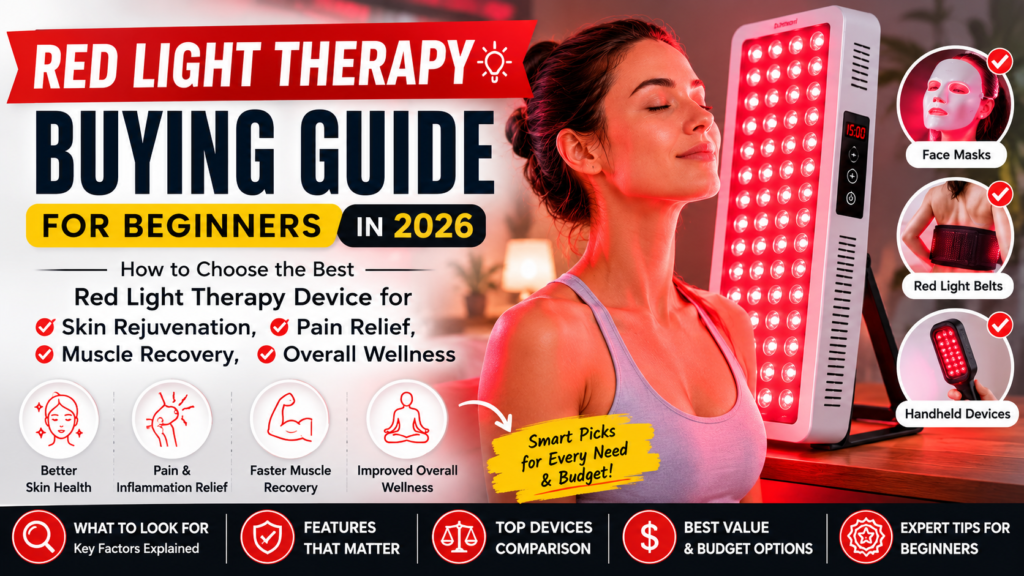
Discover the best red light therapy device with our 2026 beginner’s buying guide. Compare wavelengths, power, features, and tips for skin health, pain relief, muscle recovery, and overall wellness.
LifeCareBalance.com is reader-supported. When you buy through links on our site, we may earn an affiliate commission at no extra cost to you. As an Amazon Associate, we earn from qualifying purchases.
Red light therapy has moved from professional dermatology offices into millions of American living rooms — and the shopping experience has gotten a lot more confusing along the way. Scroll through any marketplace and you’ll find panels, masks, belts, and handheld wands ranging from $40 to $2,000, all claiming to do roughly the same thing.
This guide cuts through the noise. It’s written for beginners who want a clear, honest, no-hype explanation of how red light therapy works, what actually matters when comparing devices, and how to avoid the common (and expensive) mistakes first-time buyers make.
Quick Summary: Red light therapy uses specific wavelengths of red and near-infrared light to support skin health, ease minor aches, and aid muscle recovery. The right device for you depends on your treatment goal, the body area you want to target, and three technical specs — wavelength, irradiance, and treatment distance — more than it depends on price or brand hype.
Table of Contents
- What Is Red Light Therapy?
- How Red Light Therapy Works
- Benefits of Red Light Therapy
- Types of Red Light Therapy Devices
- Panels vs. Masks vs. Belts vs. Handheld Devices
- Understanding 660nm and 850nm Wavelengths
- Irradiance Explained
- Treatment Distance
- Treatment Time
- Safety Features to Look For
- FDA Registration vs. FDA Approval
- Build Quality
- Warranty Considerations
- Size Comparison Guide
- Budget Buying Guide
- Best Brands and Device Types to Consider
- Common Mistakes Beginners Make
- Who Should Avoid Red Light Therapy
- Frequently Asked Questions
- Final Buying Advice
1. What Is Red Light Therapy? {#what-is-red-light-therapy}
Red light therapy (RLT) — also called photobiomodulation, low-level laser therapy (LLLT), or simply “red light” — is a treatment that exposes skin and tissue to low-wavelength red and near-infrared light using LEDs.
Unlike UV light from the sun or tanning beds, red light therapy does not use ultraviolet wavelengths and does not damage skin cells or cause burns when used correctly. It’s a completely different part of the light spectrum, which is one reason it’s grown popular as a low-risk, at-home wellness tool.
Did You Know? NASA originally researched red and near-infrared LEDs in the 1990s to help plant growth in space and later found the same wavelengths showed potential for wound healing in astronauts — research that helped kick off decades of further study in this field.
Takeaway: Red light therapy is a non-UV light treatment delivered through LED devices, distinct from tanning or laser skin resurfacing.
2. How Red Light Therapy Works {#how-red-light-therapy-works}
At a basic level, red and near-infrared light penetrate the skin and are absorbed by mitochondria — the energy-producing structures inside your cells. This is thought to temporarily boost cellular energy production (ATP), which may support:
- Collagen production in skin cells
- Circulation in treated tissue
- Reduced localized inflammation
- Cellular repair processes involved in recovery
Red wavelengths (around 630–660nm) tend to act more on the surface layers of skin, while near-infrared wavelengths (around 810–850nm) penetrate deeper into muscle and joint tissue. This is why many devices combine both.
Pro Tip: If you’re shopping for a device meant to help with both skin tone and deeper muscle soreness, look for a dual-wavelength device rather than a single-wavelength one.
Takeaway: Red light works by delivering energy to cells that may support repair and circulation — deeper wavelengths reach muscle and joints, while shorter red wavelengths focus on skin.
3. Benefits of Red Light Therapy {#benefits-of-red-light-therapy}
Research on red light therapy is still evolving, and results vary by individual, but commonly reported and studied areas of benefit include:
- Skin appearance: Support for fine lines, skin tone, and overall skin texture
- Muscle recovery: Reduced perceived soreness after exercise
- Joint and muscle discomfort: Temporary relief from minor aches and stiffness
- Circulation: Improved localized blood flow to treated areas
- Wound and scar support: Some evidence for supporting the skin’s natural healing process
- Mood and sleep: Anecdotally reported, though evidence here is more limited
Important: Red light therapy is a wellness and recovery tool. It is not a substitute for medical diagnosis or treatment. If you have a chronic pain condition, skin disease, or injury, talk to a doctor or dermatologist before relying on it.
If your main goal is post-workout recovery, red light therapy pairs well with other recovery tools — many athletes combine light therapy sessions with compression devices like the options covered in our guide to the best leg recovery boots for a more complete recovery routine.
Takeaway: Benefits are generally supportive and cosmetic/recovery-focused rather than curative — set expectations accordingly.
4. Types of Red Light Therapy Devices {#types-of-devices}
Beginners typically choose from four main categories:
- Panels – Wall-mounted or stand-mounted units for full-body or large-area treatment
- Masks – Face-shaped devices designed specifically for facial skin
- Belts/Wraps – Flexible devices that wrap around joints, the back, or abdomen
- Handheld Devices – Small, portable wands for spot-treating specific areas
Each is built for a different use case, and choosing the wrong type is one of the most common regret-purchases beginners make.
Takeaway: Match the device type to your primary goal — don’t buy a panel if all you want is facial treatment, and don’t buy a mask if you want full-body recovery.
5. Panels vs. Masks vs. Belts vs. Handheld Devices {#panels-vs-masks-vs-belts-vs-handheld}
| Device Type | Best For | Treatment Area | Typical Price Range | Pros | Cons |
|---|---|---|---|---|---|
| Panel | Full-body wellness, recovery, larger muscle groups | Large (12″–48″+) | $150–$1,500+ | Versatile, treats multiple areas at once, faster whole-body sessions | Takes up space, higher upfront cost |
| Mask | Facial skin rejuvenation | Face only | $40–$300 | Hands-free, precise facial fit, easy to use daily | Face only, can’t treat body |
| Belt/Wrap | Back, joints, abdomen, targeted pain relief | Medium, contoured | $80–$400 | Flexible fit, hands-free, good for joints | Limited to wrap-friendly body areas |
| Handheld | Spot treatment, travel, small areas | Small | $30–$200 | Portable, affordable, precise | Requires manual holding, slower for large areas |
Quick Summary: If you only buy one device and want the most flexibility, a mid-size panel usually offers the best value because it can address skin, muscle, and joint goals in one device. If your goal is purely facial skin, a mask is the more efficient, purpose-built choice.
6. Understanding 660nm and 850nm Wavelengths {#wavelengths}
This is the single most important spec on any red light therapy product listing.
- 630–660nm (Red Light): Best absorbed by skin cells. Commonly used for skin tone, fine lines, and surface-level healing.
- 810–850nm (Near-Infrared, NIR): Invisible or barely visible to the eye, penetrates deeper into muscle, tendons, and joints. Commonly used for pain relief and muscle recovery.
Many quality devices combine both wavelengths (often alternating LEDs) so you get surface and deep-tissue benefits from a single session.
Pro Tip: Be cautious of listings that only advertise “red light” without specific wavelength numbers. Reputable brands always disclose their exact nanometer (nm) output because it directly affects what the device can and can’t do.
Takeaway: Look for a device that clearly lists 660nm for skin and 850nm for deeper tissue — vague “red light” marketing without numbers is a red flag.
7. Irradiance Explained {#irradiance-explained}
Irradiance (measured in mW/cm²) tells you how much light energy actually reaches your skin at a given distance. It’s arguably more important than the total number of LEDs a panel has, because a device with fewer, higher-quality diodes can outperform one with dozens of weak LEDs.
- Low irradiance (under 20 mW/cm²): Requires much longer sessions to get meaningful dose
- Moderate irradiance (20–50 mW/cm²): Standard for most home-use panels
- High irradiance (50–100+ mW/cm²): Faster sessions, often found in higher-end panels
Did You Know? Total light dose is measured in “joules per square centimeter” (J/cm²) and is a combination of irradiance and time. Two devices can advertise the same session length but deliver very different total doses if their irradiance differs.
Takeaway: Always check the manufacturer’s irradiance measurement at a specific distance (usually 6 inches) — it’s a better indicator of real-world effectiveness than LED count alone.
8. Treatment Distance {#treatment-distance}
Distance from the device directly affects how much light energy reaches your skin. Most home panels are designed to be used 6–12 inches from the skin, while masks sit directly on the face and handheld devices are often held 1–2 inches away.
- Too far away = weaker, less effective dose
- Too close (for high-powered panels) = can feel uncomfortably warm, though red/NIR light itself won’t burn skin the way UV does
Always follow the manufacturer’s recommended distance, since irradiance specs are only accurate at that specific range.
Takeaway: A device’s stated benefits only apply at its recommended distance — don’t assume “closer is always better.”
9. Treatment Time {#treatment-time}
Most home sessions run 10–20 minutes per treated area, done 3–5 times per week for best results. Facial masks are often used daily for shorter 10-minute sessions.
- Skin goals: 10 minutes per session, 3–5x weekly
- Muscle recovery: 10–15 minutes post-workout
- Pain relief: 15–20 minutes on the affected area
Consistency tends to matter more than session length — most users report noticeable changes after 8–12 weeks of regular use, not after a single session.
Pro Tip: Set a recurring calendar reminder for your sessions for the first month. Adherence, not intensity, is what determines whether you see results.
Takeaway: Shorter, consistent sessions several times a week outperform occasional long sessions.
10. Safety Features to Look For {#safety-features}
Before buying, check for:
- Timer/auto shut-off – Prevents overuse and adds convenience
- Eye protection guidance – Reputable brands recommend (or include) protective goggles, especially for higher-irradiance panels
- Low EMF design – Reduces electromagnetic field exposure from the device
- Temperature control/fans – Prevents overheating during longer sessions
- UL or ETL electrical safety certification – Confirms the device meets US electrical safety standards
Takeaway: A well-designed device should include basic safety features like a timer and clear eye-safety guidance — treat their absence as a warning sign, not a minor omission.
11. FDA Registration vs. FDA Approval {#fda-registration-vs-approval}
This is one of the most misunderstood — and most marketed — aspects of the industry.
- FDA-registered / FDA-listed: Means the manufacturer has registered its facility and device class with the FDA. This is a basic administrative step, not a safety or effectiveness endorsement.
- FDA-cleared (510(k)): Means the device has gone through a review process and was found “substantially equivalent” to an existing cleared device for a specific use (like temporary muscle/joint pain relief).
- FDA-approved: A much higher bar typically reserved for drugs and certain medical devices — most consumer red light therapy products are not, and do not need to be, “FDA-approved” to be sold legally.
Many marketing pages blur these terms together. If a company claims “FDA-approved” for a general wellness LED device, treat that as a red flag, since it’s rarely accurate terminology for this product category. Reputable brands are specific about which claim applies and for which use.
For general reference on device classifications, the U.S. Food and Drug Administration’s device database is a reliable place to verify a specific product’s actual FDA status.
Takeaway: “FDA-registered” is not the same as “FDA-cleared,” and neither is the same as “FDA-approved” — always verify what a brand is actually claiming.
12. Build Quality {#build-quality}
Because these devices run for extended periods and sit close to your skin, build quality matters more than it might for other electronics. Look for:
- Solid, non-flimsy housing (metal or reinforced plastic)
- Even LED spacing without visible dead spots
- A fan or heat sink for panels used in longer sessions
- Cords and hanging hardware rated for repeated home use
Cheaper panels sometimes cut costs with sparse or uneven LED arrays, which creates “hot spots” and inconsistent dosing across the treatment area.
Takeaway: Read verified buyer photos and reviews for signs of LED die-off, flickering, or overheating — these are the most common build-quality complaints.
13. Warranty Considerations {#warranty}
LED lifespan is typically rated in tens of thousands of hours, but real-world failures (driver issues, individual diode burnout) do happen. A solid warranty is a meaningful trust signal.
- Under 1 year: Below average for this category
- 1–2 years: Standard/acceptable
- 3+ years: Strong sign of manufacturer confidence
- Lifetime warranty on LEDs: Offered by some premium brands and a strong positive signal
Takeaway: Treat warranty length as a proxy for how much a company stands behind its own build quality — longer is better, and anything under a year deserves extra scrutiny.
14. Size Comparison Guide {#size-comparison}
| Size Category | Dimensions (approx.) | Best For | Session Efficiency |
|---|---|---|---|
| Compact/Handheld | Under 8 inches | Spot treatment, travel | Slower for large areas |
| Mini Panel | 8″–16″ | Face, hands, small joints | Moderate |
| Mid-Size Panel | 16″–30″ | Torso, back, larger muscle groups | Good balance of coverage and cost |
| Full-Body Panel | 30″–48″+ | Full-body sessions, multiple people | Fastest full-body coverage, highest price |
Quick Summary: Most beginners are best served by a mid-size panel — large enough for meaningful body coverage without the cost or space commitment of a full-body unit.
15. Budget Buying Guide {#budget-guide}
| Budget Tier | Price Range | What You Can Expect |
|---|---|---|
| Entry-Level | $30–$150 | Handhelds or small masks; good for testing whether RLT fits your routine |
| Mid-Range | $150–$500 | Solid mid-size panels or belts with dual wavelengths and decent irradiance |
| Premium | $500–$1,200 | Larger panels, higher irradiance, better build quality and warranties |
| Professional/Full-Body | $1,200+ | Full-body panels for serious daily users or multi-person households |
Pro Tip: If you’re unsure whether you’ll stick with red light therapy long-term, start in the entry-level or mid-range tier. You can always upgrade to a full panel once you’ve confirmed it fits your routine.
16. Best Brands and Device Types to Consider {#best-brands}
Rather than pushing a single “best” product, here’s an honest breakdown by category so you can match a device to your goal.
Comparison Table: Beginner-Friendly Device Categories
| Category | Price Range | Treatment Area | Wavelength | Irradiance | Warranty | Best For | Overall Value |
|---|---|---|---|---|---|---|---|
| Budget Handheld Wand | $30–$80 | Small/spot | 660nm only or 660/850nm | Low–moderate | 6 mo–1 yr | First-time testers, travel | Good |
| Facial LED Mask | $60–$250 | Face | 630–660nm (some add 850nm) | Moderate | 1 yr | Skin tone, fine lines | Very good |
| Mid-Size Home Panel | $200–$500 | Torso/back/legs | 660nm + 850nm | Moderate–high | 2–3 yrs | General wellness, recovery | Excellent |
| Targeted Belt/Wrap | $100–$350 | Joints, back, abdomen | 660nm + 850nm | Moderate | 1–2 yrs | Joint discomfort, back pain | Very good |
| Full-Body Panel | $700–$1,500+ | Full body | 660nm + 850nm | High | 3–5 yrs/lifetime LEDs | Daily users, households, serious recovery | Excellent (long-term) |
Honest Pros and Cons by Category
- Budget Handhelds — Pros: Cheap entry point, portable. Cons: Slow for large areas, often lower irradiance.
- Facial Masks — Pros: Hands-free, purpose-built fit. Cons: Face-only, can’t address body pain or recovery.
- Mid-Size Panels — Pros: Best all-around value for most beginners. Cons: Requires wall or stand space.
- Belts/Wraps — Pros: Great for joints and back, hands-free. Cons: Not ideal for flat surfaces like the face or chest.
- Full-Body Panels — Pros: Fastest, most complete sessions. Cons: Highest cost and largest footprint.
If you’re building a broader home wellness or recovery setup, it’s worth pairing your red light panel with complementary tools — for example, checking out our review of the best adjustable dumbbells for home gyms if muscle recovery is your main goal, or our guide to best walking pads for home use if you’re building a low-impact daily movement routine alongside your recovery tools.
Takeaway: There’s no single “best” brand — the right choice depends on whether your priority is skin, joints, full-body recovery, or portability.
17. Common Mistakes Beginners Make {#common-mistakes}
- Buying based on LED count alone instead of checking irradiance and wavelength
- Standing too far from the panel, reducing effective dose
- Expecting instant results rather than committing to 8–12 weeks of consistent use
- Skipping eye protection during higher-irradiance sessions
- Choosing the wrong device type for their actual goal (e.g., buying a mask when they wanted body pain relief)
- Ignoring warranty length and buying from brands with no verifiable customer support
- Overusing the device thinking more time equals more benefit — more isn’t always better
Pro Tip: Take a “before” photo or note your baseline pain level before starting. It’s the easiest way to objectively track whether the device is helping after a few weeks.
Takeaway: Most beginner regrets come from mismatched expectations and device type, not from the technology itself.
18. Who Should Avoid Red Light Therapy {#who-should-avoid}
Red light therapy is generally considered low-risk, but you should talk to a doctor before use if you:
- Are pregnant
- Have a history of skin cancer or are on photosensitizing medication
- Have an active autoimmune condition affecting the skin
- Have epilepsy or a seizure disorder (some devices flicker)
- Have any implanted medical device
- Are currently being treated for an eye condition
This guide is for general wellness education and is not medical advice. Always consult a licensed healthcare provider about your specific situation before starting any new therapy.
Takeaway: Red light therapy is low-risk for most healthy adults, but certain medical conditions warrant a conversation with your doctor first.
19. Frequently Asked Questions {#faq}
Q: How often should beginners use red light therapy? A: Most beginners see the best results using their device 3–5 times per week for 10–20 minutes per session, continued consistently for at least 8–12 weeks.
Q: Is red light therapy safe for daily use? A: For most healthy adults, daily use at recommended distances and times is considered low-risk. Always follow the manufacturer’s specific guidelines for your device.
Q: What’s the difference between red light and infrared light therapy? A: Red light (around 630–660nm) mainly affects surface skin layers, while near-infrared light (around 810–850nm) penetrates deeper into muscle and joint tissue. Many devices combine both.
Q: Do I need to wear eye protection? A: It’s recommended, especially with higher-irradiance panels. Closing your eyes during facial treatments is a minimum precaution; dedicated goggles are safer for direct panel use.
Q: Can red light therapy help with wrinkles? A: Some studies and user reports suggest it may support collagen production and improve skin texture over consistent use, though results vary by individual and are not guaranteed.
Q: Is red light therapy FDA-approved? A: Most consumer devices are FDA-registered or FDA-cleared for specific uses like temporary muscle or joint pain relief, which is different from full FDA “approval.” Check each product’s specific FDA status before buying.
Q: How far should I sit or stand from a red light panel? A: Most home panels are designed for use 6–12 inches away. Always check your specific device’s manual, since stated irradiance values only apply at the recommended distance.
Q: How long until I see results? A: Many users report noticeable changes in skin tone or recovery after 4–8 weeks of consistent use, with more established improvements around the 8–12 week mark.
Q: Can I use red light therapy with other recovery tools? A: Yes. Many people combine it with tools like compression recovery boots, foam rollers, or a consistent movement routine for a more complete recovery approach.
Q: What size device do beginners actually need? A: For most people, a mid-size panel (16–30 inches) offers the best balance of coverage, cost, and convenience without the space demands of a full-body unit.
20. Final Buying Advice {#final-advice}
If you’re buying your first red light therapy device, use this simple decision path:
- Goal: Facial skin only → Choose a facial LED mask with at least 630–660nm
- Goal: Joint or back pain → Choose a belt/wrap with 660nm + 850nm
- Goal: General recovery and wellness → Choose a mid-size panel with dual wavelengths and clearly stated irradiance
- Goal: Serious daily/full-body use → Invest in a full-body panel with a strong warranty
Regardless of which you choose, prioritize these three specs above everything else: stated wavelength (660nm/850nm), irradiance (mW/cm²) at a known distance, and warranty length. Brand reputation and price matter less than these fundamentals.
Red light therapy can be a genuinely useful addition to a broader wellness routine — but it works best alongside other healthy habits, not as a replacement for them. If you’re tracking overall progress, pairing your sessions with consistent monitoring, like a smart scale for weight loss tracking, or improving your recovery environment with a quality air purifier for allergies, can help you build a more complete, sustainable wellness setup.
Bottom line: Start with a device that matches your specific goal, check the wavelength and irradiance specs before you check the price, and commit to consistent use for at least two months before judging results.
Image Placement Suggestions & ALT Text
- Hero image (top of article): A person using a red light panel at home. ALT text: “Person standing in front of a red light therapy panel at home for skin and recovery treatment”
- Wavelength diagram (Section 6): Visual chart showing 660nm vs 850nm penetration depth. ALT text: “Diagram comparing 660nm red light and 850nm near-infrared light penetration into skin and muscle”
- Device type comparison (Section 5): Side-by-side photos of a panel, mask, belt, and handheld device. ALT text: “Comparison of red light therapy panel, facial mask, belt, and handheld device types”
- Irradiance/distance chart (Section 7–8): Infographic showing session distance recommendations. ALT text: “Infographic showing recommended treatment distance for red light therapy panels”
- FDA clearance explainer graphic (Section 11): Simple chart distinguishing registered, cleared, and approved. ALT text: “Chart explaining the difference between FDA registered, FDA cleared, and FDA approved medical devices”