
LifeCareBalance.com is reader-supported. When you buy through links on our site, we may earn an affiliate commission at no extra cost to you. As an Amazon Associate, we earn from qualifying purchases.
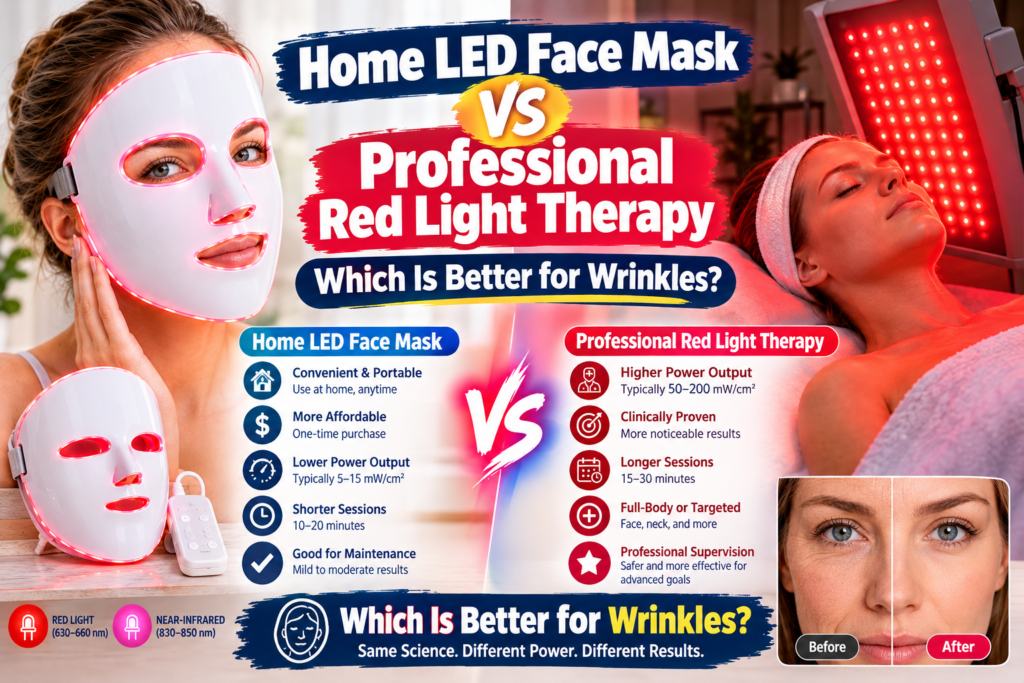
If you are comparing an at-home LED face mask with professional red light therapy, the best choice depends on more than price or how powerful a device appears. Both approaches use light-based treatments, but they may differ in wavelength, irradiance, treatment dose, coverage, supervision, and the evidence supporting their specific uses.
Quick answer: An at-home LED face mask may be more convenient for people who want a repeatable skincare routine without clinic appointments. Professional red light therapy may be preferable for people who want supervised treatment, a larger treatment area, or a protocol selected with a qualified provider. Neither option is automatically better for every person, and professional treatment does not guarantee superior anti-aging results.
The most useful comparison is between the actual devices and treatment protocols—not simply between “home” and “professional” labels.
Home LED Face Mask vs Professional Red Light Therapy: Quick Comparison
| Factor | At-Home LED Face Mask | Professional Red Light Therapy |
|---|---|---|
| Treatment setting | Your home | Clinic, dermatology office, med spa, or other professional setting |
| Main advantage | Convenience and repeatability | Potential supervision and protocol customization |
| Treatment area | Usually focused on the face | May cover the face, neck, or a larger area |
| Wavelengths | Depend on the exact device | Depend on the system and treatment protocol |
| Irradiance and dose | Device-specific; should be documented where possible | System- and distance-specific |
| Treatment schedule | Usually follows manufacturer instructions | Set according to the provider and protocol |
| Customization | Often limited to preset modes and times | May allow adjustments to positioning, area, and schedule |
| Cost structure | Upfront device purchase | Per-session charges or treatment packages |
| Practical limitation | Requires correct, consistent self-use | Requires appointments and can cost more over time |
| Best fit | People who value home use and convenience | People who prefer supervised or customized care |
This table describes common differences, not guarantees. A well-designed home mask and a professional system can vary considerably, so verify the specifications and evidence for the particular device being considered.
What Is an At-Home LED Face Mask?
An LED face mask is a wearable device that delivers light to the facial skin. Many devices marketed for signs of aging use red light, near-infrared light, or a combination of wavelengths. Some also include blue light or other treatment modes for different skincare objectives.
The appeal is straightforward: you can use the device at home, follow a predefined schedule, and avoid traveling to a clinic for every session.
However, a mask’s appearance or LED count does not tell you how effective it is likely to be. The treatment depends on the light wavelengths, the amount of light reaching the skin, the exposure time, the resulting dose, and the frequency of use.
A device may list several wavelengths without providing enough information about irradiance or how those measurements were obtained. If specifications are missing, it is difficult to compare that device meaningfully with a clinical treatment.
For a wider explanation of the evidence and limitations, see our guide to whether LED face masks actually work.
What Is Professional Red Light Therapy?
Professional red light therapy generally refers to light-based treatment delivered in a clinical or aesthetic setting. Equipment may include LED panels, larger light systems, or devices designed for a particular treatment area.
A professional may select the equipment, position the light source, determine the treatment area, and recommend a schedule. Depending on the system, the provider may have more flexibility than a consumer using a mask with fixed treatment settings.
That flexibility can be useful, but the word “professional” is not a technical specification. A clinic’s equipment still needs appropriate wavelengths, documented treatment parameters, and evidence relevant to the intended use.
Professional treatment also varies between providers. Some clinics offer LED treatment as a standalone cosmetic service, while others incorporate it into a broader skincare plan. The actual procedure, device, and purpose matter more than the setting alone.
Can a Home LED Mask Deliver Results Comparable to Professional Treatment?
Possibly for some outcomes and particular devices, but the evidence does not support treating every home mask as equivalent to every professional system.
Research has examined LED phototherapy for skin rejuvenation, including the appearance of fine lines and wrinkles. However, studies differ in the devices used, treatment parameters, schedules, study populations, and outcome measurements.
A randomized, double-blind, sham-controlled study published in 2025 evaluated a home-use LED and infrared mask for crow’s feet. It reported improvements in wrinkle assessments after repeated treatment with the specific device tested. That is useful evidence for the studied protocol, but it does not establish that every consumer mask will produce the same result.
A systematic review of randomized LED trials in dermatology likewise identified variation in study quality and treatment parameters. Skin rejuvenation was among the areas investigated, but the authors noted limitations that make broad comparisons difficult.
You can read the published 2025 clinical study and the systematic review of LED treatments in dermatology for more detail.
The practical conclusion is that a home mask may be a reasonable option for someone seeking gradual cosmetic improvement, but results should not be guaranteed. A professional treatment may offer more oversight or a different protocol, yet its effectiveness also depends on the system being used.
Irradiance vs. Dose: Why the Numbers Matter
One of the most common mistakes when comparing home and professional red light therapy is looking at irradiance alone.
Irradiance describes optical power reaching a given area, commonly expressed in milliwatts per square centimeter (mW/cm²).
Fluence, often called energy dose, describes the energy delivered per unit area, commonly expressed in joules per square centimeter (J/cm²).
When irradiance is measured at the treatment surface and remains constant, the basic relationship is:
Fluence (J/cm²) = Irradiance (mW/cm²) × time (seconds) ÷ 1,000
For example, a measured irradiance of 20 mW/cm² delivered for 300 seconds corresponds to 6 J/cm², assuming the irradiance is constant at the relevant skin surface.
This calculation illustrates the relationship; it is not a recommended treatment dose for any particular mask or skin concern.
A higher irradiance may deliver a given amount of energy in less time, but that does not automatically establish better cosmetic outcomes. Treatment response depends on the protocol, and a dose that works in one setting should not automatically be transferred to another device.
Be cautious if a manufacturer advertises a high power figure without explaining whether it represents electrical power, optical output, or irradiance measured at the skin. These are not interchangeable measurements.
Why Wavelength Matters
Wavelength affects how light interacts with tissue. Red and near-infrared wavelengths are frequently investigated in photobiomodulation research, but different wavelengths should not be considered interchangeable simply because they are marketed as red light therapy.
For example, a device using red light around 630–660 nm is not identical to one using near-infrared light around 830–850 nm. The actual treatment effect depends on more than the wavelength alone.
Before buying a home mask or paying for professional treatment, ask which wavelengths are used and whether clinical evidence supports that specific device or a sufficiently similar protocol for the intended purpose.
Do not assume that more wavelengths automatically make a device better. A broader selection of wavelengths may be useful for some designs, but it does not independently establish effectiveness.
Treatment Coverage: Face Mask vs. Professional System
A home LED mask is designed to focus on the face. Its fit and placement can make a facial routine relatively straightforward, although coverage and contact or distance can vary by design.
A professional system may treat a wider area, depending on the equipment. This can be relevant if the intended treatment includes the neck or another area beyond the face.
However, a larger illuminated area does not necessarily mean better results for wrinkles. Coverage should match the treatment objective, and the relevant skin area must receive an appropriate dose.
If your primary concern is fine lines around the eyes or mouth, ask how the device is designed to cover that area. Do not assume every mask illuminates all facial regions evenly or that a panel automatically provides uniform exposure.
For a different equipment comparison, see our LED face mask vs. red light therapy panel guide.
Customization and Professional Supervision
Most home masks use a manufacturer-defined routine. The device may have one or more preset modes and recommended session lengths, with instructions about frequency and eye protection.
This makes home use convenient, but it also means users need to follow the instructions rather than inventing longer sessions or combining devices in an attempt to accelerate results.
Professional treatment may allow more flexibility in positioning, treatment area, equipment choice, and session scheduling. A qualified provider can also help determine whether light therapy is appropriate for the person’s skin concern.
Nevertheless, professional supervision does not guarantee that a treatment will work. Ask the provider what device will be used, what evidence supports the protocol, and what realistic benefits and limitations to expect.
If a clinic cannot explain its treatment parameters or makes sweeping promises about permanent wrinkle removal, consider that a reason to ask more questions before paying.
Which Option Is More Convenient?
For many people, convenience is the strongest argument for an at-home mask. You can use it in your own space and follow the manufacturer’s schedule without booking repeated appointments.
Professional therapy involves travel, scheduling, and time spent at the treatment location. Some people nevertheless prefer appointments because they want guidance or find it easier to follow a structured plan.
Consistency matters in practical terms, but it does not mean that more frequent or longer treatment is necessarily better. Follow the device’s instructions and do not increase exposure beyond the recommended schedule without appropriate professional advice.
The most convenient option is the one you can use correctly, safely, and realistically—not simply the one with the shortest advertised session.
What About Cost?
Home LED masks generally require a larger initial purchase. After buying the device, routine use typically does not involve a separate fee for each session, although replacement parts, warranty coverage, and device lifespan can affect the overall cost.
Professional red light therapy usually involves a fee per session or a treatment package. Total costs vary by provider, location, device, and recommended number of visits.
Compare the full cost rather than just the price of one session or one mask.
For home treatment, consider the purchase price, warranty, return policy, and how long you expect to use the device. For professional treatment, ask for the total cost of the proposed course, the expected number of sessions, and whether maintenance appointments may be suggested.
Neither option guarantees a particular result, so avoid spending beyond your budget based on promises of dramatic or permanent anti-aging changes.
If you are weighing the purchase itself, our LED face mask value guide discusses practical expectations and costs.
Which Is Better for Fine Lines and Wrinkles?
Both home and professional LED treatments have been studied for facial rejuvenation, but the available evidence is specific to the devices and protocols investigated.
A consumer mask should not be assumed to reproduce the outcome of a clinical study merely because its listed wavelengths look similar. Treatment dose, coverage, exposure schedule, adherence, and study design all affect how directly the evidence applies.
For someone considering a home mask, look for transparent specifications and realistic claims. For someone considering clinic treatment, ask for the exact device and protocol rather than relying on the term “medical grade” or “professional strength.”
Also remember that red light therapy is not a substitute for established skincare measures. Daily sun protection and a skincare routine suited to your skin remain important parts of managing visible signs of aging.
Who May Prefer a Home LED Mask?
An at-home mask may suit someone who:
- Wants a convenient, repeatable skincare routine.
- Prefers to avoid repeated clinic appointments.
- Understands that results may be gradual and vary between people.
- Is willing to follow the manufacturer’s instructions consistently.
- Can evaluate device specifications and warranty terms before buying.
- Has checked whether the device is appropriate for their circumstances.
The choice should be based on the quality of the device and the person’s expectations—not the assumption that all masks work equally well.
For help evaluating product specifications, consult our LED face mask buying guide.
Who May Prefer Professional Red Light Therapy?
Professional treatment may be worth considering for someone who:
- Prefers supervision from a qualified provider.
- Wants treatment over a larger area.
- Needs help selecting an appropriate protocol.
- Is already receiving professional skincare or aesthetic care.
- Wants to discuss a particular skin concern before investing in a device.
A clinician may also help determine whether a different treatment would be more appropriate. If you have a persistent, changing, or unexplained skin problem, seek assessment rather than assuming that a cosmetic light device is the answer.
Can You Combine Home and Professional Treatments?
Some people may consider home use alongside professional sessions, but combining devices should not be interpreted as “more light is always better.”
Different devices can have different wavelengths, irradiance, exposure times, and schedules. Using them together can make the overall exposure difficult to assess.
Do not add extra sessions or extend treatment time simply because you have purchased another device. Follow the instructions for each product and ask a qualified healthcare professional whether the combined schedule is appropriate.
A home mask may sometimes be used as part of a broader skincare routine, but whether it is suitable after a clinic procedure depends on the procedure, recovery requirements, and provider’s instructions.
Questions to Ask Before Paying for Professional Treatment
Before booking a course of professional red light therapy, ask the provider:
- What exact device and wavelengths will be used?
- What is the irradiance at the actual treatment distance?
- Is the fluence or energy dose documented?
- How long does each session last?
- How often are sessions recommended, and why?
- Which areas will be treated?
- What evidence supports this specific device or protocol?
- Who will perform or supervise the treatment?
- What benefits are realistic, and what are the limitations?
- What is the total price of the recommended course?
These questions can help distinguish a well-explained treatment from one relying primarily on marketing language.
Questions to Ask Before Buying a Home LED Mask
Before purchasing a consumer device, check:
- The exact wavelengths and intended use.
- Whether irradiance is reported and how it was measured.
- The recommended session length and frequency.
- Whether treatment coverage suits your concern.
- The fit, positioning, and eye-safety instructions.
- The manufacturer’s warranty and return policy.
- The availability of clear instructions and customer support.
- Whether human clinical evidence supports the device or a comparable protocol.
The FDA’s overview of the 510(k) premarket notification process can help explain what the regulatory term means. Do not assume that every device is FDA-cleared or that clearance for one intended use proves superiority over another device. Check the exact model and its cleared indication when regulatory status is important to your decision.
Safety Considerations
LED photobiomodulation is noninvasive, but it is not automatically suitable for every person or every situation. Follow the device instructions, including any precautions about eye exposure, treatment duration, and frequency.
If you have a photosensitive condition, use medication that can increase light sensitivity, have an eye condition, or have another relevant medical concern, ask an appropriate healthcare professional whether the device is suitable for you.
Stop using a device and seek advice if you develop unexpected irritation, pain, or visual symptoms. Do not use a cosmetic mask to diagnose or treat an unexplained skin lesion.
The American Academy of Dermatology provides practical information about red light therapy, its potential uses, and precautions. Its guidance is a useful starting point, but it does not replace advice tailored to your circumstances.
Common Mistakes When Comparing Home and Professional Treatment
Mistake 1: Assuming professional treatment is always better
A professional setting can offer supervision and customization, but the actual device and protocol still matter.
Mistake 2: Comparing LED counts alone
The number of LEDs does not independently establish the amount of light reaching the skin or the likely clinical result.
Mistake 3: Looking only at irradiance
Irradiance must be interpreted alongside exposure time, dose, measurement method, and the treatment protocol.
Mistake 4: Treating all wavelengths as equivalent
Devices marketed under the same category may use different wavelengths and combinations.
Mistake 5: Expecting immediate or permanent wrinkle removal
Research typically assesses changes after repeated treatments. Results vary, and the evidence does not justify promises of permanent anti-aging effects.
Mistake 6: Assuming a study proves every mask works
Evidence from a particular device or controlled protocol does not automatically transfer to every product on the market.
Mistake 7: Ignoring total cost
A home mask may have a higher initial price, while professional care may involve repeated fees. Compare the overall expense against realistic expectations.
Final Verdict: Home LED Mask or Professional Red Light Therapy?
There is no universal winner.
Choose an at-home LED mask for convenience if you want a repeatable routine, have found a device with transparent specifications, and are comfortable following its instructions.
Consider professional red light therapy if you prefer supervision or a more tailored protocol, particularly when treatment involves a larger area or is part of a broader skincare plan.
Neither option should be chosen solely because it is more expensive, has more LEDs, or is described as professional grade. The most important considerations are the exact device, wavelength, treatment dose, schedule, coverage, safety, and evidence supporting its intended use.
The research on photobiomodulation for skin rejuvenation is promising, but it does not establish that all devices are interchangeable or that every person will experience noticeable improvement. Set realistic expectations, check the details before paying, and seek professional advice when a skin or health concern makes self-treatment uncertain.