
LifeCareBalance.com is reader-supported. When you buy through links on our site, we may earn an affiliate commission at no extra cost to you. As an Amazon Associate, we earn from qualifying purchases.
Last Updated: October 2026
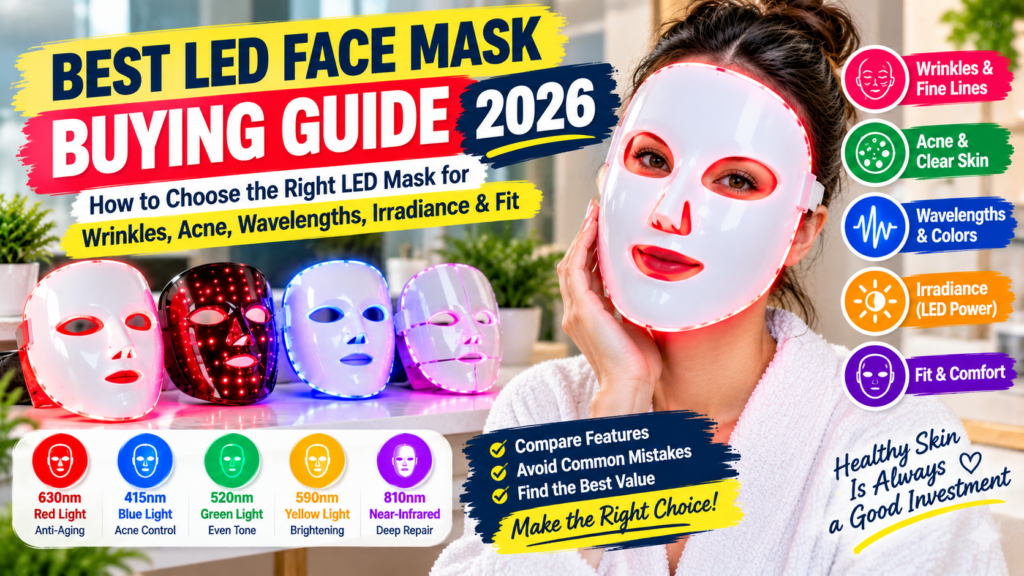
Choosing an LED face mask is not as simple as picking the device with the most lights, the highest power number, or the most colors. The useful questions are more specific: Which wavelengths does the mask use? What skin concern is it designed for? Does the manufacturer explain its treatment protocol? Does the mask fit comfortably? And can you verify its regulatory claims?
This 2026 buying guide explains the technical specifications that matter when comparing at-home LED face masks for the appearance of fine lines, wrinkles, uneven texture, and acne-prone skin. It also explains what the available evidence can—and cannot—tell you before you spend hundreds of dollars on a skincare device.
LifeCareBalance has not independently laboratory-tested every device discussed in this guide. The advice below focuses on how to assess manufacturer specifications, published evidence, safety information, and device-specific claims rather than treating marketing language as proof of performance.
Quick Answer: What Should You Look for in an LED Face Mask?
For most shoppers, the best LED face mask is one that matches their primary skincare goal, clearly identifies its wavelengths, provides understandable instructions, fits securely, and has appropriate safety information and a verifiable regulatory status.
- For visible signs of aging: Look for a device specifically designed and studied for the appearance of fine lines and wrinkles, often using red light and sometimes near-infrared light.
- For acne-prone skin: Consider a device specifically intended for acne and check whether it includes the appropriate visible-light settings, such as blue light. Light therapy is not a complete treatment for every type of acne.
- For technical transparency: Prefer manufacturers that disclose wavelength, treatment duration, recommended frequency, precautions, warranty, and relevant output measurements.
- For comfort: Check the mask’s weight, straps, eye-area design, coverage, and return policy. A technically impressive device is of little practical value if you cannot use it consistently.
- For regulatory claims: Verify the exact device and intended use. “FDA-cleared,” “FDA-approved,” and “FDA-registered” do not mean the same thing.
There is no single wavelength, irradiance number, LED count, or price that guarantees better results. Compare the whole device and its instructions—not one headline specification.
1. Start With Your Main Skin Concern
Before comparing specifications, decide what you want the mask to help address. A device designed for one purpose should not automatically be assumed to work equally well for another.
Fine lines and wrinkles
Red-light masks are commonly marketed for the appearance of fine lines, wrinkles, and uneven skin texture. Some devices also use near-infrared light. Research into photobiomodulation is promising, but studies use different devices, doses, schedules, and outcome measures. Results from one device cannot automatically be applied to every consumer mask.
The American Academy of Dermatology summarizes the current evidence and limitations in its guide to red-light therapy for skin. The practical takeaway is to look for a device with a clearly described intended use and realistic claims—not a promise that wrinkles will disappear.
Acne and breakouts
Blue light and combined blue-and-red light are used in some acne-focused devices. However, light treatments do not address every type of acne equally, and they may not clear blackheads, whiteheads, deep cysts, or nodules on their own.
The American Academy of Dermatology explains the limitations of light-based acne treatments in its guide to lasers and lights for acne. If you have persistent, painful, scarring, or severe acne, ask a dermatologist about an evidence-based treatment plan instead of relying on an LED mask alone.
Uneven tone, redness, or dark spots
Do not assume that every red-light mask is appropriate for every pigmentation concern. The cause of discoloration matters, and visible light may affect some people differently depending on their skin type and sensitivity. A mask marketed for anti-aging is not automatically a proven treatment for melasma, post-inflammatory hyperpigmentation, or other pigment disorders.
If you have a history of pigmentation problems, a darker skin tone, a photosensitivity condition, or a skin disorder, ask a qualified dermatologist whether the specific device is appropriate for you.
2. Understand Wavelengths: Red, Near-Infrared, and Blue Light
Wavelength is measured in nanometers (nm). It describes the color or spectral range of the light emitted by a device. Different wavelengths interact with skin in different ways, but wavelength alone does not establish that a mask is effective.
| Light type | Commonly marketed purpose | What to check |
|---|---|---|
| Red light | Appearance of fine lines, wrinkles, and skin texture | Exact wavelength, intended use, treatment protocol, and supporting evidence |
| Near-infrared light | Often included in devices marketed for skin rejuvenation | Exact wavelength, whether it is combined with red light, and the device’s instructions |
| Blue light | Acne-focused skincare | Whether the device is specifically intended for acne and which types of acne it addresses |
| Multiple colors | Several skincare concerns | Whether each mode has a clearly explained purpose and evidence, rather than simply adding colors for marketing appeal |
Is a higher wavelength better?
No. A larger number in nanometers does not mean a device is more powerful or more effective. Different wavelengths have different characteristics, and a useful comparison must consider the complete treatment protocol and the intended skin concern.
Be cautious with vague phrases such as “seven-color technology” or “professional spectrum” when a manufacturer does not provide exact wavelength values or explain what each mode is intended to do.
Do you need red and near-infrared light together?
Not necessarily. A combination may be appropriate for a particular device and intended use, but more wavelengths do not automatically mean better outcomes. A simpler device with clear instructions may be a better purchase than a complicated mask with poorly explained modes.
The goal is to find a device that matches your needs—not to collect the longest list of wavelengths.
3. Irradiance: What the Power Number Actually Tells You
Irradiance is commonly reported in milliwatts per square centimeter (mW/cm²). It describes the amount of optical power reaching a given area under specified measurement conditions.
Some manufacturers publish an irradiance figure prominently; others do not. A disclosed number can help you compare technical information, but only if you understand how and where it was measured.
Before relying on an irradiance claim, ask:
- Was the measurement taken at the skin-facing surface, at a stated distance, or under another setup?
- Does the figure describe the entire device, an individual LED, or a particular point?
- Is the measurement independently tested or simply reported by the manufacturer?
- Does the manufacturer provide the recommended treatment duration and frequency?
- Is the device’s output information relevant to its stated intended use?
Is higher irradiance always better?
No. Higher irradiance is not a universal measure of superior performance. A device’s results and safety depend on the complete set of parameters, including wavelength, exposure time, geometry, and the manufacturer’s validated protocol.
A high number without context can be misleading. Likewise, the absence of a published irradiance figure does not by itself prove that a device is ineffective; it does make technical comparison more difficult.
Buying rule: Treat irradiance as one comparison point, not as a stand-alone ranking system.
4. Treatment Time, Frequency, and Dose
A mask may advertise a three-minute session while another recommends ten minutes or longer. Shorter sessions are more convenient, but session length alone does not establish that one device works better than another.
The appropriate schedule depends on the device’s design, output, intended use, and instructions. Follow the manual for the exact model you buy rather than copying the schedule from another mask.
Why you should not calculate your own treatment schedule
You may see light-dose calculations online that combine irradiance and exposure time. Although such calculations can describe radiant exposure under defined conditions, they do not establish the ideal treatment dose for your skin or prove that two devices are interchangeable.
Measurement conditions, light distribution, device geometry, and the manufacturer’s validated protocol all matter. Do not increase session length or frequency to try to accelerate results.
How long does it take to notice a difference?
There is no universal timeline. Some studies report changes after repeated sessions, while results vary by device, concern, and individual. Follow the product’s stated schedule and assess results realistically. If you develop irritation or other unwanted effects, stop using the device and seek appropriate advice.
5. LED Count, Coverage, and Light Distribution
LED count is one of the most visible numbers in product marketing. A mask with more LEDs is not automatically more effective than one with fewer.
Manufacturers may count individual light-emitting diodes, LED packages, or bulbs that contain multiple emitters. This makes direct comparisons difficult unless the counting method is clearly explained.
Instead of choosing by LED count alone, examine:
- Coverage: Does the mask reach the forehead, cheeks, chin, and other areas you intend to treat?
- Fit: Does it sit securely without leaving large gaps or pressing uncomfortably against the skin?
- Light distribution: Does the manufacturer explain how light is delivered across the treatment area?
- Design: Can you position the device correctly without repeatedly adjusting it?
- Instructions: Are there clear directions for placement, cleaning, and use?
If a company advertises a very high LED count but gives little information about wavelength, treatment protocol, or safety, do not treat the count as proof of quality.
6. Fit, Comfort, and Eye Protection
Fit affects whether a mask is practical for regular use. A rigid mask may hold its shape, while a flexible silicone design may adapt more closely to different facial contours. Neither design is automatically superior for every face.
Before purchasing, consider the following:
Weight and pressure: A heavy device may become uncomfortable around the nose, cheeks, or forehead.
Straps and adjustability: Check whether the mask can be positioned securely without excessive pressure.
Coverage: Make sure the treatment area matches your goals. A face mask may not treat the neck or chest unless it is specifically designed to do so.
Visibility and movement: Some masks allow limited visibility; others are designed to cover the eyes. Think about whether you will use the device lying down or sitting still.
Eye safety: Follow the exact device instructions for eye protection. Do not assume that a closed-eye design or built-in eye shields make every device safe for every user. Use protective eyewear if the manufacturer requires it.
If you have an eye condition, light sensitivity, or a medication-related concern, ask a healthcare professional whether the device’s light exposure is appropriate.
7. FDA Clearance: How to Check the Claim
Regulatory wording is one of the most important details to verify before buying an LED face mask in the United States.
FDA-cleared is not the same as FDA-approved
A 510(k) clearance generally means the FDA determined that a device is substantially equivalent to a legally marketed predicate device for the relevant regulatory purpose. It does not mean that every marketing claim has been independently proven, nor does it guarantee the same results for every user.
“FDA registered” is also not a substitute for device clearance. Registration or listing alone should not be presented as proof that the FDA has evaluated a device’s effectiveness.
How to verify a mask
- Find the exact manufacturer and model name.
- Ask the company for the relevant 510(k) number, if applicable.
- Search the official FDA 510(k) Premarket Notification database.
- Check whether the record matches the product and manufacturer you are considering.
- Read the device description and intended use rather than relying only on a badge on a sales page.
A clearance associated with one model or intended use should not be assumed to cover every product sold by the same brand. If you cannot match the exact device to a relevant record, treat the claim as unverified until the manufacturer provides adequate documentation.
8. Safety: Who Should Be Extra Careful?
At-home LED devices are not suitable for everyone, and safety information should be part of your buying decision—not an afterthought.
Check the manufacturer’s warnings and speak with a qualified healthcare professional before use if you:
- Have a condition that makes you sensitive to light.
- Take medication that may increase photosensitivity.
- Have an eye condition or have been advised to limit light exposure.
- Have a skin condition or pigmentation concern that could be affected by visible light.
- Are pregnant, have a relevant medical condition, or are unsure whether the device is appropriate for you.
These are reasons to check suitability, not a claim that every person in these groups must avoid all LED devices. The answer depends on the device, the concern being treated, and individual circumstances.
Follow the device’s instructions
Use the mask only as directed. Do not extend sessions, increase frequency, or combine multiple light devices on the same area unless the instructions or your healthcare professional support that approach.
Stop use if you develop persistent irritation, discomfort, unusual skin changes, or eye symptoms. Seek medical advice when appropriate. An LED mask should not replace diagnosis or treatment for a skin condition.
9. Price, Warranty, and Total Cost of Ownership
LED face masks can range from inexpensive consumer products to premium devices costing several hundred dollars. Price alone does not establish clinical performance.
Compare the complete purchase:
- Warranty: How long is coverage, and what does it exclude?
- Return policy: Can you return the mask if it does not fit or is unsuitable?
- Replacement parts: Are straps, chargers, controllers, or other components replaceable?
- Charging and storage: Does the device need a cable, a separate controller, or a particular storage method?
- Cleaning: Can you clean the skin-contact surfaces using the manufacturer’s recommended method?
- Support: Can you reach the manufacturer for questions about operation, safety, or warranty claims?
A more expensive mask may offer a more comfortable design or clearer documentation, but those features do not prove superior results. A low-priced mask may be worth considering if its specifications, safety information, intended use, and support are transparent.
Do not pay extra for a large number of colors or LEDs unless the additional features serve a clearly stated purpose that matters to you.
10. Common LED Face Mask Buying Mistakes
Mistake 1: Choosing the mask with the most LEDs
LED count is not a clinical outcome. Compare wavelength, intended use, instructions, coverage, and fit.
Mistake 2: Assuming the highest irradiance wins
A higher irradiance number does not automatically mean better results. Check the measurement conditions and full treatment protocol.
Mistake 3: Treating all red-light masks as interchangeable
Devices can differ in wavelength, output, geometry, schedule, and regulatory status. Evidence for one device does not automatically apply to another.
Mistake 4: Confusing registration with clearance
Verify the exact product and regulatory record. Do not rely on vague phrases such as “FDA certified.”
Mistake 5: Buying a mask for the wrong concern
A device marketed for wrinkles is not automatically suitable for every acne or pigmentation problem. Match the intended use to your goal.
Mistake 6: Ignoring fit and eye safety
An uncomfortable mask is harder to use consistently. Review the eye-protection instructions and make sure the device fits correctly.
Mistake 7: Expecting fast or guaranteed results
LED therapy is not an instant fix. Results vary, and it may not be effective enough for your concern. Be skeptical of guaranteed transformations and dramatic claims unsupported by evidence.
11. A Simple LED Face Mask Buying Checklist
Use this checklist before placing an order.
- My main goal is clear: wrinkles, acne, or another specific concern.
- The device’s intended use matches that goal.
- Exact wavelengths are listed and explained.
- The treatment schedule and safety instructions are easy to find.
- Irradiance information, if provided, includes enough context to interpret it.
- The manufacturer explains fit, coverage, cleaning, and eye protection.
- FDA claims are specific and can be checked against an official record where applicable.
- Warranty and return terms are acceptable.
- The device fits my budget without requiring me to trust unsupported promises.
- I understand that results vary and that a mask may not replace standard skincare or medical treatment.
If a device fails several of these checks, keep comparing rather than buying because of a discount or influencer recommendation.
12. Where to Go Next
If you have finished learning about the technical specifications, use the next guide that matches your buying decision:
- To compare specific models and their features, read our best LED face masks of 2026 guide.
- For a closer look at evidence, limitations, and practical expectations, see our LED face mask review.
- If you are choosing between a wearable mask and a larger treatment device, read LED face mask vs. red light therapy panel.
- If you are deciding between light therapy and electrical facial stimulation, explore LED face mask vs. microcurrent mask.
For additional background, the peer-reviewed review Unlocking the Power of Light on the Skin: A Comprehensive Review on Photobiomodulation discusses the potential applications of photobiomodulation in dermatology while highlighting the importance of research methods and treatment parameters.
Frequently Asked Questions
What is the most important specification in an LED face mask?
There is no single most important number. Start with the intended use, then compare wavelength, treatment instructions, available output information, fit, safety guidance, and relevant regulatory documentation.
Is a higher LED count better?
Not necessarily. LED count does not show how much light reaches the skin or prove that a device produces better results. Manufacturers may also count LEDs differently.
Is a higher irradiance number better for wrinkles?
Not automatically. Irradiance must be considered alongside wavelength, exposure time, measurement conditions, and the device’s intended protocol. Do not choose a mask solely because it advertises a larger number.
Should I choose red light or blue light?
It depends on your goal and the specific device. Red-light masks are commonly marketed for the appearance of fine lines and skin texture, while blue light is used in some acne-focused devices. Neither option is suitable for every skin concern, and light therapy may need to be combined with other treatments.
Does FDA clearance guarantee results?
No. Clearance is a regulatory status tied to a specific device and regulatory purpose. It is not a guarantee that every user will see results or that all claims made in advertising are proven.
How often should I use an LED face mask?
Follow the instructions for the exact model. Treatment schedules differ, and copying the schedule from another device or extending sessions can be inappropriate.
Can an LED mask replace my skincare routine?
No. An LED mask should not automatically replace sunscreen, a suitable moisturizer, acne treatment, or care recommended by a dermatologist. Consider it only as a potential addition to an appropriate skincare plan.
Are LED face masks safe for every skin tone?
Do not assume that every device is equally suitable for every skin tone or pigmentation concern. Visible light can affect pigmentation in some people. If you have a history of dark spots or are concerned about sensitivity, ask a dermatologist before use.
Is an inexpensive LED face mask worth buying?
It may be worth considering if its intended use, specifications, safety information, warranty, and return policy are clear. A low price does not prove poor quality, but a high price does not prove better results either.
What should I do if the manufacturer does not disclose irradiance?
You can still assess the product using its wavelength information, intended use, instructions, safety guidance, regulatory documentation, fit, warranty, and the quality of its supporting evidence. However, acknowledge that the missing measurement makes technical comparisons less complete.
Final Verdict
The best LED face mask is not necessarily the most expensive, the brightest, or the one with the most LEDs. It is the device whose intended use matches your goal, whose specifications and safety instructions are transparent, whose fit makes regular use realistic, and whose regulatory claims can be checked.
Prioritize credible documentation over marketing promises. Compare the complete treatment protocol instead of one number, and consult a dermatologist if you have persistent acne, pigmentation concerns, light sensitivity, or uncertainty about whether a device is appropriate for you.