
LifeCareBalance.com is reader-supported. When you buy through links on our site, we may earn an affiliate commission at no extra cost to you. As an Amazon Associate, we earn from qualifying purchases.
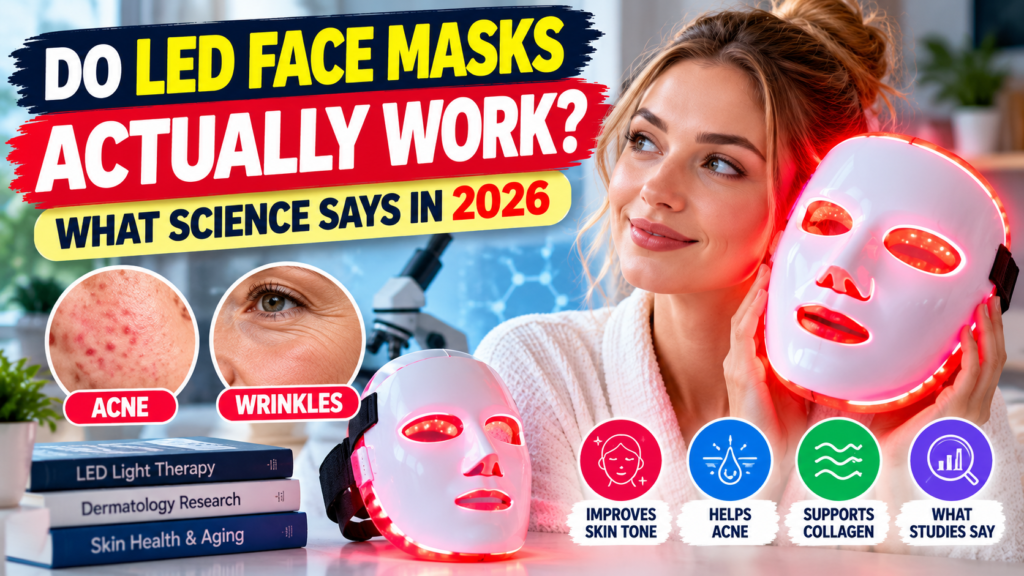
LED face masks have become a popular at-home skincare option, promising smoother-looking skin, fewer fine lines, improved texture, and fewer acne breakouts. But popularity and impressive marketing do not automatically prove that a skincare device works.
The more useful question is whether LED face masks can produce measurable results, which skin concerns have the strongest supporting evidence, and how much confidence you should place in the claims made by individual brands.
The research offers encouraging answers, particularly for mild-to-moderate acne. However, the evidence varies by condition, device, treatment protocol, and study quality. Results from clinical research on LED therapy also cannot automatically be applied to every consumer mask sold online.
In this guide, we examine the science behind red, blue, and near-infrared light, explain what clinical studies actually show, and identify the limitations that matter before you invest in an expensive device.
The short answer: LED face masks can help with certain skin concerns, but results are usually gradual, vary between individuals, and depend on the device and treatment protocol. They should be considered a complementary skincare option rather than a replacement for established treatments.
Quick Answer: Do LED Face Masks Actually Work?
Yes, some at-home LED devices have clinical evidence supporting their use for specific skin concerns. The evidence is particularly encouraging for red and/or blue LED devices used for mild-to-moderate acne. Red-light therapy also shows potential for improving the appearance of fine lines and other signs of skin aging, although results vary and more research is needed.
Here is what to know:
- Acne: A 2025 systematic review and meta-analysis found improvements in acne lesions among people using at-home red and/or blue LED devices compared with control groups.
- Fine lines and wrinkles: Research suggests potential cosmetic improvements, but the size and consistency of results vary.
- Skin texture and redness: Some studies report improvements, although evidence depends on the treatment and device.
- Deep wrinkles and severe acne: An LED mask should not be expected to resolve these conditions on its own.
- Product quality: Evidence for LED therapy does not prove that every consumer mask delivers the same benefits.
The best approach is to identify your main skin concern, evaluate the device’s intended use and specifications, and maintain realistic expectations.
What Is an LED Face Mask?
An LED face mask is a wearable skincare device that uses light-emitting diodes to deliver particular wavelengths of light to the skin.
These devices are commonly associated with photobiomodulation, a process in which certain wavelengths of light interact with biological tissue and may influence cellular activity.
Unlike ablative laser treatments, LED masks are generally designed to deliver light without intentionally removing or damaging the skin’s surface. They are typically used at home for short, repeated sessions according to the manufacturer’s instructions.
Different colors and wavelengths are used for different purposes.
Red light
Red-light devices commonly use wavelengths around 630–670 nanometers (nm).
Research has investigated red light for its potential effects on inflammation, cellular activity, collagen-related processes, and the appearance of aging skin.
Red light is commonly used in devices marketed for:
- Fine lines and wrinkles
- General skin rejuvenation
- Skin texture
- Visible redness
These are potential applications, not guaranteed outcomes for every device.
Near-infrared light
Near-infrared (NIR) light is invisible or nearly invisible to the human eye, depending on the wavelength. Consumer skincare devices commonly use wavelengths around 800–850 nm, although some products advertise additional wavelengths.
NIR penetrates tissue differently from visible red light and is often combined with it in anti-aging devices.
However, a mask with more wavelengths is not necessarily more effective. The treatment protocol and evidence for the particular device still matter.
Blue light
Blue-light devices commonly use wavelengths around 405–445 nm in acne-related research.
Blue light is used in some acne devices because certain acne-associated bacteria contain light-sensitive compounds. When exposed to appropriate wavelengths, these compounds can contribute to reactions that affect the bacteria.
Some devices combine blue and red light to address different aspects of acne-related concerns.
The important distinction is that the wavelength alone does not establish effectiveness. The complete device and its treatment protocol must be considered.
What Does the Clinical Research Actually Show?
A useful way to evaluate LED face masks is to separate general research on LED therapy from research on individual consumer products.
A study may demonstrate a benefit under particular conditions without proving that every device using a similar color of light will produce the same result.
Two research publications are especially useful for understanding the current evidence.
1. The 2022 systematic review and meta-analysis
A systematic review published in Photodermatology, Photoimmunology & Photomedicine in 2022 examined the dermatological and cosmetic applications of LED therapy.
The researchers screened 554 articles and selected 31 studies for their analysis. Their findings supported potential applications of red and blue LED light for acne, along with possible benefits from other LED approaches for selected skin conditions and rejuvenation outcomes.
This is encouraging, but the review covered different dermatological applications rather than proving that every at-home face mask works.
Differences in wavelengths, treatment settings, study populations, and outcomes make broad conclusions difficult.
Read the 2022 systematic review and meta-analysis of LED skin therapy.
2. The 2025 review of at-home LED devices for acne
A more directly relevant publication appeared in JAMA Dermatology in March 2025.
The systematic review and meta-analysis included six randomized clinical trials involving 216 participants with mild-to-moderate acne.
The researchers reported that at-home red and/or blue LED devices produced greater improvements in inflammatory and non-inflammatory acne lesions than control treatments. The study durations ranged from two days to 12 weeks, and improvements were commonly observed over four to 12 weeks.
However, there were important limitations:
- Only six studies met the inclusion criteria.
- The studies used different devices and treatment protocols.
- Participants had mild-to-moderate acne, so the results should not automatically be applied to severe acne.
- The findings do not establish that every commercial LED mask will produce comparable results.
The study supports the potential of at-home LED devices for acne, not an unconditional endorsement of the entire market.
Read the 2025 JAMA Dermatology systematic review.
Do LED Face Masks Work for Wrinkles?
Red and near-infrared LED devices are commonly marketed for fine lines, wrinkles, and the appearance of aging skin.
Some clinical research suggests that particular red-light treatment protocols can produce improvements in skin appearance. Researchers have investigated effects on collagen-related processes, skin texture, redness, and other visible signs of aging.
Nevertheless, it is important to distinguish a modest cosmetic improvement from a dramatic transformation.
An LED face mask should not be expected to:
- Eliminate deep wrinkles
- Produce a surgical facelift effect
- Reverse all visible sun damage
- Restore lost facial volume
- Deliver the same results as every professional treatment
The American Academy of Dermatology notes that studies of red-light devices have reported improvements in certain signs of skin aging, but differences between devices and study protocols make it difficult to compare results directly.
You can read the American Academy of Dermatology’s guide to red-light therapy.
How long might wrinkle improvements take?
There is no universal timeline.
Some studies evaluate outcomes after several weeks, while other treatment protocols run longer. Your response will depend on the device, how consistently you use it, the condition of your skin, and the outcome being measured.
Do not assume that a manufacturer’s advertised results timeline guarantees the same outcome for you.
If you want to evaluate an LED mask fairly, follow the specified protocol and assess changes over a reasonable period rather than judging the device after only a few sessions.
Can LED Face Masks Improve Skin Texture and Redness?
Possibly, although the strength of evidence varies by concern and treatment.
Skin texture and redness can be affected by several factors, including sun exposure, acne, irritation, inflammation, dehydration, and normal aging.
LED therapy may support certain biological processes involved in skin function, but it does not perform the same role as every other skincare treatment.
For example:
- A chemical exfoliant helps remove surface buildup.
- A retinoid can influence skin-cell turnover and has evidence supporting certain anti-aging uses.
- Moisturizers help maintain skin hydration and the skin barrier.
- Sunscreen helps protect against ultraviolet radiation.
- LED therapy delivers specific wavelengths of light and has different potential effects.
For that reason, an LED mask is better considered a possible addition to an appropriate skincare routine rather than a replacement for all other products.
If you are comparing individual devices, our Best LED Face Masks of 2026 guide focuses on product features, specifications, and shopping considerations.
Do LED Face Masks Work for Acne?
Acne is one of the areas where recent evidence is particularly useful.
Blue and red LED devices have been studied for mild-to-moderate acne, with the 2025 meta-analysis reporting improvements in acne lesions compared with control treatments.
However, acne is not a single condition with one universal cause or treatment.
Some people experience mostly inflammatory pimples, while others have blackheads, whiteheads, deeper nodules, or cystic acne. A light-based device may not address every type of acne equally well.
Blue light and acne-related bacteria
Blue light is used in certain acne devices because it can interact with light-sensitive compounds associated with Cutibacterium acnes, a bacterium involved in acne.
This does not mean that blue light eliminates every cause of acne or prevents all future breakouts.
Red light and inflammation
Red light has also been studied in acne treatment, including in combination with blue light.
The 2025 review found benefits from red, blue, and combination devices, although the limited number of studies makes it difficult to determine the ideal wavelength and protocol for every person.
When an LED mask may not be enough
Do not rely on a consumer LED mask as your only treatment if you have painful, persistent, cystic, or scarring acne.
A dermatologist can help identify an appropriate treatment plan, which may include established topical or prescription therapies.
For additional product-specific guidance, see our LED face mask buying guide for 2026.
Why the Number of LEDs Does Not Prove Effectiveness
Manufacturers often promote LED count as a major selling point.
However, a higher number of LEDs does not automatically mean better results.
Two masks may advertise similar LED counts while differing in:
- Wavelengths
- Light output
- Treatment duration
- Facial coverage
- Distance between LEDs and skin
- Intended use
- Evidence supporting the finished device
LED count is a specification, not a clinical outcome.
When comparing masks, look for the actual wavelengths and treatment instructions. If the manufacturer publishes irradiance, find out how the figure was measured and whether it represents one wavelength or combined output.
A transparent manufacturer should make it possible to understand what the device is designed to do, even if not every technical measurement is available.
What Is Irradiance, and Does It Matter?
Irradiance describes the optical power delivered per unit area, commonly expressed in milliwatts per square centimeter (mW/cm²).
Treatment time is also important because it affects the total energy delivered during a session.
The basic relationship is:
Energy dose (J/cm²) = Irradiance (W/cm²) × Time (seconds)
For example, an irradiance of 50 mW/cm² is equivalent to 0.05 W/cm². If that intensity were maintained for 600 seconds, the calculated energy dose would be 30 J/cm².
This is a mathematical example, not a recommended dose for an LED face mask.
The appropriate treatment protocol depends on the specific device and supporting evidence. Irradiance measurements can also differ depending on the measurement location and method.
When evaluating a product, ask:
- Is irradiance disclosed?
- Where was it measured?
- Is the number wavelength-specific or combined?
- What treatment duration does the manufacturer recommend?
- Is the measurement independently verified?
- Is the device supported by evidence for its intended use?
A higher irradiance figure alone does not establish that one mask is better than another.
Does Mask Fit Affect Results?
Fit can influence how consistently a mask positions its LEDs relative to the skin.
A flexible silicone design may conform closely to facial contours, while a rigid mask maintains a more fixed shape. Neither design is automatically superior.
The practical questions are whether the mask fits comfortably, provides the intended coverage, and can be used as directed.
Consider the following:
- Does it sit comfortably around the cheeks and forehead?
- Does the design leave large gaps around areas you want to treat?
- Are the straps adjustable?
- Is the device comfortable enough for repeated use?
- Does the manufacturer explain the correct positioning?
- Are eye shields or other protective measures included where required?
Comfort matters because a device you abandon after a few uses will not deliver its intended treatment schedule.
How Long Does It Take to See Results?
Results depend on the skin concern, device, and protocol.
For acne, the 2025 systematic review found that the included studies lasted from two days to 12 weeks, with improvements commonly observed over four to 12 weeks. This does not mean that every user will notice improvement within that period.
For wrinkles and general skin appearance, study protocols and assessment periods vary. Some studies report changes after several weeks, but the evidence does not support one guaranteed timeline for all masks.
A practical approach is to:
- Follow the exact device instructions.
- Avoid changing treatment frequency without guidance.
- Assess your skin consistently rather than relying on daily impressions.
- Stop if the device causes persistent irritation or unexpected symptoms.
- Seek professional advice if your skin concern is worsening.
Do not increase the duration or frequency simply because you want faster results.
Are LED Face Masks Safe?
LED masks are generally considered relatively low-risk when used correctly, but risks and suitability vary by device and individual.
The Cleveland Clinic notes that LED therapy may help certain skin concerns but that at-home devices generally produce more subtle results than professional treatments. It also advises users to follow device instructions and consider eye protection.
Before using an LED mask, pay attention to the following issues.
Eye safety
Follow the manufacturer’s specific eye-safety instructions. Do not assume that every mask is safe for open-eye use or that all devices require identical protective measures.
Photosensitivity and medication
Some medications and medical conditions can make a person more sensitive to light. Ask your healthcare professional whether LED therapy is appropriate if you take photosensitizing medication or have a photosensitivity disorder.
Existing skin conditions
People with conditions that may react to light should seek individualized medical guidance before starting treatment.
Irritation or discomfort
Stop using the device if you experience significant discomfort, persistent redness, or other unexpected symptoms. Consult a healthcare professional if symptoms continue.
Severe skin problems
An LED mask should not delay professional assessment of severe acne, suspicious skin changes, or a persistent skin condition.
For additional information, read the Cleveland Clinic’s LED light therapy guide.
FDA-Cleared vs. FDA-Approved LED Masks
Regulatory claims deserve careful attention when shopping in the United States.
FDA clearance and FDA approval are different regulatory concepts. Many medical devices use a 510(k) clearance pathway, while other devices and products may follow different regulatory routes depending on their classification and intended use.
Do not assume that a mask is FDA-cleared simply because its listing describes it as professional-grade, medical-grade, or clinically proven.
Before buying:
- Confirm the exact product name and model.
- Check the manufacturer’s regulatory documentation.
- Verify the intended use associated with the claimed status.
- Distinguish the regulatory status of the device from broader marketing claims.
- Do not assume that a claim for wrinkle treatment automatically establishes a claim for acne treatment.
The FDA’s 510(k) Premarket Notification database is one place to investigate clearance records. A similar product name alone is not enough to establish that a particular consumer mask has the status claimed by its seller.
Are Expensive LED Masks Better Than Affordable Ones?
Not necessarily.
A more expensive device may offer a flexible design, additional wavelengths, a rechargeable controller, or more detailed specifications. Those features may be useful, but price alone does not demonstrate better clinical results.
Compare products based on:
| Factor | What to check |
|---|---|
| Wavelength | Does it match your primary concern? |
| Intended use | Is the device designed for your intended application? |
| Irradiance | Is the measurement available and explained? |
| Treatment protocol | Are time and frequency clearly stated? |
| Fit | Is the mask comfortable and appropriately positioned? |
| Evidence | Are claims supported by relevant research? |
| Regulatory status | Can the exact model’s status be verified? |
| Warranty | What coverage does the manufacturer provide? |
| Returns | Can you return the device if it is unsuitable? |
| Total cost | Does the price fit your budget without unrealistic expectations? |
If you want a side-by-side look at product specifications, consult our LED Face Mask Review and Comparison 2026.
LED Face Masks vs. Professional Treatments
At-home masks offer convenience, while professional treatments may provide different equipment, controlled conditions, and individualized protocols.
The two approaches should not be assumed to deliver equivalent results.
Professional treatment may be useful when a clinician wants to assess your skin, select a suitable treatment, and monitor your response. At-home devices are more convenient for people who prefer a repeatable routine without appointments.
Which approach makes sense depends on the skin concern, the evidence for the proposed treatment, cost, and professional advice where appropriate.
For a deeper comparison of treatment formats, see our LED Face Mask vs. Red Light Therapy Panel guide.
Are LED Face Masks Worth It?
An LED face mask may be worth considering if you have a clear skincare goal, choose an appropriate device, and understand that results may be modest and gradual.
The evidence for at-home red and/or blue LED devices is encouraging for mild-to-moderate acne. Red-light therapy also shows potential for certain cosmetic concerns, including the appearance of fine lines, but the effectiveness of individual devices cannot be assumed from research on the technology alone.
An LED mask may be less appealing if you expect dramatic results, need treatment for severe acne, cannot verify the device’s specifications, or are unwilling to follow the recommended schedule.
The most sensible buying decision is not necessarily the most expensive one. Choose a device that matches your concern, provides transparent information, fits comfortably, and has realistic claims.
Frequently Asked Questions
Do LED face masks actually work?
Some at-home LED devices have evidence supporting benefits for specific skin concerns. Results vary by device and condition, and improvements are not guaranteed.
Which LED color is best for wrinkles?
Red light is commonly used for the appearance of fine lines and wrinkles. Some devices combine red with near-infrared light, but additional wavelengths do not automatically guarantee better results.
Does blue LED light help acne?
Research suggests that certain at-home blue and red LED devices can improve mild-to-moderate acne. The available evidence does not prove that every commercial device will work equally well.
How long does it take for an LED face mask to work?
For acne, improvements were commonly observed over four to 12 weeks in the studies included in a 2025 systematic review. Other concerns and devices may have different timelines.
Does a higher LED count mean better results?
No. LED count alone does not tell you the wavelength, irradiance, delivered dose, or clinical effectiveness of a device.
Are FDA-cleared LED masks guaranteed to work?
No. Regulatory clearance applies to a specific device and intended use. It does not guarantee dramatic results or establish every marketing claim.
Can an LED mask replace skincare products?
No. LED therapy does not replace sunscreen, moisturizers, or established acne and anti-aging treatments when those are appropriate for your skin.
Are LED face masks safe for everyone?
No device is suitable for everyone. People with photosensitivity disorders, relevant medication use, or other concerns should seek professional advice and follow the manufacturer’s safety instructions.
Final Verdict: What Science Says About LED Face Masks
LED face masks are neither a guaranteed skincare miracle nor a technology that should be dismissed outright.
Research supports potential benefits for selected skin concerns, particularly mild-to-moderate acne when appropriate red and/or blue LED devices are used. Red-light therapy may also provide gradual improvements in the appearance of aging skin, but the evidence varies across applications and devices.
Before purchasing, focus on the actual wavelength, treatment protocol, fit, safety instructions, regulatory documentation, and evidence supporting the device’s intended use.
Do not rely on LED count, premium pricing, influencer endorsements, or dramatic before-and-after images as proof of effectiveness.
The bottom line: An LED face mask can be a useful addition to a skincare routine for some people, but choosing an appropriate device and maintaining realistic expectations matter more than marketing claims.