
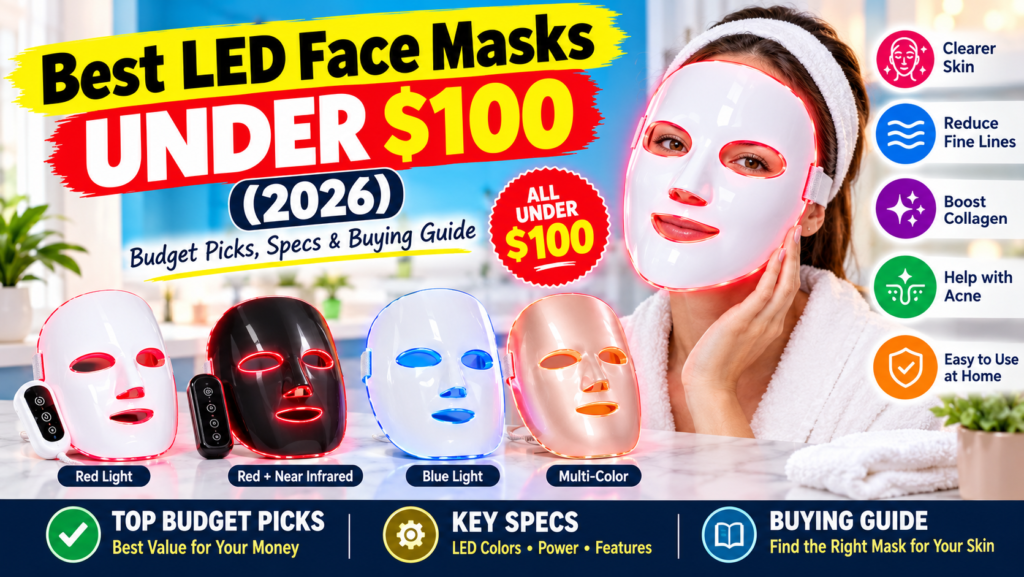
Compare LED face masks under $100, learn which specs matter, and discover how to evaluate wavelengths, irradiance, safety, and value before buying.
LifeCareBalance.com is reader-supported. When you buy through links on our site, we may earn an affiliate commission at no extra cost to you. As an Amazon Associate, we earn from qualifying purchases.
LED face masks used to feel like a luxury purchase, with many popular devices priced at $300–$500 or more. In 2026, shoppers can find much cheaper options, including multi-color LED masks advertised for less than $100. But does a lower price mean you have to sacrifice useful features, or can an affordable mask be a reasonable way to try at-home light therapy?
The answer depends on the specific device, its published specifications, safety information, and what you want it to do. A low price does not automatically mean poor quality, just as a premium price does not guarantee better results. Wavelength, light output, coverage, fit, eye protection, and the manufacturer’s documentation all matter.
This guide explains what to look for in an LED face mask under $100, reviews the budget option for which useful technical specifications are publicly available, and explains when it may be smarter to save your money rather than buy a poorly documented device.
Our key takeaway: The VEVOR 7-Color LED Face Mask is one budget option worth investigating because its manufacturer publishes wavelength-related features and an irradiance figure. However, that information alone does not prove that it delivers better skincare results than competing masks. We could not verify enough consistent, current specifications for several other commonly mentioned budget models to rank them confidently as the best choices under $100.
If you want to compare options across a wider price range, our Best LED Face Masks of 2026 guide covers more expensive devices as well.
Quick Picks: LED Face Masks Under $100
Prices and availability can change quickly. Treat the price ranges below as shopping guidance, not guaranteed offers. Confirm the current listing, exact model, included accessories, and return policy before ordering.
| Option | Best for | Published specifications | Main limitation |
|---|---|---|---|
| VEVOR 7-Color LED Face Mask | Budget shoppers who want multiple light modes, including near-infrared | Manufacturer lists 850 nm near-infrared and maximum irradiance of 16.35 mW/cm² | Published figures do not independently establish clinical effectiveness |
| Project E Beauty Photon Mask, if an exact current listing is available below $100 | Shoppers comparing an established budget-device brand | Verify the exact model and its current specifications before purchase | We could not verify a consistent current US listing and price for the specific model in this guide |
| Generic multi-color LED masks | Buyers who want the lowest entry price | Specifications vary by individual seller and model | Wavelengths, irradiance, eye protection, warranty, and support may be unclear |
Important: Only the VEVOR option has a sufficiently identifiable manufacturer specification page among these budget examples. The other rows are comparison categories, not verified product recommendations. We would not rank a generic mask or an unverified listing as a “best” product simply to make the list longer.
What Is an LED Face Mask?
An LED face mask is a wearable device that uses light-emitting diodes to expose facial skin to specific wavelengths of light. Depending on the product, it may offer red light, blue light, near-infrared light, or several additional colors.
These devices are commonly marketed for the appearance of fine lines, uneven skin tone, and acne-related concerns. Their effectiveness depends on the device, the treatment protocol, and the skin concern being addressed.
Different wavelengths have different applications:
- Red light: Commonly studied for certain signs of skin aging, including the appearance of fine lines.
- Near-infrared light: Often combined with red light in devices marketed for skin rejuvenation. Its presence does not automatically mean a mask is more effective.
- Blue light: Used in some devices designed for acne-related concerns, particularly inflammatory pimples.
- Other visible colors: Often advertised for additional cosmetic purposes, but a mask with more color settings is not necessarily better supported by clinical evidence.
Wavelengths should be evaluated alongside the amount of light delivered, treatment duration, and the evidence for the exact device or technology.
Are LED Face Masks Under $100 Worth It?
A budget mask can be a reasonable purchase if you understand its limitations and choose a product with adequate documentation. It may let you try an at-home skincare device without spending several hundred dollars.
However, three questions matter more than the price alone.
1. Does the mask disclose useful specifications?
Look for exact wavelength values rather than broad labels such as “red light” or “seven-color therapy.” If irradiance is available, check how and where it was measured. If the manufacturer does not provide these details, you have less information for comparing the device with alternatives.
Missing specifications do not automatically prove a mask is ineffective, but they make an informed comparison more difficult.
2. Is the evidence relevant to your goal?
A study of one LED device does not prove that every mask using a similar wavelength produces the same result. Light output, treatment schedule, device design, and study methods can differ.
A mask marketed for wrinkles should not be assumed to treat acne, and a multi-color mask should not be assumed to provide a clinically meaningful benefit for every advertised skin concern.
3. Is it safe and practical to use?
A mask that is uncomfortable, poorly fitted, or difficult to clean may end up unused. Eye protection, manufacturer instructions, warranty coverage, and return terms are particularly important when buying from a less-established brand.
The American Academy of Dermatology explains that red-light devices may offer modest improvements for some skin concerns, but researchers still need to answer important questions about long-term effects and the most effective treatment parameters. Read its guide to red-light therapy for skin before choosing a device.
How We Evaluated Budget LED Face Masks
LifeCareBalance is an affiliate review site, not a clinical testing laboratory. We did not independently test these devices, measure their output, or conduct a clinical trial. Our evaluation is based on publicly available manufacturer and retailer information, with unknown specifications identified rather than estimated.
We considered:
- Price and whether a product can reasonably fit the under-$100 budget
- Published wavelengths and light modes
- Irradiance information, if available
- Facial coverage and general design
- Treatment instructions and session length
- Eye protection and stated safety precautions
- Warranty, returns, and customer support
- Transparency about the exact model and its technical details
- Whether the product’s advertised purpose matches the available evidence
We did not assign a product a higher rank simply because it advertised more colors or LEDs. We also did not treat customer reviews, brand claims, or before-and-after photographs as proof of clinical effectiveness.
Best Budget Option to Investigate: VEVOR 7-Color LED Face Mask
Best for: Shoppers seeking a multi-mode mask at a relatively low price.
Approximate budget: The price can vary by retailer and promotion; check the current US listing before assuming it is under $100.
Published specifications: VEVOR’s product page lists seven light modes, 850 nm near-infrared, 240 chips, and a maximum irradiance figure of 16.35 mW/cm².
Main drawback: The listed specifications are manufacturer-reported. They do not independently demonstrate that the mask provides a particular degree of wrinkle reduction, acne improvement, or other skin benefit.
Why consider it?
The main advantage is transparency relative to listings that simply advertise “seven colors” without giving technical details. A published irradiance figure provides more information for comparison than no figure at all, although the measurement method and treatment conditions still matter.
The multi-mode design may appeal to someone who wants to explore different settings. However, additional modes are not automatically useful, and not every color has equally strong evidence for every skincare concern.
What should you verify before buying?
- Whether the current US listing is genuinely below $100
- Whether the exact model matches the manufacturer’s specification page
- How the manufacturer defines and measures irradiance
- The recommended session length and frequency
- What eye protection is included and required
- The warranty, return period, and seller identity
- Whether the manufacturer’s stated intended use matches your skincare goal
Who should consider it: A shopper who wants a budget device and is comfortable evaluating manufacturer-reported specifications carefully.
Who should skip it: Someone who requires independently verified performance data, a clearly documented clinical evidence base for the exact device, or extensive long-term support.
What About Project E Beauty Photon Masks?
Project E Beauty has sold budget-oriented skincare devices, including LED masks. However, its product range and model names can change, and similar names do not guarantee that two listings refer to the same device.
The newer Project E Beauty LightAura mask is not a reliable under-$100 recommendation based on the official listing we reviewed, which showed a price above that threshold. We would not include it as a confirmed budget pick just because it may occasionally be discounted.
If you find a Project E Beauty Photon Mask listing below $100, verify the following before buying:
- The exact model name and model number
- The current price and whether the seller is reputable
- The wavelength specifications for that model
- The manufacturer’s treatment instructions
- The return policy and warranty
- Whether the listed product is new and includes all required accessories
If the listing does not clearly identify the device or its specifications, compare it with other options rather than assuming it performs like a better-documented model.
Best LED Face Mask Under $50
The under-$50 tier can be tempting, especially if you are uncertain whether you will use a mask consistently. However, this price range includes many listings with limited technical information.
Before purchasing, look for:
- Exact wavelengths rather than only color names
- Clear instructions and warnings
- Eye protection appropriate to the device
- A traceable manufacturer or seller
- A return policy that you can understand
- A warranty or a clear explanation of what happens if the device fails
If a product has no reliable documentation, no meaningful support, and no clear safety instructions, the lowest price may not represent good value. It can be better to wait for a sale on a better-documented product than to buy an unknown device simply because it is cheap.
Best LED Face Mask Under $75
Between $50 and $75, shoppers may find entry-level multi-color masks from budget-oriented brands, depending on sales and availability. At this price, do not assume that all devices include near-infrared or publish irradiance data.
Compare the exact model specifications and included accessories rather than shopping by the number of colors alone. A mask with fewer settings and clearer documentation may be a more sensible purchase than a model with a long list of unsubstantiated beauty claims.
For anyone comparing a low-cost mask with more expensive alternatives, our LED Face Mask Review 2026 explains the factors that deserve attention before buying.
Best LED Face Mask Under $100: What Should You Choose?
There is no responsible way to name a universal winner without consistent evidence and verified current listings for the available models.
Use this decision guide instead:
- You want multiple light settings: Investigate the VEVOR model, but confirm its current price, specifications, and safety instructions.
- You want a specific wrinkle-focused routine: Prioritize a device with clearly documented wavelengths, treatment instructions, and evidence relevant to skin aging.
- You mainly want to address acne: Look for a device specifically intended for acne-related use rather than assuming any red-light mask will help.
- You want a fully documented device: You may need to expand your budget if the available under-$100 options do not meet your requirements.
- You are unsure whether light therapy is appropriate for you: Ask a dermatologist before spending money on a device.
The most useful purchase is not necessarily the mask with the most modes or the lowest price. It is the device that matches your goal, provides enough information to evaluate it, and can be used safely according to its instructions.
What to Look for in an LED Face Mask Under $100
Wavelength
Wavelength is measured in nanometers (nm). It identifies the light being emitted, but it does not tell you the full dose reaching your skin or establish how well a particular mask works.
Look for specific numbers and confirm that they belong to the exact model being sold. Be cautious of listings that use the same generic product photograph for several models with different specifications.
Irradiance and light dose
Irradiance describes the optical power reaching a given area, commonly expressed in milliwatts per square centimeter (mW/cm²). The total energy delivered over a session also depends on treatment time.
Higher irradiance is not automatically better. A useful comparison requires understanding the measurement conditions, treatment duration, and the manufacturer’s recommended protocol. A number without context can be misleading.
If irradiance is not published, that does not automatically mean the device is ineffective. It does mean you have less information for comparing light output across products.
LED count and facial coverage
A high LED count is not proof of superior performance. The placement of the LEDs, the mask’s shape, its distance from the skin, and the uniformity of exposure all affect how useful that number is.
Look for a design that covers the areas you intend to treat. Check whether the forehead, cheeks, chin, and other relevant areas are addressed, and whether the manufacturer explains how the mask should fit.
Treatment time
Session lengths vary by product. Do not assume that every LED mask should be used for 10, 15, or 20 minutes, or that a longer session will produce better results.
Follow the instructions for the exact model you purchase. Do not increase the session time or frequency to compensate for missing output information.
Fit and comfort
Rigid masks, flexible masks, and visor-style designs can feel different. A device that fits poorly may leave gaps or be uncomfortable to wear.
Check dimensions, straps, cleaning requirements, and whether the design is practical for your routine. Comfort matters because a device that stays in a drawer will not become more useful simply because it was inexpensive.
Eye protection
LED masks sit close to the eyes. Read the manufacturer’s eye-safety instructions and use the recommended protection.
Do not assume that closed eyes or ordinary sunglasses provide adequate protection. If the instructions require specific goggles or another form of protection, use the recommended equipment.
Warranty and returns
For a budget device, the warranty and return policy can be just as important as the purchase price. A low-cost mask that cannot be returned and has no meaningful support may be a poor value if it arrives damaged or does not fit.
Check the policy before opening or using the product, since some sellers apply restrictions to used beauty devices.
Cheap vs. Expensive LED Face Masks
A $400 mask is not automatically four times as effective as a $100 mask. Price can reflect design, materials, research, customer support, regulatory documentation, and brand positioning.
A more expensive device may offer:
- Better-documented specifications
- More consistent coverage or a more flexible fit
- Clearer instructions and customer support
- More extensive evidence for the exact device
- A stronger warranty or return policy
However, a premium price does not guarantee a better result for every user. Likewise, a budget price does not prove a device is ineffective.
The sensible approach is to compare the exact products rather than assume that price alone predicts performance. If the budget device does not disclose key specifications, treat that as uncertainty rather than as proof that it is weak or strong.
LED Face Mask vs. Red Light Therapy Panel
A face mask and a red-light panel are designed for different use patterns.
A mask is usually easier to position for facial use and can be hands-free. A panel can cover a larger area, but the user must follow the manufacturer’s recommended distance and positioning.
Neither format is automatically more effective. Delivered light depends on the specific device, the distance from the skin, exposure time, and other technical factors.
If you are deciding between a wearable mask and a larger device, read our LED Face Mask vs. Red Light Therapy Panel comparison.
Can LED Face Masks Help With Acne?
Some red and blue LED devices have been studied for acne-related concerns. However, light-based treatments do not work equally well for every type of acne, and home devices should not be treated as a guaranteed replacement for established acne care.
A 2025 systematic review and meta-analysis in JAMA Dermatology examined at-home LED devices for acne. The findings support potential benefits for some users, but individual outcomes and the evidence for specific products still matter.
For persistent, painful, or scarring acne, speak with a dermatologist rather than relying on a budget mask alone. You can also read our LED Face Masks for Acne in 2026 guide for a more focused discussion.
How Long Does an LED Face Mask Take to Show Results?
There is no universal timeline. Results depend on the device, the treatment protocol, the concern being addressed, and individual differences in skin.
Clinical studies often evaluate changes over several weeks using defined schedules and measurements. Those study results cannot be transferred automatically to every consumer mask.
Be wary of promises that a cheap mask will erase wrinkles in a few days or produce guaranteed results after one session. If you decide to use a device, follow its instructions and evaluate any changes realistically over time.
Are Cheap LED Face Masks Safe?
Safety depends on the device, its design, and how it is used. Do not assume that every inexpensive mask has been tested to the same standard or offers the same protection.
Before using a device:
- Read all instructions and warnings.
- Use the specified eye protection.
- Follow the recommended treatment time and frequency.
- Do not use a damaged device or modify its controls.
- Stop use if you experience an unexpected reaction.
- Ask a healthcare professional about suitability if you have a condition or medication that may increase light sensitivity.
The American Academy of Dermatology notes that short-term red-light use appears to be low risk for many people, but mild irritation can occur and long-term effects remain an area of ongoing research.
What does FDA clearance mean?
Be precise about regulatory language. FDA clearance is not the same as FDA approval, and “FDA registered” does not establish that a specific product has been cleared for a particular use.
The FDA explains that establishment registration and device listing do not, by themselves, mean that a product is approved, cleared, or authorized. See the agency’s official explanation of FDA registration and clearance.
If a seller claims that a mask is FDA-cleared, verify the exact device and intended use rather than relying only on a badge or marketing statement.
Frequently Asked Questions
Are LED face masks under $100 worth buying?
They can be worth considering if the device has clear specifications, reasonable safety instructions, and a suitable return policy. A low price alone does not establish value or effectiveness.
What is the best LED face mask under $100?
We could not verify enough consistent, current product data to name a universal winner across the entire budget category. VEVOR is one option to investigate because its manufacturer publishes technical specifications, but those specifications do not independently prove clinical results.
Can a cheap LED mask reduce wrinkles?
Some LED treatments have shown potential for improving the appearance of certain signs of skin aging. However, the findings from a clinical study of one device do not guarantee the same outcome from an inexpensive mask.
Is a seven-color LED mask better than a red-light-only mask?
Not necessarily. More colors may provide more settings, but they do not automatically mean better results. Choose according to your skincare goal and the evidence available for the exact device.
Is irradiance important?
Yes, because it helps describe how much light power reaches a given area. However, irradiance should be considered alongside treatment duration, measurement conditions, and other device specifications.
How often should I use an LED face mask?
Follow the manufacturer’s instructions for the exact model. Recommended schedules vary, and using a device more often than directed is not a reliable way to improve results.
Are generic LED face masks safe?
Safety cannot be determined from price or appearance alone. Check the manufacturer’s identity, instructions, eye protection, warranty, and available technical documentation before purchasing.
Should I spend more than $100?
Consider a higher-priced model if it provides better documentation, support, fit, or evidence that matters to your needs. Spending more is not a guarantee of better results, so compare the specifications and policies rather than relying on price alone.
Final Verdict: Is a Budget LED Face Mask Worth It?
An LED face mask under $100 may be a reasonable way to explore at-home light therapy, but budget shopping requires careful evaluation. Prioritize clear product identification, published specifications, sensible safety instructions, eye protection, and a return policy you understand.
The VEVOR 7-Color LED Face Mask is a possible starting point because its manufacturer publishes technical details, including an irradiance figure. Still, the available specifications do not prove that it delivers a particular skincare outcome. We would not recommend buying an unverified generic mask simply because it has more colors or a lower price.
If you cannot find a product under $100 that meets your requirements, consider waiting for a sale or saving for a better-documented device. A careful purchase is more valuable than a bargain built around claims you cannot verify.
Medical disclaimer: This article is for informational purposes only and is not a substitute for professional medical advice, diagnosis, or treatment. Consult a qualified healthcare professional if you have a skin condition, use medication that may increase light sensitivity, or are unsure whether an LED device is appropriate for you.
Affiliate disclosure: LifeCareBalance may earn a commission from qualifying purchases made through affiliate links, at no additional cost to the buyer. Product specifications, pricing, and availability can change; confirm current details with the seller before purchasing.