
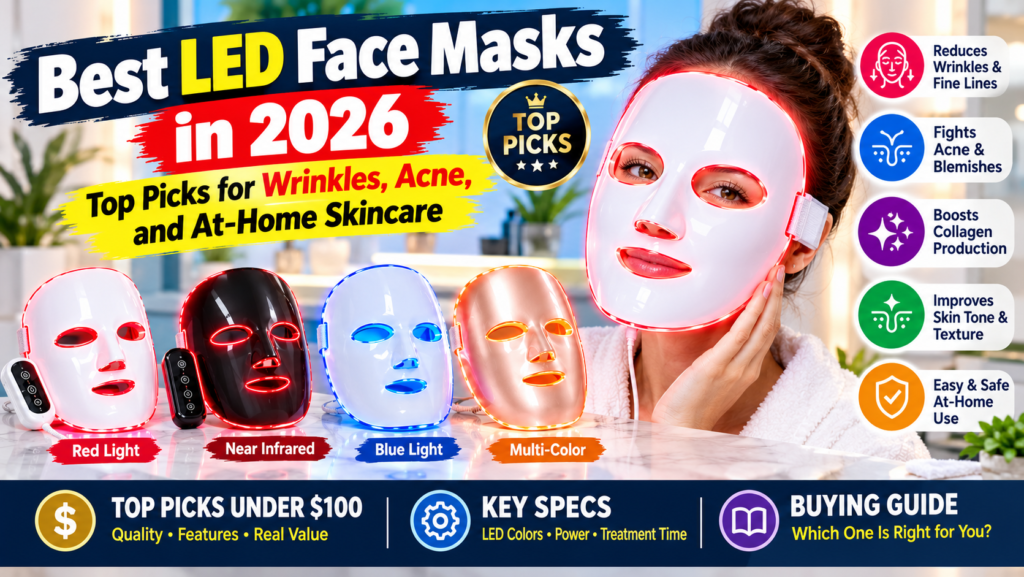
Compare the best LED face masks of 2026 for wrinkles, acne, and skin texture. Explore features, wavelengths, safety, and buying tips.
LifeCareBalance.com is reader-supported. When you buy through links on our site, we may earn an affiliate commission at no extra cost to you. As an Amazon Associate, we earn from qualifying purchases.
If you’ve scrolled through skincare content recently, you’ve probably seen someone wearing a glowing red mask while relaxing at home. LED face masks have become popular at-home skincare devices, offering a convenient way to explore light-based treatments without scheduling regular appointments at a dermatology office.
But the category can be confusing. Some masks focus on red and near-infrared light for visible signs of skin aging, while others combine red and blue light for people concerned about acne. Prices can range from under $100 to several hundred dollars, and advertised LED counts, treatment times, and claims are not always directly comparable.
So, which LED face mask is worth considering in 2026?
The answer depends on your skincare goals, budget, comfort preferences, and the quality of the information available about each device. This guide compares established options, explains what the research supports, and identifies the details worth checking before you buy.
Quick Answer: Which LED Face Mask Should You Choose?
- Best for multiple anti-aging wavelengths: CurrentBody Skin LED Mask Series 2. It combines red, near-infrared, and deep near-infrared light in a flexible silicone design.
- Best for a straightforward red-light routine: Omnilux Contour Face. It uses red and near-infrared wavelengths and has a clearly stated treatment schedule.
- Best for a short acne-and-aging routine: Dr. Dennis Gross DRx SpectraLite FaceWare Pro. It combines red and blue light in a hard-shell mask with a short treatment cycle.
- Best for budget-conscious shoppers: A carefully verified lower-cost mask with clear specifications, reliable return terms, and instructions that match your needs.
- Best buying strategy: Choose a device based on its intended use, verified specifications, fit, and safety instructions—not the number of LEDs or the strength of its marketing claims.
These are category-based recommendations, not the results of hands-on testing by LifeCareBalance. Product details should be confirmed against the manufacturer’s current information before purchasing.
What Is an LED Face Mask?
An LED face mask is a wearable skincare device containing light-emitting diodes that deliver specific wavelengths of light to the face during a timed session.
Most at-home models use one or more of these light types:
- Red light: Commonly used in devices designed to address the visible signs of skin aging, including fine lines and uneven texture.
- Near-infrared light: Often paired with red light in devices intended for skin rejuvenation.
- Blue light: Used in some acne-focused devices to target acne-related bacteria and inflammatory pimples.
This approach is commonly called photobiomodulation when referring to light-based effects on biological tissue. Different devices use different combinations of wavelengths, output levels, treatment times, and delivery designs.
LED masks are not the same as laser treatments or intense pulsed light (IPL). They also should not be assumed to deliver the same results as professional treatments simply because they use similar wavelengths.
The American Academy of Dermatology explains that at-home red-light devices may offer modest improvements for certain skin concerns, but the evidence and results vary. Read its overview of red light therapy for skin before deciding whether a device fits your skincare goals.
How LED Face Masks Work
The wavelengths emitted by an LED mask interact with skin tissue in different ways. Researchers are studying these effects, but a device’s advertised wavelength alone does not establish how well it works.
Red Light for Fine Lines and Skin Appearance
Red-light devices are commonly marketed for fine lines, wrinkles, texture, and skin tone. Some studies suggest that repeated treatments may improve certain visible signs of skin aging.
However, results depend on the particular device and treatment protocol. Evidence from a clinical study using one device cannot automatically be applied to every red-light mask on the market.
Near-Infrared Light
Near-infrared light is invisible to the human eye and is frequently combined with red light in anti-aging masks. Manufacturers may describe it as supporting skin firmness or rejuvenation.
When comparing products, look for the actual wavelength specifications and the evidence supporting the device’s intended use. The presence of near-infrared LEDs does not guarantee a better outcome.
Blue Light for Acne-Prone Skin
Blue light is used in some devices designed for acne. It may help reduce inflammatory pimples in certain circumstances, but it does not address every type of acne.
The American Academy of Dermatology notes that visible-light treatments are not effective for blackheads, whiteheads, acne cysts, or nodules. Anyone dealing with persistent, painful, or scarring acne should consider professional treatment rather than relying on a mask alone. See the AAD’s guidance on lasers and light treatments for acne.
Best LED Face Masks in 2026
The following comparison focuses on established models with identifiable product specifications. Prices are approximate US-market reference ranges, not guaranteed current offers. Confirm the exact model, included accessories, warranty, and current price before ordering.
| Product | Best For | Published Light Specifications | Treatment Routine | Main Consideration |
|---|---|---|---|---|
| CurrentBody Skin LED Mask Series 2 | Multi-wavelength anti-aging routine | 633nm red, 830nm near-infrared, 1072nm deep near-infrared; 236 LEDs | Follow current manufacturer instructions | Premium price and one main treatment preset |
| Omnilux Contour Face | Red and near-infrared skincare | 633nm red, 830nm near-infrared; 132 LEDs | 10 minutes, 3–5 times weekly for 4–6 weeks, according to the manufacturer | No blue-light acne mode |
| Dr. Dennis Gross DRx SpectraLite FaceWare Pro | Short red-and-blue-light routine | Red and blue light; confirm exact specifications for the current model | Manufacturer’s short timed treatment | Rigid design and limited treatment duration |
| Lower-cost LED masks | Budget-conscious shoppers | Varies by exact model | Follow the individual device instructions | Technical specifications and quality assurance may be harder to verify |
1. CurrentBody Skin LED Mask Series 2 — Best for Multiple Anti-Aging Wavelengths

- Enhanced collagen production capability significantly reduces fine lines, wrinkles and redness, for younger-looking skin…
- Upgraded light coverage provides our famous instant glow, for a healthier, brighter and smoother complexion.
- An all-new, exclusive layout of 236 LED bulbs emits three clinically recognised wavelengths: red (633nm), near-infrared …
Best for: Shoppers who want a flexible mask with three red and near-infrared wavelength options.
CurrentBody Skin LED Mask Series 2 is designed around a flexible silicone construction that sits across the face. The manufacturer’s published specifications list 236 LEDs, divided into 110 red LEDs at 633nm, 110 near-infrared LEDs at 830nm, and 16 deep near-infrared LEDs at 1072nm.
The device is designed for a consistent, timed home routine. Its multiple wavelengths may appeal to shoppers who want to explore a red-light approach to visible signs of aging without buying separate devices.
Potential advantages
- Three specified wavelengths in one mask.
- Flexible design intended to cover facial contours.
- Published technical specifications, including power density.
- A defined treatment protocol from the manufacturer.
Potential drawbacks
- A premium purchase compared with budget masks.
- It is primarily positioned around anti-aging rather than a dedicated blue-light acne treatment.
- More wavelengths do not automatically mean better results for every user.
Who should consider it?
This model is worth comparing if fine lines, skin texture, and visible signs of aging are your main concerns and the cost fits your budget.
Buying note: Confirm that the listing specifically identifies Series 2. Do not assume the original mask and Series 2 have identical specifications.
2. Omnilux Contour Face — Best for a Straightforward Red-Light Routine
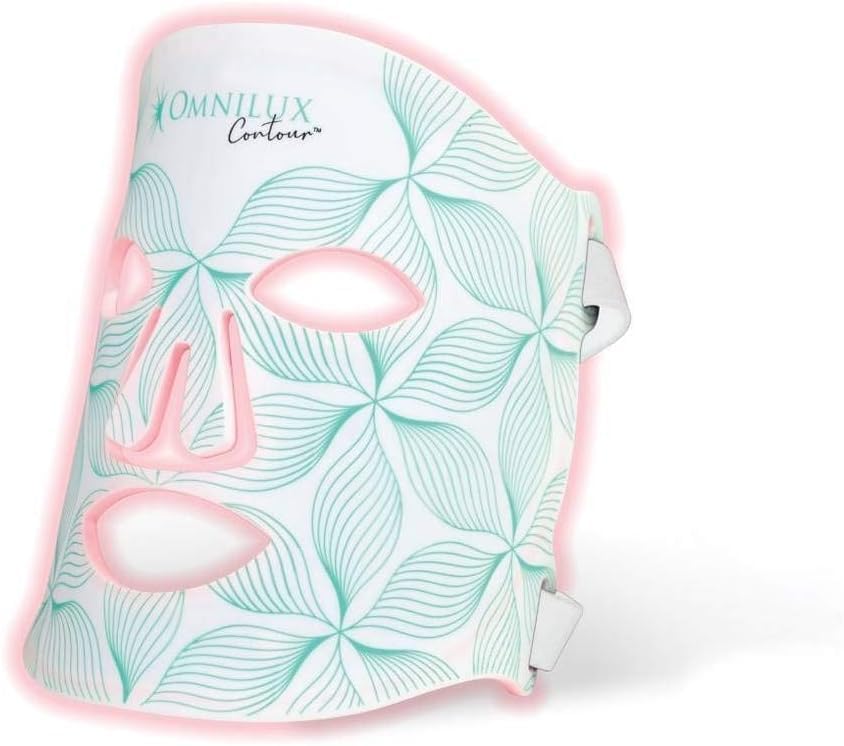
Best for: Buyers who want a focused red and near-infrared mask from an established light-therapy brand.
Omnilux Contour Face uses red light at 633nm and near-infrared light at 830nm. The manufacturer lists 132 LEDs arranged across 66 dual-chip bulbs and describes the device as an at-home option for the appearance of fine lines and wrinkles.
Omnilux recommends three to five 10-minute treatments per week for four to six weeks, followed by maintenance treatments as desired. Always follow the current instructions supplied with your specific device.
Potential advantages
- Clearly specified red and near-infrared wavelengths.
- A flexible design intended for facial use.
- A relatively simple treatment schedule.
- A focused option for shoppers who do not need blue-light functionality.
Potential drawbacks
- It does not provide a dedicated blue-light acne mode.
- Its premium price may be difficult to justify for someone who only wants to experiment with light therapy.
- The manufacturer does not provide every technical measurement that shoppers may want for a direct comparison, including a clearly stated irradiance figure on the product information reviewed.
Who should consider it?
Omnilux is worth evaluating if your priority is a simple red and near-infrared routine rather than a device with numerous colors or modes.
The brand describes Contour Face as FDA-cleared for the treatment of full-face wrinkles. FDA clearance applies to a specific device and intended use; it does not mean that dramatic results are guaranteed.
3. Dr. Dennis Gross DRx SpectraLite FaceWare Pro — Best for a Short Red-and-Blue Routine

- WHAT IT IS: This dermatologist-tested, FDA-cleared LED device stimulates collagen to reduce visible signs of aging inclu…
- HOW IT WORKS: Red LED light boosts collagen to smooth lip lines, smile lines, and puckering fine lines around the lips. …
- HOW TO USE: For use on clean dry skin. Insert mouthpiece and close mouth to hold in place. Tap On and Off button to powe…
Best for: Shoppers who want a short, timed session and both red- and blue-light modes.
The Dr. Dennis Gross DRx SpectraLite FaceWare Pro uses a rigid, hands-free shell rather than a flexible silicone mask. It combines red and blue light in a device designed for a short treatment cycle.
That combination may be appealing if you want to explore a device marketed for both signs of aging and acne-prone skin. Still, these are different goals, and the presence of two light modes does not mean that the device will treat every skin concern equally well.
Potential advantages
- Short, timed sessions according to the manufacturer.
- Red and blue light in one device.
- A hands-free design that does not require holding a wand against the face.
Potential drawbacks
- A rigid shell may not fit every face as comfortably as flexible silicone.
- It does not offer the same combination of near-infrared wavelengths as the CurrentBody Series 2 or Omnilux Contour Face.
- It is still a premium-priced device, so the additional convenience may not justify the cost for every shopper.
Who should consider it?
This model is worth comparing if short sessions and a red-and-blue-light approach are more important to you than flexible fit.
Before buying, verify the current model’s LED configuration, intended use, included eye-protection features, and treatment instructions. Avoid relying on specifications copied from an older listing or a different product version.
4. Lower-Cost LED Face Masks — Best for Budget-Conscious Shoppers
Best for: People who want to investigate light-based skincare without committing to a premium-priced device.
Budget LED masks vary considerably. Some advertise red, blue, near-infrared, and multiple color settings, but a long list of modes is not proof of better performance.
A lower price also does not automatically mean a mask is ineffective. The important question is whether the exact product has adequate, clearly described specifications and instructions for the intended use.
Before purchasing, check:
- Whether the seller states exact wavelengths rather than only saying “seven colors.”
- Whether the device has clear instructions for session duration and frequency.
- Whether eye-protection requirements are explained.
- Whether the manufacturer or seller provides a usable warranty and return policy.
- Whether the listing identifies the actual brand and model.
- Whether any FDA-clearance claim can be matched to that exact device and intended use.
A listing that does not disclose irradiance is harder to compare with one that does, but missing data alone does not prove the device is ineffective. Treat undisclosed specifications as uncertainty, not as evidence of either success or failure.
For a separate budget-focused comparison, see our guide to the best LED face masks under $100.
LED Face Mask Comparison: Which One Fits Your Needs?
The right choice becomes easier when you start with your main concern instead of a brand name.
| Your Main Priority | What to Look For | What to Keep in Mind |
|---|---|---|
| Fine lines and visible skin aging | Red light, with or without near-infrared | Improvements may be subtle and gradual |
| Acne-prone skin | A device specifically intended for acne that includes blue light, sometimes with red light | Light therapy does not treat every form of acne |
| Multiple anti-aging wavelengths | Clearly specified red and near-infrared wavelengths | More wavelengths do not guarantee superior outcomes |
| Short treatment sessions | A device with a clearly defined, manageable treatment cycle | Do not shorten sessions or increase frequency beyond the instructions |
| Lower initial cost | Transparent specifications and a usable return policy | A low price is not enough to establish value |
| Easy storage and a flexible fit | Flexible silicone construction and a secure strap | Fit and comfort vary from person to person |
For a broader comparison of mask types and product features, explore our LED face mask review and comparison guide.
What to Look for When Buying an LED Face Mask
1. Wavelengths
Wavelengths are expressed in nanometers (nm). A device designed for visible signs of aging may use red light around 630–660nm, while near-infrared devices often use wavelengths around 800–850nm.
Blue-light devices intended for acne commonly use wavelengths around 405–420nm.
These ranges are useful starting points, not a guarantee of results. The full device design and treatment protocol also matter.
2. Irradiance and Light Dose
Irradiance describes optical power reaching a given area, commonly expressed in milliwatts per square centimeter (mW/cm²). Light dose also depends on how long the exposure lasts.
A higher irradiance number does not automatically make one mask more effective than another. The measurement method, distance, coverage, wavelength, and treatment duration all affect interpretation.
If a brand publishes irradiance, check whether the measurement conditions are explained. If it does not, avoid inventing a value or assuming that a larger LED count compensates for the missing information.
3. LED Count
LED count can help describe a device, but it is not a stand-alone measure of quality.
Different manufacturers may count individual chips, bulbs, or multi-chip assemblies differently. Coverage, wavelength accuracy, optical output, and how the mask sits against the face can all affect the comparison.
Choose based on the complete specification set rather than the biggest number in an advertisement.
4. Fit and Comfort
A mask that feels uncomfortable is harder to use consistently. Flexible silicone models may adapt more closely to the face, while rigid masks can be easier to put on and remove quickly.
Look at strap placement, nose and chin coverage, weight, and the manufacturer’s fit guidance. If the device puts pressure around the eyes or does not sit securely, it may not be a good match for you.
5. Eye Protection
LED masks operate close to the eyes, so eye safety should not be treated as an optional extra.
Follow the device’s instructions about eye inserts, shields, or protective eyewear. Do not assume that closing your eyes is sufficient protection, and do not stare directly into operating LEDs.
6. Treatment Time and Frequency
Treatment protocols differ between products. One mask may use a short session, while another recommends a longer exposure several times per week.
Do not assume that a longer session is more effective or that a shorter session is always more convenient without trade-offs. Follow the specific model’s instructions rather than borrowing a schedule from another brand.
7. Warranty and Return Policy
A warranty can matter because LED masks contain electronics, straps, controllers, and sometimes rechargeable batteries.
Check the length of coverage, what components are included, whether shipping is covered, and whether returns are allowed after opening or testing the device. A clear policy is especially important when buying a more expensive mask.
8. Evidence and Regulatory Status
A product page may refer to clinical testing, FDA registration, FDA clearance, or other certifications. These terms are not interchangeable.
For US buyers, verify any FDA claim against the exact product and intended use. The FDA explains that registration alone is not the same as clearance or approval. See its guide to FDA registration, clearance, and approval claims.
Do LED Face Masks Actually Work?
The most accurate answer is that some devices may help with certain skin concerns, but results are not guaranteed and the strength of evidence differs by use.
A systematic review and meta-analysis published in JAMA Dermatology examined at-home LED devices for acne. The findings support further consideration of red and/or blue LED devices as a possible option for acne, while also highlighting the need to evaluate the quality and limitations of the available studies. Read the systematic review of at-home LED devices for acne.
For visible signs of skin aging, some studies report improvements in fine lines, skin texture, or tone. However, researchers use different devices, wavelengths, doses, and treatment schedules. Results from one study should not be presented as proof that every mask will deliver the same effect.
It is also important to separate three different kinds of information:
- Independent research: Studies published by researchers, ideally with suitable controls and transparent methods.
- Manufacturer-sponsored testing: May offer useful product-specific information, but should be identified as such.
- Customer reviews: Can help reveal practical issues such as fit, comfort, or durability, but cannot establish clinical effectiveness.
A realistic expectation is a possible, gradual improvement in selected visible concerns—not a guaranteed transformation, a cure for acne, or a replacement for established skincare treatments.
How Often Should You Use an LED Face Mask?
There is no single schedule that applies to every LED mask.
For example, Omnilux recommends three to five 10-minute treatments per week for four to six weeks for its Contour Face device. Other masks have different instructions, and some may use shorter treatment cycles.
Use the frequency and session duration supplied for your exact model. More frequent or longer exposure is not automatically better, and changing the schedule may increase irritation or other unwanted effects.
If you experience persistent redness, discomfort, or worsening skin symptoms, stop using the device and seek appropriate medical advice.
How Long Does It Take to See Results?
Some studies and manufacturers report visible changes after several weeks of consistent use. However, there is no reliable timeline that applies to every person, every concern, and every device.
The result depends on factors such as:
- The skin concern being addressed.
- The device’s design and intended use.
- The treatment schedule and consistency.
- Individual skin characteristics.
- Whether the concern needs a different or additional treatment.
Take care when reading claims that promise rapid wrinkle reduction or acne improvement within a fixed number of days. Ask whether the claim comes from an independent study, a manufacturer-sponsored trial, or anecdotal feedback.
Are LED Face Masks Safe?
At-home LED devices are generally considered low-risk when used according to their instructions, but that does not mean every device is suitable for every person.
Potential issues include temporary irritation, discomfort, and risks associated with inappropriate light exposure. Eye-protection requirements vary by device, so follow the supplied guidance.
Talk with a dermatologist or other qualified healthcare professional before using a mask if you have a condition that causes light sensitivity, take medication that may increase photosensitivity, or have a skin concern that has not been diagnosed. Ask for advice if you have a history of seizures triggered by flashing light or are unsure whether the device is suitable for you.
People who are pregnant, have a history of skin cancer, or have recently undergone a cosmetic procedure should not assume that every mask is either universally prohibited or automatically safe. Check the manufacturer’s contraindications and seek individualized medical advice when appropriate.
Do not use an LED mask as a substitute for diagnosis or treatment of persistent acne, suspicious skin lesions, severe redness, or other ongoing skin problems.
LED Face Mask vs. Red Light Therapy Panel
A face mask is designed to deliver light to the face in a wearable format. A red-light panel is a larger device that may be positioned at a specified distance from the face or body.
A mask can be convenient for a repeatable facial routine, while a panel may provide a larger treatment area. Neither format is automatically more effective: output, wavelength, distance, dose, and intended use matter.
If you want to treat only your face, a mask may be simpler to incorporate into your routine. If you want broader coverage, compare panel specifications and costs before choosing. Our guide to LED face masks vs. red light therapy panels explains the practical differences.
LED Face Mask vs. Microcurrent Mask
LED masks use light, while microcurrent devices deliver low-level electrical current. They are different technologies and should not be judged by the same specifications.
LED masks are commonly marketed for skin appearance, including fine lines and acne-prone skin, depending on the wavelengths used. Microcurrent devices are generally marketed for facial toning and the temporary appearance of definition.
If you’re choosing between these approaches, begin with your main goal and the evidence for the specific device. See our comparison of LED face masks vs. microcurrent masks for more detail.
Common LED Face Mask Buying Mistakes
Avoid these frequent mistakes when comparing products:
- Choosing by LED count alone. A high count does not establish output, coverage, or effectiveness.
- Assuming every color has proven benefits. A mask’s number of color modes is not evidence that all those modes produce meaningful results.
- Treating FDA registration as clearance. Verify the exact device and its intended use.
- Expecting immediate changes. Available evidence does not justify promising dramatic results after one session.
- Ignoring the instructions. Session duration and frequency differ between devices.
- Overlooking eye protection. Follow the manufacturer’s specific precautions.
- Confusing customer reviews with clinical evidence. Reviews may help assess usability but cannot prove treatment effectiveness.
- Buying an unverified product because it is inexpensive. Check the actual model, seller, warranty, return terms, and available specifications.
Who Should Consider an LED Face Mask?
An LED face mask may be worth considering if you want a non-invasive addition to an existing skincare routine, understand that results may be modest, and are prepared to use the device according to its instructions over time.
It may be a poor fit if you expect immediate or guaranteed results, need treatment for severe acne, want to address deep scars, or cannot verify that a particular device is appropriate for your needs.
If your main concern is acne, compare products specifically designed and authorized for the relevant acne-related use. Our best LED face masks for acne guide focuses on that narrower buying decision.
Frequently Asked Questions
Do LED face masks really work?
Some devices may improve the appearance of selected concerns, such as fine lines or inflammatory acne, but the results vary. Research findings from one device should not be assumed to apply to every mask.
Which LED face mask is best for wrinkles?
CurrentBody Skin LED Mask Series 2 and Omnilux Contour Face are two options to compare for a red and near-infrared routine. Consider verified specifications, comfort, cost, and the evidence available for the exact model.
Which LED face mask is best for acne?
Look for a device specifically intended for acne that provides blue light, sometimes combined with red light. Light therapy is not suitable for every acne type and should not replace professional care when acne is persistent, painful, or scarring.
Are expensive LED masks better than budget masks?
Not necessarily. Premium models may provide clearer specifications, better documentation, and stronger warranty terms, but price alone does not prove effectiveness. Budget masks should be evaluated using the same criteria.
Can I use an LED face mask every day?
Only if the instructions for your exact model recommend daily use. Many devices prescribe a specific number of sessions per week. Do not increase frequency or session length on your own.
Do LED face masks help with acne scars?
Evidence for treating active inflammatory acne is not the same as evidence for treating established scars. Indented scars and persistent pigmentation may require different treatments. A dermatologist can help determine which options are appropriate.
Is FDA-cleared the same as FDA-approved?
No. These terms refer to different regulatory pathways. Registration or listing alone does not establish that a device has been cleared or approved. Verify the exact product and its intended use in official FDA information.
Can LED masks replace a skincare routine?
No. An LED mask should be considered a possible supplement to appropriate skincare, not a replacement for sun protection, cleansing, moisturizing, or treatments recommended by a healthcare professional.
Final Verdict: Which LED Face Mask Is Worth Buying?
There is no single best LED face mask for everyone. The most suitable choice depends on the skin concern you want to address, the device’s documented specifications, comfort, safety instructions, and your budget.
- For multiple anti-aging wavelengths: Consider the CurrentBody Skin LED Mask Series 2 if its premium price and treatment approach suit your needs.
- For a focused red and near-infrared routine: Compare the Omnilux Contour Face and verify its current warranty and treatment guidance.
- For a short red-and-blue-light routine: Evaluate the Dr. Dennis Gross DRx SpectraLite FaceWare Pro, especially if you prefer a rigid hands-free design.
- For a budget purchase: Choose a model with transparent specifications, a clear return policy, and realistic claims rather than buying on price or LED count alone.
- For acne or another specific skin condition: Make sure the device is intended for that use, and seek professional advice when symptoms are persistent or severe.
The most useful purchase is not necessarily the most expensive mask or the one with the most advertised features. It is the device whose specifications and intended use you can verify, whose instructions you can follow comfortably, and whose limitations you understand before spending your money.