
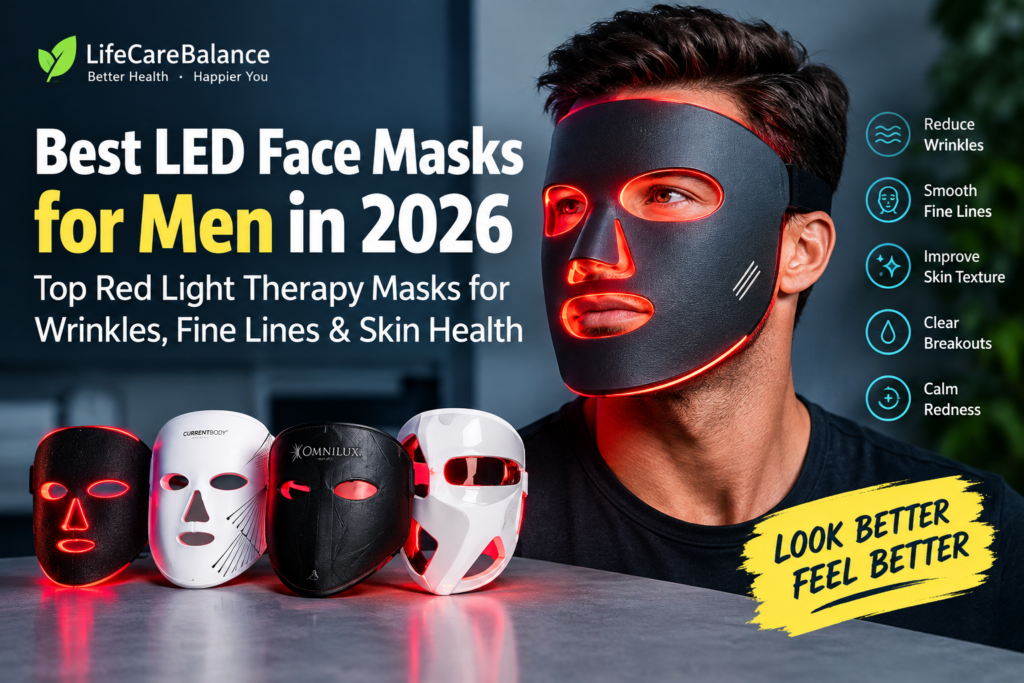
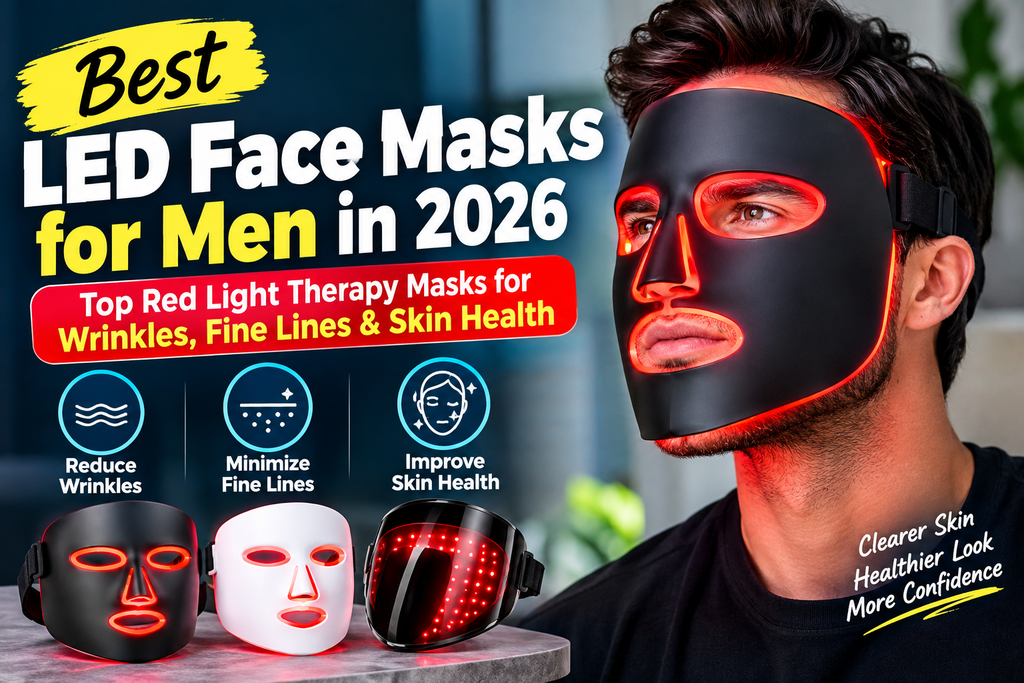
Discover the best LED face masks for men in 2026 — compare wavelengths, irradiance, and FDA status for wrinkles, fine lines, acne, and shaving irritation.
LifeCareBalance.com is reader-supported. When you buy through links on our site, we may earn an affiliate commission at no extra cost to you. As an Amazon Associate, we earn from qualifying purchases.
LifeCareBalance.com is reader-supported. When you buy through links on our site, we may earn an affiliate commission at no extra cost to you. As an Amazon Associate, we earn from qualifying purchases.
More men are adding one simple device to their skincare routine instead of a five-step regimen: an LED face mask. The appeal is obvious. You cleanse your face, strap on a mask, wait out a short timer, and go about your morning. No serums to layer, no schedule to memorize, and no trip to a dermatologist’s office.
The best LED face masks for men use red and near-infrared light — the same general category of light therapy dermatologists have studied for decades — to support the skin’s natural processes. Men often come to this category with specific concerns: fine lines and wrinkles that showed up faster than expected, razor burn and post-shave redness, uneven tone from years of sun exposure, or occasional breakouts along the jawline. An LED mask won’t fix all of that overnight, and it isn’t a substitute for sunscreen or a dermatologist visit, but it can be a genuinely low-effort addition to a routine that otherwise doesn’t have one.
This guide walks through the best LED face masks for men in 2026, how red light therapy actually works, what separates a well-engineered mask from a gimmick, and how to match a device to your specific skin goals. We’ll cover verified wavelengths, LED counts, treatment times, and FDA status for every mask on this list — and we’ll say so plainly whenever a manufacturer hasn’t published a spec.
Quick Answer — Best LED Face Masks for Men in 2026
| Product | Best For | Wavelengths | Treatment Time | Price Range | Key Advantage |
|---|---|---|---|---|---|
| Omnilux Men | Best overall for men | 633nm red, 830nm & 1072nm NIR | 10 min | ~$395 | Only mask engineered specifically for men’s thicker skin |
| CurrentBody Skin LED Mask Series 2 | Best for wrinkles & fine lines | 633nm red, 830nm & 1072nm NIR | 10 min | ~$470 | 236 LEDs and the highest published irradiance in this lineup |
| Therabody TheraFace Mask | Best premium | 415nm blue, 633nm red, 830nm NIR | 3–9 min | ~$599 | 648 LEDs plus facial vibration therapy |
| Solawave Wrinkle Retreat Pro | Best for short sessions | 605nm amber, 630nm red, 660nm deep red, 830nm NIR | 3 min | ~$399 | Four wavelengths and the highest published irradiance (65 mW/cm²) |
| HigherDOSE Red Light Face Mask | Best flexible fit | 630nm red, 830nm NIR | 10 or 20 min | ~$349 | Medical-grade silicone that contours closely to the face |
| Shark CryoGlow | Best for acne & beginners | 630nm red, 630nm blue, 830nm NIR | 4–8 min | ~$350–$360 | Built-in under-eye cooling and the shortest acne-mode sessions |
| iRESTORE Illumina | Best budget option | 635nm red, 830nm NIR, 415nm blue | 10 min | ~$349–$399 | Highest LED count (360) at the lowest price among triple-wavelength masks |
| Dr. Dennis Gross DRx SpectraLite FaceWare Pro | Best for acne + anti-aging split | 415nm blue, 630nm red | 3 min | ~$395–$455 | Dedicated eye zone and cheek/chin zones with different wavelengths |
| The Light Salon Boost | Best minimalist option | 633nm red, 830nm NIR | 10 min | ~$495 | Simple two-wavelength design based on professional salon devices |
Prices fluctuate with sales and bundles, so treat these as general ranges rather than fixed figures.
Our Top Picks at a Glance
- Best Overall: Omnilux Men — the only mask on this list engineered around men’s skin thickness, with FDA clearance and a men’s-specific near-infrared wavelength.
- Best Men’s-Specific LED Mask: Omnilux Men, again — no other major brand has built a mask around men’s dermal depth.
- Best for Wrinkles & Fine Lines: CurrentBody Skin LED Mask Series 2 — three wavelengths and the largest LED count among flexible-silicone masks.
- Best for Acne: Shark CryoGlow — a dedicated Skin Clearing mode combining blue and near-infrared light in a short session.
- Best Premium: Therabody TheraFace Mask — the highest LED count on this list plus facial vibration therapy.
- Best Flexible Fit: HigherDOSE Red Light Face Mask — medical-grade silicone that molds closely to facial contours.
- Best for Beginners: iRESTORE Illumina — simple three-wavelength design at a lower price point than most premium competitors.
- Best Budget Option: iRESTORE Illumina, again — the most LEDs per dollar of any triple-wavelength mask here.
- Best for Short Treatment Sessions: Solawave Wrinkle Retreat Pro or Dr. Dennis Gross DRx SpectraLite FaceWare Pro — both complete a full treatment in 3 minutes.
What Is an LED Face Mask and How Does Red Light Therapy Work?
LED face masks use light-emitting diodes to deliver specific wavelengths of light to the skin, a process broadly known as photobiomodulation. Unlike UV light, which damages skin, the red and near-infrared wavelengths used in these devices don’t carry the same risk profile — but that also means they work through a very different, and much gentler, mechanism.
Red light (typically 630–660nm) penetrates the outer layers of skin and is the most-studied wavelength for skin health applications. Near-infrared light (typically 810–850nm, with a few masks reaching further to 1072nm) penetrates deeper into the dermis, the layer where collagen is produced. Blue light (often around 415nm) is used specifically in acne-focused masks and devices, where it’s believed to interact with acne-causing bacteria on the skin’s surface.
Research suggests these wavelengths may support cellular energy production and encourage the skin’s own repair processes, though the exact mechanisms are still being refined in ongoing studies. The American Academy of Dermatology and other dermatology bodies note that light therapy shows promise for several skin concerns, while also cautioning that most consumer devices haven’t been tested to the same rigor as in-office equipment. You can browse relevant photobiomodulation research directly on PubMed.
Wavelength matters because different depths of skin respond to different light. But wavelength alone doesn’t tell the whole story — irradiance (how much light energy actually reaches the skin, measured in mW/cm²) and treatment dose (irradiance multiplied by exposure time) both influence how much of an effect a session may realistically deliver. A mask with an excellent wavelength but very low irradiance may under-deliver compared to a well-calibrated device with a shorter treatment time.
Do LED Face Masks Work for Men?
The honest answer: research suggests LED and red light therapy may help with several cosmetic skin concerns, but results vary from person to person and are rarely dramatic or instant.
For fine lines and wrinkles, red and near-infrared light have some of the more consistent evidence behind them, largely tied to their potential to support collagen activity in the dermis. For skin texture and tone, some users report smoother, more even-looking skin after weeks of consistent use, though controlled evidence specifically for texture and pigmentation is less extensive than for wrinkles. For redness, including the kind associated with shaving, red light’s anti-inflammatory reputation is one of the more commonly cited (if still evolving) areas of research. For acne and breakouts, blue light combined with red or near-infrared light is a fairly well-established combination in dermatology, though it works best on mild-to-moderate acne rather than cystic or severe cases.
It’s important to separate cosmetic benefit from medical treatment. LED face masks marketed for home use are generally cleared by the FDA for specific cosmetic indications — most often “temporary reduction in the appearance of fine lines and wrinkles” — not for treating underlying skin disease. If you have a diagnosed skin condition, persistent or severe acne, or take photosensitizing medication, that’s a conversation for a dermatologist, not a review article. The Mayo Clinic and Cleveland Clinic’s phototherapy overview are both useful starting points for understanding how light-based therapies are used in broader medical contexts.
Consistency matters more than any single session. Every manufacturer in this guide recommends 3–5 sessions per week for at least 4–8 weeks before expecting to see a difference, and results plateau rather than continuing to improve indefinitely.
Why Men May Want an LED Face Mask
LED masks aren’t inherently gendered devices — the underlying light therapy works the same way regardless of who’s wearing the mask. But there are a few reasons this category has specifically caught on with men:
- Shaving irritation and razor bumps. Daily or near-daily shaving is a habit most women’s skincare routines don’t have to account for, and the resulting micro-inflammation, ingrown hairs, and redness are common complaints among men who shave regularly.
- Thicker facial skin. On average, men’s facial skin is measurably thicker than women’s, which is part of the reasoning behind Omnilux Men’s deeper-penetrating 1072nm wavelength — though how much practical difference this makes for any individual varies.
- Minimal-maintenance routines. Many men are looking for a skincare tool that doesn’t require learning a multi-step process. A hands-free mask that runs its full session while you check email fits that preference well.
- Fine lines showing up “out of nowhere.” Men who haven’t used sunscreen consistently for years sometimes notice sun-related fine lines and uneven tone appear more suddenly in their late 30s and 40s.
- Acne that didn’t stop after adolescence. Adult acne along the jawline and neck — sometimes aggravated by shaving — is common enough that several masks on this list explicitly include blue light options.
None of this means every man’s skin behaves the same way, and there’s no single “male skin type.” These are simply common patterns that make LED therapy a practical fit for a lot of men’s routines.
Detailed Reviews of the Best LED Face Masks for Men
Omnilux Men
- Best for: Men specifically, thicker skin, shaving-related redness
- Price at time of writing: ~$395
- Wavelengths: 633nm red, 830nm and 1072nm near-infrared
- LED count: 132 medical-grade LEDs (66 dual-LED bulbs)
- Irradiance: Not publicly specified by the manufacturer
- Treatment time: 10 minutes
- Recommended frequency: 3–5 sessions per week for 4–6 weeks, then maintenance
- FDA status: FDA-cleared
- Fit/design: Flexible silicone, hands-free, adjustable Velcro straps
- Hands-free: Yes
- Pros: Only mask on the market explicitly engineered around men’s thicker dermal layer; includes the deep 1072nm near-infrared wavelength; backed by Omnilux’s broader clinical research library
- Cons: No blue light option for acne; premium price for a two-wavelength-family device; final sale, no returns per the manufacturer
- Who should buy it: Men prioritizing wrinkles, firmness, and shaving irritation who want a mask marketed and calibrated specifically for men’s skin
- Who should skip it: Anyone whose primary concern is active acne
CurrentBody Skin LED Light Therapy Mask: Series 2

- Targeted full face, neck and chest anti-ageing treatment
- Reduces wrinkles by 30% after 8 weeks
- Upgraded best-fit coverage for optimal results
- Best for: Wrinkles, fine lines, maximum coverage
- Price at time of writing: ~$470
- Wavelengths: 633nm red, 830nm near-infrared, 1072nm deep near-infrared
- LED count: 236 LEDs
- Irradiance: Approximately 30 mW/cm², per independent testing
- Treatment time: 10 minutes
- Recommended frequency: 3–5 sessions per week
- FDA status: FDA-cleared (510(k) clearance on record)
- Fit/design: Extended flexible silicone with full nose and chin flaps
- Hands-free: Corded to a handheld battery pack, not fully wireless
- Pros: Highest LED count of the flexible-silicone masks in this guide; three wavelengths including the less-common 1072nm; strong face coverage including the chin and jaw
- Cons: Highest price point outside the premium hard-shell masks; requires a connected battery pack rather than being fully cordless
- Who should buy it: Men who want the most complete coverage and wavelength variety in a wearable, flexible mask
- Who should skip it: Buyers who want a fully cordless, walk-around-the-house experience
Therabody TheraFace Mask

- DEPUFFING WAND: Perfect for morning routines, before a big event, or after a long flight or drive, this clinically prove…
- SKIN RADIANCE HEAT TREATMENT: Encourage lymphatic drainage, skincare product absorption, boost circulation, and brighten…
- DEPUFFING COLD TREATMENT: Cools in seconds to instantly reduce puffiness and tired-looking eyes and minimize the appeara…
- Best for: Buyers who want the most LEDs and added vibration therapy
- Price at time of writing: ~$599
- Wavelengths: 415nm blue, 633nm red, 830nm red + infrared
- LED count: 648 medical-grade LEDs
- Irradiance: Not publicly specified by the manufacturer
- Treatment time: 3–9 minutes (9-minute pre-programmed treatment used in the brand’s clinical study)
- Recommended frequency: Once daily
- FDA status: FDA-cleared, Class II device
- Fit/design: Rigid polycarbonate shell, fully cordless, includes 17 vibration motors for facial massage
- Hands-free: Yes
- Pros: Highest LED count of any mask in this guide; combines light therapy with vibration massage around the eyes, browline, and scalp; long battery life
- Cons: The most expensive mask on this list; hard-shell design is bulkier to store than flexible silicone masks
- Who should buy it: Men who want the highest-spec device available and appreciate the added massage feature
- Who should skip it: Budget-conscious buyers, or anyone who prefers a soft, flexible fit over a rigid shell
Solawave Wrinkle Retreat Pro
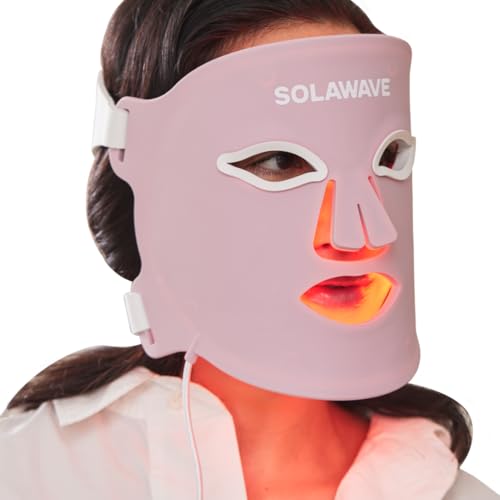
- 4 WAVELENGTHS. ZERO BLIND SPOTS: Red (630nm) softens fine lines. Deep Red (660nm) targets elasticity. Amber (605nm) revi…
- FASTER THAN BREWING YOUR MORNING COFFEE: 3 minutes. Hands-free. Automatic shut-off. While most LED masks demand 10-20 mi…
- 320 LEDS. BUILT FOR EFFICIENCY: One charge powers up to 20 full sessions – most competitor masks max out at six. Digital…
- Best for: Short sessions, tone and firmness together
- Price at time of writing: ~$399 (frequently discounted)
- Wavelengths: 605nm amber, 630nm red, 660nm deep red, 830nm near-infrared
- LED count: 320 LEDs
- Irradiance: 65 mW/cm² total, per the manufacturer
- Treatment time: 3 minutes
- Recommended frequency: 3–5 sessions per week
- FDA status: FDA-cleared, Class II device (510(k) K252983)
- Fit/design: Flexible medical-grade silicone
- Hands-free: Yes, cordless
- Pros: Four simultaneous wavelengths in a single 3-minute session; highest published irradiance figure among the masks in this guide; strong LED count for the price
- Cons: Newer to market than some competitors, so it has a shorter public track record; no dedicated blue-light acne mode
- Who should buy it: Men who want a fast daily routine and value tone/firmness alongside wrinkle reduction
- Who should skip it: Buyers specifically seeking acne-focused blue light therapy
HigherDOSE Red Light Face Mask

- Red Light Therapy for Face & Skin Rejuvenation – This FDA cleared, FSA eligible red light therapy mask uses red (630nm) …
- Facial Light Therapy, Anywhere – Lightweight and wireless, this LED face mask with red light therapy delivers targeted w…
- Red Light Mask That Works Deep – Red and near-infrared light reach deep layers to improve tone, reduce puffiness, and vi…
- Best for: Comfortable, contoured fit
- Price at time of writing: ~$349
- Wavelengths: 630nm red, 830nm near-infrared
- LED count: 66 dual-core LEDs (132 total diodes)
- Irradiance: 50 mW/cm² total (26 mW/cm² red, 24 mW/cm² NIR), per the manufacturer
- Treatment time: 10 or 20 minutes
- Recommended frequency: 3–5 sessions per week
- FDA status: FDA-cleared
- Fit/design: Medical-grade flexible silicone with a secure three-strap system
- Hands-free: Yes, cordless controller
- Pros: One of the more comfortable fits among the masks tested by outside reviewers; two treatment-length options; published irradiance figures
- Cons: Coverage gaps have been noted around the chin, jawline, and temples by some reviewers; fewer LEDs than several competitors at a similar price
- Who should buy it: Men who prioritize comfort and fit over maximum LED count or wavelength variety
- Who should skip it: Anyone who wants full jawline and chin coverage as a priority, given shaving-related concerns
Shark CryoGlow
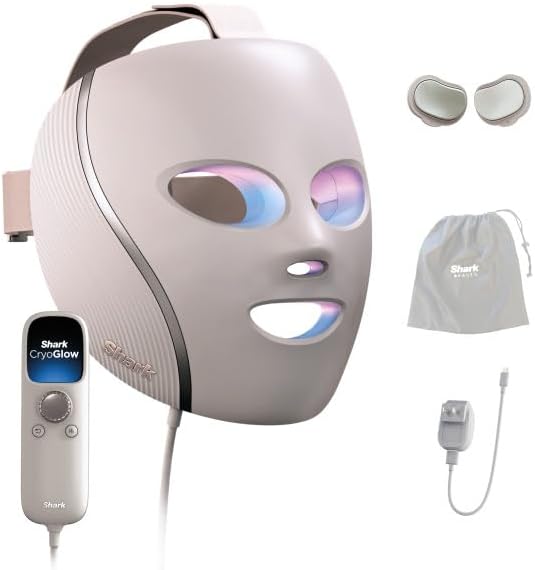
- RED LIGHT THERAPY MASK: CryoGlow is an at-home LED face mask combining red, blue & deep infrared light with under-eye co…
- MOST AWARDED LED MASK IN THE U.S.*: Real people. Real results. Clinically tested on 119 participants by an independent t…
- EXPERTLY DEVELOPED: Developed by Shark Beauty alongside optical light experts and engineers, bringing MedSpa-inspired re…
- Best for: Acne, redness, and beginners
- Price at time of writing: ~$350–$360
- Wavelengths: 630nm red, 630nm blue, 830nm infrared (brand-published figures)
- LED count: 160 tri-wick LEDs (480 individual light sources)
- Irradiance: Not publicly specified by the manufacturer
- Treatment time: 4–8 minutes depending on mode
- Recommended frequency: Once daily for LED modes
- FDA status: FDA-cleared
- Fit/design: Rigid shell with built-in under-eye cooling pads
- Hands-free: Yes
- Pros: Dedicated Skin Clearing mode combining blue, red, and infrared light for acne in an 8-minute session; integrated cooling for under-eye puffiness; shortest daily-maintenance mode (4 minutes) in this lineup
- Cons: Lower price than premium competitors comes with a less flexible, harder-shell fit; multiple short modes may be less convenient than a single one-and-done treatment
- Who should buy it: Men newer to LED therapy who want an easy multi-mode device that also addresses acne and under-eye puffiness
- Who should skip it: Buyers who strongly prefer a soft, contoured silicone fit
iRESTORE Illumina

- Proven and Trusted: With over 20 years of research and trusted by 500,000+ happy users, our chest and neck LED light the…
- Experience the power of targeted LED light therapy with two modes: Red (635nm) and Near-Infrared (830nm). Each mode uses…
- Achieve visible skin improvements in just 10-minute sessions, 3-5 times per week. Our chest and neck red light therapy d…
- Best for: Budget-conscious buyers who still want three wavelengths
- Price at time of writing: ~$349–$399
- Wavelengths: 635nm red, 830nm near-infrared, 415nm blue
- LED count: 360 medical-grade LEDs
- Irradiance: Approximately 10 mW/cm², per independent testing — lower than several premium competitors
- Treatment time: 10 minutes
- Recommended frequency: 3–5 sessions per week
- FDA status: Manufactured in an FDA-registered, GMP-certified facility; not consistently marketed with explicit FDA clearance language, so confirm current certification directly with the manufacturer before purchase
- Fit/design: Breathable, semi-rigid mask designed to fit multiple face shapes
- Hands-free: Yes, cordless
- Pros: Highest LED count of any mask in this guide; combines red, near-infrared, and blue light in a single session; lower price than most triple-wavelength competitors
- Cons: Independently measured irradiance is notably lower than CurrentBody or HigherDOSE, which may mean a lower delivered dose per session despite the high LED count
- Who should buy it: Men who want to try multi-wavelength LED therapy — including acne-focused blue light — without paying premium prices
- Who should skip it: Buyers who prioritize maximum measured light output over LED count or price
Dr. Dennis Gross DRx SpectraLite FaceWare Pro
- WHAT IT IS: Your complete routine for visibly transformed, firmer, more radiant skin.
- WHAT’S IN IT FOR YOU: A powerhouse trio designed to resurface, replenish, and restore glow. Featuring our extra strength…
- HOW TO USE IT: First cleanse then apply our Extra Strength Daily Peel to reveal a radiant, firmer, clearer complexion in…
- Best for: Splitting acne and anti-aging treatment by zone
- Price at time of writing: ~$395–$455 (frequently discounted)
- Wavelengths: 415nm blue (eye zone/cheeks depending on mode), 630nm red
- LED count: Approximately 100 LEDs
- Irradiance: Not consistently published by the manufacturer; third-party estimates vary, so treat any specific figure with caution
- Treatment time: 3 minutes, automatic shutoff
- Recommended frequency: Daily
- FDA status: FDA-cleared
- Fit/design: Rigid polycarbonate shell shaped to the face, more like a visor than a flexible mask
- Hands-free: Yes
- Pros: One of the shortest, most established treatment times in the category; well-regarded blue light zone for acne; long track record and strong brand reputation among dermatologists
- Cons: Hard-shell fit is less forgiving for larger or smaller head sizes than flexible silicone; lower LED count than most competitors
- Who should buy it: Men who want a fast daily habit and a mask with a long public track record
- Who should skip it: Anyone who specifically wants near-infrared wavelengths, which this device does not include
Omnilux Men vs CurrentBody Series 2
Both are strong choices for men focused on wrinkles and fine lines, but they take different approaches to design and pricing.
| Feature | Omnilux Men | CurrentBody Series 2 |
|---|---|---|
| Wavelengths | 633nm red, 830nm & 1072nm NIR | 633nm red, 830nm & 1072nm NIR |
| LED count | 132 | 236 |
| Treatment time | 10 minutes | 10 minutes |
| Fit | Flexible silicone, fully cordless | Flexible silicone, corded battery pack |
| Men’s-specific design | Yes — marketed and calibrated for men’s skin | No — unisex design |
| FDA status | FDA-cleared | FDA-cleared |
| Price | ~$395 | ~$470 |
| Best for | Men who want a device built specifically for male skin | Buyers prioritizing LED density and coverage over price |
Verdict: If being marketed and engineered specifically for men matters to you — and you’d rather spend less for a fully cordless experience — Omnilux Men is the more straightforward choice. If you’re comparison-shopping purely on specs and want the highest LED count and coverage available in a flexible mask, CurrentBody Series 2 is worth the roughly $75 premium, even though it isn’t marketed toward men specifically. Both share the same three core wavelengths, so the difference mostly comes down to LED density, coverage, cordless convenience, and price.
If you want a broader look at how these and other masks stack up, our best red light therapy face masks roundup covers the wider unisex market.
What Wavelengths Should Men Look for in an LED Face Mask?
There isn’t one universally “best” wavelength — the right combination depends on your specific goals.
630–660nm red light is the most consistently studied range for skin-related benefits and appears in essentially every mask on this list. It’s generally associated with surface-level concerns: tone, texture, and the appearance of fine lines.
810–850nm near-infrared light penetrates deeper into the dermis, where collagen-producing cells are located. Several masks in this guide, including CurrentBody Series 2 and Omnilux Men, add a third wavelength around 1072nm, which manufacturers claim penetrates even further — though independent evidence specifically isolating 1072nm’s added benefit over 830nm alone remains limited.
Around 415nm blue light is used in acne-focused masks like the iRESTORE Illumina, Shark CryoGlow, and Dr. Dennis Gross FaceWare Pro. It’s a well-established wavelength in dermatology for addressing acne-related bacteria on the skin’s surface, though it isn’t relevant if your primary concern is wrinkles rather than breakouts.
Rather than chasing a single “best” number, think about which wavelength category maps to your primary concern, and check whether a device you’re considering actually includes it — some masks skip near-infrared entirely, and others skip blue light.
Is Irradiance More Important Than LED Count?
LED count gets a lot of marketing attention because it’s an easy number to put in bold text. But irradiance — how much light energy is actually reaching your skin, measured in mW/cm² — arguably matters more.
A mask can have hundreds of LEDs and still deliver relatively low irradiance if each individual diode is weak, or if the measurement distance used by the manufacturer doesn’t reflect how the mask actually sits on your face. Manufacturer irradiance figures are also typically measured at a specific distance from the LED, which may not always match the true gap between the diode and your skin once the mask is worn — so these numbers are useful for comparison but not perfectly precise.
Treatment dose is really the product of irradiance and time: a mask with lower irradiance but a longer session (like HigherDOSE’s 20-minute option) can deliver a comparable total dose to a mask with higher irradiance and a shorter session (like Solawave’s 3-minute treatment). Neither approach is universally “correct” — it depends on how the whole system was engineered and tested.
The practical takeaway: don’t choose a mask on LED count alone. Look for irradiance figures when a manufacturer publishes them, and if they don’t, don’t assume the device is weaker — just note that you can’t directly compare it on that basis.
LED Face Mask vs Red Light Therapy Panel for Men
Face masks and red light therapy panels use similar underlying technology but serve different use cases. A mask is a targeted, hands-free tool built specifically for the face — you put it on, go about a short task, and take it off. A panel treats a much larger area of the body at once — face, chest, or full torso — but requires you to sit or stand in front of it for the session rather than moving around freely.
Masks tend to cost more per square inch of coverage but are far more convenient for a quick daily facial routine. Panels are typically better value if you also want to treat broader areas like the chest, back, or joints, and some men who lift weights or deal with muscle soreness find a panel does double duty. Space is also a factor: a mask stores in a drawer, while a panel needs wall or floor space.
For a deeper breakdown, see our full comparison of LED face mask vs red light therapy panel. If you’re leaning toward a panel instead of or alongside a mask, our reviews of the Hooga HG300 and the Mito Red MitoPRO 300 cover two of the more popular budget and mid-range panel options.
LED Face Mask vs Microcurrent Mask
These two categories are frequently confused because they’re both worn on the face, but they work through entirely different mechanisms. LED/red light therapy uses light wavelengths to interact with skin cells, primarily targeting collagen support, inflammation, and (in blue-light devices) acne bacteria. Microcurrent devices use very low-level electrical stimulation aimed at facial muscles, marketed mainly for a temporary toning or “lifting” effect rather than the cellular-level processes associated with light therapy.
They aren’t interchangeable, and one doesn’t produce the same category of effect as the other — some skincare routines use both, but for different stated purposes. If you’re deciding between the two, our detailed LED face mask vs microcurrent mask comparison walks through the distinction in more depth.
How to Choose the Best LED Face Mask for Men
- Wavelengths — Confirm the mask includes red light at minimum, and near-infrared or blue light if those match your specific goals.
- Irradiance — Look for a published mW/cm² figure where available; treat unpublished specs as an unknown, not a red flag by itself.
- Treatment time — Shorter sessions (3 minutes) fit tighter schedules; longer sessions (10–20 minutes) may suit a more relaxed routine.
- Coverage and fit — Flexible silicone masks generally contour better to different face shapes than rigid shells.
- Eye protection — Confirm the mask includes built-in eye shields or requires separate protective goggles.
- FDA clearance/status — Look specifically for “FDA-cleared,” and confirm what it’s cleared for.
- Comfort — Consider whether you can tolerate wearing the device for the full session, especially with facial hair.
- Hands-free design — Fully cordless masks offer more freedom of movement than corded, battery-pack designs.
- Battery/controller — Check charging time, battery life, and whether the controller is separate from the mask.
- Warranty — Warranties in this category commonly range from one to two years; confirm the specific terms before buying.
- Return policy — Some premium masks (including some Omnilux models) are sold as final sale; check before purchasing.
- Price/value — Weigh LED count, wavelengths, and irradiance together rather than any single spec in isolation.
- Manufacturer transparency — Brands that publish full spec sheets, including irradiance and FDA clearance numbers, are generally easier to evaluate and trust.
For a broader look at the category beyond this men’s-focused list, see our full best LED face masks of 2026 guide and our detailed LED face mask review breakdowns.
Common Mistakes Men Make When Buying LED Face Masks
- Buying based only on LED count. A high number looks impressive but doesn’t tell you the irradiance or dose delivered per session.
- Assuming “more powerful” always means better. Very high irradiance isn’t necessarily safer or more effective if a manufacturer hasn’t published data supporting a given treatment protocol.
- Ignoring wavelengths entirely. A mask without near-infrared light won’t address deeper-layer concerns the same way one with it might.
- Ignoring irradiance. LED count without power output is an incomplete picture.
- Buying solely because of influencer popularity. Social media visibility doesn’t confirm clinical backing or manufacturing quality.
- Confusing “FDA registered” with “FDA cleared.” Registration simply means a facility is on file with the FDA; clearance means the specific device has gone through an FDA review process for a stated use. Registered facilities and cleared devices are not the same thing — check the FDA’s medical device resources if you want to verify a specific clearance.
- Expecting overnight results. Most manufacturers recommend 4–8 weeks of consistent use before evaluating results.
- Overusing the device. More sessions per day than recommended isn’t shown to speed up results and may increase the chance of irritation.
- Ignoring eye-safety instructions. Direct LED exposure to the eyes should be avoided; use built-in shields or provided goggles every session.
- Choosing a poor fit. A mask that doesn’t sit close and evenly against your face delivers less consistent light exposure, regardless of its specs on paper.
How Often Should Men Use an LED Face Mask?
Treatment frequency depends entirely on the specific device’s instructions — there’s no single universal schedule that applies to every mask. Most manufacturers in this guide recommend 3 to 5 sessions per week, with individual sessions ranging from 3 minutes (Solawave, Dr. Dennis Gross) to 20 minutes (HigherDOSE’s longer setting).
What matters more than any specific number is consistency over several weeks. Skipping days here and there generally matters less than abandoning the routine after a week or two. If a manufacturer recommends daily use (like Shark CryoGlow or Therabody TheraFace Mask), following that specific guidance rather than assuming a universal 3x-per-week rule applies is the safer approach.
LED Face Mask Safety for Men
LED face masks are generally considered low-risk for healthy adults when used according to instructions, but a few precautions are worth taking seriously:
- Eye protection. Always use the built-in shields or included goggles. Direct, repeated LED exposure to unprotected eyes isn’t something manufacturers test for or recommend.
- Follow manufacturer instructions. Treatment time, frequency, and distance guidance vary by device — don’t assume settings from one mask apply to another.
- Photosensitizing medications. Certain prescriptions (some acne medications, antibiotics, and others) can increase skin sensitivity to light. Check with a pharmacist or doctor if you’re on any such medication before starting LED therapy.
- Skin conditions. Active rashes, open wounds, certain skin cancers, or photosensitive disorders are reasons to consult a dermatologist before use, not reasons to self-diagnose based on an article.
- Recent procedures. If you’ve recently had a chemical peel, laser treatment, or similar in-office procedure, ask your provider whether LED therapy is appropriate during recovery.
- When to speak with a professional. Persistent acne, unexplained skin changes, or any condition that isn’t improving with consistent home use is a reason to see a dermatologist rather than continue troubleshooting on your own.
This section is general educational information, not medical advice. For guidance specific to your skin and health history, talk to a licensed dermatologist or physician.
Best LED Face Masks for Men by Skin Goal
| Skin Goal | Best Type of Mask | What to Look For |
|---|---|---|
| Wrinkles | Red + NIR | Evidence/spec transparency |
| Fine lines | Red + NIR | Consistent treatment |
| Acne | Red + blue where appropriate | Acne-focused design |
| Redness | Red/NIR | Gentle fit |
| Skin texture | Red + NIR | Even coverage |
| Shaving irritation | Red/NIR | Comfortable fit |
| General skin health | Red + NIR | Easy routine |
No mask can promise a specific outcome for a specific goal — this table reflects general wavelength categories associated with each concern, not guaranteed results.
Frequently Asked Questions
What is the best LED face mask for men in 2026? Omnilux Men stands out as the only mask specifically engineered and marketed for men’s thicker skin, making it our top overall pick. CurrentBody Series 2 is the stronger choice if you want maximum LED density and coverage regardless of men’s-specific marketing.
Are LED face masks good for men’s skin? They can be a useful addition to a routine, particularly for fine lines, shaving-related redness, and mild acne. Results vary, and an LED mask works best alongside — not instead of — sunscreen and basic skincare habits.
Does red light therapy help men’s wrinkles? Research suggests red and near-infrared light may support collagen activity and reduce the appearance of fine lines with consistent use over several weeks, though individual results vary and claims of dramatic reversal aren’t supported by current evidence.
Can men use women’s LED face masks? Yes. Aside from Omnilux Men, every mask in this guide is a unisex device. There’s no technical reason a man can’t use a mask marketed toward a general or female audience — the underlying wavelengths work the same way.
Is Omnilux Men better than CurrentBody Series 2? “Better” depends on your priorities. Omnilux Men is less expensive, fully cordless, and marketed specifically for men. CurrentBody Series 2 has more LEDs and broader coverage but costs more and uses a corded battery pack.
Can LED masks help with shaving irritation? Red light’s anti-inflammatory associations make it a plausible option for calming shaving-related redness, and several brands (including Omnilux Men) specifically market this use case. It’s not a guaranteed fix, and switching razors or improving shaving technique may matter just as much.
How often should men use an LED face mask? Most manufacturers recommend 3–5 sessions per week for several weeks, though this varies by device — always follow the specific manufacturer’s guidance rather than a generic schedule.
What wavelength is best for red light therapy on the face? There isn’t one single “best” wavelength for everyone. Red light around 630–660nm is well-studied for general skin health, near-infrared around 810–850nm reaches deeper layers, and blue light around 415nm is specific to acne.
Are LED face masks safe? Generally, yes, for healthy adults following manufacturer instructions, including eye protection. People with photosensitive conditions, certain medications, or specific skin conditions should consult a doctor first.
Are LED face masks FDA approved? Most reputable LED face masks are FDA-cleared, not FDA-approved — these are different regulatory pathways. Clearance means the device has been reviewed and found substantially equivalent to an existing legally marketed device for a specific use; it isn’t the same as full FDA approval, which applies to a different category of products. Always verify a specific device’s clearance status directly with the manufacturer or the FDA.
Conclusion
There’s no single “best” LED face mask for every man — the right choice depends on your specific skin goal, how much time you want to spend per session, your budget, and how much you value a fit calibrated specifically for men’s skin. If shaving irritation, fine lines, and men’s-specific engineering matter most, Omnilux Men is the clearest fit. If you want maximum LED coverage and don’t mind paying more or dealing with a battery pack, CurrentBody Series 2 is worth the premium. If acne is your main concern, Shark CryoGlow or the Dr. Dennis Gross DRx SpectraLite FaceWare Pro both offer dedicated blue-light options. And if budget is the deciding factor, iRESTORE Illumina delivers three wavelengths at one of the lower price points in this category.https://lifecarebalance.com/
Whichever mask you consider, compare actual published specifications — wavelengths, LED count, irradiance where available, and FDA status — rather than relying on marketing claims or influencer hype alone. A best LED face mask for men, in the end, is simply the one whose specs, fit, and routine actually match your skin and your schedule;https://lifecarebalance.com/