
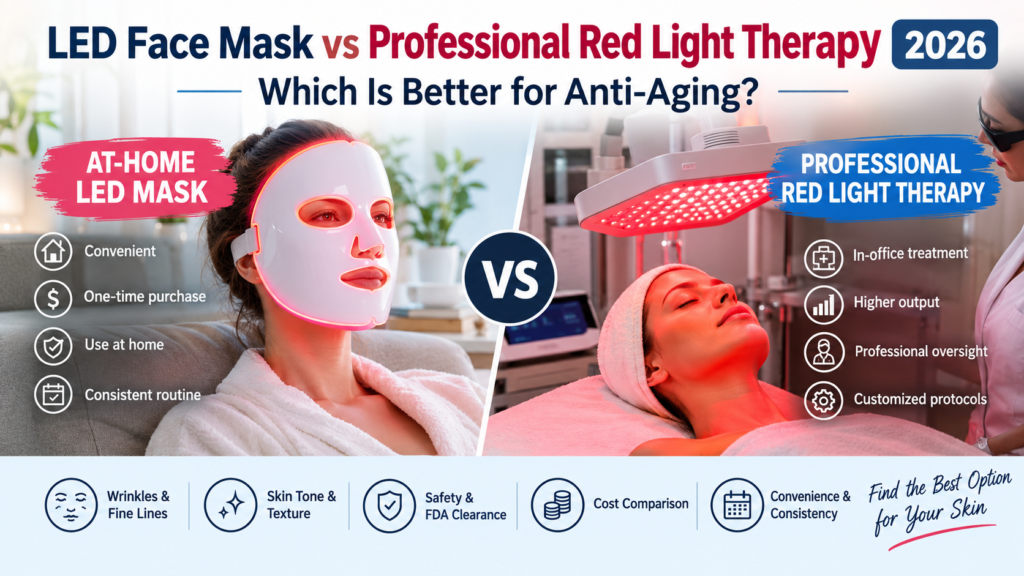
LED face mask vs professional red light therapy: compare power, cost, evidence and convenience to see which anti-aging option fits you best.
LifeCareBalance.com is reader-supported. When you buy through links on our site, we may earn an affiliate commission at no extra cost to you. As an Amazon Associate, we earn from qualifying purchases.
Can an LED face mask at home actually deliver results similar to professional red light therapy? It’s one of the most common questions people ask before spending money on anti-aging skincare, and it’s a fair one. A quality LED face mask and an in-office red light treatment both rely on the same basic idea — using red and near-infrared light to support skin health — but they aren’t the same experience, and they don’t always deliver the same results.

- RED LIGHT THERAPY MASK: CryoGlow is an at-home LED face mask combining red, blue & deep infrared light with under-eye co…
- MOST AWARDED LED MASK IN THE U.S.*: Real people. Real results. Clinically tested on 119 participants by an independent t…
- EXPERTLY DEVELOPED: Developed by Shark Beauty alongside optical light experts and engineers, bringing MedSpa-inspired re…

- HOOGA HG Series Entry-Level Red & Near-Infrared LED Panel: The HG Series is Hooga’s entry-level LED panel line designed …
- High-Output LED Technology for Home Use: Advances in LED efficiency have made high-output red and near-infrared light pa…
- Dual-Wavelength LED Configuration: The HG300 uses two LED wavelengths—660nm (red) and 850nm (near-infrared)—in a balance…
Professional treatment may use more powerful systems, larger treatment areas, and protocols tailored by a trained provider. At-home masks trade some of that power for convenience, privacy, and the ability to use them consistently, week after week, without booking an appointment. Neither option is automatically “better” for every person. This guide breaks down the real differences — power, wavelength, dose, cost, evidence, and convenience — so you can decide which approach fits your skin goals and lifestyle.
LED Face Mask vs Professional Red Light Therapy: Quick Answer
If you want the short version: at-home LED masks are more convenient, more affordable over time, and easier to use consistently, while professional red light therapy may offer higher output and the benefit of provider oversight.
A few things matter more than the “at-home vs professional” label alone:
- Convenience favors at-home masks. No appointments, no travel, and you can use them while doing other things at home.
- Output and customization may favor professional treatment. Clinical or med-spa devices can sometimes deliver higher irradiance and protocols adjusted to your skin.
- “Better” depends on the details. Wavelength, irradiance, dose, treatment protocol, and — most importantly — how consistently you actually use the treatment all influence outcomes.
- Consistency is often the deciding factor. A well-designed at-home mask used several times a week for months may provide more real-world benefit than occasional professional sessions squeezed into a busy schedule.
For most people focused on ongoing skincare maintenance rather than a specific medical concern, an at-home LED mask can be a practical starting point. For those who want a more controlled, professionally guided treatment plan, in-office red light therapy is worth considering.
What Is Professional Red Light Therapy?
Professional (or in-office) red light therapy is administered in a dermatology practice, medical spa, or aesthetic clinic, typically by a trained provider. Rather than a single wearable mask, professional setups often use larger panels, beds, or multi-panel systems designed to treat bigger areas of the body or face with more standardized output.
Dermatology sources note that clinic-based devices tend to offer providers more flexibility to fine-tune light dosing for a patient’s specific skin concern than a fixed, one-size-fits-all consumer device typically allows. In other words, a provider can potentially adjust treatment parameters more precisely than a consumer would with a fixed at-home device.
Professional red light therapy is also sometimes folded into a broader skincare or aesthetic plan — paired with other in-office treatments, product recommendations, or ongoing dermatologic care. It’s worth noting that professional treatment isn’t inherently more effective for every cosmetic goal; it simply offers a different combination of oversight, equipment, and customization than a home device.
How Do At-Home LED Face Masks Work?
At-home LED face masks use light-emitting diodes built into a wearable shell to deliver red and near-infrared light across the face. The underlying mechanism is called photobiomodulation: light at certain wavelengths is absorbed by mitochondria in skin cells, which may help support cellular energy production and, over time, processes tied to collagen and tissue repair.
A few technical terms are worth understanding before comparing devices:
- Wavelength (nm): The color/type of light. Red light is commonly in the 630–660 nm range; near-infrared is typically 810–850 nm.
- Irradiance (mW/cm²): How much light power reaches the skin at a given moment.
- Dose (J/cm²): The total light energy delivered over a treatment session — irradiance multiplied by time.
- Consistency: How regularly the device is actually used over weeks and months.
It’s a common misconception that more LEDs, or a higher LED count on the marketing page, automatically means better results. What matters more is the actual wavelength accuracy, the irradiance delivered at skin level, and the total dose per session — not simply how many diodes are packed into the mask.
LED Face Mask vs Professional Red Light Therapy — Key Differences
| Factor | At-Home LED Face Mask | Professional Red Light Therapy |
|---|---|---|
| Treatment setting | Home | Dermatology office, med-spa, or clinic |
| Device type | Wearable mask | Panel, bed, or multi-panel clinical system |
| Power/output | Moderate, consumer-grade | Often higher, clinic-grade |
| Wavelength | Typically fixed red/NIR combo (e.g., ~630–660 nm, ~810–850 nm) | May offer broader or adjustable wavelength options |
| Irradiance | Fixed by manufacturer | Can potentially be calibrated by provider |
| Dose | Fixed per session length | May be adjusted to the condition being treated |
| Treatment time | Often 10–20 minutes | Varies by clinic protocol |
| Treatment frequency | Several times per week, self-directed | Scheduled visits, provider-directed |
| Facial coverage | Full face at once (mask design) | Depends on panel size and positioning |
| Professional supervision | None | Yes |
| Convenience | High — no appointment needed | Lower — requires travel and scheduling |
| Portability | Yes | No |
| Upfront cost | One-time device purchase | Per-session cost, often recurring |
| Long-term value | Potentially strong if used consistently | Can add up significantly with repeat visits |
| Consistency | Easier for most people to maintain | Depends on ability to attend regular appointments |
| Customization | Limited to device settings | Higher, provider-adjusted |
| Safety considerations | Follow manufacturer eye and usage guidance | Provider-supervised, may reduce user error |
| Best use case | Ongoing maintenance, general skincare routine | Targeted treatment as part of a broader clinical plan |
Which Is More Powerful?
“Professional” doesn’t automatically mean “better” for cosmetic outcomes, even though clinic-based systems can often deliver higher irradiance. A few factors explain why power alone doesn’t tell the whole story:
- Treatment distance matters. A high-output panel positioned farther from the skin may deliver similar effective irradiance to a lower-output mask worn directly against the face.
- Energy density (dose) is what the tissue actually receives, and this depends on both irradiance and exposure time — not raw power alone.
- Coverage and fit matter. A well-fitted mask that maintains consistent, close contact with the skin can deliver a more even dose across the face than a panel session where positioning varies.
- Protocol design counts. How a treatment is structured — session length, frequency, and total sessions — shapes outcomes as much as the hardware itself.
- Consistency often outweighs raw power. A moderate-output device used regularly over months may contribute more cumulative benefit than a higher-output treatment used only occasionally.
None of this means professional treatment has no advantage — higher-output clinical systems can shorten treatment time or allow more targeted dosing. It simply means that comparing devices by wattage or “strength” alone is misleading.
Can an LED Face Mask Deliver Professional-Like Anti-Aging Results?
This is the core question most people are really asking, and the honest answer is nuanced. Some clinical studies do support measurable improvements in fine lines, wrinkles, and skin texture using LED and photobiomodulation devices, including designs similar to consumer masks. That said, results vary meaningfully depending on the specific device, wavelength, irradiance, dose, treatment duration, and how the study was designed.
At-home masks should not be presented as interchangeable with professional treatment — the equipment, oversight, and customization are genuinely different. However, a well-designed mask with transparent, evidence-informed specifications may offer meaningful cosmetic benefits for many users when used consistently over time. The gap between “at-home” and “professional” is less about whether a mask can work, and more about degree, customization, and the level of oversight involved.
It’s also worth being clear about what “results” realistically means here: gradual, cosmetic improvements in the appearance of fine lines and skin texture — not a reversal of the aging process, and not a substitute for medical treatment when one is needed.
What Does the Research Say About LED Masks for Wrinkles?
A handful of peer-reviewed clinical trials have specifically examined LED mask–style devices for facial wrinkles, and they offer a useful — if limited — evidence base.
One multi-center, randomized, double-blind, sham-controlled trial tested a home-use combination device pairing 630 nm LED light with 850 nm infrared LED light on participants with crow’s feet. The study concluded that LED and IRED phototherapies at 630 nm and 850 nm were effective, safe, well-tolerated, and painless for skin rejuvenation, based on comparison against a sham (inactive) device.
A separate randomized clinical trial looked at 660 nm red photobiomodulation for periocular wrinkles. Researchers found a significant reduction in wrinkle volume after red light treatment, with the treatment producing a roughly 30% wrinkle volume reduction. Notably, the same study reported that skin hydration and viscoelasticity did not significantly improve — a useful reminder that wrinkle-volume improvement and other skin metrics don’t always move together.
A third trial examined 660 nm LED mask-based photobiomodulation for facial rejuvenation, comparing different treatment frequencies to understand how often sessions should be repeated for a cosmetic benefit.
Taken together, this research is genuinely encouraging for red and near-infrared light as a cosmetic tool, but it comes with real limitations. Sample sizes in these trials were relatively small, follow-up periods were often measured in weeks rather than years, and study participants and devices varied. These findings shouldn’t be assumed to apply identically to every commercial LED mask on the market — device design, wavelength accuracy, and dose all affect whether a given product performs similarly to what was tested in a clinical setting.
Professional Red Light Therapy vs At-Home LED Mask: Cost Comparison
Cost is often the deciding factor for many shoppers, and the two options follow very different cost structures.
| Cost Factor | At-Home LED Mask | Professional Red Light Therapy |
|---|---|---|
| Upfront cost | One-time device purchase | Little to no upfront cost |
| Per-use cost | Effectively $0 after purchase | Charged per session |
| Long-term cost | Fixed, one-time investment | Accumulates with repeat visits |
| Travel/time cost | None | Time off, travel, appointment scheduling |
| Maintenance | Minimal (cleaning, occasional replacement) | None (provider maintains equipment) |
Exact clinic pricing varies widely by provider, region, and treatment length, so we won’t quote specific per-session rates here — check with a local dermatology office or med-spa for current pricing. As a general pattern, though, a one-time mask purchase can become more cost-effective over months of consistent use, while professional treatment tends to add up the more sessions are required to maintain results.
If you’re comparing specific at-home mask options, our <a href=”https://lifecarebalance.com/best-led-face-masks-2026/”>Best LED Face Masks 2026</a> guide breaks down current picks by price and specification.
Which Is Better for Fine Lines and Wrinkles?
Both approaches have research support for fine lines and wrinkles, and neither guarantees dramatic or permanent wrinkle removal. Professional treatment may offer a stronger, more controlled dose delivered under supervision, which can be appealing for people who want a provider managing the process. At-home masks, on the other hand, tend to be easier to use consistently — and consistency has repeatedly shown up as an important factor in the clinical research on photobiomodulation for skin aging.
Results from either option are typically gradual, appearing over weeks to months rather than after a single session, and outcomes vary based on skin type, the specific device or system used, and how closely someone follows a treatment routine.
Which Is Better for Skin Tone and Texture?
Beyond fine lines, people often ask about red light therapy for overall texture, tone, and redness. Realistic expectations here matter:
- Texture: Some users report smoother-feeling skin with consistent use, though improvements are typically subtle rather than dramatic.
- Redness: Red and near-infrared light has been studied for its potential to calm the appearance of redness, though results vary by individual.
- Uneven-looking tone: Some improvement in the appearance of skin tone has been reported anecdotally and in limited studies, but red light therapy should not be presented as a fix for permanent pigmentation concerns, which often require different, targeted treatments.
Whether using an at-home mask or professional therapy, texture and tone improvements tend to build gradually with consistent use rather than appearing quickly.
Which Is More Convenient?
This is where at-home masks have a clear structural advantage. Consider the practical differences:
- Appointments and travel: Professional treatment requires scheduling, travel time, and working around clinic hours. At-home masks require none of this.
- Setup and treatment time: A mask can be put on in seconds; clinic visits involve check-in, setup, and travel time on top of the treatment itself.
- Hands-free use: Many masks allow you to do other things — read, work, watch something — while treating your skin.
- Routine consistency: It’s simply easier to stick to a routine you can do at home on your own schedule.
- Privacy: Some people prefer treating their skin at home rather than in a clinical setting.
- Portability: A mask can travel with you; clinic-based treatment can’t.
A treatment someone actually uses consistently will often outperform, in real-world terms, a theoretically stronger treatment that gets skipped due to scheduling friction. This is one of the most overlooked points in the at-home-vs-professional debate.
Wavelength, Irradiance and Dose: What Actually Matters?
When comparing devices — whether at-home masks or professional systems — three specifications matter more than marketing claims about LED count or “power”:
- Wavelength (nm) determines what type of light is being delivered and how deeply it penetrates skin tissue. Commonly researched ranges for cosmetic skin applications fall around 630–660 nm (red) and 810–850 nm (near-infrared), though exact therapeutic parameters continue to be studied and vary by use case.
- Irradiance (mW/cm²) describes the intensity of light reaching the skin’s surface at a given moment.
- Dose (J/cm²) is the total energy delivered during a session, calculated from irradiance and treatment time together.
Rather than choosing a device based on the highest wattage or the largest number of LEDs advertised, look for manufacturers who publish clear, verifiable specifications for wavelength, irradiance, and recommended dose. Transparent specs are a better signal of a thoughtfully engineered device than sheer LED count.
For a deeper breakdown of these specs across different device types, see our <a href=”https://lifecarebalance.com/red-light-therapy-buying-guide-2026/”>Red Light Therapy Buying Guide</a>.
Safety and FDA Clearance
Red light and LED-based devices are generally considered safe for short-term use. Most at-home devices contain LEDs, which are considered safe for home use, according to the American Academy of Dermatology. At the same time, the AAD notes that although red-light devices are considered safe, the long-term effects on skin and hair are not yet known, and more research is needed.
It’s important to understand the difference between FDA clearance and FDA approval, since these terms are often used incorrectly in marketing. Many at-home LED devices go through the FDA’s 510(k) clearance pathway, which means the agency has determined the device is substantially equivalent to an already-legally-marketed device — not that the FDA has independently “approved” it as effective for a specific medical claim in the way a drug would be approved. You can review individual device clearances directly through the FDA’s 510(k) database.
A few practical safety notes:
- Always follow the manufacturer’s eye-protection guidance — some masks include built-in eye shielding, while others recommend separate goggles.
- Follow the recommended session length and frequency rather than exceeding it in hopes of faster results.
- People with photosensitivity, certain skin conditions, or those taking photosensitizing medications should talk with a healthcare provider before starting light therapy, whether at home or professionally administered.
- Darker skin tones may be more sensitive to visible light exposure, so following manufacturer guidance and starting conservatively is reasonable.
This article is educational and not a substitute for personalized medical advice. If you have a diagnosed skin condition or are unsure whether red light therapy is appropriate for you, consult a board-certified dermatologist.
Who Should Choose an At-Home LED Face Mask?
An at-home mask tends to be a good fit for people who:
- Want convenience and the ability to fit skincare into an existing routine
- Prefer treating their skin from home rather than visiting a clinic
- Want a repeatable, sustainable long-term routine
- Are primarily focused on facial skin rather than a broader body treatment
- Would rather make a one-time device purchase than pay per session
- Have limited time for recurring appointments
Who May Prefer Professional Red Light Therapy?
Professional treatment may be worth considering for people who:
- Want the oversight of a trained provider throughout treatment
- Are looking for a stronger or more individually customized treatment protocol
- Are already visiting a dermatologist or aesthetic clinic for other reasons
- Want red light therapy folded into a broader, professionally managed skincare or treatment plan
To be clear, professional therapy isn’t necessary for ordinary, general cosmetic skincare maintenance — it’s simply a different tier of service for people who want more oversight or customization.
At-Home LED Mask Pros and Cons
Pros:
- Convenient, no appointments required
- One-time cost rather than recurring fees
- Easy to use consistently over the long term
- Private, usable at home
- Portable
Cons:
- Generally lower output than clinical systems
- Fixed specifications with no professional customization
- No provider oversight
- Results depend heavily on user consistency
Professional Red Light Therapy Pros and Cons
Pros:
- Potentially higher output and more customizable dosing
- Provider oversight and guidance
- Can be integrated into a broader skincare or clinical plan
Cons:
- Requires scheduling and travel
- Ongoing per-session cost
- Harder to maintain a consistent long-term routine
- Less private than at-home use
How to Choose an LED Mask for Anti-Aging
If you decide an at-home mask is the right fit, use this checklist when comparing options:
- Wavelength — Look for red and/or near-infrared light in commonly researched ranges (roughly 630–660 nm and 810–850 nm).
- Irradiance — Check whether the manufacturer publishes mW/cm² specifications.
- Dose — Confirm the total J/cm² delivered per session, if available.
- Treatment time — Understand the recommended session length.
- Treatment frequency — Look for guidance on how many sessions per week are recommended.
- Facial coverage — Consider how evenly the mask covers the face and whether it fits your face shape.
- Fit — A mask that sits close to the skin will generally deliver a more consistent dose.
- Eye safety — Confirm built-in eye protection or separate goggle recommendations.
- FDA clearance when relevant — Check the device’s regulatory status if marketed for a specific skin concern.
- Warranty — Look for a reasonable manufacturer warranty period.
- Return policy — A trial period can help you evaluate fit and comfort before committing.
- Transparent manufacturer specifications — Favor brands that publish real wavelength, irradiance, and dose data over vague marketing claims.
For side-by-side comparisons of specific masks against these criteria, see our <a href=”https://lifecarebalance.com/led-face-mask-review-comparison-2026/”>LED Face Mask Review 2026</a>.
LED Face Mask vs Red Light Therapy Panel
It’s worth noting that this article focuses specifically on at-home masks versus professional, in-office treatment. If you’re instead trying to decide between a wearable LED face mask and a stand-alone red light therapy panel for home use, we cover that comparison in detail in our dedicated guide: <a href=”https://lifecarebalance.com/led-face-mask-vs-red-light-therapy-panel/”>LED Face Mask vs Red Light Therapy Panel</a>. If budget is a factor for a panel purchase, our <a href=”https://lifecarebalance.com/budget-red-light-therapy-panels-2026/”>Best Budget Red Light Therapy Panels Under $500</a> roundup and our <a href=”https://lifecarebalance.com/hooga-hg300-review-2026-budget-red-light-therapy-panel/”>Hooga HG300 Review 2026</a> are good starting points.
And if you’re also weighing LED against a different at-home technology entirely, our <a href=”https://lifecarebalance.com/led-face-mask-vs-microcurrent-mask/”>LED Face Mask vs Microcurrent Mask</a> comparison covers that distinction.
Related LifeCareBalance Guides
- <a href=”https://lifecarebalance.com/best-led-face-masks-2026/”>Best LED Face Masks 2026</a>
- <a href=”https://lifecarebalance.com/led-face-mask-review-comparison-2026/”>LED Face Mask Review 2026</a>
- <a href=”https://lifecarebalance.com/led-face-mask-vs-red-light-therapy-panel/”>LED Face Mask vs Red Light Therapy Panel</a>
- <a href=”https://lifecarebalance.com/red-light-therapy-buying-guide-2026/”>Red Light Therapy Buying Guide</a>
- <a href=”https://lifecarebalance.com/budget-red-light-therapy-panels-2026/”>Best Budget Red Light Therapy Panels Under $500</a>
- <a href=”https://lifecarebalance.com/hooga-hg300-review-2026-budget-red-light-therapy-panel/”>Hooga HG300 Review 2026</a>
- <a href=”https://lifecarebalance.com/led-face-mask-vs-microcurrent-mask/”>LED Face Mask vs Microcurrent Mask</a>
Frequently Asked Questions
Is professional red light therapy better than an LED face mask? Not universally. Professional treatment may offer higher output and provider customization, while at-home masks offer convenience and consistency. The better option depends on your goals, budget, and how important supervision is to you.
Can an LED face mask work as well as professional red light therapy? A well-designed mask used consistently may deliver meaningful cosmetic benefits, and some clinical research supports LED mask–style devices for wrinkle improvement. However, results vary by device, and at-home masks generally shouldn’t be assumed to match every capability of a clinical system.
Are professional red light therapy treatments more powerful? Often, yes — clinic-based systems can deliver higher irradiance and more customizable dosing. However, power alone doesn’t determine cosmetic outcomes; treatment distance, dose, protocol, and consistency all play a role.
How often should you use an LED face mask for wrinkles? This varies by device and manufacturer guidance, but many clinical studies on LED mask-style devices used sessions several times per week over a period of weeks to months. Always follow the specific product’s recommended frequency.
Do LED masks really reduce fine lines? Some peer-reviewed studies have found measurable reductions in wrinkle volume and periocular wrinkles using LED and photobiomodulation devices. Results are generally gradual and vary based on the device, wavelength, dose, and consistency of use — not guaranteed for every user or every product.
Is professional red light therapy worth the extra cost? It depends on your priorities. If you want a customized protocol with provider oversight, the added cost may be worthwhile. If your main goal is ongoing maintenance and convenience matters more, an at-home mask may offer better long-term value.
What wavelength is best for anti-aging LED masks? Commonly researched ranges for cosmetic skin applications include roughly 630–660 nm (red light) and 810–850 nm (near-infrared), though exact optimal parameters can vary by device and are still being studied.
Is FDA clearance important for an LED face mask? FDA clearance (not the same as “FDA approval”) indicates a device has been reviewed for substantial equivalence to legally marketed devices. It’s a reasonable factor to check, though it doesn’t guarantee a specific cosmetic result.
How long does it take to see red light therapy results? Most clinical studies on LED masks and red light therapy for wrinkles show measurable changes over several weeks of consistent use rather than after a single session — results build gradually rather than appearing immediately.
Final Verdict
Neither an at-home LED face mask nor professional red light therapy is universally “better” — they serve different needs. For people who want maximum professional control, higher potential output, and a treatment plan customized by a provider, professional red light therapy has real advantages. For those who prioritize convenience, privacy, portability, and the ability to stick with a treatment consistently over months, a quality at-home LED face mask can be a practical and evidence-aware choice for ongoing anti-aging skincare.
Whichever route you choose, keep expectations realistic: improvements tend to be gradual and cosmetic, they vary from person to person, and consistency matters as much as the equipment itself. This article is intended for general educational purposes and is not a substitute for personalized advice from a board-certified dermatologist, especially if you have an underlying skin condition or are taking photosensitizing medication.;https://lifecarebalance.com/
Sources:
- American Academy of Dermatology — Red Light Therapy Safety
- PubMed — Home-used LED and IRED mask for crow’s feet: randomized, sham-controlled study
- PubMed — Photobiomodulation reduces periocular wrinkle volume: randomized controlled trial
- PubMed — 660 nm LED mask photobiomodulation for facial rejuvenation
- FDA 510(k) Premarket Notification Database — K261496