
LifeCareBalance.com is reader-supported. When you buy through links on our site, we may earn an affiliate commission at no extra cost to you. As an Amazon Associate, we earn from qualifying purchases.
Choosing an LED face mask in 2026 can be confusing. At-home devices now offer red light, near-infrared light, blue light, multiple treatment modes, flexible silicone designs, and rigid wearable shells. Prices range from relatively affordable options to premium devices costing several hundred dollars.
The challenge is knowing which specifications actually matter. One brand may promote its LED count, another may highlight irradiance, and another may focus on additional wavelengths or shorter treatment sessions. These figures describe different aspects of a device, so they should not be treated as interchangeable measures of performance.
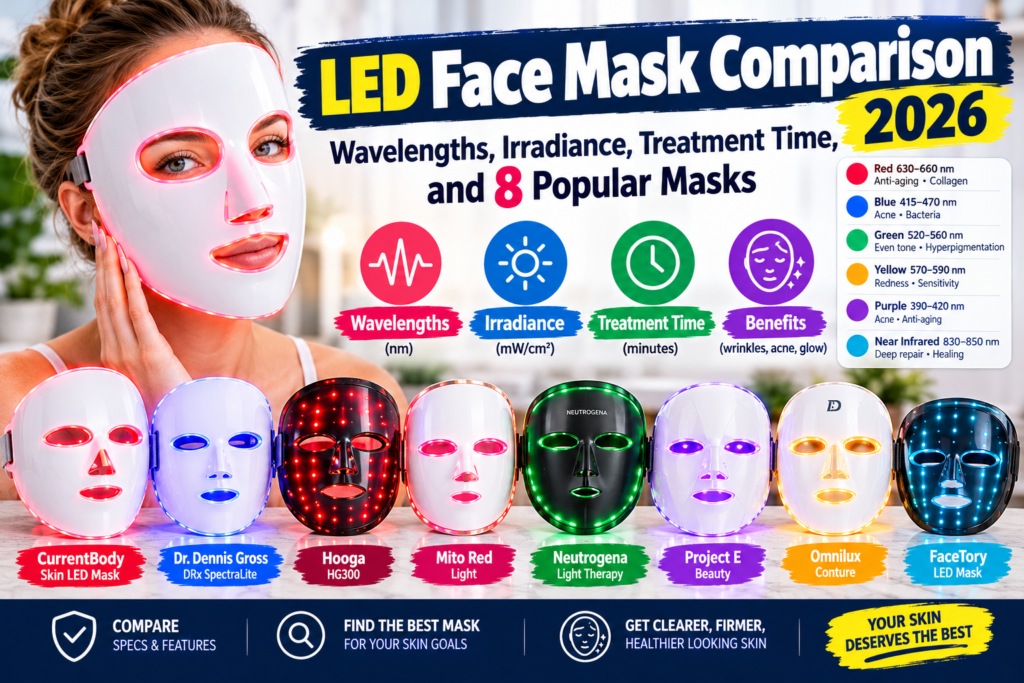
This LED face mask comparison examines eight popular models by wavelength, light output disclosure, treatment time, coverage, intended use, design, regulatory information, and price positioning. The goal is not to declare a universal winner based on marketing claims. It is to help you identify the differences that matter for your skincare goals and budget.
If you want a broader list of options before comparing specifications, start with our Best LED Face Masks of 2026. This guide takes a more technical approach to comparing individual devices.
Quick Answer: Which LED Face Mask Should You Compare First?
The right shortlist depends on your priorities.
- For a straightforward red and near-infrared routine: Compare Omnilux Contour Face with similar two-wavelength devices.
- For an additional near-infrared wavelength: Consider CurrentBody Skin LED Light Therapy Mask Series 2.
- For red and blue light in a short session: Compare Dr. Dennis Gross DRx SpectraLite FaceWare Pro.
- For a mask with additional features: Look at Therabody TheraFace Mask.
- For a flexible red-light design: Consider HigherDOSE Red Light Face Mask.
- For a short, multi-wavelength routine: Compare Solawave Wrinkle Retreat Pro.
- For additional light modes: Review iRESTORE Illumina’s specific modes and instructions.
- For a budget-conscious purchase: Compare RENPHO Artemis against the current specifications, warranty, and price of competing models.
These are comparison starting points, not clinical rankings. A longer wavelength list, a higher LED count, or a higher price does not independently prove better results.
LED Face Mask Comparison Table
| Device | Published wavelength configuration | Treatment time | Main comparison point |
|---|---|---|---|
| Omnilux Contour Face | 633 nm red + 830 nm near-infrared | About 10 minutes | Straightforward red/NIR configuration |
| CurrentBody Skin Series 2 | 633 nm red + 830 nm NIR + 1072 nm deep NIR | About 10 minutes | Three-wavelength configuration |
| Dr. Dennis Gross SpectraLite FaceWare Pro | Red and blue light; additional wavelength details should be checked for the exact model | About 3 minutes | Short session and acne-oriented blue-light mode |
| Therabody TheraFace Mask | Red, near-infrared, and blue light | About 9 minutes for the original mask’s programmed treatment | Multiple light modes and vibration features |
| HigherDOSE Red Light Face Mask | Red and near-infrared light | Follow the current model’s instructions; commonly about 10 minutes | Flexible wearable design |
| Solawave Wrinkle Retreat Pro | 605, 630, 660, and 830 nm | About 3 minutes | Multiple wavelengths in a short session |
| iRESTORE Illumina | Red, near-infrared, and blue light | Check the current model’s instructions | Multiple light modes |
| RENPHO Artemis | Red, near-infrared, and blue light are reported for this product family; verify the exact model | Check the exact model’s instructions | Compare entry cost with disclosed specifications |
Important: Specifications can vary by generation, region, and model. Confirm the manufacturer’s current documentation before purchasing. If irradiance is not publicly disclosed or cannot be compared using the same measurement method, it should be marked as unavailable rather than estimated.
What Actually Matters When Comparing LED Face Masks?
LED count is one of the easiest specifications to compare, but it is not enough to establish which device is better.
A useful comparison should consider the following factors together.
1. Wavelength
Wavelength, measured in nanometers (nm), describes the light emitted by a device. Different wavelengths interact with skin differently, and the intended use of a device matters.
Red light around 630–660 nm is commonly used in devices marketed for visible signs of skin aging. Near-infrared light, such as around 830 nm, is often combined with red light. Blue light around 415 nm is commonly included in devices designed for acne-related use.
The presence of a wavelength does not guarantee a particular outcome. The device’s output, protocol, intended use, and supporting evidence also matter.
2. Irradiance
Irradiance is commonly expressed in milliwatts per square centimeter (mW/cm²). It describes optical power delivered over an area.
A published irradiance number can be useful, but only if you understand how and where it was measured. A figure measured close to an LED may not be directly comparable with a figure measured at the skin surface.
Do not automatically choose the mask with the largest number.
3. Treatment time and dose
A three-minute treatment is not automatically better than a ten-minute treatment. The amount of light delivered depends on irradiance and duration, while wavelength, coverage, and the manufacturer’s protocol also influence the comparison.
For that reason, do not calculate or compare dose unless the underlying measurements are suitable for the calculation.
4. Coverage and fit
A mask must fit your face reasonably well and cover the areas you want to treat. Nose shape, chin coverage, strap adjustment, eye openings, and pressure points can affect comfort and routine adherence.
A device with many LEDs may still be uncomfortable or poorly suited to a particular face shape.
5. Intended use
A mask designed primarily for visible signs of aging may not be the most suitable option for someone prioritizing acne. Check whether the device offers the appropriate mode and whether its labeling supports the intended use.
6. Warranty, returns, and total cost
The purchase price is only one part of value. Check the warranty period, return window, replacement accessories, charging requirements, and whether the device is sold by an authorized seller.
For a more general buying framework, see our Best Red Light Therapy Face Masks 2026 comparison.
1. Omnilux Contour Face
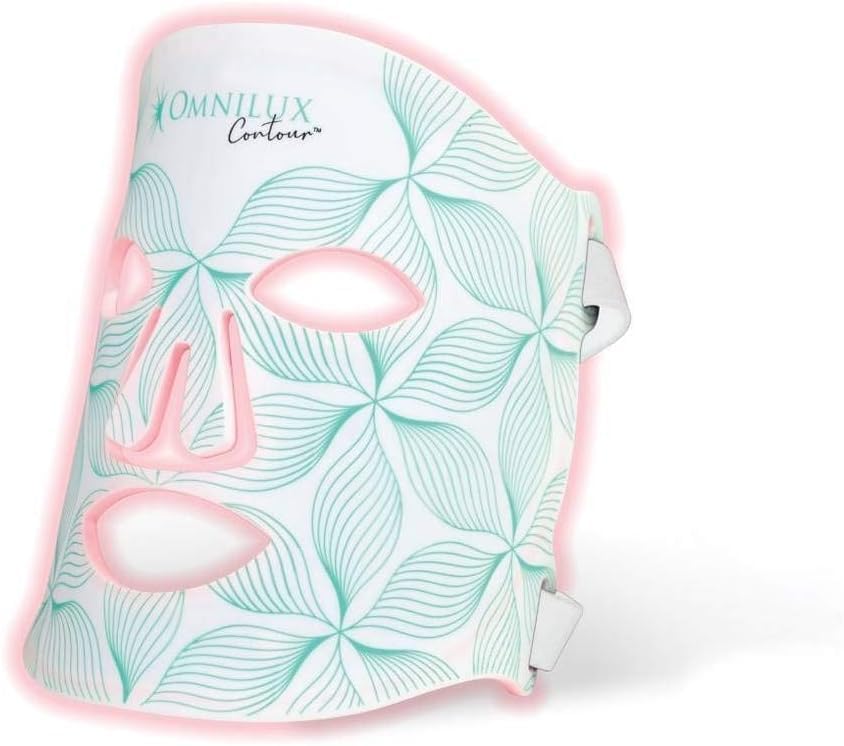
The Omnilux Contour Face uses red light at approximately 633 nm and near-infrared light at approximately 830 nm. Its relatively simple wavelength configuration makes it a useful reference point when comparing masks designed for overall skin appearance.
Key specifications
- Wavelengths: approximately 633 nm and 830 nm
- Published LED count: 132
- Typical treatment time: approximately 10 minutes
- Design: flexible silicone
- Main comparison focus: red and near-infrared treatment
- Price positioning: premium
What stands out?
The main advantage from a comparison perspective is simplicity. Buyers can evaluate the device without having to choose among numerous light modes.
However, a simpler wavelength configuration is not automatically superior to a multi-wavelength design. The important questions are whether the device suits your goals, how it fits, and what the manufacturer says about its intended use.
Who should compare it?
Consider Omnilux if you prefer a red/NIR routine and want to compare it directly with other flexible masks. Check the current warranty, treatment instructions, and price before deciding.
2. CurrentBody Skin LED Light Therapy Mask Series 2

- Enhanced collagen production capability significantly reduces fine lines, wrinkles and redness, for younger-looking skin…
- Upgraded light coverage provides our famous instant glow, for a healthier, brighter and smoother complexion.
- An all-new, exclusive layout of 236 LED bulbs emits three clinically recognised wavelengths: red (633nm), near-infrared …
CurrentBody Skin Series 2 uses three wavelengths: approximately 633 nm red light, 830 nm near-infrared light, and 1072 nm deep near-infrared light.
The manufacturer’s specifications list 236 LEDs and a treatment time of about ten minutes.
Key specifications
- Wavelengths: 633 nm, 830 nm, and 1072 nm
- LED count: 236
- Published irradiance: approximately 30 mW/cm² in product specifications
- Treatment time: approximately 10 minutes
- Design: flexible silicone
- Price positioning: premium
What makes it different?
The most visible specification difference is the additional 1072 nm wavelength. That gives the device a different configuration from masks that use only red and near-infrared light around 830 nm.
It does not prove that this mask will outperform every two-wavelength competitor. Buyers should avoid assuming that adding a wavelength necessarily produces a better cosmetic outcome.
The FDA database includes a specific 510(k) record for CurrentBody Skin LED Light Therapy Mask Series 2, model MK-90H. Regulatory records should be checked against the exact model and intended use rather than generalized to an entire brand.
Who should compare it?
Compare Series 2 with Omnilux if you want to understand the trade-off between a simpler red/NIR configuration and a device with an additional near-infrared wavelength.
3. Dr. Dennis Gross DRx SpectraLite FaceWare Pro
- WHAT IT IS: This LED device for the face targets wrinkles and acne for visibly smoother, clearer skin in just 3 minutes….
- HOW IT WORKS: Treat acne and breakouts with blue light, smooth wrinkles and build collagen with red light, or address bo…
- HOW TO USE: After cleansing, place the mask over your face, securing the strap around your head. Press & hold the power …
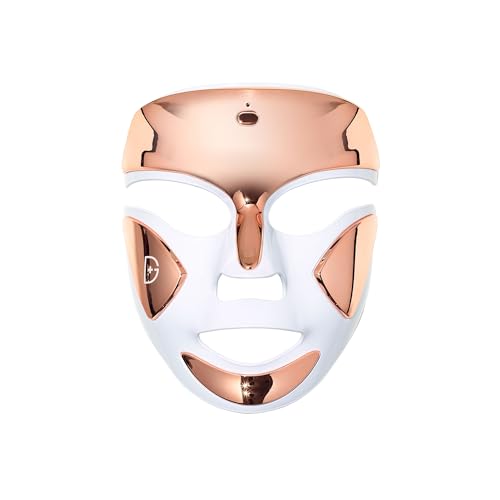
The Dr. Dennis Gross DRx SpectraLite FaceWare Pro uses a rigid wearable design and a short treatment protocol. Its red and blue light options make it relevant to shoppers comparing devices for both general skin appearance and acne-related concerns.
Key specifications
- Red and blue light modes
- Approximately three-minute treatment
- Rigid mask design
- Short programmed routine
- Premium price positioning
Main advantage
The most obvious practical distinction is treatment time. A short session may be easier to fit into a busy routine than a longer one.
However, treatment time alone does not establish efficacy. Check the exact model’s wavelength details, safety instructions, and intended-use information before comparing it with masks that use different protocols.
Who should compare it?
This model is worth comparing if you prioritize a short routine and want a device with a blue-light option. If acne is your main concern, our Best LED Face Masks for Acne in 2026 guide covers that use case in more detail.
4. Therabody TheraFace Mask
- Supercharged Face Care in 9 Minutes: A facial mask routine with 3 impressive LED light therapy technologies. Red light t…
- Vibrating Facial Massager, Too: TheraFace LED mask delivers a 15-minute vibration therapy treatment to key pressure poin…
- Powerful, Medical-Grade Lights: With 3x more LEDs than leading mask competitors for maximum efficacy and mask skincare r…
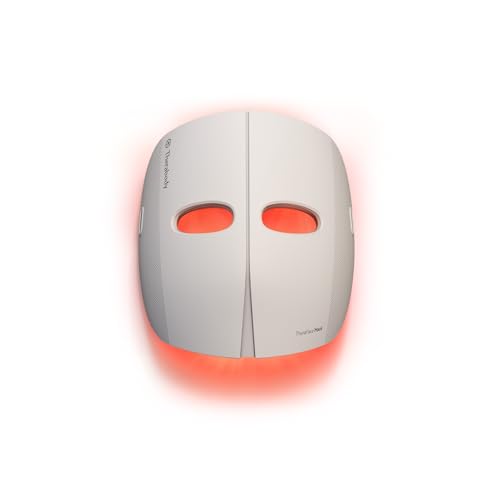
The original Therabody TheraFace Mask combines red, near-infrared, and blue light with vibration features. This gives it a broader feature set than a basic red/NIR mask.
Key specifications
- Red light
- Near-infrared light
- Blue light
- Multiple light programs
- Vibration features
- Premium price positioning
What are you paying for?
The key distinction is the combination of light modes and additional features. A buyer who values vibration may consider this a meaningful extra. Someone who wants only a simple red/NIR routine may not need it.
Make sure you distinguish the original TheraFace Mask from the newer TheraFace Mask Glo. Similar product names do not mean the devices have identical specifications, treatment protocols, or included accessories.
Who should compare it?
Compare Therabody with simpler masks if you value multiple modes and additional functionality. Review the exact model’s instructions and current price before deciding whether the extra features justify the cost.
5. HigherDOSE Red Light Face Mask

- Red Light Therapy for Face & Skin Rejuvenation – This FDA cleared, FSA eligible red light therapy mask uses red (630nm) …
- Facial Light Therapy, Anywhere – Lightweight and wireless, this LED face mask with red light therapy delivers targeted w…
- Red Light Mask That Works Deep – Red and near-infrared light reach deep layers to improve tone, reduce puffiness, and vi…
HigherDOSE focuses on red and near-infrared light in a flexible wearable format. Its design makes comfort, strap adjustment, and ease of use important parts of the comparison.
Key specifications
- Red and near-infrared light
- Flexible wearable format
- Treatment duration depends on the current model’s instructions
- Mid-to-premium price positioning
What should buyers consider?
A flexible mask may be easier for some people to store and wear, but fit is personal. Pay attention to the position of the mask, the way the straps hold it in place, and whether the treatment instructions are straightforward.
Do not judge it solely by the number of LEDs. Compare its disclosed output information with that of other devices only when the measurements are genuinely comparable.
Who should compare it?
HigherDOSE is worth considering if you prefer a red/NIR approach and value a flexible design. Check the current warranty and return policy, particularly if comfort is a major concern.
6. Solawave Wrinkle Retreat Pro
Solawave Wrinkle Retreat Pro uses four published wavelengths: approximately 605 nm, 630 nm, 660 nm, and 830 nm. It is designed around a short treatment session.
Key specifications
- Wavelengths: 605 nm, 630 nm, 660 nm, and 830 nm
- Published LED count: 320
- Treatment time: approximately three minutes
- Design: flexible wearable mask
- Price positioning: premium
What makes it different?
Its multiple wavelengths and short session distinguish it from masks that use a ten-minute red/NIR routine.
The FDA database includes a 510(k) record for the Wrinkle Retreat Pro Light Therapy Face Mask, model PH-m03. That record is specific to the device identified in the filing; it should not be interpreted as clearance for every Solawave product or every possible claim.
A short session may be convenient, but convenience is not proof of better results. Buyers should still examine fit, safety instructions, intended use, and warranty.
Who should compare it?
Compare Solawave if a short routine is important to you and you want to evaluate a multi-wavelength configuration. Review its current specifications alongside the exact product listing before purchasing.
7. iRESTORE Illumina LED Face Mask
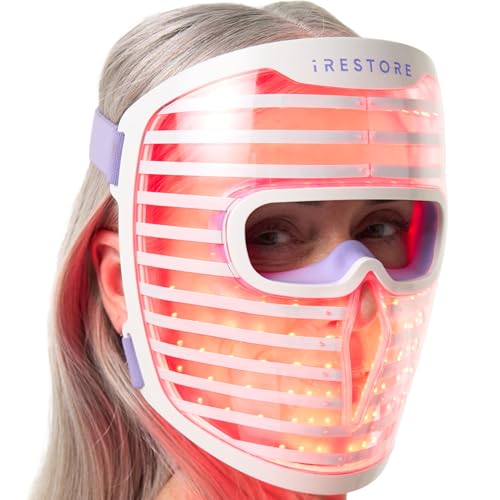
- The Most Powerful Red Light Mask for Visible Results: Experience professional-level rejuvenation at home with 360 LEDs, …
- Advanced Triple-Wavelength Technology: Powered by 3 scientifically backed wavelengths – Red (635nm), Infrared (830nm), a…
- Designed for Comfort and Multitasking: Lightweight yet sturdy, our dual-strap face mask hovers comfortably over your fac…
iRESTORE Illumina is positioned as a multi-light mask, with red, near-infrared, and blue light options reported for the product.
Key comparison points
- Multiple light modes
- Red and near-infrared options
- Blue-light option
- Treatment protocol depends on the selected mode and current model
- Premium price positioning
What should you check?
Confirm the exact Illumina model and the wavelength information in the current manufacturer’s documentation. Also verify whether the modes operate separately or in combination and whether treatment time changes between modes.
Having more options can be useful, but it can also add complexity. The most appropriate device is one whose available modes align with your intended use and whose instructions you can follow consistently.
Who should compare it?
Consider iRESTORE if you want to compare a multi-mode mask with devices focused more narrowly on red and near-infrared light. Do not assume that every mode has the same intended use or evidence.
8. RENPHO Artemis LED Light Therapy Mask
RENPHO Artemis is another model to consider when comparing multi-light face masks. Its price and included features should be checked against the exact version currently sold in the United States.
What to verify before buying
- Exact model name and model number
- Wavelengths for each available mode
- Treatment duration
- Irradiance, if disclosed
- Regulatory status for the exact device
- Warranty and return terms
- Included eye protection and accessories
Is a lower price enough to make it a good value?
Not by itself. A lower purchase price can make a device more accessible, but the buyer should still be able to understand its specifications, instructions, safety information, and warranty.
If the manufacturer does not disclose a figure, record it as unavailable rather than filling the gap with a number from another model.
Red Light vs. Near-Infrared vs. Blue Light
Different LED masks use different combinations of wavelengths. Understanding the basic distinctions can help you compare devices without assuming that every additional mode is necessary.
Red light
Red light in the approximate 630–660 nm range is commonly used in skincare devices marketed for visible signs of aging and overall skin appearance. Some research suggests potential benefits, but results vary by device, protocol, and individual.
Near-infrared light
Near-infrared wavelengths, including around 830 nm, are often paired with red light. Some newer devices also include wavelengths such as 1072 nm.
A longer wavelength does not automatically mean a better result. Device-specific output, treatment duration, and supporting evidence remain important.
Blue light
Blue light around 415 nm is commonly used in devices intended for acne-related treatment. It may be a relevant feature for people comparing masks for blemish concerns, but it is not a universal treatment for every form of acne.
If acne is your primary concern, compare the device’s intended use and instructions rather than choosing a mask simply because its product page mentions blue light.
Is a Higher LED Count Better?
Not necessarily. LED count describes the number of light-emitting components or the way a manufacturer counts them. Different brands may use different configurations, and some products distinguish individual LEDs from multi-die light sources.
Before treating LED count as a deciding factor, compare:
- Wavelengths and modes
- Light output and how it was measured
- Treatment duration
- Coverage and fit
- Manufacturer instructions
- Evidence relevant to the specific intended use
A mask with more LEDs may offer a different arrangement or coverage pattern, but LED count alone cannot establish which device produces better cosmetic results.
Irradiance vs. LED Count: How to Compare Light Output
Irradiance is usually expressed in mW/cm². LED count is a component count. These measurements describe different things.
A higher LED count does not necessarily mean higher irradiance at the skin. Similarly, a higher irradiance figure does not independently establish that a device will produce better results.
Before comparing published output figures, ask:
- Was the measurement taken at the skin surface or at another distance?
- Does it apply to the selected light mode or to the device as a whole?
- Is it a manufacturer claim, a laboratory result, or an independent measurement?
- Is the testing method comparable across devices?
- Does the manufacturer’s treatment protocol specify a duration and frequency?
If the measurement method is unclear, do not use the figure to rank devices. Missing information is better than false precision.
Which LED Face Mask Fits Your Goals?
If you want a simple red/NIR routine
Compare Omnilux Contour Face with other two-wavelength masks. Look at fit, warranty, instructions, and the manufacturer’s evidence.
If you want an additional near-infrared wavelength
CurrentBody Series 2 includes 1072 nm alongside red and near-infrared wavelengths. Consider whether that configuration matters to your purchasing decision rather than assuming that more wavelengths guarantee better outcomes.
If acne is a priority
Look for a device specifically intended for acne-related treatment and verify its blue-light mode. Compare the manufacturer’s instructions and relevant regulatory information.
If you want shorter sessions
Dr. Dennis Gross SpectraLite FaceWare Pro and Solawave Wrinkle Retreat Pro are examples of devices with short programmed sessions. A shorter routine may be easier to maintain, but it does not automatically deliver better results.
If you want additional features
Therabody offers a broader feature set in its original TheraFace Mask. Compare the specific version you are considering, because newer versions may differ.
If your budget is limited
Compare the total price, warranty, return terms, and quality of disclosed information. Avoid assuming that a less expensive mask is inferior or that a more expensive one is necessarily superior.
LED Face Mask vs. Red Light Therapy Panel
An LED face mask is designed to fit over the face and provide a wearable, hands-free format. A red light therapy panel is a different form factor that may cover a larger area, depending on its dimensions and specifications.
A mask may be more convenient for facial use. A panel may be more versatile if you want to treat other areas, but coverage and intended use depend on the specific device.
For a more detailed format comparison, read our LED Face Mask vs. Red Light Therapy Panel guide.
Safety: What to Know Before Using an LED Face Mask
At-home red-light devices are generally considered low-risk when used according to their instructions, but they are not appropriate for everyone. Possible short-term effects include temporary irritation or discomfort, and the long-term effects of repeated use are not fully understood.
The American Academy of Dermatology explains the current evidence, limitations, and precautions in its red light therapy guidance.
Before using a device:
- Follow the manufacturer’s instructions for treatment duration and frequency.
- Use the eye protection specified for that device.
- Do not assume that ordinary sunglasses provide the protection required.
- Ask a qualified healthcare professional before use if you have a photosensitivity condition, take medication that increases light sensitivity, or have a relevant eye or skin condition.
- Stop use and seek appropriate advice if you experience persistent irritation, pain, or unexpected skin changes.
If you have darker skin and are concerned about pigmentation, discuss the potential risks with a dermatologist. Visible light can affect pigmentation in some people, and individual sensitivity varies.
Understanding FDA Clearance and FDA Approval
FDA terminology is important when comparing skincare devices. In the United States, a 510(k) clearance indicates that the FDA determined a device to be substantially equivalent to a legally marketed predicate device for its specified intended use. It is not the same as FDA approval through a different regulatory pathway, and it does not guarantee a particular cosmetic result.
The FDA explains the 510(k) process in its Premarket Notification 510(k) guidance.
When a manufacturer claims that a mask is FDA-cleared, check the exact model, the relevant record, and the intended use. Do not transfer a clearance claim from one model to another simply because they share a brand name.
Final Verdict: How to Choose Between LED Face Masks
There is no single specification that determines which LED face mask is best for everyone.
The most useful comparison considers wavelength, irradiance disclosure, treatment time, coverage, fit, intended use, regulatory status, warranty, and total cost together.
For a straightforward red/NIR routine, compare Omnilux with similar devices. For an additional near-infrared wavelength, examine CurrentBody Series 2. For short sessions or blue-light options, compare the relevant models from Dr. Dennis Gross and Solawave. If you value multiple modes or additional features, examine Therabody and iRESTORE in detail.
Do not choose a mask solely because it has the most LEDs, the highest published irradiance, or the highest price. Choose the device whose documented specifications and instructions fit your intended use, budget, and willingness to maintain a regular routine.
Frequently Asked Questions
Are more LEDs better in an LED face mask?
Not necessarily. LED count does not independently show how much usable light reaches the skin. Wavelength, irradiance, coverage, treatment time, and fit also matter.
What wavelength is best for LED face masks?
There is no single wavelength for every goal. Red and near-infrared wavelengths are commonly used in devices marketed for visible signs of aging, while blue light is often included in devices intended for acne-related treatment.
Is higher irradiance always better?
No. Irradiance must be interpreted alongside the measurement method, wavelength, coverage, and treatment duration. A higher number alone does not prove better real-world results.
How long should an LED face mask session last?
Treatment time varies by model. Some devices use sessions of about three minutes, while others recommend approximately ten minutes. Follow the instructions for your exact device rather than applying one manufacturer’s protocol to another mask.
Are LED face masks FDA-approved?
Check the exact regulatory wording. Many consumer light-therapy devices are described as FDA-cleared for a specific intended use. Clearance should not be presented as a guarantee of effectiveness or as approval for every claim made about the product.
Can LED face masks help acne?
Some devices use blue light or a combination of blue and red light for acne-related treatment. Results vary, and a mask should not be treated as a universal solution for all types or severities of acne.
How long does it take to see results?
Results, when they occur, may take several weeks of consistent use. Outcomes vary by device, protocol, and individual skin characteristics. Follow the manufacturer’s directions and maintain realistic expectations.
Should I choose a mask or a panel?
Choose a mask if you prioritize a wearable format designed for facial use. Consider a panel if you want a different form factor or potentially broader coverage, while checking the manufacturer’s intended use and safety instructions.
What should I do if a specification is missing?
Treat it as undisclosed. Do not infer irradiance, dose, or regulatory status from a similar product. Contact the manufacturer if the missing information is important to your decision.
What is the most important specification to compare?
There is no single best specification. Start with your intended use, then compare wavelengths, output disclosure, treatment duration, coverage, fit, safety instructions, regulatory status, warranty, and price.