
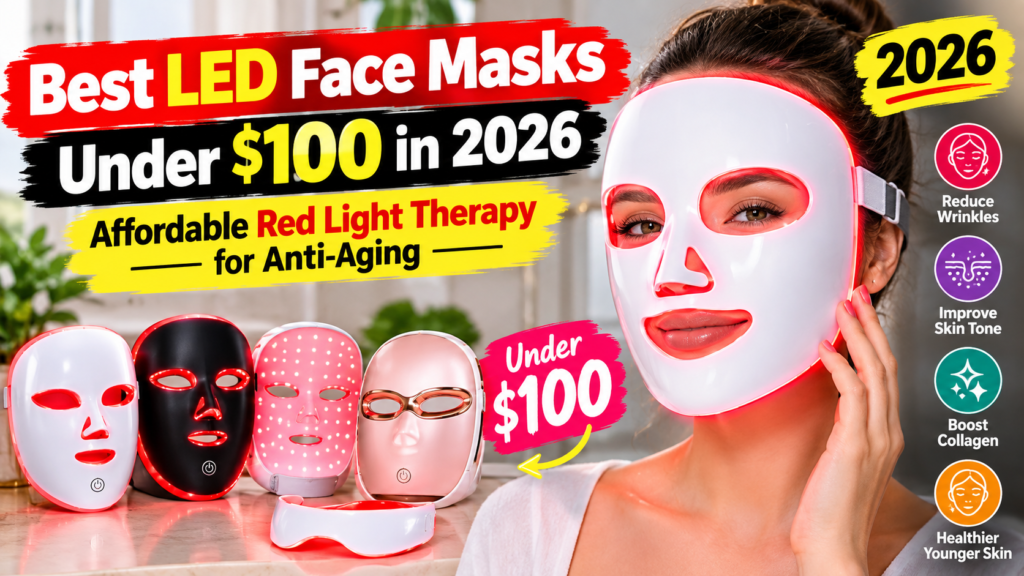
Discover the best LED face masks under $100 in 2026. Compare affordable red light therapy masks for anti-aging, fine lines, skin texture, and convenient at-home skincare.
LifeCareBalance.com is reader-supported. When you buy through links on our site, we may earn an affiliate commission at no extra cost to you. As an Amazon Associate, we earn from qualifying purchases.
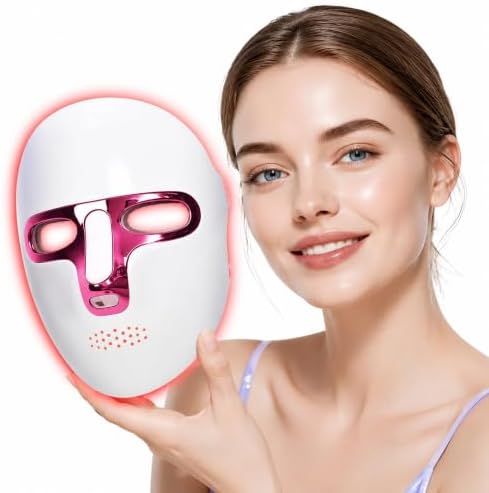
- 88 Dense Lamp Beads for Full-Face Coverage: Featuring a 88-bead LED array, this facial beauty mask delivers uniform ligh…
- 7 Customizable Beauty Light Modes: Equipped with 7 multi-wavelength LED modes (red, blue, green, yellow, purple, cyan, w…
- Portable Rechargeable Design for On-the-Go Beauty: Built with a lightweight, ergonomic frame and a high-capacity recharg…

- ▶️ SKIN-CLEARING BLUE LIGHT
- ▶️ THE POWER OF LIGHT THERAPY
- ▶️ GOODBYE OILY SKIN

- RED LIGHT THERAPY MASK: CryoGlow is an at-home LED face mask combining red, blue & deep infrared light with under-eye co…
- MOST AWARDED LED MASK IN THE U.S.*: Real people. Real results. Clinically tested on 119 participants by an independent t…
- EXPERTLY DEVELOPED: Developed by Shark Beauty alongside optical light experts and engineers, bringing MedSpa-inspired re…
LED face masks used to be a splurge item, the kind of device you’d see at a $400+ price tag and quietly close the browser tab. That’s changed. In 2026, there’s a genuine market of LED face masks under $100, and a lot of shoppers are wondering whether an affordable LED face mask can actually do anything for fine lines, dullness, or the occasional breakout — or whether “budget” just means “watered down.”
The honest answer is: it depends on the mask, not just the price tag. Spending less than $100 doesn’t automatically mean you’re getting a weaker product, and spending $500 doesn’t automatically mean you’re getting a better one. What actually separates a good LED face mask under $100 from a disappointing one comes down to a handful of specifics — wavelength, how much light actually reaches your skin, coverage, comfort, and how transparent the brand is about all of it.
This guide walks through what to look for in a budget LED face mask, what a reasonable set of expectations looks like, and which currently available options are worth a closer look if you want red light therapy without the three-figure-plus price tag. If you want a broader look that isn’t limited by price, our best LED face masks of 2026 roundup covers the category more broadly, including higher-end devices.
Quick Picks: Best LED Face Masks Under $100
Specifications for budget LED masks vary by seller and can change without much notice, so treat the numbers below as a general snapshot rather than a guarantee. Always confirm the wavelengths, LED count, and warranty on the current product listing before buying.
| Product | Approx. Price | Best For | Light/Wavelengths | Irradiance | Key Feature | Main Drawback |
|---|---|---|---|---|---|---|
| VEVOR 7-Color LED Face Mask | ~$70–$95 | First-time buyers wanting NIR included | Red, blue, and other visible colors, plus 850nm near-infrared (per manufacturer) | Not disclosed | 7 color/light modes at a relatively low price | Irradiance not published, so light intensity is unverified |
| Project E Beauty Skin Rejuvenation Photon Mask | ~$60–$95 | Budget beginners who want a simple mask | Red and blue (per manufacturer, ~630nm red / ~415nm blue) | Not disclosed | Long-running brand with many user reviews across marketplaces | Some listings and model numbers vary, so specs aren’t always consistent |
| Project E Beauty LightAura (7-Color) | ~$90–$120 depending on retailer | Buyers who want more LEDs for the money | 7 visible LED colors (per manufacturer) | Not disclosed | 150 LED bulbs, according to the listing | Frequently priced right at or above the $100 line depending on sale |
| Generic 7-color “wireless” masks (various Amazon-style brands) | ~$40–$80 | Shoppers who mainly want to try the category cheaply | Usually red, blue, and several “beauty” colors; NIR inclusion varies | Rarely disclosed | Lowest entry price into LED therapy | Brand transparency and warranty support can be inconsistent |
This table intentionally leaves some cells cautious. Many sub-$100 brands do not publish irradiance (light intensity) figures, and FDA clearance status is often unclear or unlisted. Check the current product listing before purchasing, since pricing and included accessories shift often.
What Is an LED Face Mask?
An LED face mask is a wearable device, usually shaped like a helmet or visor, lined with small light-emitting diodes (LEDs) that sit close to your face. Instead of heat or chemicals, it uses specific wavelengths of visible or near-infrared light aimed at the skin.
Different wavelengths are associated with different effects:
- Red light (roughly in the 620–660nm range) is the most studied wavelength for skin-related use and is generally associated with supporting collagen-related activity in skin cells.
- Near-infrared light (roughly 800–850nm) penetrates further beneath the skin’s surface than visible red light.
- Blue light (roughly 400–420nm) is commonly marketed toward blemish-prone skin, since it interacts with certain bacteria linked to breakouts.
It’s worth being precise here: this describes what these wavelengths are generally associated with in the research and marketing around light therapy — it is not a promise that any specific mask, budget or expensive, will remove wrinkles or cure acne. Results can vary from person to person, and consistency of use matters more than any single session.
Are LED Face Masks Under $100 Worth It?
This is the real question most shoppers land on, and the honest answer has some nuance.
What a budget mask can realistically offer: a low-cost way to try red light therapy at home, generally using the same basic wavelength ranges (red, blue, sometimes near-infrared) that appear in far more expensive devices. The physics of a 630nm red LED doesn’t change because the mask costs $70 instead of $700.
Where cheaper masks may compromise: the areas that are harder to see on a spec sheet. That includes irradiance (how much light actually reaches the skin, not just what wavelength it is), consistency of LED placement and coverage across the face, build quality, comfort for repeated use, eye protection quality, and how much support you get if something breaks. Budget brands are also less likely to publish clinical testing or detailed technical documentation.
Why specifications matter more than price: two masks can list “red and near-infrared light” and perform very differently, because wavelength alone doesn’t tell you dose. A mask with weak irradiance may need much longer sessions to deliver a comparable amount of light, and many budget listings simply don’t disclose this figure at all.
Why expensive doesn’t automatically mean better: paying more can buy you better documentation, broader FDA clearance history, app connectivity, or a company with a longer track record — but it does not automatically mean stronger light output or better real-world results. Some higher-priced masks compete mainly on brand and extras rather than on delivering meaningfully more light to your skin.
A realistic set of expectations: an affordable LED face mask may help support the appearance of your skin over weeks of consistent use, in the same general way the category is associated with in the wider literature. It is not a substitute for sunscreen, a dermatologist visit, or medical treatment for a diagnosed skin condition.
How We Evaluated These Budget LED Face Masks
No testing lab or clinical trial was used to produce this guide, and we’re not going to pretend otherwise. Instead, these picks were evaluated using publicly available information — manufacturer listings, retailer pages, and the specifications sellers choose to disclose — weighed against a consistent set of buyer-relevant factors:
- Price relative to other options in the category
- How transparent the brand is about wavelengths
- Whether irradiance is disclosed at all
- LED coverage across the face
- Stated treatment time per session
- Fit and wearability (rigid mask vs. flexible/wrappable design)
- Eye protection included with the device
- Battery life and charging setup
- Warranty length and return policy
- General brand transparency and reputation
- Available customer feedback across retailers
- Overall value for the price
Where a factor wasn’t disclosed anywhere we could find, we’ve said so rather than guessing.
What to Look for in an LED Face Mask Under $100
Wavelength
Wavelength is the specific “color” of light measured in nanometers (nm), and it determines what the light is generally associated with. Red light in the low-to-mid 600nm range and near-infrared around 800–850nm are the two most commonly cited for skin-appearance use; blue light in the 400–420nm range is typically marketed for blemish-prone skin. A mask that discloses its exact wavelengths is giving you more useful information than one that just says “red light” or “7 colors” without numbers.
Irradiance
Irradiance describes how much light energy actually reaches your skin, usually measured in milliwatts per square centimeter (mW/cm²). This is arguably the most-overlooked spec in the budget category — many listings mention wavelength but skip irradiance entirely. Without it, you’re left with an educated guess about how “strong” the light actually is, since a mask can technically emit the right wavelength while still delivering a weak dose.
LED coverage
More LEDs is not automatically better. What matters more is even coverage — LEDs positioned so light reaches the forehead, cheeks, chin, and jawline reasonably evenly, without large gaps. A mask with fewer, well-placed LEDs and better coverage can outperform one that lists a higher LED count but clusters most of them in one area.
Treatment time
Manufacturer-recommended session times for LED masks commonly fall somewhere in the 10-to-20-minute range, though this varies by product and should always be confirmed against the specific device’s instructions rather than assumed.
Fit and comfort
A rigid, helmet-style mask sits away from the face slightly, which some people find more comfortable for glasses-wearers or longer sessions, but it may fit less snugly across curves like the nose and jaw. A flexible, wrappable mask can conform more closely but may feel warmer or heavier during use. Comfort is genuinely personal, so if you can find real user feedback on fit before buying, it’s worth reading.
Eye protection
Because these devices sit close to the eyes, built-in eye protection (opaque padding, cutouts, or included goggles) matters. Cheaper masks sometimes skimp here, so check specifically what eye protection is included and whether reviewers mention any brightness or comfort issues around the eye area.
Battery and charging
Some masks are corded and plug directly into an outlet during use; others run on an internal rechargeable battery for a cordless session. Battery-powered masks add convenience but depend on the battery holding up over time, which is harder to judge from a listing alone.
Warranty and returns
In the sub-$100 tier, warranty coverage is inconsistent — some brands offer a year or more, while others provide only a short 90-day window or none clearly stated. A generous return policy is especially useful here, since it gives you a way to test fit and comfort risk-free.
Brand transparency
Look for brands that publish real wavelength numbers, respond to customer questions, and have a track record across multiple product listings rather than a single storefront that appears and disappears. This isn’t a guarantee of quality, but a lack of any transparency is a reasonable yellow flag.
Best LED Face Masks Under $100
The following are current examples in the budget category based on publicly available listings. Specifications can change between production runs and retailers, so treat the details below as a starting point and confirm the current listing before you buy. None of these have been independently tested by us, and none of the results below should be read as guaranteed.
VEVOR 7-Color LED Face Mask
- 88 Dense Lamp Beads for Full-Face Coverage: Featuring a 88-bead LED array, this facial beauty mask delivers uniform ligh…
- 7 Customizable Beauty Light Modes: Equipped with 7 multi-wavelength LED modes (red, blue, green, yellow, purple, cyan, w…
- Portable Rechargeable Design for On-the-Go Beauty: Built with a lightweight, ergonomic frame and a high-capacity recharg…
Best for: buyers who specifically want near-infrared included at a low price Approx. price: $70–$95, depending on retailer Wavelengths: red, blue, and several other visible colors, plus a stated 850nm near-infrared setting (per manufacturer listing) Irradiance: not disclosed Treatment time: manufacturer guidance should be checked on the current listing Key features: seven light settings in one device, including a near-infrared option that’s not always present at this price point
Pros
- Includes near-infrared alongside visible colors, which some budget masks skip
- Priced toward the lower end of the under-$100 tier
- Widely available across multiple marketplaces
Cons
- Irradiance is not published, so actual light intensity is unverified
- Build materials and long-term durability aren’t independently documented
- Warranty terms vary by seller/marketplace rather than being consistent
Who should buy it: someone who wants to try near-infrared light therapy without committing to a premium mask. Who should skip it: buyers who want a published irradiance figure before purchasing, or who need a guaranteed multi-year warranty.
Project E Beauty Skin Rejuvenation Photon Mask
- ▶️ SKIN-CLEARING BLUE LIGHT
- ▶️ THE POWER OF LIGHT THERAPY
- ▶️ GOODBYE OILY SKIN
Best for: first-time buyers who want a simple, well-known budget brand Approx. price: roughly $60–$95 depending on retailer and current promotions Wavelengths: red and blue light (manufacturer states approximately 630nm red and 415nm blue) Irradiance: not disclosed Treatment time: check the current manufacturer instructions Key features: long-running brand with a wide catalog of skincare devices and a large number of listings across marketplaces, which makes it easier to compare user feedback
Pros
- Established brand name with a long history in the budget beauty-device space
- Frequently discounted below $100, sometimes closer to $60
- Large volume of customer reviews across different retailers to reference
Cons
- Specs and included accessories vary between the brand’s different mask models, so it’s easy to compare the wrong listing
- Irradiance and FDA status are not clearly published
- Some resale/secondhand listings exist, so buying from an authorized retailer matters
Who should buy it: shoppers who want a recognizable name and plenty of user feedback to reference before committing. Who should skip it: anyone who wants a single, consistent spec sheet — this brand has several similarly named masks, and it’s worth double-checking you’re comparing the right model.
Project E Beauty LightAura (7-Color)
- RED LIGHT THERAPY MASK: CryoGlow is an at-home LED face mask combining red, blue & deep infrared light with under-eye co…
- MOST AWARDED LED MASK IN THE U.S.*: Real people. Real results. Clinically tested on 119 participants by an independent t…
- EXPERTLY DEVELOPED: Developed by Shark Beauty alongside optical light experts and engineers, bringing MedSpa-inspired re…
Best for: buyers prioritizing LED count within the budget tier Approx. price: often listed near $90–$120, so confirm it’s actually under $100 at checkout Wavelengths: seven visible LED colors (manufacturer listing) Irradiance: not disclosed Treatment time: check the current manufacturer instructions Key features: listed with 150 LED bulbs across the mask, according to the retailer description
Pros
- Higher stated LED count than many budget competitors
- Seven color settings for different stated skin concerns
- Sold through mainstream retailers, which can simplify returns
Cons
- Pricing sometimes lands right at or slightly above the $100 mark depending on the seller
- LED count alone doesn’t confirm irradiance or coverage evenness
- As with other Project E Beauty models, confirm you’re looking at this specific version’s specs
Who should buy it: someone specifically looking for a higher LED count who is comfortable watching for sales to stay under $100. Who should skip it: buyers on a strict sub-$75 budget, since this model tends to sit closer to the $100 ceiling.
Best LED Face Mask Under $50
This is the thinnest part of the market. Very few LED face masks with published wavelength information land reliably under $50 — most genuinely branded options sit in the $60–$95 range, with sub-$50 listings often being unbranded or lightly documented devices with little to no disclosed specifications. If you find one under $50, treat the lack of published wavelength and irradiance data as the default rather than the exception, and lean heavily on the return policy and seller reputation before buying. This tier is best suited to someone who mainly wants to test whether they’ll actually use an LED mask regularly, rather than someone chasing maximum light output.
Best LED Face Mask Under $75
The $50–$75 range is where a handful of established budget brands start to appear, including entry-level VEVOR and Project E Beauty listings when they’re on sale. At this price, it’s reasonable to expect a basic multi-color mask with red, blue, and possibly near-infrared settings, but it’s still uncommon to find published irradiance figures. This tier represents a reasonable middle ground: recognizable brand, several light settings, and a price that keeps the financial risk low if the mask doesn’t end up working for your routine.
Best LED Face Mask Under $100
Approaching the $100 ceiling, options like the Project E Beauty LightAura (when priced below $100) offer a higher stated LED count for shoppers who want more coverage without crossing into premium territory. This is also the price band where it becomes worth comparing a mask against our full LED face mask review, since a handful of dollars more can put you within reach of a device with clearer published specifications.
Cheap vs. Expensive LED Face Masks
It’s tempting to assume a $500 mask is simply “five times better” than a $100 one, but that’s not really how this category works.
What spending more can genuinely get you:
- Published irradiance figures and, in some cases, third-party or clinical testing data
- More consistent FDA clearance documentation
- Longer warranties and more established customer support
- More even LED coverage engineered around facial contours
- Companies with a longer track record and more resources for quality control
What spending more does not automatically guarantee:
- Dramatically different results — the underlying wavelengths (red around 630nm, near-infrared around 830–850nm) are largely the same physics whether the device costs $80 or $800
- Guaranteed anti-aging results of any specific degree
- That the mask will suit your face shape or comfort preferences better than a cheaper one
The practical takeaway: a budget LED face mask under $100 can be a reasonable way to try the category, especially if you pick a brand that’s at least somewhat transparent about wavelengths. A more expensive mask becomes worth it mainly for the documentation, support, and coverage engineering, not because the light itself is fundamentally different.
LED Face Mask vs. Red Light Therapy Panel
Masks and full-size panels solve different problems, and the right choice depends on how you want to use the device day to day.
- Coverage: a mask covers the face (and sometimes neck) in one hands-free session; a panel covers a larger area, including the body, but you have to position yourself in front of it.
- Convenience: masks are wearable and let you multitask; panels typically require you to sit or stand still facing the light.
- Distance from skin: masks sit directly on or very close to the face, which affects how much light reaches the skin; panels are used at a set distance recommended by the manufacturer, which also affects delivered irradiance.
- Portability: masks are generally easier to store and travel with; panels are bulkier and usually stay in one spot at home.
- Hands-free use: masks win here, since most are designed to be worn while doing something else; panels generally require dedicated, stationary time.
- Treatment area: masks are face-focused (some include neck); panels can address the face, but also larger areas like the chest, back, or limbs.
- Typical use case: a mask fits into an existing skincare routine; a panel suits someone interested in treating multiple body areas or who wants more flexibility in distance and exposure time.
For a deeper side-by-side, see our full breakdown of LED face masks vs. red light therapy panels.
How to Use an LED Face Mask
General guidance across most LED masks looks something like this, though you should always defer to the specific instructions that come with your device:
- Start with clean, dry, product-free skin — sunscreen, makeup, and heavy serums can interfere with light penetration.
- Put on the mask and any included eye protection.
- Select the mode/wavelength recommended for your goal, if the mask offers multiple settings.
- Use for the manufacturer’s stated session length — commonly in the 10-to-20-minute range, but this varies by device.
- Apply moisturizer or your normal skincare routine afterward.
- Use consistently, typically several times per week, since single sessions are unlikely to produce noticeable change.
Because devices differ in irradiance and recommended frequency, following your specific mask’s manual matters more than any general routine.
How Long Does Red Light Therapy Take to Show Results?
There’s no single timeline that applies to everyone or every device, and results can vary significantly based on the mask’s actual light output, your skin, and how consistently you use it. Some people report noticing changes in skin appearance over several weeks of regular use, while others may need longer or may not notice a meaningful difference at all. Consistency tends to matter more than any individual session, and it’s worth setting expectations around gradual, subtle change rather than a dramatic transformation on a fixed schedule.
Are Cheap LED Face Masks Safe?
Generally speaking, LED light therapy is considered low-risk for most people when used according to the manufacturer’s instructions, since it doesn’t involve UV light in the way tanning devices do. That said, a few general safety points are worth keeping in mind:
- Always use the eye protection included with the device, and don’t look directly at the LEDs.
- Follow the manufacturer’s recommended session length and frequency rather than assuming more is better.
- Discontinue use and consult a healthcare professional if you notice unusual irritation, discomfort, or a reaction after use.
- Because budget masks don’t always publish irradiance or safety testing data, it’s reasonable to be a bit more cautious with session length until you know how your skin responds.
This is general information, not medical advice, and it shouldn’t replace guidance from a healthcare professional about your specific skin or health situation.
Who Should Avoid an LED Face Mask or Ask a Dermatologist First?
Some people should check with a dermatologist or doctor before using an LED face mask, including those who:
- Are pregnant (out of general caution, since research specific to this population is limited)
- Have a history of light-sensitive skin conditions or are taking medications that increase photosensitivity
- Have active skin infections, open wounds, or recent cosmetic procedures on the treatment area
- Have a personal or family history of eye conditions, given the mask’s proximity to the eyes
- Are unsure whether a specific mask’s near-infrared or blue-light settings are appropriate for their skin
This list isn’t exhaustive, and when in doubt, a quick conversation with a dermatologist is a reasonable step before starting any new light therapy device, budget or premium.
FAQ
Are LED face masks under $100 worth it? For many people, yes, as a low-cost way to try red light therapy — as long as expectations stay realistic and you pick a brand that discloses at least basic wavelength information.
What is the best LED face mask under $100? There isn’t one universal “best,” since it depends on whether you prioritize near-infrared inclusion, LED count, or brand transparency. The options covered above are a reasonable starting point based on currently available listings.
Can a cheap LED mask help with wrinkles? Cheaper masks generally use similar wavelength ranges to pricier ones, so they may help support the appearance of fine lines with consistent use, but no LED mask — cheap or expensive — can guarantee wrinkle removal.
What wavelength is best for an LED face mask? Red light around 620–660nm is most associated with general skin-appearance benefits, and near-infrared around 800–850nm penetrates further. Blue light around 400–420nm is more associated with blemish-prone skin. Many masks combine more than one.
How important is irradiance? Very — it tells you how much light is actually reaching your skin, not just what color it is. Unfortunately, it’s the spec most budget masks leave out.
How often should you use an LED face mask? This varies by device, but several sessions per week is a common general recommendation. Always check your specific mask’s instructions.
Are inexpensive LED face masks safe? Generally considered low-risk when used as directed, though budget masks less often publish safety or irradiance testing, so following instructions and paying attention to how your skin responds matters.
Is an LED mask better than a red light therapy panel? Neither is universally “better” — a mask is more convenient and hands-free for facial use, while a panel offers broader body coverage and more control over distance. See our full LED face mask vs. red light therapy panel comparison for more detail.
This guide is intended for general informational purposes and reflects publicly available product information at the time of writing. It is not a substitute for professional medical or dermatological advice. Product prices, availability, and specifications change frequently — always check the current listing before purchasing