
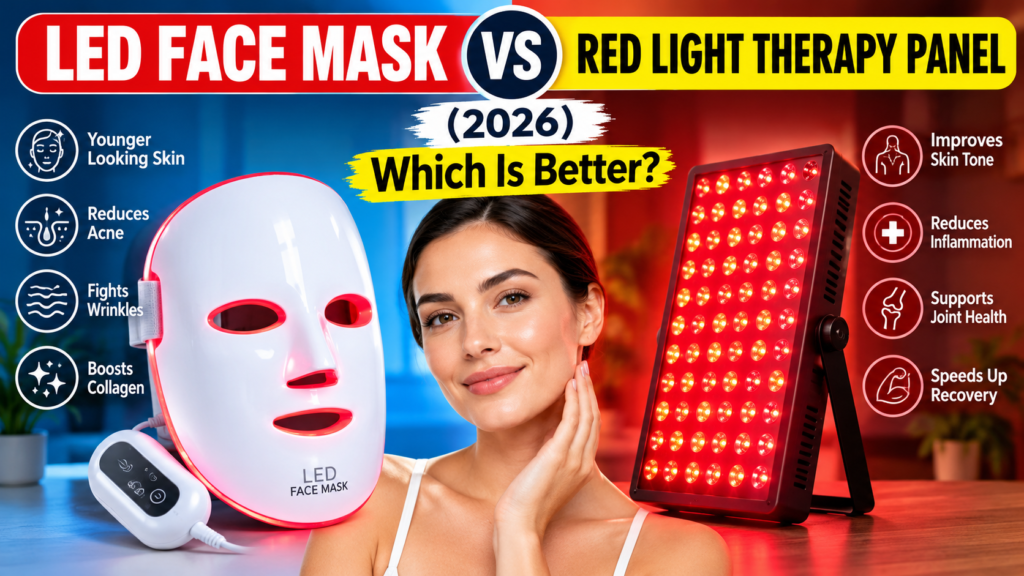
Compare LED face masks vs red light therapy panels for wrinkles, facial skincare, coverage, convenience, safety, and how to choose the right device.
LifeCareBalance.com is reader-supported. When you buy through links on our site, we may earn an affiliate commission at no extra cost to you. As an Amazon Associate, we earn from qualifying purchases.
If you are comparing an LED face mask vs. a red light therapy panel, the better choice depends on your skincare goals, available space, budget, and willingness to follow a consistent treatment routine. Both device types use light-based technology, but their design, coverage, and practical use differ.
An LED face mask is generally the more convenient option for people focused on facial skincare. A red light therapy panel offers greater flexibility because it can be positioned to treat the face, neck, chest, or other body areas, depending on its size and manufacturer instructions.
Neither format is automatically more effective. Results depend on the specific device, its wavelengths and delivered light dose, the treatment protocol, and how consistently you use it. Research on photobiomodulation is promising for certain skin concerns, but it does not establish that every home-use mask or panel produces the same results.
This guide compares the two options to help you choose a device based on practical needs and available evidence—not exaggerated marketing claims.

- Enhanced collagen production capability significantly reduces fine lines, wrinkles and redness, for younger-looking skin…
- Upgraded light coverage provides our famous instant glow, for a healthier, brighter and smoother complexion.
- An all-new, exclusive layout of 236 LED bulbs emits three clinically recognised wavelengths: red (633nm), near-infrared …
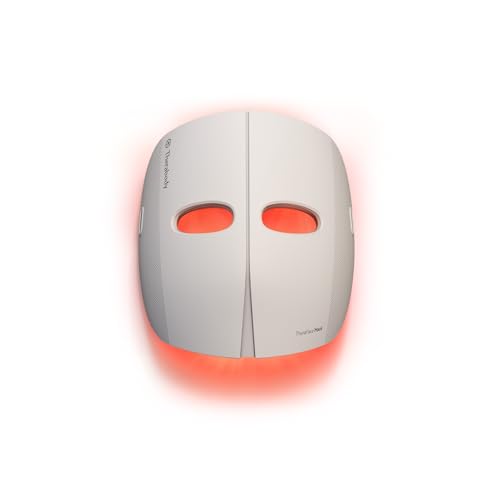
- Supercharged Face Care in 9 Minutes: A facial mask routine with 3 impressive LED light therapy technologies. Red light t…
- Vibrating Facial Massager, Too: TheraFace LED mask delivers a 15-minute vibration therapy treatment to key pressure poin…
- Powerful, Medical-Grade Lights: With 3x more LEDs than leading mask competitors for maximum efficacy and mask skincare r…
Quick Answer: LED Face Mask vs. Red Light Therapy Panel
Choose an LED face mask if your main goal is facial skincare and you want a wearable device that requires little setup. Choose a panel if you want to treat multiple body areas and have enough space to position the device correctly.
| Feature | LED Face Mask | Red Light Therapy Panel |
|---|---|---|
| Main purpose | Targeted facial skincare | Flexible treatment of different areas |
| Facial treatment | Designed around the face | Depends on panel size and positioning |
| Neck and chest | Limited unless specifically designed for these areas | Often possible by repositioning |
| Body coverage | Generally limited | Small to extensive, depending on size |
| Setup | Usually minimal | Requires positioning and a suitable distance |
| Portability | Usually easier to store and travel with | Depends on size and mounting system |
| Hands-free use | Common | Possible with a suitable stand |
| Treatment distance | Determined by device design | Must follow manufacturer instructions |
| Best fit | Facial routines and convenience | Multi-area use and flexibility |
Bottom line: A mask is usually the simpler choice for face-only routines, while a panel is more versatile for people who want broader coverage.
What Is an LED Face Mask?
An LED face mask is a wearable skincare device with light-emitting diodes arranged across a face-shaped surface. Depending on the model, it may use red light, near-infrared light, blue light, or a combination of wavelengths.
Red and near-infrared light are commonly associated with photobiomodulation, a process in which light interacts with biological tissue. Researchers have investigated these wavelengths for skin rejuvenation and other applications, although results vary by device and treatment protocol.
Potential advantages
- Convenience: Most masks have a defined treatment area and require relatively little positioning.
- Routine consistency: A wearable design can make it easier to repeat sessions according to the manufacturer’s instructions.
- Facial focus: The device is designed around facial contours rather than a broad treatment area.
- Compact storage: Many masks occupy less space than stand-mounted panels.
Potential disadvantages
- Limited coverage: Most masks do not treat the chest, back, arms, or legs.
- Fit differences: Facial shape and device construction can affect comfort and how the light sits against the intended treatment area.
- Variable specifications: LED count alone does not establish how much light reaches the skin or whether the dose matches a studied protocol.
- Eye-safety considerations: The correct precautions depend on the device’s wavelengths, design, and instructions.
For a closer look at individual mask features and specifications, read our LED Face Mask Review 2026.
What Is a Red Light Therapy Panel?
A red light therapy panel is a flat LED device that directs light toward a treatment area. Panels vary considerably in size, output, mounting options, wavelengths, and intended use.
Small panels may be designed for localized areas, while larger units can illuminate more of the body. A panel may be used for facial skincare if its manufacturer supports that application and provides appropriate instructions for distance, exposure time, and eye protection.
Potential advantages
- Flexible coverage: A suitable panel can be repositioned for the face, neck, chest, or other intended areas.
- Multiple applications: One device may serve more than one purpose, depending on its specifications and intended use.
- Adjustable positioning: Users can follow the manufacturer’s recommended distance and angle.
- Choice of size: Options range from compact units to larger systems.
Potential disadvantages
- More setup: A panel may need a stand, mounting hardware, or a dedicated space.
- Distance matters: The light reaching the skin changes with positioning and the device’s optical characteristics.
- Less convenient for travel: Larger panels can be difficult to transport or store.
- Specifications can be difficult to compare: Output figures measured under different conditions may not be directly comparable.
Our Red Light Therapy Buying Guide for 2026 explains the main specifications to examine before choosing a device.
Which Is Better for Wrinkles and Anti-Aging?
Neither a face mask nor a panel has been established as universally superior for wrinkles. The evidence relates to particular wavelengths, doses, devices, and treatment schedules—not simply to whether the light source is wearable or stand-mounted.
A 2023 randomized, split-face clinical trial published in Photobiomodulation, Photomedicine, and Laser Surgery studied 137 women aged 40–65. Participants received red light at 660 nm on one side of the face and amber light at 590 nm on the other, with ten sessions over four weeks. The researchers reported reductions in periocular wrinkle volume of 31.6% with red light and 29.9% with amber light. However, neither treatment improved skin hydration or viscoelasticity in that study. These results should not be interpreted as a guaranteed outcome from a consumer mask or panel.
You can review the study’s design and findings in the original PubMed clinical trial report.
The distinction matters: a clinical protocol using specified equipment and controlled conditions is not necessarily equivalent to an at-home device with a different output, treatment distance, or session schedule.
What this means for your purchase
If wrinkle-focused facial care is your priority, look for a device with clearly documented wavelengths, treatment instructions, and appropriate evidence for its intended use. A mask may be easier to use consistently because it is designed for the face.
A panel may also be suitable for facial treatment when the manufacturer supports that use. However, do not assume that a larger panel or a higher advertised power rating will produce better cosmetic results.
Practical verdict: Choose based on verified device specifications and convenience rather than assuming one format reverses wrinkles more effectively.
Which Is Better for General Facial Skincare?
For someone who wants to add light therapy to an existing facial skincare routine, a mask often has the practical advantage.
The face-shaped design reduces the need to reposition a light source before every session. Once you have checked the fit, safety instructions, and treatment schedule, the routine can be relatively straightforward.
A panel may be preferable if your skincare goals extend beyond your face. For example, you may want to treat the neck or chest as separate areas, provided those uses are supported by the manufacturer’s instructions.
Neither format should replace established skincare measures such as daily sun protection. Home light therapy should be considered an optional addition, not a substitute for appropriate dermatological care.
If acne is your primary concern, see our focused guide to LED Face Masks for Acne in 2026. Acne-specific evidence and device suitability should be assessed separately from wrinkle-focused claims.
Which Provides Better Coverage?
Coverage is one of the clearest practical differences between masks and panels.
Face
A mask is specifically shaped for facial use. Actual coverage depends on its design, fit, and placement of LEDs. A panel can illuminate the face too, but the coverage depends on its dimensions, positioning, and recommended treatment distance.
Neck
Most standard face masks concentrate on the face and may not cover the neck. Some products are designed with additional neck coverage. A panel can often be repositioned to treat the neck if the intended use and instructions permit it.
Chest and décolletage
A panel is generally more adaptable for the upper chest because it can be aimed at that area. A standard face mask is not designed for this purpose.
Arms, legs, and back
Panels offer a clear structural advantage for larger areas, particularly when the device is large enough to illuminate the intended treatment zone. A face mask is not a practical substitute.
Remember that the area illuminated is not necessarily the area receiving an equivalent light dose. Distance, angle, output distribution, and exposure time all matter.
Wavelengths, Irradiance, and Dose: What Should You Check?
These specifications are more useful than simply counting LEDs or comparing advertised wattage.
1. Wavelength
Wavelength is measured in nanometers (nm). Many red-light devices use wavelengths in the approximate 630–660 nm range, while near-infrared devices may use wavelengths around 800–850 nm. These are examples, not universal requirements for every application.
A device that advertises “red light” without publishing its wavelengths provides less information for evaluating its suitability.
2. Irradiance
Irradiance describes the optical power delivered per unit area and is commonly reported in milliwatts per square centimeter (mW/cm²).
A manufacturer’s irradiance figure is useful only when you understand the measurement conditions. The measurement distance, equipment, and method can affect the reported number. Figures measured directly at the LEDs should not automatically be compared with measurements taken several inches away.
There is no single irradiance threshold that guarantees better results across all consumer devices and treatment goals.
3. Treatment distance
Masks typically establish a relatively fixed relationship between the light source and the face. Panels allow adjustable positioning, which means you must follow the recommended distance for the specific device.
Do not move a panel closer or extend a session simply because you believe more light must be better.
4. Energy density
Energy density, often expressed in joules per square centimeter (J/cm²), describes the energy delivered over an area during an exposure. It is related to irradiance and time, but calculating a meaningful dose requires accurate measurements and consistent units.
The dose used in a clinical study should not be copied directly into a home routine without establishing that the device and protocol are comparable.
5. Transparency
Before buying, check whether the manufacturer publishes measurable specifications, realistic treatment instructions, eye-safety information, and evidence relevant to the device’s intended use.
For additional context on clinical applications, the 2025 evidence-based consensus on photobiomodulation in dermatology discusses the available evidence and clinical recommendations. Its conclusions should not be treated as proof that every consumer product performs equally well.
FDA Registration, Clearance, and Approval: Know the Difference
A device’s regulatory status is another factor to verify, especially when marketing materials make strong medical or cosmetic claims.
- Registration and listing: These administrative steps do not, by themselves, mean the FDA reviewed or cleared a device.
- FDA clearance: A device may receive 510(k) clearance when the FDA determines that it is substantially equivalent to a legally marketed predicate device for the relevant intended use.
- FDA approval: This is a distinct regulatory pathway and should not be used as a generic synonym for clearance.
The FDA explains these distinctions in its official guidance on medical device registration and listing and its overview of how medical devices are studied and marketed.
Check the exact device and intended use rather than relying on a general statement that a brand is “FDA registered.” Regulatory status alone also does not guarantee a particular cosmetic result.
Safety: Masks and Panels Both Need Careful Use
Both formats require users to follow the manufacturer’s instructions. Neither should be assumed risk-free simply because it uses non-UV light.
Before starting, review these precautions:
- Follow eye-protection instructions. Do not look directly into LEDs. Use any required eye protection, particularly for devices that include blue light or produce intense illumination.
- Follow the recommended session schedule. Longer or more frequent sessions are not automatically more effective.
- Stop if you experience concerning symptoms. Persistent irritation, pain, unusual visual symptoms, or other unexpected effects warrant stopping use and seeking appropriate medical advice.
- Check photosensitivity concerns. Certain medications and medical conditions can increase sensitivity to light. Ask a healthcare professional if you are unsure whether a device is suitable.
- Seek individualized advice when necessary. If you have an eye condition, a history of skin cancer, an active skin disorder, or another relevant medical concern, discuss the intended treatment with a qualified clinician before using the device.
A 2023 systematic review examined the oncologic safety evidence for photobiomodulation used in aesthetic skin rejuvenation. The authors found no relevant clinical-trial evidence linking treatment with significant adverse events such as new or recurrent malignancy, while also discussing limitations in the available evidence. This is reassuring but does not establish that every device, exposure level, or circumstance is risk-free. Read the full systematic review in PubMed Central.
LED Face Mask Pros and Cons
Pros
- Simple, face-focused routine
- Minimal positioning once the device fits correctly
- Usually compact and easy to store
- Can be convenient for repeated sessions
Cons
- Limited coverage beyond the face
- Fit and comfort vary by design
- Product specifications and supporting evidence differ
- Does not guarantee visible improvements
Red Light Therapy Panel Pros and Cons
Pros
- Can accommodate different treatment areas
- Offers flexibility in positioning
- May suit users who want one device for several areas
- Available in different sizes and configurations
Cons
- Requires suitable space and positioning
- Treatment distance must follow the device instructions
- Larger units can be difficult to transport
- Advertised output figures can be difficult to compare
How to Choose the Right Device
Before purchasing either format, use this checklist:
- Define your goal. Decide whether you want facial skincare only or broader coverage.
- Verify wavelengths. Look for specific figures rather than vague descriptions.
- Check irradiance conditions. Determine where and how the reported measurement was taken.
- Read treatment instructions. Confirm the session length, recommended frequency, and distance.
- Assess coverage. Check the actual illuminated area rather than relying on product images alone.
- Prioritize eye safety. Understand the precautions required for the particular device.
- Review the warranty and return policy. Comfort and fit are particularly important for wearable masks.
- Verify regulatory claims. Confirm the exact device and intended use where applicable.
- Evaluate evidence realistically. Look for studies relevant to the device’s intended use and avoid guaranteed-result claims.
- Consider consistency. A device that fits your routine is more practical than one you rarely use.
For a side-by-side look at specific mask features, wavelengths, and treatment times, explore our LED Face Mask Review & Comparison 2026. Use that product comparison alongside this guide rather than assuming that every mask has identical specifications.
Frequently Asked Questions
Is a red light therapy panel better than an LED face mask?
Not universally. A panel is generally more flexible for multiple treatment areas, while a mask is usually easier to position for facial use. Neither format guarantees better results.
Can I use a red light panel on my face?
Some panels are intended for facial use. Follow the specific manufacturer’s instructions for distance, exposure time, eye protection, and treatment frequency.
Are LED face masks effective for wrinkles?
Clinical research on photobiomodulation has reported improvements in certain wrinkle measurements, but results depend on the treatment protocol and device. Individual outcomes vary, and a consumer mask should not be expected to reproduce a clinical study’s results automatically.
Can a panel replace an LED face mask?
It may be a practical alternative if the panel supports facial treatment and you are comfortable following its positioning instructions. A panel is not necessarily a direct substitute for a mask with a different output or treatment protocol.
Do more LEDs mean better results?
No. LED count alone does not establish wavelength accuracy, irradiance at the treatment area, dose, or clinical effectiveness.
Does higher irradiance always mean better treatment?
No. Irradiance must be considered alongside treatment distance, exposure time, and the device’s intended use. Higher output is not automatically better or safer.
How often should I use a mask or panel?
There is no universal schedule for every device. Follow the manufacturer’s instructions, which should be appropriate for the device’s design and intended use. Do not copy another product’s treatment schedule without evidence that the protocols are comparable.
Should I buy a mask or a panel for neck and chest coverage?
A panel is usually the more flexible option for those areas, provided the device is intended for the application. Some masks include separate neck attachments, so compare the actual coverage of the models you are considering.
Final Verdict: Mask or Panel?
The best choice depends on what you want to treat and how you plan to use the device.
Choose an LED face mask if you primarily want facial skincare, prefer a simple wearable routine, and value compact storage and convenience.
Choose a red light therapy panel if you want flexibility to treat the face and other areas, have room for the equipment, and are comfortable following the recommended positioning and distance.
Neither category has a universal advantage for wrinkles or skin rejuvenation. The individual device’s specifications, intended use, safety instructions, and supporting evidence matter more than its shape or advertised LED count.
Choose the format that suits your routine, evaluate the specific product carefully, and keep expectations realistic. At-home light therapy may complement a skincare routine, but it is not a guaranteed solution for wrinkles or other skin concerns.
Medical disclaimer: This article is for educational purposes only and does not replace professional medical advice, diagnosis, or treatment. Consult a qualified healthcare professional if you have a medical condition, take photosensitizing medication, or are unsure whether light therapy is appropriate for you.