
LifeCareBalance.com is reader-supported. When you buy through links on our site, we may earn an affiliate commission at no extra cost to you. As an Amazon Associate, we earn from qualifying purchases.
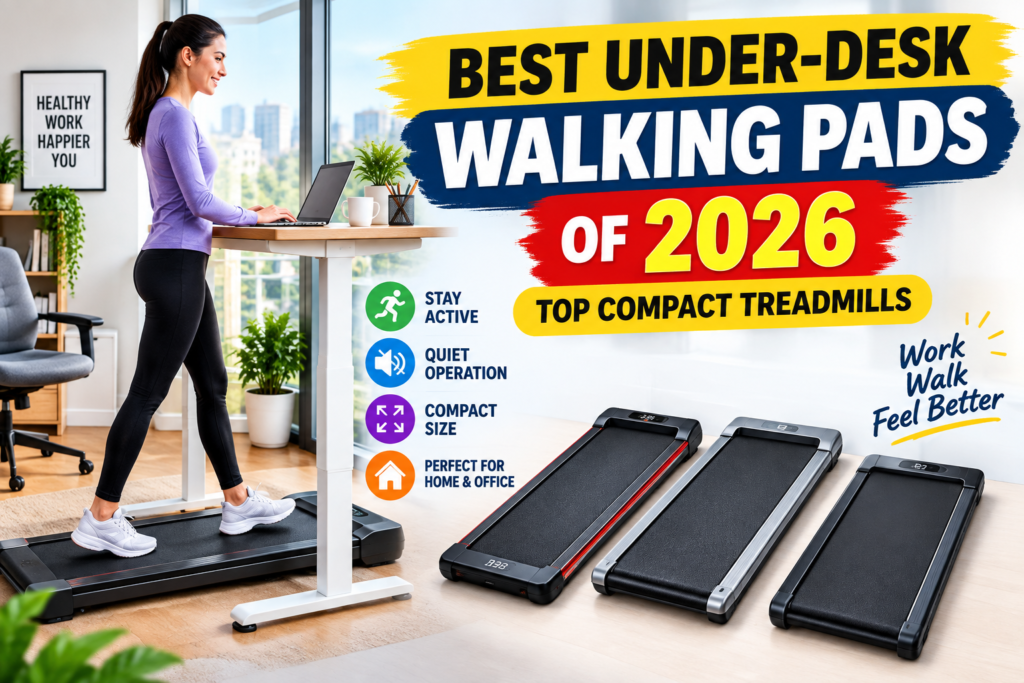
An under-desk walking pad can make it easier to add movement to a workday that would otherwise involve hours of sitting. Instead of setting aside a separate workout every time you want to move, you can use a compatible standing desk and a compact treadmill to walk during selected parts of your working day.
However, the best under-desk walking pad is not necessarily the fastest, cheapest, or smallest model. For a home office, the most important factors are desk compatibility, walking belt dimensions, low-speed stability, noise, weight capacity, storage, and safety.
A machine that fits your room but forces you to hunch over your keyboard is not a good choice. Likewise, a treadmill that works well for occasional exercise may be inconvenient during meetings or detailed computer work.
This guide explains what to check before buying an under-desk walking pad, how to choose the right design for your workspace, and which common purchasing mistakes to avoid.
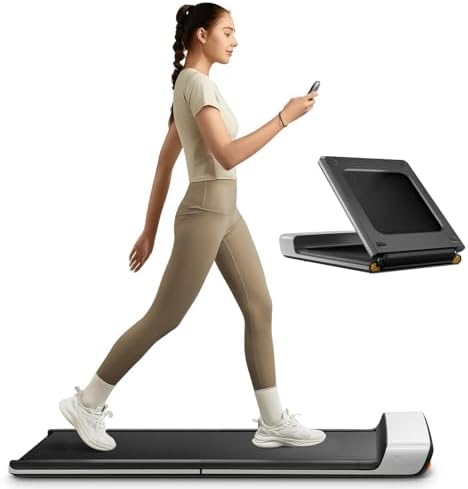
- Folds in Half: Easy to Store, Easy to Love. This walking pad folds completely in half, reducing its footprint by 50% whe…
- Timeless Design, Built to Last: Love a clean, classic look? The WalkingPad P1 sticks with our signature aluminum frame -…
- Wider Belt, More Room to Move: With a 16.5″ wide walking belt, you get extra side-to-side space that helps your steps fe…
Quick Answer: What Should You Look for in an Under-Desk Walking Pad?
For most work-from-home setups, prioritize these features in order:
- Desk compatibility: Your desk must rise high enough to accommodate the walking pad while keeping your arms and shoulders comfortable.
- Belt dimensions: Choose a walking surface that accommodates your height, stride, and preferred speed.
- Low-speed control: The machine should move smoothly at the slower speeds you intend to use while working.
- Noise and vibration: Consider the motor, belt, footsteps, flooring, and impact transmitted through the room.
- Weight capacity: Select a model with an appropriate margin above the heaviest regular user’s weight.
- Storage: Check the machine’s actual dimensions and weight before assuming it will fit under furniture.
- Safety and warranty: Verify the exact model, available support, replacement parts, and applicable safety warnings.
A low-profile walking-only machine is generally the more straightforward choice when desk walking is your primary purpose. A 2-in-1 treadmill may be more appropriate if you also want to jog after work.
For a broader product comparison, see our Best Walking Pads 2026 guide.
What Is an Under-Desk Walking Pad?
An under-desk walking pad is a compact motorized treadmill designed to fit beneath a standing desk. Most models have a lower profile than conventional treadmills and omit the large console and permanent handrails found on many full-size machines.
Common features include:
- A compact walking deck
- A motorized belt
- A remote control or simple control system
- A relatively low maximum speed
- Wheels or other storage-oriented features on some models
- A design intended primarily for walking rather than running
Not every compact treadmill is suitable for continuous desk use. Some products are designed for occasional walking, while others have more substantial frames and are intended for longer sessions.
A 2-in-1 treadmill may include a folding or removable handrail and offer a higher speed range. Before purchasing, confirm that its configuration is approved for use beneath a desk and that the handrail, controls, and other components will not interfere with your workspace.
Are Under-Desk Walking Pads Worth It?
An under-desk walking pad can be useful if your job involves prolonged sitting and you want a convenient way to add movement without leaving your home office.
A 2021 systematic review and meta-analysis examined 13 studies involving 351 participants. It found increased energy expenditure in laboratory settings and a modest reduction in sitting time in workplace studies. However, evidence for broader long-term cardiometabolic benefits remained limited.
You can read the original research in the systematic review of treadmill desks and sedentary behavior.
The practical benefit is straightforward: a walking pad creates another opportunity to move during the day. It does not automatically produce weight loss, eliminate the effects of prolonged sitting, or replace structured exercise.
The US Centers for Disease Control and Prevention recommends that adults aim for at least 150 minutes of moderate-intensity aerobic activity per week, along with muscle-strengthening activities on at least two days. Walking during work can contribute to an active routine, depending on its intensity, but not every slow desk-walking session will count as moderate-intensity activity.
See the CDC’s adult physical activity guidance for the broader recommendations.
1. Check Your Standing Desk Before Buying
Desk compatibility should be your first practical check.
A walking pad raises your feet above the floor. This changes the effective height of your desk relative to your body, potentially making your keyboard and mouse feel too low.
Before ordering a machine, measure the following:
- Your comfortable standing desk height
- The height of the walking pad’s deck
- The maximum height of your adjustable desk
- The space available beneath the desk frame
- The position of your keyboard, mouse, and monitor
The goal is to maintain a comfortable posture while walking. Your shoulders should not need to rise excessively, and your wrists should not be forced into an awkward position.
Also consider the desk frame. Some adjustable desks have crossbars or support structures that can interfere with the treadmill or restrict where you can position your feet.
If your desk cannot rise high enough, you may need a different workstation arrangement rather than a smaller treadmill.
2. Choose the Right Belt Length and Width
The walking belt is one of the most important specifications to compare.
A compact machine may save floor space but provide less room for a natural stride. This can become uncomfortable during longer sessions, particularly for taller users or people who prefer a faster walking pace.
Check the actual belt dimensions rather than relying on the treadmill’s overall length and width.
Belt length
Consider your height, natural stride, and intended walking speed. A longer belt generally provides more room to move, although the ideal size depends on the individual and the machine’s design.
If possible, test the machine before purchasing or review credible measurements and demonstrations.
Belt width
A wider belt can provide more lateral room when you adjust your position, move your hands between the keyboard and mouse, or look between monitors.
However, a wider machine also requires more floor space. Balance comfort with the dimensions of your room and desk.
Do not assume that a compact walking pad will be comfortable simply because its dimensions fit your apartment.
3. Prioritize Smooth Low-Speed Operation
Maximum speed is not the most important specification for desk walking.
A treadmill capable of running at high speeds is not automatically better for answering emails or attending virtual meetings. You need a machine that operates predictably at the slower speeds you will actually use.
Start with a pace that allows you to maintain balance and concentrate on simple tasks. Increase it only when you can walk comfortably without constantly looking down or correcting your position.
Typing, detailed spreadsheet work, and precise mouse movements may require a slower pace or a stationary position.
Research on treadmill workstations has found that walking can affect typing performance, although the size of the effect varies by task and walking speed. A study of walking speed and typing performance illustrates why it is useful to experiment with different speeds rather than assuming faster walking is always better.
4. Match Your Walking Speed to Your Work
An under-desk walking pad does not make every computer task equally easy.
Tasks that may work well while walking
- Listening to meetings
- Phone calls
- Reading articles and documents
- Reviewing presentations
- Watching training videos
- Simple administrative tasks
- Some routine email work
Tasks that may be easier while stationary
- Detailed spreadsheet editing
- Graphic design
- Precision mouse work
- Complex data entry
- Drawing or handwriting
- Tasks requiring very steady hand control
Typing speed, mouse accuracy, and concentration can vary during treadmill-desk use. For demanding work, stop the belt or switch to a stationary standing position.
The purpose is to make movement easier to incorporate into your routine, not to force yourself to walk through every task.
5. Evaluate Noise and Floor Vibration
Noise is especially important if you work from a shared home, attend video meetings, or need a quiet environment.
A walking pad produces more than motor noise. Other sources include:
- Footsteps striking the belt
- Belt movement
- Frame vibration
- Floor resonance
- Mechanical sounds from the deck
The noise you hear in a product demonstration may not match what your laptop microphone captures. Footsteps and vibration can be particularly noticeable on hard floors or in rooms with limited sound absorption.
If quiet operation is essential, look for independent testing that describes the measurement method and operating speed. A manufacturer’s decibel figure alone may not reflect real-world video-call performance.
Use only a floor mat that is compatible with the treadmill and permitted by the manufacturer’s instructions. A suitable mat may help with vibration or floor protection, but it will not eliminate every sound.
If possible, test the machine at the speed you intend to use during calls.
6. Understand Motor Specifications
Motor specifications can be difficult to compare because manufacturers may advertise different measurements, including peak power and continuous power.
These figures are not interchangeable. Do not assume two machines with similar advertised horsepower will deliver identical performance.
Check the manufacturer’s documentation for:
- The stated motor rating and what it represents
- The recommended operating conditions
- The maximum user weight
- Any stated restrictions on continuous use
- Warranty coverage for the motor and other major components
Brushless motors are often marketed for quieter operation, but motor type alone does not determine the noise or durability of the complete treadmill.
The belt, frame, bearings, flooring, walking speed, and maintenance requirements all influence the experience.
Choose based on the complete machine and its documented specifications rather than one marketing term.
7. Leave Enough Weight-Capacity Margin
The maximum user weight is a specification to verify, not a target to operate against without consideration.
Choose a model rated for your weight and leave a reasonable margin where practical. If several people will use the machine, account for the heaviest regular user.
A more substantial frame and higher weight capacity may be desirable for frequent use, but these features can increase the machine’s size and weight.
For example, the LifeSpan TR1200-DT3 is positioned toward dedicated desk-walking setups, while compact walking pads are often designed with portability in mind. Compare the current manufacturer specifications for belt dimensions, weight capacity, and intended use before choosing between them.
Do not assume that a higher weight rating automatically means a better treadmill. Belt size, low-speed stability, desk fit, and warranty support still matter.
8. Decide Whether You Need a Folding or Portable Design
Storage can make a substantial difference in a small home office.
Before buying, measure the actual location where you intend to store the walking pad. Check:
- Overall length and width
- Stored or folded height
- Machine weight
- Whether wheels are included
- Whether you can move it safely
- Whether it fits beneath your intended furniture
- Whether the storage position allows the machine to cool and remain accessible
A machine that looks compact in an online photograph can still be difficult to move through a narrow room.
Also consider how often you will put it away. If you plan to walk every working day, a machine that is easy to position and use may be more practical than one that requires substantial effort to move.
For broader home and apartment recommendations, see our Best Walking Pads for Home Use 2026 guide.
9. Walking Pad vs. 2-in-1 Treadmill
| Feature | Under-Desk Walking Pad | 2-in-1 Treadmill |
|---|---|---|
| Primary purpose | Desk walking | Walking and additional workouts |
| Low-profile design | Common | Depends on model |
| Handrail | Often absent | Often folding or removable |
| Walking | Suitable | Suitable |
| Jogging | Usually limited | Supported by some models |
| Storage | Often easier | May be bulkier |
| Maximum speed | Usually lower | Often higher |
| Desk compatibility | Often straightforward | Requires configuration checks |
Choose a dedicated walking pad if your main goal is low-speed movement while working.
Choose a 2-in-1 treadmill if you also want to use the machine for faster exercise and its manufacturer explicitly supports the intended configuration.
Do not assume every 2-in-1 machine can safely operate at every speed with its handrail folded or removed.
10. Choosing a Walking Pad for a Small Apartment
In a small apartment, the most useful features are usually:
- A manageable footprint
- A suitable belt length
- Easy repositioning
- Low-speed stability
- Reasonable noise and vibration
- Storage dimensions that match your available space
Measure doorways, desk legs, and the storage area before ordering.
Avoid buying the smallest model solely to save space. If the walking belt is uncomfortable or the machine is difficult to use consistently, the initial space saving may not be worth the trade-off.
Compare the complete dimensions and intended use of each machine rather than judging compactness from photographs alone.
11. What Tall Users Should Consider
Taller users may need a longer walking surface to accommodate their natural stride.
Compare the actual belt length and width, not just the overall machine dimensions. Consider the walking speed you expect to maintain and whether you can test the machine before purchasing.
The WalkingPad P1 and LifeSpan TR1200-DT3 are examples of products with different design priorities. Verify their current belt dimensions and specifications directly before deciding which one suits your stride and workspace.
Do not rely on height recommendations alone. Two people of similar height may have different stride lengths and comfort preferences.
12. What Heavier Users Should Consider
For heavier users, begin with the manufacturer’s maximum user-weight specification.
Check that the machine is explicitly rated for your weight and consider additional capacity if multiple people will use it.
Also examine belt dimensions, frame construction, stability, and the manufacturer’s instructions for session length and maintenance.
A heavier-duty treadmill may be less portable, so consider whether you need to move it regularly or intend to leave it beneath a dedicated desk.
Capacity should be one part of the decision rather than the only deciding factor.
13. How Much Should You Spend?
There is no single price that guarantees a good under-desk walking pad.
Budget models may be appropriate for occasional use, while a more substantial machine may make sense for someone who expects to use it frequently throughout the working week.
Evaluate the complete ownership cost, including:
- The purchase price
- Delivery and return costs
- Warranty coverage
- Replacement parts
- Maintenance requirements
- The effort needed to store and move the machine
Ask yourself how often you will realistically use it. A less expensive machine that does not fit your desk or is too noisy for your home office may provide less value than a model better suited to your routine.
Prices and product specifications change, so verify current information before publishing specific price claims or recommending a particular model.
14. Safety Checks Before Buying or Using a Walking Pad
Safety deserves special attention when choosing motorized exercise equipment.
On April 16, 2026, the U.S. Consumer Product Safety Commission warned consumers to stop using specific Sperax walking pads and treadmills, including models Pro, Q1, RM-01, and RM-02. The warning described reports involving unexpected speed changes, abrupt stops, falls, overheating, and fire hazards.
This is a warning about those named products, not proof that every walking pad is unsafe.
Read the official CPSC warning for the affected Sperax models before buying or using a product from that list.
For any walking pad:
- Check the exact model number and manufacturer.
- Search for applicable recalls and safety warnings.
- Read the operating manual before use.
- Use supplied safety features as directed.
- Keep children and pets away from the moving belt.
- Keep the surrounding area clear.
- Avoid mounting or dismounting while the belt is moving.
- Stop using the machine if it behaves unexpectedly or shows signs of overheating or electrical damage.
- Follow the manufacturer’s instructions for cleaning, lubrication, and maintenance.
If a specific product is covered by a stop-use warning, do not continue using it while attempting to troubleshoot the problem.
15. Warranty, Returns, and Replacement Parts
Warranty support matters because a walking pad contains moving and electrical components.
Before ordering, determine:
- How long the warranty lasts
- Whether the motor and frame have separate coverage
- Whether parts and labor are included
- Who handles warranty claims
- Whether replacement belts and remotes are available
- Whether the seller accepts returns if the machine does not fit your setup
Read the actual warranty terms instead of relying on a short product-page summary.
If you are uncertain about belt length, desk clearance, or noise, confirm the return policy before purchasing. Returning a heavy treadmill may involve shipping costs or additional restrictions.
Under-Desk Walking Pad Buying Checklist
Use this checklist before placing your order.
- The walking belt is appropriate for my height and stride.
- The belt width provides enough room for comfortable walking.
- My desk can rise high enough for an ergonomic working position.
- The treadmill fits beneath my desk without interfering with its frame.
- The machine operates smoothly at my intended walking speed.
- Noise and floor vibration are acceptable for my home office.
- The manufacturer’s weight limit is appropriate for every regular user.
- I have measured the storage space.
- I can move the machine safely if needed.
- I understand the controls and safety features.
- The warranty and return terms are clear.
- I have checked current safety notices for the exact model.
Frequently Asked Questions
Are under-desk walking pads worth buying?
They can be useful if you spend much of your workday sitting and want a convenient way to add movement. Their value depends on comfort, workspace compatibility, noise, and whether you will use the machine consistently.
What is the best speed for walking while working?
There is no universal ideal speed. Begin slowly and find a pace that allows you to maintain balance and perform your task comfortably. Detailed typing and precision work may require a slower pace or a stationary position.
Can I type while using a walking pad?
Yes, but your typing speed or accuracy may change. Test your normal work at a slow pace and stop walking for tasks that require precise control.
Are under-desk walking pads quiet enough for video calls?
Some are suitable for home-office use, but noise depends on the motor, belt, footsteps, flooring, and walking speed. Look for credible real-world testing and assess the machine in your actual environment.
Can I use a walking pad with any standing desk?
No. The desk must provide enough height and clearance to keep your working posture comfortable while your feet are elevated by the treadmill.
What belt length should I choose?
Choose a belt that accommodates your height, natural stride, and intended speed. Taller users and people with longer strides may prefer a longer walking surface.
Are walking pads safe?
They can be used according to the manufacturer’s instructions, but buyers should check the exact model for applicable recalls and safety warnings. Follow the manual and stop using any machine covered by an official stop-use warning.
Can I run on an under-desk walking pad?
Most dedicated walking pads are intended primarily for walking. Some 2-in-1 treadmills support jogging, but always follow the manufacturer’s intended configuration and speed limits.
Does walking on a treadmill desk replace exercise?
Not necessarily. Slow desk walking can add movement, but it may not provide the same intensity as brisk walking or other aerobic exercise. Maintain a balanced activity routine that includes appropriate aerobic and muscle-strengthening activities.
Final Verdict
The best under-desk walking pad for working from home is the one that fits your desk, accommodates your stride, operates smoothly at low speeds, and is practical to use and store.
Prioritize belt dimensions, desk height, noise, weight capacity, warranty support, and safety over maximum speed or marketing claims. If you plan to walk while performing demanding computer work, remember that typing and precision tasks may be easier when the belt is stopped.
A well-matched walking pad can make it more convenient to add movement to a sedentary workday. The goal is to create a comfortable, sustainable routine rather than to walk through every working hour.
For specific product recommendations, visit our Best Under-Desk Walking Pads of 2026 roundup. For a broader comparison of different styles and uses, see Best Walking Pads 2026.
If your priority is general home use rather than desk walking, our Best Walking Pads for Home Use 2026 guide covers that separate buying need.