
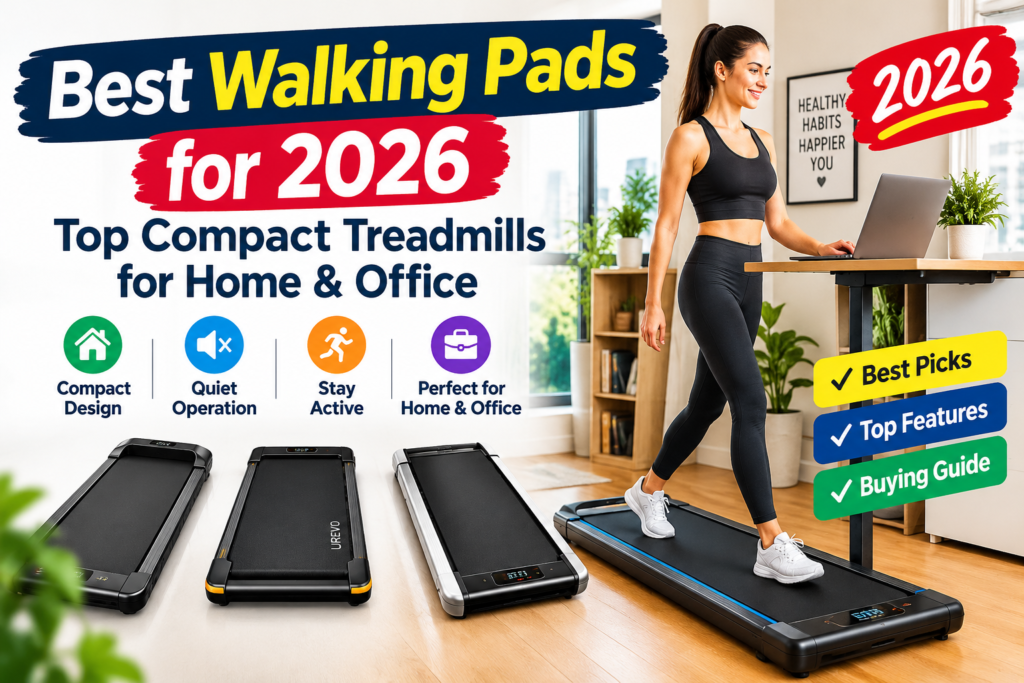
Discover the best walking pads for 2026, including top compact treadmills for home and office use. Compare features, size, noise, speed, and key buying factors.
LifeCareBalance.com is reader-supported. When you buy through links on our site, we may earn an affiliate commission at no extra cost to you. As an Amazon Associate, we earn from qualifying purchases.
If you want a short answer: the best walking pad for most home-office setups is a foldable, auto-incline model in the 300–350 lb weight-capacity range with a belt at least 40 inches long, a motor noise rating under roughly 50 dB, and a deck slim enough to slide under a standing desk. Below, we break that down by use case — home, office, apartment, budget, and heavier users — with a full comparison table, a buying checklist, and a decision tree so you can match a machine to how you’ll actually use it.
Walking pads have become one of the most searched home-fitness categories of 2026, largely because they solve a specific problem: most people don’t have room for a full treadmill, but they still want to move more during the workday. This guide focuses on the things that actually matter when you’re shopping — desk compatibility, noise, storage footprint, and safety — rather than repeating marketing copy.
Quick Answer: Best Walking Pads for 2026
- Best overall for home office: A foldable, auto-incline pad such as the WalkingPad C2 or a comparable UREVO SpaceWalk model
- Best for small apartments: A slim, foldable design like the WalkingPad C2 — see our walking pads for home use guide
- Best budget pick: An entry-level pad in the $200–$300 range, such as a Sunny Health & Fitness or Yagud model, with a shorter but adequate belt
- Best for quiet operation: A model with a published noise rating near 30–35 dB, such as UREVO’s CyberPad line
- Best for heavier users: A pad with a verified weight capacity of 320 lbs or higher, such as UREVO’s SpaceWalk 5L
- Best for walking plus light jogging: A 2-in-1 model with a higher speed ceiling and handrail, such as UREVO’s Strol 2E
- Best premium pick: A higher-end desk treadmill with incline and app connectivity for daily, all-day use
Prices shift often on Amazon, so treat the ranges below as approximate and check current availability before buying.
Comparison Table
| Product | Approx. Price | Belt Size | Max Speed | Weight Capacity | Folding | Incline | Best For |
|---|---|---|---|---|---|---|---|
| WalkingPad C2 | $400–$500 | ~40 x 15.7 in | ~3.7 mph | ~220–265 lbs | Yes (hinge fold) | No | Small spaces, storage |
| UREVO SpaceWalk 3S | $250–$320 | ~40 x 16 in | ~3.8 mph | ~265 lbs | Yes | Auto, multi-level | Home office, tall users |
| UREVO SpaceWalk 5L | $280–$350 | ~40 x 16 in | ~3.8 mph | ~320 lbs | Yes | Auto | Heavier users |
| UREVO CyberPad Office | $300–$400 | Check current spec | ~3.8 mph | Check current spec | Yes | Auto, higher-grade | Quiet operation |
| UREVO Strol 2E | $250–$350 | Check current spec | Up to ~6+ mph | Check current spec | Yes | No | Walking + light jogging |
| Egofit Walker Pro M1 | $350–$450 | Narrower deck | ~3–3.5 mph | Check current spec | No (fixed) | Fixed incline | Tiny footprints |
| Sunny Health & Fitness (entry models) | $200–$280 | Shorter deck | ~2.5–3 mph | ~220 lbs | Yes | No | Budget buyers |
| Goplus 2-in-1 Folding Treadmill | $250–$350 | Check current spec | Up to running speeds | Check current spec | Yes | No | Walking + occasional running |
Specifications above reflect commonly published manufacturer figures as of 2026 and can change between revisions. Always confirm the exact belt length, weight capacity, and noise rating on the current Amazon listing or manufacturer page before purchase — do not rely solely on marketing headlines.
What Is a Walking Pad?
A walking pad is a slim, motorized treadmill designed for walking rather than running, typically without the tall handrail and console structure found on a traditional treadmill. Most models fold flat or have a compact deck low enough to store under a bed, in a closet, or against a wall. They’re built around a narrower speed range — usually 0.5 to roughly 4 mph — which matches walking pace rather than jogging or sprinting.
Some newer 2-in-1 models add a handlebar and a higher top speed to support light jogging, but a standard walking pad is not designed as a running machine.
Why Walking Pads Are Popular for Home and Office Use
The appeal is mostly about space and convenience. A walking pad can sit under a standing desk, slide under furniture when not in use, and run quietly enough for a video call. That fits the way a lot of people now work — split between focused desk time and a desire to move more throughout the day.
There’s also a public-health backdrop here. The American Heart Association’s physical activity recommendations point to regular movement throughout the day as a component of overall cardiovascular health, alongside structured exercise. Research on breaking up long sitting periods with short activity has also examined how movement breaks relate to markers like glucose response over the course of a day. A walking pad is one practical way to add more of that daily movement without needing a separate workout block — though it’s a tool that supports activity, not a guaranteed health outcome on its own.
How We Evaluated the Walking Pads
This guide draws on publicly available manufacturer specifications, independent reporting such as Consumer Reports’ under-desk treadmill testing, and verified safety notices from the CPSC. LifeCareBalance has not conducted in-house lab testing of decibel levels or belt durability for every product listed here; where a specific number (like a decibel rating or exact dimension) isn’t independently verified, we say so rather than inventing a figure. For hands-on lab comparisons, Consumer Reports’ testing is a good independent reference point.
Best Walking Pads for 2026
Best Walking Pad for Home Office
For most home-office setups, a slim, auto-incline pad with a belt around 40 inches long is the safest match for typing, video calls, and slow-paced work. Look for a model with a low deck height so it clears your desk at its lowest setting, and a speed range that tops out around 3.5–4 mph — you’re not trying to run under your desk.
Best Walking Pad for Small Spaces
If floor space is tight, prioritize a folding hinge and a low stored height over top speed or incline. Our walking pads for daily fitness roundup goes deeper into models built specifically for compact apartments.
Best Foldable Walking Pad
The WalkingPad C2 remains one of the most recognized foldable designs, largely because its hinge-fold mechanism reduces the stored footprint significantly compared with flat, non-folding decks. See our full WalkingPad C2 review [INSERT INTERNAL LINK] for a closer look at its folding mechanism and real-world storage dimensions.
Best Budget Walking Pad
Entry-level pads in the $200–$300 range typically trade off belt length, incline, and motor durability for a lower price. That’s a reasonable trade for light, occasional use, but check the weight capacity and belt length carefully — a shorter belt is more likely to feel cramped for taller users.
Best Walking Pad for Quiet Operation
Noise is one of the most misunderstood specs in this category. Manufacturer-quoted decibel numbers are often measured under ideal lab conditions, not real footstep noise in a living room. If quiet operation for calls matters most, look for models with a lower published noise rating and read independent reviews that specifically test noise during actual walking, not just idle motor hum.
Best Walking Pad for Heavier Users
Don’t shop by the maximum advertised weight capacity alone — see the weight capacity section below for why. Look for models that pair a higher rated capacity with a wider, more stable deck and a heavier overall unit weight, which generally indicates a sturdier frame.
Best Walking Pad for Walking + Light Jogging
If you want the option to jog occasionally, a 2-in-1 model with a handlebar and a higher top speed — UREVO’s Strol 2E is one example currently on the market — is a better fit than a standard walking-only pad, which typically isn’t built for running speeds or impact.
Best Premium Walking Pad
If you’re on your desk treadmill most of the workday, a higher-end model with app connectivity, multi-level auto incline, and a more robust motor may be worth the extra cost for daily durability.
How to Choose a Walking Pad
Start with three questions: Where will it live (home office, bedroom, shared space)? How tall are you and how long is your stride? And do you need it to support only walking, or occasional jogging too? Those three answers narrow the field more than any single spec.
Belt Size: How Long and Wide Should It Be?
Belt length and width directly affect comfort and safety. A belt that’s too short for your stride length increases the risk of stepping off the back or front while walking, especially at a faster pace. As a general guideline, taller users and those with a longer natural stride should look for belts on the longer end of the compact category (around 40+ inches), while belt width mostly affects side-to-side comfort and stability. Always check the manufacturer’s current specification rather than assuming all “compact” pads have the same footprint — see our walking pad for standing desk considerations for more on matching belt size to desk use.
Weight Capacity: What Should You Look For?
Advertised maximum weight capacity is not the same as comfortable, long-term operating capacity. A motor and belt rated at their absolute ceiling may run hotter, wear faster, or feel less stable than one with headroom above your body weight. As a practical rule, look for a rated capacity comfortably above your own weight rather than choosing a model that’s rated exactly at it.
Motor Power: HP vs CHP and What Actually Matters
Manufacturers often list horsepower using different conventions — continuous horsepower (CHP) measured under sustained load, versus peak horsepower reached briefly. A pad might advertise a large peak number but a smaller continuous rating that better reflects real all-day performance. When comparing motors, continuous/rated horsepower is generally more meaningful for daily desk-walking use than a peak figure, though exact performance also depends on build quality that isn’t always disclosed. Where a manufacturer doesn’t clearly separate the two, check the manufacturer’s current specification page rather than assuming.
Noise: How Quiet Should a Walking Pad Be?
There are really two sources of noise: the motor itself, and footstep impact noise as you walk on the belt. A quiet motor doesn’t guarantee a quiet overall experience if the deck transmits footstep sound loudly. For video calls in a home office or apartment, look at both the manufacturer’s motor noise rating and, where available, independent hands-on reviews that describe actual walking noise — not just idle hum. Consumer Reports’ testing is one useful independent reference for how noise plays out in practice across different under-desk treadmill models.
Desk Compatibility and Under-Desk Clearance
Before buying, measure the clearance under your desk at its lowest setting and compare it against the walking pad’s deck height (not the folded height, which is different). Standing desks vary widely in minimum height, and a pad that’s a close fit on paper may not clear cable trays, desk legs, or crossbars. When in doubt, measure twice — returns on bulky fitness equipment can be inconvenient.
Folding and Storage
Folding mechanisms fall into a few categories: hinge-fold designs that reduce length substantially, flat non-folding decks that simply slide under furniture, and manual slat-style decks. If storage space is your top priority, a hinge-fold model paired with built-in wheels for moving it will generally be easier to live with day to day. Our best foldable treadmills for small spaces guide covers additional storage-focused alternatives if a walking pad’s footprint still feels too large for your room.
Walking Pad vs Traditional Treadmill
A traditional treadmill typically offers a longer deck, a taller handrail and console, a wider speed range that supports running, and often incline features — but it takes up significantly more permanent floor space. A walking pad trades some of that capability for a compact, often foldable design meant for walking at a desk or in a small room. If you want a single machine for both structured runs and desk-walking, a traditional treadmill or a 2-in-1 walking pad with a higher speed range is a better fit than a walking-only pad. For a deeper look at how the two compare for calorie expenditure specifically, see our walking pad vs treadmill for weight loss comparison.
Can You Use a Walking Pad While Working?
Yes, for many tasks — but not all. Walking at a slow, steady pace tends to work well for reading, phone calls, video meetings where you’re mostly listening, and light email. It’s generally harder to use while typing quickly, doing precise mouse work, video editing, or anything that requires fine motor control or sustained focus at a keyboard. Most people find a middle ground: walk during lower-focus tasks and step off for deep work.
Are Walking Pads Good for Weight Loss?
Walking pads can help you move more throughout the day, which increases overall energy expenditure — but no walking pad guarantees weight loss on its own. Actual weight change depends on total calorie balance, diet, sleep, overall activity level, and individual factors that vary from person to person. Research on breaking up prolonged sitting with light activity suggests movement breaks may support metabolic markers like glucose response, and general physical activity guidelines from the American Heart Association support regular movement as part of overall health. But walking at a desk should be viewed as one piece of a broader activity and nutrition picture, not a standalone weight-loss solution.
Walking Pad Safety: What Buyers Need to Know
Important 2026 safety note: In April 2026, the U.S. Consumer Product Safety Commission issued a warning urging consumers to immediately stop using specific Sperax walking pads and treadmills — including the Pro, Q1, RM-01, and RM-02 models — after receiving reports of the products suddenly changing speed or stopping abruptly, as well as reports of overheating and fire hazards. This warning applies specifically to the named Sperax models, not to walking pads as a category or to other brands. If you own one of the affected models, check the exact model number against the CPSC’s warning and follow their guidance directly rather than relying on secondhand summaries.
Beyond that specific warning, general walking-pad safety practices apply to any brand: don’t step onto a moving belt at high speed, keep a stable connection to a nearby wall or desk if you feel unsteady, use the safety clip or auto-stop feature if the model has one, keep the area around the pad clear, and unplug the unit when not in use. Check that any model you’re considering has a working safety-stop mechanism, and register your product with the manufacturer when possible so you receive safety notices directly.
Maintenance and Lifespan
Like any motorized equipment, walking pads need periodic belt lubrication (frequency varies by model — check the manufacturer’s manual rather than assuming a universal schedule), occasional belt tension adjustment, and a clean, dry operating environment to avoid dust buildup around the motor. Expected lifespan varies significantly by build quality, usage hours, and maintenance, so treat any specific “years of use” marketing claim with some skepticism unless it’s backed by independent testing.
Walking Pad Buying Checklist
- Measure your available floor space and under-desk clearance before shopping
- Match belt length to your height and stride, not just the “compact” label
- Choose a weight capacity comfortably above your own body weight
- Compare continuous (not just peak) motor power where available
- Check noise ratings and, where possible, independent walking-noise reviews
- Confirm the folding mechanism and stored dimensions if storage matters
- Verify the model number against any active CPSC warnings before buying or continuing to use a unit
- Check the manufacturer’s warranty length and what it actually covers
- Decide whether you need walking-only or a 2-in-1 model with jogging capability
- Read at least one independent, hands-on review in addition to manufacturer specs
Which Walking Pad Is Right for You? (Decision Tree)
- Want quiet home-office walking? → Choose a model with a lower published noise rating and good real-world review coverage for call-friendly use.
- Have very limited storage? → Choose a foldable, hinge-fold model with a low stored height.
- Want walking plus occasional jogging? → Choose a 2-in-1 model with a higher speed ceiling and a handrail.
- Need a higher weight capacity? → Prioritize a verified, published weight rating with headroom above your body weight, and a wider, sturdier deck.
- Need premium daily desk use? → Consider a higher-end desk treadmill with incline and app tracking built for extended daily hours.
- Budget under $300? → Focus on verified specifications and honest reviews rather than the lowest price alone; a slightly higher-priced model with a documented motor and belt spec is often the safer bet.
No single model is “the best” purely because of price or a marketing headline — the right choice depends on your space, body size, and how you plan to use it.
FAQs
What is the best walking pad in 2026? There isn’t one universal “best” model — it depends on your space, height, weight capacity needs, and whether you want a walking-only or 2-in-1 jogging-capable pad. See the Quick Answer and Comparison Table above for picks by category.
Are walking pads worth it? For people who sit most of the day and want a low-friction way to add movement, many find them worthwhile. They’re not a replacement for structured exercise or a guaranteed fitness solution.
Can I use a walking pad under a standing desk? Yes, as long as the deck height clears your desk’s lowest setting. Measure both before buying.
How fast should I walk while working? Most people use a slow, steady pace — often under 2 mph — for tasks requiring focus, and a slightly faster pace for calls or reading where typing isn’t required.
Are walking pads safe? Most walking pads on the market are designed with standard safety features like auto-stop clips. However, buyers should check for any active safety warnings on the specific model and brand, such as the 2026 CPSC warning on certain Sperax units, before purchasing or continuing to use one.
Can you run on a walking pad? Standard walking pads are built for walking speeds, typically up to around 4 mph. Some 2-in-1 models support higher speeds suitable for light jogging, but always check the manufacturer’s rated speed range before attempting to run.
How much noise does a walking pad make? It varies by model and includes both motor noise and footstep noise. Check both the manufacturer’s decibel rating and independent reviews that describe real walking noise, not just idle hum.
How long do walking pads last? Lifespan depends heavily on build quality, usage frequency, and maintenance. There’s no universal number, so treat specific lifespan claims with some caution unless backed by independent testing.
What belt size should I choose? Choose a belt long enough to comfortably fit your stride — generally, taller users benefit from a longer belt — and a width that feels stable for your walking style.
What weight capacity should I look for? Pick a model with a rated capacity comfortably above your body weight rather than one rated exactly at it, since operating near the maximum can affect motor strain and stability.
Are walking pads good for weight loss? They can help increase daily activity and energy expenditure, which may support weight management as part of an overall calorie balance and lifestyle — but they don’t guarantee weight loss on their own.
Is a walking pad better than a treadmill? Neither is universally “better” — a walking pad is more compact and often foldable, while a traditional treadmill typically supports higher speeds, running, and incline. The right choice depends on your space and goals.
Can a walking pad damage hardwood floors? Some models are heavy enough that placing a protective mat underneath is a reasonable precaution, especially if you plan to move the unit frequently. Check the manufacturer’s guidance for your specific model and floor type.
How often should a walking pad be lubricated? This varies by model and usage level — check your specific manufacturer’s manual rather than assuming a universal schedule, since over- or under-lubricating can both cause issues.
Final Buying Summary
If you only take one thing from this guide: measure your space and your desk clearance first, then shop by verified belt length, weight capacity headroom, and noise information — not by the loudest marketing claim. A foldable, auto-incline pad with a belt around 40 inches and a capacity comfortably above your body weight covers most home-office needs. Tight on space, go foldable and slim. Want occasional jogging, look at a 2-in-1 with a handrail. And before buying or continuing to use any walking pad, double check the model number against current CPSC warnings, since the April 2026 Sperax warning is a reminder that model-specific safety checks matter in this category.
For more detailed comparisons, see our WalkingPad C2 vs UREVO comparison [INSERT INTERNAL LINK] and our broader walking pads for home use guide.
As prices, specifications, and availability change frequently, always compare current Amazon listings and manufacturer pages before purchasing.
Sources referenced: U.S. Consumer Product Safety Commission (Sperax warning, April 2026); Consumer Reports under-desk treadmill testing; American Heart Association physical activity recommendations; PubMed research on activity breaks and prolonged sitting (study 1, study 2).
LifeCareBalance is reader-supported. As an Amazon Associate, we may earn from qualifying purchases made through links on this page, at no additional cost to you.