
LifeCareBalance.com is reader-supported. When you buy through links on our site, we may earn an affiliate commission at no extra cost to you. As an Amazon Associate, we earn from qualifying purchases.
If you spend most of your day at a computer, you already know the trade-off: get work done, or get moving. An under-desk treadmill is built to close that gap. But “walking pad” has become a catch-all term for two genuinely different products — a flat, handrail-free pad meant to slide under a standing desk, and a 2-in-1 folding treadmill with a removable handrail that can also handle a light jog. Picking the wrong type for your space, your height, or your work setup is the most common mistake buyers make.
This guide is built specifically around that decision. Instead of ranking walking pads the way a general roundup would, we’re focused on the details that matter once the machine is actually sitting under your desk: belt size relative to your height, real-world noise during a video call, desk clearance, storage footprint, and weight capacity. We verified current specifications directly from manufacturer listings and independent testing sources for every model below, and flagged anywhere a number couldn’t be reliably confirmed.
If you want a wider-angle comparison across more budget tiers and brands, our full walking pad buying guide for home use covers additional models. This article goes deeper on the under-desk and home-office use case specifically.
Quick Comparison: Best Walking Pads 2026
| Product | Approx. Price | Max Speed | Belt Size | Weight Capacity | Foldable | Best For |
|---|---|---|---|---|---|---|
| WalkingPad P1 | $349–$499 | 3.5–3.75 mph | 16.5″ × 47″ | 220 lbs | Yes (180° fold) | Best overall under-desk pad |
| WalkingPad C2 | $399–$529 | 3.6–3.7 mph | 16″ × 48″ | 220 lbs | Yes (half-fold) | Small apartments, quiet use |
| UREVO SpaceWalk 3S | $299.99 | 0.6–4.0 mph | 16.5″ wide (length not clearly disclosed) | 265 lbs | Yes, flat fold | Budget pick with incline |
| Goplus 2-in-1 Superfit | $250–$350 | Walking 3.8 mph / running up to 7.5 mph | 16″ × 39–40″ | 265 lbs | Yes, handrail folds | Walking + light jogging |
| Egofit Walker Pro M1 | $299–$349 | 3.1–3.7 mph | 16.5″ × 33.8″ | 220–242 lbs | Yes | Fixed-incline calorie focus |
| LifeSpan TR1200-DT3 | $999–$1,199 | Up to 4.0 mph | 20″ × 50″ | 350 lbs | No | All-day office use, heavier users |
Prices fluctuate with sales and retailer, so treat these as a realistic current range rather than a fixed number.
True Walking Pad vs. 2-in-1 Treadmill: What’s the Real Difference?
A true walking pad — the WalkingPad P1, C2, and similar flat-deck models — has no handrail and is designed to sit fully underneath a standing desk while you work. It’s slimmer, folds flatter, and is generally quieter, but it also caps out around 3.5–4 mph, which is a walking pace, not a jogging one.
A 2-in-1 under-desk treadmill, like the Goplus Superfit line, includes a removable or foldable handrail. With the handrail attached, you get more stability at higher speeds — some models reach 7+ mph, enough for a light jog. With the handrail down or off, it can slide partly under a desk, though the added hardware usually makes it bulkier and a bit louder than a dedicated walking pad.
Neither type is objectively better — they solve different problems. If your goal is walking quietly while typing, answering email, or sitting on video calls for hours, a true walking pad is almost always the better fit. If you want one machine that covers slow desk-walking during the day and a faster cardio session in the evening, a 2-in-1 makes more sense, provided you have the floor space and desk clearance to accommodate the handrail.
Best Walking Pads and Under-Desk Treadmills of 2026
WalkingPad P1 — Best Overall Under-Desk Treadmill
Best for: Daily desk walking, compact storage, most user heights.
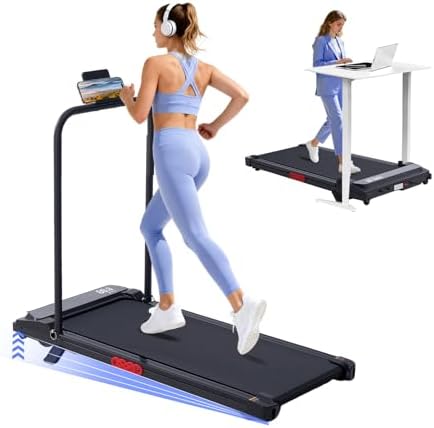
- 【Kassadin Model LS007 Treadmill with Handle Bar】A higher investment in your health deserves an unwavering foundation. Bu…
- Imported Qualitys
- 【High-Performance Small Treadmills with Incline】Powered by a 3.0HP motor, this treadmill home small reaches 0.6–7.6MPH a…
The P1 has one of the longest belts in the compact walking pad category at 16.5 by 47 inches, which gives shorter and average-height users real room to stride without feeling cramped. It has FootSense automatic speed adjustment, meaning it speeds up or slows down based on where you’re standing on the belt, so you rarely need to touch the remote mid-task. It folds 180 degrees to about 5 inches tall for storage under a bed, sofa, or desk. Note that the P1 uses a lower-cost brushed motor rather than the brushless motor found in other WalkingPad models — it’s a lighter-duty machine designed for consistent walking, not running.
Main drawbacks: The 220-pound weight limit rules it out for some users, there’s no incline, and one independent reviewer found it fairly noticeable during simultaneous work use, so it isn’t the quietest option on this list.
Skip it if: You’re over 220 lbs or specifically shopping for a quiet walking pad for a shared or open office.
WalkingPad C2 — Best Foldable Walking Pad for Small Apartments

- GET ACTIVE: Boost your metabolism and burn more calories with our mini desk walking treadmill, designed to provide a con…
- EASY TRAVEL and STORAGE – Thanks to its wheels and compact dimensions, you can easily take the portable walking pad unde…
- Compact Design with Adjustable Handlebar: Pacer mini Small Walking Pad is specifically designed for use under your desk,…
Best for: Renters and small-space living where every square foot of storage counts.
The C2 uses a half-fold hinge that produces one of the smallest stored footprints of any quality walking pad — folded dimensions run around 32.5 by 20.4 by 5.4 inches. The belt measures roughly 16 by 48 inches, with a brushless 1 HP motor rated for a top speed near 3.6–3.7 mph. Several long-term owners have reported the belt drifting off-center after months of heavy use, though the included tools allow you to re-center it yourself.
Main drawbacks: Same 220-pound weight capacity ceiling as the P1, no incline, and belt-centering maintenance may be needed over time.
Skip it if: You need a higher weight capacity or want to avoid occasional manual maintenance.
UREVO SpaceWalk 3S — Best Budget Walking Pad with Incline

- 🐋【Stable Grip, Safer Stride】Upgrade your walking pad to a more secure and comfortable treadmill experience with the UREV…
- 🎡【Quick and Easy Setup】Instantly transform your walking pad into a treadmill with the UREVO handle bar. Featuring a quic…
- ✨【Suitable for Models Up to 23.6″ Wide】No need to worry about compatibility issues. The UREVO Walking Pad handlebar is d…
Best for: Buyers who want auto-incline without paying premium prices.
At roughly $300, the SpaceWalk 3S includes a 9-level auto-incline feature (0–9%), a 265-pound weight capacity, and a manufacturer-claimed noise level under 45 decibels. The speed range runs from 0.6 to 4.0 mph. Belt width is listed at 16.5 inches; exact belt length for this specific model was not clearly disclosed in current manufacturer materials, so measure your intended walking space rather than assuming it matches UREVO’s other under-desk models.
Main drawbacks: Motor horsepower is advertised at 2.5 HP, but this is typically a peak rating rather than continuous output, and UREVO doesn’t publish continuous horsepower figures the way some competitors do.
Skip it if: You want a verified belt length before buying, or you need a recognized long-standing brand with an established warranty history.
Goplus 2-in-1 Superfit — Best for Walking Plus Light Jogging

- 2-in-1 Under Desk Treadmill – Comparing to traditional treadmills, this foldable treadmill features 2 exercise modes: wa…
- 100% Foldable for Space Saving – This desk treadmill can be folded into a compact and flat shape with a thickness only 5…
- Wide & Non-Slip Running Belt – The 39.3″ x 16″ running area is built with 5-layer running belt and 8 shock absorbers, wh…
Best for: Buyers who want one machine for both desk walking and faster cardio.
This is a true 2-in-1: walking mode tops out around 3.8 mph, and running mode (handrail attached) reaches up to 7.5 mph on most current SKUs, with a 265-pound weight capacity and a 2.25 HP peak motor. The running belt measures approximately 16 by 39–40 inches depending on the specific version. It includes a removable handrail, LED display, and remote control, and Goplus lists the unit as CE, RoHS, and EN957 certified on its own product documentation.
Main drawbacks: With the handrail attached, this unit is noticeably larger and won’t fit under most standard-height desks — it’s better suited to a living room or dedicated home-gym corner used part of the day for desk walking and part of the day for a jog.
Skip it if: You need the machine to sit fully under a fixed-height desk at all times.
Egofit Walker Pro M1 — Best Fixed-Incline Option for Calorie Focus

- 100% Nylon
- ✔️ Smallest And Lightest Treadmill You Can Find In The World – elegant to exercise in your office and home! It’s a motor…
- ✔️ Handle And Maintain With Ease – APP Mobile control and WIRELESS Remote control optional for you to operate the treadm…
Best for: Users specifically prioritizing incline walking for a calorie-focused routine.
The M1 pairs a 2.0 HP motor with a fixed (non-adjustable) incline around 5%, a belt measuring roughly 16.5 by 33.8 inches, and weight capacity listed between 220 and 242.5 lbs depending on the specific SKU. It’s compact and stores on its side. Manufacturer documentation lists motor noise as staying under 70 decibels — worth noting because that’s a notably higher ceiling than the sub-45 dB claims from some competitors, so don’t assume “whisper quiet” without testing it in your own space.
Main drawbacks: The belt is shorter front-to-back than most competitors on this list, which may feel tight for taller users or longer strides, and the fixed incline can make simultaneous typing less comfortable than a flat deck.
Skip it if: You’re on the taller side or primarily want a flat, stable surface for typing while walking.
LifeSpan TR1200-DT3 — Best Premium Pick for Heavier Users and All-Day Use

Best for: Home offices where the treadmill stays permanently in place and gets heavy daily use.
According to LifeSpan’s own product specification sheet, the TR1200-DT3 has a 20-by-50-inch belt — the widest and longest on this list — a 2.25 HP continuous-duty motor, a top speed of 4.0 mph, and a low 4.6-inch step-up height. Weight capacity is rated at 350 lbs, well above the 220–265 lb range typical of folding walking pads, which makes it a strong choice for heavier users or households with multiple people sharing one machine. Warranty coverage is unusually strong for the category: lifetime on the frame, three years on the motor, two years on parts, and one year on labor.
Main drawbacks: It doesn’t fold, so it requires permanent floor space under your desk, it’s the most expensive option here, and its 4.0 mph ceiling still limits it to walking rather than running.
Skip it if: You need to store the machine when it’s not in use, or your budget is under $500.
Belt Size vs. User Height: Why Speed Isn’t the Only Spec That Matters
Manufacturers advertise top speed heavily, but belt length and width affect comfort far more for most walking-pad use. A shorter belt (under 40 inches) can feel adequate for users under about 5’6″, but taller users or anyone with a longer natural stride may find their foot landing close to the front or back edge, which feels less secure regardless of how fast the belt can go. Belt width matters too — narrower decks (14–15 inches) leave less margin for side-to-side foot placement, which matters if you tend to shift position while typing or during a call.
There’s no single universal rule tying exact height to exact belt dimensions, since stride length varies by individual. As a practical guide: shorter and average-height users generally do fine on 40–44 inch belts, while taller users or anyone who wants extra confidence walking without looking down should lean toward belts in the 47–50 inch range, like the WalkingPad P1, C2, or the LifeSpan TR1200-DT3.
Noise: What Actually Matters for Home Office Use
Walking pad noise comes from three sources: the motor, the belt itself, and your footsteps. Manufacturer decibel claims are measured under controlled conditions and often reflect the motor alone — real-world noise, including footstep impact, tends to run higher, and it varies significantly based on your flooring. Hard floors transmit both belt hum and footfall more than carpet or a rubber mat placed under the unit.
For video calls, the practical threshold most home-office users care about is whether a colleague on the other end of the call can hear the treadmill through your microphone. Brushless motors (used in the WalkingPad C2 and, per LifeSpan’s literature, the TR1200-DT3) are generally quieter and more consistent at low speeds than budget brushed motors. If a quiet walking pad for calls is your top priority, test the unit at your actual working speed — usually 1.5–2.5 mph — since noise levels at that pace often differ meaningfully from a manufacturer’s rating taken at a higher test speed.
Weight Capacity: Don’t Treat the Maximum as a Target
A listed weight capacity is the upper limit the manufacturer has tested the frame, motor, and belt to handle — not a comfortable working range. Running a machine consistently near its stated maximum can accelerate wear on the motor and belt, and manufacturers don’t guarantee the same durability or safety margin at the ceiling that they do at moderate loads. Before buying, check the current listing for the exact rated capacity (these numbers do change between model revisions), and consider leaving meaningful headroom rather than buying right at your bodyweight limit.
Desk Compatibility: Height, Clearance, and What Kind of Work Actually Works
Most walking pads are 4.5 to 5.5 inches tall when unfolded, so you’ll need a standing desk (or a desk you’re comfortable standing at) roughly 4–6 inches taller than your normal seated setting to keep your arms and keyboard at a comfortable angle while walking. Measure the clearance under your desk, and measure your desk’s maximum height if it’s adjustable.
Not every work task is well-suited to walking. Reading, email, calls, and other tasks without fine motor demands generally transfer well to walking pace. Precision tasks — detailed spreadsheet work, graphic design, or anything requiring very steady hand control — are usually better performed standing still or seated, since even slow walking introduces enough motion to affect fine mouse or stylus control for some people.
Storage: What to Measure Before You Buy
- Flat walking pads (WalkingPad P1, C2) fold to roughly 5 inches tall and slide under a bed, sofa, or low shelf.
- Half-fold models (WalkingPad C2) produce the smallest footprint of the fold types, useful for tight closets.
- Handrail 2-in-1 treadmills (Goplus) fold the handrail down or in, but the base itself is usually longer and heavier once collapsed.
- Non-folding under-desk treadmills (LifeSpan TR1200-DT3) require a permanent spot and don’t tuck away — factor that into your space planning before ordering.
Measure your intended storage spot’s height, width, and depth, and compare it against the manufacturer’s folded dimensions, not just the unfolded footprint.
Safety Guidance for Walking Pad and Under-Desk Treadmill Use
Treadmills and walking pads are generally safe when used as intended, but a few practical habits matter. Always use the included safety key or clip where one is provided, start at the lowest speed and increase gradually, keep at least a few feet of clear space around the unit, and keep children and pets away while it’s running. Periodically check that the belt tracks straight and centered, and stop use immediately if you notice unusual sounds, jerking, or speed changes that don’t match your input.
That last point isn’t hypothetical. In April 2026, the U.S. Consumer Product Safety Commission warned consumers to stop using certain Sperax-brand walking pads and treadmills after receiving reports of sudden, uncontrolled speed changes and abrupt stops, along with hundreds of overheating and fire reports. It’s a useful reminder to buy from established brands, register your product for warranty and recall notifications, and stay alert to unusual behavior in any electric treadmill, regardless of brand. Also remember that most walking pads are not rated for running — check the manufacturer’s speed rating before assuming a faster setting is safe to jog on.
Walking Pad vs. Traditional Treadmill
| Feature | Walking Pad | Traditional Treadmill |
|---|---|---|
| Price | $150–$1,200 | $500–$3,000+ |
| Footprint | Small, low-profile | Larger, taller frame |
| Storage | Folds flat or half-fold | Bulky even when folded |
| Max Speed | 3.5–7.5 mph | 10–15+ mph |
| Incline | Rare or fixed | Common, adjustable |
| Running | Limited or not supported | Fully supported |
| Under-Desk Use | Designed for it | Not designed for it |
| Console/Features | Basic remote or small display | Full console, programs, entertainment |
| Ideal Buyer | Desk workers, step accumulation | Dedicated cardio or running training |
Neither replaces the other for every purpose. A walking pad adds movement to time you’d otherwise spend sitting; a traditional treadmill is a dedicated cardio tool for structured workouts and running.
Buying Checklist: What to Confirm Before You Purchase
- Belt length and width relative to your height and stride
- Weight capacity, with margin above your current bodyweight
- Top speed appropriate to walking vs. jogging goals
- Motor type (brushless generally runs quieter and longer) and whether the rating is continuous or peak
- Noise level, ideally tested at your actual working pace
- Folded dimensions vs. your storage space
- Desk height and under-desk clearance
- Incline availability, if that matters to your routine
- Warranty length and what it actually covers (frame, motor, parts, labor)
- Return policy and any restocking fees
- Availability of replacement belts or parts
- Included safety features (safety key, auto-shutoff)
- Current price, since walking pad pricing fluctuates with sales
Which Walking Pad Fits Your Situation?
- Best overall / best for home office: WalkingPad P1 — long belt, auto-speed control, compact storage.
- Best under $300: UREVO SpaceWalk 3S — auto-incline at a budget price.
- Best quiet walking pad: WalkingPad C2, tested at your working speed on a mat or carpet to minimize footstep noise.
- Best foldable option / best for small apartments: WalkingPad C2’s half-fold design.
- Best for tall users: LifeSpan TR1200-DT3 or WalkingPad P1, both with belts near or above 47 inches.
- Best for heavier users: LifeSpan TR1200-DT3, with its 350-lb capacity.
- Best for walking plus light jogging: Goplus 2-in-1 Superfit.
- Best premium option: LifeSpan TR1200-DT3, for all-day, multi-user office use.
If your walking-pad goal is tied to weight loss, it can help to track results over time rather than by feel alone — our guide to the best smart scales for weight loss tracking covers options that sync body composition data as your activity level changes.
Walking Pads, Weight Loss, and Realistic Expectations
Walking on a treadmill or walking pad contributes to your total daily energy expenditure, and the CDC’s Physical Activity Guidelines for Americans recommend at least 150 minutes of moderate-intensity activity per week, which a walking pad can help you accumulate during work hours. It’s worth being clear-eyed about what that does and doesn’t guarantee: body weight change depends on the overall balance between calories consumed and calories used, along with individual factors like metabolism, sleep, and stress, as NIH’s National Institute of Diabetes and Digestive and Kidney Diseases research on energy balance and obesity makes clear. A walking pad is a tool that supports an active lifestyle — not a guarantee of weight loss on its own.
There is a separate, well-documented reason to care about movement beyond weight: the American Heart Association has reported that prolonged sedentary time is linked to increased cardiovascular risk even among people who exercise regularly, which is part of why breaking up sitting time with a walking pad has value independent of any calorie math.
Frequently Asked Questions
What is the best walking pad in 2026? For most home-office users, the WalkingPad P1 offers the best combination of belt length, auto-speed control, and compact storage. Buyers needing a higher weight capacity or all-day durability should look at the LifeSpan TR1200-DT3 instead.
Are walking pads worth it? For people who sit most of the day, a walking pad is a practical way to add consistent low-intensity movement without carving out separate workout time. Whether it’s “worth it” for you depends on whether you have a suitable desk setup and realistic expectations about the pace of results.
What is the best walking pad for working from home? A true flat walking pad — not a 2-in-1 with a handrail — generally works best for desk use, since it slides fully under a standing desk. The WalkingPad P1 and C2 are both strong picks for this specific use case.
Can you use a walking pad under a standing desk? Yes, provided your desk height accommodates the pad’s deck height (typically 4.5–5.5 inches) plus your normal standing posture, and you have enough clearance underneath when the desk is at its lowest setting.
Are walking pads good for weight loss? They can support weight loss as part of an overall plan by increasing daily activity, but weight change ultimately depends on total energy balance — diet, activity, and individual factors together, not the walking pad alone.
How fast should you walk on a walking pad while working? Most desk users walk between 1.0 and 2.5 mph, which is slow enough to type, read, and take calls comfortably. Faster paces are better reserved for dedicated walking sessions without simultaneous desk work.
Can you run on a walking pad? Most true walking pads top out around 3.5–4 mph and aren’t designed for running. Some 2-in-1 models with a handrail, like the Goplus Superfit, reach higher speeds suitable for a light jog, but always check the manufacturer’s rated speed and stability before attempting to run.
Are walking pads noisy? Noise varies by motor type, speed, and flooring. Brushless motors on hard flooring at low speeds are typically quiet enough for video calls, while budget motors or higher speeds can be noticeably louder — testing at your actual working pace is the most reliable way to know.
What walking pad is best for small apartments? The WalkingPad C2’s half-fold design produces one of the smallest stored footprints available, making it a strong pick where closet or under-bed space is limited.
How do I choose the right walking pad? Start with your height and typical stride (belt size), your bodyweight plus a safety margin (weight capacity), your desk height and available floor space (desk compatibility and storage), and your noise tolerance for shared or open work environments — then match those constraints against the models in this guide rather than choosing based on price or speed alone.
Final Thoughts
The right walking pad isn’t the one with the flashiest spec sheet — it’s the one that actually fits your desk, your height, your space, and how you plan to use it day to day. Whether that’s the compact, quiet WalkingPad P1 for daily desk sessions, the space-saving WalkingPad C2 for a small apartment, or the heavy-duty LifeSpan TR1200-DT3 for all-day office use, matching the machine to your specific situation — not just chasing the highest top speed — is what makes a walking pad a habit that sticks rather than a purchase that ends up in the closet.