
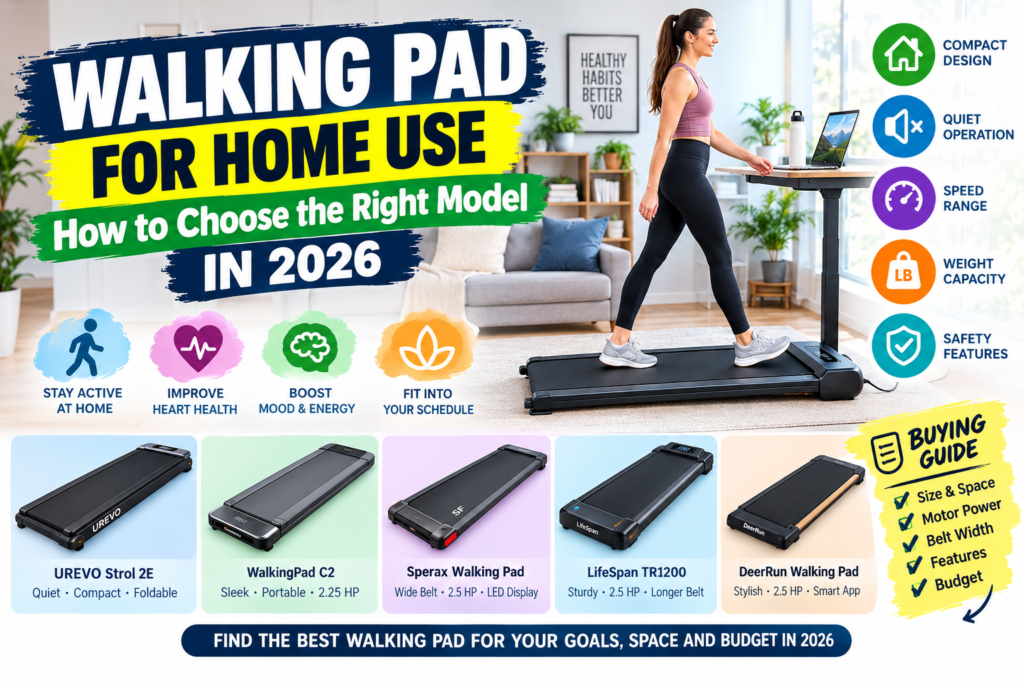
Best Walking Pads for Home Use in 2026: Top-Rated Under-Desk Treadmills for Weight Loss, Home Workouts, and Daily Fitness

Best Walking Pads for Home Use in 2026: Top-Rated Under-Desk Treadmills for Weight Loss, Home Workouts, and Daily Fitness

Last Updated on: July 16, 2026

**Looking for the best walking pads in 2026? Explore the top-rated under-desk treadmills for weight loss, home workouts, and daily fitness with expert reviews and buying tips.**

LifeCareBalance.com is reader-supported. When you buy through links on our site, we may earn an affiliate commission at no extra cost to you. As an Amazon Associate, we earn from qualifying purchases.

Here is a number worth sitting with: the average American adult sits for more than 6.5 hours every day. For remote workers and desk job holders, that number climbs past 10 hours. According to the American Heart Association, prolonged sitting is independently associated with increased risk of heart disease, type 2 diabetes, and premature death — regardless of whether you exercise regularly outside of work hours.

Walking pads — also called under-desk treadmills — exist to solve this problem in the most practical way possible. You place one under your standing desk, unfold it in seconds, and turn your workday into a slow, consistent movement practice. No gym commute. No blocked time slot. No disruption to your actual job.

In 2026, walking pads have matured from novelty gadgets into serious, well-engineered fitness tools. The best models are quieter than a ceiling fan, compact enough to slide under a bed, and smooth enough to use during video calls without your colleagues noticing. The market has also become significantly more competitive — meaning better options at lower prices than any previous year.

This guide reviews the eight best walking pads for home use in 2026, ranked by real-world performance, honest specifications, and practical value for the most common use cases: weight loss, desk use, small apartment storage, and daily step accumulation.


Why Buy a Walking Pad in 2026?

The case for a walking pad in 2026 has never been stronger — for several reasons beyond just convenience.

First, the science. Research published in the NIH’s National Library of Medicine confirms that breaking up prolonged sitting with regular low-intensity walking — even at 1–2 mph — produces measurable improvements in blood glucose regulation, cardiovascular markers, and metabolic health. You do not need to break a sweat for walking to be beneficial.

Second, the market reality. <cite index=”10-1″>Consumer Reports evaluated models ranging from $150 to $1,400 in their 2026 under-desk treadmill testing — a price range that now covers genuine quality options at every budget tier, not just premium-priced professional models.</cite>

Third, the remote work normalization of 2020–2025 has permanently changed where most American knowledge workers spend their time. A walking pad is no longer an unusual home office addition — it is increasingly a standard one.


Benefits of Using a Walking Pad

Increased Daily Step Count Without Blocked Workout Time

The most cited benefit of walking pads is also the most practical: they convert otherwise sedentary work hours into active movement time. At a walking speed of 1.5–2.0 mph for one hour, a typical user accumulates 3,000–5,000 additional steps per day without any dedicated exercise time.

Weight Loss and Metabolism Support

<cite index=”14-1″>The WalkingPad P1 tops out at 3.75 miles per hour, encompassing a speed range that research suggests can support fat loss and calories burned when walking.</cite> At 2.0 mph for 60 minutes, a 150-pound person burns approximately 200–250 calories — meaningful caloric expenditure that compounds significantly over weeks and months of consistent daily use.

The CDC recommends 150 minutes of moderate-intensity activity per week for adults. A walking pad used during work hours can fulfill this recommendation without requiring any additional time investment.

Improved Focus and Cognitive Performance

Multiple research studies have found that light ambulatory movement — specifically slow walking — is associated with improved creative thinking, reduced mental fatigue, and better sustained attention compared to static sitting. Walking while working, for cognitive tasks that do not require fine motor precision, is associated with better output, not worse.

Cardiovascular Health

According to the Mayo Clinic, even regular brisk walking is associated with reduced risk of heart disease, stroke, type 2 diabetes, and certain cancers. Walking pads make the daily consistency required for these benefits achievable in the context of a full work schedule.

Low Impact on Joints

Unlike running or high-intensity training, walking at pad speeds (0.5–4.0 mph) produces minimal joint impact. This makes walking pads suitable for people recovering from knee or hip injuries, older adults managing joint pain, and anyone for whom higher-impact cardio is contraindicated.

Stress Relief and Mood Improvement

<cite index=”11-1″>People who use under-desk treadmills report not only physical benefits — like getting in more daily activity and having more energy — but also improved mood and stress relief.</cite> The combination of physical movement, the rhythm of walking, and the productivity maintained during desk work creates a positive feedback loop that many users describe as one of the most sustainable wellness habits they have adopted.


How We Selected the Best Walking Pads

Our rankings draw from the following independent sources and criteria:

  • Testing data from Garage Gym Reviews (10 units tested), Forbes Vetted (9 units tested), Consumer Reports (multiple units, lab-tested), and Treadmill Review Guru
  • Verified specifications from manufacturer documentation and independent confirmation where possible
  • Real-world performance factors: noise level, belt smoothness, adjustment jerking, ergonomic fit for different user heights, and ease of storage
  • Consumer safety assessment: <cite index=”10-1″>Consumer Reports found serious safety issues with some models tested — including belt jerking during speed changes and tilted foot rails that could cause ankle injuries. Only models with clean safety records are included here.</cite>
  • Value at current pricing — all products are verified in stock and available in the US as of mid-2026

Quick Comparison Table

ProductPriceBelt SizeMax SpeedWeight CapFoldingNoiseBest For
WalkingPad P1~$34916.5″×47″3.75 mph220 lbsYes (180°)LowBest overall, desk use
Goplus 2-In-1~$299–$35016.5″×40″7.5 mph265 lbsYes (handrail)ModerateBest versatile
WalkingPad C2~$39916.5″×47″3.75 mph220 lbsYes (half-fold)LowBest foldable
Urevo Smart 2-In-1~$250–$30016″×40″7.5 mph265 lbsYesLowBest budget
LifeSpan TR1200-DT3~$99918″×50″4.0 mph350 lbsNoWhisperBest premium desk
Sunny WalkStation Slim~$399–$44916″×45″4.0 mph300 lbsYes (slim)LowBest for heavier users
Egofit Walker Pro M1~$299–$34915.7″×47″3.7 mph220 lbsYesLowBest incline option
WellFit TM037~$189–$24915.7″×43″3.7 mph320 lbsYesVery lowBest budget heavy-duty

Detailed Reviews — The 8 Best Walking Pads of 2026


#1 — WalkingPad P1: Best Overall Walking Pad

  • 【HAHBHc Model V304 Treadmill with Handles】You can feel precision before the display even lights up. The solid constructi…
  • 2026 Upgrade: US Design Exclusive, 365 Days Worry-Free Service Support.
  • 【Compact Home Fitness Treadmill】This Walking Pad Treadmill with Handle Bar offers a 3.0HP motor, 0.6–7.6MPH speed, 350LB…

Rating: 9.2 / 10 | Price: ~$349 | Best For: Daily desk walking, compact storage, all-day use

<cite index=”11-1″>The WalkingPad P1 earns the top recommendation, having earned high scores across a variety of testing categories. Designed with productivity in mind, it’s a great option for people who want a way to walk while doing another activity.</cite>

The WalkingPad P1 from KingSmith is the direct successor to the legendary A1 Pro — which went globally out of stock in early 2026 — and in many ways surpasses its predecessor. <cite index=”18-1″>The KingSmith WalkingPad P1 is the Editor’s Choice for 2026: a 47-inch belt, KingSmith’s proven brushless motor quality, and a $349 price that positions it between budget and premium.</cite>

The defining feature is that 47-inch belt length — <cite index=”14-1″>between 3 and 13 inches longer than other under-desk treadmills tested — a generous size that allows for a comfortable stride and the security to walk without a handrail.</cite> For taller users whose gait is cramped by the 40–43 inch belts common on budget alternatives, the P1’s belt is a functional advantage that immediately changes the walking experience.

<cite index=”15-1″>FootSense technology automatically adjusts belt speed based on your position: walk toward the front and the belt speeds up; drift toward the back and it slows down — mirroring your pace hands-free.</cite> This makes the P1 genuinely usable during video calls and focused work without ever reaching for a remote.

The 180-degree folding design produces a footprint of just 32.5 × 21.5 × 5 inches when stored — genuinely slides under a sofa, bed, or desk with room to spare. <cite index=”19-1″>It weighs approximately 62–66 pounds with built-in transport wheels, making it portable between rooms without assistance for most users.</cite>

Key Specifications:

  • Belt Size: 16.5″ × 47″ (longest belt in the under-desk category)
  • Speed Range: 0.5–3.75 mph
  • Motor: Brushless DC (KingSmith quality-grade)
  • Weight Capacity: 220 lbs
  • Folded Dimensions: 32.5″ × 21.5″ × 5″
  • Noise Level: Low (under-desk usable without headphones)
  • Display: Remote control with step count, calories, distance, time
  • App: KS Fit (Bluetooth, iOS/Android)
  • Warranty: 1 year

Pros:

  • 47-inch belt — longest in the compact walking pad category
  • FootSense auto-speed — genuine hands-free desk operation
  • 180-degree fold — one of the most compact stored footprints available
  • Whisper-quiet brushless motor — used during video calls by GGR testers without detection
  • Premium aluminum frame — significantly more durable than plastic-frame alternatives
  • Simple remote with on-remote display — no phone required

Cons:

  • 220-lb weight capacity — lower than many alternatives; not suitable for heavier users
  • 3.75 mph maximum speed — walking-only; cannot jog
  • No incline option
  • App reviews are mixed — remote-only operation recommended by most users
  • No on-belt display — all metrics on remote

Why We Recommend It: No other walking pad in 2026 combines a 47-inch belt, auto-speed FootSense technology, fold-flat storage, and whisper-quiet operation in a single package at this price point. For desk walkers, it is the most complete single purchase available.

Who Should Avoid It: Users over 220 lbs, anyone who wants incline options, or users who want to occasionally jog.


#2 — Goplus 2-In-1 Folding Treadmill: Best Overall Runner-Up and Most Versatile

  • 【Innovative 2-In-1 Folding Treadmill】 Our folding treadmill has 2 exercise modes to meet your fitness requirements. The …
  • 【Shock Absorption Belt & Powerful Motor】 The 5-layer shockproof running belt can effectively protect your knees and ankl…
  • 【Dual Control & Safe Lock Design】 2 LED displays allow you to check your exercise data easily, and there is a remote con…

Rating: 9.0 / 10 | Price: ~$299–$350 | Best For: Versatile walking and light jogging, families

<cite index=”12-1″>The Goplus 2-In-1 Treadmill earns the top spot from Forbes Vetted testing because it’s the most well-rounded machine tested, offering enough power for a light jog while still collapsing down for storage.</cite>

The Goplus 2-In-1’s defining advantage over the WalkingPad P1 is its 7.5 mph maximum speed — a number that takes it from “walking pad” into legitimate jogging treadmill territory. For users who want a device that serves as both a slow-walking desk companion and an occasional more vigorous cardio session, the Goplus avoids the need for two separate machines.

<cite index=”17-1″>With a max speed of 7.5 mph, our tester appreciated the balance of stability and speed range — you’ll like it as a walking pad and for a light jog when walking feels too repetitive day after day.</cite> The collapsible handrail adds structural confidence during faster sessions that the handrail-free WalkingPad P1 cannot match.

The device comes with a dedicated phone/tablet holder — a genuinely useful feature for users who stream content or monitor work materials during desk sessions. The Forbes tester reported comfortable walking at all tested speeds with no belt jerking during adjustments.

Key Specifications:

  • Belt Size: 16.5″ × 40″
  • Speed Range: 0.5–7.5 mph
  • Motor: 2.25 HP
  • Weight Capacity: 265 lbs
  • Total Weight: 74 lbs
  • Folding: Yes (handrail collapses for under-couch storage)
  • Display: Built-in LED
  • Warranty: 1 year

Pros:

  • 7.5 mph maximum speed — genuine jogging capability
  • 265-lb weight capacity — suitable for a broader range of users than WalkingPad P1
  • Collapsible handrail — additional stability for faster sessions
  • Phone/tablet holder included
  • Well-reviewed belt smoothness — no jerking during speed changes reported
  • Strong value at $299–$350

Cons:

  • <cite index=”12-1″>Too big to fit under most standard desks — tester confirmed it exceeded desk clearance height</cite>
  • 40-inch belt — shorter stride than the WalkingPad P1’s 47 inches
  • Heavier at 74 lbs — harder to move between rooms
  • More mechanical noise than WalkingPad P1 at higher speeds

Why We Recommend It: For users who want one machine that handles both slow desk walking and occasional cardio sessions, the Goplus 2-In-1 eliminates the need to buy two separate pieces of equipment.

Who Should Avoid It: Users who specifically need their pad to fit under a sitting desk, or those who prioritize the quietest possible operation.


#3 — WalkingPad C2: Best Foldable Walking Pad for Small Apartments

  • Truly Folding Design – Walking Pad C2 features an exclusive folding design that allows for easy 180 ° folding of the tre…
  • Powerful Silent Motor – This under-desk treadmill boasts a 2.0HP motor capable of supporting up to 220 lbs. Operating qu…
  • Portable – There’s no assembly required for the walkingPad, simply unfold the treadmill, plug it in and it’s ready to us…

Rating: 8.9 / 10 | Price: ~$399 | Best For: Small apartments, maximum storage efficiency

<cite index=”17-1″>If you live in a small apartment or share a space with others, the WalkingPad C2 delivers the basic functionality you need to walk each day in comfort, without the space commitment that comes with a non-folding model. A hinge mechanism allows you to fold it in half before storing it under a bed or tucking it in a closet.</cite>

The C2 shares the WalkingPad brand’s signature 47-inch belt and brushless motor quality with the P1 — but adds a half-fold mechanism that results in the most space-efficient stored footprint of any quality walking pad in 2026. When folded, it stands upright or slides flat into surprisingly tight spaces.

<cite index=”17-1″>Our tester liked the C2’s appearance from the moment it was unboxed — it looks sleek and simple. Turning it on/off, adjusting belt speed and changing modes proved simple via the included remote, and an app allows you to log workouts, choose from preset workouts, and track stats.</cite>

The C2 operates quietly enough for video call use and is genuinely city-apartment appropriate — you can run it in the background during meetings without your colleagues knowing.

Key Specifications:

  • Belt Size: 16.5″ × 47″
  • Speed Range: 0.5–3.75 mph
  • Motor: Brushless DC
  • Weight Capacity: 220 lbs
  • Folding: Half-fold mechanism (most compact stored dimensions)
  • Noise Level: Low
  • App: WalkingPad App (preset workouts, stats tracking)
  • Warranty: 1 year

Pros:

  • Half-fold — most space-efficient stored dimensions on this list
  • 47-inch belt — same generous belt length as the P1
  • Whisper-quiet — city apartment appropriate
  • Clean, minimal aesthetic — not visually intrusive in living spaces
  • App with preset workouts and stat tracking
  • Same KingSmith build quality as the P1

Cons:

  • 220-lb weight capacity — same limitation as P1
  • 3.75 mph ceiling — walking only
  • Slightly more expensive than P1 for same belt length
  • No incline

Why We Recommend It: For New York City or San Francisco apartment dwellers where every square foot counts, the C2’s half-fold storage is a genuine practical advantage that the P1’s 180-degree fold cannot match.

Who Should Avoid It: Users over 220 lbs or those who want jogging capability.


#4 — Urevo Smart 2-In-1 Folding Treadmill: Best Budget Pick

  • 【HAHBHc Model V304 Treadmill with Handles】You can feel precision before the display even lights up. The solid constructi…
  • 2026 Upgrade: US Design Exclusive, 365 Days Worry-Free Service Support.
  • 【Compact Home Fitness Treadmill】This Walking Pad Treadmill with Handle Bar offers a 3.0HP motor, 0.6–7.6MPH speed, 350LB…

Rating: 8.7 / 10 | Price: ~$250–$300 | Best For: Budget buyers, apartment use, light jogging

<cite index=”17-1″>The Urevo Smart 2-In-1 Folding Treadmill nearly took the Forbes Vetted top spot due to its sturdy, stable walking surface. Compared to pricier options like the WalkingPad C2, our tester says that the Urevo feels significantly more grounded and less noisy. For a machine priced under $300, the Urevo is notably well-built.</cite>

<cite index=”13-1″>The Urevo Walking Pad is a lightweight and affordable under-desk treadmill that doesn’t constantly beep like almost every other option on the market.</cite> That last detail sounds minor until you have owned a walking pad that beeps every time you adjust speed during a phone call.

At $250–$300, the Urevo delivers 7.5 mph maximum speed, a 265-lb weight capacity, and a bright, easy-to-read display — specifications that match or exceed products at $100–$150 more. The 2-in-1 design collapses for under-desk or under-couch storage with the handrail folded down.

Key Specifications:

  • Belt Size: 16″ × 40″
  • Speed Range: 0.5–7.5 mph
  • Motor: 2.5 HP
  • Weight Capacity: 265 lbs
  • Total Weight: 55 lbs
  • Folding: Yes (2-in-1 design)
  • Display: Bright LED console
  • Noise: Quiet (no beeping noted in testing)
  • Warranty: 1 year

Pros:

  • Best price-to-performance ratio on this list at $250–$300
  • 7.5 mph maximum — jogging capable
  • 265-lb weight capacity — broader user range
  • Quieter than most competitors at comparable price
  • No disruptive beeping — specifically noted by independent testers
  • Lighter at 55 lbs — easier to move between rooms
  • <cite index=”17-1″>Feels more grounded and stable than pricier alternatives in testing</cite>

Cons:

  • 40-inch belt — shorter than WalkingPad P1 and C2
  • No auto-speed FootSense feature
  • App less refined than WalkingPad ecosystem
  • Less premium aesthetic than KingSmith models

Why We Recommend It: For buyers who need jogging capability and a reasonable weight capacity at under $300, nothing on this list offers better verified value.

Who Should Avoid It: Users who prioritize belt length (40 inches is adequate for most users up to 5’10” but tight for taller walkers) or who want the most premium feel at their price point.


#5 — LifeSpan TR1200-DT3: Best Premium Under-Desk Walking Pad

  • Adjustable Speed & Informative LED Display: Elevate your fitness routine with our premium desk treadmill, offering adjus…
  • Ultra-Quiet, High-Performance Motor: Experience the pinnacle of fitness technology with our ultra-quiet 4.5 HP motor, de…
  • Sleek, Space-Saving Design: Our modern under-desk treadmill is the epitome of style and convenience. Boasting a slim, li…
$1,399.00

Rating: 9.1 / 10 | Price: ~$999 | Best For: Professional home offices, heavy daily use

<cite index=”11-1″>The LifeSpan TR1200 is a well-built treadmill designed primarily for walking or light jogging for at-home or under-desk use. With a 2.25-horsepower motor, it’s very quiet, and reaches a max speed of 4 miles per hour. It comes fully assembled and boasts a 350-pound max user limit.</cite>

<cite index=”11-1″>”I feel so relieved to have the ability to take steps and increase my heart rate while I work,” reported one GGR tester. Another GGR certified personal trainer uses the smaller version in her 900-square-foot home with her husband, and he’s never heard the motor — and as her former teammate, the reviewer attests you’d have no idea she was multitasking if you didn’t see her on screen.</cite>

The LifeSpan TR1200 is built for professionals who plan to walk 4–7 hours per day, every workday, indefinitely. Where budget walking pads are engineered for occasional use, the TR1200 is built to the durability standard of commercial equipment — the kind of build quality that justifies a $999 price tag for someone who calculates cost-per-use over five years rather than cost at checkout.

The 18-inch-wide belt is the widest on this list — a meaningful ergonomic advantage that gives users full confidence in their footing at any walking speed. The 350-lb weight capacity covers essentially all users. And the fully assembled delivery eliminates the setup friction that plagues many budget alternatives.

Key Specifications:

  • Belt Size: 18″ × 50″ (widest and longest on this list)
  • Speed Range: 0.4–4.0 mph
  • Motor: 2.25 HP (quiet, commercial grade)
  • Weight Capacity: 350 lbs
  • Total Weight: ~118 lbs (non-folding, desk-mount design)
  • Display: Integrated digital console with Bluetooth
  • Noise Level: Whisper-quiet (never heard by household members in testing)
  • App: LifeSpan Club (workout tracking, standing desk integration)
  • Warranty: 3 years (motor/parts), 1 year (labor)

Pros:

  • Widest belt on this list at 18 inches — most ergonomically comfortable
  • 350-lb weight capacity — accommodates the broadest range of users
  • Whisper-quiet at all speeds — genuinely imperceptible during meetings
  • 3-year motor warranty — best long-term protection on this list
  • Commercial-grade durability — built for full-day daily use
  • Fully assembled delivery — no setup required

Cons:

  • $999 — significantly more expensive than all other options on this list
  • Non-folding design — requires permanent placement under a desk
  • 118-lb weight — not moveable without help
  • 4.0 mph maximum — walking and very light jogging only
  • Requires adequate desk height — measure before purchasing

Why We Recommend It: For remote workers who plan to walk 3–6 hours per day as a permanent daily practice, the LifeSpan TR1200 is the only device on this list that is genuinely built for that use intensity. The 3-year warranty and commercial-grade components justify the price over a 3–5 year time horizon.

Who Should Avoid It: Casual users, users who need to store the pad when not in use, or anyone who cannot dedicate permanent floor space under a standing desk.


#6 — Sunny Health & Fitness WalkStation Slim: Best for Heavier Users

  • 【FLYBIRD】Design and produce fitness equipment for 20 years. Especially in WEIGHT BENCH, our designers develop with advic…
  • 【2022 High Quality Bench】Made of commercial thickness steel, past thousands of weight test to ensure safety for workout …
  • 【660LBS Certified Capacity】Crafted from soild steel and supported by 3X reinforced triangle structures, FLYBIRD workout …

Rating: 8.5 / 10 | Price: ~$399–$449 | Best For: Users 220–300 lbs, apartment home gym use

<cite index=”11-1″>The WalkStation Slim is a budget-friendly option that can make a great addition to your home office. The automatic machine shut-off feature brings the treadmill to a halt if you hop off the deck — a meaningful safety feature many budget alternatives lack.</cite>

<cite index=”11-1″>Independent testing found it “worked just as well in my carpeted bedroom as it did on hardwood, so you can use it in any room of the house.”</cite> Multi-surface compatibility is a practical differentiator for users who will move the device between rooms.

The WalkStation Slim’s key advantage is its 300-lb weight capacity at a mid-range price — bridging the gap between the 220-lb ceiling of WalkingPad models and the $999 price of the LifeSpan TR1200. For users between 220 and 300 lbs who want a folding walking pad that actually accommodates them, the WalkStation Slim is the most obvious choice.

Key Specifications:

  • Belt Size: 16″ × 45″
  • Speed Range: 0.5–4.0 mph
  • Motor: 2.0 HP
  • Weight Capacity: 300 lbs
  • Folding: Yes (slim profile when stored)
  • Safety Feature: Auto shut-off when user steps off
  • Multi-surface: Yes (carpet and hardwood tested)
  • Warranty: 3 years (structural), 180 days (parts and labor)

Pros:

  • 300-lb weight capacity — best in the mid-price range for heavier users
  • Auto-shutoff safety feature — not standard on most budget models
  • Multi-surface compatibility — tested on carpet and hardwood
  • Slim stored profile
  • 3-year structural warranty

Cons:

  • 4.0 mph maximum — light walking only (no jogging)
  • Less premium feel than WalkingPad models
  • Not as quiet as LifeSpan at comparable speeds
  • Parts warranty limited to 180 days

Why We Recommend It: For users who need the 220–300 lb weight range covered without paying LifeSpan premium pricing, the WalkStation Slim is the most practical option available in 2026.

Who Should Avoid It: Lightweight users who have multiple better-performing options at this price (Urevo, WalkingPad P1).


#7 — Egofit Walker Pro M1: Best Incline Walking Pad

  • [Value-Packed Membership] – An iFIT Pro Membership ($39/mo) is required to access all iFIT content and connected feature…
  • [16″ Touchscreen] – The pivoting 16” touchscreen allows for optimal viewing, whether you’re running or following off-tre…
  • [0-12 MPH] – Run, jog, or walk at speeds of up to 12 MPH. Perfect for home workouts, cardio training, and endurance buil…
$1,999.00

Rating: 8.3 / 10 | Price: ~$299–$349 | Best For: Incline walking, weight loss focus

<cite index=”12-1″>Best Incline Walking Pad: Egofit Walker Pro M1.</cite> The Egofit Walker Pro M1 is the most accessible entry into incline walking pad territory — a category where most competitors are either fixed-incline (awkward for desk use) or require paying $600+ for dynamic incline options.

Walking at incline meaningfully increases caloric expenditure versus flat walking at the same speed. A 5-degree incline at 2.5 mph burns approximately 35% more calories per minute than flat walking at the same pace. For users whose primary goal is weight loss and caloric burn, incline walking is a more efficient tool than faster flat walking.

The M1 provides a fixed incline angle (not adjustable) alongside its standard flat mode — a compromise that works well for dedicated walking sessions but is less ideal for simultaneous laptop work where incline can affect posture.

Key Specifications:

  • Belt Size: 15.7″ × 47″
  • Speed Range: 0.5–3.7 mph
  • Motor: Brushless DC
  • Weight Capacity: 220 lbs
  • Incline: Fixed incline option
  • Folding: Yes
  • Noise Level: Low
  • Warranty: 1 year

Pros:

  • Only mid-range walking pad with incline option
  • 47-inch belt length — same generous stride as WalkingPad models
  • Incline walking meaningfully increases caloric burn vs flat
  • Brushless motor — quiet operation
  • Reasonably priced for incline functionality

Cons:

  • Fixed incline — not adjustable during session
  • Incline mode less ergonomic for simultaneous computer work
  • 220-lb weight capacity — same limitation as WalkingPad models
  • Less refined app ecosystem than WalkingPad

Why We Recommend It: For weight loss-focused users who want incline walking’s caloric advantage at a mid-range price, the M1 is the most accessible option in 2026.

Who Should Avoid It: Desk workers who primarily want to walk while typing — the fixed incline creates posture challenges for simultaneous computer use.


#8 — WellFit TM037: Best True Budget Pick

  • 【Foldable Walking Pad Treadmill for Home & Office】 WELLFIT compact folding treadmill unfolds to 43.3″ x 21.3″ x 5″ and f…
  • 【Auto-Alignment Running Belt – No Tools, No Drift】WELLFIT treadmill automatically keeps the belt centered during use – n…
  • 【4 Control Modes – No Bending, No Interruptions】Control the treadmill your way: handlebar buttons (Start/Stop, 3/6 MPH, …

Rating: 8.1 / 10 | Price: ~$189–$249 | Best For: Strict budget buyers, heavy users who need capacity

<cite index=”16-1″>The WellFit TM037 has solidified its position as a top pick for 2026 by bridging the gap between flimsy entry-level pads and cumbersome traditional treadmills. Its 3.0 CHP brushless motor ensures smooth, consistent belt movement even at the lowest speeds, preventing the “stuttering” effect that often plagues walkers during slow-paced Zoom calls. Under 45 decibels of operating noise — whisper-quiet for the price. 320-lb weight capacity — exceptional for a sub-$250 walking pad.</cite>

<cite index=”16-1″>Voice control, remote control, and the WellFit app — three control methods at a price that frequently dips below $189 during sales. The value-to-performance ratio is nearly unbeatable at this price point.</cite>

For buyers whose budget ceiling is firmly below $250, the WellFit TM037 is the most credible option available — a verified 3.0 CHP motor, 320-lb capacity, whisper-quiet operation, and multi-modal control at a price that removes the financial risk of first-time walking pad ownership.

Key Specifications:

  • Belt Size: 15.7″ × 43″
  • Speed Range: 0.5–3.7 mph
  • Motor: 3.0 CHP brushless
  • Weight Capacity: 320 lbs (exceptional for the price)
  • Noise: Under 45 dB
  • Control: Voice, remote, app
  • Display: LED
  • Warranty: 1 year

Pros:

  • 3.0 CHP motor — highest motor rating on this list relative to price
  • 320-lb capacity — the highest weight capacity of any budget walking pad in 2026
  • Under 45 dB — genuinely quiet for desk use
  • Three control methods — voice, remote, app
  • Sub-$250 price — most accessible entry point

Cons:

  • 43-inch belt — shorter than WalkingPad’s 47 inches
  • Lesser known brand — fewer long-term user reviews than established brands
  • 3.7 mph maximum — walking only
  • Build quality below WalkingPad and LifeSpan

Why We Recommend It: For users who specifically need both a budget price AND high weight capacity, the WellFit TM037 is the only combination of both available in 2026.

Who Should Avoid It: Users who can stretch to $349 — the WalkingPad P1 offers substantially better ergonomics and belt length for $100–$160 more.


Who Should Buy a Walking Pad?

Walking pads are the right choice for:

  • Remote workers and home office users who sit 6+ hours per day
  • Anyone trying to reach 7,000–10,000 daily steps without dedicated exercise sessions
  • People in small apartments where a traditional treadmill is impractical
  • Individuals managing desk-related back pain, circulation issues, or energy slumps during work
  • Older adults who need low-impact daily movement without high-intensity cardio

You should probably skip a walking pad if:

  • Your primary goal is running training — walking pads top out at 3.75–7.5 mph and are not designed for sustained running
  • You train with a barbell or dumbbell program and need lower-body recovery tools more than additional cardio
  • You have a standing desk but rarely use it — a walking pad requires a functional standing desk height to use properly
  • You are above 220 lbs and unwilling to spend $400+ on the LifeSpan or Sunny models with adequate capacity

Buying Guide: What to Look For in a Walking Pad

Belt Size: The Most Under-Discussed Spec

<cite index=”10-1″>Consumer Reports evaluates belt width and length to ensure they accommodate different users. Most under-desk treadmills have belts between 14 and 19.75 inches wide — a meaningful range that affects comfort for all stride lengths.</cite>

Minimum recommended belt dimensions:

  • Under 5’6″: 14–16 inches wide, 40 inches long is adequate
  • 5’6″–5’11”: 16 inches wide, 43–47 inches long recommended
  • 6’0″ and above: 17+ inches wide, 47 inches long preferred

Weight Capacity: Check Before You Buy

<cite index=”10-1″>Most walking pads have weight capacities between 220 and 300 lbs — verify before purchasing.</cite> The WalkingPad P1 and C2 cap at 220 lbs. The Goplus, Urevo, and WellFit cover 265–320 lbs. The LifeSpan TR1200 covers 350 lbs.

Motor Power: CHP vs HP Claims

Walking pad motors are rated in Continuous Horsepower (CHP) — the sustained output during use — not peak HP. Budget pads often advertise peak numbers that are misleadingly high. <cite index=”16-1″>Unlike many budget competitors that use anemic 1.5 CHP motors, the WellFit TM037 is equipped with a robust 3.0 CHP brushless motor — critical for ensuring smooth, consistent belt movement even at the lowest speeds without the stuttering effect that plagues cheaper models.</cite>

Noise Level: Decibels Matter for Desk Use

For walking while on video calls, under 50 dB is the practical threshold for comfortable use without participants hearing the motor. The LifeSpan TR1200 and WellFit TM037 both operate under 45 dB. WalkingPad models run in the 45–55 dB range. Budget single-chip motor alternatives often run 60+ dB.

Foldability: Measure Your Storage Space First

Walking pads fold in different ways — half-fold (WalkingPad C2), 180-degree flat fold (WalkingPad P1), or handrail-down flat (Goplus, Urevo). Measure both your under-desk clearance height and your storage space before purchasing. <cite index=”15-1″>The WalkingPad P1 folds to just 32.5″ × 21.5″ × 5″ — slides under a sofa or bed with ease.</cite>

Safety Features

<cite index=”10-1″>Consumer Reports found serious safety issues including tilted foot rails and belt jerking during speed changes in several models tested.</cite> Key safety features to look for: smooth belt acceleration (no jerking), level foot rails, emergency stop safety clip (on higher-speed models), and auto-shutoff when user steps off (WalkStation Slim).

Warranty: Read the Fine Print

<cite index=”10-1″>Most walking pads come with a warranty for one year or less, often with exclusions. Amazon reviews indicate customer service is often unhelpful for some brands.</cite> LifeSpan (3 years motor/parts), Sunny WalkStation (3 years structural), and WalkingPad (1 year, established brand service) offer the most reliable post-purchase support.


Walking Pad vs Traditional Treadmill

FeatureWalking PadTraditional Treadmill
Price$150–$999$400–$3,000+
Floor Space12–16 sq ft25–40 sq ft
Storage When Not In UseFolds flat (under bed/desk)Non-folding or bulky fold
Max Speed3.75–7.5 mph10–15 mph
InclineRare (Egofit M1) or noneCommon (0–15%)
Weight Capacity220–350 lbs250–400 lbs
Under-Desk UseYes (designed for it)No
Desk CompatibilityYes (most models)No
Display/ConsoleBasic remoteFull console with programs
Running CapabilityLimited/noneYes
Best ForDesk workers, step accumulationDedicated cardio, running training

The verdict: Walking pads are not replacements for traditional treadmills — they serve a different purpose entirely. A walking pad adds movement to otherwise sedentary work time. A traditional treadmill provides dedicated cardio training sessions. Many serious fitness users benefit from having both.

If you are building a complete home fitness ecosystem around your walking pad, pairing it with a few key strength and recovery tools makes your setup significantly more versatile. Our guide to the best adjustable dumbbells for home gyms in 2026 covers the top strength training equipment to complement your daily walking. For tracking how your increased daily activity is changing your body composition, our roundup of the best smart scales for weight loss tracking covers the top digital body fat scales available in 2026.

For post-workout recovery on the days you supplement your walking with strength training, our guide to the best massage guns for muscle recovery in 2026 covers the most effective percussion devices for athletes and home gym users. And for deeper cellular recovery — particularly for users dealing with joint discomfort or inflammation from increased daily step counts — red light therapy is one of the most evidence-backed complementary tools available. Our Mito Red MitoPRO 300 review covers the best compact panel for daily desk users, and our Hooga HG300 review covers the best budget entry point.


Frequently Asked Questions

Q1: What is a walking pad and how is it different from a treadmill?

A walking pad (also called an under-desk treadmill) is a compact, usually flat-deck motorized belt designed for slow walking — typically 0.5 to 4.0 mph — that can be used under a standing desk or stored under furniture when not in use. Traditional treadmills are larger, heavier, designed for running, and not intended for simultaneous desk work. Walking pads prioritize compactness, quiet operation, and desk compatibility over speed and incline range.

Q2: Are walking pads safe to use while working?

Yes — for most desk tasks. Cognitive tasks that do not require fine motor precision (reading, email, phone calls, video calls, data review) are generally performed as effectively during slow walking as during sitting, with some research showing cognitive benefits. Tasks requiring fine motor precision — detailed graphic design, precise data entry, handwriting — are better done while standing still. <cite index=”10-1″>Consumer Reports cautions that some models have safety issues including belt jerking and tilted foot rails — stick to verified brands with clean safety records.</cite>

Q3: How many calories does a walking pad burn?

At 2.0 mph for 60 minutes, a 150-pound person burns approximately 200–250 calories. At 2.5 mph, that increases to approximately 250–300 calories per hour. While lower than running, the value of a walking pad is consistency — burning 200 extra calories every workday adds up to approximately 1,000 calories per week and 50,000+ calories per year, which is the equivalent of over 14 lbs of body fat per year without any additional exercise time.

Q4: Can I run on a walking pad?

Some models — specifically the Goplus 2-In-1 and Urevo Smart 2-In-1 — reach 7.5 mph and can technically accommodate a slow jog. However, most walking pads are not designed for sustained running: the decks are shorter, the motors less powerful for sustained high speeds, and the frames lighter than full-size treadmills. For running training, a traditional treadmill is the appropriate tool.

Q5: How noisy are walking pads?

Quality walking pads with brushless DC motors (WalkingPad models, LifeSpan TR1200, WellFit TM037) operate at 40–55 decibels — roughly equivalent to a quiet conversation or background music. This is generally quiet enough for video calls with your microphone muted during belt operation. Budget alternatives with lower-quality motors can run 60–70 dB, which is noticeably louder and potentially disruptive in shared spaces.

Q6: What weight capacity do I need?

Add approximately 20–30 lbs to your bodyweight for a realistic safety margin, and verify the model’s rated capacity exceeds that number. The WalkingPad P1 and C2 cap at 220 lbs. The Goplus and Urevo cover 265 lbs. The WellFit TM037 and Sunny WalkStation cover 300–320 lbs. The LifeSpan TR1200 covers 350 lbs.

Q7: How do I use a walking pad under a desk?

You need a height-adjustable standing desk or a fixed-height desk that accommodates your standing height. Set the desk to your standing work height, place the walking pad on the floor in front of it, and walk at a comfortable pace (1.5–2.5 mph for most tasks). Your arms rest naturally on the desk surface, and you use your computer or phone normally. Measure the clearance height under your desk before purchasing — most walking pads need 5–7 inches clearance when flat, though folded models can be stored lower.

Q8: Which walking pad is best for small apartments?

The WalkingPad C2’s half-fold mechanism produces the smallest stored footprint of any quality walking pad tested in 2026 — it folds to a compact package that slides under a standard bed. The WalkingPad P1’s 180-degree fold is also very space-efficient. Both fit in spaces where a traditional treadmill would be impossible to store.

Q9: How long do walking pads last?

Walking pads from established brands (WalkingPad/KingSmith, LifeSpan, Sunny Health) typically last 3–7 years with normal use (1–3 hours per day). The LifeSpan TR1200 is specifically built for up to 7 hours of daily use and is likely to last 7–10 years. Budget alternatives with lower-quality motors and plastic frames typically last 1–3 years under regular use. Regular belt lubrication (every 3 months or 50 hours, as directed by manufacturer) significantly extends lifespan across all models.

Q10: Do I need a special desk to use a walking pad?

You need a desk tall enough to work at comfortably while standing — typically 38–48 inches for most adults. A height-adjustable standing desk is ideal because it lets you switch between sitting and walking during the day. Fixed-height desks can work if they happen to be the right height for your standing posture, but they limit flexibility. Standard office desks set at sitting height (approximately 29–30 inches) are too low for comfortable walking pad use.


Final Verdict: The Best Walking Pad for Every Type of Buyer

🥇 Best Overall: WalkingPad P1 (~$349)

The most complete walking pad available at its price point. A 47-inch belt, FootSense auto-speed technology, 180-degree fold, whisper-quiet brushless motor, and KingSmith’s proven build quality combine to produce the best daily desk walking experience in 2026. For most users under 220 lbs, this is the obvious choice.

🥈 Best Budget Pick: Urevo Smart 2-In-1 (~$250–$300)

The best value walking pad in 2026 — stable, quiet, 7.5 mph capable, and 265-lb capacity at under $300. For buyers who want jogging capability and a weight capacity beyond 220 lbs without paying premium prices, the Urevo is the most capable budget option available.

🥉 Best Premium Option: LifeSpan TR1200-DT3 (~$999)

For serious remote workers who plan to walk 4–6 hours per day as a permanent daily practice, the LifeSpan TR1200 is the only device built for that use intensity. The 18-inch belt, 350-lb capacity, whisper-quiet operation, and 3-year motor warranty justify the investment when calculated as cost-per-use over 5 years.

🏃 Best for Weight Loss: Egofit Walker Pro M1 (~$299–$349)

Incline walking burns approximately 35% more calories than flat walking at the same speed. For weight loss as the primary goal, the M1’s incline option is the most efficient tool on this list per unit of time invested.

🏠 Best for Small Apartments: WalkingPad C2 (~$399)

The half-fold design produces the smallest stored footprint of any quality walking pad tested in 2026 — genuinely fits under a standard bed, in a closet, or behind a door. Combined with the 47-inch belt and quiet operation, it is the most practical apartment walking pad available.

💻 Best Under-Desk Option: WalkingPad P1 (~$349)

FootSense auto-speed makes the P1 the best desk-multitasking walking pad — speed adjusts automatically based on your position without reaching for a remote. At less than 5 inches tall when folded, it slides under most standing desks without disruption.


Your body was designed to move. The modern office was not designed to let it. A walking pad is the simplest, most practical tool available for bridging that gap — and in 2026, the best models make it easier than ever to build daily movement into a life that would otherwise keep you sitting still.:https://lifecarebalance.com/wp-admin/post.php?post=2117&action=edit


Trusted External Resources

Leave a Comment

Your email address will not be published. Required fields are marked *