
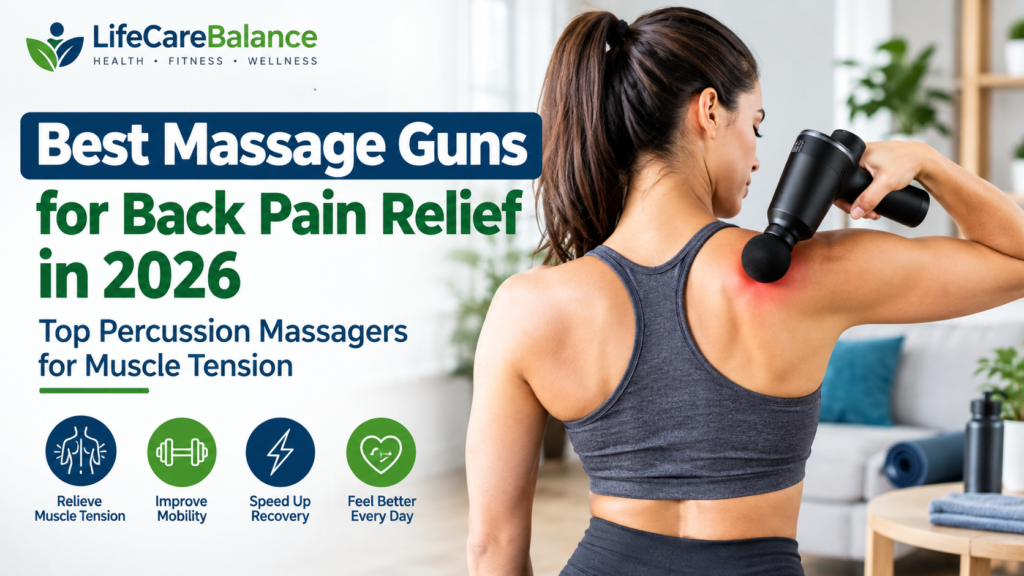
Discover the best massage guns for back pain relief in 2026. Compare top percussion massagers for muscle tension, recovery, comfort, and home use.
LifeCareBalance.com is reader-supported. When you buy through links on our site, we may earn an affiliate commission at no extra cost to you. As an Amazon Associate, we earn from qualifying purchases.
If your back tightens up by 3 p.m. at your desk, or your lower back feels locked after leg day, you’ve probably considered a massage gun. These handheld percussion devices have become one of the most popular at-home recovery tools in the U.S., promising deep-tissue relief without booking a massage therapist.
But here’s the honest version: a massage gun can be genuinely useful for muscular tightness, soreness, and short-term mobility — it is not a fix for every kind of back pain. Nerve-related pain, structural spine problems, and chronic conditions need a different kind of care. This guide covers both sides: which massage guns are worth buying for back-related tension in 2026, and where the limits of percussive therapy actually are.
Quick Picks
| Product | Best For | Price | Amplitude | Stall Force | Speed Settings | Battery Life | Weight | Noise | Attachments | Warranty | Back-Pain Use Case |
|---|---|---|---|---|---|---|---|---|---|---|---|
| Hypervolt 3 | Best Overall | $249 | 12mm | 60 lbs | 5 (1,500–2,500 PPM) | Up to 4 hrs | 2.0 lbs | ~48 dB | 5, incl. heated head | 1-year | Everyday desk tension across upper and lower back |
| Theragun Pro Plus G6 | Best Premium | ~$650 | 16mm | Not publicly specified | 5 | ~150 min (varies by attachment) | ~3.6 lbs (1,650g) | Not publicly specified | Multiple, incl. heat & vibration heads | 2-year (per manufacturer) | Chronic muscular tightness wanting heat + deep percussion in one device |
| Ekrin Athletics B37 | Best Value | $229 (often $189–199) | 12mm | 56 lbs | 5 (1,400–3,200 PPM) | Up to 8 hrs (USB-C) | 2.1 lbs | Marketed as ultra-quiet; independently tested near 70 dB at top speed | 4 | Lifetime | Angled handle designed for self-reach on the lower back |
| RENPHO Power Massage Gun | Best Budget | ~$100 | 12mm | 50 lbs (manufacturer-stated) | 6 (up to 2,600 PPM) | Up to 4 hrs | Not publicly specified | ~45 dB (third-party tested) | 5 | Not publicly specified | Occasional desk-related stiffness on a tight budget |
| Theragun Prime Plus | Best for Upper Back & Shoulders | $429 | 16mm | ~40 lbs (manufacturer copy; not in official spec sheet) | 5 | 150 min | 1.95 lbs (886g) | Quieter than earlier Theragun models; dB not publicly specified | 5, incl. heated attachment | 1-year limited | Heated attachment for tight traps and shoulder-blade tension |
| Hypervolt Go 3 | Best Portable Option | $149 | 10mm | 45 lbs | 5 (1,500–2,500 PPM) | Up to 4 hrs (USB-C) | 1.6 lbs | ~55 dB | 2 | 1-year | Travel bag or gym locker relief for mild tightness |
| Hypervolt 3 Pro | Best for Athletes | $349 | ~14mm (third-party tested) | 70 lbs | 6 (1,500–2,500 RPM) | Up to 4 hrs | 2.5 lbs | ~51 dB | 5, incl. heated head | 1-year | High-volume training recovery for glutes, lats, and thoracic muscles |
Prices, specs, and availability change regularly — always confirm current numbers on the retailer’s page before buying.
Can a Massage Gun Help With Back Pain?
Percussive therapy delivers rapid, short pulses into soft tissue. Research on the underlying category — including a 2026 randomized controlled trial on percussive massage therapy — found it more effective than static stretching for reducing delayed-onset muscle soreness (DOMS) and improving joint range of motion after exercise. Physical therapists at Cleveland Clinic note that percussion tools work by warming tissue and increasing blood flow to a target area, which can loosen tight muscles when seeing a massage therapist isn’t practical.
That mechanism maps reasonably well onto several common back complaints:
- Muscular tightness in the traps, rhomboids, or lumbar erector muscles from stress or overuse
- Post-workout soreness after deadlifts, rows, or a hard leg day
- Prolonged sitting stiffness from a desk job or long commute
- Upper-back and shoulder tension tied to hunched posture or screen time
- General lower-back muscular stiffness with no red-flag symptoms
- Temporary range-of-motion benefits before or after a workout
What it isn’t shown to do is treat the underlying cause of nerve compression, disc herniation, spinal arthritis, or other structural conditions. If pain radiates down a leg, comes with numbness, or follows a specific injury, that’s a different problem than muscular tightness, and a massage gun isn’t the tool for it.
Upper Back vs. Lower Back: Where Can You Use a Massage Gun?
Upper back and shoulders are generally easier to self-treat. You can reach the trapezius, rhomboids, and the muscles along the shoulder blades with a standard-length device and a flat or ball attachment, working around — not directly on — the shoulder blade bone itself.
Lower back is trickier because most people can’t comfortably angle a massage gun onto their own lumbar muscles without straining the shoulder that’s holding it. This is where a lighter device, a device with an angled handle (like the Ekrin B37), or simply having a partner run the device for you makes a real difference. Stick to the thick muscle tissue on either side of the spine — the erector spinae — rather than reaching for the spine itself.
Where NOT to Use a Massage Gun
Percussion force is strong enough to cause harm in the wrong spot. Avoid these areas:
- Directly over the spine — work the muscles beside it, never the bony column itself
- Any bone or joint — knees, elbows, ankles, shoulder blades
- The front or side of the neck — the carotid artery and other structures sit close to the surface
- The kidney/flank area — roughly where your lowest ribs sit on either side of the spine
- Open wounds, cuts, or skin conditions
- Acute injuries — a fresh strain or sprain needs rest, not percussion
- Areas with significant swelling or inflammation
- Areas with numbness or impaired sensation, where you can’t reliably feel if pressure is too much
Always read the manufacturer’s manual for your specific device — precautions can vary slightly by model.
When to Talk to a Doctor or Physical Therapist
Skip the massage gun and seek medical care if you experience:
- Severe or unexplained back pain
- Pain following a significant fall, accident, or injury
- Symptoms that are persistent or getting worse over time
- Numbness, tingling, or weakness in the legs
- Pain that radiates down one or both legs
- Fever, unexplained weight loss, or loss of bladder/bowel control
None of this is a diagnosis — it’s a signal that a clinician, not a percussion device, is the right next step.
How to Use a Massage Gun for Back Pain Safely
- Start at the lowest comfortable speed. You can always increase intensity; you can’t undo overdoing it.
- Begin around the surrounding muscle, not directly on the sorest or bony spot.
- Use a soft or standard attachment for the back rather than a pointed or bullet head.
- Keep the device moving — glide slowly across the muscle rather than holding it in one spot.
- Limit time per area to roughly 1–2 minutes.
- Stop immediately if you feel sharp pain, numbness, or anything that feels worse rather than better.
If you can’t comfortably reach your own lower back, ask a partner to hold the device, choose a lighter model, or focus on upper-back and side-of-hip areas you can reach safely on your own.
How to Choose the Best Massage Gun for Back Pain
A few specs actually matter for back-focused use:
- Amplitude — how far the head travels per stroke (deeper isn’t automatically better; more amplitude can feel too aggressive for sensitive back muscles)
- Stall force — how much pressure the motor tolerates before slowing down
- Speed range — a wide range with a genuinely gentle low setting matters more than a high top speed
- Ergonomic handle — an angled or rotating handle matters more for the back than for arms or legs, since self-reach is the real limiting factor
- Weight — a heavier device gets tiring fast when you’re holding it at an awkward angle behind your back
- Noise — matters if you’re using it near a partner, roommate, or baby
- Battery life and charging method — USB-C charging is increasingly standard and convenient
- Attachments — a flat or soft ball head suits back muscles better than pinpoint or fork attachments
- Heat, if included — can help muscles feel looser before percussion, though it’s a comfort feature more than a clinical one
- App connectivity — nice-to-have, not essential for back relief
- Warranty and price/value
For back pain specifically, prioritize control and comfortable low-speed operation over raw power. A device with a big stall force number that’s uncomfortable to hold at the right angle is less useful than a lighter, more controllable one.
Massage Gun vs. Foam Roller vs. Professional Massage
| Precision | Self-Use | Cost | Portability | Coverage | Best Use | Limitations | |
|---|---|---|---|---|---|---|---|
| Massage Gun | High | Easy | $100–650 one-time | Good | Targeted spots | Quick, localized tension release | Can’t self-reach lower back easily |
| Foam Roller | Lower | Easy | $15–40 one-time | Excellent | Broad areas | Warm-up, general myofascial release | Less targeted; requires floor space |
| Professional Massage | Highest | Requires appointment | $60–150+ per session | None | Full body, hands-on assessment | Deep, individualized therapeutic work | Cost and scheduling add up over time |
Massage Gun vs. Recovery Boots
Massage guns target specific muscle knots and tension points with percussive force, while pneumatic compression devices work differently — applying sequential pressure to improve circulation, mostly in the legs. If you’re weighing both tools for a full recovery routine, our guide to the best recovery boots for athletes breaks down how compression therapy complements (rather than replaces) percussive massage.
What Does the Evidence Say About Percussion Massage?
The clearest evidence for massage guns is in the recovery and soreness space, not the medical-treatment space. A 2026 randomized controlled trial on percussive massage therapy found it outperformed static stretching for DOMS recovery and knee joint range of motion in physically active young men. A broader systematic review of post-exercise recovery techniques found that massage-based approaches can meaningfully reduce perceived soreness and support faster recovery of muscle function after exercise.
That’s meaningfully different from evidence for treating the underlying cause of chronic or structural back pain — a herniated disc, spinal stenosis, or sciatica isn’t going to resolve because a muscle around it feels looser for an afternoon. The research supports percussion massage as a recovery and soreness-management tool, not a treatment for the conditions that cause serious, persistent back pain.
How These Massage Guns Were Evaluated
For this guide, products were compared using published manufacturer specifications, third-party testing data where available, and features specifically relevant to back-pain use: amplitude, stall force, speed control (especially at the low end), ergonomics and self-reach, weight, noise, attachments, battery life, warranty coverage, and overall value. Where a specification wasn’t publicly confirmed, it’s marked “Not publicly specified” rather than estimated. This isn’t based on hands-on testing of every unit by LifeCareBalance; it’s based on published specifications, expert testing from independent reviewers, and available evidence.
FAQ: Massage Guns and Back Pain
Is a massage gun good for lower back pain? It can help with muscular tightness and stiffness in the lower back, particularly from sitting or overuse. It’s not a treatment for nerve-related or structural lower back pain.
Can you use a massage gun on your lower back? Yes, on the thick muscle tissue beside the spine — never directly on the spine itself or over the kidney area.
Can a massage gun help tight back muscles? Generally yes. Percussive therapy is best suited to muscular tightness and tension rather than joint or nerve issues.
How long should you use a massage gun on your back? Most guidance suggests roughly 1–2 minutes per muscle area, moving the device rather than holding it in place.
What attachment is best for back muscles? A flat or large round/soft attachment generally works better on the back than pointed or bullet-shaped heads, which are meant for smaller, more localized areas.
Is a massage gun safe for back pain? Used correctly — avoiding the spine, bones, and kidney area, starting at a low speed, and stopping if pain increases — it’s generally considered safe for muscular tension. It’s not appropriate for acute injuries, unexplained pain, or symptoms with numbness or radiating pain.
Can a massage gun help sciatica? Sciatica involves nerve compression, not just muscle tightness, so a massage gun is not a treatment for it. Some people find that reducing surrounding muscle tension eases discomfort slightly, but persistent or radiating leg pain warrants medical evaluation.
Is a massage gun better than a foam roller? Neither is strictly “better” — a massage gun offers more targeted, precise treatment of a specific spot, while a foam roller covers larger areas and is easier to use hands-free.
What amplitude is best for a massage gun? For back use, a moderate amplitude (around 10–12mm) paired with a comfortable low-speed setting is often more practical than the deepest stroke available, especially for sensitive muscles.
Can I use a massage gun every day? Light, low-speed daily use on muscular tension is generally considered reasonable for most people, but give any specific sore spot a rest if it doesn’t improve, and stop entirely if pain worsens.
Final Buying Guide: Which Massage Gun Fits You?
- Want one device that does it all? The Theragun Pro Plus G6 — read our full Theragun Pro review — bundles heat and deep percussion for people who want a premium, multi-therapy tool and don’t mind the price.
- Want the best balance of price and performance? The Hypervolt 3 covers most desk-related and post-workout back tension without a steep price tag.
- On a tight budget? The RENPHO Power Massage Gun delivers real stall force for occasional use at a fraction of premium pricing.
- Struggle to reach your own lower back? The Ekrin B37’s angled handle and lifetime warranty make it a practical long-term pick.
- Need something for a gym bag or carry-on? The Hypervolt Go 3 trades some power for genuine portability.
Whichever model you choose, treat it as one part of a broader routine — good posture, movement breaks, and strength work do more for long-term back health than any single recovery gadget. For more recovery tools worth considering alongside a massage gun, see our roundup of wellness recovery products, or check out budget-friendly options like budget red light therapy panels, including our Hooga HG300 review, if you’re building out a full at-home recovery setup.
Sources:
- Mayo Clinic — Back pain: Symptoms and causes
- Cleveland Clinic — Do Massage Guns Actually Work?
- PMC — The effect of percussion massage therapy on the recovery of DOMS: a randomized controlled trial
- UCLA Health — Considering a massage gun? What to know about percussive therapy
- PMC — An Evidence-Based Approach for Choosing Post-Exercise Recovery Techniques (systematic review)