
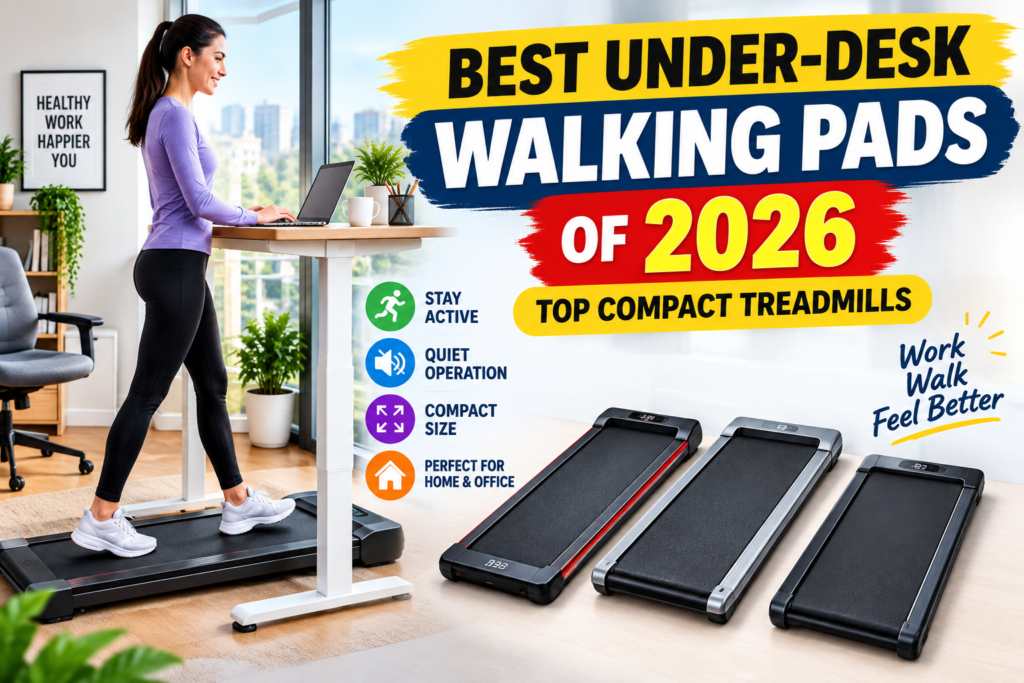
Discover the best under-desk walking pads of 2026. Compare top compact treadmills for home and office use, including features, noise, size, and value.
LifeCareBalance.com is reader-supported. When you buy through links on our site, we may earn an affiliate commission at no extra cost to you. As an Amazon Associate, we earn from qualifying purchases.
If you work from home, a walking pad can turn dead sitting time into daily steps — but only if it actually fits your desk, your height, and your workday. Most buying guides call a treadmill “compact” and move on. This one digs into the details that actually determine whether a walking pad works under your desk: clearance, belt size for your stride, noise during video calls, and how fast you can walk without your typing falling apart.
We looked at models currently sold in the U.S. from WalkingPad, UREVO, Goplus, LifeSpan, Sunny Health & Fitness, and Egofit, cross-checking manufacturer specs against independent testing from outlets like Tom’s Guide and Garage Gym Reviews wherever the two disagreed. Below you’ll find quick picks, a full comparison table, and detailed buying guidance so you don’t need to read five other roundups to make a decision.
LifeCareBalance is a participant in the Amazon Associates program. If you buy through links on this page, we may earn a commission at no extra cost to you. This does not affect our recommendations.
Quick Answer: Top Picks for 2026
- Best Overall for Under-Desk Use: WalkingPad C2
- Best Budget: UREVO SpaceWalk E1L
- Best Quiet Option: LifeSpan TR1000-GlowUp
- Best Foldable: WalkingPad P1
- Best for Small Apartments: Egofit Walker Pro M1
- Best for Tall Users: Sunny Health & Fitness Walkstation Slim / Asuna TreadPad
- Best for Higher Weight Capacity: UREVO SpaceWalk 5L
- Best Walking + Jogging Option: Goplus 2-in-1 SuperFit
If you also want a broader look at walking pads beyond desk use — including models built more for living-room cardio — see our companion guide to the best walking pads for home use in 2026.
Comparison Table
| Product | Price (approx.) | Belt Size | Max Walking Speed | Weight Capacity | Machine Height | Folded Dimensions | Noise | Incline | Warranty | Best For |
|---|---|---|---|---|---|---|---|---|---|---|
| WalkingPad C2 | $300–$400 | 47.2″ x 15.8″ | 3.7 mph | 220 lb | 4.9″ | 32.5″ x 20.4″ x 5.4″ | Quiet (1 HP brushless) | None | 1 year | Under-desk use, foldability |
| WalkingPad P1 | $329–$499 | 47″ x 16.5″ | 3.5 mph | 220 lb | ~5″ | Folds in half (bulkier profile) | Moderate (brushed motor) | None | 1 year | Budget WalkingPad buyer |
| UREVO SpaceWalk 5L | ~$400 | ~46″ x 18″ (approx.) | ~3.7 mph | 300 lb (mfr. manual) | 6.1″ | Not published | Very quiet (dual brushless, ~40 dB claimed) | Up to 9% auto | 18 months | Higher weight capacity |
| UREVO SpaceWalk E1L | $160–$170 | 35.5″ x 15″ | Up to 4 mph | 242 lb | ~4–4.8″ | ~42″ x 19″ x 4″ | Quiet | None | 18 months | Budget buyers |
| Goplus 2-in-1 SuperFit | $150–$300 (varies widely) | 40″ x 16″ | Up to 7.5 mph (jogging mode) | 265 lb | ~5″ folded | 52″ x 27″ x 5″ | Moderate | None (some variants: slight) | Varies by retailer | Walking + occasional jogging |
| LifeSpan TR1000-GlowUp | $900–$1,700 | 20″ x 44″ | 4.0 mph | 350 lb | 7.25″ | Not foldable (rolls on wheels) | Very quiet, call-friendly | None | 10-yr frame / 2-yr parts / 1-yr labor | Quiet, daily desk use |
| Sunny Health & Fitness Walkstation Slim / Asuna TreadPad | $300–$500 | ~51″ x 17.5″ | 3.7–4.0 mph | 220 lb | ~5.4″ | Not foldable | Quiet | None | 3-yr manufacturer / 90-day parts | Taller users, longer stride |
| Egofit Walker Pro M1 | $399–$479 | 34.25″ x 16.54″ | 3.1 mph | 220 lb | 6.89″ | Not foldable (already compact) | Moderate to loud (see notes) | Fixed 5% | 1 year | Smallest footprint / low-clearance desks |
Specs above reflect manufacturer listings as of 2026, cross-checked against independent reviews where available. Several manufacturers publish inconsistent numbers across their own store pages, manuals, and Amazon listings — we’ve flagged the discrepancies we found in the product reviews below. When two sources disagree, treat the more conservative figure as the safer assumption.
How We Evaluated These Walking Pads
We didn’t personally test every unit in this guide, and we’re upfront about that — LifeCareBalance’s evaluation here is based on manufacturer specifications, user manuals, and independent testing published by outlets including Tom’s Guide, Garage Gym Reviews, and BarBend, cross-referenced against each other for consistency. Where our sources disagreed on a spec (weight capacity and noise levels were the most common conflicts), we noted it rather than picking whichever number sounded best.
Our criteria focused specifically on under-desk suitability:
- Real clearance and footprint, not just marketing language like “slim” or “compact”
- Belt length and width relative to different user heights and stride lengths
- Noise at typical desk-walking speeds (roughly 1–2 mph), separate from noise at max speed
- Weight capacity as published in the manual, not just the headline marketing number
- Safety features — auto-stop, safety key or child lock, and belt behavior at start-up
- Storage and portability — folded height, wheels, and whether it can realistically slide under furniture
Detailed Product Reviews
WalkingPad C2 — Best Overall for Under-Desk Use

- Truly Folding Design – Walking Pad C2 features an exclusive folding design that allows for easy 180 ° folding of the tre…
- Powerful Silent Motor – This under-desk treadmill boasts a 2.0HP motor capable of supporting up to 220 lbs. Operating qu…
- Portable – There’s no assembly required for the walkingPad, simply unfold the treadmill, plug it in and it’s ready to us…
Best for: Buyers who want the most desk-tested, widely reviewed compact walking pad with genuine flat-fold storage.
Approximate price: $300–$400, frequently discounted from a $400 list price.
Key specs: 1 HP brushless motor, 47.2″ x 15.8″ belt, 0.5–3.7 mph speed range, 220 lb weight capacity, 4.9″ height, 55 lb unit weight.
Under-desk compatibility: At under 5 inches tall, the C2 clears most standing desks set to standard walking height and slides under desks with at least 6 inches of clearance at their lowest setting. Its 180-degree fold reduces the footprint to about 32.5″ x 20.4″ x 5.4″ for storage against a wall or under a bed.
Noise and call use: The brushless motor is one of the quieter options in this category, and multiple independent reviewers have called it appropriate for calls at typical desk-walking speeds. Footstep noise on hard flooring will still be audible to anyone in the room, though it won’t come through clearly on the other end of a video call at low volume.
Belt size: At 47.2″ long, the belt comfortably fits most users up to roughly 6’2″ without feeling cramped, though very long strides may still feel the width limit (15.8″) at faster paces.
Storage: Genuinely flat-folding — this is the feature that distinguishes it from bulkier competitors.
Safety: Includes a step-sensing auto speed control, a physical remote that bypasses the sensors for manual control, and standard overload/auto-standby protection.
Pros:
- Flat, low-profile fold for real under-furniture storage
- Quiet enough for most video calls at desk-walking speeds
- Widely available with a large body of independent reviews
Cons:
- 220 lb weight limit excludes some users
- No incline
- Warranty requires registration and the buyer covers return shipping
Who should buy it: Renters, apartment dwellers, and anyone whose top priority is a treadmill that disappears into a closet or under a couch when not in use.
Who should skip it: Users over 220 lbs or anyone who wants an incline option for variety.
WalkingPad P1 — Best Foldable (Budget Pick)
Best for: Buyers who want WalkingPad’s brand reputation at a lower price point and don’t mind a brushed motor.
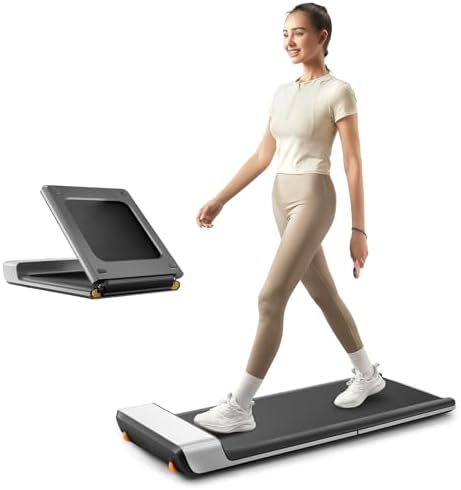
- Ultra-thin Folding Design: walking pad P1 is designed with ultra-thin high-strength aluminum alloy frame and professiona…
- Smart Gravity Foot Sensing Speed Control:To avoid fall down risk on the speed walking pad, this foldable treadmill P1 bu…
- Remote Control With High-Definition Display: walking pad P1 wireless remote control, equipped with a high-definition dis…
Approximate price: $329–$499 depending on retailer and promotions.
Key specs: Brushed motor (WalkingPad’s only current model with one), 47″ x 16.5″ belt, up to 3.5–3.7 mph, 220 lb weight capacity, roughly 62 lb unit weight.
Under-desk compatibility: Similar footprint to the C2 when unfolded, but its fold-in-half design (rather than a flat fold) leaves a bulkier stored shape — Tom’s Guide specifically flagged this as a downside in testing.
Noise and call use: The brushed motor runs a bit louder than WalkingPad’s brushless models, though it’s still workable for most calls at low speeds.
Belt size: Slightly wider than the C2 at 16.5″, which some taller or wider-stance walkers may prefer.
Storage: Folds but doesn’t lie as flat as the C2; plan for a taller stored profile.
Safety: FootSense adaptive speed control plus a physical remote and app control via Bluetooth.
Pros:
- Usually the least expensive WalkingPad-branded model
- Long-running, well-documented product line with years of user reviews
- Simple setup with no assembly
Cons:
- Brushed motor generally means a shorter service life than brushless alternatives
- Bulkier when folded than the C2
- Tom’s Guide testing found the included remote glitchy
Who should buy it: Budget-conscious buyers who specifically want the WalkingPad brand and don’t need the flattest possible fold.
Who should skip it: Anyone tight on storage space who needs the flattest possible folded profile — get the C2 instead.
UREVO SpaceWalk E1L — Best Budget
Best for: First-time buyers testing whether a walking pad fits their routine before spending more.
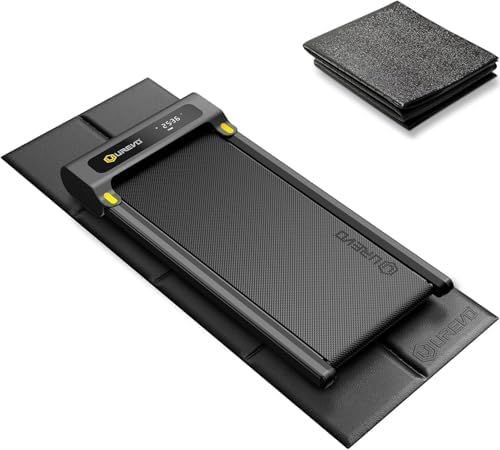
- PVC
- Imported
- 🚀【1-Second Fold & Space Magic】Unfolds to 63″x26″, folds to compact 15.8″x12.8″ (85% smaller than regular mats)! Slides e…
Approximate price: $160–$170.
Key specs: 2.5 HP motor, 35.5″ x 15″ belt (some listings cite slightly different figures), 242 lb weight capacity per the safety section of UREVO’s manual (a separate spec table on the same page lists 265 lb — treat 242 lb as the safer number), dual shock absorption.
Under-desk compatibility: Its shorter belt makes it one of the more compact options for tight under-desk spaces, though the shorter length also means less room for a longer stride.
Noise and call use: Generally reported as quiet at typical desk speeds, in line with most budget brushed-motor pads.
Belt size: The shortest belt in this comparison at 35.5″ — fine for shorter users or careful, controlled steps, but tall users with a long stride may feel cramped.
Storage: Compact dimensions, though UREVO’s own listings show some inconsistency between the Amazon spec sheet and the printed manual (roughly 42″ x 19″ x 4″ vs. 46.8″ x 19.3″ x 4.8″). Measure your specific unit rather than relying on either figure alone.
Safety: Includes UREVO’s app for goal tracking and standard overload protection.
Pros:
- Among the lowest prices for a name-brand walking pad
- Light and easy to move
- App integration for tracking steps and distance
Cons:
- Shortest belt in this roundup
- UREVO cut its warranty from 2 years to 18 months (1 year + a 180-day extension that requires app registration) as of March 2026
- Spec discrepancies across UREVO’s own listings mean it’s worth double-checking before buying
Who should buy it: Budget shoppers and shorter-statured users who want to try under-desk walking without a big investment.
Who should skip it: Taller users or long-stride walkers who will feel the shorter belt.
UREVO SpaceWalk 5L — Best for Higher Weight Capacity

- 【Replacement for UREVO Walking Treadmill】 Designed as a dedicated replacement remote, perfectly compatible with UREVO wa…
- 【Attention ! ! !】If you are not sure whether the remote control is the one you need, please let us know. We will check a…
- 【Abbreviated Description 】Treadmill remote features an easy-to-use control panel for effortless treadmill operation, inc…
Best for: Heavier users who want auto-incline without stepping up to a full-size LifeSpan unit.
Approximate price: Around $400.
Key specs: Dual 2.5 HP brushless motors, 9-level auto incline up to 9%, extruded monotube frame, roughly 6.1″ height, about 50.7 lb unit weight.
Under-desk compatibility: The dual-motor design and auto incline add some height (6.1″) compared to flat pads like the WalkingPad C2, so measure your desk’s minimum clearance carefully before buying.
Noise and call use: UREVO advertises around 40 dB, which — if accurate — would put it among the quieter pads here, though this figure comes from the manufacturer rather than independent lab testing.
Belt size: Not independently confirmed to the inch, but UREVO’s own materials describe a running area sized for taller users; if belt length is your top priority, verify current dimensions on UREVO’s product page before ordering.
Storage: Doesn’t fold as compactly as WalkingPad models due to its dual-motor housing.
Safety: UREVO app control, though note the flag below.
Pros:
- Auto incline, uncommon at this price point
- Dual brushless motors instead of the single motor typical of budget pads
- Reinforced frame construction
Cons:
- UREVO’s manual rates the deck to 300 lb, while the brand’s own store pages advertise 400 lb — the manual is the more conservative, engineering-based figure, and we’d treat 300 lb as the number to plan around
- Taller stored height than flat-folding competitors
- At roughly $400, it’s priced above most UREVO models
Who should buy it: Users who want incline variety and extra weight headroom without LifeSpan-level pricing.
Who should skip it: Anyone with very limited desk clearance — check the 6.1″ height against your desk’s minimum first.
Goplus 2-in-1 SuperFit — Best Walking + Jogging Option

- 2-In-1 Treadmill: With the 2-in-1 design, this Superfit treadmill offers 2 different running speeds. When the risers are…
- LED Touch Screen & Colorful Light: The LED touch screen allows you to adjust the speed, volume and feeds back your sport…
- Powerful Motor & Shockproof Running Belt: Equipped with 4.75HP powerful motor, this high quality Superfit treadmill prov…
Best for: Buyers who want one machine for both desk-walking and a faster workout with the handlebar attached.
Approximate price: Highly variable — we’ve seen it listed anywhere from about $150 to $300, with frequent deep discounts.
Key specs: 2.25 HP motor, 40″ x 16″ running area, speed range up to roughly 7.5 mph (12 km/h) in jogging mode, 265 lb weight capacity, Bluetooth speaker, LED display.
Under-desk compatibility: With the handlebar removed, it slides under most desks in walking mode; the handlebar assembly is designed to attach and detach for jogging sessions elsewhere in the room.
Noise and call use: Reasonably quiet at walking speeds; expect more noise once you push toward jogging pace, which isn’t desk-appropriate anyway.
Belt size: At 40″ x 16″, it’s on the shorter side for very tall users, a trade-off Outdoor Gear Lab’s testing specifically noted as limiting for long strides or faster running.
Storage: Folds relatively flat for a 2-in-1 model, with published folded dimensions around 52″ x 27″ x 5″.
Safety: Includes a physical safety key (clips to clothing and shuts off the belt if you step away), remote control, and app pairing.
Pros:
- Only true 2-in-1 (walking + jogging) option in this roundup
- Frequently available at steep discounts
- Includes a physical safety key, a feature not every walking pad offers
Cons:
- Independent testing found it “far from ideal for running at higher speeds or those with a long stride” due to the shorter belt
- Assembly and warranty terms vary noticeably by retailer and promotion
- Handlebar posts add bulk compared to handlebar-free walking pads
Who should buy it: People who genuinely want the option to jog occasionally, not just walk, without buying two machines.
Who should skip it: Anyone with a long stride who plans to run regularly — a dedicated running treadmill will serve you better.
LifeSpan TR1000-GlowUp — Best Quiet Option
Best for: Daily, all-day desk walking where call quality and long-term durability matter more than price.

- ▶︎ Replacement Round Prong Treadmill Safety Key
- ▶︎ Compatible with LifeSpan Models: TR500, TR1000-08, TR3000 HRC, VP1000
Approximate price: Commonly listed between roughly $900 and $1,700 depending on the console configuration and retailer; LifeSpan’s own list pricing runs higher than typical street prices, so it’s worth comparing a few sellers.
Key specs: 2.25 HP continuous-duty motor, 20″ x 44″ belt, 0.4–4.0 mph speed range, six independent compression shocks, 3/4″ phenolic deck, roughly 117 lb unit weight.
Under-desk compatibility: At 7.25″ tall, it’s noticeably taller than flat-folding pads like the WalkingPad C2, so it needs a desk with more vertical clearance — but its low 58″ x 28.5″ footprint and front wheels make it easy to roll into position.
Noise and call use: This is where the TR1000 stands out. LifeSpan markets it as “whisper-quiet,” and Garage Gym Reviews’ independent testing specifically noted it as quiet enough for calls — a claim backed by real hands-on use rather than just marketing copy.
Belt size: At 44″ long and 20″ wide, it’s one of the more generous belts in this guide, comfortable for a wider range of heights and stride lengths.
Storage: Does not fold. It’s designed to live under or near your desk full-time rather than be stowed away daily, which is worth factoring in if floor space is tight.
Safety: LifeSpan’s Intelli-Guard technology only runs the belt while you’re actively walking, and Intelli-Step counts steps automatically.
Pros:
- Independently confirmed as quiet enough for professional calls
- 350 lb published weight capacity (though note: some retail partner listings for related SKUs show a lower 250 lb figure — confirm the exact model and capacity before buying)
- Strong warranty: 10-year frame, 2-year parts, 1-year labor
Cons:
- Significantly more expensive than the WalkingPad or UREVO options
- Doesn’t fold flat — needs a permanent or semi-permanent spot
- Taller profile means less desk clearance to work with
Who should buy it: Remote workers walking multiple hours a day who want durability and quiet operation and have the budget and desk clearance for it.
Who should skip it: Anyone who needs to fold and store the unit daily, or who’s on a tighter budget.
Sunny Health & Fitness Walkstation Slim / Asuna TreadPad — Best for Tall Users

- EASY-TO-USE DISPLAY: Watch your workout progress in real time with the 4-window display. View your time, distance, speed…
- EXTREMELY PORTABLE: This running treadmill can be easily and securely folded flat with the included folding key. Take ad…
- FOLDING TOOL: Turn the tool counterclockwise in the frame locks to fold the treadmill frame. After it is folded, use the…
Best for: Taller users who want a longer deck without paying LifeSpan prices.
Approximate price: $300–$500 depending on model and retailer.
Key specs: 1.5 HP motor, roughly 51″ x 17.5″ deck (Asuna TreadPad specs), 0.3–4.0 mph speed range, 220 lb weight capacity, no incline.
Under-desk compatibility: Comes pre-assembled and slides under most desks; at about 5.4″ tall it clears many standing desks at typical walking height, though — like most non-folding pads — it’s designed to stay in place rather than be tucked away daily.
Noise and call use: Tom’s Guide specifically called it one of the quietest under-desk options it tested, describing it as appropriate for late-night or shared-living use.
Belt size: At roughly 51″ long, this is the longest deck in our comparison — a real advantage for taller users or anyone with a longer natural stride.
Storage: Doesn’t fold; built more for a semi-permanent desk setup than daily stow-away use.
Safety: Standard remote-controlled speed adjustment; the SunnyFit app adds workout tracking on some models.
Pros:
- Longest belt length in this comparison
- Independently noted as one of the quieter options tested
- The Walkstation Slim carries an unusually strong 3-year manufacturer warranty for this price range
Cons:
- 220 lb weight capacity limits some users
- No incline
- Doesn’t fold for storage
Who should buy it: Taller users (roughly 5’10” and up) who want more belt length than most compact pads offer, without LifeSpan pricing.
Who should skip it: Anyone needing to fold and store the treadmill regularly, or users above 220 lbs.
Egofit Walker Pro M1 — Best for Small Apartments

- 100% Nylon
- ✔️ Smallest And Lightest Treadmill You Can Find In The World – elegant to exercise in your office and home! It’s a motor…
- ✔️ Handle And Maintain With Ease – APP Mobile control and WIRELESS Remote control optional for you to operate the treadm…
Best for: The tightest desk clearances and smallest footprints, where every inch matters.
Approximate price: $399–$479.
Key specs: 2 HP motor, 34.25″ x 16.54″ belt, 0.62–3.11 mph speed range, fixed 5% incline, roughly 48.5 lb unit weight, 38.39″ x 21.85″ x 6.89″ footprint.
Under-desk compatibility: Marketed as one of the smallest under-desk treadmills available, which is genuinely true by footprint — but its fixed 5% incline and 6.89″ height mean it needs more vertical clearance than flat pads like the WalkingPad C2, so measure before assuming “small” means “fits everywhere.”
Noise and call use: This is a point of real disagreement between sources. Egofit’s own marketing claims operation never exceeds 50 dB, but at least one long-term reviewer measured noise noticeably higher than that at full speed. Given the conflicting figures, don’t assume it’s silent enough for calls without testing it yourself during the return window.
Belt size: At 34.25″ x 16.54″, it’s one of the shorter belts here, better suited to shorter users or careful, deliberate steps than a long, fast stride.
Storage: Already small enough that most owners leave it in place rather than folding or hiding it.
Safety: Remote and app control; standard overload protection.
Pros:
- Smallest footprint in this comparison
- Fixed incline adds variety that flat pads lack
- Ships fully assembled
Cons:
- Short belt limits it to shorter users or slower, controlled walking
- Noise claims are disputed between the manufacturer and independent long-term reviews
- Only a 1-year warranty
Who should buy it: Shorter users in very tight apartments or offices where a few extra inches of desk clearance make the difference.
Who should skip it: Taller users, long-stride walkers, or anyone whose top priority is guaranteed call-quiet operation.
What Makes a Good Under-Desk Walking Pad?
A treadmill that’s “compact” in a product photo isn’t automatically desk-compatible. Four things determine real under-desk usability:
- Overall height, including any incline mechanism, has to clear your desk’s lowest usable setting with margin to spare.
- Belt length needs to accommodate your natural stride without you feeling like you’re clipping the front or back edge.
- Noise at low, desk-appropriate speeds (not the manufacturer’s headline noise rating, which is often measured at a different speed) determines whether it disrupts calls or roommates.
- Control method matters more than it seems — a remote you can reach without breaking your typing rhythm, or a foot-sensing auto mode, keeps the machine from becoming a distraction.
Belt Size Guide
Belt length matters more than most shoppers expect. As a rough guide based on typical stride lengths:
- Under 5’4″: A 34–40″ belt (like the Egofit Walker Pro M1 or UREVO E1L) is usually sufficient.
- 5’4″–5’10”: Look for at least 44–47″ of belt length (WalkingPad C2 or P1 fit this range comfortably).
- Over 5’10”: Prioritize the longest available decks — the Sunny Health & Fitness Asuna TreadPad’s roughly 51″ belt or LifeSpan’s 44″–48″ options give more margin.
Belt width matters too, especially if you tend to walk with a wider stance or shift your feet during long sessions; 16″ or wider is more forgiving than the 15″ belts found on some budget models.
Desk Height and Clearance Guide
Before buying, measure the actual clear space between your floor and the underside of your desk at the height you use for standing or walking. Then subtract at least half an inch for a safety margin.
- Standing desk height for walking is typically a few inches taller than your seated typing height, since your arms need to reach the keyboard while your body is upright and in motion rather than seated.
- Keyboard and mouse position should stay at roughly elbow height with your arms relaxed — walking desks that force you to reach up or hunch down will fatigue your shoulders faster than sitting will.
- Minimum clearance should account for the treadmill’s tallest point, not just its average profile — units with incline mechanisms (like the UREVO SpaceWalk 5L or Egofit Walker Pro M1) are taller than flat pads even when “folded” language suggests otherwise.
- A treadmill can be marketed as compact and still be unsuitable for your setup if your desk sits lower than average, or if your standing-desk frame has crossbars or a center support beam that reduces usable clearance.
If you’re setting up a full walking-desk station and haven’t finalized your desk yet, factor treadmill height into that purchase rather than buying the treadmill first and hoping it fits.
Noise Guide: Motor Noise vs. Footstep Noise
Two separate sources of sound matter for desk use, and manufacturers usually only advertise one of them.
Motor noise is what most brands report, usually measured at a specific speed under ideal conditions. Brushless motors (used in the WalkingPad C2, UREVO SpaceWalk models, and LifeSpan’s line) are generally quieter and more consistent over time than brushed motors (used in the WalkingPad P1 and some budget UREVO and Goplus models).
Footstep noise — the thump of your feet hitting the belt — is often the bigger issue for downstairs neighbors or people in the next room, and it’s rarely measured or disclosed at all. Shock-absorbing decks (LifeSpan’s six independent compression shocks, or the multi-layer belts used by WalkingPad and UREVO) reduce this, but no walking pad eliminates footstep sound entirely. If you live in an apartment with sound-sensitive neighbors, test during a return window before committing.
For video calls specifically, walking at 1–1.5 mph on a quality brushless-motor pad is generally unnoticeable to people on the other end of the call at normal microphone sensitivity, based on the pattern of independent reviews cited throughout this guide — though we can’t guarantee this for every microphone and room setup.
Weight Capacity Guide
Weight capacity in this category tends to cluster around 220–265 lbs for compact pads, with a few models reaching 300–350 lbs.
- Under 220 lbs: Nearly every model in this guide works, including the most compact options.
- 220–265 lbs: The UREVO E1L, Goplus SuperFit, and similar mid-range models generally have headroom, but check the specific SKU — as we found with UREVO’s own conflicting spec sheets, published numbers aren’t always consistent.
- Over 265 lbs: Your safest options are the LifeSpan TR1000 (350 lb published capacity) or the UREVO SpaceWalk 5L (300 lb per its manual, despite higher marketing claims).
Always use the manufacturer’s user manual figure rather than a marketing headline when the two disagree, and never exceed the stated capacity — motors and belts are engineered to that number specifically, and treadmill motor failures are a documented driver of the fall and overheating incidents discussed in the safety section below.
Walking Speed While Working
Speed choice depends heavily on the task at hand, based on published research on treadmill-desk performance:
- 0.5–1.5 mph: Suitable for reading, watching video, phone calls, and light browsing. Minimal impact on fine motor tasks.
- 1.5–2.5 mph: Workable for typing and most computer work, though a peer-reviewed study of experienced transcriptionists found typing speed dropped by about 16% while walking compared to sitting, even after training.<sup>[1]</sup>
- Above 2.5–3 mph: Increasingly difficult to combine with precise mouse work or detailed reading; most people naturally slow down or step off for tasks requiring sustained concentration.
If your job involves heavy typing or detail work, expect to alternate between walking and standing or sitting throughout the day rather than walking continuously. That alternation is normal and doesn’t defeat the purpose — even intermittent walking adds meaningfully more movement than a fully seated day.
Walking Pad vs. Traditional Treadmill
A traditional treadmill includes handrails, a taller frame, an incline motor, and usually a higher top speed built for running. That makes it more versatile for cardio training but far less suitable for desk use — the handrails and console height typically block clearance under any desk, and the larger footprint doesn’t fold away.
Walking pads strip out the handrails and console to minimize height and footprint, trading versatility (lower top speed, usually no incline, lower weight capacity) for the ability to actually slide under furniture. If your primary goal is a dedicated home-gym cardio machine and desk use is secondary, a traditional treadmill is likely the better investment. If desk compatibility is the priority, a walking pad is purpose-built for it in a way a general treadmill isn’t.
Walking Pad vs. Under-Desk Treadmill
These terms are often used interchangeably, but there’s a meaningful distinction in this category. “Walking pad” typically refers to the flat, low-profile, handrail-free design popularized by WalkingPad and copied by UREVO, Goplus, and others — foldable, portable, and priced from roughly $150–$400. “Under-desk treadmill” is sometimes used more specifically for non-folding, desk-dedicated units like LifeSpan’s TR-series, which prioritize durability, quieter motors, and higher weight capacity over portability, at a correspondingly higher price.
Neither term is regulated, so always check the actual specs — height, fold mechanism, and weight capacity — rather than assuming the label tells you everything you need to know.
Safety Guide
Treadmills of any kind carry inherent risks, and under-desk models are no exception. Follow these practices regardless of which model you choose:
- Start at the slowest speed and increase gradually once you’re steady on the belt.
- Keep the walking surface clear of cables, bags, and other tripping hazards.
- Use any safety key, child lock, or auto-stop feature the manufacturer provides, and don’t disable it.
- Never exceed the manufacturer’s stated weight limit.
- Keep children and pets away from the moving belt at all times, including when the unit is plugged in but not in use.
- Avoid tasks requiring fine balance or precision — like carrying hot drinks — while the belt is moving.
- Stop using the machine immediately if you notice unusual belt behavior, unexpected speed changes, overheating, unusual odors, or any electrical issues, and unplug it.
- Check for open recalls or safety warnings before and after purchase.
On that last point: none of the models reviewed in this guide are currently subject to a CPSC recall or warning as of this writing. However, it’s worth knowing that in April 2026, the U.S. Consumer Product Safety Commission warned consumers to stop using Sperax-brand walking pads and treadmills (models Pro, Q1, RM-01, and RM-02) after receiving hundreds of reports of sudden speed changes, abrupt stops, and overheating or fire incidents.<sup>[2]</sup> Sperax is not one of the brands covered in this guide, and its importer had refused to agree to a formal recall as of the warning date. This is a useful reminder to check CPSC.gov directly for the brand and model you’re considering, since recall status can change after a guide like this is published.
Maintenance Guide
Most walking pads need only light, occasional upkeep:
- Belt lubrication: Most manufacturers recommend periodic silicone lubrication (often included in the box) to reduce friction and motor strain — check your specific manual for the recommended interval, which varies by usage.
- Belt alignment and tension: Watch for the belt drifting to one side, which usually signals it needs re-centering per the manual’s instructions.
- Dust and debris: Wipe down the deck and vacuum around the motor housing periodically, especially in carpeted rooms.
- Warranty registration: Several brands in this guide (WalkingPad, UREVO) require registration within a set window to activate full warranty coverage or extensions — don’t skip this step.
- Long-term costs: Budget for occasional replacement parts (belts, lubricant) over a multi-year ownership period, and factor in that several manufacturers here require the buyer to pay return shipping on warranty claims.
Who Should Buy an Under-Desk Walking Pad?
- Remote or hybrid workers who sit most of the day and want a low-effort way to add movement
- Apartment or small-home dwellers who need equipment that stores away rather than occupying a dedicated room
- People already using or planning a standing desk who want to make some of that standing time active
- Anyone advised by a doctor to move more throughout the day, as a complement to (not replacement for) other recommended activity
Who Should NOT Buy an Under-Desk Walking Pad?
- Anyone with balance issues, certain joint conditions, or other mobility concerns should consult a doctor before starting treadmill-desk use of any kind
- Users whose body weight exceeds every model’s published capacity in this guide (most cap out between 220–350 lbs)
- People whose desk truly cannot accommodate the clearance any of these units need, even the shortest ones
- Anyone expecting a walking pad to replace structured exercise entirely — these units support light, incidental movement, not a full fitness program
- Households with very sound-sensitive neighbors who haven’t been able to test noise levels first
Frequently Asked Questions
What is the best under-desk walking pad in 2026? Based on the balance of desk compatibility, quiet operation, and wide availability, the WalkingPad C2 is our top overall pick, with the LifeSpan TR1000-GlowUp as the best option for buyers prioritizing quiet, daily, all-day use.
What speed should I use on a walking pad while working? Most people find 0.5–1.5 mph comfortable for typing-heavy work, with speeds up to 2.5 mph workable for lighter tasks like reading or calls. Research on treadmill-desk use has found measurable, though modest, drops in typing speed and fine motor precision at faster paces.
Are walking pads quiet enough for video calls? Many are, particularly brushless-motor models at low speeds, but noise varies by brand and even by individual unit. Footstep noise is a separate factor manufacturers rarely disclose, so test during a return window if possible.
Can you use a walking pad under any standing desk? No. You need to measure your desk’s actual minimum clearance and compare it to the treadmill’s full height, including any incline mechanism, before assuming it will fit.
What belt size should a tall person choose? Users over about 5’10” should look for belts of at least 44–48 inches long, such as those on the Sunny Health & Fitness Asuna TreadPad or LifeSpan’s TR-series.
Are under-desk treadmills safe? When used according to the manufacturer’s instructions — starting slow, respecting the weight limit, and using included safety features — they carry similar risks to other home fitness equipment. Always check for current recalls before purchase.
Can you jog on a walking pad? Most walking pads are designed for walking speeds only, generally topping out around 3.5–4 mph. If you want to jog, look specifically at a 2-in-1 model like the Goplus SuperFit, which reaches higher speeds, though its shorter belt is still a limiting factor for longer strides.
How much weight can a walking pad hold? It varies widely by model, from 220 lbs on compact options up to 350 lbs on units like the LifeSpan TR1000. Always confirm the manufacturer’s manual figure, since marketing pages sometimes list higher numbers than the printed specifications.
Are walking pads good for small apartments? Yes, particularly foldable models like the WalkingPad C2 or genuinely small-footprint units like the Egofit Walker Pro M1, both designed to store in tight spaces.
How long do walking pads last? This varies by build quality and usage, but brushless-motor models generally have a longer expected service life than brushed-motor budget models, based on how manufacturers position their own product lines.
Do walking pads need maintenance? Yes — periodic belt lubrication and alignment checks are standard across nearly every model, and skipping them can shorten motor life.
Is a walking pad better than a traditional treadmill? It depends on your goal. For desk compatibility and storage, yes. For higher speeds, incline training, or general home-gym cardio, a traditional treadmill remains more versatile.
Final Buying Advice
Start with your desk, not the treadmill. Measure your actual clearance, know your height and typical stride, and decide upfront whether daily fold-and-store matters to you or whether a permanent, non-folding unit like the LifeSpan TR1000 fits your space better. From there, weight capacity and noise tolerance should narrow the list quickly — and if the numbers on a manufacturer’s website and its printed manual disagree, trust the manual.
None of these machines will build serious cardiovascular fitness on their own, and calorie burn on any of them depends heavily on your body weight, walking speed, and session length — brief, incidental walking is a supplement to the physical activity guidelines set by the CDC, which recommends adults get at least 150 minutes of moderate-intensity activity per week, not a replacement for it.<sup>[3]</sup> Even short bouts of movement throughout the day are associated with better outcomes than prolonged uninterrupted sitting, according to a scientific advisory from the American Heart Association.<sup>[4]</sup> If you’re also building out a broader home gym alongside your walking pad setup, our guide to the best adjustable dumbbells for home gyms covers strength-training equipment that pairs well with daily step goals.
Sources cited:
- Thompson WG, Levine JA. “Productivity of transcriptionists using a treadmill desk.” Work. 2011. PubMed
- U.S. Consumer Product Safety Commission. “CPSC Warns Consumers to Stop Using Sperax Walking Pads and Treadmills Immediately.” April 2026. CPSC.gov
- Centers for Disease Control and Prevention. “How Much Physical Activity Do Adults Need?” CDC.gov
- American Heart Association. “Sitting too much may raise heart disease risk.” Heart.org
- Consumer Reports. Treadmill and walking pad safety coverage. ConsumerReports.org