
LifeCareBalance.com is reader-supported. When you buy through links on our site, we may earn an affiliate commission at no extra cost to you. As an Amazon Associate, we earn from qualifying purchases.
If you are new to LED face masks, the hardest part is usually not putting the mask on your face. It is knowing how to start, how often to use it, what results to expect, and which beginner mistakes to avoid.
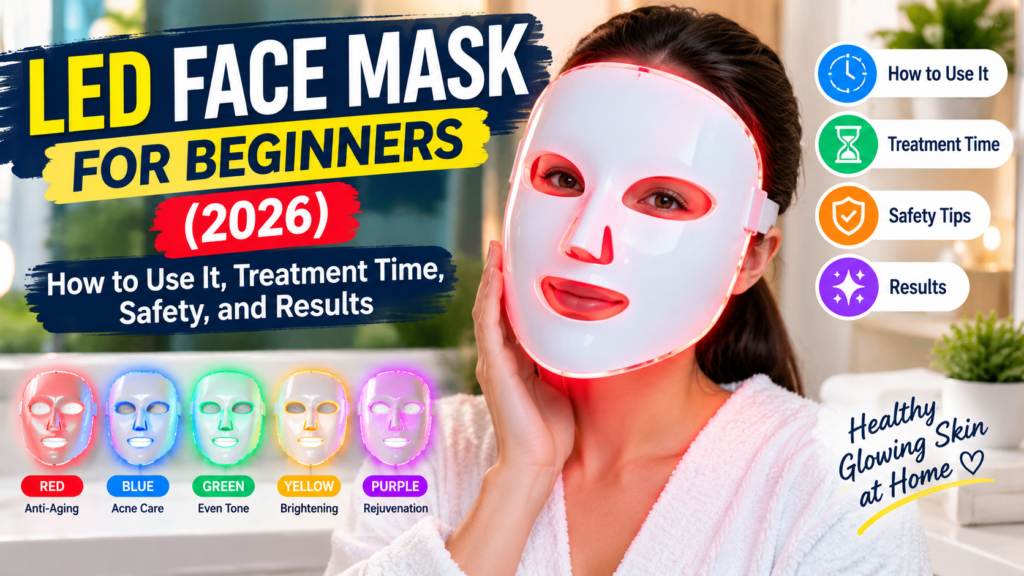
LED face masks are at-home skincare devices that use specific wavelengths of light. Depending on the device, they may use red light, near-infrared light, blue light, or a combination. Red-light devices are commonly marketed for improving the appearance of fine lines and other signs of skin aging, while some devices include blue light for acne-related concerns.
However, LED masks are not instant skincare treatments, and not every device is designed for every skin concern. The manufacturer’s instructions, treatment protocol, and safety information matter more than simply choosing a mask with the most colors or LEDs.
This beginner-friendly guide explains how LED masks work, how to establish a simple routine, how to approach safety, and how to evaluate results without getting overwhelmed by technical specifications.
Quick Answer: How Should a Beginner Start With an LED Face Mask?
For your first session, keep the process simple:
- Read the instructions for your exact device.
- Start with clean, dry skin unless the manufacturer says otherwise.
- Follow the recommended treatment duration.
- Use the manufacturer’s recommended frequency rather than copying another person’s schedule.
- Follow the device’s eye-protection instructions.
- Clean and store the device as directed.
- Give the routine time, without expecting overnight changes.
- Stop using it if you experience significant discomfort or an unexpected reaction.
There is no universal schedule for all LED face masks. Different devices have different wavelengths, light outputs, designs, and treatment protocols.
If you take medication that can increase photosensitivity, have a condition that may be aggravated by light, or have a history of pigmentation problems, consult a qualified healthcare professional before starting.
What Is an LED Face Mask?
An LED face mask is a wearable skincare device that uses light-emitting diodes to expose facial skin to specific wavelengths of light.
The process is commonly described as photobiomodulation. It involves the interaction between light and biological tissue and is being studied for several skin-related applications.
Unlike ultraviolet tanning devices, LED masks are not designed to tan the skin. However, that does not mean every light-based device is appropriate for every user or that all advertised benefits are proven.
At-home LED masks are designed to make light treatments convenient. You use the device at home instead of scheduling every session at a clinic.
For beginners, remember three things:
- An LED mask is a routine-based device, not an instant treatment.
- Different colors and wavelengths have different intended uses.
- Results vary, and using a device correctly does not guarantee a visible improvement.
What Do Red, Blue, and Near-Infrared Light Mean?
Before using your first mask, it helps to understand the basic terms.
Red light
Red light is commonly included in at-home devices marketed for skin rejuvenation and visible signs of aging. Research has investigated its potential effects on concerns such as fine lines, wrinkles, redness, and overall skin appearance.
These potential benefits should not be interpreted as a promise that every red-light mask will visibly improve the skin. Devices differ in their specifications and protocols, and results are not consistent for everyone.
Near-infrared light
Near-infrared light is outside the visible portion of the spectrum. Some masks combine it with red light.
A device that includes near-infrared light is not automatically more effective than one that does not. The wavelength, output, treatment duration, intended use, and available evidence all matter.
Blue light
Blue light is commonly included in devices designed for acne-related use. Some masks offer blue light alone, while others combine blue and red light.
Do not assume that a red-light mask is an acne treatment or that a multi-color mask can treat every type of breakout.
For a more detailed explanation of device specifications, see our LED Face Mask Buying Guide for 2026.
What Can Beginners Realistically Expect From LED Therapy?
The most useful expectation is gradual, device-dependent improvement rather than a dramatic transformation.
Research suggests that LED therapy may help with some skin concerns, including certain signs of aging and mild-to-moderate acne. However, at-home devices may produce subtle results, and evidence for one device cannot automatically be applied to every mask on the market.
The American Academy of Dermatology explains that at-home red-light devices vary and that results depend on the treatment and individual circumstances.
A beginner should therefore avoid buying a mask based on claims such as “instant facelift,” “permanent wrinkle removal,” or guaranteed results in a few sessions.
Instead, ask:
- Is the device intended for my main skin concern?
- Does the manufacturer explain how to use it?
- Are the wavelengths and treatment instructions available?
- Are its safety warnings clear?
- Can I follow its routine consistently?
- Do I understand that results are not guaranteed?
How Often Should a Beginner Use an LED Face Mask?
The correct frequency depends on your exact device.
Some consumer masks recommend several sessions each week, while others have different schedules. It is not appropriate to apply one manufacturer’s protocol to another mask simply because both use red light.
Follow the instructions supplied with your own device.
Do not assume that daily use is better, and do not double your sessions because you want faster results. Increasing exposure beyond the recommended schedule has not been established as a reliable way to improve outcomes.
A practical way to organize your routine
Before your first session: Read the instructions and identify the recommended session length, frequency, eye precautions, and contraindications.
During the first few weeks: Follow the prescribed schedule without adding extra sessions. Pay attention to how your skin responds.
As you continue: Evaluate whether the routine is practical and whether you notice a meaningful change over time. Do not change the schedule unless the manufacturer or an appropriate healthcare professional advises you to do so.
This is a planning approach, not a universal treatment schedule. Your device’s specific instructions always take priority.
How Long Should an LED Mask Session Last?
There is no single session duration that applies to every LED face mask.
Some devices use short sessions, while others require longer exposure. The treatment time depends on the product’s design and the protocol established for that particular device.
Check the manufacturer’s instructions for:
- Recommended session duration
- Recommended weekly frequency
- Whether the device has an automatic timer
- Whether different modes use different treatment times
- Any limits on consecutive or repeated sessions
Do not extend a session simply because you feel no warmth or sensation. Light therapy does not need to feel hot to be working, and a lack of sensation is not a reason to increase exposure.
Similarly, do not assume that a three-minute mask is automatically more effective or less effective than a ten-minute model.
How to Use an LED Face Mask: Step by Step
Step 1: Read the device instructions
Before your first session, read the full manual rather than relying only on the product packaging or an online video.
Identify the intended use, treatment duration, recommended frequency, cleaning method, eye precautions, and warnings.
If the manufacturer advises against use in a situation that applies to you, do not ignore that warning.
Step 2: Clean your face
Many masks are designed to be used on clean skin without makeup or sunscreen. Follow the instructions for your model.
Unless the manufacturer specifically says otherwise, avoid placing makeup or skincare products between the device and your skin.
If your skin is already irritated, peeling, or unusually sensitive, do not assume that an LED session will help it recover. Consider pausing and seeking professional advice if the irritation is significant.
Step 3: Position the mask correctly
Position the mask as directed. Check that it fits comfortably and that the treatment area aligns with the manufacturer’s instructions.
Do not force a mask into an uncomfortable position or modify its straps, light sources, or electrical components.
A poor fit can affect comfort and how the device sits against the face.
Step 4: Follow eye-safety instructions
Eye precautions vary by model. Some devices supply eye protection, while others provide specific instructions about positioning and use.
Use the protection specified by the manufacturer. Do not substitute ordinary sunglasses for protective eyewear when the instructions require something else.
If the device causes eye pain, unusual visual symptoms, or significant discomfort, stop using it and seek appropriate medical advice.
Step 5: Complete the recommended session
Start the device and follow its prescribed treatment cycle. If it has a timer, let the normal cycle finish.
Do not add extra minutes or repeat the treatment immediately because you want faster results.
Step 6: Continue your normal skincare routine
After treatment, follow the manufacturer’s advice about skincare products. Many routines place moisturizer or other suitable products after the light session, but this is not a universal rule.
If your skin is sensitive, avoid introducing several new active ingredients at the same time. That makes it easier to identify the cause if irritation occurs.
Step 7: Clean and store the mask
Clean the device using the method recommended by its manufacturer. Avoid harsh cleaning products unless they are specifically permitted.
Store the mask in a dry, safe place, and protect it from damage. Never use a device with damaged wiring, a cracked housing, or other signs of malfunction.
Should You Use Skincare Products Before or After LED Therapy?
The answer depends on the device.
Many manufacturers recommend using the mask on clean, dry skin. This means removing makeup and other products before treatment, then applying suitable skincare afterward.
However, there is no reason to assume that every serum, moisturizer, or acne treatment is compatible with every LED device.
If you use prescription medication, retinoids, exfoliating acids, or products that cause irritation, check the device instructions and ask a healthcare professional if you are uncertain. Some medicines can increase sensitivity to light.
Avoid layering several new products into your routine on the same day you first use a mask. A simpler routine makes it easier to identify the source of an unexpected reaction.
What Results Should You Expect, and When?
There is no reliable timeline that applies to every mask or every user.
Some people may notice a gradual change in their skin’s appearance, while others may see little difference. Results depend on the skin concern, the device, its treatment protocol, and individual factors.
Do not judge the device after one or two sessions. Equally, do not continue indefinitely just because the product advertises dramatic results.
A practical approach is to:
- Follow the recommended routine.
- Keep the rest of your skincare routine reasonably consistent.
- Take occasional photos under similar lighting if you want to track appearance.
- Evaluate changes realistically.
- Stop and seek advice if the device causes a concerning reaction.
Remember that photographs can be affected by lighting, camera angle, facial expression, and makeup. They are not a substitute for clinical evidence.
Is an LED Face Mask Safe for Beginners?
At-home red-light devices appear to have a relatively low risk of short-term side effects when used appropriately, but they are not suitable for everyone. Reported reactions can include temporary irritation, redness, or discomfort.
The American Academy of Dermatology recommends taking precautions when considering at-home red-light therapy, including following the manufacturer’s instructions and using the specified eye protection.
Before starting, consider speaking with a dermatologist if you:
- Take medication that may increase photosensitivity.
- Have a condition that can be aggravated by light.
- Have an eye condition or concerns about light exposure.
- Have a history of pigmentation problems.
- Have an active skin condition that has not been diagnosed.
- Are unsure whether the device is appropriate for your circumstances.
People with darker skin tones may be more susceptible to visible-light-related pigmentation changes in some situations. If you have a history of hyperpigmentation, discuss the suitability of red-light therapy with a dermatologist before starting.
Do not interpret “low-risk” as “risk-free.” Long-term evidence is still limited, and individual risks depend on the device and the person using it.
For an overview of precautions, read the American Academy of Dermatology’s red-light therapy safety guidance.
Can Beginners Use LED Masks for Acne?
Some LED devices use blue light or a combination of blue and red light for acne-related treatment. However, not every mask is designed for acne, and light therapy should not be treated as a complete solution for every type of breakout.
If acne is your primary concern, check the exact device’s intended use and instructions. For painful, persistent, cystic, nodular, or scarring acne, seek professional dermatology care rather than relying on a home mask alone.
You can explore our dedicated Best LED Face Masks for Acne in 2026 guide for more focused information.
Do Beginners Need an Expensive LED Mask?
No. A higher price does not automatically mean a mask will produce better results.
A sensible beginner should prioritize:
- Clear instructions
- Appropriate intended use
- Transparent device specifications
- Comfortable fit
- Suitable eye-safety precautions
- A realistic treatment schedule
- Warranty and return-policy information
- Credible evidence for the claimed use
Avoid paying extra solely for a high LED count, more light colors, or broad marketing claims.
If you are ready to compare devices, our Best LED Face Masks of 2026 guide covers product choices separately from this how-to article.
LED Face Masks vs. Professional Treatment
At-home devices and professional light-therapy systems are not necessarily equivalent.
Professional treatments may use different equipment, output levels, protocols, and clinical supervision. A healthcare professional can also assess whether the skin concern is suitable for light therapy in the first place.
For some people, an at-home mask may be a convenient addition to skincare. Others may benefit more from a different treatment or professional assessment.
The important point is not that everyone needs a clinic visit. It is that a consumer device should not replace appropriate medical care for a persistent or unexplained skin problem.
For a practical comparison of device formats, see our LED Face Mask vs. Red Light Therapy Panel guide.
Common Beginner Mistakes to Avoid
Using the device longer than instructed
More exposure is not automatically better. Follow the prescribed session time.
Copying another mask’s schedule
Different models have different treatment protocols. Use the instructions for your own device.
Expecting immediate results
LED therapy is not an instant facelift. Improvements, when they occur, may be gradual and subtle.
Ignoring eye-safety instructions
Use the protection recommended for the exact device. Do not assume that all masks have the same eye-safety design.
Using the device on irritated skin without considering the cause
If your skin is already inflamed, peeling, or painful, pause and assess the problem rather than automatically adding another treatment.
Assuming every mask treats acne and wrinkles equally
A device’s intended use matters. Do not assume that a mask marketed for wrinkles is automatically suitable for acne.
Believing every FDA claim
In the United States, FDA-cleared, FDA-approved, FDA-registered, and FDA-listed are not interchangeable terms. Verify the exact model and its stated regulatory status rather than trusting a generic marketing badge.
Changing several skincare products at once
If you introduce a new mask and multiple new products together, it becomes harder to identify what caused a reaction or improvement. Keep the routine simple while evaluating a new device.
How to Choose a Beginner-Friendly Mask
A beginner-friendly mask is not necessarily the cheapest or the one with the most features. It is a device whose instructions and intended use you understand, whose safety information is accessible, and whose routine you can realistically follow.
Before buying, confirm:
- Which skin concern the device is intended to address.
- Which wavelengths it uses.
- How long each session should last.
- How often the manufacturer recommends treatment.
- What eye protection is required.
- Whether the manufacturer lists relevant contraindications.
- How to clean, store, and maintain the device.
- What the warranty and return terms are.
You do not need to master every technical specification before your first session. However, you should be able to understand how to use the device safely and what it is intended to do.
Beginner LED Face Mask Checklist
Before your first session, make sure you can answer these questions:
- Have I read the instructions for my exact model?
- Do I know the recommended treatment duration?
- Do I know the recommended frequency?
- Have I checked the eye-safety instructions?
- Do I know whether any medication I take could increase photosensitivity?
- Am I using the device on skin prepared as directed?
- Do I understand how to clean and store it?
- Are my expectations realistic?
- Do I know when to stop and seek professional advice?
If you can answer these questions, you have a solid starting point.
Frequently Asked Questions
Can I use an LED face mask every day?
Only if the instructions for your exact model recommend daily use. Some devices have different schedules, and daily use should not be assumed to be appropriate for every mask.
Should I use an LED mask before or after skincare?
Many masks are intended for clean, dry skin, with suitable skincare products applied afterward. Follow your device’s instructions.
How long should a beginner use an LED face mask?
Session times vary. Follow the treatment duration specified by the manufacturer rather than applying a generic number to every mask.
How many times a week should I use it?
There is no universal schedule. Use the frequency specified for your device and do not increase it to accelerate results.
Can I wear makeup under an LED face mask?
Most beginner routines should start with clean skin unless the manufacturer specifically instructs otherwise. Remove makeup and sunscreen before treatment when required by the device instructions.
How long does it take to see results?
Results vary by device and individual. Some users may notice gradual changes, while others may see little difference. There is no guaranteed timeline.
Are LED masks suitable for sensitive skin?
They may not be suitable for everyone. If you have sensitive or irritated skin, a photosensitive condition, or a history of pigmentation concerns, seek appropriate advice before starting.
Do LED masks replace a dermatologist?
No. They should not replace professional assessment for persistent acne, unexplained skin changes, severe irritation, or other significant skin concerns.
Are expensive LED masks better?
Not automatically. Compare intended use, specifications, instructions, safety information, warranty, and evidence rather than relying on price alone.
Final Takeaway: Start Simple and Use Your Device Correctly
Starting with an LED face mask does not need to be complicated. You do not need to memorize every technical specification or buy the most expensive device available.
Your priorities should be understanding the device, following its treatment instructions, using the required eye protection, and keeping expectations realistic.
Clean your skin as directed, follow the recommended session time and frequency, avoid overuse, and monitor how your skin responds.
If you are ready to research products, use our separate product roundup to compare options. If acne is your primary concern, consult the dedicated acne guide. For technical details, use the buying guide instead of relying on broad marketing claims.
LED therapy may be a useful addition to a skincare routine for some people, but it is not a guaranteed treatment for every concern. The best beginner approach is to choose a suitable device, use it as instructed, and seek professional advice when your skin or medical circumstances call for it.