
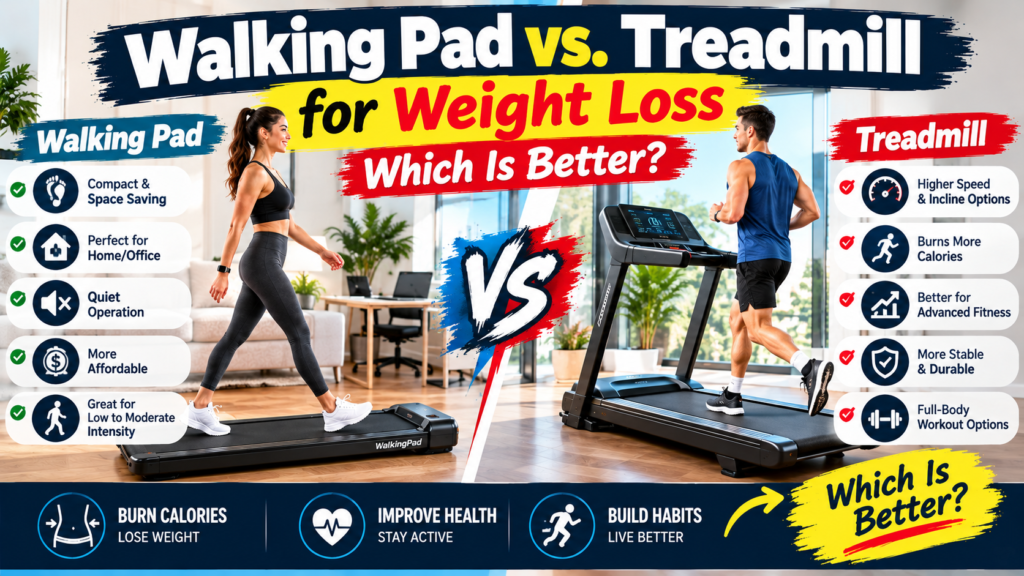
Compare walking pads and treadmills for weight loss, calorie burn, daily steps, incline workouts, space, and cost to choose the right machine.
LifeCareBalance.com is reader-supported. When you buy through links on our site, we may earn an affiliate commission at no extra cost to you. As an Amazon Associate, we earn from qualifying purchases.
If you are choosing between a walking pad and a treadmill for weight loss, the best option depends on how you plan to exercise. A treadmill generally offers more flexibility for incline walking, jogging, running, and structured cardio workouts. A walking pad focuses on convenient walking, making it easier to add movement to a workday or fit exercise into a small home.
Neither machine automatically produces weight loss. Your results depend on your overall eating patterns, physical activity, consistency, and individual circumstances. The most useful machine is the one that fits your lifestyle and helps you maintain a realistic routine.
This guide compares walking pads and treadmills for weight loss, including calorie expenditure, daily steps, belly fat, beginner workouts, space requirements, safety, and cost. Instead of promising a specific result, it explains what each machine can realistically help you do.
Quick Answer: Walking Pad or Treadmill for Weight Loss?
- Choose a walking pad if you mainly want to walk more, reduce sitting time, work at a standing desk, or exercise in a small apartment.
- Choose a treadmill if you want incline workouts, faster walking, jogging, running, or more structured cardio sessions.
- For daily movement: A walking pad can make short walking sessions easier to fit into your routine.
- For workout intensity: A treadmill generally provides more options for increasing speed and incline.
- For weight loss: Neither machine guarantees better results. Overall energy balance and consistent activity matter more than the equipment label.
- For beginners: Either can work. Consider the controls, belt size, handrails, stability, and your comfort with the machine.
The bottom line is simple: a treadmill offers more workout versatility, while a walking pad prioritizes convenience. Choose according to the type of movement you will realistically do week after week.
Walking Pad vs. Treadmill: Key Differences
| Feature | Walking pad | Traditional treadmill |
|---|---|---|
| Primary purpose | Walking and everyday movement | Walking, jogging, running, and cardio |
| Typical design | Compact, low-profile | Larger frame with console and handrails |
| Speed range | Often limited to walking speeds | Usually supports a wider speed range |
| Incline | Often absent, but model-dependent | Common on many models |
| Running | Usually not supported unless specifically rated | Supported by running-rated models |
| Walking surface | Often shorter or narrower | Often longer and wider |
| Under-desk use | Many models are designed for it | Usually not designed for it |
| Storage | Often easier to move or store | Usually heavier and bulkier |
| Handrails | Frequently absent or optional | Common on traditional models |
| Workout variety | Primarily walking | Walking, incline, intervals, jogging, and running |
| Price | Often lower, depending on features | Often higher, depending on construction |
| Best fit | Daily movement and limited spaces | Dedicated workouts and progressive cardio |
These are general differences, not rules for every product. Some walking pads include incline or folding handrails, while some compact treadmills are designed for easier storage. Check the exact model’s specifications before buying.
For a broader explanation of belt size, motor ratings, weight capacity, and storage, read the walking pad buying guide.
Which Burns More Calories: A Walking Pad or a Treadmill?
Calorie expenditure depends on several factors, including your body weight, walking speed, incline, workout duration, and effort. The machine itself does not determine how many calories you burn.
A treadmill usually gives you more ways to increase workout intensity. You can walk faster, adjust the incline, or run on a model rated for running. These options can increase energy expenditure during a session.
A walking pad can still contribute to your daily activity. It may allow you to accumulate more walking time because you can use it during appropriate work tasks, television time, or short breaks.
Consider two hypothetical routines:
| Routine | Main advantage | Important limitation |
|---|---|---|
| Walking pad for 20–30 minutes on most days | Convenient, repeatable walking | Usually offers fewer ways to increase intensity |
| Treadmill for 30 minutes with changing speed or incline | More control over workout intensity | Requires dedicated exercise time and sufficient space |
| Several short walking sessions throughout the day | Easier to fit into a busy schedule | The total activity and intensity still matter |
| Progressive treadmill sessions several times per week | Can support increasing fitness demands | Requires a suitable model and gradual progression |
These examples illustrate different approaches, not a guarantee that one routine will produce more weight loss.
A treadmill session may expend more energy per minute when it involves greater effort. However, if you rarely use the treadmill and consistently use a walking pad, the walking pad may fit your real-life routine better.
What About Incline Walking?
Incline walking increases the effort required compared with walking on a level surface at the same speed. Research on treadmill walking has examined how changes in grade affect energy expenditure and movement demands.
A laboratory study comparing the popular 12-3-30 treadmill workout with self-paced running found that the running session expended energy at a higher rate, while the incline-walking session involved a higher proportion of fat oxidation during exercise. The sessions were matched for total energy expenditure, and the results do not establish that incline walking causes greater long-term body-fat loss.
Read the peer-reviewed 12-3-30 and running study for the study design and findings.
The practical takeaway is that incline is another way to change workout intensity, not a shortcut that guarantees faster weight loss.
Can a Walking Pad Help You Lose Weight?
Yes, a walking pad can support a weight-loss plan by making regular walking more convenient. It can be especially useful for people who sit for long periods or struggle to schedule a separate workout.
Potential advantages include:
- Making short walking sessions easier to fit into the day.
- Creating opportunities to move during suitable work tasks.
- Supporting a consistent walking habit at home.
- Providing an indoor option when weather or outdoor access is inconvenient.
- Helping increase activity without requiring a large exercise area.
A systematic review and meta-analysis of treadmill desks found that treadmill-desk use increased energy expenditure in laboratory studies compared with sitting. The research also found reduced sitting time in workplace studies, although evidence for broader cardiometabolic outcomes was more limited.
Read the systematic review of treadmill desks and energy expenditure for more detail.
These findings support the idea that walking during desk work can increase movement. They do not prove that every walking pad user will lose weight or that desk walking replaces all other exercise.
What Are the Limitations?
A walking pad may not be suitable if you want to run regularly, need a substantial incline, or prefer handrails for balance support. Some models have shorter belts, lower maximum speeds, or user-weight limits that do not suit every shopper.
Also, walking while typing can make certain tasks harder. Start slowly, pay attention to your posture, and stop walking when you need precise hand movements or full concentration.
Is a Treadmill Better for Weight Loss?
A treadmill may be a better fit if your goal is to progress from comfortable walking to more demanding cardio sessions.
Its advantages can include:
- Incline walking for greater workout intensity.
- Faster walking and running on appropriately rated models.
- Interval workouts that alternate easier and harder periods.
- A larger walking surface on many models.
- Handrails that can provide a stable reference point.
- More structured workout settings on some consoles.
The main tradeoffs are size, weight, price, and storage. A traditional treadmill may be difficult to fit into a small apartment, and its additional features are not valuable if you do not plan to use them.
If you are comparing specific compact models, see our WalkingPad C2 vs. UREVO comparison. Remember that individual models may differ in speed, incline, dimensions, and intended use.
Walking Pad vs. Treadmill for Belly Fat
Neither a walking pad nor a treadmill can reliably target belly fat specifically. Exercise can contribute to overall fat loss, but doing a particular activity does not guarantee that fat will come off one chosen area first.
For many people, reducing body fat involves a combination of sustainable eating habits, regular activity, and consistency over time. Genetics, age, sleep, medications, and other individual factors can influence body composition and how fat is distributed.
A walking pad may help you move more frequently throughout the day. A treadmill may help you complete more intense workouts. Either can form part of a broader activity plan, but neither should be marketed as a belly-fat removal solution.
Be skeptical of products or workout programs promising spot reduction, dramatic results in a fixed number of days, or guaranteed fat loss without changes to overall habits.
Walking Pad vs. Treadmill for Daily Steps
A walking pad can be especially convenient when your goal is to accumulate more steps rather than complete one long workout.
You might use it for a short walk before work, a slow session during a suitable task, and another walk in the evening. These sessions can make daily movement more accessible, especially if you spend most of the day at a desk.
A treadmill can also help you increase steps, but many users treat it as a dedicated exercise machine that they use at a specific time.
Daily step targets should be realistic rather than rigid. Research on daily steps and health outcomes suggests that higher step counts are associated with health benefits, although the relationship varies by age and other factors and does not establish one ideal target for everyone. See this systematic review and meta-analysis of physical activity and adiposity for research on daily steps and body-composition measures.
If you are starting from a low activity level, build up gradually instead of treating 10,000 steps as a mandatory starting point.
Which Is Better for Beginners?
Both machines can work for beginners. The right choice depends on the features you need and how comfortable you feel using the equipment.
A Walking Pad May Suit You If:
- You want to begin with slow walking.
- You have limited floor space.
- You want to add short walking sessions to your workday.
- You do not need incline or running.
- You feel comfortable using a model without handrails.
A Treadmill May Suit You If:
- You want handrails for balance support.
- You prefer a larger walking surface.
- You plan to progress toward jogging or running.
- You want incline options.
- You prefer a more structured workout console.
Neither machine is automatically safer for every beginner. If you have balance concerns, difficulty walking independently, or a condition that affects exercise tolerance, seek suitable professional guidance before choosing equipment.
Start at a comfortable pace, learn the stopping controls, and increase duration or intensity gradually.
Walking Pad vs. Treadmill for Heavier Users
For heavier users, the most important factors are the manufacturer’s user-weight rating, walking-surface dimensions, stability, intended operating duration, and available support.
Do not choose equipment based on marketing labels such as “heavy duty” alone. Confirm the published maximum user weight for the exact model and make sure it suits your needs.
Consider these points:
- Weight capacity: Do not exceed the manufacturer’s stated limit.
- Belt dimensions: A longer or wider belt may feel more comfortable for some users.
- Stability: Check the frame design and credible reports of movement or wobbling.
- Handrails: These may be useful for users who need additional balance support.
- Motor and operating guidance: Check whether the manufacturer permits the duration and frequency of use you expect.
- Warranty: Review the motor, frame, parts, and labor terms.
A traditional treadmill may offer a larger belt or handrails, but not every treadmill has a higher weight rating than every walking pad. Compare specifications rather than assuming the product category determines capacity.
Beginner Walking Pad Workout for Weight Loss
This sample session is a starting point for someone who can walk comfortably and whose machine supports the chosen speeds. Adjust the pace to your ability and the manufacturer’s limits.
| Stage | Duration | Effort |
|---|---|---|
| Warm-up | 5 minutes | Very easy walking |
| Comfortable walk | 10 minutes | A pace that allows conversation |
| Slightly brisk walk | 10 minutes | Moderately challenging but controlled |
| Cool-down | 5 minutes | Return to an easy pace |
Total: 30 minutes.
If 30 minutes is too much at first, start with shorter sessions. You can divide activity into manageable periods throughout the day and build up gradually.
The aim is to establish a routine that you can repeat comfortably. You do not need to walk at the fastest possible speed to make the session worthwhile.
Beginner Treadmill Workout for Weight Loss
A treadmill allows you to add incline if your machine includes that feature. You do not need to use a steep incline to begin.
| Stage | Duration | Effort |
|---|---|---|
| Warm-up | 5 minutes | Easy, flat walking |
| Comfortable walking | 10 minutes | Steady pace |
| Optional incline segment | 5–10 minutes | Modest incline at a controlled speed |
| Cool-down | 5 minutes | Easy, flat walking |
Total: 25–30 minutes, depending on the incline segment.
If you are new to exercise, start with flat walking until it feels comfortable. Add incline only if it suits your ability and your treadmill’s instructions. Avoid increasing speed and incline aggressively at the same time.
Stop if you experience unusual symptoms such as chest pain, faintness, or severe shortness of breath, and seek appropriate medical help.
How Much Exercise Do You Need for Weight Loss?
There is no single exercise duration that guarantees weight loss. Your needs depend on your current activity level, food intake, health, schedule, and goals.
The CDC recommends that adults aim for at least 150 minutes of moderate-intensity aerobic activity per week, alongside muscle-strengthening activity on at least two days. Some people may need more activity or changes to eating patterns to achieve and maintain weight loss.
See the CDC’s guidance on physical activity and weight management for the relationship between activity, energy expenditure, and body weight.
You can use either a walking pad or a treadmill to contribute to your weekly activity. Choose an amount you can build toward safely, and do not treat the minimum recommendation as a guarantee of a particular weight change.
Which Machine Is Better for a Home Office?
A walking pad is often the more practical option for a home office because many models are low-profile and designed to fit beneath a standing desk.
Before buying one, measure the desk height with the walking surface under your feet. Check that your monitor, keyboard, and mouse remain in comfortable positions, and make sure you can stop the machine easily.
Keep the speed low enough that you can maintain balance and work comfortably. Some tasks are better performed while stationary, especially those requiring precise typing or sustained concentration.
A traditional treadmill is generally less convenient for under-desk use because its frame, handrails, and console may interfere with desk placement.
Which Is Better for a Small Apartment?
Walking pads usually have an advantage in small spaces, but storage convenience depends on the model.
Before purchasing, measure the available floor space and the location where you plan to store the machine. Check the product’s actual dimensions, weight, folding mechanism, and transport wheels.
Also consider noise and vibration. A machine that sounds quiet in one room may still transmit footsteps through a floor. Flooring, walking style, speed, and building construction can affect the experience.
A treadmill can still be the right choice for an apartment if you have enough space and need its broader workout options. Do not sacrifice essential features or a suitable walking surface solely to obtain the smallest machine.
What to Check Before Buying Either Machine
Use these practical checks to compare individual products:
- Intended use: Is the model designed for walking only, or does the manufacturer support jogging or running?
- Walking surface: Is the belt long and wide enough for your stride?
- Speed and incline: Do the available settings match your planned workouts?
- Weight capacity: Does the stated limit suit your needs?
- Stability and controls: Can you use the machine comfortably and stop it quickly?
- Desk compatibility: If needed, will it fit your desk height and workspace?
- Storage: Can you move and store it where you intend?
- Warranty: What is covered, for how long, and under what conditions?
- Maintenance: What cleaning, lubrication, and belt-alignment procedures does the manufacturer require?
- Return policy: Can you return the machine if the size, noise, or usability does not meet expectations?
For model-specific options, browse our Best Walking Pads of 2026 guide and compare the specifications of each shortlisted product.
Final Verdict: Walking Pad vs. Treadmill for Weight Loss
A treadmill is generally the better choice for people who want incline walking, jogging, running, or a wider range of structured workouts. A walking pad is often the more practical option for people who want to increase daily movement, work while walking slowly, or exercise in a small space.
Neither machine guarantees weight loss. A more intense workout can increase energy expenditure during a session, while convenient equipment may help you maintain a more consistent routine. Your overall activity, eating patterns, and ability to keep using the equipment are what matter over time.
Before buying, check the exact model’s dimensions, intended use, weight capacity, controls, warranty, and storage requirements. Choose the machine that fits your needs today and supports a routine you can realistically maintain.
Frequently Asked Questions
Is a walking pad or treadmill better for weight loss?
A treadmill generally offers more ways to increase exercise intensity through incline and running. A walking pad may be easier to use frequently for daily movement. Neither is universally better; the right choice depends on your routine and overall weight-management plan.
Does a treadmill burn more calories than a walking pad?
A treadmill can allow higher energy expenditure per minute when used for faster walking, incline workouts, or running. Actual expenditure depends on the person, speed, incline, duration, and effort.
Can I lose weight using only a walking pad?
A walking pad can contribute to weight loss by helping you increase physical activity. Weight change also depends on eating patterns, total energy balance, consistency, and individual factors.
Does a walking pad reduce belly fat?
A walking pad cannot specifically target belly fat. Regular activity can support overall fat loss, but the body does not reliably lose fat from a chosen area simply because of the exercise performed.
Is incline walking necessary for weight loss?
No. Incline is one way to increase workout intensity, but flat walking can also contribute to physical activity. Choose a level of effort that is appropriate for your fitness and comfort.
How long should I walk each day?
Start with an amount you can manage comfortably and build gradually. Weekly activity recommendations provide a useful general target, but no specific duration guarantees a particular amount of weight loss.
Is a walking pad suitable for beginners?
It can be, especially for someone who wants to begin with slow walking. Check whether the model has handrails if you need balance support, and learn the stopping controls before using it.
Should I buy a treadmill if I plan to run?
Usually, yes. A traditional treadmill designed and rated for running is generally a better choice than a walking-only machine. Always confirm the exact model’s intended use and specifications.