
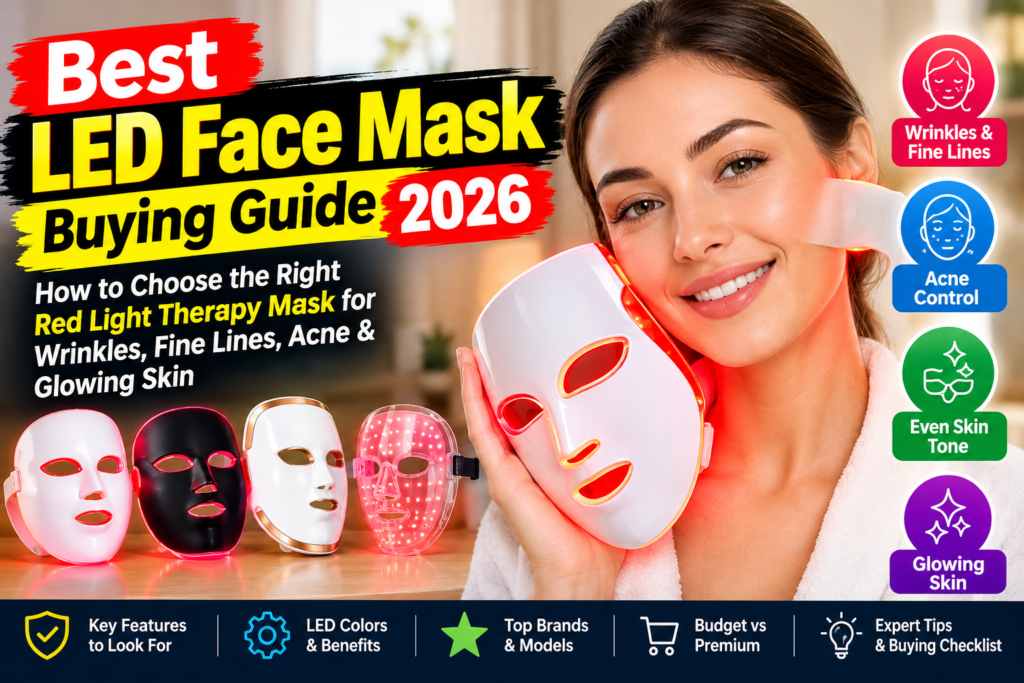
Learn how to choose the best LED face mask in 2026 for wrinkles, fine lines, acne and glowing skin, including wavelengths, irradiance, fit and safety.
LifeCareBalance.com is reader-supported. When you buy through links on our site, we may earn an affiliate commission at no extra cost to you. As an Amazon Associate, we earn from qualifying purchases.
LED face masks are everywhere right now, and the marketing is louder than ever. Scroll for five minutes and you’ll see masks promising to “erase” wrinkles, deliver an “instant facelift,” or work simply because they pack in more LEDs than the mask next to it. None of that tells you whether a specific device will actually work for your skin.
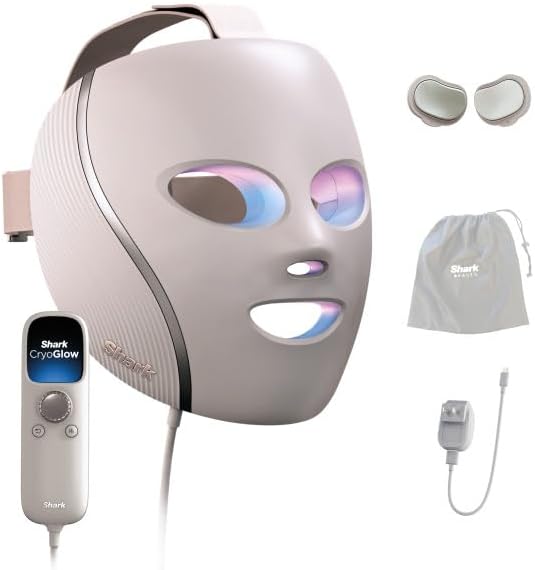
- RED LIGHT THERAPY MASK: CryoGlow is an at-home LED face mask combining red, blue & deep infrared light with under-eye co…
- MOST AWARDED LED MASK IN THE U.S.*: Real people. Real results. Clinically tested on 119 participants by an independent t…
- EXPERTLY DEVELOPED: Developed by Shark Beauty alongside optical light experts and engineers, bringing MedSpa-inspired re…
This guide skips the hype and focuses on the handful of things that genuinely determine whether an LED face mask is worth your money: wavelength, irradiance and dose, coverage and fit, and regulatory status. If you want a curated product roundup, our best LED face masks of 2026 picks up where this guide leaves off. Here, the goal is to make sure you know exactly what to look for before you spend $200 to $2,000 on a mask.
Quick Answer: What Should You Look for in an LED Face Mask?
At a minimum, a good LED face mask should clearly state its wavelengths (in nanometers), its irradiance (in mW/cm²), and its recommended treatment time, because those three numbers determine your actual light dose. It should also disclose its FDA clearance status and exact indication (wrinkles, acne, or both), fit your face shape with even skin contact, and come from a manufacturer willing to publish real specifications rather than vague marketing claims. If a listing can’t answer “what wavelength, what irradiance, for how long, cleared for what,” that’s a red flag worth taking seriously.
How to Choose an LED Face Mask in 2026
Most LED face mask content online is a ranked list of products. That’s useful once you already know what you’re looking for, but it skips the part that actually matters: understanding the variables that separate an effective mask from an expensive nightlight.
Choosing the right LED face mask really comes down to five questions, in this order:
- What’s your main concern? Wrinkles and fine lines call for different wavelengths than acne.
- Does the mask disclose real specifications? Wavelength and irradiance, not just “clinical-grade LEDs.”
- Will it actually cover and contact the areas you care about? A mask that gaps at the jawline or nose won’t treat those areas effectively, regardless of its specs.
- Is it cleared by the FDA for your specific concern? And does the listing actually say what it’s cleared for?
- Can you commit to consistent use? LED therapy is cumulative, not a one-time fix.
The rest of this guide walks through each of those in order, starting with the one buyers get wrong most often: wavelength.
Which LED Wavelength Is Best for Your Skin?
Different wavelengths of light penetrate the skin to different depths and interact with different types of tissue. According to the American Academy of Dermatology, red and near-infrared light — sometimes called photobiomodulation — is the category dermatologists most commonly discuss for signs of aging, while visible light in the blue, red, or combined blue-and-red range is used specifically to treat pimples, and is not effective against blackheads, whiteheads, cysts, or nodules.
Here’s a simple framework for matching wavelength category to your primary concern. Keep in mind that wavelength is only the starting point — two masks with the same wavelength can still perform very differently depending on irradiance, dose, and coverage, which we cover next.
| Concern | Best-fit wavelength category | What to know |
|---|---|---|
| Wrinkles | Red or red + near-infrared (NIR) | NIR reaches deeper into the dermis; often paired with red light for wrinkle-specific devices |
| Fine lines | Red or red + NIR | Similar profile to wrinkles; consistency matters more than a single “best” wavelength |
| Acne | Blue or blue + red | Blue is associated with acne-causing bacteria; red is added to help calm inflammation |
| Skin tone / discoloration | Red / NIR | Marketed for evenness and redness, evidence is more limited than for wrinkles or acne |
| Texture | Red / NIR | Often bundled into “anti-aging” or “rejuvenation” mask categories |
| Overall skin appearance | Red / NIR | The broad “glow” category most general-purpose masks target |
| Multiple concerns | Multi-wavelength (blue + red, or red + amber + NIR) | Look for masks that let you select modes rather than blending everything into one setting |
A wavelength match doesn’t guarantee a specific outcome — it just tells you the device is aimed at the right biological target. Two “red + NIR” masks can still differ enormously in how much light they actually deliver to your skin, which is where irradiance comes in.
Red Light vs Near-Infrared vs Blue Light
- Red light (roughly 620–700 nm) sits at the visible end of the spectrum and is the wavelength most consistently associated with wrinkle- and rejuvenation-focused devices. It penetrates the outer layers of skin.
- Near-infrared (NIR) light (roughly 780–850 nm) is invisible to the eye and penetrates deeper into skin tissue than red light. It’s frequently paired with red light in devices marketed for fine lines, wrinkles, and firmness, and — separately — near-infrared is also used in devices intended simply for topical heating and temporary muscle or joint relief, which is a different use case entirely.
- Blue light (roughly 400–420 nm) is the wavelength most associated with acne-focused devices. The American Academy of Dermatology notes that the FDA has cleared some visible-light LED devices — blue, red, and blue-plus-red — for at-home use, and that these are less powerful than the devices used in a dermatologist’s office.
A 2026 FDA clearance letter for one LED face mask illustrates how manufacturers actually map these wavelengths to indications in practice: that device’s red light (630 nm), amber light (605 nm), and combined red-plus-near-infrared (630 nm + 830 nm) modes were cleared specifically for treatment of wrinkles, while its blue light (415 nm) and combined blue-plus-red modes were cleared specifically for mild-to-moderate inflammatory acne — and a separate near-infrared-only mode was cleared only for topical heating and temporary muscle/joint relief, not for wrinkles or acne. This is a useful reminder that even within one mask, different light settings can carry entirely different intended uses.
If you’re deciding between a dedicated LED face mask and a larger red light therapy panel, our LED face mask vs red light therapy panel comparison breaks down the practical trade-offs in coverage, convenience, and typical irradiance between the two formats.
What Is Irradiance and Why Does It Matter?
Irradiance is simply how much light power hits a given area of skin, usually measured in milliwatts per square centimeter (mW/cm²). Think of it like water pressure from a showerhead: two showerheads can deliver the same total amount of water, but one with higher pressure gets you wetter faster.
Irradiance interacts directly with treatment time to produce your actual dose (also called fluence), typically measured in joules per square centimeter (J/cm²). The relationship is straightforward:
Dose (J/cm²) = Irradiance (mW/cm²) × Time (seconds) ÷ 1,000
So a mask delivering 20 mW/cm² for 10 minutes (600 seconds) delivers roughly 12 J/cm² — the same total dose you’d get from a mask delivering 10 mW/cm² for 20 minutes. Neither number alone tells you the full story; you need both.
This is also why higher irradiance is not automatically better. Research on photobiomodulation suggests that light dose-response isn’t simply “more is more” — there can be a point of diminishing or even counterproductive returns, and manufacturers set their recommended treatment times specifically to land in a tested, effective dose range for their device’s irradiance. A mask with lower irradiance and a longer session can deliver a comparable — or in some cases more appropriate — dose than one with very high irradiance and a short session. What actually matters is whether the manufacturer has published irradiance figures at all, and whether the recommended protocol (time, frequency, distance from skin) reflects real testing rather than a guess.
When you’re comparing masks, look specifically for irradiance figures broken out per wavelength or per mode — many FDA filings show that mixed-light settings (like red plus blue) report noticeably higher combined irradiance than a single wavelength alone, so a straight side-by-side of “mode A vs mode B” only makes sense when you’re comparing the same type of setting.
Does More LEDs Mean a Better LED Mask?
No — LED count is one of the most overused marketing numbers in this category, and by itself it tells you very little. A mask with 200 dim, poorly placed LEDs can deliver less usable light to your skin than a mask with 100 well-positioned ones, because what actually determines effectiveness is a combination of factors:
- Wavelength accuracy — LEDs at 630 nm vs. 660 nm vs. 670 nm are all “red,” but they’re not identical
- Irradiance — the actual power output reaching skin, not just diode count
- Dose — irradiance combined with treatment time
- Coverage — whether LEDs are positioned to reach cheeks, jawline, nose, and eye areas evenly
- Fit and distance from skin — light intensity drops off quickly as distance from skin increases
- Treatment protocol — how often and how long the manufacturer recommends using it, and whether that protocol is backed by testing
A “1,000 LED mask” headline is easy to print on a box. Irradiance and wavelength data take more effort to test and disclose — which is exactly why their presence (or absence) tells you more about how seriously a brand approached product development.
How Long Should You Use an LED Face Mask?
This varies by device, wavelength, and manufacturer protocol — there’s no single universal number. As a general reference point, the FDA clearance for one recent LED face mask specifies a 10-minute session across its red, amber, and red+NIR wrinkle modes, and its blue and blue+red acne modes. Other devices reviewed by the FDA in the same product category have used session lengths ranging from 10 to 30 minutes, with some acne-specific protocols calling for use 3 to 4 times weekly for about 4 weeks, and general rejuvenation protocols often recommending most days of the week on an ongoing basis.
The safest approach is simple: follow the specific instructions that come with your device, not a generic number you saw in a listicle. Manufacturers set their protocols based on the irradiance their specific hardware produces — a protocol from one mask’s instructions may deliver a very different dose if applied to a different mask.
Does LED Mask Fit Matter?
Yes, and it’s one of the most underexplored parts of most buying guides. Even a mask with excellent wavelength and irradiance specs underperforms if it doesn’t sit properly against your skin.
Silicone vs. rigid masks. Flexible silicone masks tend to mold more closely to individual face shapes, which helps maintain consistent skin contact and distance. Rigid plastic masks are often more affordable and durable but can gap noticeably on smaller or larger faces, especially around the cheeks and jaw.
Skin contact and distance. Light intensity falls off sharply as distance from the skin increases. A mask that sits even a centimeter away from part of your face in a gap delivers meaningfully less irradiance to that spot than the manufacturer’s tested distance — which is usually very close to, or touching, skin.
Cheek and jawline coverage. These are the areas most likely to be under-treated by masks designed around an “average” face shape. If you have a narrower or broader face than the mask’s mold, check reviews specifically for fit complaints in these zones.
Nose area. Because the nose projects outward, many rigid masks create a visible gap here — check whether the design accounts for this with a cutout or flexible zone.
Eye area. Some masks include eye-safe panels for periocular treatment (relevant if fine lines around the eyes are a priority); others exclude the eye area entirely and require separate goggles. Confirm which category your mask falls into, since periocular treatment has some of the more specific supporting research in this space.
Strap comfort and wearability. A mask you find uncomfortable to wear for the full session length is a mask you’ll eventually stop using — which matters more than almost any spec sheet, given how central consistency is to results.
Face shape differences. One-size masks are inherently a compromise. If you have a notably narrow, broad, long, or short face, look specifically for brands that offer sizing options or highly flexible/adjustable designs.
FDA Cleared vs FDA Approved: What Buyers Should Know
This distinction trips up a lot of shoppers, and it’s worth getting exactly right. According to the American Academy of Dermatology, “FDA cleared” devices are ones the FDA considers to pose a low risk to the public, and this clearance says nothing about how effective the device actually is — it only speaks to safety. The AAD is also explicit that terms like “FDA approved” or “FDA certified” have no real meaning when used to describe a medical device, because the FDA clears devices rather than approving or certifying them.
In practice, this means:
- “FDA cleared” ≠ “clinically proven to work.” It means the agency found the device substantially equivalent in safety to an already-legally-marketed device — a process called 510(k) clearance.
- Clearance is indication-specific. A device can be cleared for “treatment of wrinkles” under one mode and “treatment of mild-to-moderate inflammatory acne” under another, and NOT cleared for other uses (like general anti-aging claims or deeper acne types). Reviewing one recent 510(k) filing for an LED face mask shows exactly this pattern: red, amber, and red+NIR modes were cleared for wrinkles, while blue and blue+red modes were cleared specifically for mild-to-moderate inflammatory acne — two clearly separate indications on the same physical device.
- “Cleared” doesn’t mean “approved.” Class III devices go through a more rigorous PMA (premarket approval) pathway; most at-home LED masks are Class II devices cleared through the 510(k) pathway, which is a different (and lower) bar.
- Always check the specific device, not the category. A brand having “an FDA-cleared mask” in its lineup doesn’t mean every mask or every mode it sells carries that clearance.
The AAD’s guidance is direct on this point: dermatologists recommend choosing a red-light device created for the specific concern you want to treat, and confirming FDA clearance status directly rather than assuming it from marketing language. When in doubt, look up the manufacturer’s specific model number in the FDA’s 510(k) database rather than relying on packaging claims.
How Much Should You Spend on an LED Face Mask?
Prices for at-home LED face masks span a wide range, and the AAD notes that costs for red-light devices generally run from around $100 to more than $1,000. Within that range:
- Budget masks (roughly under $150) often disclose the least specification detail and may use lower or unspecified irradiance. Not automatically bad, but harder to evaluate.
- Mid-range masks (roughly $150–$500) are where most well-known consumer brands sit, and where you’ll find the most variation in build quality, fit, and disclosed specs.
- Premium masks (roughly $500+) more often publish detailed irradiance and clinical-testing information, and may use silicone construction for better fit — but price alone is not a reliable proxy for effectiveness.
Prices for specific models change frequently and vary by retailer and promotion, so always verify current pricing directly with the manufacturer or retailer before buying — don’t rely on prices quoted in any article, including this one. For deeper hands-on pricing and performance impressions on specific models, see our LED face mask review.
Best LED Mask Features by Skin Concern
Anti-aging buyers and acne buyers are often shopping for functionally different products, even when both are labeled “LED face masks.” It’s worth separating the two rather than assuming one mask serves both audiences equally well.
If wrinkles or fine lines are your priority, look for:
- Red and/or near-infrared wavelengths, ideally with published nanometer values
- Disclosed irradiance for the red/NIR mode specifically
- Eye-area coverage if periocular lines (crow’s feet) are a concern, since that’s an area with some of the more specific supporting research
- A realistic multi-week-to-multi-month usage expectation, not a “results in days” claim
If acne is your priority, look for:
- Blue light or blue+red combination modes specifically, since dermatology guidance points to visible light treating pimples but not blackheads, whiteheads, cysts, or nodules
- A device explicitly cleared for “inflammatory acne,” since that’s the specific indication most at-home devices target
- A realistic 4-to-12-week timeline before judging results
- Awareness that at-home devices are less powerful than in-office treatments and work best as a complement to — not a replacement for — a broader acne routine, including topicals your dermatologist may recommend
If acne is a significant concern, it’s also worth reading our dedicated comparison of LED face mask vs microcurrent mask, since microcurrent devices target muscle tone rather than acne or wrinkles and are sometimes confused with LED options by first-time buyers.
LED Face Mask Buying Checklist
Save or screenshot this list before you buy:
- Wavelength(s) disclosed in nanometers — not just “red light” or “clinical-grade”
- Irradiance disclosed in mW/cm² for each mode you’ll actually use
- Recommended treatment time and frequency provided by the manufacturer
- FDA clearance status confirmed for your specific device and specific concern (wrinkles vs. acne are separate indications)
- Material and fit — silicone vs. rigid, and how it handles your face shape
- Coverage of your priority areas — cheeks, jawline, nose, eyes as needed
- Eye protection included or required, and instructions on how to use it
- Realistic before/after claims — no “permanent,” no “instant,” no guaranteed timelines
- Return policy — useful given how fit-dependent results can be
- A plan for consistent use — most protocols call for regular sessions over weeks to months
Common LED Face Mask Buying Mistakes
- Buying based on LED count alone. As covered above, this number is largely a marketing artifact without irradiance and wavelength context.
- Assuming “FDA cleared” means “clinically proven effective.” It confirms safety-equivalence, not efficacy for your specific concern.
- Ignoring fit for face shape. A great mask on someone else’s face can be a poor fit on yours.
- Expecting fast results. Most credible research points to improvement over weeks to months of consistent use, not days.
- Buying a wrinkle-focused mask for acne, or vice versa, without checking that the wavelength and clearance actually match your concern.
- Skipping the safety check. Not everyone is automatically a good candidate for at-home light therapy (see the safety note below).
- Not verifying current price and specs directly with the manufacturer, since listings and promotions change often.
LED Face Mask vs Red Light Therapy Panel
LED face masks and red light therapy panels use the same underlying technology but differ in format. A mask conforms to the face and is generally easier to use hands-free, but treats a fixed, smaller surface area. A panel treats a larger area (face, neck, chest, or body) at a greater distance, which can mean more even irradiance across a flat treatment field but requires you to sit still in front of it. Panels are also more commonly used for body applications beyond the face. For a full side-by-side, see our LED face mask vs red light therapy panel breakdown, and for general guidance on shopping this broader category, our red light therapy buying guide covers panels, wands, and masks together.
LED Face Mask vs Microcurrent Mask
These are frequently shelved next to each other but do fundamentally different things. LED masks use light wavelengths to target skin cells and are the focus of this guide. Microcurrent masks use low-level electrical current aimed primarily at facial muscles, marketed for toning and lifting rather than the wrinkle- or acne-focused mechanisms of LED. Some devices now combine both technologies in one mask. If you’re deciding between the two — or considering a combination device — our detailed LED face mask vs microcurrent mask comparison covers the mechanism differences and what each is (and isn’t) good for in more depth.
Are LED Face Masks Worth It in 2026?
For the right buyer with realistic expectations, yes — with caveats. The American Academy of Dermatology notes that in one study, 90 patients who received 8 LED red-light treatments to the face over 4 weeks showed improvement in more than 90% of cases, including softer, smoother skin, less redness, and lightening of dark spots, and that similar results have been observed in larger studies, including improvement in discoloration and swelling when red light was used after laser treatment. For acne, a 2025 systematic review and meta-analysis from Mass General Brigham researchers pooled data from six randomized controlled trials totaling 216 participants and found that at-home red and/or blue LED devices produced meaningfully greater reductions in both inflammatory and non-inflammatory acne lesions compared to control conditions, with benefits typically appearing after roughly four to twelve weeks of consistent use.
That said, the AAD is also candid about the limits of current evidence: researchers study different devices, test them for differing amounts of time, and design studies to answer different questions, which means results from different studies of different devices generally cannot be directly compared. In other words, a strong result from one specific mask in one specific study doesn’t automatically transfer to a different mask with different specs.
At-home LED masks are also inherently less powerful than in-office devices. The AAD notes that the red light dermatologists use in-office is more powerful than what’s found in devices sold for at-home use, and typically recommends red light as a complementary therapy alongside other treatments rather than a standalone fix.
So: worth it, if you go in expecting gradual, “may help” and “can improve the appearance of” results from consistent use of a well-specified device — not a replacement for dermatologist-directed treatment, and not a guaranteed transformation.
Final Verdict
There’s no single “best” LED face mask for everyone, because the right choice depends on your specific concern, face shape, and willingness to use it consistently over weeks or months. What separates a reasonable purchase from a wasted one isn’t LED count or a flashy before-and-after photo — it’s whether the manufacturer discloses real wavelength and irradiance data, whether the device is actually cleared for your specific concern, and whether it fits your face well enough to deliver that light consistently.
Use the checklist above every time you’re comparing masks, be skeptical of anything promising instant or permanent results, and when your concern is significant, persistent, or you’re unsure whether at-home light therapy is appropriate for you, loop in a board-certified dermatologist before you buy.
A note on safety: LED face masks are generally considered low-risk for short-term use, but they’re not automatically appropriate for everyone. Talk to a healthcare professional before use if you take photosensitizing medications, have a light-sensitive skin condition, have persistent or severe acne that hasn’t responded to standard treatments, have any concerning or changing skin lesions, or are simply unsure whether LED therapy is right for your skin. People with darker skin tones should also be aware that dermatology research has found increased sensitivity to visible light, which can increase the risk of hyperpigmentation — another reason to check with a dermatologist before starting. This guide is educational and does not replace personalized medical advice.
Frequently Asked Questions
Is red light therapy the same as an LED face mask? Not exactly. Red light therapy refers to the broader treatment approach using red and/or near-infrared light. An LED face mask is one delivery format for that treatment — others include panels, wands, and caps.
What’s the difference between red light and blue light therapy for skin? Red and near-infrared light are most associated with wrinkle- and rejuvenation-focused devices, while blue light (often combined with red) is associated with acne-focused devices targeting pimples specifically, not blackheads, whiteheads, cysts, or nodules.
Do LED face masks really reduce wrinkles? Some research shows measurable, though not universal, improvement in the appearance of fine lines, wrinkles, and skin texture with consistent use, according to AAD-cited studies. Results vary by device, protocol, and individual skin, and no device permanently removes wrinkles.
How long does it take to see results from an LED face mask? Most protocols call for regular use over several weeks to a few months before meaningful change is visible. Acne-focused reviews have generally found improvement emerging around four to twelve weeks of consistent use; wrinkle-focused studies often use similar or longer timelines.
Are LED face masks FDA approved? Technically, no device is “FDA approved” in this category — that term doesn’t apply to how the FDA regulates most LED masks. Many are “FDA cleared” through the 510(k) pathway, which confirms safety-equivalence to a similar legally marketed device, not proven effectiveness.
Can I use an LED face mask if I have acne and wrinkles? Multi-wavelength masks exist specifically for this — look for a device that includes both blue/red modes (acne) and red/NIR modes (wrinkles) rather than assuming one wavelength category covers both concerns.
Is a higher irradiance always better? No. Irradiance needs to be matched with an appropriate treatment time to produce a sensible dose. Very high irradiance without a tested protocol isn’t automatically more effective and could increase discomfort or side-effect risk.
Do more LEDs mean better results? Not by itself. Wavelength accuracy, irradiance, dose, fit, and coverage all matter more than raw LED count. A mask with fewer, well-placed, well-specified LEDs can outperform one with more LEDs and no published specs.
Are LED face masks safe for daily use? Many are designed for frequent use, but you should always follow the specific manufacturer’s protocol, since irradiance and recommended frequency vary by device. Check with a dermatologist if you have a light-sensitive condition or take photosensitizing medication.
Do at-home LED masks work as well as in-office treatments? Generally no — dermatology sources note that in-office devices are more powerful than at-home versions. At-home masks are typically positioned as a complementary or maintenance option rather than a replacement for professional treatment;https://lifecarebalance.com/
5 Suggested FAQ Questions for Schema:
- Is red light therapy the same as an LED face mask?
- What’s the difference between red light and blue light therapy for skin?
- Are LED face masks FDA approved?
- Is a higher irradiance always better?
- Do at-home LED masks work as well as in-office treatments?