
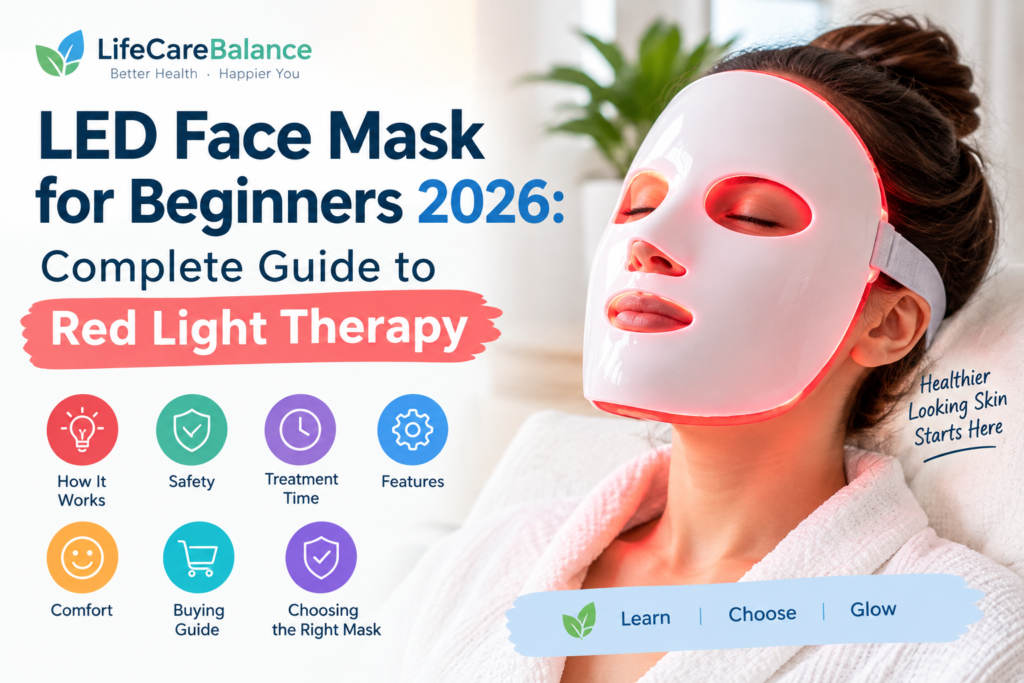
LED face mask for beginners in 2026: learn how red light therapy works, treatment time, safety, key features, comfort, and how to choose the right mask.
LifeCareBalance.com is reader-supported. When you buy through links on our site, we may earn an affiliate commission at no extra cost to you. As an Amazon Associate, we earn from qualifying purchases.
If you’ve seen LED face masks all over your social media feed and wondered whether they’re worth trying, you’re not alone. These glowing silicone masks have gone from dermatology offices to bathroom shelves, and 2026 has brought a wave of new at-home options at every price point.

- ✔ FDA CLEARED & INDEPENDENTLY STUDIED: This device is FDA Cleared under 510(k) number K252096 for the treatment of wrink…
- ✔ CLINICIAN-GRADED AND CONSUMER-VERIFIED RESULTS: In a 12-week independent clinical study, statistically significant imp…
- ✔ DUAL-WAVELENGTH RED AND NEAR-INFRARED LIGHT THERAPY: Defy-Age mode delivers Red light at 630nm and Near-Infrared light…
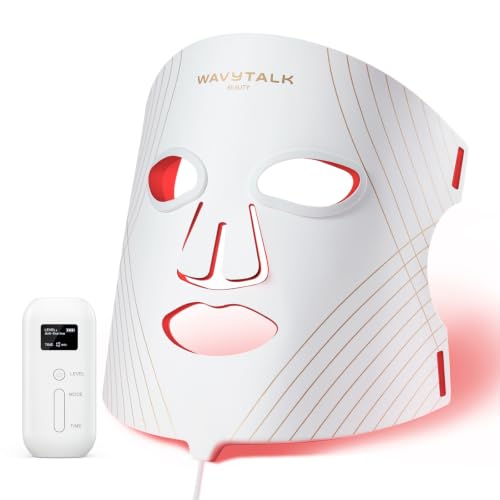
- Clinically Proven Results in 28 Days: Achieve visible improvements backed by lab data with Wavytalk’s LED face mask ligh…
- 3-in-1 Light Therapy for Targeted Care: Wavytalk’s Glow Time LED Mask features Anti-Fine Line (630nm red + 850nm near-in…
- Medical-Grade Power & Full-Face Coverage: With 456 high-purity LED Chips and 40mW/cm² power density, this red light face…
This guide is written specifically for an LED face mask for beginners audience — people who’ve heard the buzzwords “red light therapy,” “near-infrared,” and “photobiomodulation” but don’t yet know what they actually mean, how long a session should last, or what separates a good beginner device from a gimmick.
By the end, you’ll understand how these masks work, how to use one safely, what a realistic results timeline looks like, and which specifications actually matter when you’re comparing your first purchase.
Quick Answers Before You Buy
- What is it? A wearable device that uses LED lights (usually red and/or near-infrared) to expose facial skin to specific wavelengths of light, a process called photobiomodulation.
- How long per session? Typically 3 to 20 minutes, depending on the device’s irradiance. There is no single universal number — always follow the manufacturer’s stated time.
- How often? Most manufacturers recommend 3 to 5 sessions per week to start, though some devices are designed for daily use. More is not automatically better.
- Is it safe? Generally considered low-risk for short-term home use, according to the American Academy of Dermatology, though eye protection, medication interactions, and skin sensitivity need to be considered.
- Does it work? Some research shows modest, gradual improvements in fine lines, tone, and redness, but results vary by device and person, and are not guaranteed.
What Is an LED Face Mask?
An LED face mask is a curved, wearable panel — usually made of flexible silicone or rigid plastic — that’s lined with small light-emitting diodes (LEDs) positioned to shine directly onto the skin of your face. Most masks plug into a controller or battery pack and run on a timed cycle.
Unlike lasers, LEDs emit low-level, non-thermal light across a narrow range of wavelengths. That’s an important distinction for beginners: an LED face mask isn’t “heating” or “burning” the skin the way a laser treatment might. It’s delivering light energy that the skin’s cells can absorb.
Manufacturers market these devices for a range of cosmetic goals — smoother-looking skin, reduced redness, a brighter complexion, and support for acne-prone skin. As you’ll see throughout this guide, the evidence behind these claims is encouraging but still developing, which is why it’s worth understanding the science rather than just the marketing.
If you eventually want to compare specific products side by side, LifeCareBalance’s best LED face masks of 2026 roundup is a good next stop once you understand the basics covered here.
How Does Red Light Therapy Work?
The mechanism behind red light therapy is called photobiomodulation — light-based stimulation of cellular activity. In simple terms, cells contain structures called mitochondria that produce the energy cells need to function. Red and near-infrared light are thought to be absorbed by a mitochondrial enzyme, which may temporarily increase cellular energy production and trigger a cascade of secondary effects in skin cells.
Researchers who study this process, including reviews published in peer-reviewed journals, describe effects that may include modest changes in inflammation, circulation, and collagen-producing cell activity — though the exact clinical impact on skin appearance is still an active area of research and not fully settled (Freitas & Hamblin, Proposed Mechanisms of Photobiomodulation or Low-Level Light Therapy, PMC).
It’s worth being clear-eyed here: photobiomodulation is a real, studied phenomenon, but that doesn’t mean every at-home LED mask delivers a clinically meaningful dose of light. The strength of the effect depends heavily on wavelength accuracy, irradiance (light intensity), and how consistently you use the device — all things we’ll walk through below.
For a deeper look at the evidence specifically behind at-home masks, see LifeCareBalance’s LED face mask review and evidence roundup.
Are LED Face Masks Safe for Beginners?
For most healthy adults, at-home LED masks are considered a low-risk cosmetic tool when used as directed. The American Academy of Dermatology notes that in the short term, red light therapy appears to be safe, and research hasn’t found that red light causes any type of cancer the way UV light can. That said, “low risk” isn’t the same as “no risk,” and beginners should keep several things in mind.
General safety basics:
- The most common side effects are mild — some people develop temporary mild pain or irritated skin after a session.
- Always follow the specific time, distance, and frequency instructions that came with your device. Protocols vary meaningfully between brands.
- People with darker skin tones are more sensitive to visible light, including red light, than people with lighter skin tones, which can increase the risk of hyperpigmentation — a dermatologist consult beforehand is worth considering.
Eye protection matters. Many masks direct light close to the eye area. If your device includes goggles or instructs you to keep your eyes closed, follow that guidance every time — don’t substitute sunglasses for the eye protection the manufacturer recommends.
Photosensitivity and medication. If you take medication that increases light sensitivity (certain antibiotics, acne medications like isotretinoin, or some supplements), or you have a condition such as lupus that can be aggravated by light exposure, talk to a healthcare provider before starting.
When to check with a dermatologist first. The AAD’s own guidance for at-home red-light devices is to see a board-certified dermatologist before using red light at home, particularly if you have an active skin condition, are pregnant, are on photosensitizing medication, or simply want a professional opinion on whether it’s likely to help your specific concern before you spend money on a device.
None of this is meant to be alarming — it’s meant to help you use a mask the way it was designed to be used. For more on how at-home devices compare to what happens in a dermatology office, see the LED face mask vs. professional red light therapy comparison later in this guide and in its own dedicated article.
Red vs. Blue vs. Near-Infrared Light
LED masks typically use one or more of three wavelength ranges. Manufacturers vary in their exact specifications, so treat these as general categories rather than fixed numbers.
| Light Type | Typical Wavelength Range | Common Marketed Use |
|---|---|---|
| Red light | Approximately 630–660 nm | Overall skin tone, fine lines, general rejuvenation |
| Blue light | Approximately 405–420 nm | Acne-prone skin, blemish-focused routines |
| Near-infrared (NIR) | Approximately 800–870 nm | Deeper tissue penetration, often paired with red light |
A few beginner-friendly points:
- Red light is the most common wavelength in general-purpose anti-aging masks and is the one most associated with skin tone and texture claims.
- Blue light is more often marketed for acne-prone skin. The AAD’s page on light therapy for acne covers how dermatologists use light-based treatments, including blue light, in professional settings.
- Near-infrared light penetrates deeper into tissue than visible red light and is often combined with red light in dual-wavelength masks.
- Some masks combine two or three wavelengths in one device; others are single-wavelength and more targeted.
Exact wavelength ranges and how they’re combined vary by manufacturer — always check the specific device’s listed specs rather than assuming every “red light mask” uses the same wavelength. If you’re specifically shopping for acne-prone skin, LifeCareBalance’s best LED face masks for acne-prone skin guide goes deeper on that use case.
How Long Should Beginners Use an LED Face Mask?
This is one of the most common beginner questions, and there’s no single correct answer — treatment time depends on the device’s irradiance (how much light energy it delivers per second) working together with wavelength and coverage.
Here’s why: a mask with higher irradiance can deliver the same total light dose in less time than a lower-irradiance device. That’s why one brand’s mask might recommend a 3-minute session while another recommends 20 minutes — they’re not necessarily giving you more or less benefit, just delivering light at a different rate.
What beginners should actually do:
- Check the manufacturer’s instructions for your specific device and start there — don’t borrow a treatment time from a different mask or a friend’s device.
- Resist the urge to extend a session “to get better results faster.” There isn’t good evidence that exceeding the recommended time improves outcomes, and it may increase the chance of skin irritation.
- If your device offers multiple modes or intensities, start with the beginner or lower setting if one is available, especially for your first few sessions.
For manufacturer-published examples of how treatment time is defined for specific products, brands like Omnilux and CurrentBody publish device-specific protocols on their sites — useful references once you’ve picked a mask, though every brand’s numbers are specific to their own hardware.
How Often Should You Use an LED Face Mask?
Frequency, like treatment time, is device-specific. Most consumer masks fall somewhere between three sessions a week and daily use, and the right cadence for you depends on what the manufacturer designed the device to do.
General guidance for beginners:
- Start with the lower end of the manufacturer’s recommended frequency range, if one is given, so you can see how your skin responds.
- Consistency tends to matter more than intensity. A realistic, repeatable routine (for example, three sessions a week for two months) is more useful than sporadic long sessions.
- Red light therapy isn’t a one-and-done treatment — the amount of time needed varies by device, so following the specific directions that came with your mask matters more than any generic rule you find online.
- More exposure is not automatically better. Overusing a device beyond its intended protocol hasn’t been shown to accelerate results and may increase the risk of irritation.
If you’re comparing how different masks handle frequency and intensity as part of your research, LifeCareBalance’s LED face mask comparison guide lays several popular options side by side.
How to Use an LED Face Mask Step by Step
Once you have a device, the basic routine is similar across most brands, though you should always defer to your specific manufacturer’s manual.
- Read the device instructions first. Don’t assume your mask works exactly like a video you saw online — treatment time, distance, and modes vary by product.
- Cleanse and dry your face. Remove makeup, sunscreen, and skincare products so light can reach the skin directly, and pat the skin dry.
- Prepare the mask. Charge or plug in the device as needed, and select the mode or wavelength setting recommended for your goal.
- Protect your eyes if required. Wear any included goggles or close your eyes for the full session if that’s what the instructions call for.
- Select the appropriate mode. If your mask offers red, near-infrared, or combination settings, choose based on your intended use and the manufacturer’s guidance.
- Complete the recommended session length. Let the built-in timer run its course rather than guessing at time.
- Follow your normal skincare routine afterward. Most brands recommend applying moisturizer or serum after the session, once the light treatment is complete.
- Clean and store the mask correctly. Wipe down the interior per the manufacturer’s cleaning instructions and store it away from direct sunlight and moisture to protect the LEDs and electronics.
When Will You See Results?
Results from LED face masks tend to build gradually rather than appear overnight, and how quickly you notice changes — if you do — depends on your skin, your consistency, and the specific device you’re using. Here’s a general, non-guaranteed timeline reported anecdotally and in some manufacturer materials:
| Timeframe | What Some Users Report |
|---|---|
| Week 1–2 | Skin may feel slightly smoother or more hydrated-looking; no dramatic visible change yet |
| Week 3–4 | Subtle improvements in tone or texture may start to become noticeable with consistent use |
| Week 5–8 | Fine lines, redness, or overall glow may show more visible improvement for some users |
| Week 8–12+ | Continued, cumulative changes are sometimes reported with sustained, consistent use |
Importantly, this timeline is illustrative, not a promise. Results vary by device (wavelength and irradiance), your skin type and condition, your age, how consistently you use the mask, and the specific treatment protocol you follow. Some people notice very little change; others notice more. No LED mask can guarantee a specific outcome.
What Should Beginners Look for When Buying an LED Face Mask?
Rather than starting with “which mask is best,” it’s more useful for beginners to understand the specifications that actually affect performance. Here’s a buying checklist:
Wavelength transparency. A trustworthy listing states the actual wavelength(s) in nanometers (for example, “630 nm red light”), not just vague marketing like “clinical-grade light.”
Irradiance. This measures how much light power reaches the skin, usually in milliwatts per square centimeter (mW/cm²). Think of it as the “strength” of the light source. A higher irradiance number isn’t automatically better — it needs to be paired with an appropriate treatment time, and very high irradiance without proper protocols can increase the risk of skin sensitivity for some users.
Treatment time. Check whether the recommended session length is realistic for your routine and matches the device’s stated irradiance.
Light coverage. Does the mask cover the full face evenly, including areas like under the eyes and jawline, or does it leave gaps?
Fit. A poorly fitting mask (too tight, too loose, or oddly shaped for your face) may leave parts of your skin further from the light source, reducing effective exposure.
Comfort. Rigid masks and flexible silicone masks feel very different. If you plan to use the mask regularly, comfort affects whether you’ll actually stick with it.
Eye protection. Look for built-in eye protection features or included goggles, especially for masks that don’t allow you to close your eyes fully during the session.
FDA clearance. Look for a mask that is FDA cleared. This is a regulatory safety status, not a performance guarantee — clearance means the FDA considers the device to pose a low risk to the public, not that it’s clinically proven to outperform other devices.
Cordless/battery design. Some masks require you to stay tethered to an outlet; others run on battery power, which affects how easily you can multitask during a session.
Warranty. LED diodes can degrade over time. A reasonable warranty period protects your investment.
Return policy. Since results vary by person, a workable return window lets you evaluate fit and comfort risk-free.
Price and value. Higher price doesn’t automatically mean better performance. Compare the specs above rather than price alone. If budget is a primary concern, LifeCareBalance’s guide to affordable LED face masks under $100 focuses specifically on budget-friendly options.
Common LED Face Mask Mistakes Beginners Make
- Buying based only on LED count. More diodes don’t automatically mean more effective treatment if wavelength and irradiance aren’t disclosed.
- Ignoring wavelength specifications. A mask that doesn’t list its wavelength in nanometers makes it hard to know what you’re actually buying.
- Assuming more power is always better. Irradiance needs to be matched with an appropriate treatment time and protocol, not maximized.
- Using the mask longer than instructed. Extending sessions doesn’t reliably speed up results and can increase the risk of irritation.
- Inconsistent use. Skipping sessions, then trying to “catch up” with longer or more frequent use, isn’t how these devices are designed to work.
- Skipping the safety instructions. Manufacturer manuals often include important details on distance, skin prep, and contraindications.
- Ignoring eye protection requirements. This is one of the more avoidable risks associated with at-home light devices.
- Expecting instant results. As the results timeline above shows, changes — if they occur — tend to build gradually.
- Buying a mask that doesn’t match your skin goal. A device optimized for redness isn’t necessarily optimized for acne, and vice versa.
- Treating a serious skin condition without professional advice. LED masks are a cosmetic tool, not a substitute for a dermatologist’s evaluation of an active skin condition.
Best LED Mask Type for Different Skin Goals
This table is meant to help you understand which wavelength categories are typically marketed toward different concerns — it’s a starting point for research, not a guarantee of results for any specific product.
| Skin Goal | Commonly Marketed Light Type | Notes for Beginners |
|---|---|---|
| Fine lines | Red light | Often the primary wavelength in general anti-aging masks |
| Wrinkles | Red + near-infrared | Combination devices are commonly marketed for deeper-looking lines |
| Acne | Blue light (sometimes paired with red) | Discuss with a dermatologist if acne is moderate to severe |
| Redness | Red light | Often marketed for calming appearance; individual response varies |
| Overall skin appearance | Red light | The most common entry point for beginners |
| Multiple concerns | Multi-wavelength (red + blue + NIR) | Look for masks that clearly list each wavelength and its purpose |
LED Face Mask vs. Professional Red Light Therapy
It’s natural to wonder whether an at-home mask can match what you’d get from a dermatologist’s office. The honest answer is: it depends on what you’re comparing and what you’re trying to achieve.
| Factor | At-Home LED Mask | Professional Red Light Therapy |
|---|---|---|
| Cost | Lower upfront cost, one-time purchase | Higher per-session cost, ongoing visits |
| Convenience | Use at home, on your own schedule | Requires appointments and travel |
| Treatment intensity | Generally less powerful than the devices used in dermatology offices | Typically higher-intensity, professional-grade equipment |
| Supervision | Self-administered, no professional oversight during use | Delivered or supervised by a trained provider |
| Typical use | Ongoing maintenance, general cosmetic goals | Often used as part of a broader treatment plan alongside things like medicated creams or professional procedures |
| Expected results | Gradual, subtle changes with consistent use; varies widely | May be more pronounced for some concerns, particularly when combined with other treatments |
Neither option is universally “better” — a dermatologist can evaluate your specific skin and history, while a home device offers convenience and a lower cost of entry for general maintenance. Some people use both: professional treatments for specific concerns and an at-home mask for upkeep in between visits. For more detail on this comparison, see LifeCareBalance’s full LED face mask vs. professional red light therapy guide.
If you’re also curious how masks compare to other at-home red light formats, the LED face mask vs. red light therapy panel and LED mask vs. microcurrent mask comparisons cover those specific questions.
Beginner Checklist Before Your First Purchase
- I understand the difference between red, blue, and near-infrared light
- I’ve checked whether the device is FDA cleared
- I know the device’s stated wavelength(s) and irradiance
- I’ve read the manufacturer’s recommended treatment time and frequency
- I understand FDA clearance relates to safety, not proven effectiveness
- I’ve checked whether eye protection is included or required
- I’ve considered my skin type, skin tone, and any medications before buying
- I have realistic expectations about how long results may take
- I’ve checked the warranty and return policy
A Few 2026 Devices Worth Knowing About
As you research, you’ll likely come across a handful of names repeatedly in 2026, including the Omnilux Contour Face, CurrentBody Skin LED Face Mask Series 2, HigherDOSE Red Light Face Mask, Dr. Dennis Gross SpectraLite FaceWare Pro, and Therabody TheraFace Mask. These represent different price points, wavelength combinations, and design approaches — no single one is universally “the best,” and the right choice depends on your budget, skin goals, and the buying criteria covered above. Prices and specifications change, so always verify current details directly with the manufacturer before purchasing. LifeCareBalance’s best LED face masks of 2026 guide breaks these and other options down in more depth.
Frequently Asked Questions
Are LED face masks good for beginners? Yes, for most healthy adults, LED face masks are considered an accessible entry point into light therapy. Beginners should still read the manufacturer’s instructions carefully and consider a dermatologist consult if they have an active skin condition or take photosensitizing medication.
How long should a beginner use an LED face mask? There’s no universal number — treatment time depends on the specific device’s irradiance and design. Always follow the manufacturer’s recommended session length rather than a generic online figure.
How often should you use an LED face mask? Most devices recommend somewhere between three sessions a week and daily use, but this varies by brand. Start with the manufacturer’s suggested frequency and stay consistent.
Can I use an LED face mask every day? Some devices are designed for daily use; others are not. Check your specific mask’s instructions, since using a device more often than intended isn’t shown to speed up results and may increase irritation risk.
What color LED light is best for beginners? Red light is the most common starting point for general skin tone and texture goals. Blue light is more often marketed for acne-prone skin. Many beginner devices combine red with near-infrared light.
Does red light therapy really work? Some research shows modest improvements in fine lines, tone, and redness with consistent use, and the FDA has cleared several red-light devices for treating signs of skin aging at home based on encouraging study results. However, it’s difficult to compare results across different studies since researchers test different devices for different lengths of time, so results are not guaranteed for any individual product or person.
Should I use an LED mask before or after skincare? Most manufacturers recommend using the mask on clean, product-free skin, then applying serums and moisturizer afterward. Check your specific device’s instructions, since some brands have different recommendations.
Do LED face masks damage your eyes? Manufacturer-designed devices are intended to be used with any included eye protection or with eyes closed, as instructed. Always wear the specific eye protection your device’s directions recommend, and don’t substitute sunglasses for it.
How long does it take to see results? Some users report subtle changes within a few weeks, with more noticeable results reported after 8 to 12 weeks of consistent use in some cases. Timelines vary widely by device, skin type, and consistency, and results are not guaranteed.
Are expensive LED face masks worth it? Not necessarily. Price doesn’t always correlate with performance. Focus on disclosed wavelength, irradiance, FDA clearance status, coverage, and warranty rather than price alone when comparing options.
The Bottom Line
LED face masks are a low-risk, at-home way to experiment with red light therapy, but they’re not a guaranteed fix and they’re not one-size-fits-all. As a beginner, your best first steps are to understand the wavelength and irradiance your device offers, follow its specific treatment time and frequency instructions, protect your eyes as directed, and set realistic expectations about how gradually results tend to appear.
If you have an active skin condition, take photosensitizing medication, or simply want a professional opinion before you buy, a quick conversation with a board-certified dermatologist is worth the time. From there, comparing specific devices against the buying criteria in this guide — rather than marketing claims alone — will put you in a much better position to choose a mask that actually fits your skin goals and budget