
LifeCareBalance.com is reader-supported. When you buy through links on our site, we may earn an affiliate commission at no extra cost to you. As an Amazon Associate, we earn from qualifying purchases.
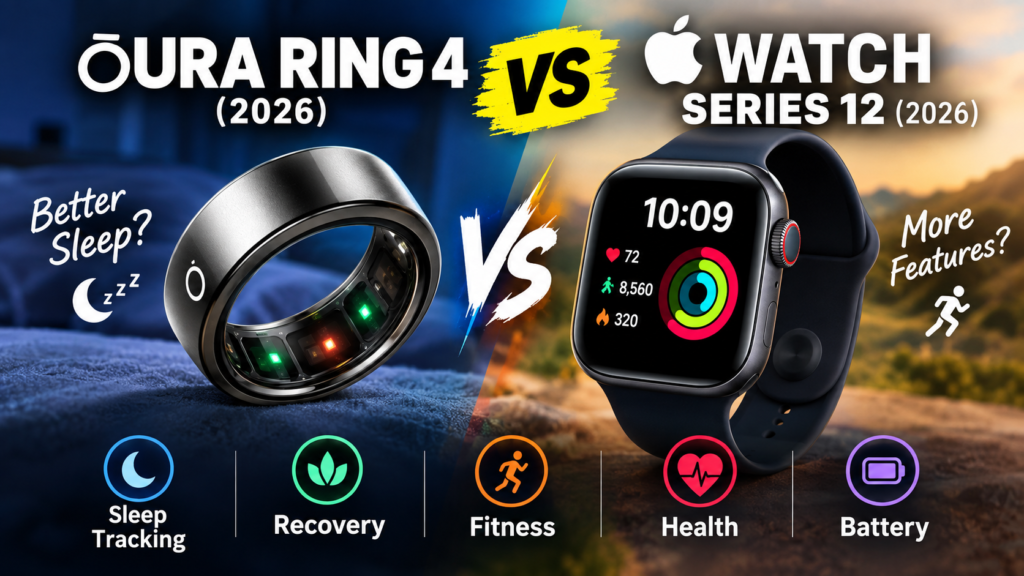
Oura Ring 4 and Apple Watch Series 12 aren’t really competing for the same job. One is a finger-worn sleep and recovery tracker with no screen. The other is a wrist-worn computer that happens to be very good at health tracking. That distinction matters more than any spec sheet, and it’s why the usual “Oura for sleep, Apple Watch for fitness” answer only tells part of the story.

- ACCURACY – SMART SENSING – Oura tracks over 50 health metrics, including sleep, activity, stress, heart health, and wome…
- ACCURATE SIZING ESSENTIAL – Oura Ring 4 uses unique sizing different from standard jewelry rings; use the Oura Ring 4 Si…
- LONG LASTING BATTERY – With up to 8 days of battery life, no screens and no vibrations, Oura Ring 4 allows you to focus …

- STAY CLOSER TO YOUR HEART HEALTH—The most accurate heart rate sensing in a wearable,* Series 12 now measures HRV as ofte…
- A FULL-FEATURED HEALTH TRACKER—Better understand your body with invaluable health insights. View your overnight health m…
- CHECK YOUR READINESS FOR THE DAY—Know when to rest or put yourself to the test. The readiness experience can help you de…
This guide compares Oura Ring 4 vs Apple Watch Series 12 across sleep tracking, recovery and readiness, health monitoring, workouts, battery life, comfort, subscription costs and everyday smart features — using current 2026 specifications and the research that actually exists on wearable sleep accuracy. We’ll also cover the scenario most comparison articles skip: using both devices together.
A note on generations: some older articles still compare Oura Ring 4 against Apple Watch Series 10 or Series 11. Apple Watch Series 12, released September 18, 2026, is the current mainstream Apple Watch, and that’s the model this article covers. Where older research used earlier-generation devices, we say so explicitly.
Quick Comparison Table
| Feature | Oura Ring 4 | Apple Watch Series 12 |
|---|---|---|
| Price (US, starting) | $349 | $399 |
| Subscription | Oura Membership required for full features ($5.99/month or $69.99/year) | No subscription required for core watch and health features |
| Form factor | Titanium smart ring, no display | Aluminum, titanium, or ceramic smartwatch with display |
| Weight | 3.3–5.2 g (size-dependent) | Roughly 32–39 g depending on case size and material |
| Display | None | Always-On Retina, LTPO3, up to 2,000 nits |
| GPS | No built-in GPS | Built-in GPS (GPS+Cellular available) |
| Battery life | 5–8 days | Up to 24 hours (up to 38 hours in Low Power Mode) |
| Sleep tracking | Yes, core feature | Yes |
| Sleep score | Yes | Yes |
| Readiness/recovery score | Oura Readiness | Apple Readiness (new for Series 12) |
| HRV tracking | Yes, overnight-focused | Yes, near-continuous with Series 12’s more frequent sampling |
| Temperature sensing | Yes, nightly trend | Yes, wrist temperature |
| ECG | No | Yes |
| Sleep apnea notifications | No | Yes (Series 9 and later, including Series 12) |
| Workout tracking | Basic activity and heart-rate tracking, limited live metrics | Comprehensive, with live on-wrist metrics and structured workouts |
| Smartphone compatibility | iOS and Android | iPhone required (iOS 27, iPhone 11 or later) |
| Water resistance | 100m (10 ATM) | WR50M (50 meters) |
Oura Ring 4 vs Apple Watch Series 12: Key Differences
The core difference is philosophical. Oura Ring 4 is built to disappear. It has no screen, weighs a few grams, and is designed to be worn continuously — including in the shower, in the pool, and all night — so it can build a long-term picture of your sleep and recovery with minimal friction. You check in on an app; you don’t interact with the ring itself.
Apple Watch Series 12 is an active, on-wrist computer. Its Health Sensing System now takes heart rate readings every five seconds and HRV readings roughly every five minutes — a meaningful jump from Series 11 — and feeds that data into a new Readiness score, plus the existing sleep score, ECG, and notification features. It’s also a full smartwatch: calls, messages, apps, Apple Pay, and (with cellular) independence from your phone.
The result is two devices that are both “good at health tracking” but optimized for different daily habits. If you resent charging a watch every night or find a screen on your wrist distracting during sleep, that alone may decide this comparison for you. If you want live pace and heart-rate data mid-run, or health features like ECG and fall detection, the ring can’t do that.
Detailed Specifications Comparison
| Spec | Oura Ring 4 | Apple Watch Series 12 |
|---|---|---|
| Starting price | $349 | $399 (42mm aluminum, GPS) |
| Sizes | Sizes 4–15 | 42mm and 46mm |
| Case/band material | Titanium | Aluminum, titanium, or ceramic |
| Dimensions | 7.9mm width, 2.88mm thickness | 9.7mm thick (aluminum/titanium); 9.85mm (ceramic) |
| Weight | 3.3–5.2 g | ~32–39 g depending on size and material |
| Display | None | Always-On Retina OLED, LTPO3, up to 2,000 nits |
| Chip | Oura smart sensing platform | Apple S11 |
| Connectivity | Bluetooth Low Energy | Bluetooth 5.3; GPS+Cellular option on some models |
| Sensors | Accelerometer, infrared PPG heart-rate sensor, skin temperature sensor | Second-gen electrical heart sensor, always-on optical heart sensor, blood oxygen sensor, temperature sensor, compass, altimeter, accelerometer, gyroscope |
| Battery | 5–8 days; 20–80 minute charge depending on level | Up to 24 hours; up to 38 hours in Low Power Mode |
| Water resistance | 100m (10 ATM) | WR50M, IP6X dust resistance |
| OS compatibility | iOS and Android | iPhone 11 or later, iOS 27+ (no Android support) |
| Subscription | Oura Membership: $5.99/month or $69.99/year for full functionality | None required for core features |
Specifications above are drawn from Apple’s official Series 12 pages and Oura’s own Ring 4 support documentation. Confirm current pricing and regional availability before buying, since promotions and configurations change.
Sleep Tracking Comparison
Both devices track sleep duration, sleep stages, and a nightly sleep score, but they weight the underlying metrics differently.
Sleep duration and stages: Both estimate time in light, deep, and REM sleep using motion and heart-rate signals. Oura has built its entire product identity around sleep and has iterated on its staging algorithm across four ring generations. Apple Watch added sleep-stage tracking more recently, and Series 12 benefits from more frequent background heart-rate and HRV sampling than earlier Apple Watches, which can improve the underlying signal quality — though Apple hasn’t published stage-by-stage accuracy figures specific to Series 12.
Sleep score: Oura’s sleep score blends total sleep, efficiency, restfulness, REM and deep sleep amounts, latency, and timing. Apple’s sleep score, introduced with Series 11 and carried forward on Series 12, similarly rolls several sleep metrics into one number in the Health app.
Sleep consistency: Both platforms track how regular your bedtime and wake time are night to night, since consistency itself affects sleep quality independent of duration.
Naps: Oura can detect and log daytime naps automatically because the ring is worn continuously. Apple Watch can also log naps, but nap detection is more reliable when the watch is actually being worn during the day, which not everyone does.
HRV and resting heart rate: Both track overnight HRV and resting heart rate trends. Series 12’s Health Sensing System takes HRV readings far more often throughout the day than previous Apple Watches, which is more relevant to daytime stress tracking than to the overnight numbers used for sleep and readiness scoring.
Temperature: Oura logs nightly skin temperature deviation from your personal baseline, useful for spotting illness or cycle-related shifts. Apple Watch also measures wrist temperature overnight and factors it into Vitals and cycle tracking.
Respiratory metrics: Both estimate respiratory rate during sleep, which factors into Apple’s sleep apnea notifications and Oura’s broader sleep and readiness insights.
For a closer look at how the ring performs on its own, see our full Oura Ring 4 review, and for a broader field of options, our best sleep trackers of 2026 roundup.
Sleep Accuracy: What Research Actually Says
It’s worth being precise about what “accurate” means for a sleep tracker. Consumer wearables don’t measure brain activity. Polysomnography (PSG) — the clinical gold standard — records EEG brain waves, eye movement, muscle activity, breathing, and oxygen levels simultaneously in a sleep lab. Wrist- and finger-worn devices instead infer sleep stages indirectly, mainly from movement (accelerometer) and heart-rate patterns, then run that data through a proprietary algorithm. That’s a meaningfully different kind of measurement, not a smaller version of the same one.
The most directly relevant study here is a 2024 Sensors journal study from Brigham and Women’s Hospital, which tested the Oura Ring Gen 3, Fitbit Sense 2, and Apple Watch Series 8 against PSG in 35 adults during a single overnight lab stay. All three devices were good at telling sleep from wake, with sensitivity above 95%. Differentiating sleep stages was harder for all of them: Oura showed sensitivity of roughly 76–79.5% across stages and, per the researchers, did not significantly over- or underestimate any individual stage. The Apple Watch Series 8 showed more variable performance, overestimating light and deep sleep by an average of around 45 and 43 minutes respectively in that sample.
Two caveats matter for a 2026 buying decision. First, that study used the Oura Ring Gen 3 and Apple Watch Series 8 — both several generations behind the Ring 4 and Series 12 discussed in this article — so it tells you about that generation’s algorithms, not necessarily today’s. Second, the sample size (35 participants, one night each) is small, which is typical for lab-based PSG studies because they’re expensive and labor-intensive to run.
A broader picture comes from a 2025 meta-analysis published in the Journal of Clinical Sleep Medicine, which pooled 24 studies and 798 participants across a range of consumer wrist-worn sleep trackers (not limited to Oura or Apple) compared with PSG. It found statistically significant differences between consumer devices and PSG for total sleep time, sleep efficiency, sleep latency, and wake-after-sleep-onset — with the size and direction of the gap varying by device and metric. The consistent theme across this literature is that wearables are reasonably reliable for distinguishing sleep from wake, less reliable for precise stage-by-stage breakdowns, and best used for tracking your own trends over time rather than as a substitute for a clinical sleep study.
Neither Oura Ring 4 nor Apple Watch Series 12 has been validated in a published PSG study at the time of writing — comparisons above use each brand’s earlier-generation hardware, which is worth keeping in mind when you see accuracy claims framed as if they apply directly to the current models.
Recovery and Readiness Comparison
Both companies now offer a daily score meant to answer “should I push hard today or take it easy?” — but they’re built differently.
Oura Readiness draws on your overnight HRV, resting heart rate, sleep quality and duration, body temperature deviation, and recent activity load, producing a single score each morning that updates as new data comes in.
Apple Readiness, new to Series 12, is built from recent activity, training load, vital signs, and your sleep score, producing a 0–10 score that places you into one of four categories — Recover, Pace Yourself, Ready, or Go For It. Unlike a score generated only once in the morning, Apple’s Readiness can update through the day as new sensor data arrives, thanks to the Health Sensing System’s more frequent heart-rate and HRV sampling.
In practice, both scores lean on the same underlying signals — HRV, resting heart rate, sleep, and training load — and both are wellness tools rather than clinical measurements. Oura has a multi-year head start refining Readiness specifically as its signature feature, while Apple’s version is brand new to Series 12 and, according to Apple, is based on an internal study of more than 1,000 participants that has not been published with a full methodology or independent validation. If you want a stress and recovery interpretation baked into every screen you check, Apple’s always-visible approach may fit better; if you prefer a single dedicated recovery app you check once a day, Oura’s model is more purpose-built for that habit.
Health Monitoring
This is where the devices diverge most in capability, not just design.
Heart rate: Both track continuous or near-continuous heart rate. Series 12’s optical sensor now samples every five seconds throughout the day, a step up from prior Apple Watches; Oura samples heart rate primarily overnight and during detected activity.
ECG: Apple Watch Series 12 includes the ECG app, letting you record a single-lead electrocardiogram to check for signs of atrial fibrillation. Oura Ring 4 has no ECG capability.
HRV: Both track HRV as an input to recovery scoring; Apple now samples it far more frequently across the day.
Temperature: Both track skin/wrist temperature trends overnight, useful for spotting illness onset or menstrual cycle phase shifts, not for reading an absolute body temperature.
Blood oxygen: Both offer blood-oxygen-related sensing; Apple’s Blood Oxygen app supports on-demand and background readings where regionally available, while Oura provides oxygen saturation trend data as part of its broader health metrics.
Respiratory rate: Both estimate this during sleep.
Irregular rhythm notifications: Available on Apple Watch, not on Oura Ring 4.
Hypertension notifications: Apple Watch analyzes optical heart-sensor data over rolling 30-day windows to flag patterns consistent with hypertension; it does not take a blood-pressure reading and produces no numeric value. This feature is not available on Oura. Note that hypertension notifications aren’t available in every region on the newest Apple Watch models pending additional regulatory clearances, according to Apple’s own release materials.
Sleep apnea notifications: Apple Watch (Series 9 and later, including Series 12) can flag patterns of breathing disturbance suggestive of moderate-to-severe sleep apnea. This is genuinely useful, but it is not a diagnosis. According to the FDA’s 510(k) clearance for Apple’s Sleep Apnea Notification Feature, the feature is intended for over-the-counter use in adults 18 and older who have not been previously diagnosed with sleep apnea, and it is explicitly “not intended to diagnose, treat, or aid in the management of sleep apnea.” Clearance data cited in FDA filings put sensitivity for moderate-to-severe apnea at roughly 66%, meaning the feature will miss a meaningful share of cases and can also produce false negatives — the absence of a notification does not mean apnea is absent. Oura Ring 4 has no equivalent sleep apnea detection feature.
It’s worth stating plainly: neither device is a medical diagnostic tool for general use, and neither should be described as “medical grade” across the board. Apple’s ECG and sleep apnea notification features do carry specific FDA clearances for their stated, narrow purposes; Oura’s metrics, and most of what both devices report day to day, are wellness insights meant to inform conversations with a doctor, not replace one.
Fitness and Workout Tracking
This is Apple Watch Series 12’s clearest advantage.
Running, cycling, walking: Apple Watch tracks pace, distance, cadence, elevation, and heart-rate zones in real time, visible on your wrist mid-workout, with built-in GPS for outdoor accuracy. It also offers structured tools like Pacer for time/distance goals, Race Route to compete against past efforts, and Automatic Track Detection for more precise metrics at a track. Oura Ring 4 logs workouts after the fact using motion and heart-rate data but has no screen for live pace, splits, or zone alerts, and no built-in GPS, so it can’t independently map a route.
Gym and strength training: Apple Watch can log sets, reps (with supported apps), and heart-rate response during strength sessions, with on-wrist feedback. Oura will register elevated heart rate and effort as general activity, but without the same exercise-specific detail or live display.
Swimming: Both are water resistant enough for swimming (Oura to 100m, Apple Watch to 50m/WR50M), but only Apple Watch offers dedicated pool and open-water swim tracking with lap counts and stroke detection.
GPS: Built-in GPS is a genuine gap for Oura. If you run or cycle outdoors and want an accurate route and pace without carrying a phone, Apple Watch (or a phone paired to the ring) is necessary.
The value of a screen mid-workout: This is easy to underrate until you’ve missed it. Checking pace, heart-rate zone, or remaining distance without breaking stride is something only a device with a display can do. Oura’s strength is passive, continuous monitoring — not real-time feedback during exercise.
Battery Life and Charging
Oura Ring 4 is rated for 5–8 days per charge, with a 20–80 minute top-up depending on how depleted it is. Apple Watch Series 12 is rated for up to 24 hours of normal use, or up to 38 hours in Low Power Mode.
Battery matters more for sleep tracking than people expect. A device that needs daily or near-daily charging creates a real risk of gaps in overnight data — charge it at the wrong time and you lose that night’s sleep record. Oura’s multi-day battery life means charging can be scheduled around your day rather than your sleep. Apple Watch owners who want continuous sleep tracking typically need a charging routine (a quick top-up during a shower or while getting ready) to avoid an empty battery at bedtime — workable, but it’s an extra habit the ring doesn’t require.
Comfort for Sleep and 24/7 Wear
A ring and a watch feel very different overnight. Oura Ring 4 weighs a few grams, has no clasp or strap to adjust, and most wearers report barely noticing it during sleep once they’re used to the size. Apple Watch, even with a soft sport band, is bulkier on the wrist, and some people find any wristband uncomfortable to sleep in, especially side sleepers whose wrist presses into a pillow.
That said, comfort is genuinely personal. Some people prefer feeling their watch’s Sleep tracking is “just handled” without giving the ring a second thought about sizing, while others dislike the idea of a ring they can’t easily glance at. If sizing is a concern with either device, Oura ships a sizing kit before your ring order ships, and Apple Watch bands come in adjustable and multiple length options.
Smart Features and Everyday Use
Apple Watch Series 12 is a full smartwatch: it shows notifications, takes calls and messages (independently with cellular), runs a large App Store catalog, supports Apple Pay, plays music and podcasts, offers turn-by-turn navigation, and includes Siri, now enhanced with on-device and server-assisted Apple Intelligence features (subject to daily usage limits and regional availability). It’s a genuinely useful companion for daily errands separate from its health tracking.
Oura Ring 4 has none of this. It has no display, no notifications, no apps, and no payment feature. Its entire interaction model is passive sensing plus a companion app you check when you want to. That’s a feature for people who find constant notifications intrusive, and a limitation for anyone who wants one device to handle both health tracking and daily communication.
iPhone vs Android Compatibility
This is one of the most important, and most overlooked, buying constraints in this comparison.
Oura Ring 4 works with both iOS and Android, so your phone choice doesn’t affect which features you get.
Apple Watch Series 12 requires an iPhone — specifically iPhone 11 or later running iOS 27 — and has no Android support at all, now or ever, since watchOS is built exclusively around the iPhone ecosystem for setup, health data syncing, and app functionality.
If you use an Android phone, Apple Watch Series 12 simply isn’t an option, full stop. That single fact should end the comparison for a meaningful share of readers before cost or features even enter the picture.
Subscription and Long-Term Cost
Oura’s business model requires an ongoing membership to unlock full functionality (sleep, readiness, and activity insights); without it, the ring only surfaces limited data. Apple Watch Series 12 has no required subscription for its core watch, fitness, and health features — Apple Fitness+ is a separate, optional add-on for guided workout content, not something you need for sleep tracking, Readiness, ECG, or notifications to work.
Using the stated hardware prices ($349 for Oura Ring 4, $399 for Apple Watch Series 12, 42mm aluminum GPS) and Oura’s annual membership rate ($69.99/year, ignoring any introductory free-trial period), here’s how ownership cost compares over time:
| Timeframe | Oura Ring 4 (hardware + membership) | Apple Watch Series 12 (hardware only) |
|---|---|---|
| Year 1 | $349 + $69.99 = $418.99 | $399 |
| Year 2 | $418.99 + $69.99 = $488.98 | $399 |
| Year 3 | $488.98 + $69.99 = $558.97 | $399 |
These figures assume no hardware replacement, no promotional pricing, and the annual Oura membership tier rather than the $5.99/month plan (which would cost slightly more per year at $71.88). They also assume you don’t add optional Apple Watch costs like a cellular plan or Apple Fitness+. Actual prices and promotions change over time, so treat this as a framework rather than a guarantee.
The takeaway: Apple Watch Series 12 has a higher upfront cost but no required recurring fee, while Oura Ring 4 costs less upfront but accumulates ongoing membership costs that surpass the watch’s price within about two years if you’re comparing hardware alone.
Which Wearable Fits Different Users?
| User Profile | Oura Ring 4 Considerations | Apple Watch Series 12 Considerations |
|---|---|---|
| Sleep-focused user | Purpose-built for sleep insight; long battery avoids charging conflicts with sleep | Capable, but nightly charging habit can interrupt data continuity |
| Recovery-focused user | Mature, dedicated Readiness feature refined over several ring generations | New Readiness score, updates throughout the day, less track record |
| Runner | No built-in GPS or live pace display; limited for outdoor training | Built-in GPS, live pace/heart-rate zones, Pacer and Race Route tools |
| Gym user | Logs general activity and heart rate, lacks exercise-specific detail | Strong set logging, live heart-rate feedback, workout app ecosystem |
| Casual wellness user | Low-maintenance, passive tracking with minimal daily interaction | More features to explore, but also more to manage day to day |
| Smartwatch user (notifications, apps, payments) | Not designed for this at all | Built for this; core reason to choose a watch over a ring |
| iPhone user | Works fine, but won’t unlock Apple ecosystem features | Full integration with iPhone, iMessage, Apple Pay, Find My |
| Android user | Fully compatible | Not compatible — Apple Watch requires an iPhone |
| Subscription-averse user | Membership required for full functionality; adds up over years | No required subscription for core features |
| User prioritizing discreet, minimal-wear sleep tracking | Strong fit — lightweight, no screen, multi-day battery | Workable, but bulkier and needs more frequent charging |
| User interested in health/safety features (ECG, fall detection, sleep apnea and hypertension notifications) | Not available on Oura | Available, with appropriate medical caveats |
No single row here produces a universal winner — the right choice depends on which rows matter most to you.
Can You Use Oura Ring 4 and Apple Watch Series 12 Together?
Yes, and it’s a more common setup than most comparisons acknowledge. Many people wear Apple Watch Series 12 during the day and workouts — for live GPS pace, heart-rate zones, notifications, and payments — then switch to Oura Ring 4 overnight for lightweight, uninterrupted sleep and recovery tracking without needing to charge a watch every evening.
This dual setup avoids the two biggest weaknesses of each device on its own: Apple Watch’s daily charging habit disrupting sleep data, and Oura’s lack of live workout metrics and smart features. The tradeoff is straightforward — two devices to charge, manage, and pay for, including two potential subscriptions if you also use Apple Fitness+.
If you’re weighing this kind of layered approach, it’s worth browsing our broader guide to the best health and wellness products to see how sleep and recovery wearables fit alongside other tools like smart scales.
Pros and Cons
Oura Ring 4
Pros:
- Lightweight, screen-free design that’s easy to forget you’re wearing, day or night
- 5–8 day battery life avoids nightly charging conflicts with sleep tracking
- Works with both iOS and Android
- Mature, dedicated Readiness and sleep-scoring features
- 100m water resistance
Cons:
- Requires an ongoing membership for full functionality
- No display, so no live workout metrics
- No built-in GPS
- No ECG, sleep apnea, or hypertension notifications
- Less detailed exercise-specific tracking for gym and strength training
Apple Watch Series 12
Pros:
- Built-in GPS and a display for live pace, heart-rate zones, and workout metrics
- No required subscription for core health and fitness features
- ECG, sleep apnea notifications, hypertension notifications, and fall/crash detection
- Full smartwatch functionality: notifications, calls, apps, Apple Pay
- New Readiness score updates throughout the day using more frequent sensor data
Cons:
- Requires an iPhone; no Android support at all
- Battery life (up to 24 hours) requires a daily charging routine that can interrupt overnight sleep tracking
- Bulkier on the wrist for sleep than a ring
- Higher upfront price than Oura hardware alone
FAQ
Is Oura Ring 4 better than Apple Watch Series 12 for sleep? Oura is generally considered stronger for passive, uninterrupted overnight tracking because of its long battery life and screen-free design, and it has a longer track record specifically optimizing sleep algorithms. Apple Watch Series 12 also tracks sleep well but requires a charging routine that can occasionally interrupt overnight data.
Does Apple Watch Series 12 track sleep accurately? It tracks sleep duration, stages, and a sleep score, and Apple’s more frequent Health Sensing System data should, in principle, improve input signal quality. However, no published, independent polysomnography study has specifically validated Series 12; existing research on Apple Watch sleep accuracy used earlier models.
Does Oura Ring 4 have GPS? No. Oura Ring 4 has no built-in GPS and relies on your phone for location-based features, which are limited compared with a GPS-equipped smartwatch.
Does Oura Ring 4 require a subscription? Yes, for full functionality. Oura Membership costs $5.99/month or $69.99/year. Without it, the ring works with limited features and you can still export your own data.
Does Apple Watch Series 12 require a subscription? No. Core health, sleep, fitness, and safety features work without any subscription. Apple Fitness+ is a separate, optional paid service for guided workout content.
Which tracks recovery better? Oura Readiness has years of refinement behind it and is the ring’s signature feature. Apple Readiness is new to Series 12 and benefits from more frequent all-day sensor sampling, but has less independent validation so far. Neither is clearly “better” in an objective sense — they use similar underlying signals.
Can Oura Ring 4 detect sleep apnea? No. Oura Ring 4 has no sleep apnea detection or notification feature.
Can Apple Watch Series 12 detect sleep apnea? It can flag patterns suggestive of moderate-to-severe sleep apnea through an FDA-cleared feature available on Series 9 and later. It is explicitly not intended to diagnose, treat, or manage sleep apnea, and its published sensitivity is around 66%, meaning it will miss some cases.
Which has better battery life? Oura Ring 4, by a wide margin — 5 to 8 days versus Apple Watch’s roughly 24 hours (up to 38 in Low Power Mode).
Can Oura Ring 4 replace Apple Watch? Only if you don’t need a display, GPS, calls, apps, or payments. For sleep and recovery tracking alone, yes; as an everyday smartwatch replacement, no.
Can you wear Oura and Apple Watch together? Yes. Many users wear Apple Watch during the day and workouts, then switch to Oura overnight, combining live workout data with lightweight, uninterrupted sleep tracking.
Is Oura Ring 4 compatible with Android? Yes, Oura Ring 4 works with both iOS and Android devices.
Is Apple Watch Series 12 compatible with Android? No. It requires an iPhone 11 or later running iOS 27; there is no Android compatibility.
Which is better for running? Apple Watch Series 12, thanks to built-in GPS, a live display for pace and heart-rate zones, and structured training tools like Pacer and Race Route.
Which is better for gym workouts? Apple Watch Series 12, for the same reason — live feedback and more detailed exercise logging beat Oura’s after-the-fact activity summaries.
Is Oura Ring 4 a medical device? No. Oura Ring 4 is a consumer wellness device. Its sleep, readiness, and health metrics are meant to inform your own understanding of patterns over time, not to diagnose or treat any medical condition.
Final Buying Guide
Skip the idea of a single winner and instead ask what you actually want a wearable to do:
- Want the least intrusive, longest-lasting device purely for sleep and recovery insight? Oura Ring 4 fits that job description closely, provided you’re comfortable paying an ongoing membership.
- Want live workout data, GPS, a screen, and smartwatch features alongside solid health tracking — and you own an iPhone? Apple Watch Series 12 covers more ground in one device, with no required subscription for its core features.
- Use Android? Apple Watch Series 12 isn’t an option regardless of any other factor, which makes Oura Ring 4 the wearable in this comparison you can actually buy.
- Want the best of both, and don’t mind managing two devices? Wearing Apple Watch by day and Oura overnight is a legitimate, increasingly common setup.
Whichever direction you lean, treat both devices as wellness tools rather than diagnostic ones, and bring any concerning notifications or trends to a healthcare provider rather than relying on the device alone. For related buying research, see our best smart scales for health tracking, our smart scale buying guide, and comparisons like Withings vs Eufy and our Withings Body Smart review if you’re building out a broader home health-tracking setup — and check our notes on smart scale accuracy for the same “wellness tool, not medical device” caveats that apply here.