
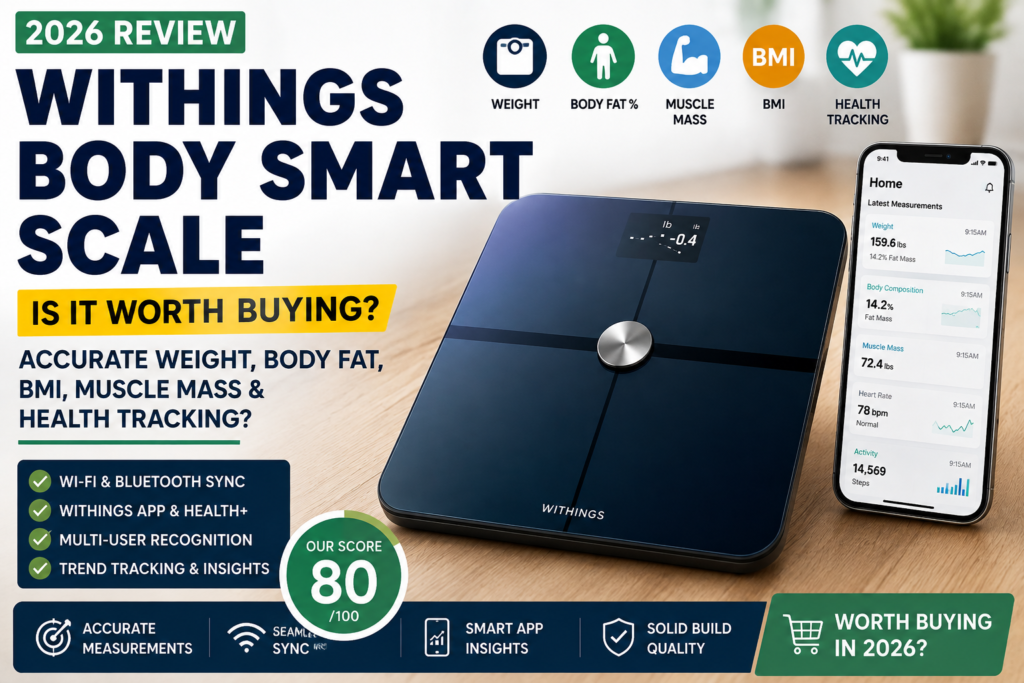
Read our Withings Body Smart review for 2026, covering weight accuracy, body fat estimates, app syncing, subscription costs, and buying advice.
LifeCareBalance.com is reader-supported. When you buy through links on our site, we may earn an affiliate commission at no extra cost to you. As an Amazon Associate, we earn from qualifying purchases.
Is the Withings Body Smart worth buying in 2026? For people who want convenient weight tracking, automatic smartphone syncing, and estimated body-composition trends, it is a strong option to consider. However, if your main goal is obtaining an exact body-fat percentage or clinical-grade muscle measurements, this smart scale has important limitations.
The Withings Body Smart is a connected bathroom scale that combines weight measurements with bioelectrical impedance analysis (BIA), a companion app, and Wi-Fi connectivity. It can track weight, estimated body fat, muscle mass, body water, bone mass, visceral fat index, basal metabolic rate, and standing heart rate.
Its main advantage is convenience. Your measurements can sync automatically without requiring you to open an app after every weigh-in. Its biggest drawback is that several displayed metrics are estimates rather than direct measurements.
This review examines the scale’s features, measurement limitations, app experience, subscription costs, competitors, and the types of buyers most likely to benefit from it.

- A CLINICAL SCAN OF YOUR HEALTH – Body Smart, developed in collaboration with leading hospitals and clinical institutions…
- ACHIEVE YOUR WEIGHT GOALS FASTER – Reliably track your weight to within 50 g and view your weight trends directly on the…
- INCREASE MUSCLE MASS FASTER – Increase muscle mass faster by analyzing body composition to tailor efforts.
Quick Verdict: Is Withings Body Smart Worth It?
Our verdict: The Withings Body Smart is worth considering if you want a connected scale for tracking weight and general body-composition trends over time.
Best for: People who value automatic syncing, a polished health app, multiple user profiles, and convenient at-home measurements.
Not ideal for: Buyers who need precise clinical body-fat measurements, segmental muscle analysis, or a basic scale without connected features.
Main advantage: Wi-Fi syncing and a well-integrated app make regular tracking convenient.
Main limitation: Body-composition measurements rely on BIA estimates and may differ from reference methods such as DXA.
Official US price: Approximately $129.95 at the time of this review. Check the current price before purchasing.
Subscription: Withings+ is optional. The standard weight-tracking experience does not require a paid subscription.
Buying recommendation: Consider it for consistent weight tracking and general trends, not as a medical diagnostic device.
Withings Body Smart: Key Specifications
| Feature | Details |
|---|---|
| Weight range | 9–440 lb (5–200 kg) |
| Weight increments | 0.1 lb / 50 g |
| Body-fat measurement | Estimated using BIA |
| Other composition metrics | Muscle mass, water, bone mass, visceral fat index |
| Additional metrics | BMI, estimated BMR, standing heart rate |
| Connectivity | Wi-Fi and Bluetooth |
| Display | 2.8-inch color screen |
| User recognition | Up to 8 users |
| Power | Four AAA batteries |
| Advertised battery life | Approximately 15 months |
| Companion app | Withings app |
| Optional subscription | Withings+ |
| Platform compatibility | iOS and Android; check current OS requirements |
These specifications are based on the manufacturer’s product information. Confirm the current requirements, available features, and regional specifications on the official Withings Body Smart product page before buying.
Design and Build Quality
The Body Smart has a slim, square platform with a tempered-glass surface and a color display. Its understated design suits most modern bathrooms without requiring much storage space.
The display presents your weight and other available measurements directly on the scale. This is useful if you prefer seeing your results immediately rather than reaching for your phone after every weigh-in.
Its footprint is approximately 12.8 by 12.8 inches, making it similar in size to many conventional bathroom scales. The glass construction looks premium, although users should still place it on a firm, level surface and follow the manufacturer’s handling instructions.
The scale uses replaceable AAA batteries rather than a rechargeable battery. That means you do not need to remember to charge it, but you will eventually need to replace the batteries.
One important consideration is flooring. For consistent results, place the scale on a hard, level floor rather than carpet. If you plan to use it in a shared bathroom, make sure it can remain in a stable location between measurements.
Weight Accuracy: The Most Useful Feature
Weight is generally the most straightforward measurement provided by a connected scale. The Body Smart displays weight in increments of 0.1 lb, or approximately 50 grams.
However, the displayed increment is not the same as a guarantee that every measurement is accurate to within exactly 0.1 lb under every condition. Scale placement, movement, floor stability, and ordinary changes in body weight can influence readings.
For practical weight management, consistency matters more than chasing tiny changes.
To get more comparable measurements:
- Weigh yourself at approximately the same time each day.
- Use the scale on the same hard, level surface.
- Follow the manufacturer’s instructions about foot placement.
- Compare weekly or monthly trends rather than reacting to every daily fluctuation.
- Avoid interpreting a short-term weight increase as automatic evidence of fat gain.
Food, fluid intake, bowel movements, and changes in hydration can all affect body weight. A scale records your current weight; it cannot tell you why that number changed.
For someone monitoring a long-term weight-management goal, the app’s historical graphs may be more useful than the number shown during any single session.
Body Fat Accuracy: What You Should Know
The Body Smart estimates body composition through bioelectrical impedance analysis, commonly called BIA.
During a measurement, the scale sends a very low electrical current through the body and measures impedance. Its algorithm combines that information with profile data to estimate body fat and other composition metrics.
This is not the same as directly measuring the amount of fat or muscle in your body.
Can you trust the body-fat percentage?
The most sensible approach is to treat the number as an estimate that may help you follow trends, not as an exact clinical measurement.
Research comparing consumer smart scales with DXA has found that weight measurements can be substantially more dependable than the scales’ estimates of fat mass and lean mass. The amount of disagreement varies by device and individual.
A relevant study is available in the peer-reviewed journal JMIR mHealth and uHealth: Accuracy of Smart Scales on Weight and Body Composition.
That study evaluated several consumer scales, including an earlier Withings model. It did not test the current Body Smart model, so its results should not be presented as a direct accuracy score for this specific product.
The distinction is important: evidence about BIA technology generally can explain its limitations, but it cannot establish the exact error rate of every smart scale.
Why body-composition readings fluctuate
BIA estimates can be affected by hydration, recent exercise, food and fluid intake, skin temperature, and measurement conditions.
For example, a reading after a strenuous workout may differ from a reading taken in the morning before breakfast. That difference does not necessarily mean your actual body fat changed overnight.
The scale may still be useful if you measure under reasonably similar conditions and follow longer-term patterns.
Our recommendation: If you are tracking body recomposition, consider body weight, strength performance, clothing fit, waist measurements, and other relevant indicators alongside the scale’s estimates. Do not make major health decisions based on one BIA reading.
For a deeper explanation of this technology, read our guide to smart-scale body-fat accuracy.
What Do the Body Smart’s Other Metrics Mean?
The scale offers more than a weight reading, but additional numbers are useful only when you understand what they represent.
BMI: Body mass index is calculated from height and weight. It can be useful as a screening measure, but it does not distinguish fat from muscle and cannot independently establish whether someone is healthy.
Muscle mass: This is an estimate generated by the device’s measurement method and algorithm. It should not be treated as a direct measurement of individual muscles or a precise assessment of muscle gain.
Body water: This is an estimated body-water percentage. Because hydration influences BIA, it can change without a meaningful change in body fat.
Bone mass: This is an estimate and is not equivalent to a bone-density test. The scale cannot diagnose osteoporosis.
Visceral fat index: This is an algorithm-based index, not a direct scan of the fat surrounding internal organs.
Basal metabolic rate: BMR is an estimate of the energy your body uses at rest. It is not a direct measurement of your daily calorie needs.
Standing heart rate: The scale can record a heart-rate reading while you stand on it. This is a useful additional data point, but it is not a substitute for a dedicated heart-rate monitor or medical assessment.
These metrics may help some users organize their health information, but more displayed data does not automatically mean more accurate data.
Withings App Experience and Wi-Fi Syncing
The companion app is one of the main reasons to consider the Body Smart over a conventional bathroom scale.
Once setup is complete, the scale can transmit measurements through Wi-Fi without requiring your phone to be beside it for each weigh-in. Bluetooth is also available for connectivity and setup.
The app provides historical measurements and trend graphs, allowing users to review changes over time. It can also serve as a central dashboard if they use other compatible Withings products.
Features that may appeal to buyers include:
- Automatic measurement syncing.
- Historical weight and body-composition trends.
- Multiple user profiles.
- Integration with compatible health platforms.
- A connected dashboard for other supported Withings devices.
The scale supports automatic recognition for up to eight users, making it practical for many households. However, users should check that their individual profiles are configured correctly and verify that measurements are being assigned to the right person.
Compatibility can change as mobile operating systems and health platforms are updated. Confirm current support for Apple Health, Google Health Connect, and other integrations before buying if a specific connection is essential to your routine.
For more guidance on selecting features that actually matter, see our smart scale buying guide.
Does Withings Body Smart Require a Subscription?
No. The Body Smart’s core scale functions do not require a paid Withings+ subscription.
The free experience supports the main use case: recording measurements, syncing data, and reviewing trends.
Withings+ is an optional paid service that adds certain coaching, personalized guidance, and other premium features. Its exact benefits and pricing may change, so review the current terms before starting a trial.
At the time of this review, the manufacturer’s US site lists Withings+ at approximately $9.95 per month or $99.50 per year, subject to the applicable offer and subscription terms.
Who should consider Withings+?
It may be useful if you want structured coaching or additional guidance and intend to use those features regularly.
Who can skip it?
If your main goal is to track weight and view your scale readings over time, the free experience may be sufficient.
Before accepting a trial, check whether it automatically renews, when billing begins, and how to cancel. You should not buy the scale assuming that every premium feature is included permanently.
Withings Body Smart vs Garmin Index S2 vs RENPHO
These scales appeal to different buyers, and the right choice depends on your budget, app preferences, and measurement needs.
| Category | Withings Body Smart | Garmin Index S2 | RENPHO entry-level models |
|---|---|---|---|
| Typical price position | Mid-range | Mid-range to premium | Budget |
| Weight tracking | Yes | Yes | Yes |
| Body composition | BIA estimates | BIA estimates | BIA estimates |
| Wi-Fi | Yes | Yes | Depends on model |
| Bluetooth | Yes | Yes | Depends on model |
| App ecosystem | Withings | Garmin Connect | RENPHO app |
| Multi-user use | Up to 8 users | Multiple user profiles | Depends on model |
| Best fit | Connected health tracking | Existing Garmin users | Lower-cost tracking |
Prices and features vary by retailer and model, so this table is a general buying comparison rather than a claim that every RENPHO scale has the same capabilities.
Withings Body Smart vs Garmin Index S2
The Withings model is attractive to buyers who want a broad set of measurements, a color display, and integration with the Withings health ecosystem.
The Garmin Index S2 may be more appealing to someone who already uses Garmin watches or relies on Garmin Connect for fitness data.
Neither scale should be assumed to deliver clinically exact body-fat readings simply because it uses a connected app. Both rely on BIA for composition estimates.
For a detailed comparison, see Wareable’s Withings Body Smart vs Garmin Index S2 review.
Withings Body Smart vs RENPHO
RENPHO is worth considering if your priority is spending less on a connected scale. The brand offers several models, from basic Bluetooth devices to more advanced scales with additional electrodes and features.
The trade-off depends on the exact model. A budget RENPHO scale may provide enough functionality for simple weight tracking, while a more advanced model may offer a different measurement configuration.
Compare Wi-Fi support, app compatibility, user recognition, warranty, and the metrics you actually intend to use. Do not choose a scale based solely on the number of measurements listed in its marketing.
If you are deciding between the two ecosystems, our Withings vs Eufy smart scale comparison offers another perspective on connected-scale features and usability.
Is Withings Body Smart Better Than a Basic Scale?
That depends on how you use your data.
A basic digital scale is usually the more economical choice if you only want your weight. You can record readings manually or use a separate app.
The Body Smart becomes more appealing when you want to remove that extra effort. Automatic syncing, historical graphs, multiple profiles, and additional estimates may make consistent tracking easier.
The important question is whether those features will change how you monitor your progress.
If you enjoy reviewing trends and already use a connected health platform, the additional convenience may justify the price. If you rarely check app data, you may be paying for features you will not use.
A useful way to approach any wellness purchase is to identify the decision the device will help you make. Our personalized wellness guide explains why choosing a small number of meaningful measurements can be more useful than tracking everything.
Who Should Buy the Withings Body Smart?
The Body Smart is a reasonable choice for:
- Weight-management users who want to review long-term weight trends.
- Connected-health users who prefer automatic syncing and app-based records.
- Households that want a scale with separate profiles for several people.
- Fitness enthusiasts who want additional estimates to review alongside their workouts and other progress measures.
- People who value convenience and are willing to pay more than they would for a basic scale.
It is less suitable for someone who needs detailed segmental analysis, wants a simple weight-only device, or expects exact body-fat measurements.
If you have a medical reason to monitor body composition, discuss the most appropriate measurement method with your healthcare professional.
How to Get More Consistent Readings
You do not need a complicated testing routine to get useful information from a smart scale.
- Place the scale on a hard, level floor.
- Use it at a similar time of day.
- Follow the manufacturer’s instructions and use bare feet for BIA measurements.
- Avoid comparing a reading taken immediately after exercise with one taken after a long period of rest.
- Keep your user profile accurate.
- Use the same scale for ongoing comparisons rather than switching between brands.
- Review trends over several weeks instead of focusing on a single day’s numbers.
These steps help make measurements more comparable. They do not turn a consumer scale into a clinical body-composition instrument.
Frequently Asked Questions
Is Withings Body Smart accurate?
It is designed to measure weight in 0.1 lb increments. Its body-composition metrics are BIA-based estimates, and their agreement with reference methods can vary. Focus on consistent measurements and long-term trends rather than assuming every displayed number is exact.
Is Withings Body Smart accurate for body fat?
It estimates body fat rather than measuring it directly. Consumer BIA devices can differ from reference methods, and research on other models cannot establish the precise error rate of the current Body Smart.
Does Withings Body Smart measure muscle mass?
Yes. It provides an estimated muscle-mass metric. This should be treated as an approximation, not a direct measurement of muscle tissue.
Does Withings Body Smart work without Wi-Fi?
It supports Wi-Fi and Bluetooth. The scale can display readings locally, but syncing behavior depends on the connection and setup. Follow the manufacturer’s current instructions for offline use and later synchronization.
Does Withings Body Smart require Withings+?
No. Core scale measurements and standard tracking functions are available without a paid subscription. Withings+ adds optional premium features.
Does it work with Apple Health and Android?
The Withings app supports compatible iOS and Android devices, and the manufacturer lists Apple Health and Android health-platform integrations. Confirm the current operating-system requirements and integration list before buying.
Can several people share one scale?
Yes. The manufacturer lists automatic recognition for up to eight users. Correct profile setup is important to avoid assigning a measurement to the wrong household member.
Is it better than RENPHO?
There is no universal winner. Withings may suit buyers who prioritize its app ecosystem and Wi-Fi syncing, while RENPHO offers a range of lower-cost options. Compare the exact models rather than the brands in general.
Is it a replacement for a DXA scan?
No. A smart scale is intended for convenient at-home tracking. DXA provides a different form of body-composition assessment and may be more appropriate when a clinician or researcher needs a more detailed evaluation. DXA also has limitations and should be used for an appropriate purpose.
Is Withings Body Smart worth buying in 2026?
Yes, for people who want a convenient connected scale for weight tracking and general body-composition trends. It is less compelling for buyers who only need weight or require clinical body-composition measurements.
Final Verdict: Should You Buy Withings Body Smart?
The Withings Body Smart is a well-rounded connected scale for everyday weight tracking. Its Wi-Fi syncing, color display, multi-user support, and app-based trends make it convenient for people who want their measurements recorded with minimal effort.
Its limitations are equally important. Body-fat percentage, muscle mass, body water, bone mass, and visceral fat index are estimates, not direct measurements. The presence of multiple metrics should not be confused with clinical accuracy.
Buy it if you want automatic weight tracking, a connected health dashboard, and general body-composition trends in one device.
Skip it if you only need a basic weight reading, want to avoid connected features, or expect precise clinical body-fat measurements.
Our final recommendation: The Withings Body Smart is worth considering for trend-focused home tracking, especially if you value the Withings app experience. Compare its current price with Garmin and the specific RENPHO model you are considering, then choose according to the features you will genuinely use.
Check the current price on Amazon
This article is for informational purposes only and is not a substitute for professional medical advice.