
LifeCareBalance.com is reader-supported. When you buy through links on our site, we may earn an affiliate commission at no extra cost to you. As an Amazon Associate, we earn from qualifying purchases.
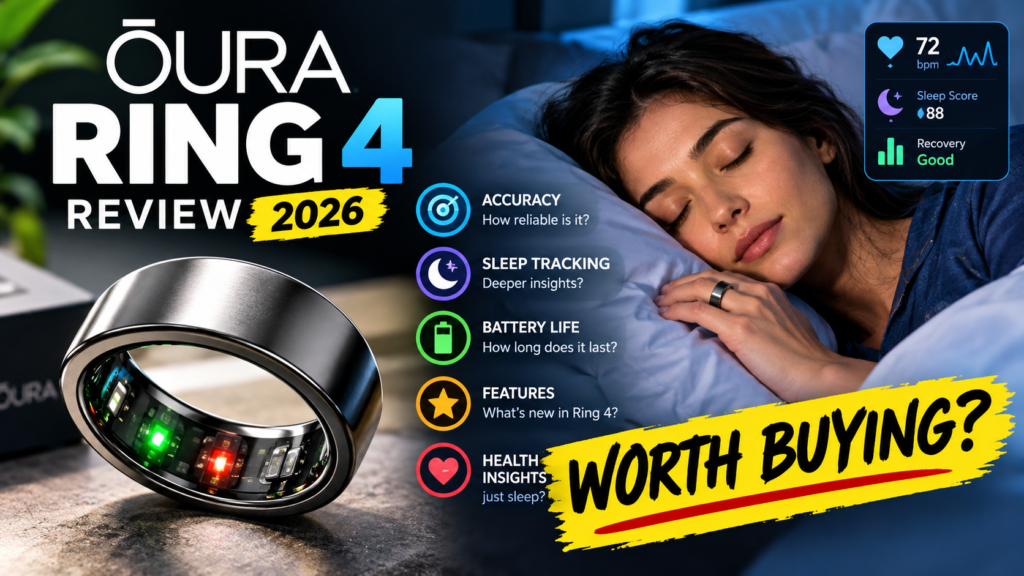
If you’re researching the Oura Ring 4 in 2026, there’s one thing to know up front: it’s no longer Oura’s newest ring. Oura Ring 5 launched in May 2026, bringing a smaller, thinner design. So why are people still searching for an Oura Ring 4 review this year? Mostly because Ring 4 remains widely available, often at a reduced price compared to Ring 5, and it still runs the same core Oura software experience.

- ACCURACY – SMART SENSING – Oura tracks over 50 health metrics, including sleep, activity, stress, heart health, and wome…
- ACCURATE SIZING ESSENTIAL – Oura Ring 4 uses unique sizing different from standard jewelry rings; use the Oura Ring 4 Si…
- LONG LASTING BATTERY – With up to 8 days of battery life, no screens and no vibrations, Oura Ring 4 allows you to focus …
This review breaks down what Ring 4 actually offers, what independent research says (and doesn’t say) about its accuracy, what it costs to own long-term once you factor in membership fees, and — most importantly — whether it still makes sense to buy in a Ring 5 world.
Table of Contents
- At a Glance
- What Is Oura Ring 4?
- Features and Specifications
- Smart Sensing Explained
- How Accurate Is Oura Ring 4?
- Sleep Tracking
- What Does the Research Say About Oura Sleep Accuracy?
- Health and Wellness Insights
- App Experience
- Battery Life
- Charging and Daily Use
- Comfort, Fit and Durability
- Oura Membership: Is It Worth It?
- Oura Ring 4 vs Oura Ring 5
- Oura Ring 4 vs Smartwatch
- Pros and Cons
- Who Should Buy Oura Ring 4?
- Who Should NOT Buy Oura Ring 4?
- Is Oura Ring 4 Still Worth Buying in 2026?
- FAQs
- Bottom Line
At a Glance
| Product | Oura Ring 4 |
| Generation | Fourth generation (superseded by Ring 5, launched May 2026) |
| Price | Varies by retailer; check current listings, as pricing changes and often drops post-Ring 5 launch |
| Membership | $5.99/month or $69.99/year, first month free for new members |
| Battery | Approximately 5–8 days per charge |
| Sizes | 4–15 |
| Sensors | Red/infrared LEDs (SpO2), green/infrared PPG (heart rate, HRV), temperature sensor, accelerometer |
| Water Resistance | Rated for everyday wear including swimming (confirm current depth rating on Oura’s site before purchase) |
| Compatible Platforms | iOS and Android via the Oura app |
| Best For | Sleep-focused tracking, recovery insights, discreet all-day wear |
| Biggest Drawback | Requires ongoing membership for full feature access |
What Is Oura Ring 4?
The Oura Ring 4 is a titanium smart ring built around continuous physiological sensing rather than a screen-based interface. Instead of notifications, apps, or a display, it collects biometric data — heart rate, heart rate variability (HRV), skin temperature, blood oxygen, and movement — and hands that data off to the Oura smartphone app, where it’s translated into daily scores for sleep, readiness, and activity.
It launched as the successor to Oura Ring 3, with a redesigned sensor array (Oura calls this “Smart Sensing”) and broader sizing. As of 2026, it sits one generation behind the current Ring 5, which means it’s typically positioned as the value option in Oura’s lineup rather than the flagship.
Features and Specifications
Based on Oura’s official Ring 4 specification page, the ring includes:
- Red and infrared LEDs for blood oxygen (SpO2) sensing
- Green and infrared PPG sensors for heart rate and HRV tracking
- A skin temperature sensor for tracking temperature trends
- An accelerometer for movement and activity detection
- 24/7 tracking of heart-rate-related and activity data
- Width: approximately 7.9 mm
- Thickness: approximately 2.88 mm
- Sizes: 4–15, giving it one of the widest size ranges of any smart ring
Because the ring has no screen, buttons, or haptic feedback, all specification-level detail lives in the companion app rather than on the hardware itself.
Smart Sensing Explained
“Smart Sensing” is Oura’s marketing term for the sensor architecture introduced with Ring 4. In practice, it refers to the combination of PPG (photoplethysmography) sensors, the temperature sensor, and the accelerometer working together, along with updated algorithms, to capture data across a broader range of finger sizes and skin tones than earlier generations.
It’s worth being precise here: Smart Sensing describes the hardware and processing pipeline, not a guarantee of a specific accuracy level. Oura does not publish exact accuracy percentages for Smart Sensing itself, which is a distinction that matters when comparing marketing claims to independent research (more on that below).
How Accurate Is Oura Ring 4?
Accuracy is the single most important — and most misunderstood — question buyers ask. It helps to separate three categories of information: what Oura claims, what independent reviewers have observed anecdotally, and what peer-reviewed research actually measured.
Heart rate and HRV: The green and infrared PPG sensors continuously sample pulse data, which the app uses to calculate resting heart rate and HRV trends. Consumer PPG sensors in general are well-documented to perform reasonably well for resting-state heart rate but less reliably during high-intensity movement, when blood flow and motion artifacts interfere with the optical signal.
Temperature: The temperature sensor tracks relative change from your personal baseline, not an absolute clinical temperature reading. This is useful for spotting deviations (e.g., a possible illness onset or cycle-related shift) but isn’t equivalent to a medical thermometer.
SpO2 (blood oxygen): The red/infrared LEDs estimate blood oxygen saturation, primarily used for overnight trend tracking rather than moment-to-moment monitoring.
Activity detection: The accelerometer classifies movement and estimates activity type and intensity, which — as with most wearables — works better for continuous, rhythmic activities (walking, running, cycling) than for irregular movement patterns (weightlifting, sports with frequent stops and starts).
Sleep tracking: Covered in depth in the next two sections, since this is where the most rigorous independent research exists.
Across every category, it’s important to state plainly: Oura Ring 4 is not a medical device, is not marketed as one, and should not be used to diagnose or rule out any medical condition. It provides consumer-grade wellness estimates, not clinical measurements.
Oura Ring 4 Sleep Tracking
Sleep is Oura’s core strength as a product category, and the app breaks it down into several layers:
- Total sleep time — overall duration asleep
- Sleep latency — how long it takes you to fall asleep
- Wake periods — interruptions during the night
- Sleep stages — estimated light, deep, and REM sleep
- Sleep score — a composite daily score combining these metrics
- Sleep regularity — how consistent your bedtime and wake time are night to night
- Bedtime and wake-time insights — trend-based recommendations for adjusting your schedule
The sleep score is Oura’s most visible feature and the one most new users check first each morning. It’s a useful relative indicator — good for noticing when your sleep quality is trending up or down over weeks — but stage-by-stage estimates (especially deep vs. REM) should not be treated as equivalent to a clinical polysomnography (PSG) sleep study conducted in a lab. Consumer wearables use movement and physiological proxies to infer sleep stage, not the brainwave (EEG) measurements a clinical sleep study relies on.
If you’re deciding between wearable options for sleep specifically, our sleep tracker buying guide compares tracking approaches across rings, watches, and bedside devices.
What Does the Research Say About Oura Sleep Accuracy?
This is where evidence-based reporting matters more than marketing copy.
A 2024 peer-reviewed study compared Oura Ring (Gen 3) against ambulatory polysomnography across 96 participants and 421,045 sleep epochs. It reported strong agreement for several global sleep measures and approximately 91.7–91.8% overall sleep/wake accuracy, while sleep-stage accuracy varied by stage. You can review the study directly via PubMed.
A later systematic review and meta-analysis, covering six studies and 388 participants, found no statistically significant differences between Oura and PSG/actigraphy for several major sleep parameters — including total sleep time, sleep efficiency, wake after sleep onset, sleep onset latency, light sleep, deep sleep, and REM sleep. The full review is available on PubMed.
The important caveat: both bodies of research primarily evaluated earlier Oura hardware generations (Gen 3), not an independent clinical validation of Ring 4’s specific sensor array. Ring 4’s Smart Sensing platform is newer, and while it’s reasonable to assume similar or improved performance given the shared underlying approach, that hasn’t been independently confirmed through the same rigorous PSG comparison published for Gen 3. Treat this research as strong supporting context for Oura’s general sleep-tracking approach — not as a direct accuracy certification of the Ring 4 specifically.
Health and Wellness Insights
Beyond sleep, Oura organizes its data into a few key daily scores:
- Readiness — a composite score suggesting how recovered your body appears to be, based on sleep, HRV, resting heart rate, and temperature trends
- Activity — daily movement, calorie estimates, and activity goal tracking
- Recovery-related signals — largely derived from HRV and resting heart rate trends over time
- Stress — daytime stress and recovery windows based on heart rate patterns
- Heart-health-related metrics — resting heart rate trends and cardiovascular-related data points (not diagnostic heart health assessments)
- Temperature trends — useful for spotting deviations from your personal baseline
- Women’s health features — cycle tracking and temperature-based ovulation window estimates, as documented in Oura’s app; these are wellness estimates, not fertility or medical diagnostic tools
None of these scores should be interpreted as medical assessments. They’re best used as long-term trend indicators — is my recovery generally improving or declining over weeks — rather than single-day diagnostic readings.
Oura App Experience
The app is arguably as important as the ring itself, since all of the ring’s raw sensor data is meaningless without it. The Oura app converts continuous biometric signals into:
- Daily scores (Sleep, Readiness, Activity)
- Trend graphs over weeks and months
- Contextual explanations for score changes
- Personalized recommendations (e.g., suggested bedtime, activity pacing)
- Longer-term pattern recognition, such as cycle tracking or illness-detection style alerts based on temperature and HRV shifts
The app experience has generally been well-reviewed for being clean and approachable for non-technical users, though most of its deeper insights sit behind the membership paywall, which we cover below.
Oura Ring 4 Battery Life
Oura’s own documentation states the Ring 4 typically provides approximately 5–8 days of battery life per charge, according to Oura’s official battery information page. That range isn’t a marketing floor-to-ceiling spread for effect — it reflects genuine variability based on:
- Ring size (smaller rings have less physical room for battery capacity)
- Feature settings (continuous SpO2 sensing, for example, draws more power)
- Activity levels and how often workouts are logged
- Battery age, since lithium-ion batteries lose capacity over time
- General usage patterns
In practical terms, this means two people with the same ring model can see meaningfully different real-world battery life depending on their ring size and how they use it — which is worth factoring in if all-day, screen-free wear (without frequent charging) is a priority for you.
Charging and Daily Use
The ring charges via a small proprietary charging dock, typically reaching a full charge in under a couple of hours. Because there’s no screen or haptic buzzing, daily use is passive by design — you wear it, and the data accumulates in the background for the app to interpret. This is part of Oura’s core appeal: it doesn’t require any daily interaction the way a smartwatch does.
Comfort, Fit and Durability
The titanium build and 4–15 size range make Ring 4 one of the more accommodating smart rings on the market for different finger sizes. Reviewers across outlets like WIRED, TechRadar, and Android Authority have generally noted the ring is comfortable for extended daily and overnight wear, which matters given that sleep tracking depends on people actually being willing to wear it to bed consistently.
As with any ring-based wearable, correct sizing matters significantly for both comfort and sensor accuracy — a loose-fitting ring can produce noisier PPG readings, so ordering a properly fitted sizing kit before purchasing the actual ring is worth the extra step if you’re unsure of your size.
Oura Membership: Is the Subscription Worth Considering? {#membership}
This is one of the most commonly searched — and most commonly misunderstood — parts of Oura ownership.
Cost: Oura Membership currently costs $5.99/month or $69.99/year in the US, with a first month free for new members, according to Oura’s membership page.
What membership unlocks: Full daily scores (Sleep, Readiness, Activity), detailed trend analysis, personalized insights, and most of the app’s deeper interpretive features.
What remains available without membership: The ring and app continue to function and collect data, but the depth of insights and features is substantially more limited compared to an active membership.
Long-term ownership cost: This is the detail many reviews gloss over. At $69.99/year, five years of membership adds roughly $350 on top of the ring’s purchase price — a meaningful factor when comparing Ring 4’s total cost of ownership against other wearables that don’t require an ongoing subscription for core functionality.
If you’re weighing wearables against other connected health devices with different subscription models, our wellness products guide is a useful next stop for broader context.
Oura Ring 4 vs Oura Ring 5 {#ring-4-vs-ring-5}
| Oura Ring 4 | Oura Ring 5 | |
|---|---|---|
| Generation | 4th gen (2024) | 5th gen (launched May 2026) |
| Width | ~7.9 mm | ~6.09 mm |
| Thickness | ~2.88 mm | ~2.28 mm |
| Sizes | 4–15 | 6–13 |
| Sensor architecture | Smart Sensing (PPG, temperature, accelerometer, SpO2 LEDs) | Updated Smart Sensing platform |
| Battery | ~5–8 days | ~6–9 days |
| Design | Larger, wider band | Approximately 40% less volume, notably thinner design per Oura |
| Membership | Same $5.99/mo or $69.99/yr structure | Same membership structure |
| Current buying position | Prior-generation, often discounted | Current flagship |
There’s no single winner here — it depends on your priorities. Ring 5’s smaller, thinner profile and wider battery range appeal to buyers who found Ring 4 too bulky or want the newest hardware. Ring 4’s wider size range (4–15 vs. Ring 5’s 6–13) actually makes it the better fit option for people at the extreme ends of finger sizing, and its typically lower price at this point in the product cycle makes it a reasonable value pick if the core software experience is what you’re really paying for.
Oura Ring 4 vs Smartwatch {#vs-smartwatch}
Oura Ring 4 is fundamentally a discreet health, sleep, and wellness wearable — not a smartwatch replacement. It has no screen, no notifications, no app ecosystem, no GPS mapping display, and no voice assistant. If you want:
- Message and call notifications on your wrist
- Built-in GPS route tracking with a map display
- Music control, contactless payment, or third-party apps
- Detailed, screen-based workout metrics in real time
…a smartwatch will cover more ground. Where Oura tends to outperform many smartwatches is in sleep-specific comfort — a ring is generally easier to wear overnight than a bulkier watch — and in battery life, since it lasts days rather than needing nightly charging.
Oura Ring 4 Pros and Cons
Pros:
- Comfortable, screen-free design suited for continuous and overnight wear
- Widest sizing range in Oura’s current lineup (4–15)
- Multi-day battery life relative to most smartwatches
- Strong sleep- and recovery-focused feature set
- Backed by peer-reviewed sleep research on the broader Oura platform (with the Gen 3 caveat noted above)
- Often available at a lower price than Ring 5 post-launch
Cons:
- No longer Oura’s current-generation hardware
- Requires ongoing membership for full feature depth
- Not a substitute for detailed, real-time smartwatch workout tracking
- Accuracy research specifically validating Ring 4 (versus earlier generations) is limited
- No display, notifications, or app ecosystem
Who Should Buy Oura Ring 4? {#who-should-buy}
Ring 4 is a solid fit for people who:
- Prioritize sleep tracking and recovery insights over workout-specific metrics
- Want a discreet, screen-free wearable for daily and overnight use
- Value long-term health trend tracking (HRV, temperature, resting heart rate) over real-time data
- Prefer not to wear anything on their wrist, especially at night
- Are comfortable paying for a membership in exchange for full app functionality
- Can get Ring 4 at a meaningfully lower price than Ring 5 and don’t need the newest hardware
Who Should NOT Buy Oura Ring 4? {#who-should-not-buy}
Consider skipping Ring 4 if you:
- Dislike the idea of an ongoing subscription for full features
- Want detailed, real-time workout metrics (pace, route maps, live heart rate zones)
- Want a true smartwatch replacement with notifications and apps
- Specifically want the newest generation hardware and thinnest design (Ring 5)
- Need medical-grade monitoring for a diagnosed health condition — Oura is not a medical device and should not be used for diagnosis
Is Oura Ring 4 Still Worth Buying in 2026? {#worth-it-2026}
The honest answer is: it depends on price and priorities, not a blanket yes or no.
If Ring 4 is available at a meaningfully reduced price compared to Ring 5, and your priorities are sleep tracking, recovery trends, and all-day comfort rather than the absolute latest hardware, Ring 4 remains a reasonable purchase in 2026. The core software experience — scores, trends, and insights — is largely shared across generations, so you’re not losing access to Oura’s central value proposition by buying the older ring.
If you specifically want the smallest, thinnest design, the longest battery range, or simply prefer buying the current flagship model, Ring 5 is the more future-proofed choice, assuming the price difference fits your budget.
Either way, membership cost is a fixed, ongoing factor regardless of which generation you choose — so budget for that $69.99/year (or $5.99/month) as part of the real cost of ownership, not just the upfront ring price.
FAQs {#faqs}
Is Oura Ring 4 still worth it in 2026?
It can be, particularly if it’s priced meaningfully below Ring 5 and your priorities are sleep tracking, recovery, and discreet wear rather than owning the newest hardware.
Is Oura Ring 4 accurate?
It performs comparably to other consumer PPG-based wearables for resting heart rate, HRV trends, and sleep tracking, based on research covering Oura’s broader platform. It is not a medical-grade device.
How accurate is Oura Ring 4 for sleep?
Peer-reviewed research on Oura Gen 3 found approximately 91.7–91.8% overall sleep/wake accuracy against polysomnography, with a later meta-analysis finding no significant differences from PSG/actigraphy across several major sleep parameters. This research primarily covers earlier hardware, not an independent Ring 4-specific validation.
How long does Oura Ring 4 battery last?
Oura states approximately 5–8 days per charge, depending on ring size, settings, activity, and battery age.
Does Oura Ring 4 require a subscription?
Full features require an active Oura Membership ($5.99/month or $69.99/year, first month free for new members). The ring and app work without it, but with substantially fewer insights.
Can Oura Ring 4 work without membership?
Yes, but with limited feature depth compared to an active subscription.
Is Oura Ring 4 better than a smartwatch for sleep?
For overnight comfort specifically, many users find a ring easier to wear than a bulkier smartwatch. Smartwatches typically offer more real-time workout data in exchange.
Is Oura Ring 4 waterproof?
It’s rated for everyday water exposure, including swimming; check Oura’s current official specifications for exact depth ratings before purchase.
Is Oura Ring 4 better than Ring 5?
Neither is a universal “better” — Ring 5 is thinner, smaller, and has a slightly longer battery range, while Ring 4 offers a wider size range (4–15 vs. 6–13) and is often available at a lower price.
Can Oura Ring 4 detect health problems?
No. It provides wellness-related trend data and is not designed or marketed to diagnose medical conditions.
Is Oura Ring 4 good for recovery?
It provides recovery-related trend data through HRV, resting heart rate, and temperature tracking, which many users find useful for pacing training and daily activity — though it’s an estimate, not a clinical recovery assessment.
Who should buy Oura Ring 4?
Buyers who prioritize sleep and recovery tracking, want a screen-free wearable, and can get Ring 4 at a solid discount relative to Ring 5.
Bottom Line {#bottom-line}
Oura Ring 4 is no longer the newest ring in Oura’s lineup, but it hasn’t become obsolete — its core sleep and recovery tracking experience remains largely intact, and its price positioning post-Ring 5 launch can make it genuinely good value for the right buyer. If you specifically want Oura’s newest, smallest hardware, Ring 5 is the better fit. If you want strong sleep and recovery insights at a lower price point, Ring 4 still holds up in 2026.