
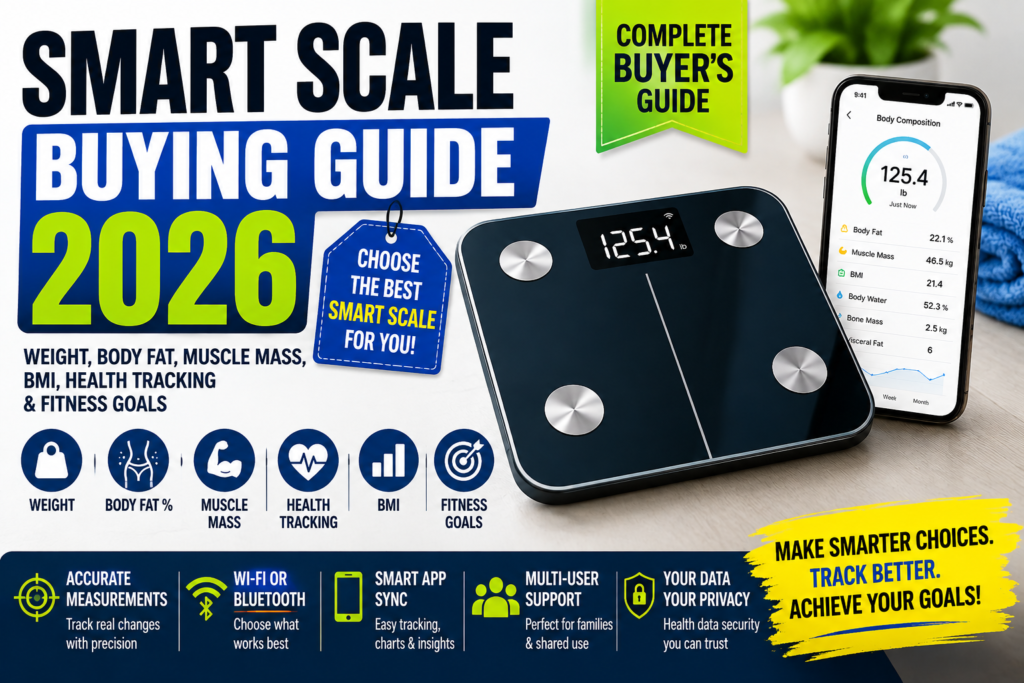
Learn how to choose a smart scale in 2026. Compare accuracy, body-fat metrics, Wi-Fi vs. Bluetooth, app compatibility, privacy, and essential features.
LifeCareBalance.com is reader-supported. When you buy through links on our site, we may earn an affiliate commission at no extra cost to you. As an Amazon Associate, we earn from qualifying purchases.
A traditional bathroom scale tells you how much you weigh. A smart scale can record that number in an app, show changes over time, and estimate additional measurements such as body fat percentage, muscle mass, and body water.
Those extra features can be useful, but they also make shopping more confusing. Two scales may advertise similar metrics while offering different apps, connectivity options, user profiles, and measurement methods. A model that reports 30 measurements is not automatically more accurate or more useful than one that reports eight.
This smart scale buying guide for 2026 explains what to look for before buying, which measurements deserve attention, how to understand body-composition estimates, and how to choose a scale that fits your goals and household.
The main principle is simple: prioritize reliable weight tracking, useful software, consistent measurements, and practical features over a long list of impressive-sounding metrics.
Quick Answer: What Should You Look for in a Smart Scale?
For most shoppers, the best smart scale is one that measures body weight consistently, syncs reliably with a compatible phone or health app, supports the people who will use it, and fits the household’s budget and privacy expectations.
Before buying, prioritize these features:
- Consistent weight measurement: The scale should provide repeatable readings on a hard, level floor.
- Useful app: Look for understandable charts, measurement history, and straightforward account management.
- The right connection: Wi-Fi is convenient for automatic syncing; Bluetooth may be sufficient for individual users.
- Compatible health platforms: Confirm support for your specific phone and preferred apps rather than assuming every model works with every platform.
- Appropriate capacity and size: Check the manufacturer’s stated weight limit and platform dimensions.
- Realistic body-composition expectations: Body fat and muscle measurements from consumer scales are estimates, not definitive clinical results.
- Privacy and account controls: Review data collection, sharing, deletion, and household profile options.
If you mainly want to monitor body weight, a basic digital scale may be enough. Pay extra for smart features only when they solve a problem you actually have.
What Is a Smart Scale?
A smart scale is a digital bathroom scale that connects to a smartphone, tablet, or online account to store and display measurements. Depending on the model, it may record weight alone or estimate additional body-composition metrics.
Most connected scales use Bluetooth, Wi-Fi, or both. Their companion apps can display historical readings, calculate changes over time, and sometimes share data with third-party health and fitness applications.
A smart scale is therefore a combination of two products:
- The scale, which measures weight and may collect electrical impedance data.
- The software, which stores readings, displays trends, manages user profiles, and connects with other platforms.
That second part deserves serious attention. A scale with an excellent feature list can still be inconvenient if the app is confusing, syncing is unreliable, or important features require an unwanted subscription.
How Do Smart Scales Work?
Understanding Bioelectrical Impedance Analysis (BIA)
Many smart scales use a method called bioelectrical impedance analysis, or BIA, to estimate body composition.
When you stand barefoot on a compatible scale, electrodes in the platform send a very small electrical current through the body and measure the resistance, or impedance, encountered by that current. The device combines this information with details such as your height, age, and sex to estimate measurements including body fat and lean mass.
Water and lean tissues conduct electricity differently from fat tissue. The scale’s algorithm uses those differences to produce estimates.
However, BIA does not directly photograph, scan, or independently measure each type of tissue. The result depends on the device’s electrode arrangement, calculation method, user information, and measurement conditions.
Some consumer scales use foot-to-foot electrodes, while certain higher-end devices use additional hand electrodes or other measurement configurations. These designs may gather different information, but more electrodes do not automatically guarantee that a particular result is clinically accurate.
A useful starting point is this research comparing consumer BIA devices with MRI and DXA measurements. It illustrates why agreement can vary by device and measurement method.
What Does a Smart Scale Actually Measure?
The following distinction is important:
- Weight: Measured by the scale’s weight sensors.
- Body fat percentage: Estimated using impedance data and an algorithm.
- Muscle mass: Estimated rather than directly weighed as a separate tissue measurement.
- Body water: Estimated and affected by fluid distribution.
- Visceral fat rating: Often a proprietary estimate or score, not a direct image of fat surrounding the organs.
- Bone mass: Usually an estimate, not a measurement of bone density from medical imaging.
- Basal metabolic rate (BMR): Typically calculated using a formula, not measured by directly testing energy expenditure.
- Metabolic age: A derived comparison based on the manufacturer’s chosen calculations, not a medical diagnosis.
A product may display all these measurements on the same screen, but they do not have the same level of reliability or clinical meaning.
Are Smart Scales Accurate?
Weight Accuracy Versus Body-Composition Accuracy
Weight and body composition should be evaluated separately.
A scale can provide repeatable body-weight readings while producing less reliable estimates of body fat or muscle mass. Consumer Reports explains that smart connectivity does not automatically make a bathroom scale more accurate and that body-composition features have important limitations in its bathroom scale buying guide.
For weight tracking, look for consistent results when the scale is used correctly. Place it on a firm, level surface, follow the manufacturer’s instructions, and avoid moving it between measurements unless the manual explains how to recalibrate it.
For body composition, use a more cautious approach.
A 2021 observational study comparing three consumer smart scales with DXA found that body-weight measurements were substantially closer to the reference measurements than several fat-mass and muscle-mass estimates. The authors concluded that the tested smart scales should not replace DXA for body-composition assessment in patient care. Read the full study in JMIR mHealth and uHealth.
This does not mean every smart scale performs identically. It means you should not assume that a body-fat number is exact simply because the scale displays it to one decimal place.
Why Body-Fat Readings Can Differ
Body-composition estimates can vary because of:
- Hydration and fluid distribution
- Recent exercise
- Meals and drinks
- Time of day
- Skin temperature and contact with electrodes
- Foot placement
- Differences in algorithms between brands
- Incorrect height, age, or other profile information
The size and direction of the error can differ between devices and people. Avoid applying one universal error percentage to every model.
Are Expensive Smart Scales More Accurate?
Not necessarily. A higher-priced model may offer Wi-Fi, a better display, hand electrodes, additional profiles, more detailed software, or broader app integration. Those features may improve convenience.
Price alone, however, does not prove that the body-fat estimate is more accurate. Look for credible independent testing of the exact model if measurement accuracy is your main reason for spending more.
For a deeper explanation of consumer body-fat estimates, see the LifeCareBalance guide to smart scale body-fat accuracy and BIA limitations.
Which Smart Scale Metrics Are Worth Tracking?
Not every number on a smart scale deserves equal attention. The right metrics depend on your goals and whether the information helps you make a practical decision.
| Metric | Potential usefulness | Main limitation |
|---|---|---|
| Weight | High for monitoring weight trends | Changes with food, fluid, clothing, and time of day |
| BMI | Basic population-level screening | Does not distinguish fat from muscle |
| Body fat percentage | May help track a long-term trend | An estimate that varies with measurement conditions |
| Muscle mass | May offer a rough trend for fitness users | Not a direct measurement of muscle tissue or strength |
| Body water | May show a general trend within one device | Not a substitute for clinical hydration assessment |
| Visceral fat rating | May provide a manufacturer-specific trend | Scores differ between brands and are not directly interchangeable |
| Bone mass | Limited value for routine home tracking | Does not measure bone density like a clinical scan |
| BMR | May offer a rough formula-based reference | Not a direct measurement of metabolism |
| Metabolic age | Limited practical value | Depends on proprietary calculations |
| Segmental body composition | May interest advanced fitness users | Accuracy depends on the method and device |
For most people, weight trends and a small number of additional measurements are enough. If you are working on strength training, use workout performance, training records, and recovery alongside any scale estimates. A muscle-mass number alone cannot tell you whether your strength has improved.
How Many Metrics Do You Need?
There is no ideal metric count for everyone. Start with the measurements that support your goals.
For general weight management, weight history may be sufficient. For fitness tracking, body-fat estimates may be of interest if you understand their limitations. For a household, profile management and automatic syncing may matter more than additional measurements.
A scale that presents a few understandable trends clearly can be more useful than a model that displays dozens of numbers without explaining how to interpret them.
Wi-Fi vs. Bluetooth Smart Scales
Both connection types can be useful. The better choice depends on how you plan to use the scale.
| Feature | Bluetooth | Wi-Fi |
|---|---|---|
| Typical setup | Pairs with a nearby phone | Connects to a compatible home network |
| Syncing | May depend on phone proximity or app behavior | Often supports automatic cloud syncing |
| Phone-free weighing | Depends on model; readings may sync later | Often convenient for automatic syncing |
| Multiple users | Can work well if profiles and app behavior suit the household | Can be convenient for households that want automatic syncing |
| Network requirement | Usually no home Wi-Fi needed for the Bluetooth connection | Compatible Wi-Fi network required |
| Best fit | Individual users who prefer a simple setup | Users who value hands-off syncing |
Do not assume every Bluetooth scale requires the app to remain open or that every Wi-Fi scale recognizes every household member correctly. Read the model’s instructions and recent owner feedback to understand its actual behavior.
Choose Bluetooth if you want a simpler connection and do not mind checking that your readings sync.
Choose Wi-Fi if you prefer automatic syncing without having to bring your phone into the bathroom, provided the device’s app and network requirements fit your setup.
Why the Companion App Matters
A smart scale is only convenient if its software makes the information easy to use.
Before purchasing, check whether the app offers:
- Clear charts and a searchable measurement history
- Easy setup and profile management
- Reliable syncing
- Data export or sharing options, if you need them
- Transparent subscription requirements
- A straightforward way to delete your account or data
- Compatibility with your phone and preferred health platform
Apple Health, Android, and Other Integrations
Do not rely on a generic statement such as “works with health apps.” Confirm the exact model’s compatibility with your phone and the specific app you use.
Android users should check the current requirements for Google Health Connect. Health Connect is a platform for sharing health and fitness data between compatible Android applications; it does not mean every smart scale automatically supports it.
Similarly, Apple Health, Fitbit, Samsung Health, and MyFitnessPal compatibility depends on the relevant scale app, supported integrations, region, and software versions. A connection may be one-way, may require permissions, or may not include every measurement.
If you are comparing two specific models, our Withings Body Smart vs. Eufy Smart Scale P2 Pro comparison explains which features to examine when comparing their software and measurement options.
Multi-User Support: What Families Should Check
If several people will use one scale, check more than the advertised number of user profiles.
Look for:
Automatic user recognition. Find out how the scale identifies each person and what happens when two household members have similar weights.
Separate measurement histories. Each person’s readings should be associated with the correct profile and account.
Profile limits. Confirm the number of users supported by the exact model and whether the limit applies to the scale, app, or account.
Guest or private use. Check whether a one-time reading can be kept separate from regular household records.
Account access. Understand who can view shared measurements and whether each person needs a separate account.
Wi-Fi can make automatic syncing convenient, but it does not guarantee perfect user recognition. Check real-world reports for the model you intend to buy.
Smart Scale Privacy and Data Security
A connected scale may collect weight, estimated body-composition data, profile information, and account details. Depending on the app, measurements may be stored on your phone, in a cloud account, or in more than one place.
Before creating an account, review the manufacturer’s current privacy policy and app permissions.
Ask these questions:
- Is an account required for basic weighing?
- Which data are collected and stored?
- Does the company share data with service providers or other third parties?
- Can you limit optional data sharing?
- Can you delete your account and stored data?
- Are family members’ records kept separate?
- Does the app request permissions that seem unnecessary for its features?
Privacy policies and software behavior can change. Check the current policy rather than relying only on an older review or a general claim about the brand.
If privacy is a priority, prefer a product with clear data controls and an understandable explanation of what happens to your measurements.
Weight Capacity, Platform Size, and Design
A scale must physically suit the people who will use it.
Weight Capacity
Check the exact model’s maximum supported weight. Do not assume that every smart scale supports 400 or 440 pounds simply because some models do.
The published limit should comfortably cover the expected user range. If a person is close to the limit, follow the manufacturer’s guidance rather than assuming the device will perform normally beyond its rating.
Platform Dimensions
A larger platform may feel more comfortable for some users. Compare the published width and length with your needs and the space available in your bathroom.
Surface and Stability
The scale should be placed on a hard, level floor. Carpet, uneven tiles, and unstable surfaces can interfere with consistent readings.
Glass, textured plastic, and other platform materials differ by model. Consider stability and ease of cleaning, and follow any manufacturer guidance about wet feet or bathroom use. Never step onto a scale with wet feet if doing so creates a slipping risk.
Display Readability
Some scales show weight directly on the platform; others rely heavily on the phone app. A clear display can be helpful if you want to see your weight without opening an app.
Check whether the display is readable in your usual lighting and whether it shows only weight or additional information.
Battery Life and Daily Convenience
Battery type and replacement frequency can affect long-term convenience.
Before buying, check:
- Whether the model uses replaceable or rechargeable batteries
- The manufacturer’s battery-life estimate
- Whether the app provides a low-battery warning
- How easy batteries are to replace
- Whether the scale requires regular charging
- Whether software or account updates are needed to keep connected features working
Manufacturer battery estimates depend on usage and conditions, so treat them as estimates rather than guarantees.
Also check the warranty, return policy, customer support, and availability of replacement parts if these matter to you.
Smart Scales, Pregnancy, and Medical Considerations
Consumer smart scales are primarily designed for personal wellness tracking. Their body-composition estimates should not be treated as diagnostic measurements.
Pregnancy can change body composition and fluid distribution, which can affect BIA estimates. Some manufacturers provide a pregnancy mode or instructions to disable body-composition measurements. Follow the guidance for the exact model rather than assuming all scales work the same way.
People with pacemakers or other implanted electronic medical devices should check the manufacturer’s safety instructions and consult their healthcare professional before using a scale that passes an electrical current through the body. Do not assume a BIA feature is appropriate for every medical situation.
If you need body-composition information for a medical decision, ask a qualified healthcare professional which assessment is appropriate. A consumer smart scale should not replace clinical evaluation.
How to Get More Consistent Readings
Even a good scale can show changing numbers when the measurement conditions change. To make your readings easier to compare:
- Use the same scale. Different brands use different algorithms, so their body-composition readings may not match.
- Choose a consistent time. Many users prefer weighing in the morning after using the bathroom and before breakfast.
- Use a hard, level surface. Avoid carpet and uneven flooring.
- Follow the instructions. Use bare feet and the specified sensor placement when required.
- Keep conditions similar. Large meals, recent exercise, and changes in hydration may affect BIA estimates.
- Check your profile details. Incorrect height, age, or other entered information can affect calculated results.
- Review trends rather than isolated numbers. One reading may reflect temporary variation rather than a meaningful change.
Consistency improves comparability; it does not transform a consumer scale into a clinical body-composition test.
How Much Should You Spend on a Smart Scale?
Smart scales can be grouped into three broad budget categories. Exact prices change frequently, so compare current prices and features before buying.
Budget Models
Budget models often focus on weight, a basic app, and a selection of estimated body-composition metrics. Bluetooth may be sufficient for individual users who do not need automatic cloud syncing.
Choose this tier if your main goal is recording weight and viewing simple trends.
Mid-Range Models
Mid-range models may add Wi-Fi, more developed apps, additional user profiles, or broader integration options. They can be a practical choice for families and people who want more convenient tracking.
Compare the actual features rather than assuming every mid-range model has better sensors or more accurate readings.
Premium Models
Premium scales may offer larger displays, hand electrodes, segmental analysis, additional sensors, or more advanced software features. These extras may be useful for specific needs, but they are not essential for everyone.
Do not pay more solely because a product advertises a large number of metrics or uses phrases such as “advanced body analysis.” Look for evidence that the extra feature provides a real benefit to you.
For an example of how one model’s features and limitations can be assessed, see the LifeCareBalance Eufy Smart Scale P2 Pro review.
Which Smart Scale Is Best for Different Users?
There is no single best design for every household. Match the features to your priorities.
For beginners: Choose a straightforward scale with consistent weight readings, an easy app, and a simple setup.
For weight management: Prioritize reliable weight history, clear charts, and a routine you can maintain without becoming preoccupied with every daily fluctuation.
For strength training: Consider whether estimated muscle and body-fat trends are useful to you, but also track training performance, exercise progression, and recovery.
For families: Look for adequate profile support, clear account separation, and dependable automatic syncing.
For privacy-conscious users: Read the data policy before purchasing and confirm which features work without optional sharing or subscriptions.
For Apple users: Verify compatibility with your iPhone and Apple Health for the exact model.
For Android users: Check the scale app’s current compatibility with your device and any required health-data integration.
For people who only need body weight: A basic digital scale may be the more economical choice. Smart features are optional, not a requirement for useful weight tracking.
Common Smart Scale Buying Mistakes
Buying the Scale With the Most Metrics
More measurements do not automatically mean more accurate information. Buy according to the metrics you will actually use.
Treating Body Fat as an Exact Number
Consumer BIA estimates can differ from clinical methods and can vary with measurement conditions. Use them cautiously as trends.
Ignoring App Compatibility
A scale that cannot share data with your preferred platform may create more work than it saves. Verify compatibility before purchasing.
Assuming Wi-Fi Means Perfect Syncing
Connectivity still depends on the model, home network, app, and account setup. Check the actual syncing process and support documentation.
Overlooking Privacy
Weight and body-composition data can be personal. Read the policy and understand account controls before storing measurements online.
Comparing Different Brands’ Body-Composition Numbers
Different algorithms and measurement configurations can produce different estimates. Do not assume that two brands’ body-fat percentages are interchangeable.
Buying Features You Will Not Use
A premium display or segmental analysis may be unnecessary if you only want a simple weight chart. Choose the smallest feature set that meets your real needs.
Smart Scale Buying Checklist
Use this checklist before you order:
- The maximum weight capacity fits the intended users.
- The platform dimensions are suitable.
- The scale can be placed on a hard, level surface.
- The app supports my phone and preferred health platform.
- I understand whether the model uses Wi-Fi, Bluetooth, or both.
- Multi-user support matches my household.
- I understand which measurements are direct readings and which are estimates.
- The privacy policy explains data storage, sharing, and deletion.
- Any subscription or recurring cost is clearly disclosed.
- The battery or charging arrangement suits my routine.
- The warranty, return policy, and support options are acceptable.
- The price reflects features I will actually use.
Frequently Asked Questions
Are smart scales accurate for body fat?
Smart scales estimate body fat using methods such as BIA. Accuracy varies by device and person, and results can differ from clinical methods. Treat body-fat readings as estimates rather than exact measurements.
Are smart scales worth buying?
They can be worthwhile if you want automatic weight records, trend charts, multiple profiles, or health-app integration. If you only need weight, a basic digital scale may be sufficient.
What does BIA mean on a smart scale?
BIA stands for bioelectrical impedance analysis. It measures how a small electrical current encounters resistance in the body and uses an algorithm to estimate body composition.
Is Wi-Fi better than Bluetooth?
Wi-Fi often makes automatic syncing more convenient when the model supports it. Bluetooth can be sufficient for someone who prefers a simple setup and does not mind checking whether measurements have synced.
How many metrics should a smart scale have?
There is no ideal number. Prioritize the measurements that support your goals, such as weight trends, and avoid paying extra for numbers you will not use.
Can a smart scale measure muscle mass?
Many models estimate muscle mass through BIA-based calculations. The result is not a direct measurement of muscle tissue and should not replace strength or performance tracking.
Can smart scales be used by multiple people?
Many models support multiple profiles, but profile limits and automatic recognition vary. Confirm how the exact scale handles similar weights, separate accounts, and guest readings.
Do smart scales work with Apple Health or Android apps?
Some do, but support depends on the model, companion app, operating system, and integration available at the time. Verify the exact compatibility before buying.
How often should I use a smart scale?
That depends on your goals and how weighing affects you. If you choose to track weight, consistency of timing and conditions is more important than reacting to every individual fluctuation.
Can I compare body-fat readings from two different scales?
It is better not to treat the values as directly interchangeable. Different devices may use different electrodes and algorithms, so a change in the number may reflect the device as well as your body.
Are smart scales medical devices?
Consumer smart scales are generally intended for personal wellness tracking. Do not assume their body-composition estimates can diagnose a condition or replace measurements recommended by a healthcare professional.
Related Smart Scale and Wellness Guides
If you are considering a specific device, read our Withings Body Smart Scale review for a closer look at one model’s features, app experience, and practical limitations.
For a broader approach to health tracking and everyday habits, explore our Personalized Wellness Guide.
For another perspective on choosing a bathroom scale, consult Consumer Reports’ bathroom scale recommendations. Its testing approach emphasizes weight accuracy, consistency, and usability rather than assuming that extra features guarantee better results.
Final Verdict: Choose the Scale That Fits Your Real Needs
The best smart scale is not necessarily the most expensive model or the one with the longest list of measurements. It is the scale that measures weight consistently, fits your household, works with your preferred apps, protects your data appropriately, and makes long-term tracking convenient.
Start by deciding what you want to monitor. Check weight capacity, platform size, connectivity, app compatibility, privacy, and recurring costs. Then consider extra body-composition features if they serve a clear purpose.
Most importantly, understand the limits of the numbers. Weight trends can be useful for many people, while body-fat, muscle, and other BIA-derived readings should be interpreted cautiously. A smart scale can support a wellness routine, but it cannot independently diagnose a health problem or tell the whole story about your health.
Choose for usefulness, not for the longest spec sheet.