
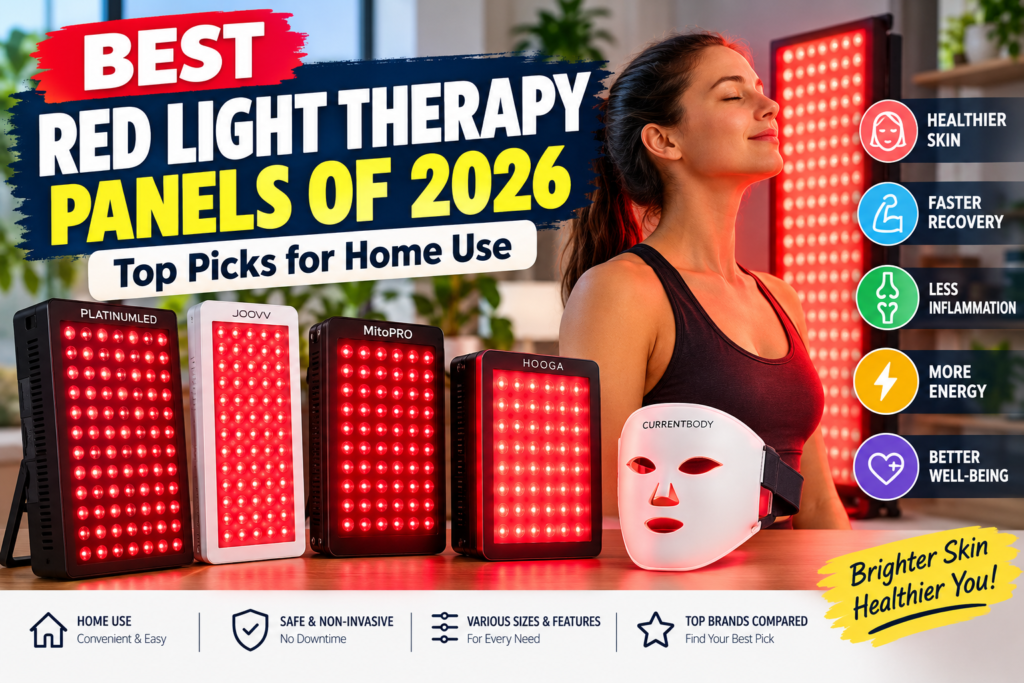
Discover the 6 best red light therapy panels of 2026 for home use. Compare top full-body panels for skin health, muscle recovery, pain relief, wellness, features, and value.
LifeCareBalance.com is reader-supported. When you buy through links on our site, we may earn an affiliate commission at no extra cost to you. As an Amazon Associate, we earn from qualifying purchases.
Shopping for a red light therapy panel usually starts with a simple question — “which one should I buy?” — and quickly turns into a spec sheet full of numbers that don’t mean much on their own: mW/cm², J/cm², nanometers, beam angle, EMF. This guide is built to answer both problems at once.
Below, we compare six current red light therapy panels across the specs that actually determine results: wavelength, irradiance, treatment distance, dose, coverage area, controls, warranty, and price. Each pick is built around a different use case — best overall, best full-body, best for skin, best for muscle recovery, best budget, and best compact — so you can match the panel to what you’re actually trying to do, not just the biggest number on the box.
We also explain, in plain terms, how to read a manufacturer’s irradiance claim, how far you should stand from a panel, how to calculate your actual dose, and what “FDA registered” really means versus “FDA cleared.” None of the six panels below were physically tested by our team; every spec is drawn from manufacturer product pages and cross-checked against independent sources, with any unverifiable figure flagged rather than guessed at.
- Better Experience at Home: Skipping the expensive outdoor visit, this compact yet powerful red light therapy panel deliv…
- Reliable and Comfortable Use: Designed with thoughtful engineering, this infrared red light panel delivers up to 70 mW/c…
- Targeted & Versatile Use: Our red light therapy device combines red and near-infrared light for versatile coverage. Whet…
- Eye Protection for Red Light Therapy: Red Light Therapy Glasses designed to attenuate commonly used wavelengths in red l…
- Reduces Brightness & Intensity of Red Light Therapy: Red light eye protection helps shield your eyes from brightness dur…
- Balanced & Targeted Attenuation: It’s important to use eye protection designed for both red and near-infrared light. The…
- HOOGA HG Series Entry-Level Red & Near-Infrared LED Panel: The HG Series is Hooga’s entry-level LED panel line designed …
- High-Output LED Technology for Home Use: Advances in LED efficiency have made high-output red and near-infrared light pa…
- Dual-Wavelength LED Configuration: The HG300 uses two LED wavelengths—660nm (red) and 850nm (near-infrared)—in a balance…
- 𝟐,𝟓𝟕𝟎 𝐒𝐌𝐃 𝟓𝟎𝟓𝟎 𝐋𝐄𝐃𝐬 & 𝐃𝐮𝐚𝐥-𝐖𝐚𝐯𝐞𝐥𝐞𝐧𝐠𝐭𝐡 𝐋𝐢𝐠𝐡𝐭 𝐓𝐞𝐜𝐡𝐧𝐨𝐥𝐨𝐠𝐲:Experience advanced full-body red light therapy powered by 2,570 …
- 𝟏𝟐𝟎𝐦𝐖/𝐜𝐦² 𝐇𝐢𝐠𝐡 𝐈𝐫𝐫𝐚𝐝𝐢𝐚𝐧𝐜𝐞 & 𝟏𝟎𝟎% 𝐃𝐢𝐫𝐞𝐜𝐭 𝐋𝐢𝐠𝐡𝐭 𝐓𝐫𝐚𝐧𝐬𝐦𝐢𝐬𝐬𝐢𝐨𝐧:Built for powerful and efficient light delivery, this full-bo…
- 𝟕𝟓”×𝟑𝟒” 𝐂𝐨𝐜𝐨𝐨𝐧-𝐒𝐭𝐲𝐥𝐞 𝐅𝐮𝐥𝐥 𝐁𝐨𝐝𝐲 𝐂𝐨𝐯𝐞𝐫𝐚𝐠𝐞:Designed with a spacious 75″ × 34″ full-body sleeping bag structure, this red li…
- DUAL-CHIP RED & NEAR-INFRARED LIGHT – Features 60 dual-chip LEDs, with each LED delivering both 660nm red light and 850n…
- HIGH-OUTPUT DUAL-CHIP LED PANEL: Features 900 dual-chip LEDs for consistent light output and true full-body coverage in …
- SUPPORTS DAILY WELLNESS: A convenient way to support relaxation, post-exercise recovery, and skin health as part of a da…
- TARGETED MEDIUM-AREA COVERAGE WITH 216 LEDS: Designed with 216 high-performance LEDs to provide consistent light coverag…
- 7-WAVELENGTH MULTI-SPECTRUM TECHNOLOGY: Features 7 carefully selected wavelengths including red, near-infrared, blue, an…
- STRONG IRRADIANCE FOR EFFICIENT SESSIONS: Engineered for powerful light output at recommended distances to help maximize…
Best Red Light Therapy Panels of 2026 — Quick Picks
| Panel | Best For | Wavelengths | Irradiance | Coverage | Price | Warranty |
|---|---|---|---|---|---|---|
| PlatinumLED BioMax 900 | Best Overall | 480, 630, 660, 810, 830, 850, 1060nm (7) | ~185 mW/cm² at 6 in. (manufacturer/third-party estimates vary) | 36″ x 12″ (torso to mid-thigh, standing) | ~$1,149–$1,299 (varies by retailer/sale) | 3 years |
| Mito Red Light MitoPRO 1500+ | Best Full-Body | 630, 660, 830, 850nm (4) | Not clearly disclosed by the manufacturer at a specific distance | 43″ tall panel | $1,169 | 3 years |
| RLT Home Total Spectrum Compact | Best for Skin & Anti-Aging | 480, 630, 660, 810, 830, 850, 1064nm (7) | 99.0 mW/cm² at 6 in. (spectrometer) / 172 mW/cm² at 8 in. (solar meter) — see note below | ~2.5 ft tall x 1 ft wide | ~$995–$1,295 (frequent sales) | 3 years |
| Joovv Solo 3.0 | Best for Muscle Recovery | 660, 850nm (2) | >100 mW/cm² (measured at LED surface, not stated treatment distance) | 36″ x 8.75″ | ~$1,295–$1,699 (pricing varies significantly by source) | 2 years |
| Hooga PRO300 | Best Budget | 660, 850nm (2) | >109 mW/cm² at 6 in. | 12.7″ x 8.6″ | $299 | 3 years |
| RLT Home Total Spectrum Mini | Best Compact / Small Space | 480, 630, 660, 810, 830, 850, 1064nm (7) | Not separately disclosed from the Compact model’s figures | ~1 ft x 1 ft | ~$495–$695 (frequent sales) | 3 years |
Prices fluctuate with manufacturer sales and were sourced from multiple retailer listings; confirm current pricing on the manufacturer’s site before buying.
If home strength training is already part of your recovery routine, it’s worth pairing red light sessions with solid equipment — our Bowflex SelectTech 552 review covers one of the more space-efficient options for a home gym.
6 Best Red Light Therapy Panels of 2026
#1 — Best Overall: PlatinumLED BioMax 900
- Better Experience at Home: Skipping the expensive outdoor visit, this compact yet powerful red light therapy panel deliv…
- Reliable and Comfortable Use: Designed with thoughtful engineering, this infrared red light panel delivers up to 70 mW/c…
- Targeted & Versatile Use: Our red light therapy device combines red and near-infrared light for versatile coverage. Whet…
Why We Picked It
The BioMax 900 earns “best overall” because it doesn’t force a tradeoff between wavelength breadth and output. It’s one of the few consumer panels that pairs a full seven-wavelength spectrum (including the deeper-penetrating 1060nm band) with irradiance figures that sit at the high end of the home market, and PlatinumLED has a long-enough track record and a 3-year warranty to back it.
Key Specifications
- Wavelengths: 480nm (blue), 630nm, 660nm (red), 810nm, 830nm, 850nm, 1060nm (near-infrared)
- Red-light wavelengths: 630nm, 660nm
- NIR wavelengths: 810nm, 830nm, 850nm, 1060nm
- Irradiance: Manufacturer and independent estimates range from roughly 100 mW/cm² to 185 mW/cm² depending on measurement method and distance — figures are not fully consistent across sources, so treat any single number as approximate
- Irradiance measurement distance: Commonly cited at 6 inches, though exact protocol is not clearly disclosed by the manufacturer in a single standardized figure
- Panel dimensions: Approximately 36″ x 12″ x 3″
- Treatment area: Roughly 900 sq. cm — torso, back, or both legs at once for most standing users
- Weight: Approximately 33 lb
- Timer: Included (session length varies by mode)
- Modes: Red only, NIR only, or combined; touchscreen/remote control on current models
- Red/NIR controls: Independent switches for red and near-infrared
- Pulse settings: Available on current-generation BioMax panels
- Mounting options: Door-hanging hardware included; wall-mount compatible
- Stand: Included stand; an upgraded adjustable stand is sold separately
- EMF information: Not clearly disclosed by the manufacturer in a standardized figure
- Warranty: 3 years
- Return period: 60 days
- Current price: Reported between roughly $769 and $1,299 depending on retailer, bundle, and sale timing — confirm current price before purchase
Pros
- Widest wavelength spectrum of the panels in this guide (7 bands, 480–1060nm)
- High irradiance relative to most full-size home panels
- 3-year warranty and an established manufacturer with over a decade in the category
- Independent third-party irradiance testing is publicly referenced by the brand
Cons
- At 33 lb, it’s heavier than most single-panel competitors and needs secure mounting
- Doesn’t cover true full-body in a single standing session — expect torso-to-mid-thigh coverage
- Reported pricing varies significantly across retailers, making it harder to know the “real” price without checking directly
- EMF and exact irradiance-measurement protocol are not clearly disclosed in one consistent figure
Best For
Users who want the broadest wavelength coverage in a single panel — people targeting both surface skin concerns and deeper joint or muscle issues without buying two devices.
Not Ideal For
Anyone who wants guaranteed full-body coverage from one panel, or buyers on a tight budget who don’t need more than the two core wavelengths (660nm/850nm).
Is It Worth the Price?
At the lower end of its reported price range, the BioMax 900 is competitively priced for a 7-wavelength panel with this output. At the higher end, it’s priced similarly to premium 2-wavelength panels from other brands, so the extra spectrum is what you’re paying for — worthwhile if you have specific use cases (e.g., skin plus deep joint work) that benefit from the additional bands.
Our Verdict
A strong, broad-spectrum all-rounder for buyers who want one panel that can flex between skin, recovery, and pain-relief goals — just confirm the current price and don’t expect single-session full-body coverage.
#2 — Best Full-Body: Mito Red Light MitoPRO 1500+
- Eye Protection for Red Light Therapy: Red Light Therapy Glasses designed to attenuate commonly used wavelengths in red l…
- Reduces Brightness & Intensity of Red Light Therapy: Red light eye protection helps shield your eyes from brightness dur…
- Balanced & Targeted Attenuation: It’s important to use eye protection designed for both red and near-infrared light. The…
Why We Picked It
At 43 inches tall with 300 LEDs, the MitoPRO 1500+ is sized specifically for full-torso, standing-height sessions, and Mito Red Light backs it with a longer-than-average return window plus HSA/FSA eligibility, which matters for buyers weighing this as a real household purchase.
Key Specifications
- Wavelengths: 630nm, 660nm, 830nm, 850nm (4)
- Red-light wavelengths: 630nm, 660nm
- NIR wavelengths: 830nm, 850nm
- Irradiance: Not clearly disclosed by the manufacturer at a specific, single treatment distance on the pages we reviewed
- Irradiance measurement distance: Not clearly disclosed
- Panel dimensions: 43″ tall (width/depth not clearly disclosed in the sources reviewed)
- Treatment area: Full torso in a single standing session; described by the manufacturer as suited to “full body” use
- Weight: Not clearly disclosed
- Timer: Included
- Modes: Red only, NIR only, or combined
- Red/NIR controls: Independent controls
- Pulse settings: Not clearly disclosed for this specific model (available on other Mito Red lines)
- Mounting options: Door and wall mounting supported
- Stand: Included
- EMF information: Not clearly disclosed
- Warranty: 3 years
- Return period: 60 days
- Current price: $1,169 (manufacturer site)
Pros
- Full-body-height panel designed for single-session, standing coverage
- Long 60-day return window and 3-year warranty
- HSA/FSA payment eligibility, which can offset the cost for some buyers
- 300 LEDs across 4 clinically studied wavelengths (630/660/830/850nm)
Cons
- Irradiance is not clearly published at a specific distance, making it hard to directly compare against panels that do disclose this
- Fewer wavelengths than the PlatinumLED or RLT Home panels in this guide
- Weight and full dimensions aren’t clearly listed on the pages reviewed
Best For
Buyers who specifically want single-panel, standing-height full-body coverage without assembling a multi-panel array, and who value a long return window to test it at home.
Not Ideal For
Buyers who want to compare irradiance numbers precisely before purchasing — you’ll need to contact the manufacturer directly for a distance-specific figure, or lean on independent testing if you can find it.
Is It Worth the Price?
At $1,169, it sits mid-pack against other full-body-height panels. The value case rests more on coverage, warranty, and return policy than on a headline irradiance number, since that figure isn’t clearly published.
Our Verdict
A reasonable full-body pick if single-panel, standing coverage matters more to you than having a precise, published irradiance-at-distance figure to compare against competitors.
#3 — Best for Skin & Anti-Aging: RLT Home Total Spectrum Compact
- HOOGA HG Series Entry-Level Red & Near-Infrared LED Panel: The HG Series is Hooga’s entry-level LED panel line designed …
- High-Output LED Technology for Home Use: Advances in LED efficiency have made high-output red and near-infrared light pa…
- Dual-Wavelength LED Configuration: The HG300 uses two LED wavelengths—660nm (red) and 850nm (near-infrared)—in a balance…
Why We Picked It
This panel earns the skin category because its wavelength mix is explicitly built around skin biology: 480nm blue light for surface concerns, plus 630nm and 660nm red light, which are the two most-studied wavelengths for collagen stimulation and skin tone. It also publishes irradiance figures from two different measurement methods, which is more transparency than most competitors offer.
Key Specifications
- Wavelengths: 480nm, 630nm, 660nm, 810nm, 830nm, 850nm, 1064nm (7)
- Red-light wavelengths: 630nm, 660nm
- NIR wavelengths: 810nm, 830nm, 850nm, 1064nm
- Irradiance: 99.0 mW/cm² at 6 inches (measured with a spectrometer, per manufacturer) and 172 mW/cm² at 8 inches (measured with a solar power meter, per manufacturer)
- Irradiance measurement distance: 6 inches and 8 inches (two separate published figures — see note below)
- Panel dimensions: Approximately 2.5 ft tall x 1 ft wide
- Treatment area: Back, shoulders, legs, or face at a distance
- Weight: 26.5 lb
- Timer: Built-in
- Modes: 9 pre-built modes (including a skin/anti-aging mode) plus a custom mode with adjustable intensity across 4 channels
- Red/NIR controls: Independent channel control (red, blue, near-infrared, 1064nm)
- Pulse settings: Adjustable 0–5,000 Hz
- Mounting options: Freestanding; door/wall options vary by accessory purchased
- Stand: Included
- EMF information: Approximately 0.0 µT at 6 inches or greater (manufacturer, measured with a Cornet EMF meter)
- Warranty: 3 years
- Return period: 60 days
- Current price: Frequently discounted between roughly $995 and $1,295 depending on ongoing promotions
Pros
- Includes 480nm blue light specifically for surface skin concerns, alongside 630nm/660nm red
- Publishes irradiance from two separate measurement methods rather than a single unverifiable number
- Dedicated skin/anti-aging preset mode
- No app or internet connection required — a plus for privacy-focused buyers
- 100,000-hour rated LED lifespan (per manufacturer)
Cons
- The published irradiance figures (99.0 mW/cm² at 6 in. vs. 172 mW/cm² at 8 in.) are inconsistent with each other — irradiance normally falls as distance increases, so this discrepancy likely reflects the two different measurement tools rather than the panel itself, and buyers should treat it as an illustration of why measurement method matters, not a precise number to plan a protocol around
- No app-based session tracking
- Price fluctuates significantly with frequent sitewide sales, so the “regular” price is hard to pin down
Best For
Buyers whose primary goal is skin tone, texture, and fine lines, who want a panel with an anti-bacterial blue-light option alongside red and near-infrared.
Not Ideal For
Buyers who want a single, internally consistent irradiance figure to build a precise dosing protocol — cross-check with independent testing if that level of precision matters to you.
Is It Worth the Price?
At sale pricing (roughly $995), it’s competitively positioned against other 7-wavelength mid-size panels. At full list price, it’s a premium purchase, so timing your purchase around a sale is worth doing.
Our Verdict
A strong pick specifically for skin-focused users, with the caveat that you should read irradiance claims from any brand — including this one — with some skepticism until independently verified.
#4 — Best for Muscle Recovery: Joovv Solo 3.0
- 𝟐,𝟓𝟕𝟎 𝐒𝐌𝐃 𝟓𝟎𝟓𝟎 𝐋𝐄𝐃𝐬 & 𝐃𝐮𝐚𝐥-𝐖𝐚𝐯𝐞𝐥𝐞𝐧𝐠𝐭𝐡 𝐋𝐢𝐠𝐡𝐭 𝐓𝐞𝐜𝐡𝐧𝐨𝐥𝐨𝐠𝐲:Experience advanced full-body red light therapy powered by 2,570 …
- 𝟏𝟐𝟎𝐦𝐖/𝐜𝐦² 𝐇𝐢𝐠𝐡 𝐈𝐫𝐫𝐚𝐝𝐢𝐚𝐧𝐜𝐞 & 𝟏𝟎𝟎% 𝐃𝐢𝐫𝐞𝐜𝐭 𝐋𝐢𝐠𝐡𝐭 𝐓𝐫𝐚𝐧𝐬𝐦𝐢𝐬𝐬𝐢𝐨𝐧:Built for powerful and efficient light delivery, this full-bo…
- 𝟕𝟓”×𝟑𝟒” 𝐂𝐨𝐜𝐨𝐨𝐧-𝐒𝐭𝐲𝐥𝐞 𝐅𝐮𝐥𝐥 𝐁𝐨𝐝𝐲 𝐂𝐨𝐯𝐞𝐫𝐚𝐠𝐞:Designed with a spacious 75″ × 34″ full-body sleeping bag structure, this red li…
Why We Picked It
Joovv’s Recovery+ mode — a pulsed near-infrared setting built specifically for post-training use — combined with IEC 60601 medical-electrical-equipment safety certification and a well-documented app for session tracking, makes the Solo 3.0 a natural fit for athletes building a structured recovery routine.
Key Specifications
- Wavelengths: 660nm (red), 850nm (near-infrared) (2)
- Red-light wavelengths: 660nm
- NIR wavelengths: 850nm
- Irradiance: Manufacturer states “>100 mW/cm²”; independent spectrometer testing from one reviewer measured closer to ~59–72 mW/cm² averaged across the panel surface — these figures don’t fully agree, so treat the manufacturer number as an upper-bound claim rather than a guaranteed treatment-distance figure
- Irradiance measurement distance: Manufacturer specifies “at LED surface,” not a standard treatment distance — this matters, since surface irradiance is always higher than irradiance at 6–12 inches
- Panel dimensions: 36″ (L) x 8.75″ (W) x 2.34″ (H)
- Treatment area: Moderate — torso, back, or legs in a rotating routine rather than full body in one pass
- Weight: Approximately 14 lb
- Timer: Managed through the Joovv Bluetooth app
- Modes: Standard, Recovery+ (pulsed NIR), and Ambient (evening wind-down)
- Red/NIR controls: App-controlled
- Pulse settings: Recovery+ mode pulses NIR at a fixed frequency
- Mounting options: Boot floor stand, door mount, or wall (Nano Wall System) — sold separately in some kits
- Stand: Available as an accessory depending on kit
- EMF information: Not clearly disclosed in a standardized figure
- Warranty: 2 years
- Return period: 60 days
- Current price: Reported between roughly $1,295 and $1,699 across different sources — Joovv’s pricing has shifted across product generations and bundles, so confirm the current figure directly with Joovv before buying
Pros
- Recovery+ pulsed-NIR mode is purpose-built for post-workout use
- IEC 60601 medical-electrical safety certification — a differentiator versus most competitors
- Bluetooth app with session logging and guided protocols
- Modular design lets you add a second panel later for broader coverage
- Well-established brand with a long service history
Cons
- Only two wavelengths (660nm/850nm), versus the 4–7 wavelengths offered by several competitors in this guide at lower prices
- Manufacturer irradiance figure is measured “at surface,” not at a realistic treatment distance, and independent measurements have come in meaningfully lower
- Highest price-per-wavelength of any panel in this guide
- Single Solo panel does not provide full-body coverage; a second unit is typically needed for that
Best For
Athletes and lifters who want a structured, app-guided recovery protocol and value the Recovery+ pulsed mode and medical-grade safety certification over having more wavelengths.
Not Ideal For
Budget-conscious buyers, or anyone prioritizing wavelength variety and coverage size per dollar — several panels in this guide offer more of both for less money.
Is It Worth the Price?
This is the most debated value question in the category. You’re paying a real premium for build quality, app polish, and the IEC 60601 certification rather than for raw specs — worth it if those specifically matter to you, harder to justify on output-per-dollar alone.
Our Verdict
A premium, well-built recovery-focused panel best suited to buyers who want the Joovv ecosystem and app experience specifically — price-sensitive buyers should compare it directly against the Hooga and Mito Red panels above before deciding.
#5 — Best Budget: Hooga PRO300
- DUAL-CHIP RED & NEAR-INFRARED LIGHT – Features 60 dual-chip LEDs, with each LED delivering both 660nm red light and 850n…
- HIGH-OUTPUT DUAL-CHIP LED PANEL: Features 900 dual-chip LEDs for consistent light output and true full-body coverage in …
- SUPPORTS DAILY WELLNESS: A convenient way to support relaxation, post-exercise recovery, and skin health as part of a da…
Why We Picked It
The PRO300 delivers dual-chip 660nm/850nm LEDs with a manufacturer-published irradiance figure at a clearly stated distance, a 3-year warranty, and an included stand — all at roughly a fifth of the price of some premium panels in this guide. That combination of transparency and price is why it wins the budget category.
Key Specifications
- Wavelengths: 660nm (red), 850nm (near-infrared) (2)
- Red-light wavelengths: 660nm
- NIR wavelengths: 850nm
- Irradiance: Over 109 mW/cm²
- Irradiance measurement distance: 6 inches
- Panel dimensions: 12.7″ x 8.6″
- Treatment area: Targeted — face, neck, shoulders, knees, or joints rather than full body
- Weight: Not clearly disclosed for the PRO300 specifically (the similarly sized HG300 weighs approximately 6 lb)
- Timer: Built-in digital countdown timer
- Modes: Red only, NIR only, or both
- Red/NIR controls: Independent power switches
- Pulse settings: Not clearly disclosed by the manufacturer for this model
- Mounting options: Tabletop stand included; modular connection to other PRO-series panels and mobile stands for larger setups
- Stand: Included, built-in adjustable tabletop stand
- EMF information: 0.0 µT at the recommended 6-inch treatment distance (manufacturer)
- Warranty: 3 years
- Return period: 60 days
- Current price: $299
Pros
- Clearly stated irradiance figure (109 mW/cm²) at a clearly stated distance (6 inches) — more transparent than several higher-priced competitors in this guide
- 3-year warranty matches or beats panels costing 3–5x more
- Built-in stand, carrying handle, and digital timer included at this price
- Zero measured EMF at the recommended treatment distance
- Modular — can be expanded later by adding more PRO-series panels
Cons
- Small footprint means targeted use only, not full-body in one session
- Only two wavelengths (660nm/850nm)
- No app or Bluetooth connectivity
- Weight not clearly disclosed by the manufacturer for this exact model
Best For
First-time buyers, anyone treating a specific area (face, shoulder, knee), and budget-conscious shoppers who still want a manufacturer-disclosed, distance-specific irradiance figure rather than a vague marketing number.
Not Ideal For
Buyers who want full-body coverage from a single panel, or who want more than two wavelengths.
Is It Worth the Price?
Yes — at $299 with a 3-year warranty and a clearly published spec sheet, this is one of the stronger value propositions in the category, even against panels costing several times more.
Our Verdict
The best starting point for most first-time buyers: enough real output to be effective, small enough to fit anywhere, and priced low enough that trying red light therapy isn’t a big financial commitment.
#6 — Best Compact / Small Space: RLT Home Total Spectrum Mini
- TARGETED MEDIUM-AREA COVERAGE WITH 216 LEDS: Designed with 216 high-performance LEDs to provide consistent light coverag…
- 7-WAVELENGTH MULTI-SPECTRUM TECHNOLOGY: Features 7 carefully selected wavelengths including red, near-infrared, blue, an…
- STRONG IRRADIANCE FOR EFFICIENT SESSIONS: Engineered for powerful light output at recommended distances to help maximize…
Why We Picked It
At roughly 1 ft x 1 ft and 11 lb, the Total Spectrum Mini is the smallest true panel in this guide that still carries the full 7-wavelength spectrum used across the rest of the RLT Home line — a rare combination of small footprint and wavelength breadth.
Key Specifications
- Wavelengths: 480nm, 630nm, 660nm, 810nm, 830nm, 850nm, 1064nm (7)
- Red-light wavelengths: 630nm, 660nm
- NIR wavelengths: 810nm, 830nm, 850nm, 1064nm
- Irradiance: Not separately published for the Mini in the sources reviewed; the larger Compact model in this guide reports 99.0 mW/cm² at 6 inches (spectrometer) / 172 mW/cm² at 8 inches (solar meter) using the same core LED technology, but this should not be assumed to be identical for the Mini without direct confirmation
- Irradiance measurement distance: Not clearly disclosed specifically for the Mini
- Panel dimensions: Approximately 1 ft x 1 ft
- Treatment area: Small — hands, feet, face, or a single joint
- Weight: 11 lb
- Timer: Built-in
- Modes: 9 pre-built modes plus custom 4-channel adjustment (shared platform with the Compact model)
- Red/NIR controls: Independent channel control
- Pulse settings: Adjustable 0–5,000 Hz
- Mounting options: Freestanding, included stand
- Stand: Included, stand-up device
- EMF information: Approximately 0.0 µT at 6 inches or greater (manufacturer)
- Warranty: 3 years
- Return period: 60 days
- Current price: Frequently discounted between roughly $495 and $695
Pros
- Smallest panel in this guide with the full 7-wavelength spectrum
- 11 lb and roughly 1 sq. ft. footprint — easy to store, travel with, or use on a desk
- No app or internet connectivity required
- Shares the same 3-year warranty and 60-day return window as the larger RLT Home models
- 100,000-hour rated LED lifespan (per manufacturer, shared platform spec)
Cons
- Small treatment area means it’s not suitable as a primary full-body or even torso device
- Irradiance is not separately and clearly published for this specific model
- Frequent sales make the “true” price hard to pin down without checking at time of purchase
Best For
Apartment dwellers, frequent travelers, and anyone who wants a dedicated device for a single joint, the face, or hands without giving up closet space to a full-size panel.
Not Ideal For
Anyone treating the torso, back, or legs regularly — step up to the Compact model or a full-body panel instead.
Is It Worth the Price?
At sale pricing, it’s a reasonable entry point into the 7-wavelength RLT Home platform for buyers who genuinely only need a small treatment area. At full price, compare it against the Hooga PRO300 above, which is smaller in wavelength count but meaningfully cheaper.
Our Verdict
The right choice specifically for small-space or travel use — most buyers who plan to treat larger areas regularly should look at the Compact or full-body picks instead.
Red Light Therapy Panel Comparison
| Panel | Wavelengths | Irradiance | Measurement Distance | Coverage | Timer | Mounting | Warranty | Return Policy | Price |
|---|---|---|---|---|---|---|---|---|---|
| PlatinumLED BioMax 900 | 7 (480–1060nm) | ~100–185 mW/cm² (sources vary — not fully consistent) | ~6 in. (not fully standardized across sources) | 36″ x 12″ | Included | Door / wall | 3 yrs | 60 days | ~$769–$1,299 |
| Mito Red MitoPRO 1500+ | 4 (630/660/830/850nm) | Not clearly disclosed at a specific distance | Not clearly disclosed | 43″ tall panel | Included | Door / wall | 3 yrs | 60 days | $1,169 |
| RLT Home Total Spectrum Compact | 7 (480–1064nm) | 99.0 mW/cm² (spectrometer) / 172 mW/cm² (solar meter) | 6 in. / 8 in. (two methods) | ~2.5 ft tall | Included | Freestanding | 3 yrs | 60 days | ~$995–$1,295 |
| Joovv Solo 3.0 | 2 (660/850nm) | >100 mW/cm² (mfr., at LED surface); ~59–72 mW/cm² (independent, averaged) | Surface (mfr.); not a standard treatment distance | 36″ x 8.75″ | App-managed | Door / wall / floor stand | 2 yrs | 60 days | ~$1,295–$1,699 |
| Hooga PRO300 | 2 (660/850nm) | >109 mW/cm² | 6 in. | 12.7″ x 8.6″ | Included | Tabletop / modular | 3 yrs | 60 days | $299 |
| RLT Home Total Spectrum Mini | 7 (480–1064nm) | Not separately disclosed for this model | Not clearly disclosed | ~1 ft x 1 ft | Included | Freestanding | 3 yrs | 60 days | ~$495–$695 |
Note on data sources: Wavelength counts and product dimensions above come from manufacturer product pages. Irradiance figures are a mix of manufacturer-reported and independently reported data — we’ve labeled each accordingly, and flagged any figure that could not be clearly verified rather than presenting an estimate as fact. Where sources disagreed (notably PlatinumLED and Joovv), we’ve shown the range rather than picking one number.
How We Chose and Rated These Red Light Therapy Panels
This guide was built from manufacturer product documentation and independent review sources, cross-checked against each other where possible. We did not physically test these six panels ourselves, and we don’t claim hands-on testing anywhere in this article — any performance claims are attributed to the manufacturer or the independent source cited.
We evaluated each panel across:
- Wavelength transparency — does the manufacturer clearly state which wavelengths are included?
- Irradiance transparency — is a specific mW/cm² figure published, and is it clearly attributable?
- Irradiance at a practical treatment distance — is the figure given at 6–12 inches, or only at the LED surface (which is always a higher, less realistic number)?
- Treatment area — how much of the body can realistically be covered in one session?
- Dose practicality — can a typical user reach a useful dose in a reasonable session length?
- Controls — can red and NIR be run independently, and are there useful modes?
- Timer — is session length managed automatically?
- Mounting/setup — how easy is it to actually use the panel day to day?
- Build quality — based on manufacturer materials and independent reviewer notes
- Heat — reported heat output during sessions, where available
- Noise — reported fan/operational noise, where available
- EMF disclosure — does the manufacturer publish EMF data?
- Warranty — length and terms
- Return policy — length of trial period
- Price/value — output and features relative to cost
- Manufacturer transparency — overall willingness to publish verifiable specs rather than vague marketing claims
Where a spec could not be confirmed, we labeled it “Not clearly disclosed” rather than filling in an assumed number.
What Wavelengths Should a Red Light Therapy Panel Have?
Red light therapy panels typically use light somewhere in the 600–1100nm range, and different wavelengths within that range behave differently in the body.
- 630nm / 633nm — Visible red light that mostly affects the outer skin layers. Commonly used for surface-level skin concerns.
- 660nm — The most extensively studied visible red wavelength for skin. It penetrates the dermis and is the wavelength most associated with collagen-related research.
- 810nm / 830nm — Near-infrared light, invisible to the eye, that penetrates further than visible red — commonly discussed in relation to muscle and joint tissue.
- 850nm — The most commonly used near-infrared wavelength in consumer panels, generally considered to reach deeper than 660nm.
- 1060nm / 1064nm — Deeper-penetrating near-infrared/infrared light included on some premium panels, marketed for deeper joint, muscle, or bone-adjacent tissue.
Visible red light (630–670nm) is generally associated with more surface-level effects — skin, wound healing — while near-infrared light (800nm and above) is invisible and generally associated with deeper tissue effects like muscle and joint support.
Important: more wavelengths does not automatically mean a better panel. A well-implemented two-wavelength panel (660nm + 850nm) with strong, clearly disclosed irradiance can outperform a poorly implemented seven-wavelength panel with weak or unclear output. Wavelength count is one input, not the whole picture — irradiance, distance, and dose matter just as much.
What Irradiance Should a Red Light Therapy Panel Have?
Irradiance is the amount of light power delivered per square centimeter of skin, usually expressed in milliwatts per square centimeter (mW/cm²). It’s the number that determines how quickly you accumulate a therapeutic dose.
A few things matter more than the raw number:
- Measurement distance changes everything. A panel measured “at the LED surface” will always show a much higher number than the same panel measured at a realistic 6–12 inch treatment distance. Always check which distance a manufacturer used before comparing panels.
- Measurement tools differ. As shown in the RLT Home Total Spectrum Compact review above, a spectrometer and a solar power meter can produce meaningfully different readings on the exact same panel. This is a real limitation of the industry, not something unique to one brand.
- Manufacturer-reported numbers aren’t always independently verified. Where we found independent testing that contradicted a manufacturer’s claim (as with the Joovv Solo 3.0), we’ve noted both figures rather than picking one.
Higher irradiance is not automatically better; appropriate dose at a realistic treatment distance matters more than chasing the highest number. A panel with moderate irradiance used at the correct distance for a slightly longer session can deliver the same dose as a high-irradiance panel used briefly.
How to Calculate Red Light Therapy Dose
Dose is the total amount of light energy your skin receives during a session, and it’s what most research protocols actually reference — not irradiance alone.
Dose (J/cm²) = Irradiance (W/cm²) × Time (seconds)
To use this formula with a manufacturer’s mW/cm² figure, divide by 1,000 to convert to W/cm², then multiply by your session length in seconds.
| Irradiance | 5 min | 10 min | 15 min | 20 min |
|---|---|---|---|---|
| 20 mW/cm² | 6 J/cm² | 12 J/cm² | 18 J/cm² | 24 J/cm² |
| 50 mW/cm² | 15 J/cm² | 30 J/cm² | 45 J/cm² | 60 J/cm² |
| 100 mW/cm² | 30 J/cm² | 60 J/cm² | 90 J/cm² | 120 J/cm² |
(Calculations verified: 20 mW/cm² = 0.02 W/cm²; 0.02 × 300s = 6 J/cm²; 0.02 × 600s = 12 J/cm²; 0.02 × 900s = 18 J/cm²; 0.02 × 1200s = 24 J/cm². 50 mW/cm² = 0.05 W/cm²; 0.05 × 300s = 15 J/cm²; and so on at 100 mW/cm² = 0.1 W/cm².)
These figures are illustrative math, not a universal recommended dose. Appropriate dosing depends on the specific device, wavelength, your goal (skin vs. muscle vs. pain), the treatment protocol you’re following, and the state of the available evidence for that specific use case — the numbers above simply show how the formula works, not what you should aim for.
How Far Should You Stand From a Red Light Therapy Panel?
Distance matters because irradiance drops off sharply as you move away from a panel — light spreads out over a larger area the farther it travels, so the same panel delivers far less power per square centimeter at 24 inches than it does at 6 inches.
Most home panels are designed to be used somewhere between 6 and 24 inches, with 6–12 inches being the most common range manufacturers cite for effective sessions. Manufacturer-recommended distances for the panels in this guide:
- PlatinumLED BioMax 900: Commonly cited around 6–12 inches, though a single standardized figure is not clearly disclosed
- Mito Red MitoPRO 1500+: Not clearly disclosed in the sources reviewed
- RLT Home Total Spectrum Compact / Mini: Irradiance figures published at 6 and 8 inches, suggesting that range as the intended treatment distance
- Joovv Solo 3.0: Irradiance stated at the LED surface; the practical treatment distance recommended in Joovv’s own safety materials is close-range use with eye protection during NIR modes
- Hooga PRO300: 6 inches (manufacturer-stated recommended minimum distance), with usable range up to 36 inches for less intense sessions
Never invent or assume a distance that isn’t stated — when in doubt, check the specific product’s manual or manufacturer page, since using a panel much closer or farther than intended will change your actual dose significantly.
Red Light Therapy Benefits — What Does the Research Actually Say?
It’s important to separate two different questions: what does research say about red and near-infrared photobiomodulation in general, and what does research say about any one specific consumer panel? Research on the therapy as a category does not automatically validate every individual device — panel design, LED quality, and actual delivered irradiance vary widely between brands.
Skin appearance
Research suggests red light in the 630–670nm range may support collagen-related processes and is associated with improvements in skin tone and texture in some studies, though results and study quality vary.
Muscle recovery
Evidence is emerging that near-infrared light in the 800–850nm range may support reduced markers of exercise-induced muscle soreness, though findings vary across studies and protocols.
Pain and discomfort
Research on photobiomodulation for musculoskeletal pain shows mixed but generally positive findings for some conditions, with effect size varying by condition, dose, and wavelength used.
Inflammation
Some research suggests red/NIR light may influence cellular processes related to inflammation, though this is an active area of ongoing study rather than settled science.
General wellness
Claims around energy, mood, or sleep benefits are more anecdotal and less consistently supported by controlled research compared to skin and musculoskeletal applications — treat these claims with more caution.
Are Red Light Therapy Panels Safe?
For most healthy adults using a panel as directed, red light therapy panels are generally considered low-risk. That said, a few safety points are worth taking seriously:
- Eye exposure: Near-infrared light is invisible and can still affect the eyes even though you don’t perceive brightness the way you would with visible light. Many manufacturers, including Joovv, specifically recommend eye protection during NIR modes. Avoid staring directly into an active panel.
- Photosensitizing medications: Certain medications increase skin sensitivity to light. If you take a medication with a known photosensitivity warning, talk to your doctor or pharmacist before starting regular sessions.
- Skin sensitivity: Some people experience mild, temporary redness or warmth after a session. This is generally not a cause for concern but should ease shortly after use.
- Overheating: Panels generate real heat, especially at close range or during long sessions. Follow the manufacturer’s recommended session length.
- Following manufacturer instructions: Distance, session length, and eye protection recommendations differ by device — the instructions that came with your specific panel should take priority over general guidance.
- When to consult a professional: If you’re pregnant, have a photosensitive skin condition, are on medication with photosensitivity warnings, or have a specific medical condition you’re hoping to address, talk to a healthcare professional before starting a home protocol.
This is general safety information, not personalized medical advice, and red light therapy panels are not a substitute for medical treatment of any diagnosed condition.
FDA Registration vs. FDA Clearance — What Buyers Need to Know
This distinction trips up a lot of shoppers, and it’s worth understanding clearly before you buy.
FDA establishment registration simply means a company has registered its manufacturing or distribution facility with the FDA, as required for many device categories. It is not automatically the same thing as FDA clearance for a specific medical indication, and registration alone doesn’t mean the FDA has reviewed or approved any particular health claim about the device.
FDA 510(k) clearance, by contrast, means the FDA has reviewed evidence that a specific device is substantially equivalent to an already-cleared device for a specific, stated medical use (for example, “temporary relief of minor muscle and joint pain”).
Several manufacturers in this guide describe their devices as “FDA registered” as a Class II device (for example, RLT Home cites product code ILY under 21 CFR 890.5500, describing this device category as 510(k)-exempt, meaning registration — not full 510(k) clearance — is the standard path for this type of consumer panel). Other sources describing specific panels in this category used the phrase “FDA cleared,” which is a stronger and more specific claim; where we could not independently verify a clearance claim against the FDA’s own database for a specific product, we have not repeated it as fact.
If a product’s exact regulatory status matters to your purchase decision — for instance, if you’re trying to use HSA/FSA funds or want a device cleared for a specific medical claim — check the FDA’s own device database directly rather than relying on marketing language alone.
Are Expensive Red Light Therapy Panels Worth It?
Not automatically — and the panels in this guide illustrate why.
Budget panels (like the Hooga PRO300 at $299) generally give you two well-studied wavelengths, a clearly stated irradiance figure, and a compact size, without app control or expanded coverage.
Mid-range panels ($700–$1,300, like the RLT Home Total Spectrum Compact or Mito Red MitoPRO 1500+) typically add wavelength breadth, larger coverage area, and sometimes app or preset-mode functionality.
Premium/full-body panels (like the Joovv Solo 3.0 or PlatinumLED BioMax 900) generally add brand-specific software ecosystems, medical-grade certifications, modular expansion, and — in some cases — higher measured output, though as shown above, higher price doesn’t always correlate cleanly with higher independently-verified irradiance.
What the extra money at the top of the market typically buys: larger coverage, the option to combine multiple panels, more sophisticated controls and modes, mounting systems, longer or more comprehensive warranties in some cases, and general build-quality polish — not necessarily a proportionally stronger dose. Don’t assume the most expensive panel automatically delivers the best result for your specific goal; match the panel to your use case first, then compare price within that category.
Best Red Light Therapy Panels by Budget
Under $300: The Hooga PRO300 ($299) is the clearest pick in this guide — a manufacturer-disclosed 109 mW/cm² at 6 inches, 3-year warranty, and included stand, in a compact targeted-use footprint.
Under $500: The RLT Home Total Spectrum Mini frequently sells in the $495–$695 range depending on promotions — worth watching for a sale if you specifically want the 7-wavelength spectrum in a small footprint.
Under $1,000: The RLT Home Total Spectrum Compact often sells around $995 during sales, bringing a full 7-wavelength, medium-coverage panel into this bracket.
Premium (over $1,000): The Mito Red MitoPRO 1500+ ($1,169), PlatinumLED BioMax 900 (~$1,149–$1,299), and Joovv Solo 3.0 (~$1,295–$1,699) sit here, each trading off differently between coverage, wavelength count, and brand ecosystem — see the individual reviews above for which tradeoff fits your goal.
At every price level, the tradeoff is roughly the same: more money generally buys more coverage, more wavelengths, or more software/ecosystem polish — rarely all three at once.
Do You Really Need a Full-Body Red Light Therapy Panel?
Not necessarily. This depends heavily on what you’re actually treating.
- Face/skin users: A compact or mini panel (like the RLT Home Total Spectrum Mini or Hooga PRO300) is usually sufficient and easier to position precisely at facial distance.
- Targeted recovery (a knee, shoulder, or lower back): A small-to-medium panel used consistently at the correct distance will often outperform a full-body panel used carelessly.
- Back/legs: A medium panel (like the RLT Home Total Spectrum Compact) covers these areas well without the cost or footprint of a full-body unit.
- Frequent full-body users: If you’re treating your whole body multiple times a week and don’t want to reposition a smaller panel repeatedly, a full-body-height panel (like the Mito Red MitoPRO 1500+) saves real time.
- Users with limited space: A compact panel is simply more practical to store, and repositioning it for different body areas is a reasonable tradeoff for the space saved.
A larger panel is not automatically better if the user only needs targeted treatment. Buying more coverage than you’ll use adds cost and storage burden without adding benefit for your specific goal.
Full-Body Coverage Explained
“Full body” claims vary a lot between brands, and it’s worth understanding what each configuration actually delivers:
- Targeted: Covers a single small area (face, one joint) — compact panels like the RLT Home Mini.
- Half-body: Covers roughly the torso or legs in one position — panels like the Hooga PRO300 or Joovv Solo 3.0 used alone.
- Full-body, front-only: A tall single panel (like the Mito Red MitoPRO 1500+) that covers the front of the body from a standing position, but not the back without repositioning.
- Front/back: Requires either repositioning during a session or a two-panel setup.
- One-panel setup: Simpler, cheaper, but generally requires moving or rotating for full coverage.
- Multi-panel setup: Higher cost and more space, but can cover front and back simultaneously (e.g., adding a second Joovv Solo, or stepping up to Joovv’s Duo/Quad kits).
None of the six panels in this guide should be described as delivering true simultaneous front-and-back full-body coverage from a single unit — that generally requires either a multi-panel array or a specific full-body-bed-style product, which is outside the scope of this panel-focused guide. If a listing calls a single flat panel “true full body,” check exactly what angle and body area that claim actually covers before assuming it means head-to-toe, front-and-back, in one session.
Setup, Mounting, Noise, and Heat
| Panel | Mounting Options | Portability | Noise | Heat |
|---|---|---|---|---|
| PlatinumLED BioMax 900 | Door hanger, wall mount, included stand | Lower (33 lb) | Not clearly disclosed in sources reviewed | Not clearly disclosed |
| Mito Red MitoPRO 1500+ | Door, wall, included stand | Moderate | Not clearly disclosed | Not clearly disclosed |
| RLT Home Total Spectrum Compact | Freestanding, included stand | Moderate (26.5 lb) | Not clearly disclosed | Not clearly disclosed |
| Joovv Solo 3.0 | Floor stand, door mount, wall system (accessories vary by kit) | Higher (14 lb, carry handles) | Not clearly disclosed | Not clearly disclosed |
| Hooga PRO300 | Built-in tabletop stand, modular add-ons | Higher (compact, carrying handle) | Fans present; specific noise rating not disclosed | Cooling fans included; specific heat rating not disclosed |
| RLT Home Total Spectrum Mini | Freestanding, included stand | Highest (11 lb) | Not clearly disclosed | Not clearly disclosed |
We’re intentionally not assigning “Silent/Low/Noticeable” or “Low/Moderate/High” ratings here, because none of the manufacturers in this guide published a standardized, comparable noise or heat rating, and we have no independent testing data to fall back on. Where a manufacturer notes something specific — like Hooga’s built-in cooling fans — we’ve mentioned it, but we won’t invent a rating that isn’t backed by real data.
Best Red Light Therapy Panel for Beginners
If you’re new to red light therapy, prioritize:
- Simple controls — independent red/NIR switches are easier to start with than complex app-based systems
- Clear wavelength information — look for a manufacturer that states exact nanometer figures, not vague terms like “clinical-grade light”
- Transparent irradiance — a specific mW/cm² number at a specific distance, ideally from more than one source
- Practical treatment distance — panels with a clearly stated 6–12 inch recommendation are easier to use correctly than ones only measured at the LED surface
- Manageable size — a compact panel is easier to fit into a daily routine than a large unit you have to find space for
- Reasonable price — there’s little reason to spend on a premium panel before you know how consistently you’ll actually use it
- Good warranty — 2–3 years is common among the panels in this guide and is a reasonable minimum to look for
Based on those criteria, the Hooga PRO300 is the most beginner-friendly option in this guide: clearly published specs, a low price, and a simple two-switch interface.
If you’re also tracking broader wellness changes alongside a new red light therapy habit, our smart scale body-fat accuracy guide covers how to interpret body-composition tracking data without over-relying on any single reading.
FAQ

What is the best red light therapy panel in 2026? It depends on your goal. In this guide, the PlatinumLED BioMax 900 is our best-overall pick for wavelength breadth and output, the Mito Red MitoPRO 1500+ is our full-body pick, and the Hooga PRO300 is our budget pick.
What is the best full-body red light therapy panel? Among the panels reviewed here, the Mito Red MitoPRO 1500+ is sized specifically for full-torso, standing-height sessions. Note that “full body” from a single flat panel generally still means front-of-body coverage, not simultaneous front-and-back.
What irradiance should a red light therapy panel have? There’s no single universally agreed minimum, but many published protocols work in the 20–100+ mW/cm² range at a realistic treatment distance. What matters more than hitting a specific number is knowing the distance the figure was measured at and using the panel consistently at that distance.
How far should you stand from a red light therapy panel? Most home panels are designed for 6–12 inches, though this varies by device — check your specific panel’s manual, since irradiance drops significantly as distance increases.
How many minutes should you use a red light therapy panel? Common session lengths range from 5–20 minutes, but the “right” length depends on your panel’s irradiance, your treatment distance, and your goal. Use the dose formula above to understand how these variables interact rather than following a fixed number blindly.
How do you calculate red light therapy dose? Dose (J/cm²) equals irradiance in W/cm² multiplied by time in seconds. See the dose calculation section above for a worked example table.
Is higher irradiance always better? No. Higher irradiance is not automatically better; appropriate dose at a realistic treatment distance matters more than chasing the highest published number, and very high irradiance used too close or too long can simply mean an unnecessarily short session rather than a better outcome.
Is 660nm or 850nm better? They’re not interchangeable — 660nm (visible red) is more associated with surface skin effects, while 850nm (near-infrared) penetrates deeper and is more associated with muscle and joint applications. Most panels combine both for this reason.
Can red light therapy help muscle recovery? Evidence is emerging that near-infrared light may support reduced exercise-related muscle soreness in some studies, though results vary by protocol and individual, and this shouldn’t be treated as a guaranteed outcome.
Can red light therapy improve skin? Research suggests red light in the 630–670nm range may support skin tone and texture in some studies, though study quality and results vary, and outcomes on a specific consumer device haven’t necessarily been independently verified.
Are expensive red light therapy panels worth it? Not automatically. Extra cost typically buys more coverage, more wavelengths, or more software/ecosystem features — not necessarily a proportionally stronger dose. Match the panel to your actual use case before comparing price.
What is the best red light therapy panel under $500? The RLT Home Total Spectrum Mini frequently sells in the $495–$695 range and is the most fully-featured (7-wavelength) option near this price point among the panels reviewed here.
Do you need eye protection with red light therapy? Several manufacturers, including Joovv, specifically recommend eye protection during near-infrared modes, since NIR is invisible but can still affect the eyes. Avoid staring directly into an active panel.
Can you use red light therapy every day? Many manufacturers describe their panels as suitable for daily use, but always follow the specific session-length and frequency guidance in your device’s manual, and consult a healthcare professional if you have a specific medical concern.
Are full-body red light therapy panels worth it? Only if you’re actually treating large or multiple body areas regularly. For face, single-joint, or targeted use, a smaller panel is usually more practical and less expensive without sacrificing effectiveness for that specific use case.

