
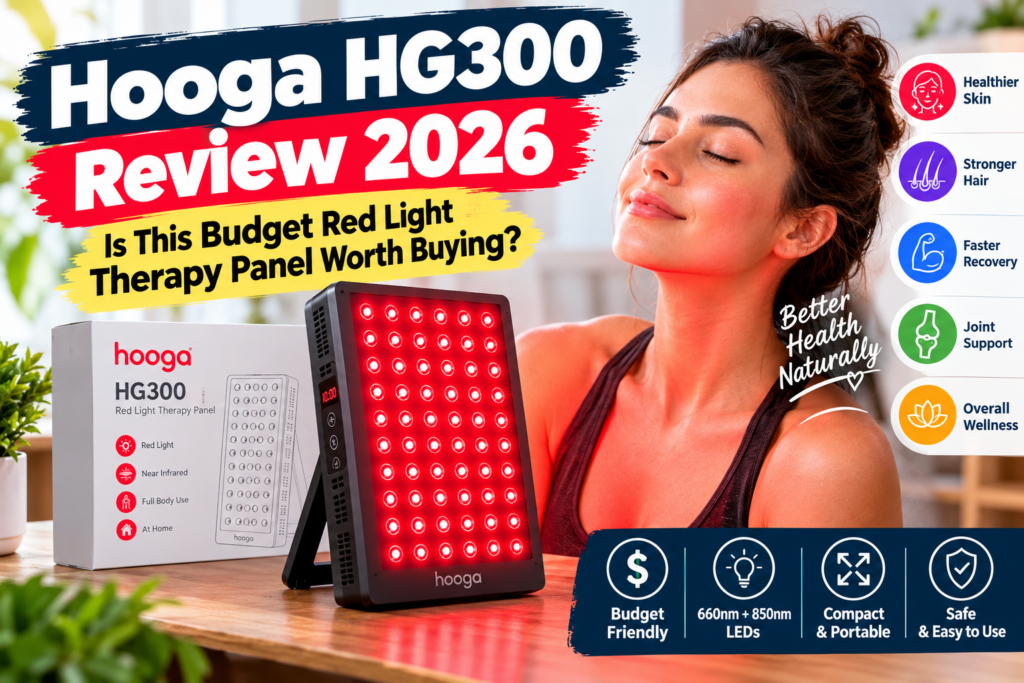
Read our Hooga HG300 review for 2026. Explore verified specs, 660nm and 850nm wavelengths, pros and cons, safety, and HG300 vs. PRO300.
LifeCareBalance.com is reader-supported. When you buy through links on our site, we may earn an affiliate commission at no extra cost to you. As an Amazon Associate, we earn from qualifying purchases.
The Hooga HG300 is a compact red light therapy panel designed for people who want to explore at-home photobiomodulation without spending several hundred dollars on a larger system. It combines 660nm red light and 850nm near-infrared light in a small tabletop device with a built-in timer, cooling fan, and fold-out stand.
But affordable does not automatically mean effective, and a panel with impressive specifications does not guarantee better health outcomes.
In this review, we examine the Hooga HG300’s published specifications, practical advantages, limitations, safety considerations, and differences from the more powerful Hooga PRO300. We also explain what research can—and cannot—tell us about red light therapy so you can make a more informed buying decision.
Quick answer: The Hooga HG300 is worth considering if you want a compact panel for targeted light exposure and prefer a straightforward, budget-conscious device. Its 660nm and 850nm wavelengths are commonly used in photobiomodulation research, but evidence for specific outcomes varies. Choose a larger panel if your priority is covering substantial body areas in fewer sessions.
Hooga HG300 at a Glance
| Feature | Published specification |
|---|---|
| Device type | Compact tabletop LED panel |
| Wavelengths | 660nm red and 850nm near-infrared |
| LED configuration | 60 single-chip LEDs |
| Manufacturer-listed irradiance | Approximately 73 mW/cm² at 6 inches |
| Dimensions | 12.2 × 8.2 × 2.5 inches |
| Weight | Approximately 6 pounds |
| Timer | Built-in session timer |
| Stand | Fold-out tabletop stand |
| Cooling | Internal fan |
| Warranty | 3 years, according to manufacturer |
| Return window | 60 days, subject to manufacturer terms |
| Listed price | Approximately $199; check the current listing |
These figures are based primarily on the manufacturer’s published product information, not a new independent laboratory test. Specifications, prices, included accessories, and return conditions should be confirmed before ordering.
What Is the Hooga HG300?
The Hooga HG300 is an entry-level red and near-infrared LED panel intended for home use. Unlike a flexible LED mask, it does not sit directly against the face. Instead, you position the panel in front of the area you want to illuminate and follow the device’s instructions for distance and session duration.
Its compact footprint makes it practical for a desk, countertop, or small home wellness space. You can reposition it to treat different areas, although doing so adds time if you want to cover more than one region.
The HG300 is part of Hooga’s HG product line. It is designed around simplicity rather than smart features, app-based coaching, or elaborate treatment presets.
The most important distinction is that the HG300 is a light-delivery device, not a guaranteed treatment for a medical condition. Its technical specifications describe how it produces light; they do not establish that it will treat arthritis, acne, chronic pain, insomnia, or any other condition in every user.
Key Features That Matter
1. Two commonly studied wavelengths
The HG300 combines 660nm red light with 850nm near-infrared light.
Red light in the 630–660nm range is commonly investigated for skin-related applications. Near-infrared wavelengths around 810–850nm are also studied in photobiomodulation research involving different tissues and clinical goals.
However, the wavelength alone does not determine effectiveness. Dose, irradiance, distance, treatment schedule, device design, and the condition being studied all matter.
2. A compact 60-LED panel
The panel uses 60 single-chip LEDs. Its small size makes targeted use more practical than whole-body treatment.
LED count should not be used as a stand-alone measure of performance. A panel with more LEDs is not automatically more effective than one with fewer LEDs. Light output, beam distribution, treatment distance, and the area illuminated are also important.
3. Built-in timer and tabletop stand
The integrated timer makes it easier to control session duration without relying on a separate phone or stopwatch. The fold-out stand provides a convenient way to position the unit on a stable surface.
There is no need to assume that a device with fewer digital features is less capable. For many buyers, simple controls are an advantage. The trade-off is less automated guidance and more responsibility for positioning the device correctly.
4. Internal cooling fan
The manufacturer includes a cooling fan to manage heat during operation. Fan noise may be noticeable in a quiet room, especially if you use the panel while reading, meditating, or preparing for bed.
If quiet operation is essential, check recent owner feedback and the return policy before purchasing.
5. Warranty and return terms
Hooga lists a three-year warranty and a 60-day return window for the HG300. Read the current terms carefully, including eligibility, return-shipping deductions, and any exclusions. A return window can reduce purchasing risk, but it is not a guarantee that the device will produce a particular result.
For the latest specifications and purchasing terms, consult the official Hooga HG300 product page.
What Does the Science Say About Red Light Therapy?
Red light therapy is also called photobiomodulation. It uses selected wavelengths of light to influence biological processes in cells and tissues.
Researchers have investigated photobiomodulation in dermatology, wound care, pain-related applications, and other areas. Results vary by indication, treatment parameters, and study quality. Evidence supporting one application should not automatically be applied to every other claim made about red light devices.
A 2018 systematic review of randomized controlled trials involving LEDs in dermatology found encouraging evidence for certain applications, while also highlighting limitations such as small study sizes, inconsistent protocols, and differences in study design.
A 2025 expert consensus paper also reviewed the clinical use of photobiomodulation and discussed conditions for which evidence supports particular applications. It does not mean every consumer panel has been clinically validated for all advertised uses.
For readers who want to examine the evidence directly, the following sources are useful:
- LEDs in Dermatology: A Systematic Review of Randomized Controlled Trials
- Evidence-Based Consensus on the Clinical Application of Photobiomodulation
The key takeaway is that promising research does not equal a universal guarantee. Clinical results from a specific device, dose, and treatment protocol cannot automatically be transferred to the HG300.
Potential Uses: What Buyers Should Realistically Expect
Skin appearance and fine lines
Red light photobiomodulation has been investigated for skin texture, wrinkles, and other cosmetic outcomes. Some studies report improvements, but results depend on the protocol and device used.
If you are considering the HG300 for cosmetic purposes, use realistic expectations. It is not a replacement for sunscreen, a dermatologist’s advice, or established treatments for skin conditions. A manufacturer’s wavelength specifications alone do not prove that this particular panel will reduce wrinkles.
People with melasma, a history of skin cancer, persistent rashes, or unexplained skin changes should seek appropriate medical advice before starting light-based treatment.
Acne and skin concerns
Red light has been studied for its potential effects on inflammation and certain skin conditions. However, acne treatment can involve different light wavelengths and treatment methods, and the results of one protocol should not be assumed to apply to another.
The HG300’s 660nm wavelength does not, by itself, establish that the panel will treat acne. It should not replace a proven acne-care routine or professional treatment for severe, painful, or scarring breakouts.
Muscle recovery and localized discomfort
Photobiomodulation has been studied in some pain and exercise-recovery settings. Findings vary by muscle group, treatment timing, dose, and study design.
The HG300 may appeal to people who want to experiment with targeted light exposure around a specific area. Nevertheless, it should not be described as a proven treatment for arthritis, tendon injuries, or chronic pain without evidence specific to the condition and device.
Persistent pain, swelling, numbness, or an injury that is not improving warrants medical assessment rather than relying on a home panel.
Sleep and energy
Some consumers report changes in sleep or energy when using red light devices. These personal experiences are not sufficient evidence that the HG300 improves melatonin production, resets circadian rhythms, or treats insomnia.
Do not buy the panel solely for a promised sleep benefit. Consistent sleep and wake times, appropriate light exposure during the day, and a comfortable sleep environment remain sensible starting points for sleep health.
Wound healing
Photobiomodulation has been investigated for wound healing in specific clinical settings. That does not establish the HG300 as a wound-care device or justify using it on an open wound without clinical advice.
Do not use a consumer wellness panel as a substitute for wound assessment, infection management, or instructions from a healthcare professional.
Irradiance: How to Interpret the HG300’s Numbers
Irradiance is the amount of optical power reaching a unit of area, usually expressed in milliwatts per square centimeter (mW/cm²). It is useful when comparing devices, but only when measurements are made under comparable conditions.
Hooga lists approximately 73 mW/cm² at six inches for the HG300. Treat this as a manufacturer-published figure rather than an independently confirmed measurement in this review.
When comparing output claims, check:
- The distance at which irradiance was measured.
- Whether the reading is a central peak or an average across the treatment area.
- Whether the measurement method and equipment are disclosed.
- Whether the value is from the manufacturer or an independent tester.
- How much area receives the stated output.
A higher irradiance reading does not automatically mean better results. Photobiomodulation is dose-dependent, and more light is not necessarily better for every application.
It is also important not to calculate a treatment recommendation from irradiance alone. The actual dose reaching tissue depends on the delivered light, exposure time, distance, and other factors. Follow the manufacturer’s instructions and any relevant clinical guidance rather than trying to maximize exposure.
Hooga HG300 Pros and Cons
Pros
- Accessible entry price: A lower initial cost than many larger panels.
- Compact footprint: Convenient for targeted use and smaller spaces.
- Two established research wavelengths: 660nm red and 850nm near-infrared.
- Simple setup: A tabletop stand and built-in timer reduce setup complexity.
- Manufacturer warranty: A published three-year warranty, subject to its terms.
- Useful for focused sessions: You can reposition the panel for different areas.
Cons
- Limited coverage: Treating several large areas requires repositioning.
- No guarantee of clinical benefit: Wavelengths and output specifications do not prove a specific health outcome.
- Manual positioning: You must manage distance, alignment, and session timing.
- Potential fan noise: The cooling system may be noticeable in quiet environments.
- Output claims need context: Manufacturer irradiance figures should not be confused with independently verified averages.
- Not a full-body solution: Buyers wanting extensive coverage may prefer a larger panel.
Hooga HG300 vs. Hooga PRO300

- RED & NEAR-INFRARED LIGHT FOR DAILY WELLNESS – The Hooga HG300 features 60 LEDs delivering 660nm red light and 850nm nea…
- COMPACT PANEL, TARGETED SESSIONS – Designed for convenient, targeted use on smaller areas of the body. The HG300 is idea…
- HIGH-OUTPUT PERFORMANCE IN A SMALL FOOTPRINT – Delivers over 73 mW/cm² irradiance at 6 inches, with high-quality 5W LEDs…

- DUAL-CHIP RED & NEAR-INFRARED LIGHT – Features 60 dual-chip LEDs, with each LED delivering both 660nm red light and 850n…
- HIGH-OUTPUT DUAL-CHIP LED PANEL: Features 900 dual-chip LEDs for consistent light output and true full-body coverage in …
- SUPPORTS DAILY WELLNESS: A convenient way to support relaxation, post-exercise recovery, and skin health as part of a da…
The PRO300 is the relevant upgrade to consider if you like Hooga’s compact-panel format but want higher published output.
| Comparison | HG300 | PRO300 |
|---|---|---|
| Intended role | Entry-level targeted panel | Higher-output compact panel |
| Wavelengths | 660nm + 850nm | 660nm + 850nm |
| LED configuration | Single-chip LEDs | Dual-chip LEDs |
| Manufacturer-listed irradiance at 6 inches | Approximately 73 mW/cm² | Approximately 109 mW/cm² |
| Form factor | Compact tabletop | Compact tabletop |
| Best reason to consider it | Lower initial cost | Higher published output |
These figures are manufacturer-published specifications and should not be interpreted as independently verified measurements under identical conditions.
Choose the HG300 if:
- You want a lower-cost entry into home red light therapy.
- Your intended use is limited to a relatively small area at a time.
- You value straightforward controls over additional features.
- You are comfortable following the device’s instructions and maintaining realistic expectations.
Consider the PRO300 if:
- You prefer higher manufacturer-listed irradiance in a similar compact format.
- You expect to use the device regularly and value shorter potential exposure times, provided the appropriate dose and protocol support that choice.
- You want to compare the cost of the upgrade against the time saved during your routine.
The PRO300 is not automatically more effective for every goal just because its published irradiance is higher. If your main need is broad body coverage, compare larger panels as well rather than assuming a compact upgrade solves that limitation.
How to Choose the Right Red Light Therapy Device
Before purchasing the HG300, answer four practical questions.
1. What area do you want to treat?
A small panel is easier to position for a localized area, but it may be inefficient for covering the back, legs, and torso in one session. Consider the treatment area before comparing wattage or price.
2. Are the technical claims transparent?
Look for specific wavelengths, irradiance with a stated measurement distance, clear instructions, warranty information, and accessible customer support. Be cautious when a listing relies on vague claims such as “clinical strength” without explaining the measurements behind them.
3. Does the device match your goal?
A panel, facial mask, and flexible wrap are not interchangeable. A mask may be more convenient for a facial skincare routine, while a panel offers more flexibility for directing light at different body areas.
Our Best Red Light Therapy Devices for Home Use in 2026 compares device options across different needs.
For a price-focused comparison, see Best Budget Red Light Therapy Panels for 2026.
4. Can you use it consistently and safely?
A theoretically impressive device is not useful if it does not fit your space or routine. Consider setup time, fan noise, distance requirements, eye-safety instructions, and the return policy before deciding.
Safety: What to Know Before Using the HG300
Red light therapy does not use ultraviolet light, but that does not mean every device or use pattern is risk-free. Light intensity, exposure, eye sensitivity, underlying conditions, and medications all matter.
Follow the HG300 manual and do not assume that longer sessions or closer positioning will produce better outcomes.
Take additional care if you:
- Have a condition that causes sensitivity to light.
- Take medication that may increase photosensitivity.
- Have an eye condition or concerns about exposure to bright LEDs.
- Have active skin cancer, a suspicious lesion, or a condition affecting the intended treatment area.
- Are pregnant or have an implanted electronic medical device and are unsure whether light therapy is appropriate.
Ask a qualified healthcare professional whether treatment is appropriate for your circumstances. Stop using the device if it causes discomfort, irritation, or unexpected symptoms.
The FDA’s information on non-invasive body-contouring technologies and low-level light therapy also explains that light-based procedures can carry risks, including eye injury and other complications. Its guidance should be applied to the specific procedure or device in question, rather than treated as blanket clearance for the HG300.
Do not assume the HG300 is FDA-cleared or FDA-approved for a particular medical indication. Verify any claimed regulatory status against the exact device and intended use.
Price, Warranty, and Value
Hooga lists the HG300 at around $199, although prices and availability can change. Confirm the current selling price before comparing it with competing panels.
The best way to evaluate value is to look beyond the initial price:
- How much of your intended treatment area can it cover?
- Will you need to reposition it repeatedly?
- Does the warranty cover the issues you are concerned about?
- What are the return-shipping costs and eligibility conditions?
- Are comparable devices supported by more transparent testing information?
The HG300’s main value proposition is a relatively accessible price, compact size, and simple operation. It is less attractive if your priority is whole-body coverage, advanced controls, or independently verified performance data.
Frequently Asked Questions
Is the Hooga HG300 worth buying in 2026?
It may be worth considering for buyers seeking a compact, lower-cost panel for targeted light exposure. Its value depends on your goal, expectations, budget, and comfort with the limitations of home devices. It is not a guaranteed treatment for any medical condition.
What wavelengths does the Hooga HG300 use?
The manufacturer lists 660nm red light and 850nm near-infrared light. Both wavelength ranges are used in photobiomodulation research, but their presence alone does not establish that the device will deliver a particular clinical result.
Is the HG300 powerful enough for full-body treatment?
It is a compact panel intended for targeted use. You can reposition it for different areas, but it does not illuminate the entire body evenly from one position. Buyers seeking broader coverage should compare larger panels.
Is the HG300 better than the PRO300?
The HG300 has a lower entry price, while the PRO300 has higher manufacturer-listed irradiance. Which is better depends on the intended treatment area, budget, session requirements, and the evidence for your particular goal.
Can I use the HG300 every day?
Follow the current device manual rather than assuming daily use is appropriate for everyone. Frequency and duration should depend on the instructions, intended use, and relevant health considerations. Consult a healthcare professional if you have a medical condition or take photosensitizing medication.
Does red light therapy improve collagen?
Research has investigated red light photobiomodulation for certain skin-related outcomes, including wrinkles and skin texture. Results vary by device and protocol. It is more accurate to describe collagen-related benefits as a potential outcome supported by some research than as a guaranteed result from the HG300.
Is the HG300 FDA-approved?
Do not assume so. Verify the regulatory status of the exact model and its intended use before relying on a seller’s claim. FDA clearance, approval, registration, and general compliance are not interchangeable terms.
Does the HG300 include eye protection?
Check the current product listing and the package contents before ordering, because included accessories may change. Follow the manufacturer’s eye-safety instructions, and do not look directly into bright LEDs.
Final Verdict: Should You Buy the Hooga HG300?
The Hooga HG300 makes the most sense for a buyer who wants a straightforward, compact panel without paying for a larger system. Its listed 660nm and 850nm wavelengths, built-in timer, tabletop stand, and published warranty make it a reasonable option to compare in the entry-level category.
Its limitations matter just as much: coverage is restricted, use requires correct positioning, and the manufacturer’s specifications do not prove that it will treat a particular health condition. The science behind photobiomodulation is promising in selected applications, but evidence varies and cannot be transferred automatically from clinical studies to every consumer device.
Our recommendation: Consider the HG300 if compact size and initial price are your priorities. Compare the PRO300 if you value higher published output, and look at larger panels if broad coverage is your main goal. Whichever you choose, prioritize transparent specifications, appropriate safety guidance, a clear return policy, and realistic expectations over exaggerated promises.