
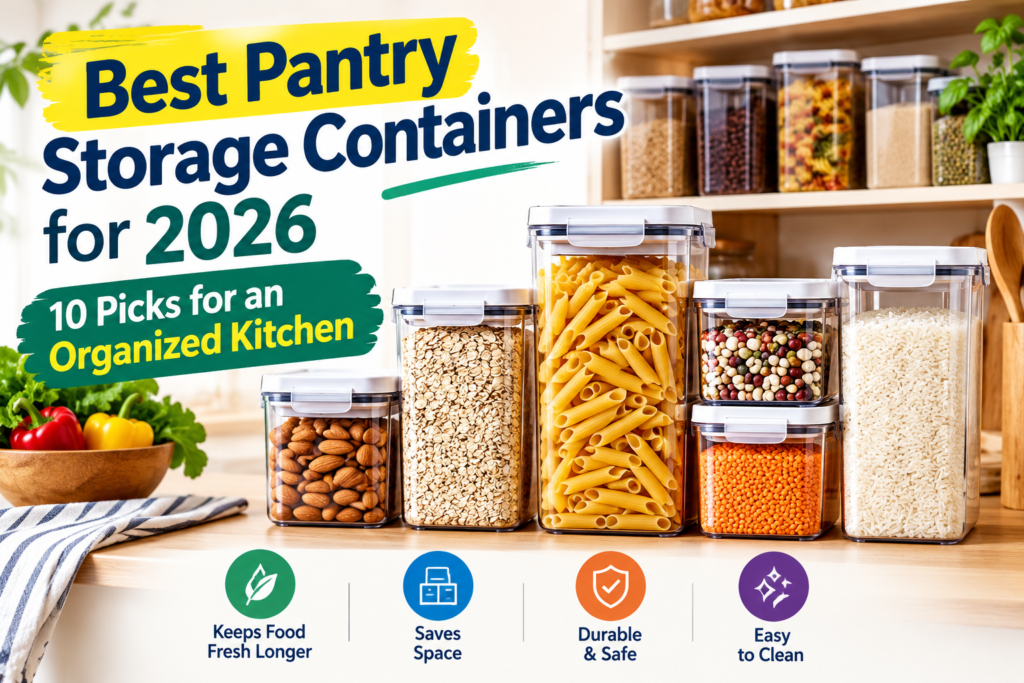
Compare the best pantry storage containers for 2026, including airtight, stackable, budget, and large-capacity options for flour, cereal, pasta, rice, and more.
LifeCareBalance.com is reader-supported. When you buy through links on our site, we may earn an affiliate commission at no extra cost to you. As an Amazon Associate, we earn from qualifying purchases.
A well-organized pantry can make everyday cooking easier, reduce clutter, and help you keep track of the foods you already have. But choosing the right pantry storage containers is not simply about buying the largest matching set.
The best pantry storage containers should fit your shelves, match the foods you regularly buy, provide secure lids, and remain easy to clean and use.
Quick answer: For most households, clear, stackable pantry containers with secure lids are a practical choice for dry foods such as cereal, flour, sugar, rice, oats, pasta, and snacks. Premium systems can offer better organization and easier access, while larger multi-piece sets can make sense when you are organizing an entire pantry.
If you are also improving your overall kitchen setup, our Designing a Kitchen That Supports Your Health Goals is a useful companion because it covers pantry organization, kitchen zones, and making everyday healthy choices more convenient.
Best Pantry Storage Containers at a Glance
| Category | Best Choice | Best For |
|---|---|---|
| Best Overall | OXO Good Grips POP | Everyday pantry organization |
| Best for Large Pantries | Vtopmart Multi-Piece Set | Organizing several food categories |
| Best for Larger Dry Goods | Chef’s Path | Flour, cereal, rice, and pasta |
| Best for Small Pantries | Rectangular Stackable Containers | Maximizing shelf space |
| Best for Visibility | Clear Containers | Easy inventory management |
The best option depends on your pantry size, shopping habits, food types, and budget.
What Makes a Good Pantry Storage Container?
A good pantry container should solve a real storage problem rather than simply make your shelves look attractive.
1. A Secure Lid
A secure lid helps keep dry food contained and can reduce exposure to environmental moisture.
However, an airtight container does not guarantee that food will stay fresh indefinitely.
Food storage depends on the type of food, its original condition, storage temperature, moisture, packaging, and other factors.
For official guidance on safe storage in cupboards and other areas of the home, see the FDA’s food-storage guidance.
2. The Right Capacity
Container capacity should match the food you normally buy.
Small containers are useful for:
- Nuts
- Seeds
- Small snacks
- Baking ingredients
Medium containers work well for:
- Oats
- Rice
- Pasta
- Beans
Large containers are better for:
- Cereal
- Flour
- Sugar
- Larger dry-food purchases
Buying containers that are too small creates constant refilling.
Buying containers that are too large wastes shelf space.
3. Stackability
Stackable containers can make better use of vertical pantry space.
Square and rectangular containers are often easier to arrange than round containers because they leave fewer unused gaps.
However, do not stack containers so high that they become difficult or unsafe to remove.
4. Clear Construction
Clear containers make it easier to see what you already have.
This is especially useful for:
- Cereal
- Rice
- Flour
- Sugar
- Pasta
- Oats
- Beans
- Snacks
Visibility can also make grocery shopping easier because you can quickly see what needs replacing.
5. Easy Cleaning
A pantry container should fit your normal cleaning routine.
Look for containers that are easy to open, wash, dry, and refill.
If a lid has multiple removable parts, make sure you are comfortable cleaning all of them regularly.
Best Overall: OXO Good Grips POP Containers

- OXO Good Grips 5-Piece POP Container Set is airtight, stackable, space-efficient and now dishwasher safe, making it easy…
- Set includes: one 2.3 Qt / 2.1 L container, one 1.7 Qt / 1.6 L container, two 1.1 Qt / 1 L container and one 0.4 Qt / 0….
- Push the button to engage the airtight seal. The button doubles as a handle for the lid
OXO Good Grips POP Airtight Food Storage Containers are a strong premium option for shoppers who want a consistent pantry organization system.
The POP design uses a push-button lid mechanism intended to make opening and sealing convenient.
The biggest advantage is consistency. Instead of mixing many different container shapes and lids, you can build a more uniform pantry system.
Best For
OXO POP-style containers are particularly useful for:
- Flour
- Sugar
- Cereal
- Oats
- Pasta
- Rice
- Dried beans
- Snacks
Why Consider Them?
- Consistent modular design
- Clear construction
- Convenient lid mechanism
- Multiple sizes available
- Suitable for common pantry staples
- Easy to organize across shelves
Potential Downside
Premium pantry systems can cost more than generic multi-piece sets.
If you are organizing a very large pantry on a limited budget, a larger value-oriented set may provide more containers for your money.
Best for a Large Pantry: Vtopmart Multi-Piece Set

- Help Organize Your Kitchen and Pantry: Imagine every time walking to your kitchen or pantry, found everything is neatly …
- 4 Size Combinations Fit Your Needs: Our kitchen storage container set comes in 4 different sizes. Includes 6 Tall Contai…
- Airtight Containers Keep Food Fresh: The side-locking lids with silicone gasket make these storage containers airtight, …
A large multi-size set can make sense when you are starting a pantry organization project from scratch.
Vtopmart Airtight Food Storage Containers with Lids, 24-Piece Set is a practical option for shoppers who want multiple containers for different pantry categories.
Multiple container sizes allow you to organize foods according to their actual volume instead of forcing everything into one or two container sizes.
Best For
A larger set can be useful for:
- Cereal
- Pasta
- Rice
- Flour
- Sugar
- Oats
- Beans
- Snacks
Advantages
- Multiple sizes
- Consistent appearance
- Stackable rectangular shapes
- Clear construction
- Useful for a complete pantry reset
- Labels can improve identification
Potential Downside
More containers are not automatically better.
If you have a small pantry, purchasing a very large set may leave you with containers that do not fit your shelves or that you rarely use.
Measure your shelves before buying.
Best for Larger Dry Goods: Chef’s Path

- [Top Kitchen Organization] – Our canister sets for kitchen counter will transform your kitchen glamorously. These air ti…
- [Superior Built ] – These flip lock kitchen canisters are 100% airtight and leak proof. These BPA Free clear food storag…
- [Best Value] – Includes 1 large (8.0 cups /1.9L), 2 medium (5.1 cups /1.2L), 2 small (3.4 cups /0.8L) and 2 mini contain…
Chef’s Path Airtight Food Storage Containers, 7-Piece Set offers larger airtight food-storage options that can work well for shoppers who want to organize larger dry-food packages.
Large containers are particularly useful for ingredients that take up considerable space in their original packaging.
Good Uses
- Flour
- Sugar
- Cereal
- Rice
- Oats
- Pasta
- Other dry staples
What to Check Before Buying
Measure the vertical clearance of your pantry shelves.
A container that technically fits on the shelf but cannot be removed comfortably is not a practical storage solution.
Pantry Storage Container Comparison
| Feature | OXO POP | Vtopmart Multi-Piece | Chef’s Path |
|---|---|---|---|
| Best for | Premium organization | Full pantry setup | Larger dry goods |
| Multiple sizes | Yes | Yes | Yes |
| Stackable | Yes | Yes | Yes |
| Clear design | Yes | Yes | Yes |
| Best for small pantry | Good | Depends on space | Good |
| Best for large pantry | Good | Excellent | Good |
| Budget position | Premium | Value-focused | Mid-range |
Plastic vs. Glass Pantry Containers
One of the most common decisions is choosing between plastic and glass.
Neither material is automatically best for every pantry.
Plastic Containers
Plastic containers are popular because they are lightweight and available in many shapes and sizes.
Advantages
- Lightweight
- Easy to move
- Many capacity options
- Convenient for high shelves
- Practical for larger pantry systems
Potential Downsides
Some plastic products can develop scratches or retain odors depending on their material and use.
Always follow the manufacturer’s food-contact and cleaning instructions.
Glass Containers
Glass provides a heavier alternative.
Advantages
- Clear visibility
- Attractive appearance
- Useful for open shelving
- Does not have the same odor-absorption concerns as some plastics
Potential Downsides
- Heavier
- Can break if dropped
- Large glass containers become very heavy when filled with dense foods
For high shelves, lightweight containers may be easier to handle.
How to Choose Containers for Different Pantry Foods
Different foods benefit from different container sizes and shapes.
Flour
Choose a container large enough for the amount of flour you normally purchase.
A wide opening is also useful if you regularly scoop flour while baking.
Keep the container clean and completely dry before adding a new supply.
Sugar
Sugar can be transferred into a suitable sealed container for easier pantry organization.
A container with a practical opening can make scooping easier when baking.
Cereal
Large clear containers can make cereal easier to see and access.
Check the container’s height against your shelf before purchasing.
Pasta
Long pasta shapes such as spaghetti require enough internal height.
Short pasta such as penne or macaroni can work well in shorter rectangular containers.
Rice and Grains
Rice, oats, quinoa, and dried beans can work well in pantry containers.
If you buy these foods in bulk, prioritize capacity.
Snacks
Smaller containers are useful for:
- Nuts
- Crackers
- Dried fruit
- Pretzels
- Granola
- Other dry snacks
Do Airtight Containers Keep Food Fresh Longer?
A secure container can help protect dry foods from environmental exposure, but it is important not to make exaggerated freshness claims.
An airtight container does not guarantee a particular shelf life.
The FDA explains that consumers should follow storage directions on food labels and use appropriate storage practices.
For more detailed official information, see the FDA guide to storing food safely.
For dry goods specifically, USDA also provides household guidance covering safe handling and storage of dry foods and other food categories. USDA’s food-storage guidance for households.
The important takeaway is simple:
A container is part of a food-storage system—not a guarantee of indefinite freshness.
Pantry Organization Before You Buy Containers
The biggest mistake is buying containers first.
Start with your pantry.
Step 1: Remove Expired and Unwanted Food
Take everything out of the shelf or cabinet you are organizing.
Separate:
- Expired products
- Empty packages
- Duplicate foods
- Foods your household no longer uses
- Items that belong somewhere else
This prevents you from buying containers for food you do not actually need.
Step 2: Measure Your Shelves
Measure:
- Width
- Depth
- Height
- Door clearance
- Shelf spacing
Write these measurements down before shopping.
Step 3: Group Similar Foods
Create simple zones.
Breakfast
- Cereal
- Oats
- Granola
Baking
- Flour
- Sugar
- Baking ingredients
Grains
- Rice
- Quinoa
- Beans
- Lentils
Pasta
- Spaghetti
- Penne
- Macaroni
Snacks
- Crackers
- Nuts
- Dried fruit
If you want to take this one step further, our kitchen organization and healthy-kitchen guide explains how to create functional storage zones and make frequently used foods easier to access.
How to Organize a Small Pantry
Small kitchens require more careful container selection.
Use Vertical Space
Tall containers can make better use of shelf height.
But make sure you can still remove them comfortably.
Choose Consistent Footprints
Containers with similar widths and depths can make narrow shelves easier to organize.
Avoid Oversized Sets
You do not need 20 containers if your pantry only needs six.
A smaller, well-planned system is often easier to maintain.
Keep Heavy Containers Low
Large containers filled with rice, flour, or other dense foods can become heavy.
Place heavier items where they can be safely accessed.
Should You Transfer Food From Original Packaging?
Not always.
Some foods can remain in their original packaging without any problem.
Transfer foods when it gives you a practical benefit such as:
- Better visibility
- Easier organization
- More efficient shelf use
- Easier measuring
- Easier inventory management
Do not assume that every pantry product must be transferred into a matching container.
The goal is a functional pantry, not simply a photo-ready shelf.
Pantry Storage and Food Safety
Good organization should support safe food handling.
FDA’s official Food Safety in Your Kitchen resource covers safe shopping, storage, and meal-preparation practices for households. FDA Food Safety in Your Kitchen.
For dry pantry foods, USDA recommends reviewing the manufacturer’s label and using appropriate storage practices to maintain quality and safe handling. USDA’s best practices for storing food at home.
Keep shelf-stable food in a suitable cool, dry location and avoid storing food near household chemicals.
A beautiful container system is not useful if the food itself is stored incorrectly.
Should You Label Pantry Containers?
Labels can be useful, but they are not mandatory.
They are especially helpful when several foods look similar.
For example:
- Flour
- Powdered sugar
- Baking soda
- Cornstarch
- Rice flour
A simple label can include:
Food name
Optionally, you can also record:
Date opened
or
Purchase date
Avoid relying entirely on memory when multiple similar ingredients are stored together.
Use Older Food First
When practical, use older food before newer purchases.
Instead of continually pouring a new package on top of an old supply, consider:
- Finish the older supply.
- Clean and dry the container.
- Add the new supply.
This approach makes inventory easier and helps you see what you actually have.
It can also reduce the chance that an older ingredient gets forgotten behind newer purchases.
FDA’s food-waste guidance recommends checking what you already have and using appropriate storage practices to reduce unnecessary waste. FDA guidance on reducing food waste and maintaining food safety.
Pantry Containers vs. Fresh Produce Storage
Pantry containers are primarily intended for dry, shelf-stable foods.
Fresh fruits and vegetables have different storage requirements, so they should not automatically be moved into the same type of container used for flour or cereal.
If you are organizing fresh produce as well, see our dedicated Reusable Produce Storage Bags guide.
That article focuses specifically on produce-storage options and explains why different fruits and vegetables may require different storage approaches.
This distinction is important because the best storage solution depends on the food—not simply on the container.
Pantry Organization and Meal Planning
A well-organized pantry can make meal preparation more convenient because ingredients are easier to see and retrieve.
But pantry containers should not be presented as a weight-loss treatment or a guarantee of healthier eating.
They are simply an organizational tool.
If you are also working on practical meal structure and portion awareness, our Best Portion Control Plates for Weight Loss guide covers visual meal organization and portion-control tools.
The two topics should remain separate:
Pantry containers: organize ingredients.
Portion-control tools: organize meals and serving structure.
That distinction also helps avoid overlapping the search intent of different LifeCareBalance articles.
Pantry Organization and a Healthier Lifestyle
Your kitchen is one part of a broader daily routine.
An organized pantry can make ingredients easier to access, but it is only one component of a healthy lifestyle.
For readers who want to connect kitchen organization with broader wellness habits, our Holistic Wellness Guide covers nutrition, movement, sleep, stress management, and other lifestyle habits.
The goal is not to claim that storage containers directly improve health.
The goal is to create an environment that makes everyday routines simpler and easier to maintain.
Common Pantry Storage Mistakes
1. Buying Containers Before Measuring
Always measure first.
2. Buying a Huge Set Because It Looks Like a Bargain
More pieces do not necessarily mean better organization.
3. Choosing Appearance Over Function
The most attractive container is not always the easiest to use.
4. Ignoring Cleaning Requirements
A complicated lid can become a maintenance problem.
5. Mixing Old and New Food Without Thinking
Use older supplies first when practical.
6. Overfilling Containers
Leave enough room for comfortable handling and closing.
7. Storing Food in Damp Conditions
Dry pantry foods should be kept in appropriate dry storage conditions.
8. Treating Every Food the Same
Rice, flour, cereal, fresh produce, and refrigerated foods have different storage needs.
How Many Pantry Containers Do You Actually Need?
There is no universal number.
Start with your highest-use foods.
A small pantry might need:
- 2 large containers
- 3–5 medium containers
- Several smaller containers
A larger household may benefit from a larger multi-size system.
For example, if you regularly buy cereal, oats, rice, flour, sugar, and pasta, start with those categories.
Once those are organized, determine whether additional containers actually solve another storage problem.
Best Pantry Setup for Different Households
Best for a Small Apartment
Choose:
- 5–8 containers
- Rectangular shapes
- Medium capacities
- A few taller containers
- Minimal duplication
Focus on foods you use every week.
Best for a Family Pantry
A larger multi-size set may be more practical.
Use separate zones for:
- Breakfast
- Baking
- Grains
- Pasta
- Snacks
- Cooking staples
Best for Bulk Shoppers
Prioritize:
- Large capacities
- Secure lids
- Easy scooping
- Durable construction
- Containers that fit your shelves
Best for a Minimalist Kitchen
Do not transfer everything.
Choose only the foods where containers genuinely improve organization.
Pantry Container Buying Checklist
Before purchasing a new container, ask:
- Does it fit my shelf?
- Is it large enough for the food?
- Is it too large for the shelf?
- Is the lid easy to use?
- Can I clean it easily?
- Can I see the contents?
- Can I stack it safely?
- Do I actually need another container?
- Does the food need this type of storage?
- Will I realistically use it every week?
If the answer to most of these questions is yes, it is more likely to be a useful purchase.
Final Verdict
The best pantry storage container is not necessarily the biggest, cheapest, or most attractive one.
For premium everyday organization, OXO Good Grips POP Airtight Food Storage Containers are a strong choice.
For shoppers organizing an entire pantry at once, Vtopmart Airtight Food Storage Containers with Lids, 24-Piece Set can provide more sizes and flexibility.
For larger dry goods, Chef’s Path Airtight Food Storage Containers, 7-Piece Set is another practical option to consider.
The most important step is to organize around your real shopping habits.
Measure your shelves first.
Identify the foods you actually buy.
Choose container sizes around those foods.
Keep frequently used ingredients accessible.
Use labels when they genuinely improve organization.
And remember that containers are an organizational tool—not a substitute for proper food-storage practices.
A successful pantry does not have to look perfect.
It needs to be easy to see, easy to use, easy to clean, and easy to maintain.
Frequently Asked Questions
What are the best pantry storage containers?
The best pantry containers are clear, appropriately sized, easy to clean, and equipped with secure lids. OXO POP is a strong premium option, while larger multi-piece sets can be useful for complete pantry organization.
Are airtight containers better for pantry storage?
They can be useful for many dry foods because they provide a secure enclosure, but they do not guarantee a specific shelf life. Always follow the food’s storage instructions.
What is the best container for flour?
Choose a container large enough for the amount of flour you normally purchase, with a wide enough opening for easy scooping.
What is the best container for cereal?
A tall, clear container with enough capacity for your normal cereal package can make cereal easier to see and access.
Should I use glass or plastic pantry containers?
Both can work. Glass is heavier and attractive, while plastic is generally easier to handle, particularly for large containers or high shelves.
Are pantry containers worth it?
They can be worth buying when they solve a genuine organization problem. They are less useful when you purchase large sets that do not fit your shelves or shopping habits.
How many pantry containers do I need?
There is no fixed number. Start with the foods you use most frequently and expand only when another container solves a specific storage problem.
Should all pantry containers match?
No. Matching containers can create a consistent appearance, but function matters more than appearance.
Do pantry containers keep food fresh longer?
A suitable container can help protect dry foods from environmental exposure, but it cannot guarantee a particular shelf life. Food type and storage conditions still matter.
Should I label every container?
Not necessarily. Labels are most useful for similar-looking foods, frequently used ingredients, and large pantry systems.
Can I store fresh vegetables in pantry containers?
Fresh vegetables have different storage requirements from dry pantry foods. Use storage methods appropriate for the specific produce.
Should I transfer food out of the original package?
Only when doing so provides a practical benefit such as better organization, visibility, or easier measuring.
Final Takeaway
The best pantry organization system is the one that fits your actual kitchen, actual shelves, and actual shopping habits.
Start with the foods you use most often.
Measure before buying.
Choose practical container sizes.
Keep heavy items in safe, accessible locations.
Use clear containers when visibility helps.
And use food-safety guidance from trusted sources rather than relying on exaggerated product claims.
For broader kitchen organization, healthy routines, fresh-produce storage, and meal-structure ideas, the related LifeCareBalance guides linked throughout this article can take you to the next relevant topic without repeating the same information on this page.