
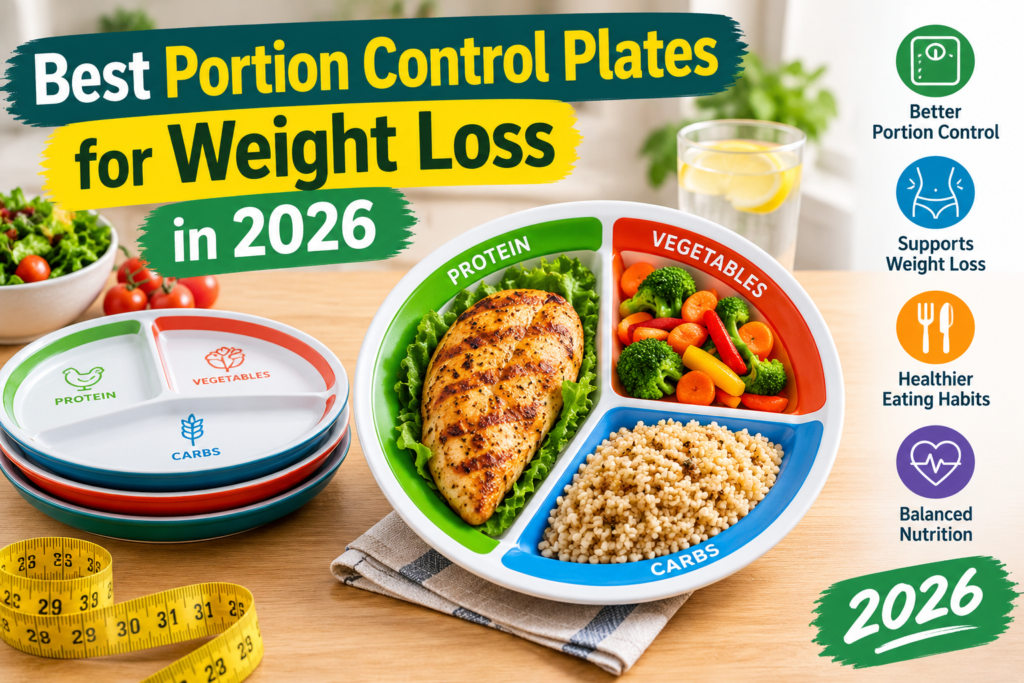
Discover the best portion control plates for weight loss in 2026. Compare plate designs, materials, portion guidance, meal prep options, and buying tips.
LifeCareBalance.com is reader-supported. When you buy through links on our site, we may earn an affiliate commission at no extra cost to you. As an Amazon Associate, we earn from qualifying purchases.
Portion control can be one of the simplest ways to make everyday meals more structured without weighing every ingredient or tracking every calorie.
A portion control plate gives you a visual framework for deciding how much space different foods should occupy on your plate. Instead of asking whether a meal “looks healthy,” you can build it around vegetables, protein, carbohydrates, and other foods in proportions that fit your eating goals.
But not every portion control plate is equally useful.
Some are simple divided plates. Others use printed food-group labels or measurement guides. Some are made from porcelain for everyday dining, while others are lightweight and better suited to meal prep or travel. The right choice depends on how you eat, what you want the plate to accomplish, and how often you expect to use it.
This guide explains how portion control plates work, what the research actually says, which features matter when shopping, and which types are worth considering in 2026.
Quick answer: The best portion control plate is not necessarily the smallest or most heavily divided model. Look for a plate that gives you clear visual guidance, uses a practical size, fits your normal meals, and is easy enough to use consistently.
What Is a Portion Control Plate?
A portion control plate is dinnerware designed to make food portions easier to visualize.
Instead of placing everything randomly on a large dinner plate, a portion-control design may provide separate sections or printed guides for foods such as vegetables, protein, grains, carbohydrates, or fruit.
The idea is simple: visual structure can reduce some of the guesswork involved in serving a meal.
However, a portion control plate does not automatically determine exactly how many calories a person needs.
Your appropriate food intake can vary according to factors such as age, body size, activity level, and individual goals. A serving size listed on a food label is also not necessarily the same thing as the portion that is appropriate for every person.
That distinction matters when using these plates.
Portion vs. Serving Size: What Is the Difference?
One of the most overlooked topics in portion-control content is the difference between a portion and a serving.
A portion is the amount of food you choose to eat at one time.
A serving is a standardized amount used on a nutrition label or dietary guidance.
For example, if a packaged food lists one serving as one cup and you eat two cups, your portion was two servings.
That is why a portion-control plate should be viewed as a visual tool rather than a perfect calorie calculator.
If you are working toward a specific calorie, carbohydrate, protein, or medical nutrition target, you may still need nutrition labels, a food scale, or guidance from a qualified professional.
How Portion Control Plates Can Support Weight Management
Portion control plates can make healthy eating more practical because they move some decisions from abstract numbers to a visual system.
Instead of repeatedly measuring every ingredient, you can build meals using the sections or guides on the plate.
Research on portion-control plates is promising, but the evidence needs to be interpreted carefully.
A systematic review and meta-analysis found that portion-control plate interventions were associated with reductions in body weight and BMI. Another scoping review found that these plates can improve portion selection and may support weight loss, but many of the studies used portion-control plates as part of broader nutrition or lifestyle interventions.
That means the plate should be considered a supporting tool, not a standalone weight-loss treatment.
A better strategy is to combine it with:
- A nutrient-dense eating pattern
- Appropriate portions
- Regular physical activity
- Adequate sleep
- Reasonable hydration
- Consistent eating habits
- A realistic long-term approach
The Simple Plate Method
For many everyday meals, a useful starting point is:
Half the plate: vegetables and other produce
Build the largest part of the meal around vegetables and, depending on the meal, fruit.
Examples include:
- Broccoli
- Green beans
- Spinach
- Salad greens
- Carrots
- Peppers
- Tomatoes
- Cauliflower
- Other non-starchy vegetables
The exact amount you need will vary, but using a larger section for vegetables can make a meal more filling without relying entirely on calorie-dense foods.
One quarter: protein
Use the protein section for foods such as:
- Chicken
- Fish
- Eggs
- Tofu
- Beans
- Lentils
- Lean meat
- Other protein-rich foods
USDA guidance recognizes a wide range of protein foods, including seafood, meat, poultry, eggs, beans, peas, lentils, nuts, seeds, and soy products.
One quarter: grains or other carbohydrate foods
Depending on your eating pattern, this section may include:
- Brown rice
- Whole-grain pasta
- Oatmeal
- Quinoa
- Whole-grain bread
- Potatoes
- Other carbohydrate-rich foods
The plate method is a visual starting point, not a prescription that every meal must follow exactly the same proportions.
Do Portion Control Plates Actually Work?
The honest answer is: they can help, but they are not magic.
Research has found positive effects from some portion-control plate interventions, including improvements in weight-related outcomes and portion selection.
However, studies also show limitations.
Many interventions combine portion-control plates with nutrition education, counseling, or other lifestyle changes. Therefore, it is difficult to claim that the plate itself causes all of the observed results.
Another systematic review found that portion-control tools produced a modest overall effect on weight loss, with calibrated tableware appearing more useful than simply using smaller plates.
The practical takeaway is straightforward:
A portion-control plate can make better portion decisions easier, but your overall eating pattern still matters more than the dinnerware itself.
Best Portion Control Plates to Consider in 2026
If you are shopping for a portion-control plate, these are three product types worth considering based on different use cases.
1. Uba Portion Control Plate (PORCELAIN) for Adults for Healthy Diet (White, 1)

- GUIDED BALANCED MEALS: Portion control divided plate to guide portion size of each food group, making it easier to stay …
- RECOMMENDED BY: Dietitians, Nutritionists, and Diabetes Educators internationally. Control portions and serve right amou…
- FINEST QUALITY: Dishwasher safe, Freezer safe, and Microwave safe; Plate can withstand heat up to 572 degrees F.
Best for: Adults who want a more traditional dinnerware feel
This porcelain option is a good fit for someone who wants portion guidance without using a brightly colored plastic-style plate.
Its divided design provides visual structure for everyday meals, while the porcelain construction gives it a more conventional dinnerware appearance.
It is especially appealing for adults who want a portion-control plate that can stay on the table as part of a normal dining setup.
Why consider it:
- Adult-oriented design
- Porcelain construction
- Divided meal structure
- Suitable for everyday meals
- Dishwasher and microwave use are listed by the manufacturer/seller
Best for: Everyday home meals and users who prefer porcelain.
2. Health Beet 10” Diabetic Portion Control Plate for Balanced Eating

- 𝐇𝐞𝐚𝐥𝐭𝐡 𝐁𝐞𝐞𝐭 𝐅𝐥𝐚𝐭 𝐃𝐢𝐞𝐭 𝐏𝐥𝐚𝐭𝐞𝐬: Our Diet Plates or bariatric plates for portion control are designed to eat your favorite …
- 𝐒𝐭𝐫𝐞𝐚𝐦𝐥𝐢𝐧𝐞𝐝 𝐍𝐮𝐭𝐫𝐢𝐭𝐢𝐨𝐧 𝐁𝐚𝐬𝐞𝐝 𝐏𝐥𝐚𝐭𝐞𝐬: The portion plates divide your meal visually, emphasizing the four key nutrient grou…
- 𝐇𝐞𝐚𝐥𝐭𝐡𝐲 𝐄𝐚𝐭𝐢𝐧𝐠 𝐰𝐢𝐭𝐡 𝐔𝐒𝐃𝐀 𝐂𝐡𝐨𝐨𝐬𝐞 𝐌𝐲𝐏𝐥𝐚𝐭𝐞 𝐆𝐮𝐢𝐝𝐞𝐥𝐢𝐧𝐞𝐬: Aligned with USDA guidelines, these weight loss portion control plat…
Best for: Clear visual food-group guidance
Health Beet’s portion-control designs focus heavily on visual meal structure.
The 10-inch format gives users a straightforward way to separate food groups and make portion decisions without needing to weigh every ingredient.
Although products in this category are sometimes marketed toward diabetes-friendly eating, they should not be treated as medical devices or as a substitute for individualized diabetes nutrition advice.
Why consider it:
- Clear food-group sections
- Practical size for everyday meals
- Strong visual guidance
- Useful for people learning portion awareness
- Suitable for balanced-meal planning
Best for: Beginners who want clear visual guidance.
3. BNYD Portion Control Lunch Container with Lid – Travel Food Storage
Best for: Meal prep and eating away from home
A portion-control system becomes much more useful when you can continue using it outside your kitchen.
A divided container with a lid can help with packed lunches, meal preparation, office meals, and travel.
Instead of preparing a balanced meal at home and then losing your portion structure when you leave the house, a portable divided container can extend the same approach to your workday.
Why consider it:
- Portable design
- Divided food compartments
- Useful for packed lunches
- Helpful for meal prep
- Includes a lid for transport
Best for: Work lunches, meal prep, and people who frequently eat away from home.
How to Choose the Best Portion Control Plate
The best plate depends on more than the number of compartments.
1. Choose the Right Size
A huge dinner plate can make reasonable portions look surprisingly small.
You do not necessarily need the smallest plate available, but the plate should provide enough room for a balanced meal without encouraging unnecessary overfilling.
Around the 9–10-inch range is common among many portion-control designs, although dimensions vary by product.
2. Look at the Section Design
Some plates have three main sections.
Others divide food into four categories.
Some include printed labels while others rely on simple physical dividers.
Choose the system you are most likely to understand and use consistently.
3. Consider the Material
Common materials include:
- Porcelain
- Ceramic
- Plastic
- Melamine
- Stainless steel
- Bamboo-based materials
For everyday home dining, porcelain or ceramic may feel more like traditional dinnerware.
For children, travel, outdoor meals, or meal prep, lightweight materials may be more practical.
Always follow the manufacturer’s instructions for microwave, dishwasher, oven, and food-contact use.
4. Check Microwave and Dishwasher Compatibility
If you expect to use the plate every day, convenience matters.
A plate that requires complicated cleaning or cannot be used with your normal meal-preparation routine may eventually end up unused.
5. Think About Your Actual Meals
A plate designed around Western-style meals may not be ideal for everyone.
Think about what you actually eat.
Rice bowls, pasta dishes, curries, stir-fries, tacos, sandwiches, salads, and mixed dishes do not always fit neatly into traditional three-section designs.
A flexible plate may therefore be more useful than a highly restrictive design.
6. Decide Whether You Need Portability
If most meals happen at home, a traditional dinner plate may be enough.
If you regularly take lunch to work, travel, or prepare meals in advance, a divided container with a secure lid may be more practical.
Portion Control Plates vs. Regular Dinner Plates
Regular dinner plate
Pros:
- Familiar
- Flexible
- Works with almost every meal
- More attractive for traditional dining
Cons:
- Provides little visual portion guidance
- Large surfaces can make portions look smaller
- Requires more judgment when serving
Portion control plate
Pros:
- Provides visual guidance
- Makes food-group balance easier to see
- Can simplify meal planning
- Useful for beginners
- Can reinforce consistent meal structure
Cons:
- Fixed sections may not fit every meal
- Some designs look more clinical or specialized
- The visual proportions may not match everyone’s nutrition needs
- Cannot replace individualized dietary guidance
Are Smaller Plates Better for Weight Loss?
This is where marketing often becomes too simplistic.
A smaller plate can influence how much food appears appropriate, but plate size alone does not determine calorie intake or weight change.
What matters is the entire meal.
A smaller plate filled with highly calorie-dense foods can still contain substantial calories.
Likewise, a larger plate containing a balanced meal can be appropriate depending on the person’s needs.
The more useful goal is not simply:
“Use a small plate.”
Instead, think:
“Create a balanced meal with portions that fit my needs.”
Common Mistakes When Using Portion Control Plates
Overfilling every section
A divided plate does not prevent overeating if every section is piled above its intended capacity.
Treating the plate as a calorie calculator
The same volume of different foods can contain very different amounts of energy.
A portion of vegetables and a portion of a calorie-dense sauce are not nutritionally equivalent.
Ignoring beverages
Sugary drinks, specialty coffees, alcohol, and other calorie-containing beverages can contribute significantly to overall intake.
Avoiding carbohydrates completely
A portion-control plate is designed to create balance, not necessarily eliminate an entire food group.
Whole grains, fruits, beans, and other carbohydrate-containing foods can be part of a healthy eating pattern.
Assuming “healthy” foods can be unlimited
Foods such as nuts, avocado, oils, dried fruit, and certain calorie-dense foods can still contribute substantial calories.
Portion awareness applies to healthy foods too.
Expecting instant weight loss
A plate is a tool.
It does not replace consistent nutrition, physical activity, sleep, or an overall weight-management strategy.
How to Use a Portion Control Plate for Meal Prep
Meal prep is one of the best ways to make portion awareness practical.
Start by preparing a protein source, several vegetables, and one or two carbohydrate options.
Then divide meals according to your chosen plate framework.
For example:
Meal 1
- Grilled chicken
- Roasted broccoli
- Brown rice
- Fresh fruit
Meal 2
- Salmon
- Mixed vegetables
- Quinoa
- Berries
Meal 3
- Tofu or beans
- Stir-fried vegetables
- Brown rice
- Fresh fruit
The goal is not to make every meal identical.
The goal is to create a repeatable structure that makes healthy choices easier when you are busy.
For more practical kitchen strategies, see our guide on Design a Kitchen That Supports Your Health Goals.
Who May Benefit From a Portion Control Plate?
Portion-control dinnerware may be useful for:
- Adults learning portion awareness
- People trying to create more structured meals
- Beginners who dislike calorie counting
- Busy professionals
- People preparing meals in advance
- Families teaching children about balanced meals
- People who want a visual reminder at mealtimes
However, people with diabetes, eating disorders, gastrointestinal conditions, kidney disease, or other medical nutrition needs should not assume that a generic plate design is automatically appropriate for their individual needs.
A healthcare professional or registered dietitian can provide personalized guidance when necessary.
How to Make Portion Control Easier Without Buying a Special Plate
You do not have to purchase specialized dinnerware to practice portion awareness.
You can use an ordinary plate and create your own visual system.
Start by filling roughly half the plate with vegetables and other produce, then add protein and carbohydrate foods in appropriate amounts.
You can also use measuring cups temporarily to learn what common serving sizes actually look like.
After you become familiar with portions, you may find that you no longer need to measure every meal.
For additional healthy-lifestyle strategies, see our Holistic Wellness Guide.
The Role of the Kitchen Environment
Your environment influences your daily decisions.
A kitchen filled with convenient, nutrient-dense foods makes healthy choices easier.
A cluttered kitchen with oversized serving dishes, constant snack visibility, and little meal-planning structure can make consistency harder.
Portion-control dinnerware works best as part of a larger environment that supports healthy habits.
For ideas on organizing your kitchen around healthier routines, see our Kitchen Pantry Storage Containers for Organization guide.
Can a Portion Control Plate Replace Calorie Tracking?
For some people, visual portion guidance may be simpler and more sustainable than tracking every calorie.
For others, calorie or nutrient tracking may be useful temporarily or for a specific goal.
Neither approach is automatically better for everyone.
The important question is:
Which system can you use consistently without making healthy eating unnecessarily complicated?
If a portion-control plate helps you build balanced meals without creating stress, it may be a useful tool.
If you need precise nutritional targets, a plate alone may not provide enough information.
Final Verdict
The best portion control plates for weight loss are not necessarily the ones with the most compartments or the strongest marketing claims.
The most useful option is the one that gives you clear visual guidance, fits your normal meals, is convenient to clean and use, and encourages consistency.
For traditional home dining, a porcelain option such as the Uba Portion Control Plate (PORCELAIN) for Adults for Healthy Diet (White, 1) is worth considering.
For straightforward visual meal guidance, the Health Beet 10” Diabetic Portion Control Plate for Balanced Eating is another strong option.
For meal prep and portable lunches, the BNYD Portion Control Lunch Container with Lid – Travel Food Storage offers a different but practical approach.
Most importantly, remember that a portion-control plate is a tool—not a treatment and not a guarantee of weight loss.
Use it alongside balanced nutrition, regular movement, adequate sleep, and sustainable habits.
The goal is not to eat as little as possible.
The goal is to make reasonable portions and balanced meals easier to repeat.
Frequently Asked Questions
Are portion control plates good for weight loss?
They can be useful as a visual portion-management tool. Research suggests that portion-control interventions may support weight-related outcomes, but plates work best as part of a broader healthy eating and lifestyle strategy.
What is the best size for a portion control plate?
Many portion-control plates are around 9–10 inches, but there is no single size that is ideal for everyone. Choose a size that provides enough space for a balanced meal without encouraging excessive portions.
Do portion control plates really work?
Evidence suggests they can improve portion selection and may contribute to weight management, but they should not be considered a standalone weight-loss solution.
Should half the plate be vegetables?
A common healthy-plate framework uses about half the plate for vegetables and other produce, with the remaining space divided between protein and carbohydrate-rich foods. Individual nutrition needs can vary.
Can I use a portion control plate if I have diabetes?
A portion-control plate can provide a useful visual structure, but people with diabetes should not assume that every plate design is appropriate for their individual carbohydrate or medication needs. Personalized advice from a healthcare professional may be appropriate.
Are porcelain or plastic portion control plates better?
It depends on how you use them. Porcelain can feel more like traditional dinnerware, while lightweight materials may be better for travel, children, meal prep, or outdoor use.
Do I need a special plate to control portions?
No. A regular plate can work if you use a consistent visual system for building balanced meals. A specialized plate simply makes the visual guidance easier.
Can portion control plates replace calorie counting?
For some people, they can reduce the need for constant measuring and tracking. However, they cannot provide the same precision as calorie or nutrient tracking when a specific nutritional target is required.
What should I look for when buying a portion control plate?
Focus on plate size, section layout, material, durability, microwave and dishwasher compatibility, portability, and whether the design actually fits the foods you normally eat.
Disclaimer
This article is for educational purposes only and is not medical or nutritional advice. Portion needs vary from person to person. If you have a medical condition, take medications that affect nutrition or blood sugar, or have been advised to follow a specific diet, consult a qualified healthcare professional or registered dietitian for individualized guidance.