
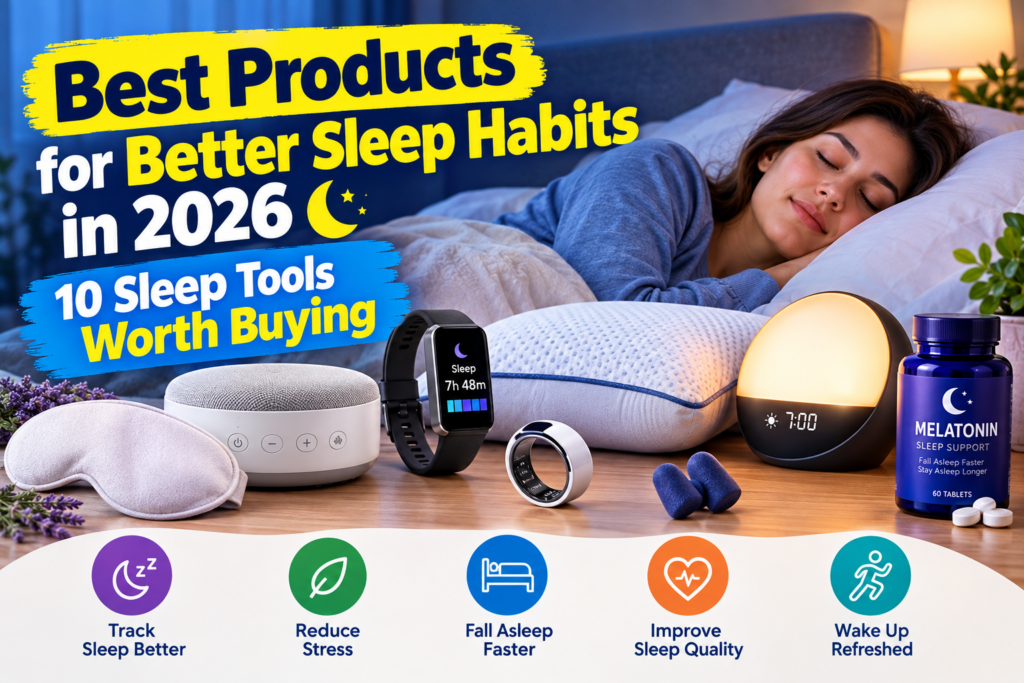
Discover the best products for better sleep habits in 2026, including sleep masks, sound machines, adjustable pillows, bedtime tools, and smart sleep technology.
LifeCareBalance.com is reader-supported. When you buy through links on our site, we may earn an affiliate commission at no extra cost to you. As an Amazon Associate, we earn from qualifying purchases.
Getting better sleep does not necessarily require a bedroom full of expensive technology.
For many people, the most useful sleep products are simple tools that solve one specific problem: too much light, unwanted noise, an uncomfortable pillow, an inconsistent bedtime routine, or an uncomfortable sleep environment.
The best products for better sleep habits should make healthy routines easier to maintain—not promise to fix insomnia or guarantee perfect sleep.
For most adults, sleep starts with the basics: giving yourself enough time to sleep, keeping a reasonably consistent schedule, and creating a bedroom that is comfortable, dark, quiet, and cool. The American Academy of Sleep Medicine recommends that healthy adults regularly get at least seven hours of sleep per night. American Academy of Sleep Medicine — Adult Sleep Duration
Once those foundations are in place, the right sleep product can make your routine more convenient and easier to repeat.
If you are building a broader wellness routine rather than only changing your bedroom, our Personalized Wellness Guide for 2026 explains how sleep fits alongside movement, nutrition, stress management, and other daily habits.
Quick Answer: What Are the Best Products for Better Sleep Habits?
The best sleep product depends on the problem you are trying to solve.
| Sleep Problem | Product to Consider | Best Reason to Buy |
|---|---|---|
| Inconsistent bedtime | Hatch Restore 3 | Creates a structured bedtime and wake-up routine |
| Environmental noise | YOGASLEEP Dohm Uno | Provides simple continuous background noise |
| Too much light | MZOO Luxury Sleep Eye Mask | Helps block unwanted light |
| Uncomfortable pillow | Coop Home Goods Original Adjustable Pillow | Lets you adjust pillow loft |
| Noise from a partner or surroundings | Mack’s Pillow Soft Silicone Earplugs | Simple passive noise reduction |
| Want sleep data | Sleep tracker | Helps identify personal sleep patterns |
| Hot bedroom | Cooling bedding or temperature-control product | Improves physical comfort |
| Frequent travel | Sleep mask and earplugs | Portable sleep-environment tools |
You do not need every product on this list.
A better approach is to identify the biggest problem affecting your sleep environment and start with the simplest product that addresses it.
Best Products for Better Sleep Habits in 2026
1. Hatch Restore 3 — Best for Building a Consistent Bedtime Routine

- 𝗖𝗿𝗲𝗮𝘁𝗲 𝗵𝗲𝗮𝗹𝘁𝗵𝘆 𝘀𝗹𝗲𝗲𝗽 𝗵𝗮𝗯𝗶𝘁𝘀: 𝖱𝖾𝗌𝗍𝗈𝗋𝖾 𝟥 𝗂𝗌 𝖽𝖾𝗌𝗂𝗀𝗇𝖾𝖽 𝗍𝗈 𝗁𝖾𝗅𝗉 𝗒𝗈𝗎 𝖻𝗎𝗂𝗅𝖽 𝖺 𝖻𝖾𝖽𝗍𝗂𝗆𝖾 𝗋𝗈𝗎𝗍𝗂𝗇𝖾 𝗍𝗁𝖺𝗍 𝗊𝗎𝗂𝖾𝗍𝗌 𝗒𝗈𝗎𝗋 𝗆𝗂𝗇𝖽 𝗌𝗈 𝗒𝗈𝗎 𝖼𝖺𝗇 …
- 𝗛𝗮𝘁𝗰𝗵+ 𝗦𝘂𝗯𝘀𝗰𝗿𝗶𝗽𝘁𝗶𝗼𝗻: 𝖯𝗎𝗋𝖼𝗁𝖺𝗌𝖾 𝗂𝗇𝖼𝗅𝗎𝖽𝖾𝗌 𝟥𝟢-𝖽𝖺𝗒 𝖿𝗋𝖾𝖾 𝗍𝗋𝗂𝖺𝗅 𝗈𝖿 𝖧𝖺𝗍𝖼𝗁+ 𝗉𝗋𝖾𝗆𝗂𝗎𝗆 𝖼𝗈𝗇𝗍𝖾𝗇𝗍 𝖺𝗇𝖽 𝖿𝖾𝖺𝗍𝗎𝗋𝖾𝗌, 𝖿𝗈𝗋 𝗇𝖾𝗐 𝗌𝗎𝖻𝗌𝖼𝗋𝗂𝖻𝖾𝗋𝗌 𝗈𝗇𝗅…
- 𝗨𝗻𝘄𝗶𝗻𝗱 𝗻𝗶𝗴𝗵𝘁𝗹𝘆: 𝖱𝖾𝗌𝗍𝗈𝗋𝖾 𝗁𝖾𝗅𝗉𝗌 𝗒𝗈𝗎 𝖼𝗋𝖾𝖺𝗍𝖾 𝖺 𝖻𝖾𝖽𝗍𝗂𝗆𝖾 𝗋𝗈𝗎𝗍𝗂𝗇𝖾 𝗌𝗈 𝗒𝗈𝗎 𝖼𝖺𝗇 𝖿𝖺𝗅𝗅 𝖺𝗌𝗅𝖾𝖾𝗉 𝖾𝖺𝗌𝗂𝖾𝗋 𝖺𝗇𝖽 𝖿𝖺𝗌𝗍𝖾𝗋. 𝖯𝗋𝖾𝗉𝖺𝗋𝖾 𝗒𝗈𝗎𝗋 𝗆𝗂𝗇𝖽 𝖿…
Hatch Restore 3 is a strong choice for people who want more structure around their evening and morning routine.
Instead of using a smartphone for everything, a dedicated bedside device can combine functions such as a sunrise-style alarm, sleep sounds, lighting, and bedtime routines.
Best For
Hatch Restore 3 makes the most sense for people who:
- Have inconsistent bedtime routines
- Want a dedicated bedside alarm
- Prefer a screen-free wind-down environment
- Like customizable bedtime routines
- Want both evening and morning features in one device
Why It Stands Out
The biggest advantage is convenience.
A phone can be useful for alarms and sleep sounds, but it also brings notifications, social media, email, and other distractions into the bedroom.
A dedicated device can separate the bedtime routine from those distractions.
Sleep Foundation also includes Hatch Restore 3 among its 2026 sleep-product recommendations, particularly in the wake-up-light category.
Who Should Skip It?
You may not need a premium sleep routine device if:
- You already have a consistent bedtime
- A basic alarm works perfectly for you
- You do not want app-connected products
- You prefer a minimalist bedroom
The product should support your routine, not create another complicated routine you have to manage.
2. YOGASLEEP Dohm Uno — Best for Simple Background Noise

- WHITE NOISE, SIMPLIFIED: Dohm Uno features our Yogasleep sound: natural, comforting, fan-based noise, without the annoya…
- CUSTOMIZED EXPERIENCE: Dohm Uno offers a simple one-speed setting while allowing you to effortlessly tailor the tone to …
- CRAFTED WITH LOVE: For over 60 years, Yogasleep has consistently set the gold standard in crafting sleep-enhancing produ…
If unwanted environmental noise is your biggest problem, a sound machine may be more useful than a high-tech sleep tracker.
The YOGASLEEP Dohm Uno takes a deliberately simple approach. Instead of depending on a large digital sound library, it creates continuous fan-based background noise.
Best For
It can be useful for people dealing with:
- Traffic noise
- Household sounds
- Occasional neighborhood noise
- A partner moving around
- Other intermittent environmental sounds
Why Simplicity Matters
You do not always need dozens of sounds, app controls, sleep scores, or complicated settings.
Sometimes the goal is simply to create a consistent background sound that makes sudden environmental noises less noticeable.
A sound machine should not be presented as a treatment for insomnia.
Its role is much simpler: it can become part of a comfortable and predictable sleep environment.
Who Should Skip It?
If your bedroom is already quiet, a sound machine may provide little additional value.
You should also consider whether you need to hear important sounds such as alarms or a child during the night before choosing a product that creates continuous background noise.
3. MZOO Luxury Sleep Eye Mask — Best for Blocking Bedroom Light

- Low – Rebound Memory Foam, Soft and Comfortable.
- Zero Eye Pressure: The Deepest 13mm arc-shaped widened eye cups provide makeup-safe space and allow natural blinking
- Great for Side Sleepers: Upgraded 15°-curved thin sides ensure smooth transitions with no uncomfortable bulge, minimizin…
Light is one of the easiest sleep-environment problems to address without spending a lot of money.
The MZOO Luxury Sleep Eye Mask is designed for people who want a portable way to block unwanted light.
Best For
A sleep mask can be especially useful for:
- Daytime sleepers
- Frequent travelers
- Shift workers
- People with bright bedroom windows
- People who share a room with someone who stays up later
- Hotel guests
What to Look For
When choosing a sleep mask, prioritize:
- Adjustable fit
- Comfortable materials
- Effective light blocking
- Minimal pressure around the eyes
- A secure fit that does not constantly move
A mask does not need to be expensive to be useful.
If unwanted light is your only major problem, a simple sleep mask may make more sense than investing in a complete smart-sleep system.
Who Should Skip It?
If you find anything around your eyes uncomfortable or you already sleep in a completely dark room, a sleep mask may not add much value.
4. Coop Home Goods Original Adjustable Pillow — Best for Customizable Pillow Height

- Fully Adjustable to Your Comfort: Coop’s Original Pillow is fully adjustable. Simply add or remove memory foam fill to a…
- Premium Materials for Ultimate Comfort: The Coop Original Pillow is the best pillow for sleeping, featuring our signatur…
- Fresh, New Foam Every Time: We use only freshly manufactured memory foam, never repurposed or recycled, ensuring the hig…
Your pillow is one of the most personal parts of your sleep setup.
There is no single pillow height that works for every sleeper.
Side sleepers, back sleepers, and stomach sleepers can have different preferences, and even people who sleep in the same position may prefer different levels of firmness and loft.
The Coop Home Goods Original Adjustable Pillow is designed around adjustability, allowing the fill to be added or removed to change the pillow’s loft.
Best For
It is worth considering if:
- You are unsure what pillow height you prefer
- Your current pillow feels too high
- Your current pillow feels too low
- You change sleeping positions
- You want more control over pillow firmness
Why Adjustability Matters
A fixed-height pillow gives you one configuration.
An adjustable pillow gives you the opportunity to experiment.
That does not mean it will automatically be comfortable for everyone.
The value is flexibility.
If your pillow is already comfortable and you consistently sleep well, there may be little reason to replace it.
Who Should Skip It?
Skip an adjustable pillow if:
- You already have a pillow you love
- You dislike memory-foam feel
- You want an extremely simple pillow with no adjustment
- You do not want to spend time experimenting with loft
5. Mack’s Pillow Soft Silicone Earplugs — Best for Reducing Surrounding Noise

- THE ORIGINAL AND #1 SELLING – USA’s original and #1 selling moldable silicone ear plugs. Provides safe, non-toxic, non-a…
- THE ULTIMATE IN EARPLUG COMFORT – Mack’s soft moldable silicone putty molds very comfortably to the unique contours of a…
- #1 BRAND FOR SNORING – Mack’s is the #1 Doctor Recommended Brand to get a good night’s sleep when sleeping with a snorin…
When noise is the main problem, you may not need a sound machine at all.
Mack’s Pillow Soft Silicone Earplugs offer a simple passive approach to reducing surrounding noise.
They are particularly useful for:
- Travel
- Snoring from a partner
- Hotel rooms
- Neighborhood noise
- Shared bedrooms
- Other situations where environmental noise is difficult to control
Why Consider Earplugs?
They are small, portable, and do not require electricity or an app.
That makes them particularly practical for travel.
However, earplugs are not appropriate for everyone. Follow the manufacturer’s instructions and stop using them if they cause pain, irritation, or other problems.
If you need to remain aware of alarms or important sounds during sleep, a sound machine or environmental noise solution may be a better fit.
Sleep Products vs. Sleep Habits: What Matters More?
Products are tools.
They are not substitutes for healthy sleep habits.
The National Heart, Lung, and Blood Institute recommends maintaining a consistent sleep schedule, using the hour before bed for quiet activities, limiting bright artificial light, and keeping the bedroom quiet, cool, and dark. NHLBI Healthy Sleep Habits
That leads to a simple priority system:
Habit first → environment second → technology third.
For example, buying a $200 sleep gadget while going to bed at completely different times every night may not address the main problem.
A more practical approach is:
- Give yourself enough time to sleep.
- Establish a reasonably consistent schedule.
- Improve the bedroom environment.
- Identify the biggest remaining problem.
- Buy one product that directly addresses that problem.
- Evaluate whether it actually fits your routine.
This approach also reduces unnecessary spending.
Build a Better Sleep Environment
Your bedroom should support sleep rather than compete with it.
Keep It Dark
Use:
- Blackout curtains
- A sleep mask
- Dim lighting before bed
- Reduced screen brightness
If light is your primary problem, start there before purchasing advanced sleep technology.
Keep It Quiet
Depending on your environment, consider:
- Earplugs
- A sound machine
- Closing windows
- Reducing household noise
- Moving noisy electronics away from the bed
The goal is not necessarily complete silence.
The goal is a sleep environment that does not repeatedly disrupt you.
Keep It Comfortable
Comfort includes:
- Pillow height
- Mattress feel
- Bedding
- Room temperature
- Airflow
- Clothing
- Bedroom layout
A sophisticated sleep tracker cannot compensate for a pillow or mattress that you find uncomfortable.
Keep Technology Under Control
Technology can be useful, but it can also become part of the problem.
A dedicated alarm can help keep your phone away from the bed.
The NHLBI recommends using the period before bed for quiet time and reducing exposure to bright artificial light.
Do You Need a Sleep Tracker?
Not necessarily.
Sleep trackers can be useful for people who want to observe patterns in:
- Sleep duration
- Bedtime consistency
- Heart rate
- HRV
- Estimated sleep stages
- Recovery metrics
But consumer sleep trackers estimate sleep rather than directly measuring brain activity in the way a clinical sleep study does.
If you want to compare smart rings, watches, bands, and contactless devices, our Sleep Tracker Buying Guide 2026 covers accuracy, comfort, battery life, metrics, subscriptions, privacy, and form factor.
This distinction is important for SEO and for reader trust:
This article is about products that support better sleep habits.
The dedicated sleep-tracker guide is where detailed tracker buying decisions belong.
That separation keeps the two pages useful without forcing them to compete for exactly the same search intent.
How Sleep Tracking Can Fit Into a Better Routine
A sleep tracker is most useful when the information changes a decision.
For example, you might notice:
- Your bedtime has become less consistent
- Your total sleep time has gradually declined
- Your sleep schedule changes significantly on weekends
- Your recovery metrics are different after unusually late nights
The goal should not be to chase a perfect score every morning.
Your own longer-term pattern is usually more useful than one unusual night.
For readers interested in the connection between sleep tracking and physical recovery, see our Sleep Tracking and Recovery in 2026 guide.
That article focuses specifically on sleep duration, consistency, HRV, resting heart rate, recovery trends, and how to interpret sleep data without treating it as a medical measurement.
How to Choose the Right Sleep Product
Before buying anything, answer these questions.
What Is My Biggest Sleep Problem?
Be specific.
Is it:
- Light?
- Noise?
- Temperature?
- Pillow comfort?
- Bedtime inconsistency?
- Phone use?
- Travel?
- A desire to understand sleep patterns?
Your answer should determine the product category.
Can a Simple Product Solve It?
If light is the problem, start with a sleep mask.
If noise is the problem, try earplugs or a sound machine.
If pillow comfort is the problem, consider an adjustable pillow.
If bedtime consistency is the problem, a dedicated routine device may be worth considering.
You do not need to start with the most expensive technology.
Will I Use It Consistently?
A product only has practical value if it fits your routine.
Before buying, ask:
Will I realistically use this every night or every time I need it?
If the answer is no, a cheaper and simpler option may be better.
Are There Ongoing Costs?
Check for:
- Subscriptions
- Replacement parts
- Batteries
- App fees
- Consumables
- Accessories
The purchase price is not always the total cost of ownership.
What About Advanced Sleep Technology?
Advanced sleep technology can be useful for people who specifically want connected data or environmental control.
But it should not automatically be considered better than a basic sleep product.
For example:
A sleep mask may solve a light problem.
Earplugs may solve a noise problem.
An adjustable pillow may solve a comfort problem.
A sleep tracker may provide useful trend data.
A sophisticated connected sleep system may offer more features—but those features matter only if you actually need and use them.
The best product is not necessarily the product with the longest feature list.
What About Weighted Blankets?
Weighted blankets remain popular, but they should not be presented as guaranteed treatments for anxiety, insomnia, or other medical conditions.
Some people find the pressure comfortable and relaxing.
Others may find a weighted blanket too warm, restrictive, or uncomfortable.
If you are considering one, think about:
- Your comfort
- Bedroom temperature
- Blanket weight
- Ease of movement
- Manufacturer safety guidance
- Whether you actually enjoy using it
A product that makes you uncomfortable is unlikely to improve your bedtime routine.
What About Herbal Sleep Teas and Essential Oils?
Herbal teas and aromatherapy can be optional parts of a relaxing bedtime routine, but they should not be marketed as guaranteed sleep treatments.
A caffeine-free drink can become a simple cue that the day is winding down.
A pleasant scent may also make the bedroom feel more relaxing for some people.
However, “natural” does not automatically mean risk-free or medically effective.
If you take medications, are pregnant or breastfeeding, have allergies, or have a medical condition, discuss regular use of herbs or concentrated essential oils with an appropriate healthcare professional.
For this reason, these products are better treated as optional relaxation accessories rather than core sleep solutions.
How to Create a Simple 30-Minute Bedtime Routine
You do not need a complicated 15-step protocol.
Try a simple sequence.
30 Minutes Before Bed
Put your phone away or switch it to a mode that reduces interruptions.
25 Minutes Before Bed
Dim the lights and reduce unnecessary stimulation.
20 Minutes Before Bed
Complete basic hygiene and prepare the bedroom.
15 Minutes Before Bed
Start your sound machine or bedtime routine device if you use one.
10 Minutes Before Bed
Read, stretch gently, or choose another quiet activity.
At Bedtime
Keep the bedroom dark, comfortable, and quiet.
The purpose is not to create a perfect ritual.
The purpose is to create a routine that you can realistically repeat.
Best Sleep Setup by Budget
| Budget | Product Type | Best Use |
|---|---|---|
| Under $25 | Sleep mask or basic earplugs | Light or noise |
| $25–$75 | Sound machine or adjustable pillow | Noise or comfort |
| $75–$200 | Premium bedtime device | Routine and wake-up structure |
| $200+ | Advanced sleep technology | Connected data or environmental control |
Do not move to a more expensive category unless the simpler solution fails to address your actual problem.
Best Products by Sleep Type
Light Sleeper
Prioritize:
- Sleep mask
- Dark curtains
- Quiet bedroom
- Reduced evening light
Side Sleeper
Focus on:
- Pillow height
- Pillow adjustability
- Comfortable bedding
- Pressure points
Hot Sleeper
Prioritize:
- Bedroom temperature
- Airflow
- Breathable bedding
- Personal comfort
Shift Worker
Light-blocking and noise-reduction products can be particularly useful when sleeping during daylight hours.
Frequent Traveler
Choose compact products such as:
- Sleep mask
- Earplugs
- Small travel-friendly sleep accessories
Tech-Focused Sleeper
A sleep tracker or connected sleep product may be worthwhile if you actually want the information and will use it.
Minimalist Sleeper
You may need very little technology.
Focus on:
- A comfortable pillow
- Appropriate bedding
- Darkness
- Quiet
- A consistent sleep schedule
Sleep Products and Overall Wellness
Sleep should not be treated as an isolated part of health.
It interacts with physical activity, nutrition, stress management, daily routines, and recovery.
Our Holistic Wellness Guide looks at sleep alongside movement, nutrition, stress management, and broader lifestyle habits.
For a wider overview of products that support different areas of daily wellness, our Best Wellness Products 2026 guide covers sleep accessories alongside fitness, recovery, self-care, and other wellness categories.
The important principle is simple:
A healthier routine should not require a shopping cart full of products.
Choose tools that solve real problems.
When Sleep Products Are Not Enough
Sleep products are designed to support comfort, routine, or the sleep environment.
They should not replace professional evaluation when persistent sleep problems may indicate a medical issue.
If you regularly experience symptoms such as:
- Loud snoring
- Gasping during sleep
- Persistent insomnia
- Repeated nighttime awakenings
- Significant daytime sleepiness
consider discussing those symptoms with a healthcare professional.
The CDC also recommends speaking with a healthcare provider when ongoing sleep problems are affecting you. CDC — About Sleep
A consumer sleep product should not be used as a substitute for diagnosis or treatment.
Common Sleep-Product Buying Mistakes
1. Buying Too Many Products at Once
Start with one problem.
2. Choosing Technology Before Fixing Basic Habits
A sleep gadget cannot replace adequate sleep time and a reasonably consistent schedule.
3. Buying Based Only on Marketing Claims
Look at the actual function, limitations, ongoing costs, and return policy.
4. Ignoring Comfort
A product that is uncomfortable is unlikely to become part of a sustainable routine.
5. Forgetting Subscription Costs
Some connected products require recurring fees for premium features.
6. Treating Sleep Trackers as Medical Devices
Consumer trackers provide estimates and trends. They should not automatically be treated as clinical diagnostic tools.
The FDA distinguishes general-wellness technologies from products making medical claims. FDA — Digital Health Technologies
7. Buying the Most Expensive Option
More features do not automatically mean more value.
Best Products for Better Sleep: Quick Decision Guide
If you are unsure what to buy, use this simple decision process.
Problem: Light
Start with: MZOO Luxury Sleep Eye Mask
Problem: Noise
Start with: YOGASLEEP Dohm Uno or Mack’s Pillow Soft Silicone Earplugs
Problem: Uncomfortable Pillow
Start with: Coop Home Goods Original Adjustable Pillow
Problem: Inconsistent Bedtime
Start with: Hatch Restore 3
Problem: Want Sleep Data
Start with: A sleep tracker—but first decide what information you actually want.
If you are choosing a tracker, use our dedicated Sleep Tracker Buying Guide 2026 rather than choosing a device simply because it has the most sensors.
Frequently Asked Questions
What is the best product for better sleep habits?
There is no single best product for everyone. Start with the biggest problem affecting your sleep environment. A sleep mask can address unwanted light, a sound machine can help with distracting environmental noise, an adjustable pillow can improve comfort, and a dedicated bedtime device can help structure a routine.
Do sleep products actually improve sleep?
Some products can make the sleep environment more comfortable or help support consistent routines. Their usefulness depends on the problem they are solving. They should not be presented as guaranteed treatments for insomnia or other sleep disorders.
What should I buy first for better sleep?
Start with the simplest product that addresses your biggest problem. If light is the issue, try a sleep mask. If noise is the issue, try earplugs or a sound machine. If your pillow is uncomfortable, consider an adjustable pillow.
Is a sleep tracker necessary?
No. Many people can improve their sleep without a tracker. A tracker may be useful if you want to observe patterns over time, but the information should be treated as estimates and trends rather than medical measurements.
Are white-noise machines good for sleep?
A sound machine may help some people mask distracting environmental sounds. Choose one based on your bedroom environment and your preference for mechanical or digital sounds.
Should I use a sleep mask every night?
If it is comfortable and does not cause irritation or pressure, a sleep mask can be part of a regular bedtime routine. Choose a breathable, adjustable design that blocks light without creating discomfort.
Is an expensive sleep gadget better?
Not necessarily. A more expensive product may offer more features, but those features are only valuable if you will actually use them. A simple sleep mask, earplugs, pillow, or sound machine may be the better purchase.
How many hours of sleep should adults get?
The American Academy of Sleep Medicine recommends that healthy adults regularly get at least seven hours of sleep. Individual needs can vary, so the goal should be adequate, regular sleep rather than chasing one exact number.
Can sleep products treat insomnia?
Sleep products should not be presented as treatments for insomnia. They can support comfort and bedtime routines, but persistent insomnia or other sleep symptoms may require professional evaluation.
Should I buy a sleep tracker or a sleep accessory?
If your problem is light, noise, or comfort, start with the relevant environmental product. If you want to understand sleep patterns and trends, a tracker may be more appropriate.
What is the best sleep product for travel?
A sleep mask and earplugs are among the simplest portable options because they are small and do not require a complete bedroom setup.
Final Verdict
The best products for better sleep habits are not necessarily the most expensive or technologically advanced.
Start with the basics:
- Give yourself enough time to sleep.
- Maintain a reasonably consistent schedule.
- Keep the bedroom dark.
- Keep it quiet.
- Keep it comfortable.
- Reduce unnecessary stimulation before bed.
Then choose a product based on the specific problem you are trying to solve.
For a structured bedtime and wake-up routine, Hatch Restore 3 is the most comprehensive choice in this guide.
For simple background noise, YOGASLEEP Dohm Uno is a straightforward option.
If light is the problem, MZOO Luxury Sleep Eye Mask may be all you need.
For customizable pillow height, Coop Home Goods Original Adjustable Pillow is worth considering.
When environmental noise is the main issue, Mack’s Pillow Soft Silicone Earplugs provide a simple, portable option.
You do not need all five.
The best sleep setup is the one that solves your actual problem, fits your budget, and is simple enough to become part of your routine.
Better sleep is usually built through consistency—not through collecting more gadgets.