
LifeCareBalance.com is reader-supported. When you buy through links on our site, we may earn an affiliate commission at no extra cost to you. As an Amazon Associate, we earn from qualifying purchases.
Walking pads offer a convenient way to add more movement at home without making room for a full-size treadmill. Some are designed for walking beneath a standing desk, while others offer folding decks, automatic incline, higher weight capacities, or enough speed for occasional light jogging.
The challenge is choosing a model that fits your body, workspace, budget, and daily routine. A compact treadmill may be easy to store but have a shorter walking belt. An incline model may offer more workout flexibility but weigh more. A dedicated under-desk treadmill may provide a larger walking surface but be difficult to move between rooms.
This guide compares eight walking pads using their published specifications and intended uses. LifeCareBalance has not independently laboratory-tested every model, so the recommendations below are based on available product information and practical buying criteria—not a claim of hands-on testing.
Prices, specifications, warranties, and availability can change. Confirm the exact model and current U.S. listing before purchasing.
Quick Answer: Which Walking Pad Should You Choose?
The right walking pad depends on what you need most:
- Best all-around option for home walking: UREVO SpaceWalk 3S
- Best for folding and storage: WalkingPad Z1
- Best for incline and a higher published weight capacity: MERACH NovaWalk W50
- Best for a work-from-home setup: UREVO CyberPad, after confirming the exact version
- Best for very small spaces: Egofit Walker Pro-M1
- Best for walking and occasional running: Goplus 2-in-1 Folding Treadmill
- Best for a dedicated desk-walking setup: LifeSpan TR1200-DT3
- Best foldable alternative with a higher published capacity than the Z1: WalkingPad A1 Pro
These are use-case recommendations based on published features, not verified head-to-head performance rankings.
Quick Comparison: Best Walking Pads of 2026
| Walking pad | Best for | Published speed range | Walking area | Maximum user weight | Incline |
|---|---|---|---|---|---|
| UREVO SpaceWalk 3S | Everyday home walking | 0.6–4 mph | 42.5 × 16.54 in | 265 lb | Automatic; verify current model |
| WalkingPad Z1 | Folding and storage | 1–4 mph | 47.6 × 15.7 in | 242 lb | No |
| MERACH NovaWalk W50 | Incline and higher capacity | 0.6–4 mph | 41.3 × 16.5 in | 400 lb | 1–12% |
| UREVO CyberPad | Home-office walking | 0.6–4 mph | Varies by version | Varies by version | Varies by version |
| Egofit Walker Pro-M1 | Very small spaces | 0.62–3.11 mph | 34.25 × 16.54 in | 220 lb | Fixed 5% |
| Goplus 2-in-1 Folding Treadmill | Walking and light running | Up to 7.5 mph in running mode | 39.3 × 16 in | 265 lb | No |
| LifeSpan TR1200-DT3 | Dedicated desk walking | 0.4–4 mph | 50 × 20 in | 350 lb | No |
| WalkingPad A1 Pro | Foldable walking | 0.5–3.7 mph | 47 × 16.5 in | 300 lb | No |
Specifications reflect the supplied article and available manufacturer information where identified. Features may differ by revision, region, or seller listing. Confirm the exact version before ordering.
1. UREVO SpaceWalk 3S — Best All-Around Option for Home Walking

- 🎢【Efficient Calorie Burning】Spacewalk 3S smart walking pad treadmill is designed with a 9% auto incline, enhancing calor…
- 🏜【Bring the Outdoors In】No more worrying about the rain outside. Get the sensation of hiking without leaving your house …
- 🤖【AI-Powered Your Fitness】UREVO treadmill syncs music and guidance to enhance your efficiency and motivation more scient…
The UREVO SpaceWalk 3S is worth considering if you want a compact walking pad with a little more workout flexibility than a basic flat model.
UREVO’s published support specifications list a 42.5 × 16.54-inch walking area, a speed range of 0.6–4 mph, and a maximum user weight of 265 pounds. The machine’s net weight is approximately 56.7 pounds.
Why consider it?
- A walking area suitable for everyday indoor walking
- Speeds up to 4 mph
- A relatively compact footprint compared with a traditional treadmill
- An option for buyers who want to investigate incline functionality
Best for
People who want a general-purpose walking pad for regular home use, daily movement breaks, or walking while watching television.
Potential limitation
The walking surface may feel restrictive for users with longer strides who prefer a larger deck. The exact incline configuration should also be confirmed before purchase because model specifications can change.
Review the manufacturer’s UREVO SpaceWalk 3S support and specifications before choosing a listing.
2. WalkingPad Z1 — Best for Folding and Storage
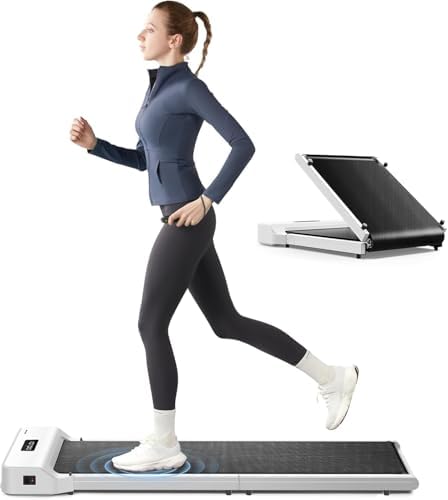
- Folds in Half – Easy to Store, Easy to Love. This walking pad folds completely in half, reducing its footprint by 50% wh…
- Light, Slim, and Surprisingly Strong – If you're just getting started or want something simple and compact, the WalkingP…
- Longer Belt, Safer Step – With a 47.6" walking belt length, you'll enjoy a more natural stride without feeling cramped, …
The WalkingPad Z1 is aimed at buyers who need to reclaim floor space after walking. Its folding design makes it particularly relevant for apartments, bedrooms, and home offices.
Published specifications list a 1–4 mph speed range, a 47.6 × 15.7-inch walking area, a maximum user weight of 242 pounds, and a machine weight of approximately 51 pounds. The folded dimensions are substantially smaller than the operating footprint.
Why consider it?
- Folding design for storage
- Walking speeds up to 4 mph
- Remote control and app support
- A longer belt than some ultra-compact models
Best for
People who plan to store their walking pad between sessions and do not need jogging or running speeds.
Potential limitation
The 15.7-inch belt is relatively narrow compared with some alternatives. Check both the belt dimensions and folded dimensions against your stride and storage space.
Before purchasing, verify the exact model and its current U.S. listing. For another folding option, compare the WalkingPad A1 Pro later in this guide.
3. MERACH NovaWalk W50 — Best for Incline and Higher Weight Capacity
The MERACH NovaWalk W50 is designed for buyers who want incline walking and a higher published weight capacity than many compact walking pads offer.
MERACH lists a 0.6–4 mph speed range, 1–12% automatic incline, a 16.5 × 41.3-inch belt, and a maximum user weight of 400 pounds. Its published specifications also distinguish between continuous and peak motor ratings, which is useful when comparing products.
Why consider it?
- Automatic incline up to 12%
- Published 400-pound user-weight capacity
- A 16.5-inch-wide belt
- Speeds up to 4 mph
- App compatibility and remote control
Best for
Buyers who want incline walking or need a model with a higher published weight capacity.
Potential limitation
At roughly 69 pounds, the W50 is heavier than many compact walking pads. It may be less convenient if you intend to move it frequently between rooms.
Do not assume that incline or a higher weight rating automatically makes a treadmill more comfortable. Belt dimensions, stability, controls, and the machine’s intended use still matter.
Check the MERACH NovaWalk W50 manufacturer page for the current specifications and model details.
4. UREVO CyberPad — Best for Work-From-Home Walking

- 🏅【Dual Brushless Motor: 1 treadmill’s cost, 10 treadmills’ lifetime of use.】 10X Longer Lifespan + Stable for 10 Years …
- 💪【14% Auto Incline – 15 Mins of Exercise = 35 Mins of Flat Walking for Calorie Burn】 Turn limited time into maximum r…
- 📱 【UREVO Smart App: Fun & Smart Workouts】 UREVO app fixes it:Auto-logging: Saves daily data (distance, time, calories, …
The UREVO CyberPad range is worth considering for people who want a walking pad that fits into a home-office routine.
The exact product name matters here. Different CyberPad versions can have different dimensions and weight capacities. The currently published UREVO CyberPad for Home, for example, lists a 43.3 × 16.5-inch walking area, speeds of 0.6–4 mph, a maximum user weight of 350 pounds, and automatic incline up to 14%.
Those specifications should not automatically be attributed to a differently named CyberPad Office listing.
Why consider it?
- A low-profile format suitable for some standing-desk setups
- Walking speeds suitable for slower work-and-walk sessions
- Automatic incline on applicable models
- App connectivity on supported versions
Best for
People who want to add walking breaks to suitable work tasks, such as listening to meetings or reading less demanding material.
Potential limitation
A low-profile treadmill still needs adequate desk clearance. Check the deck height, desk height, cable trays, and keyboard position. Walking while typing or doing precision work may also be uncomfortable.
Before ordering, confirm the exact CyberPad version, user-weight limit, included accessories, warranty, and return policy.
5. Egofit Walker Pro-M1 — Best for Very Small Spaces
The Egofit Walker Pro-M1 takes a compact approach. Its shorter walking area can be useful where floor space is the main limitation.
The specifications in the supplied comparison list a 34.25 × 16.54-inch walking area, a speed range of 0.62–3.11 mph, a maximum user weight of 220 pounds, and a fixed 5% incline.
Why consider it?
- Compact footprint
- Walking-focused speed range
- Fixed incline
- Designed for space-conscious home and desk use
Best for
People who need a small machine for slow walking and have limited room for exercise equipment.
Potential limitation
Its short belt is a significant trade-off. Taller users or people with longer strides should carefully assess whether the walking area is comfortable. The fixed incline also means you cannot select a flat setting if that is important to you.
Choose this model for its compact design only if its dimensions and capacity suit the intended user.
6. Goplus 2-in-1 Folding Treadmill — Best for Walking and Light Running
The Goplus 2-in-1 Folding Treadmill differs from walking-only models because it is designed to support walking and a faster running mode.
The supplied specifications list walking mode up to 2.5 mph, running mode up to 7.5 mph, a 39.3 × 16-inch running area, and a maximum user weight of 265 pounds.
Why consider it?
- Walking and running modes
- Folding handrail
- Higher maximum speed than most walking-only pads
- Remote control and transport wheels on applicable versions
Best for
Buyers who want one machine for desk walking and occasional faster workouts.
Potential limitation
A 2-in-1 treadmill is not always as easy to store as a flat walking pad. Its handrail, footprint, and higher-speed use also require additional space around the machine.
If running is a priority, confirm the exact model’s speed limit, safety instructions, and recommended clearance. Do not assume every Goplus listing has identical features.
7. LifeSpan TR1200-DT3 — Best for a Dedicated Desk-Walking Setup
The LifeSpan TR1200-DT3 is designed around desk walking rather than frequent storage under furniture.
The supplied specifications list a 20 × 50-inch walking belt, a 0.4–4 mph speed range, a maximum user weight of 350 pounds, and a 2.25 HP continuous-duty DC motor.
Why consider it?
- A larger walking surface than most compact pads
- A published 350-pound weight capacity
- Designed for desk-based walking
- A more substantial format for a permanent workspace
Best for
People who plan to walk regularly at a standing desk and have room to keep the treadmill in one location.
Potential limitation
This is not an ultra-portable model. Its larger belt and more substantial construction may make it less suitable for a small apartment where the floor needs to be cleared after every session.
Measure the workstation and surrounding space before buying. Confirm the current model specifications, warranty, and service support.
8. WalkingPad A1 Pro — Best Foldable Alternative
The WalkingPad A1 Pro is another option for buyers who want a folding walking treadmill but need to compare a different belt size or capacity from the Z1.
The supplied specifications list a 0.5–3.7 mph speed range, a 47 × 16.5-inch walking area, a maximum user weight of 300 pounds, and a machine weight of approximately 63 pounds.
Why consider it?
- Folding design
- A 16.5-inch-wide walking surface
- A higher published weight capacity than the Z1
- Remote and app-based controls on supported versions
Best for
People who want a foldable walking pad and do not need the higher speed range of a running treadmill.
Potential limitation
At around 63 pounds, it may be less convenient to carry or reposition than lighter folding models. Confirm the exact version and current U.S. availability before choosing it.
How to Choose the Right Walking Pad
1. Check belt length and width
The usable walking area affects how comfortable a machine feels. A narrow or short belt may work for slow walking but feel restrictive for a longer stride.
Compare the belt dimensions rather than the overall treadmill frame. If several people will use the machine, consider the needs of the tallest intended user.
2. Match the weight capacity to the user
Never exceed the manufacturer’s maximum user-weight rating. Choose a model whose published capacity comfortably suits the heaviest intended user.
A higher capacity alone does not prove better stability or durability. Consider the belt size, frame, intended use, warranty, and manufacturer support as well.
3. Decide whether incline matters
If you only want easy walking breaks, a flat walking pad may be sufficient. If you want to vary the difficulty without substantially increasing speed, an incline model may be useful.
Check whether the incline is fixed or adjustable, whether adjustment is automatic, and what range the exact model supports.
4. Measure your desk setup
For under-desk walking, measure:
- Clearance under the desk at its lowest height
- Desk and keyboard height when standing
- The treadmill’s operating height
- Space behind and beside the treadmill
- Safe space to step on and off
A treadmill that fits beneath a desk may still force you to reach awkwardly for the keyboard. Your posture and ability to work comfortably matter more than the smallest possible footprint.
For a more focused comparison, see our Best Under-Desk Walking Pads of 2026 guide.
5. Consider storage and portability
Folding is useful if you genuinely plan to store the machine after use. Check the folded dimensions, machine weight, transport wheels, and whether you can move it safely.
A heavier model may be a better fit for a permanent workstation, while a folding model may suit someone who needs to reclaim floor space.
For broader home-use selection advice, see Walking Pad for Home Use: How to Choose the Right Model.
6. Compare motor specifications carefully
Manufacturers may advertise peak horsepower or continuous-duty ratings. These are not interchangeable measures, so avoid ranking models solely by the largest horsepower number.
Look at the complete specification set, the manufacturer’s intended use, the maintenance requirements, and the warranty.
7. Treat noise claims cautiously
Actual noise depends on the motor, belt, walking speed, footsteps, footwear, flooring, and the building itself. A manufacturer’s quiet-operation claim does not guarantee that the treadmill will be silent during a video call.
If possible, read independent testing that specifically evaluates noise, comfort, and stability. The current Tom’s Guide walking-pad comparison provides another perspective on models and practical trade-offs.
Walking Pad vs. Under-Desk Treadmill vs. 2-in-1 Treadmill
These terms overlap, but they often describe different priorities.
| Type | Main advantage | Main limitation |
|---|---|---|
| Walking pad | Compact design for everyday walking | Many models are not designed for running |
| Under-desk treadmill | Designed to fit a standing-desk routine | Requires careful desk and posture setup |
| 2-in-1 treadmill | Can support walking and, on some models, faster workouts | May be larger and harder to store |
| Traditional treadmill | Often better suited to running and structured cardio | Usually requires more floor space |
Choose according to how you will actually use the machine. If you need running speed, do not assume a low-profile walking pad will provide the same experience as a traditional treadmill.
Are Walking Pads Worth It?
A walking pad can make movement more convenient for people who spend long periods sitting. It may help create opportunities for walking breaks without requiring a separate trip to a gym.
However, a walking pad is a tool for adding activity—not a guarantee of weight loss or a replacement for every type of exercise. The CDC’s adult physical activity guidance provides broader context for regular movement and physical activity.
Start at a comfortable pace and increase duration gradually. When working, use a speed that allows you to maintain control and complete the task safely. Some activities, especially precise typing, may be better performed while standing still or sitting.
Walking Pad Safety: What to Check Before Buying
Before using a walking pad:
- Place it on a stable, level surface.
- Keep the surrounding area clear.
- Start at a slow speed and learn the controls.
- Use an emergency stop mechanism when provided.
- Keep children and pets away while the machine is operating.
- Follow the manufacturer’s maintenance and lubrication instructions.
- Never exceed the stated weight capacity.
- Stop using the treadmill if it changes speed unexpectedly, stops abruptly, overheats, or behaves unusually.
Check for current model-specific safety notices before purchasing a used or new machine. In particular, the U.S. Consumer Product Safety Commission issued an April 16, 2026, warning urging consumers to stop using specified Sperax walking pads and treadmills because of fall, burn, and fire hazards. The affected models named in that warning were Pro, Q1, RM-01, and RM-02. This warning should not be generalized to every walking pad or every brand.
Read the CPSC’s official Sperax walking-pad safety warning and verify the exact model number if you own or are considering a Sperax machine.
Common Walking Pad Buying Mistakes
Choosing the smallest model automatically
A smaller machine may save space but can have a short belt that feels uncomfortable for your stride.
Ignoring desk height
A treadmill beneath a desk is only useful if you can walk without awkward posture or reaching for the keyboard.
Buying based on horsepower alone
Peak and continuous motor ratings can differ. Consider the full specification set rather than one marketing number.
Assuming every model supports running
Many walking pads are designed primarily for walking. Check the speed range and the manufacturer’s stated use.
Forgetting the return policy
Bulky exercise equipment can be inconvenient to return. Read the policy, warranty, and support terms before ordering.
Ignoring model-specific safety notices
Check the exact product and model number. Do not rely only on brand reputation or customer star ratings.
Frequently Asked Questions
What is the best walking pad in 2026?
There is no single best model for everyone. The UREVO SpaceWalk 3S is worth investigating for general home walking, the WalkingPad Z1 for folding and storage, the MERACH W50 for incline and higher published capacity, and the LifeSpan TR1200-DT3 for a dedicated desk setup.
Are walking pads good for working from home?
They can help add walking to suitable tasks, such as listening to meetings or reading. They may be less suitable for precise typing or tasks that require sustained fine-motor control. Start slowly and adjust according to the task.
Can you run on a walking pad?
Some 2-in-1 models support faster speeds for light running, but many walking pads are intended primarily for walking. Verify the exact model’s speed limit and safety instructions before attempting to run.
What belt width should I choose?
A wider belt can provide more lateral room, while belt length is especially important for users with longer strides. Choose dimensions that suit your body and walking style rather than selecting by the overall frame size.
Are walking pads noisy?
Noise varies by model, walking speed, footstep impact, and flooring. Read independent reviews that discuss real walking noise rather than relying solely on a manufacturer’s quiet-operation claim.
Do walking pads need maintenance?
Yes. Follow the manual for your exact model. Depending on the design, maintenance may include cleaning, belt alignment checks, and lubrication at the recommended intervals.
Are walking pads safe?
They can be used safely when operated according to the manufacturer’s instructions, but no treadmill is risk-free. Keep the surrounding area clear, learn the controls, and check current safety notices for the exact model.
Do walking pads guarantee weight loss?
No. They can help increase activity, but weight change depends on overall energy balance and individual factors. Treat a walking pad as one tool within a broader activity and nutrition routine.
Final Verdict: Choose the Walking Pad That Fits Your Routine
The best walking pad is the one that fits your body, room, desk, and intended use.
The UREVO SpaceWalk 3S is worth comparing for general home walking. The WalkingPad Z1 is relevant when folding and storage are priorities. The MERACH NovaWalk W50 offers incline and a higher published capacity, while the LifeSpan TR1200-DT3 is designed for a more permanent desk-walking setup. The Goplus 2-in-1 is the option to investigate if you need faster speeds for occasional running.
Before purchasing, confirm the exact model, belt dimensions, maximum user weight, speed range, incline, operating and storage dimensions, warranty, return policy, and current safety information.
Choose transparent specifications over marketing promises, and buy a machine you can comfortably and safely use as part of your normal routine.