
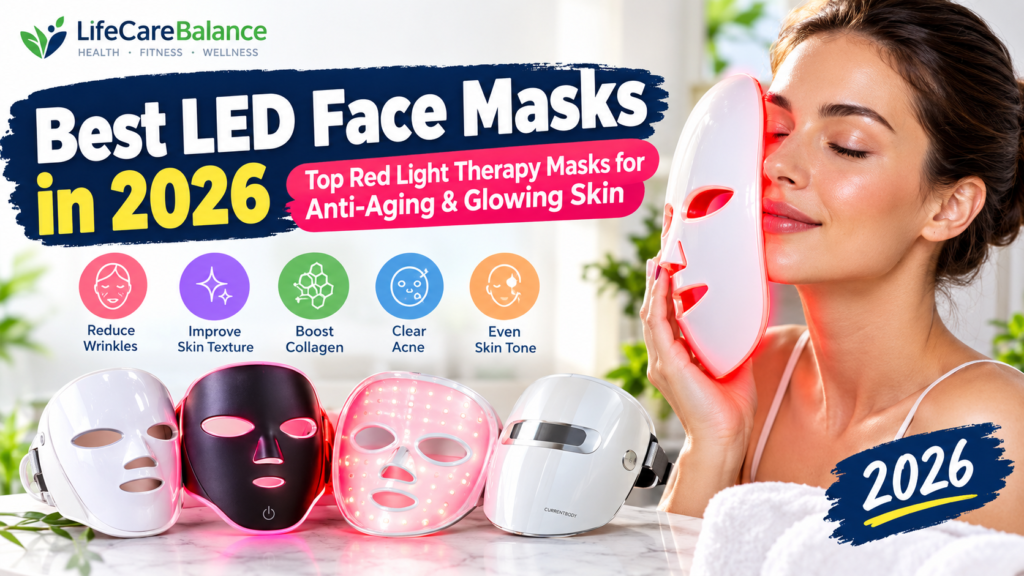
Discover the best LED face masks in 2026 for anti-aging, fine lines, glowing skin, and at-home skincare. Compare top red light therapy masks and find your best pick.
LifeCareBalance.com is reader-supported. When you buy through links on our site, we may earn an affiliate commission at no extra cost to you. As an Amazon Associate, we earn from qualifying purchases.
If you’ve scrolled through skincare content in the last year, you’ve probably seen someone sitting in front of the mirror wearing a glowing red mask. LED face masks have gone from a niche derm-office treatment to one of the most talked-about at-home skincare tools of 2026, and for good reason: they’re one of the few devices that combine real clinical research with genuinely easy, screen-time-friendly use.
But “LED face mask” has become a crowded category, spanning $40 no-name masks on Amazon and $500 medical-grade devices from dermatologist-backed brands. The specs vary wildly, and so do the results you can realistically expect.
This guide breaks down how LED face masks actually work, what the research does and doesn’t support, and which best LED face masks are worth considering in 2026 — whether your priority is fine lines, acne, or simply an easy at-home glow-up routine.
What Is an LED Face Mask?
An LED face mask is a wearable device, usually made of flexible silicone or a rigid plastic shell, embedded with dozens to hundreds of small LED bulbs. When you put it on and turn it on, the LEDs emit specific wavelengths of light directly onto your skin for a set treatment time, typically 3 to 20 minutes.
This falls under a broader category called photobiomodulation, or low-level light therapy (LLLT). It’s the same underlying technology used in professional red light therapy devices at dermatology offices and med spas, just scaled down and simplified for home use.
Unlike lasers or IPL treatments, LED light therapy doesn’t heat, cut, or damage the skin’s surface. There’s no downtime, which is part of why it has become such a popular entry point into at-home skin tech.
How LED Face Masks Work
Each wavelength of light penetrates the skin to a different depth and is absorbed differently by skin cells:
- Red light (around 620–660nm) is absorbed mostly by the upper layers of skin and is the wavelength most associated with collagen stimulation and fine line reduction.
- Near-infrared light (around 800–850nm and beyond) penetrates deeper into the dermis, where it’s thought to support circulation, tissue repair, and firmness.
- Blue light (around 405–420nm) works differently. It doesn’t penetrate as deeply and is instead used to target the bacteria associated with acne breakouts.
The theory behind red and near-infrared light therapy for skin is that these wavelengths are absorbed by mitochondria in skin cells, which may increase cellular energy (ATP) production. That, in turn, is believed to support the skin’s natural repair processes, including collagen synthesis. This mechanism has reasonable scientific support from small clinical studies, though results and study quality vary, and at-home devices are generally less powerful than the professional-grade equipment used in most published research.
Potential Benefits of LED Face Masks
It’s worth being upfront here: LED face masks are not a miracle device, and no reputable brand should claim they cure anything. What the current evidence supports is more modest — visible improvement, not transformation, and results that depend heavily on consistency and device quality.
Fine Lines and Wrinkles
This is where red and near-infrared LED face masks have the most supporting research. Regular use over several weeks has been associated with a reduction in the visible appearance of fine lines, largely attributed to increased collagen and elastin activity.
Skin Texture
Many users report smoother-feeling skin with regular use, likely tied to the same collagen-support mechanism, along with reduced inflammation.
Collagen Support
This is one of the most heavily marketed claims, and it’s important to separate manufacturer language from evidence-based expectations. Red and near-infrared light appear to stimulate fibroblast activity in some studies, which is the cell type responsible for producing collagen. However, “boosts collagen” is a gradual, cumulative effect measured over weeks to months, not something you’ll see after a single session.
Acne
This is where blue light LED masks come in. Blue light is thought to help reduce the bacteria linked to acne breakouts. Many masks pair blue with red light so users can address both active breakouts and the inflammation or discoloration left behind. LED alone is generally considered a supportive tool for mild to moderate acne, not a replacement for a dermatologist-guided acne treatment plan.
Redness and Skin Tone
Some users find that consistent LED use helps calm visible redness and even out tone over time, likely related to the anti-inflammatory effects reported in some studies. Individual results vary significantly based on the underlying cause of the redness.
Overall Skin Appearance
Taken together, the cumulative effect many users report is skin that looks a bit brighter, calmer, and more even — a “glow” effect rather than a dramatic transformation.
Best LED Face Masks in 2026
Below is a comparison of some of the most established options on the market, spanning budget-friendly to premium. Because pricing and promotions change frequently, always confirm current specs and pricing on the manufacturer’s product page before purchasing.
| Product | Best For | Wavelengths | LED Count | Treatment Time | Key Features | Price Range | Main Pros | Main Cons |
|---|---|---|---|---|---|---|---|---|
| CurrentBody Skin LED Mask: Series 2 | Mature skin, fine lines, wrinkles | 633nm red, 830nm near-infrared, 1072nm deep near-infrared | 236 LEDs | 10 minutes | Flexible silicone fit, chin coverage, optional eye inserts, 2-year warranty | $370–$470 | Full-face coverage, three wavelengths, strong reputation | Premium price, single treatment mode |
| Omnilux Contour Face | Dermatologist-backed anti-aging | 633nm red, 830nm near-infrared | 132 LEDs (66 dual-chip bulbs) | 10 minutes | FDA-cleared, flexible silicone, used in clinics | $395–$490 | Strong clinical backing, comfortable fit | Fewer wavelengths than some rivals, no acne-specific blue light |
| Dr. Dennis Gross DRx SpectraLite FaceWare Pro | Fast routines, dual acne + anti-aging | Red and blue (specific nm should be checked on the current product page) | 162 LEDs (100 red, 62 blue) | 3 minutes | Hard-shell hands-free design, red/blue/combo modes | $450–$465 | Very short sessions, combines red and blue in one device | Rigid fit isn’t as contouring as silicone masks, no near-infrared |
| Budget silicone masks (e.g., entry-level Amazon-market brands) | First-time buyers, budget shoppers | Varies by model — confirm on product page | Commonly 150–450 LEDs depending on model | Typically 10–30 minutes | Multiple color modes, remote controls, cordless/rechargeable | Under $100 | Accessible price point, often good LED density | Wavelength precision, irradiance, and build quality vary and are harder to verify |
For a deeper breakdown of budget-friendly picks specifically, see our guide to the best LED face masks under $100, and for hands-on impressions of individual devices, check our full LED face mask review roundup.
A Note on Budget Devices
The under-$100 category has genuinely improved in recent years, and several budget masks now advertise LED counts and wavelengths that rival premium devices on paper. That said, published irradiance (light intensity) and third-party testing are much harder to verify for lesser-known brands. If a budget listing doesn’t disclose irradiance or wavelength specifics, treat the marketing claims with some skepticism and prioritize brands with visible testing or certifications.
What to Look for When Buying an LED Face Mask
Wavelengths
Look for at least red light (approximately 630–660nm) for anti-aging benefits. If acne is a priority, look for blue light (around 405–420nm) as well. Near-infrared (800nm+) is a bonus for deeper skin support, though it adds cost.
Irradiance
This refers to the power output of the light, usually measured in mW/cm². Higher irradiance generally means more effective treatment in less time, but few budget listings disclose this clearly — it’s one of the most useful numbers to look for if you can find it.
LED Count
More LEDs generally mean more even coverage, but count alone doesn’t tell you about wavelength accuracy or power. A mask with fewer, well-calibrated LEDs can outperform one with more low-quality bulbs.
Coverage and Fit
Silicone masks tend to contour more closely to facial curves (nose, eye area, jawline) than rigid plastic shells, which can mean more consistent light exposure.
Treatment Time
Sessions range from 3 minutes to 20+ minutes. Shorter sessions are easier to stick with, but this usually correlates with higher irradiance devices rather than a shortcut.
Fit and Comfort
Weight, strap design, and flexibility all affect whether you’ll actually use the mask consistently. A mask that’s uncomfortable tends to end up in a drawer.
Eye Protection
LED masks emit bright light close to the eyes. Look for masks with built-in eye protection or optional eye inserts, and never look directly at the LEDs.
Battery or Wired Operation
Cordless, rechargeable masks are more convenient for a relaxed routine, while wired options may offer more consistent power delivery.
Warranty
Established brands typically offer 1–2 year warranties on the device and controller. A limited or unclear warranty can be a red flag on lesser-known devices.
Price
Price generally correlates with wavelength range, irradiance transparency, certifications, and build quality — but not always. It’s worth comparing specs, not just price tags, before deciding.
LED Face Mask vs Red Light Therapy Panel
LED face masks are convenient, hands-free, and designed specifically for facial contours. Red light therapy panels, by contrast, are larger stand-mounted or wall-mounted devices that can treat the face, neck, chest, and body in one session, often at higher irradiance since they aren’t constrained by a wearable form factor.
If your main concern is facial skin specifically, a mask is usually more practical. If you want broader body coverage — for muscle recovery, larger skin areas, or multiple family members using the same device — a panel may offer better value per session. For a detailed side-by-side, see our full comparison of LED face mask vs red light therapy panel options.
LED Face Mask vs Microcurrent Mask
These are frequently confused but work in completely different ways. LED masks use light wavelengths to influence cellular activity. Microcurrent masks deliver low-level electrical currents intended to temporarily stimulate facial muscles, sometimes marketed for a “lifting” or toning effect.
Some premium devices now combine both technologies in a single mask. If you’re deciding between the two — or considering a combo device — our breakdown of LED face mask vs microcurrent mask covers the differences in more depth.
Are Expensive LED Face Masks Worth It?
This depends on what you’re comparing. Premium masks like CurrentBody Skin Series 2 or Omnilux Contour Face tend to offer:
- Documented, brand-specific clinical testing
- Verified irradiance and wavelength precision
- FDA clearance (a regulatory classification, not a guarantee of dramatic results)
- Better build quality and more even coverage
- Stronger warranties
Budget masks can still deliver a reasonable amount of red and near-infrared exposure, especially if you’re mainly looking for a general wellness and glow-support routine rather than targeting stubborn wrinkles. But if you have a specific anti-aging or acne goal and want to maximize your odds of a visible result, spending more generally buys you more verified performance data — not just a nicer aesthetic experience. Our best LED face masks guide breaks down picks across every price tier if you want a broader side-by-side.
Common LED Face Mask Buying Mistakes
- Assuming higher LED count always means better results. Wavelength accuracy and irradiance matter more than raw bulb count.
- Skipping eye protection. Direct, unprotected exposure to bright LED light isn’t worth the risk.
- Expecting overnight results. LED therapy is cumulative; a single session won’t visibly change your skin.
- Ignoring irradiance entirely. If a brand won’t disclose it, that’s worth factoring into your decision.
- Using it inconsistently. Most clinical protocols involve 3–5 sessions per week for several weeks — sporadic use is unlikely to produce noticeable change.
- Buying based on price alone. Both overpaying for marketing hype and underpaying for an unverified device are common pitfalls.
How Often Should You Use an LED Face Mask?
Most manufacturers recommend 3 to 5 sessions per week for the first 4 to 8 weeks, followed by a maintenance schedule of 1 to 3 times per week. Session length depends on the device’s irradiance — some higher-powered masks require only 3 minutes, while others need 10 to 20 minutes to deliver a comparable dose of light.
Consistency tends to matter more than any single session’s length.
How Long Does It Take to See Results?
Based on available research and manufacturer clinical data, most users who notice visible changes report them somewhere between 4 and 10 weeks of consistent use. Acne-related improvements from blue light may show up sooner, sometimes within one to two weeks, while collagen-related changes for fine lines and firmness tend to take longer since collagen remodeling is a gradual biological process.
Individual results vary based on skin type, age, consistency of use, and the specific device’s power output.
Who Should Use an LED Face Mask?
LED face masks are generally considered a reasonable option for adults who:
- Want a low-effort addition to an existing skincare routine
- Are interested in supporting the appearance of fine lines, dullness, or mild acne
- Prefer a non-invasive, no-downtime approach over more aggressive treatments
- Are comfortable with a multi-week commitment for gradual results
Who Should Be Cautious
Certain groups should consult a dermatologist or physician before using an LED face mask:
- Those who are pregnant (some brands advise against use during pregnancy)
- People with photosensitivity disorders or a history of skin cancer
- Anyone taking medications that increase light sensitivity, such as certain acne medications or antibiotics
- People with active skin infections, open wounds, or recent cosmetic procedures who haven’t been cleared for light exposure
- Anyone with epilepsy or a history of light-triggered seizures, due to the pulsing or bright light involved in some devices
When in doubt, a quick conversation with a dermatologist is the safest way to confirm an LED mask is appropriate for your skin and health history.
LED Face Mask vs Professional Treatments
In-office LED and laser treatments typically use significantly higher irradiance than at-home devices, often producing more noticeable results in fewer sessions — but at a much higher cost per treatment and with the need for appointments. At-home LED face masks trade some power for convenience and long-term affordability, since a one-time device purchase can be used indefinitely. Many dermatologists suggest at-home masks as a way to maintain results between in-office treatments rather than as a full replacement for professional care, especially for more advanced signs of aging.
Frequently Asked Questions
Do LED face masks actually work? Small clinical studies support red and near-infrared light for improving the appearance of fine lines, texture, and tone, and blue light for supporting acne-prone skin. Results are generally modest, gradual, and dependent on consistent use — not dramatic or guaranteed.
How often should I use an LED face mask for best results? Most brands recommend 3 to 5 sessions per week for the first several weeks, then a lighter maintenance schedule afterward.
Can LED face masks cause skin damage? LED light therapy is considered low-risk when used as directed, since it doesn’t generate the heat associated with lasers. Eye protection is still important, and anyone with photosensitivity or certain medical conditions should check with a doctor first.
What’s the difference between red light and blue light face masks? Red light is primarily associated with collagen support and fine lines, while blue light targets acne-causing bacteria. Many masks now combine both.
Are LED face masks safe for sensitive skin? Generally considered gentle, but sensitive skin can still react to close, sustained light exposure. Starting with shorter sessions and monitoring your skin’s response is a reasonable approach.
Is a more expensive LED face mask always better? Not necessarily, but higher-priced devices from established brands tend to offer more verified wavelength precision, irradiance data, and clinical testing.
Can I use an LED face mask every day? Some devices are designed for daily use, but many manufacturers recommend rest days, particularly for higher-irradiance devices. Always follow the specific product’s guidelines.
Do LED face masks help with acne scars? There’s more evidence supporting LED’s role in active acne and inflammation than in established scarring. For textured or pigmented scarring, other treatments are generally considered more effective, and a dermatologist can help set realistic expectations.
Final Verdict
There isn’t a single “best” LED face mask for everyone — the right choice depends on your goals and budget.
- For overall anti-aging: A multi-wavelength mask like CurrentBody Skin Series 2, which includes red, near-infrared, and deep near-infrared light, offers the broadest coverage for fine lines, firmness, and tone.
- For fine lines and wrinkles specifically: Omnilux Contour Face’s dermatologist-backed, clinically studied red and near-infrared combination is a strong, well-documented option.
- For acne-prone skin: Look for a mask with dedicated blue light modes, such as Dr. Dennis Gross’s SpectraLite FaceWare Pro, which pairs red and blue light in short sessions.
- For budget shoppers: A well-reviewed sub-$100 mask can be a reasonable entry point, as long as you verify wavelengths and manage expectations around irradiance and long-term durability.
- For premium shoppers: Devices with published irradiance data, FDA clearance, and multi-year warranties offer the most confidence that you’re getting what you’re paying for.
- For beginners: Start with a mid-range, well-reviewed mask with clear usage instructions rather than jumping straight to the most expensive or most heavily marketed option — consistency matters more than specs at first.
Whichever LED face mask you choose, remember that it works best as part of a broader skincare routine, not a standalone fix. Pair it with sun protection, a solid cleansing and moisturizing routine, and realistic expectations, and give it several weeks of consistent use before judging the results