
LifeCareBalance.com is reader-supported. When you buy through links on our site, we may earn an affiliate commission at no extra cost to you. As an Amazon Associate, we earn from qualifying purchases.
Sleep trackers no longer come in just one form. You can wear one on your wrist, slip one onto your finger, attach a lightweight band, place a sensor underneath your mattress, or use a bedside device that monitors your sleep without requiring you to wear anything.
Although these devices all aim to help you understand your sleep, they don’t measure it in exactly the same way—and they aren’t designed for the same type of user.
That’s what makes choosing a sleep tracker more complicated than simply looking for the device with the most sensors or the longest list of features.
An athlete may care most about HRV, resting heart rate, recovery, and training readiness. Someone struggling with inconsistent sleep may care more about sleep duration and bedtime consistency. Another person may simply want a comfortable device that tells them whether they’re getting enough sleep each night.
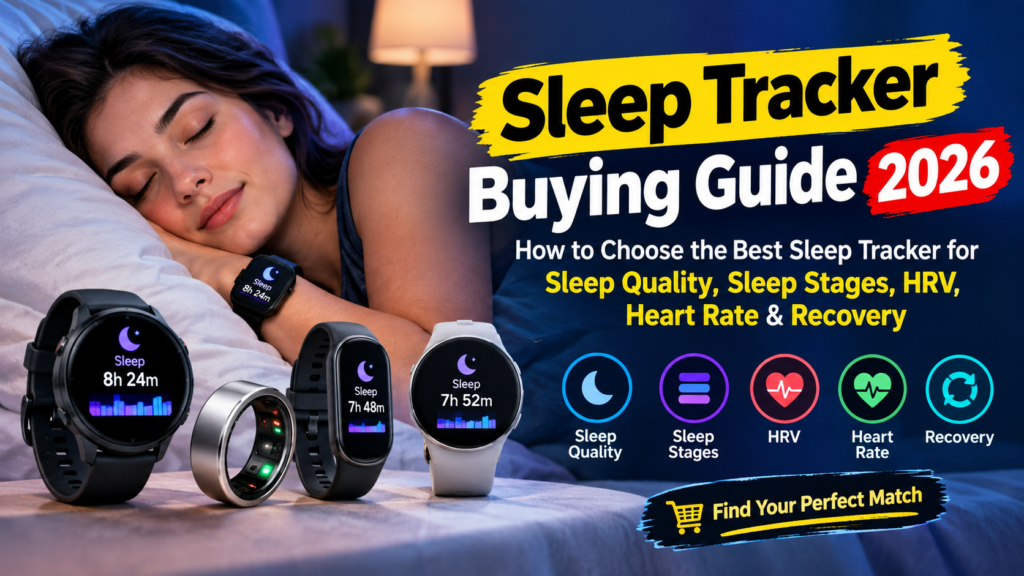
This sleep tracker buying guide 2026 explains what to look for before buying, which sleep metrics matter, how accurate consumer sleep trackers can be, and how to choose between smart rings, smartwatches, fitness bands, and contactless sleep monitors.
In short: the most important factors are accuracy, comfort, sleep metrics, form factor, battery life, app quality, subscription costs, privacy, and your personal reason for tracking sleep.
If you are already comparing specific devices, you can also see our Best Sleep Trackers in 2026 guide for a product-focused comparison.
What Is a Sleep Tracker and How Does It Work?
A consumer sleep tracker doesn’t directly read your brain activity. Instead, it uses sensors to collect physiological and movement data and then applies algorithms to estimate when you’re awake, asleep, or moving between different sleep stages.
Depending on the device, a sleep tracker may use:
- Accelerometers to detect movement and periods of stillness
- Optical heart-rate sensors to monitor heart rate throughout the night
- Heart rate variability (HRV) measurements as an input for recovery and sleep analysis
- Respiratory rate to estimate changes in breathing during sleep
- Skin temperature sensors to monitor overnight temperature trends
- SpO2 sensors to estimate blood oxygen saturation
- Additional sensors for environmental or physiological measurements
The important distinction is that consumer trackers estimate sleep rather than directly measuring brain activity.
A clinical polysomnography (PSG) sleep study uses measurements such as electroencephalography (EEG), eye movements, muscle activity, heart activity, and breathing signals to determine sleep stages.
That difference is important when interpreting your sleep-tracking results. A wearable can provide useful trends, but its sleep-stage numbers shouldn’t automatically be treated as equivalent to laboratory measurements.
What Should a Sleep Tracker Measure?
Not every metric reported by a sleep tracker deserves equal importance. Some measurements can be useful for tracking long-term trends, while others are more heavily dependent on the device’s algorithms.
| Metric | What It Tells You | Why It Matters | Important Limitation |
|---|---|---|---|
| Total sleep time | How long you actually slept | Basic measure of sleep quantity | Still an estimate |
| Time in bed | Time spent in bed | Provides context for sleep efficiency | Doesn’t equal actual sleep |
| Sleep efficiency | Percentage of time in bed spent asleep | Helps identify fragmented or inefficient sleep | Algorithm-dependent |
| Sleep onset latency | Estimated time needed to fall asleep | Useful for monitoring bedtime patterns | Brief periods of wakefulness can be missed |
| Wake after sleep onset | Time awake after falling asleep | Helps identify nighttime interruptions | Short awakenings can be underestimated |
| Light sleep | Estimated lighter sleep | Provides a general sleep-stage breakdown | Algorithm-estimated |
| Deep sleep | Estimated slow-wave sleep | Useful for observing long-term trends | Accuracy varies between devices |
| REM sleep | Estimated REM sleep | Helps provide a broader sleep-stage picture | Not directly measured by most consumer devices |
| Heart rate | Overnight heart-rate trend | Useful for tracking personal patterns | Best interpreted over time |
| HRV | Variation between heartbeats | Often used for recovery analysis | Highly individual |
| Respiratory rate | Breaths per minute | Helps identify changes in overnight breathing patterns | Not a diagnostic measurement |
| SpO2 | Estimated blood oxygen saturation | Can provide an additional wellness signal | Not automatically diagnostic |
| Skin temperature | Changes from your normal baseline | Useful for trend monitoring | Affected by environment and other factors |
| Sleep score | Composite sleep rating | Easy way to review nightly data | Algorithms differ by brand |
| Recovery/readiness | Composite recovery estimate | Useful for training-focused users | Proprietary and not standardized |
For many users, total sleep time, sleep consistency, sleep efficiency, resting heart rate, and personal HRV trends are more useful than obsessing over one night’s estimated REM or deep-sleep number.
How Accurate Are Sleep Trackers in 2026?
Accuracy is one of the most important things to consider when buying a sleep tracker.
The answer isn’t simply that one category of device is accurate and another isn’t. Accuracy depends on the specific device, sensor configuration, algorithm, metric being measured, and testing methodology.
Sleep vs. Wake Detection
Consumer sleep trackers generally perform better at identifying whether a person is asleep or awake than they do at determining the exact sleep stage.
That makes sense because movement and physiological changes can provide useful signals about whether someone is sleeping.
However, even relatively strong sleep-versus-wake performance doesn’t mean that every sleep metric reported by the device is equally accurate.
Sleep Stage Accuracy
Sleep-stage estimation is considerably more complicated.
Most consumer devices estimate light, deep, and REM sleep using combinations of movement, heart rate, HRV, and other signals rather than directly measuring brain waves.
Research comparing consumer wearables with polysomnography has found meaningful differences between devices and between sleep stages.
This means you shouldn’t interpret a wearable’s statement that you received a particular number of minutes of REM or deep sleep as if it were a laboratory measurement.
What About Long-Term Trends?
This is where sleep trackers can become more useful.
Instead of asking:
“Was my deep sleep exactly 72 minutes last night?”
A better question may be:
“Has my sleep pattern changed consistently over the past month?”
Long-term trends can help you understand whether your sleep duration, bedtime consistency, resting heart rate, or other tracked measurements are changing.
The American Academy of Sleep Medicine also emphasizes the limitations of consumer sleep technology and the distinction between consumer tracking and clinical sleep assessment.
Practical takeaway: use sleep-tracker data as a tool for observing patterns, not as a substitute for clinical testing.
Sleep Tracker vs. Polysomnography: What’s the Difference?
Polysomnography, commonly called a sleep study, is used in clinical settings to evaluate sleep and diagnose sleep disorders.
A consumer sleep tracker has a very different purpose.
| Feature | Consumer Sleep Tracker | Polysomnography |
|---|---|---|
| Sleep duration | Estimated | Measured using multiple signals |
| Sleep stages | Algorithm-estimated | Determined using EEG and other measurements |
| Brain activity | Usually not measured | Directly measured with EEG |
| Heart rate | Optical sensor or other wearable sensor | Clinical-grade ECG |
| Breathing | Estimated using available sensors | Directly monitored using multiple signals |
| Sleep-disorder diagnosis | Not intended for diagnosis | Used clinically |
| Convenience | High | Lower |
| Everyday use | Designed for repeated home use | Clinical or supervised home testing |
| Cost | Hardware plus possible subscription | Generally much more expensive |
| Long-term trend tracking | Strong use case | Not designed primarily for daily consumer tracking |
The key point is simple: a consumer sleep tracker is not a replacement for a clinical sleep study.
If you experience persistent symptoms such as loud snoring, gasping during sleep, repeated nighttime awakenings, or significant daytime sleepiness, discuss those symptoms with a qualified healthcare professional instead of relying only on wearable data.
How to Choose a Sleep Tracker: 10 Factors to Consider
1. Identify Your Main Sleep-Tracking Goal
Start with what you actually want to learn.
Are you interested in:
- Sleep duration?
- Sleep consistency?
- Sleep stages?
- HRV?
- Recovery?
- Training readiness?
- Heart rate?
- Breathing trends?
- General wellness?
Your answer should determine which features you prioritize.
If you only want basic sleep-duration tracking, paying extra for advanced recovery analytics may not make sense.
2. Look for Independent Validation
Marketing specifications don’t tell the entire story.
When possible, look for independent research comparing a device with polysomnography or another accepted reference method.
A device doesn’t have to be perfect to be useful, but independent validation provides more meaningful evidence than a manufacturer’s marketing claim alone.
3. Decide Which Metrics You Actually Need
More metrics aren’t automatically better.
For example:
- A casual user may mainly need sleep duration and consistency.
- An athlete may value HRV and recovery information.
- A wellness-focused user may be interested in temperature trends.
- Someone interested in overnight oxygen measurements may prioritize SpO2.
Choose the metrics that match your actual goals.
4. Consider the Form Factor
Sleep trackers come in different designs:
- Smart rings
- Smartwatches
- Fitness bands
- Screenless recovery wearables
- Under-mattress sensors
- Bedside/contactless monitors
The best form factor is often the one you can comfortably use every night.
5. Prioritize Overnight Comfort
A technically advanced tracker isn’t very useful if you stop wearing it because it’s uncomfortable.
Consider:
- Weight
- Size
- Material
- Strap design
- Ring fit
- Sleep position
- Skin sensitivity
Side sleepers may have different preferences from people who sleep primarily on their backs.
6. Check Battery Life
Battery life is especially important for sleep tracking.
If the device needs frequent charging, you may eventually create gaps in your sleep data.
Look for:
- Multi-day battery life
- Fast charging
- Convenient charging periods
- Battery-life estimates based on your intended features
Consistency matters because sleep tracking becomes more useful when you have a longer history of data.
7. Evaluate the App
The hardware collects the information, but the app is where you actually interpret it.
Look for:
- Weekly and monthly trends
- Clear charts
- Sleep history
- Recovery information
- Personalized insights
- Easy-to-understand scores
- Apple Health compatibility
- Google Health Connect compatibility
- Data export options
A complicated app can make an otherwise capable device frustrating to use.
8. Calculate Subscription Costs
Don’t compare devices based only on their upfront price.
Some trackers offer most features without an ongoing fee. Others use a subscription model for advanced sleep analysis, recovery insights, coaching, or historical data.
Consider your expected ownership period.
For example, a hypothetical $10 monthly subscription would cost:
- $120 over one year
- $240 over two years
- $360 over three years
That recurring cost can significantly change the total price of a device.
Always verify current subscription pricing before purchasing.
9. Check Ecosystem Compatibility
If you already use other health and fitness devices, check whether the tracker integrates with your existing ecosystem.
Important considerations include:
- Apple Health
- Google Health Connect
- Fitness platforms
- Workout apps
- Data export
- Third-party integrations
You don’t want your sleep data trapped in an ecosystem that doesn’t work with the other health information you already use.
For readers comparing multiple connected wellness devices, our Best Smart Scales 2026 guide provides another example of what to consider when evaluating health-tracking technology.
10. Review Privacy Policies
Sleep data, heart-rate data, and other health information can be sensitive.
Before purchasing, check:
- What data the company collects
- How data is stored
- Whether information is shared with third parties
- Whether cloud storage is required
- Whether you can export your information
- Whether you can delete your account and data
Privacy policies can change, so review the manufacturer’s current policy before buying.
Choose the Right Sleep Tracker Form Factor
Smart Rings

- THE WORLD’S SMALLEST SMART RING – 40% smaller than the previous generation, Oura Ring 5 is thinner, lighter and smaller …
- SIZING IS ESSENTIAL – Oura Ring 5 uses unique sizing different from standard jewelry rings and other Oura Ring generatio…
- EVERYDAY HEALTH SENSING – Oura tracks over 50 health metrics, including sleep, activity, stress, heart health, metabolic…
Smart rings are particularly popular among people who prioritize sleep and recovery.
Their small size can make them easier to wear overnight than a smartwatch, and many models focus heavily on sleep, HRV, heart rate, temperature, and recovery metrics.
Advantages
- Small and discreet
- Generally comfortable for overnight use
- No large screen
- Often strong battery life
- Useful for sleep and recovery tracking
- Temperature tracking on many models
Limitations
- No large display
- Smaller physical battery
- Some advanced features may require subscriptions
- Less useful for people who want extensive smartwatch functionality
If you’re considering a ring-based sleep tracker, our Oura Ring Review 2026 provides a more detailed look at Oura’s sleep, recovery, and health-tracking features.
If you’re deciding between a ring and a screenless recovery wearable, see our Oura Ring vs WHOOP 2026 comparison for a more focused comparison.
Smartwatches

- STAY CLOSER TO YOUR HEART HEALTH—The most accurate heart rate sensing in a wearable,* Series 12 now measures HRV as ofte…
- A FULL-FEATURED HEALTH TRACKER—Better understand your body with invaluable health insights. View your overnight health m…
- CHECK YOUR READINESS FOR THE DAY—Know when to rest or put yourself to the test. The readiness experience can help you de…
Smartwatches combine sleep tracking with daytime fitness and health features.
They can be useful for people who want one device for:
- Sleep tracking
- Exercise
- Heart-rate monitoring
- Notifications
- Workouts
- General health tracking
The main trade-off is size and battery life.
Some people find a smartwatch perfectly comfortable at night, while others prefer a smaller ring or band.
Fitness Bands and Screenless Wearables

- 24/7 Continuous Health Tracking: This activity tracker automatically tracks heart rate, blood pressure, blood oxygen, HR…
- 170+ Sport Modes & Built‑in GPS: This screenless fitness tracker keeps recording your daily basic activities and support…
- Exclusive Couple & Family‑Care Features: Within the Couple Space, bind your partnership by entering each other’s email a…
Fitness bands and screenless recovery wearables sit between smartwatches and rings.
They can be useful for people who want:
- Sleep tracking
- HRV
- Recovery data
- Training metrics
- Lightweight overnight wear
Before buying, check whether advanced recovery features require an ongoing subscription.
Contactless and Under-Mattress Sleep Trackers

- 🧘🏽 ZEN OUT IN MINUTES: Drift into deep relaxation in as little as 10 minutes a day. Lay back on the Balance Mate mat to …
- 👐 FULL-BODY SUPPORT: This pressure point mat targets key acupressure zones across your back and neck. Enjoy head-to-toe …
- 👶 BETTER SLEEP, LESS STRESS: Use this mat before bed to release endorphins and calm your mind. Customers report easing s…
Contactless trackers are designed for people who don’t want to wear anything while sleeping.
Depending on the product, these systems may use sensors under the mattress or bedside sensing technology.
Advantages
- No wearable required
- No overnight charging
- Comfortable for people who dislike wearable devices
- Convenient for long-term use
Limitations
- Shared beds can complicate tracking
- May provide fewer individual physiological measurements
- Technology varies significantly between products
For someone who strongly dislikes wearing a device overnight, a contactless system may be more practical than a premium wearable.
How Important Are Sleep Stages?
Most sleep trackers divide sleep into:
- Light sleep
- Deep sleep
- REM sleep
These stages are important parts of normal sleep architecture, but consumer trackers don’t normally determine them by directly measuring brain activity.
Instead, algorithms estimate sleep stages using available signals such as movement, heart rate, and HRV.
This means that sleep-stage numbers should be interpreted cautiously.
If your tracker says you received less deep sleep than usual one night, that doesn’t automatically mean something is wrong.
A better approach is to look for persistent trends over time and consider those trends alongside how you actually feel.
Is HRV Important When Choosing a Sleep Tracker?
Heart rate variability, or HRV, describes changes in the time intervals between consecutive heartbeats.
Many sleep and recovery devices use HRV as one input for recovery or readiness scores.
HRV can be useful, but there is no single “ideal” number that applies to everyone.
Your normal HRV can differ significantly from another person’s.
For this reason, a tracker that provides consistent overnight measurements and helps you understand your personal baseline can be more useful than one that simply displays a larger number of metrics.
Avoid treating one unusually high or low HRV reading as a diagnosis or definitive health assessment.
Should You Buy a Sleep Tracker With SpO2?
SpO2 refers to estimated blood oxygen saturation.
Some sleep trackers measure SpO2 during the night and display overnight oxygen trends.
For many consumers, this is best viewed as an additional wellness metric rather than a diagnostic measurement.
It’s particularly important not to assume that ordinary SpO2 tracking means a device can diagnose sleep apnea.
Some specific wearable features have received regulatory authorization for defined sleep-apnea-related purposes, but that doesn’t mean every wearable with an SpO2 sensor can detect or diagnose sleep apnea.
If sleep apnea is a concern, discuss symptoms with a healthcare professional rather than relying on a general-purpose sleep tracker.
Sleep Tracker Subscription Costs: What Should You Check?
Subscription pricing can dramatically affect the long-term cost of a sleep tracker.
Before buying, check whether the subscription is required for:
- Detailed sleep analysis
- Sleep-stage history
- Recovery scores
- Readiness scores
- Coaching
- Long-term trends
- Advanced health insights
A device that costs less initially may become more expensive over several years if its important features require a monthly membership.
Example
Suppose:
- Device A costs $300 with no subscription.
- Device B costs $150 but requires $10 per month.
After three years:
Device A: $300 total hardware cost
Device B: $150 + $360 subscription = $510
This is only a hypothetical example, but it demonstrates why buyers should compare total ownership cost, not just the initial hardware price.
Sleep Tracker Battery Life and Overnight Comfort
Battery life directly affects the consistency of your sleep data.
A dead tracker cannot record your sleep.
Look for:
- Multi-day battery life
- Quick charging
- Convenient charging times
- Comfortable overnight design
- Reliable fit
Comfort is equally important.
A heavy smartwatch may bother some side sleepers, while another person may barely notice it.
A ring can be more discreet, while a contactless tracker eliminates the need to wear anything.
Ultimately, the tracker you consistently use is more valuable than one with an impressive specification sheet that you rarely wear.
Sleep Tracker App and Data Ecosystem
The app can be just as important as the hardware.
A good sleep-tracking app should make it easy to understand:
- Sleep duration
- Bedtime consistency
- Sleep trends
- Sleep stages
- HRV
- Resting heart rate
- Recovery
- Changes over time
Look for long-term trend graphs rather than an app that focuses almost entirely on a single daily score.
If you’re building a wider health-tracking setup, you may also want to explore our Smart Scale Buying Guide 2026 to understand how other connected health devices fit into a broader wellness ecosystem.
Privacy and Health Data: What Buyers Should Check
Before purchasing a sleep tracker, take a few minutes to review the manufacturer’s privacy policy.
Look for information about:
- Account requirements
- Cloud storage
- Data sharing
- Third-party services
- Advertising
- Data export
- Data deletion
- Account deletion
Don’t assume that two devices collecting similar health information handle that data in the same way.
Privacy policies can change, so checking the current version before purchase is worthwhile.
Which Sleep Tracker Is Right for You?
| User Type | Features to Prioritize | Possible Form Factor |
|---|---|---|
| Sleep-focused user | Sleep duration, consistency, sleep stages | Ring, band, contactless tracker |
| Athlete | HRV, recovery, resting heart rate | Ring, band, smartwatch |
| Fitness + sleep user | Workouts + sleep tracking | Smartwatch |
| Beginner | Simple app, basic sleep metrics | Entry-level band, ring, or watch |
| Budget-conscious buyer | Core features without expensive subscription | Fitness band or smartwatch |
| Doesn’t like wearables | No overnight wearable | Contactless tracker |
| Wants advanced health data | HRV, temperature, SpO2 and other metrics | Premium ring or smartwatch |
| Interested in authorized sleep-apnea features | Specific regulatory-authorized feature | Verify the exact device feature |
There isn’t one sleep tracker that is automatically right for everyone.
Your decision should be based on your goals, comfort preferences, desired metrics, budget, and willingness to use the device consistently.
Common Sleep Tracker Buying Mistakes
Avoid these common mistakes when choosing a sleep tracker:
1. Choosing Based Only on Sensor Count
More sensors don’t automatically mean more accurate sleep data.
2. Assuming More Metrics Mean Better Tracking
A long list of metrics isn’t useful if you don’t understand or use them.
3. Ignoring Subscription Costs
Always calculate the expected cost over several years.
4. Ignoring Comfort
An uncomfortable device may eventually end up in a drawer.
5. Treating Sleep-Stage Numbers as Exact
Consumer sleep-stage measurements are estimates.
6. Comparing Different Algorithms as if They’re Identical
Different companies can process the same physiological signals differently.
7. Using a Tracker to Diagnose a Sleep Disorder
Consumer trackers aren’t substitutes for clinical evaluation.
8. Ignoring Privacy
Read the company’s current privacy policy before connecting sensitive health information.
9. Focusing on One Night
One unusual night doesn’t necessarily represent your normal sleep pattern.
10. Paying for Features You Don’t Need
Choose features based on your actual goals instead of buying the longest specification list.
How to Get Better Sleep Data From a Tracker
You can improve the usefulness of your sleep tracker by using it consistently.
Wear It Consistently
Try to use the same device every night when possible.
Follow the Manufacturer’s Fit Instructions
A poor fit can affect sensor readings.
Keep It Charged
Charging during convenient daytime periods can reduce overnight data gaps.
Track Trends
Look at weekly and monthly patterns rather than focusing on individual readings.
Combine Objective and Subjective Data
Your tracker might report an excellent sleep score while you feel exhausted—or the reverse.
Your own experience remains useful context.
Don’t Overreact to One Bad Night
Sleep naturally varies.
Seek Professional Advice When Appropriate
Persistent snoring, gasping, excessive daytime sleepiness, or other concerning symptoms should be discussed with a healthcare professional.
Are Sleep Trackers Worth It in 2026?
For many people, a sleep tracker can be useful because it makes otherwise invisible sleep patterns easier to observe.
It may help you understand:
- How much you actually sleep
- Whether your sleep schedule is consistent
- How your sleep changes over time
- How recovery metrics change alongside training
- Whether lifestyle changes appear to affect your sleep patterns
However, a sleep tracker isn’t necessary for everyone.
Someone who doesn’t enjoy wearing technology overnight may get little value from a wearable. Someone looking for a medical diagnosis also needs more than consumer tracking data.
The most useful sleep tracker is ultimately one that matches your goals, fits comfortably, provides the metrics you care about, and is practical enough for you to use consistently.
For a wider overview of health and wellness technology, you can also explore LifeCareBalance’s best health and wellness products for 2026.
Frequently Asked Questions
What should I look for when buying a sleep tracker?
Prioritize your main goal, sleep metrics, independent validation, comfort, battery life, app quality, subscription cost, ecosystem compatibility, and privacy.
What is the most important sleep tracker metric?
For many users, total sleep time and sleep consistency are more useful than individual sleep-stage estimates. The most useful metric depends on your personal goal.
Are sleep trackers accurate for deep sleep and REM?
Sleep-stage estimates can vary significantly between devices. Deep and REM sleep should generally be treated as estimates and interpreted as trends rather than exact laboratory measurements.
Is HRV important for sleep tracking?
HRV can be useful for recovery and readiness tracking, especially when compared with your personal baseline over time.
Should I buy a smart ring or smartwatch for sleep?
A smart ring may appeal to people who prioritize discreet overnight tracking, while a smartwatch can be more useful if you want sleep tracking alongside workouts, notifications, and broader fitness features.
Do sleep trackers need a subscription?
Some do and some don’t. Check which features are included with the hardware and which require a monthly or annual subscription.
Can a sleep tracker detect sleep apnea?
General sleep tracking should not be treated as a sleep-apnea diagnosis. Some specific device features have received regulatory authorization for defined sleep-apnea-related purposes, but authorization must be checked for the exact feature and device.
Can sleep trackers replace a sleep study?
No. Consumer trackers estimate sleep using indirect signals. Clinical sleep studies use more comprehensive measurements and are used for diagnosing sleep disorders.
How often should I wear a sleep tracker?
Ideally, consistently. Regular use creates a larger dataset and makes long-term trend analysis more useful.
Are expensive sleep trackers more accurate?
Not necessarily. Higher prices can reflect design, ecosystem features, sensors, software, or subscriptions. Independent validation is more useful than price alone when evaluating accuracy.
What is the best sleep tracker for beginners?
Look for a device with a simple app, comfortable overnight design, clear sleep metrics, and an ownership cost you are comfortable with.
What is the best sleep tracker for recovery?
A device that consistently measures HRV, resting heart rate, sleep, and recovery-related metrics may be suitable for recovery-focused users. The right choice depends on which measurements and ecosystem you prefer.
Final Thoughts
Choosing a sleep tracker in 2026 is less about finding the device with the longest feature list and more about finding the device that fits your actual needs.
Start with your goal.
If you want simple sleep tracking, prioritize comfort and basic sleep metrics. If you’re an athlete, HRV and recovery information may matter more. If you want an all-in-one fitness device, a smartwatch may make more sense. If you don’t want to wear anything overnight, consider a contactless option.
Most importantly, remember that consumer sleep trackers provide estimates and trends rather than clinical sleep measurements.
Use the data to understand your patterns, avoid obsessing over individual numbers, and seek professional evaluation when persistent sleep symptoms require medical attention.
For readers who want to move from the buying guide to specific products, our Best Sleep Trackers in 2026 guide is the natural next step.
Consumer sleep trackers are wellness tools and should not replace professional evaluation or a clinical sleep study when symptoms or medical concerns are present.