
LifeCareBalance.com is reader-supported. When you buy through links on our site, we may earn an affiliate commission at no extra cost to you. As an Amazon Associate, we earn from qualifying purchases.
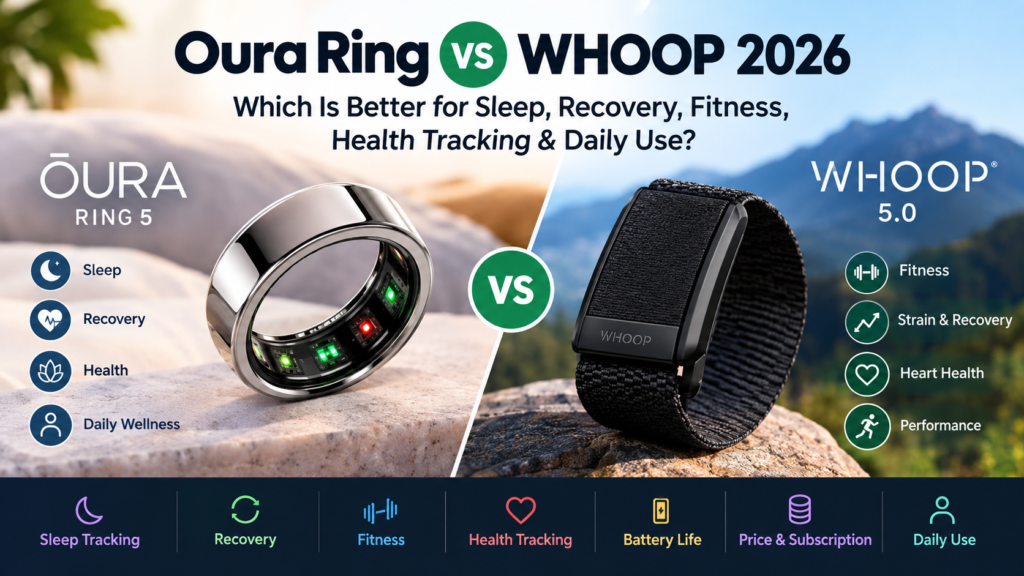
Oura Ring 5 and WHOOP 5.0 approach health and fitness tracking from two different directions. Oura uses a discreet titanium ring to monitor sleep, readiness, activity, and broader wellness trends. WHOOP uses a screenless wearable designed around continuous physiological monitoring, training load, and recovery coaching.
Both devices are designed for people who want more information than a basic step counter provides. However, their form factors, membership models, and fitness features make them better suited to different users.
This Oura Ring 5 vs WHOOP 5.0 comparison for 2026 examines their current specifications, subscription costs, sleep tracking, recovery scores, workout features, battery life, and health measurements. It also considers what independent accuracy research can—and cannot—tell us about the two platforms.
Editorial disclosure: This comparison uses publicly available manufacturer documentation and published research. It does not claim first-hand testing of both devices by the LifeCareBalance author. Manufacturer specifications are distinguished from independently validated results, and wearable health scores are not presented as medical diagnoses.
Oura Ring 5 vs WHOOP 5.0: Quick Comparison

- THE WORLD’S SMALLEST SMART RING – 40% smaller than the previous generation, Oura Ring 5 is thinner, lighter and smaller …
- SIZING IS ESSENTIAL – Oura Ring 5 uses unique sizing different from standard jewelry rings and other Oura Ring generatio…
- EVERYDAY HEALTH SENSING – Oura tracks over 50 health metrics, including sleep, activity, stress, heart health, metabolic…
- What You Get – A 12-month membership, WHOOP 5.0 device, a SuperKnit band, and a waterproof* Wireless PowerPack. Choose f…
- HSA/FSA Eligible – All 12-month WHOOP memberships and battery packs qualify for HSA/FSA reimbursement.
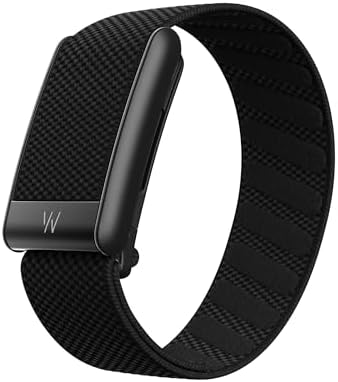
- Screenless, Distraction-Free – No screen, no buzzing notifications. WHOOP focuses entirely on your health and performanc…
| Feature | Oura Ring 5 | WHOOP 5.0 |
|---|---|---|
| Form factor | Titanium smart ring | Screenless wrist or compatible body-worn band |
| Display | None | None |
| Starting U.S. hardware price | $399 | Included with membership |
| Premium hardware pricing | Up to $499, depending on finish | WHOOP Life costs $359/year and includes WHOOP MG |
| Battery life | 6–9 days claimed | 14+ days claimed |
| Charging | Ring charging dock; optional charging case | Basic Charger or compatible Wireless PowerPack |
| Sleep tracking | Sleep stages, Sleep Score, sleep trends | Sleep stages, Sleep Performance, Sleep Need, Sleep Coach |
| Recovery | Readiness Score | Recovery Score |
| Training load | Activity and workout tracking | Strain score from 0–21 |
| Strength training | Activity logging and supported workout features | Strength Trainer and Muscular Strain features |
| HRV | Yes | Yes |
| Resting heart rate | Yes | Yes |
| Respiratory rate | Yes | Yes |
| Temperature tracking | Body-temperature trends | Skin-temperature trends |
| Blood oxygen | Overnight tracking | Overnight tracking |
| VO₂ Max | Available through supported features | Estimate after calibration |
| Built-in GPS | No | No |
| Membership | $69.99/year or $5.99/month in the U.S. | $199–$359/year in the U.S. |
| Best suited for | Sleep-focused wellness and discreet wear | Training, recovery, and performance tracking |
Specifications and prices are based on current manufacturer information and may change. Oura Ring 5 hardware prices vary by finish, while WHOOP membership pricing depends on the selected tier.
For the latest product information, see the official Oura Ring 5 specifications and WHOOP membership comparison.
The Fundamental Difference: A Ring vs a Screenless Band
The most important difference is not a particular sensor or score. It is how each company organizes the tracking experience.
Oura Ring 5: Discreet Wellness Tracking
Oura Ring 5 is designed to look and feel like a piece of jewelry. It tracks physiological signals while you go about your day, then presents the information through the Oura app.
The platform emphasizes sleep, readiness, activity, stress, and longer-term wellness patterns.
Its ring form factor may appeal to people who do not want a wrist strap or another visible device. It can also be convenient for people who prefer to review their health trends in the morning rather than monitor training metrics throughout the day.
However, a ring is not ideal for everyone. Some users may find it uncomfortable during heavy lifting, gripping exercises, or activities where a ring can move against equipment.
WHOOP 5.0: Training and Recovery Tracking
WHOOP 5.0 is designed around continuous wear and a more detailed training and recovery framework.
Its core concepts are:
- Sleep Performance and Sleep Need
- Daily Recovery Score
- Daily and workout-related Strain
- Heart-rate and HRV trends
- Personalized coaching
- Strength-training features
- Additional wellness features on higher membership tiers
The device has no traditional display, so most interaction happens in the app. This suits users who want training analytics rather than a conventional smartwatch experience.
The practical distinction: Oura organizes its experience around daily wellness and readiness, while WHOOP connects recovery more directly to training load and recommended exertion.
For a closer look at Oura’s overall features, read our Oura Ring Review 2026.
Oura Ring 5 vs WHOOP 5.0 for Sleep
Sleep is a major strength of both platforms, but each presents its data differently.
Oura Sleep Tracking
Oura tracks sleep duration, estimated sleep stages, timing, efficiency, and other sleep-related patterns. Its Sleep Score summarizes selected aspects of the previous night’s sleep.
The app also uses overnight physiological information, including HRV, resting heart rate, and temperature trends, to help inform the broader Readiness experience.
Depending on the supported software features, Oura can also provide nap-related information and insights into accumulated sleep debt.
The advantage is a relatively straightforward view of sleep and how it may relate to the following day’s readiness.
WHOOP Sleep Tracking
WHOOP tracks estimated sleep stages and uses sleep duration, consistency, and other information to calculate Sleep Performance.
Its Sleep Coach provides a more prescriptive approach. Rather than simply showing how much you slept, it estimates your Sleep Need and recommends how much sleep to aim for based on your recent patterns and activity.
This can be helpful for people whose training schedules change throughout the week.
For example, someone completing a demanding workout may receive a different sleep recommendation from someone who has had a light-activity day.
Which Is Better for Sleep?
Oura is a strong option for people who want a discreet wearable and a clear overview of sleep and readiness.
WHOOP is attractive to people who want sleep recommendations integrated into a training-focused system.
Neither platform can guarantee that its estimated sleep stages precisely match a clinical sleep study. Both are more useful for observing patterns over time than interpreting a single night’s numbers as definitive measurements.
If sleep tracking is your primary goal, explore our Best Sleep Trackers in 2026 guide for additional wearable and non-wearable options.
Oura Readiness vs WHOOP Recovery
Both devices condense multiple measurements into a daily score, but the scores serve slightly different purposes.
Oura Readiness Score
Oura Readiness is designed to summarize how prepared you may be for the day.
Depending on the available features and data, its inputs include sleep-related information, HRV, resting heart rate, temperature deviations, and recent activity.
The app also provides contributing factors to help explain why your score may be higher or lower than usual.
WHOOP Recovery Score
WHOOP Recovery uses physiological and sleep-related information to estimate how prepared your body may be for additional strain.
Its color-coded system commonly uses these ranges:
| Recovery category | Score |
|---|---|
| Green | 67–100% |
| Yellow | 34–66% |
| Red | 0–33% |
WHOOP also connects Recovery to its daily Strain recommendations, making the relationship between recovery and exercise intensity a central part of the platform.
Which Recovery System Is More Useful?
Choose Oura if you prefer a broader wellness-oriented readiness summary.
Choose WHOOP if you want recovery information closely integrated with training-load guidance.
Neither score is a direct measurement of muscle recovery or a guarantee that you can safely complete a demanding workout. Use these scores alongside your energy levels, soreness, sleep habits, and training history.
Oura Ring 5 vs WHOOP 5.0 for Fitness and Workouts
This is one of the clearest differences between the two devices.
Oura Fitness Tracking
Oura tracks daily activity and supported workouts, helping users understand how movement relates to their overall wellness trends.
Its app can provide activity-related information and estimates through supported features. However, Oura does not have built-in GPS, and its ring form factor is not designed to replace a dedicated sports watch.
For users who exercise recreationally, this may be sufficient. People who want extensive workout-specific training-load analysis may prefer another platform.
WHOOP Fitness Tracking
WHOOP places more emphasis on training intensity and accumulated exertion.
Its Strain system uses a proprietary scale from 0 to 21. The platform also supports automatic activity detection and provides Strength Trainer features intended to account for muscular effort during resistance exercise.
This distinction matters because heart rate alone does not fully represent the demands of every lifting session.
WHOOP’s training-oriented system may therefore appeal to athletes who regularly review workout load, recovery, and longer-term performance patterns.
Which Is Better for Athletes?
WHOOP is generally the more natural fit for people who want detailed training and recovery guidance.
Oura is a reasonable option for people who exercise regularly but want activity tracking to remain one part of a broader wellness experience.
Neither device includes built-in GPS, so users who require independent route tracking and navigation should compare dedicated sports watches as well.
Health Tracking: What Can Each Device Tell You?
Both Oura and WHOOP track physiological signals beyond basic activity.
| Metric | Oura Ring 5 | WHOOP 5.0 |
|---|---|---|
| Heart rate | Yes | Yes |
| HRV | Yes | Yes |
| Resting heart rate | Yes | Yes |
| Respiratory rate | Yes | Yes |
| Temperature trends | Yes | Yes |
| Blood oxygen | Yes | Yes |
| Sleep estimates | Yes | Yes |
| VO₂ Max estimate | Supported feature | Supported feature after calibration |
| Proprietary readiness/recovery score | Readiness | Recovery |
| Blood pressure-related insights | Available through supported wellness features | WHOOP MG/Life only |
| ECG | Not a standard ring feature | WHOOP MG/Life, subject to eligibility and availability |
The availability of advanced features can depend on country, app version, membership, and regulatory requirements.
Important Limitations
Wearables use sensors and algorithms to estimate many of their health metrics. A change in resting heart rate, HRV, temperature, or blood oxygen does not identify the cause of that change.
Oura’s blood-pressure-related features should not be confused with a conventional blood pressure measurement. WHOOP Blood Pressure Insights are also intended for wellness use rather than diagnosis or treatment.
WHOOP’s ECG features require compatible WHOOP MG hardware and an eligible membership. They are not included with standard WHOOP 5.0 hardware.
Neither product should be purchased on the assumption that it can independently diagnose a health condition.
Oura Ring 5 vs WHOOP 5.0: Subscription and Total Cost
Subscription pricing is one of the most important considerations because the two companies use different ownership models.
Oura Ring 5 Pricing
Oura Ring 5 starts at $399 in the U.S., with certain premium finishes priced at $499.
Oura Membership is listed at $5.99 per month or $69.99 per year in the U.S. Membership provides access to the full set of app insights and features.
Using the base ring price and annual membership:
| Ownership period | Approximate cost |
|---|---|
| Initial ring purchase | $399 |
| First year, including annual membership | $468.99 |
| Three years, including annual membership each year | $608.97 |
| Five years, including annual membership each year | $748.95 |
These estimates assume a $399 ring, annual membership at $69.99, no discounts, no taxes, and no replacement hardware or accessories.
WHOOP Membership Pricing
WHOOP bundles its hardware with membership rather than charging a separate standard device price.
| Membership | Annual U.S. price | Main distinction |
|---|---|---|
| WHOOP One | $199 | Core Sleep, Recovery, and Strain tracking |
| WHOOP Peak | $239 | Adds Health Monitor, Stress Monitor, and Healthspan features |
| WHOOP Life | $359 | Includes WHOOP MG and additional cardiovascular features |
Assuming unchanged prices and continuous membership:
| Membership | One year | Three years | Five years |
|---|---|---|---|
| WHOOP One | $199 | $597 | $995 |
| WHOOP Peak | $239 | $717 | $1,195 |
| WHOOP Life | $359 | $1,077 | $1,795 |
These are simple cost projections, not guarantees of future pricing or membership terms.
Which Is Cheaper Long-Term?
Oura generally has the lower ongoing membership cost once the ring has been purchased.
WHOOP One may cost less initially because the hardware is included with membership. However, the annual fee continues, so the total cost increases with each renewal.
The comparison also depends on what you value. WHOOP’s annual membership includes access to its training and recovery platform and bundled hardware, while Oura’s separate hardware purchase gives you a different ownership model.
Do not compare subscription prices alone. Consider the features you will actually use, replacement costs, and whether you prefer a ring or a band.
Battery Life and Charging
WHOOP has the longer advertised battery interval.
Oura Ring 5
Oura lists approximately 6–9 days of battery life for Ring 5. The ring charges on a compatible dock, and an optional charging case is available for portable charging.
The ring must be placed on its charger to replenish the battery, creating a period when it is not being worn.
WHOOP 5.0
WHOOP advertises 14+ days of battery life. The Basic Charger can charge the device off the wrist, while the compatible Wireless PowerPack can charge it while being worn.
The ability to charge without removing the wearable is a practical advantage for people who prioritize continuous monitoring.
WHOOP also promotes extended use with its Wireless PowerPack, but actual battery performance depends on usage and conditions.
Winner for advertised battery life: WHOOP 5.0.
For official charging details, see WHOOP’s battery and charging documentation.
Comfort and Everyday Wear
Comfort depends on individual fit and activity.
Why You Might Prefer Oura
Oura is less visible than a wrist strap and can suit people who want a wearable that looks like ordinary jewelry.
Its slim profile and lack of a display may make it convenient for everyday wear and sleep tracking. However, correct sizing is important, and ring comfort can vary during gripping exercises, weightlifting, or other activities involving the hands.
Why You Might Prefer WHOOP
WHOOP’s band design supports wrist wear and compatible alternative placements. This can be useful for people who prefer not to wear a ring during workouts.
The device is designed for continuous use, including sleep. Still, strap fit, skin sensitivity, moisture, and personal preference can influence comfort.
Neither product is guaranteed to feel comfortable for every person. If possible, consider sizing and return policies before purchasing.
Accuracy: What Does Independent Research Say?
It is tempting to ask which device is more accurate overall, but that question is too broad.
Sleep stages, HRV, recovery scores, and activity measurements are different metrics. A device may perform well for one measurement and less consistently for another.
Published research has examined earlier generations of consumer wearables, including Oura Ring 3, Oura Ring 4, and WHOOP 4.0. Such studies can help explain the strengths and limitations of wearable measurements, but their findings cannot automatically be transferred to the newest hardware.
For example, a peer-reviewed study available through the National Library of Medicine compared several wearables against an ECG reference for resting heart rate and HRV. The study provides evidence about the tested devices and conditions, not proof that one current-generation product is universally more accurate.
Read the published wearable validation study for its methods and limitations.
Oura and WHOOP both describe improvements to their newer sensors and algorithms. Those manufacturer claims should be distinguished from independent validation of each current-generation model.
The practical takeaway is to use wearable data for personal trends, not to assume that every score is a precise physiological measurement.
Oura Ring 5 Pros and Cons
Pros
- Discreet titanium ring design
- No screen or traditional smartwatch notifications
- Strong focus on sleep, readiness, and wellness trends
- Advertised battery life of 6–9 days
- Lower ongoing membership cost than WHOOP
- Useful for people who prefer not to wear a wrist strap
Cons
- Higher upfront hardware cost
- Membership required for full insights
- Must be removed for dock charging
- Ring fit may be inconvenient during some strength-training activities
- No built-in GPS
- Wellness estimates should not be treated as medical diagnoses
WHOOP 5.0 Pros and Cons
Pros
- Advertised battery life of 14+ days
- Wireless PowerPack can charge the device while worn
- Dedicated Recovery and Strain framework
- Training-oriented coaching and Strength Trainer features
- Hardware included with membership
- Higher tiers offer additional health and longevity features
Cons
- Ongoing membership required
- Annual cost is higher than Oura’s ongoing membership fee
- No traditional smartwatch display or built-in GPS
- Some features require Peak or Life
- WHOOP MG features are not available on standard WHOOP 5.0
- Proprietary scores are not clinical measurements
Which One Should You Buy?
The best option depends on what you want from a wearable.
Choose Oura Ring 5 if:
- Sleep and everyday wellness are your main priorities.
- You prefer a discreet ring over a wrist strap.
- You want readiness insights without a training-focused interface.
- You prefer a lower ongoing membership cost after purchasing hardware.
Choose WHOOP 5.0 if:
- You train regularly and want a dedicated Strain system.
- You want Recovery connected to daily training recommendations.
- You use detailed workout and strength-training insights.
- You value longer advertised battery life and on-wrist charging.
Consider a different wearable if:
- You need built-in GPS navigation.
- You want a display, notifications, apps, or calls.
- You do not want any recurring membership.
- You need clinical measurements rather than wellness estimates.
For a wider look at devices across different budgets and use cases, explore our Best Wellness Products 2026 guide.
Frequently Asked Questions
Is Oura Ring 5 better than WHOOP 5.0?
Neither is universally better. Oura is more focused on discreet sleep and wellness tracking, while WHOOP is more explicitly designed around training load, Recovery, and Strain.
Which is better for sleep tracking?
Both provide sleep-stage estimates and sleep-related insights. Oura emphasizes Sleep Score and Readiness, while WHOOP adds Sleep Coach recommendations based on estimated Sleep Need.
Which is better for athletes?
WHOOP is generally the stronger fit for users who want training-load analysis, a dedicated Strain scale, and recovery-linked exercise guidance.
Which has better battery life?
WHOOP advertises 14+ days per charge, compared with Oura Ring 5’s advertised 6–9 days. Actual battery life varies.
Is Oura cheaper than WHOOP?
Oura has a higher upfront hardware cost but a lower ongoing membership fee. WHOOP includes its device with membership, but the annual subscription continues for as long as you want the full service.
Can I use Oura without a membership?
Oura provides limited functionality without an active membership. Full insights and the complete app experience require membership.
Can I use WHOOP without a membership?
An active WHOOP membership is required for its core ongoing service. It is not designed as a conventional one-time hardware purchase with full functionality continuing indefinitely.
Does WHOOP have ECG?
ECG features are available with eligible WHOOP Life membership and WHOOP MG hardware, subject to regional availability and eligibility requirements. Standard WHOOP 5.0 does not include this functionality.
Do either of these devices diagnose medical conditions?
No. Their general wellness scores and estimates should not replace clinical tests, medical evaluation, or advice from a qualified healthcare professional.
Can Oura and WHOOP track VO₂ Max?
Both offer VO₂ Max-related estimates or supported features, but availability and calculation methods differ. Neither should be treated as a substitute for a laboratory exercise test.
Final Verdict: Oura Ring 5 vs WHOOP 5.0
Oura Ring 5 and WHOOP 5.0 offer overlapping health-tracking capabilities but serve different priorities.
Oura is the better fit for many people who want discreet wear, sleep insights, and a broader wellness dashboard. Its separate hardware purchase and lower ongoing membership cost may also appeal to users thinking about long-term ownership.
WHOOP is better aligned with people who want detailed training and recovery guidance, a dedicated Strain system, and longer advertised battery life. Its membership model makes the most sense when you intend to use the coaching and analytics consistently.
Our recommendation: Choose Oura Ring 5 for a sleep- and wellness-first experience. Choose WHOOP 5.0 for a training- and recovery-first experience. Before buying either device, compare the total cost over several years and make sure its form factor and membership model suit your routine.
Neither wearable can replace clinical assessment, and neither is automatically the more accurate choice for every health metric. The best device is the one whose data you can understand, trust appropriately, and use to support realistic habits.