
LifeCareBalance.com is reader-supported. When you buy through links on our site, we may earn an affiliate commission at no extra cost to you. As an Amazon Associate, we earn from qualifying purchases.
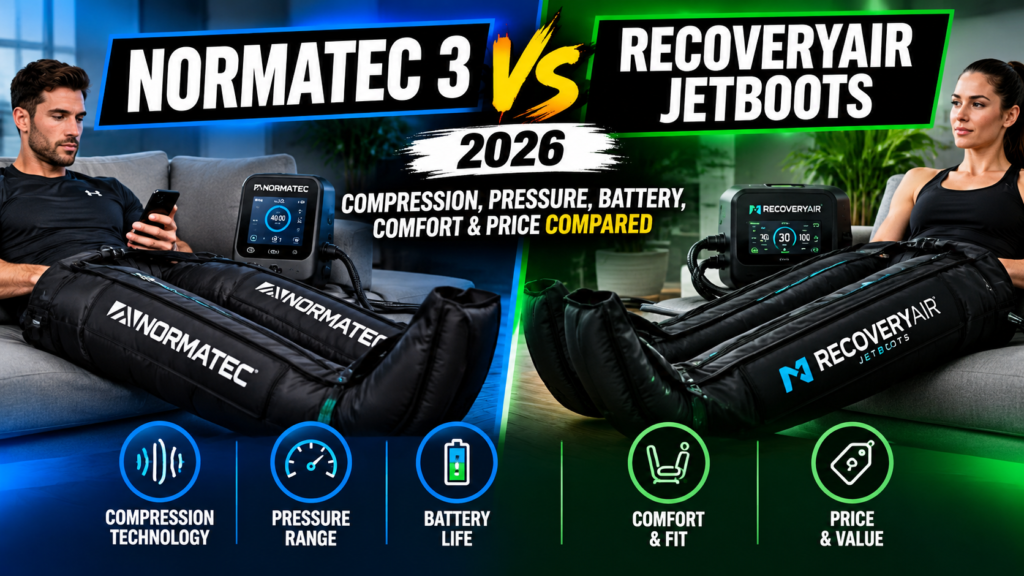
Which compression boots make more sense for your recovery routine — Normatec 3 or RecoveryAir JetBoots? Both use pneumatic compression, the same broad technology hospitals have used for decades to support circulation, but the two systems take different approaches to design, control, and portability. Normatec 3 pairs its boots with a separate control unit and hose, giving you deep zone-by-zone customization. RecoveryAir JetBoots, Therabody’s original fully wireless design, builds the pump directly into each boot for a grab-and-go setup.
This guide compares Normatec 3 vs RecoveryAir JetBoots on the details that actually affect your daily routine: pressure levels, battery life, wireless convenience, comfort, app control, and price. We’ll also look at what independent research says about compression boots for leg recovery — separate from what either brand claims in its marketing. Nothing here is a substitute for individualized medical advice.
A quick naming note before we start: Therabody’s product lineup has shifted. The original RecoveryAir JetBoots (the model this article focuses on) was the company’s first cordless compression boot. Therabody has since introduced JetBoots Prime and JetBoots PRO Plus as updated, separate products with their own specs and pricing. We’ll flag the distinction throughout so you don’t end up comparing mismatched generations.
Quick Comparison Table
| Feature | Normatec 3 Legs | RecoveryAir JetBoots (original) |
|---|---|---|
| Current price | $899 (Hyperice.com) | Approximately $799–$899 at most retailers; original MSRP has been listed as high as $1,299 |
| Compression technology | Dynamic air compression via external control unit + hose | TruGrade Technology; integrated pumps in each boot |
| Pressure/intensity levels | 7 levels, 40–110 mmHg | 4 levels, 20–100 mmHg |
| Compression zones/chambers | 5 zones with gapless coverage | Sequential chambers (feet-to-heart gradient) |
| Battery | Up to 3 hours (control unit) | Up to 240 minutes (4 hours) |
| Wireless/wired design | Boots connect via hose to a separate control unit | Fully wireless; no external pump or tubing |
| App support | Bluetooth, Hyperice App | Bluetooth, Therabody App |
| Session options | Custom duration via app; ZoneBoost for targeted zones | 20, 40, 60 minutes, or continuous mode |
| Sizes | Short, Standard, Tall | Small, Medium, Large |
| Weight | 3.2 lbs (control unit only; boots are separate) | Heavier per boot due to built-in motors; exact figures vary by retailer listing |
| Warranty | Standard Hyperice limited warranty (confirm current term at checkout) | Standard Therabody limited warranty (confirm current term at therabody.com) |
| Best suited for | Users who want maximum pressure range and zone-specific customization | Users who prioritize a cordless, grab-and-go setup |
Specifications reflect the manufacturers’ published listings as of this writing and can change. Always confirm current specs on Hyperice’s official Normatec 3 page and Therabody’s JetBoots resource page before purchasing.
Normatec 3 Overview
Normatec 3 uses what Hyperice calls dynamic air compression: a control unit inflates and deflates five overlapping zones in the boot in a patterned sequence, mimicking the body’s natural muscle pump. The system offers 7 compression levels ranging from 40 to 110 mmHg, and a feature called ZoneBoost lets you add extra pressure to one specific zone — useful if your calves feel tighter than your thighs, for example.
The control unit runs on Bluetooth and pairs with the Hyperice App, which unlocks more granular session control than the boots’ built-in buttons alone. Battery life is rated at up to 3 hours, and the unit itself weighs about 3.2 lbs, small enough that Hyperice markets it as TSA-friendly for travel.
Setup means clipping the boots into the control unit via a hose, then sitting or lying down for the session — you’re tethered to the unit rather than fully mobile. Sizing runs Short, Standard, and Tall, based on height.
Strengths: wide pressure range, granular zone customization, established brand with a long track record in both sports and clinical settings.
Limitations: the hose-and-control-unit design means less freedom of movement during a session compared to a fully wireless boot, and at $899 it sits at the higher end of the compression boot category.
RecoveryAir JetBoots Overview
RecoveryAir JetBoots was Therabody’s answer to the tethered-boot format: instead of a separate control unit, each boot has its own integrated pump. There’s no hose to manage and nothing to set on the floor next to you — you put the boots on, power them up, and go.
The system uses TruGrade Technology, which Therabody describes as applying a true negative-pressure gradient starting at the feet and working toward the heart. A second feature, FastFlush Technology, is built to complete a full inflate-and-deflate cycle in about 60 seconds, which the company positions as notably faster than typical hose-connected systems.
Users get 4 pressure settings between 20 and 100 mmHg and four session options: 20, 40, 60 minutes, or a continuous mode. Battery life is rated at up to 240 minutes. Controls are accessible via one-touch buttons on the boots themselves, with deeper customization available through the Therabody App over Bluetooth. Sizing runs Small, Medium, and Large based on outseam and height.
It’s worth repeating: this is the original RecoveryAir JetBoots line. Therabody’s current catalog lists two newer, separate wireless compression products — JetBoots Prime and JetBoots PRO Plus — with different chamber counts, pressure increments, and added features like infrared LED and vibration therapy. If you’re shopping today, check which specific model a listing is actually describing; specs and pricing for the original RecoveryAir JetBoots and the newer JetBoots Prime/PRO Plus are not interchangeable. The official RecoveryAir JetBoots user manual is the most reliable source for this specific model’s operating specs.
Strengths: genuinely cordless design, fast inflation/deflation cycles, simple one-touch operation.
Limitations: narrower pressure range (20–100 mmHg vs. Normatec 3’s 40–110 mmHg) and fewer preset session lengths than some competitors offer.
Normatec 3 vs RecoveryAir JetBoots: Compression Technology
Both systems rely on the same underlying principle: pneumatic compression, where air chambers inflate and deflate in a sequence to apply and release pressure along the leg. Where they differ is in how that pressure is generated and delivered.
Normatec 3 keeps the pump in a separate control unit, sending air through a hose into five overlapping zones in each boot — Hyperice calls this “gapless” compression because the zones overlap rather than leaving pressure gaps between chambers. RecoveryAir JetBoots moves the pump hardware into the boot itself, using TruGrade Technology to create a directional pressure gradient without any external tubing.
Neither approach has been shown to be medically superior to the other in independent research; the practical differences show up more in daily convenience — portability, setup time, and how much gear you’re managing — than in any proven physiological advantage of one pump location over the other.
Pressure and Intensity Comparison
Normatec 3 offers 7 levels across a 40–110 mmHg range, while RecoveryAir JetBoots offers 4 levels across a 20–100 mmHg range. In practical terms, Normatec 3 gives you finer gradations to dial in and a higher ceiling if you prefer a firmer squeeze, while RecoveryAir JetBoots’ narrower range still covers the pressure band most consumer research and manufacturer guidance points to for general recovery use.
It’s worth being clear about what pressure settings do and don’t mean for the average user: a higher number is not automatically “better” or more effective for recovery. Comfort, session length, and consistency of use appear to matter as much as peak pressure. Many users find a moderate setting more sustainable for regular sessions than maxing out the intensity every time.
Wireless Design vs. Hose-Connected Design
This is one of the most practical differences between the two systems, and it’s likely to matter more to your day-to-day experience than the pressure specs.
Portability: RecoveryAir JetBoots’ integrated-pump design means there’s no separate control unit to pack, making it easier to toss in a gym bag or suitcase. Normatec 3 requires bringing (or storing) the control unit alongside the boots.
Setup: Normatec 3 involves clipping boots into the control unit and running the hose before starting a session. RecoveryAir JetBoots’ setup is closer to putting on a pair of shoes and pressing a button.
Travel: Neither system is tiny, but a fully wireless boot avoids the tangle of hoses in a suitcase and doesn’t require finding floor space for a control box in a hotel room.
Sitting on the couch or in bed: With Normatec 3, you’re tethered to the control unit’s hose length, which limits how far you can move during a session. RecoveryAir JetBoots lets you shift position more freely since there’s nothing connecting the boots to an external box.
Gym use: A wireless design is generally easier to use in a locker room or shared training space where floor space and outlets may be limited.
Storage: Normatec 3’s control unit and boots store as separate pieces; RecoveryAir JetBoots’ boots are more self-contained, though they still need to be charged and stored somewhere with adequate airflow.
If wireless convenience is your top priority, this section alone may settle the decision. If you value the customization Normatec 3’s control unit and app combination offer, the trade-off in portability may be worth it.
Comfort and Fit
Normatec 3 covers the leg in five overlapping zones and is available in Short, Standard, and Tall sizing based on height, with Hyperice recommending sizing down if you’re between sizes. RecoveryAir JetBoots uses Small, Medium, and Large sizing based on outseam and height measurements.
Because RecoveryAir JetBoots houses a motor inside each boot, the boots themselves carry more built-in hardware than Normatec 3’s boots, which route their pump function through the external control unit. This can affect how the boot feels on the leg, particularly around fit and how the boot flexes when you move. Neither company publishes independent comfort data, so claims about “softer” or “more comfortable” boots between the two systems should be treated as subjective until backed by user testing rather than manufacturer copy.
For longer sessions (45–60 minutes), sizing accuracy matters more than it does for a quick 20-minute flush — a boot that’s slightly too tight can become noticeably uncomfortable as the session goes on. Both brands publish sizing charts based on height and inseam/outseam measurements; measuring carefully before ordering is worth the extra few minutes.
Battery Life and Portability
Normatec 3’s control unit is rated for up to 3 hours of battery life, while RecoveryAir JetBoots is rated for up to 240 minutes (4 hours). On paper, that gives RecoveryAir JetBoots a longer runway between charges, which may matter more to frequent travelers, teams sharing a single pair between multiple athletes, or anyone who wants to skip charging for several days at a time.
Runners, cyclists, and other athletes recovering away from home — hotel rooms, race weekends, team facilities — are the group most likely to feel the practical benefit of a wireless, longer-battery design. Someone using their boots primarily at home on a consistent charging schedule may find the battery difference less significant day to day.
App and Customization
Both systems pair with a companion app over Bluetooth: Normatec 3 with the Hyperice App, and RecoveryAir JetBoots with the Therabody App. Both apps allow remote adjustment of pressure and session time beyond what the physical controls on the units or boots offer.
Normatec 3’s ZoneBoost feature stands out here, letting you push extra pressure into one specific zone rather than treating the whole leg uniformly — a useful option if soreness is concentrated in one area, like calves after a hard run. RecoveryAir JetBoots’ four time-interval and four pressure-setting combinations give you a smaller but simpler set of choices, which some users may prefer for a “select and go” experience rather than fine-tuning zone-by-zone.
Neither app-based system requires a subscription to use core functions, based on current manufacturer information, though this is worth double-checking at the time of purchase since policies can change.
Recovery Benefits — What Does the Evidence Actually Say?
Marketing copy for compression boots often promises faster recovery and reduced soreness. Independent research offers a more measured picture, and it’s worth separating manufacturer claims from what’s actually been studied.
A 2024 systematic review and meta-analysis published in Biology of Sport examined 17 studies on lower-limb intermittent pneumatic compression (IPC) for sports recovery. The researchers found a trivial-to-small effect on muscular function recovery, a trivial-to-moderate effect on perceived pain and soreness (the strongest benefit showed up around the 48-hour mark, which coincides with typical delayed-onset muscle soreness), and highly inconsistent results on physiological markers of muscle damage like creatine kinase. The review’s authors concluded that lower-limb IPC “might be a method with potential effects for recovery in sports, mainly reducing perceived soreness” — but stopped well short of claiming it improves objective measures of athletic performance. You can read the full study via PubMed.
A more recent 2025 review in the Strength and Conditioning Journal, covering 27 studies and more than 500 participants, likewise found that evidence for IPC’s effect on muscle recovery after exercise-induced muscle damage remains limited and inconsistent across outcome measures. You can review the abstract via PubMed.
Taken together, the current evidence suggests compression boots may help with how sore you feel — particularly in the 24-to-48-hour window after hard exercise — but the research does not support claims that they meaningfully speed up objective muscle-function recovery, flush out lactic acid, or prevent injury. If you’re weighing compression boots against other recovery tools, it’s worth reading our related coverage on massage guns for athletes and the massage gun buying guide for comparison, since the evidence base for percussive therapy has its own strengths and limits.
Which One Fits Your Use Case?
Rather than naming an overall winner, here’s how the two systems tend to line up with different priorities:
- For maximum customization: Normatec 3’s 7 pressure levels and ZoneBoost give you more granular control.
- For wireless portability: RecoveryAir JetBoots’ integrated-pump design wins on convenience.
- For frequent travelers: RecoveryAir JetBoots’ cordless setup and slightly longer battery rating are practical advantages.
- For home recovery: Either system works well if you have dedicated space for a couch or recliner session; Normatec 3’s app-based zone control may appeal to users who like to fine-tune each session.
- For runners: Both are commonly used post-run; RecoveryAir JetBoots’ fast inflate/deflate cycle may suit shorter between-run sessions.
- For cyclists: Normatec 3’s higher pressure ceiling may appeal to those who prefer a firmer compression feel after long rides.
- For lifters: Either system’s pressure range covers typical post-lift recovery use; Normatec 3’s zone targeting may help with localized soreness.
- For people who want simple controls: RecoveryAir JetBoots’ one-touch, preset-based interface is more straightforward.
- For people who want zone-specific adjustment: Normatec 3’s ZoneBoost is the more tailored option.
- For buyers comparing premium recovery systems generally: Both sit at the higher end of the leg recovery boots category and are worth comparing against your budget and how often you’ll realistically use them.
Price and Value
Normatec 3 Legs currently lists at $899 directly through Hyperice. RecoveryAir JetBoots pricing varies more by retailer, typically landing between roughly $799 and $899, though some listings show a higher original MSRP before discounts. Given that Therabody’s current catalog has shifted toward JetBoots Prime ($549.99) and JetBoots PRO Plus ($1,149.99) as the actively promoted wireless compression products, RecoveryAir JetBoots inventory is increasingly found through third-party retailers rather than Therabody’s own site — worth factoring in if warranty support or return policy matters to your decision.
Neither product is objectively “better value” in a blanket sense. What you’re paying for differs: Normatec 3’s price reflects its wider pressure range, zone-specific customization, and a longer track record in both athletic and clinical settings. RecoveryAir JetBoots’ value proposition centers on the convenience of a genuinely cordless design. Which one justifies its price depends on whether portability or customization matters more for how and where you’ll actually use the boots.
Pros and Cons
Normatec 3 Pros
- Widest pressure range in this comparison (40–110 mmHg)
- ZoneBoost allows targeted pressure to specific areas
- Long-standing brand history in both sports and medical compression
- TSA-friendly control unit for travel
Normatec 3 Cons
- Hose-and-control-unit design limits mobility during sessions
- Higher price point than RecoveryAir JetBoots
- More pieces to pack, charge, and store
RecoveryAir JetBoots Pros
- Fully wireless with no external pump or hose
- Fast inflate/deflate cycle (about 60 seconds per Therabody’s specs)
- Simple one-touch controls
- Slightly longer rated battery life
RecoveryAir JetBoots Cons
- Narrower pressure range (20–100 mmHg) and fewer levels than Normatec 3
- Increasingly available mainly through third-party retailers rather than Therabody’s primary storefront
- No zone-specific pressure targeting comparable to ZoneBoost
Safety and Precautions
Pneumatic compression devices are not appropriate for everyone. People with certain vascular or circulatory conditions, a suspected or confirmed blood clot or deep vein thrombosis (DVT), recent leg surgery or injury, uncontrolled heart conditions, or other relevant medical concerns should consult a healthcare professional before using any compression boot system. Pregnant users and anyone with an unclear medical history related to circulation should also check with a doctor first.
This article does not diagnose any condition and isn’t a substitute for individualized medical advice. Both manufacturers publish their own safety and contraindication guidance — refer to Therabody’s official precautions page and Hyperice’s product documentation for the most current safety information before use.
FAQ
Is Normatec 3 better than RecoveryAir JetBoots? Neither is universally “better” — Normatec 3 offers a wider pressure range and zone-specific customization, while RecoveryAir JetBoots offers a fully wireless, more portable design. The right choice depends on whether you prioritize customization or convenience.
What is the difference between Normatec 3 and RecoveryAir JetBoots? Normatec 3 uses a separate control unit connected to the boots via a hose, offering 7 pressure levels and 5 compression zones. RecoveryAir JetBoots integrates the pump into each boot for a wireless design, with 4 pressure levels and a feet-to-heart pressure gradient.
Which has stronger compression? Normatec 3 has a higher maximum pressure setting (110 mmHg vs. 100 mmHg) and more total levels (7 vs. 4), giving it a wider intensity range overall.
Are RecoveryAir JetBoots wireless? Yes. RecoveryAir JetBoots use integrated pumps built into each boot, eliminating the external control unit and hose that Normatec 3 requires.
How long does Normatec 3 battery last? Hyperice rates the Normatec 3 control unit’s battery at up to 3 hours per charge, though actual runtime can vary with pressure setting and session length.
Can compression boots reduce muscle soreness? Research suggests intermittent pneumatic compression may help reduce perceived soreness, particularly in the 24-to-48-hour window after hard exercise, though evidence for improving objective muscle function is more limited and mixed.
Are compression boots worth it for runners? Many runners find compression boots a convenient part of their recovery routine, and research shows some benefit for perceived soreness. Whether the cost is “worth it” depends on your budget, training volume, and how consistently you’ll use the device.
Can you use compression boots every day? Many users incorporate compression boots into a daily or near-daily routine, but session length and pressure should stay within manufacturer guidance, and anyone with underlying health conditions should check with a doctor about appropriate frequency.
Which compression boots are better for travel? RecoveryAir JetBoots’ fully wireless design generally makes it more travel-friendly, since there’s no external control unit or hose to pack alongside the boots.
Final Thoughts
Normatec 3 and RecoveryAir JetBoots both apply the same core technology — pneumatic compression — but they emphasize different priorities. Normatec 3 leans into customization and zone-specific control through its separate control unit and app, while RecoveryAir JetBoots’ wireless design emphasizes convenience and portability above all else. Neither is a universal winner; the better fit depends on whether you value fine-tuned control or grab-and-go simplicity more in your own recovery routine.
If you’re still comparing recovery tools, it may help to look at how compression boots stack up against other options in our guides on premium vs. budget massage guns and how to choose the right massage gun.