
LifeCareBalance.com is reader-supported. When you buy through links on our site, we may earn an affiliate commission at no extra cost to you. As an Amazon Associate, we earn from qualifying purchases.
If you’ve spent any time researching recovery gear, you already know the Normatec 3 isn’t cheap. At $899 for the Legs system, it costs several times more than a foam roller, a pair of compression socks, or even most massage guns. So before you add it to your cart, the real question isn’t “does it work” — it’s whether dynamic air compression justifies that price compared with cheaper recovery tools you may already own.
This Hyperice Normatec 3 review breaks down the manufacturer’s specifications, what independent reviewers say the experience is actually like, what the current scientific research shows about recovery outcomes, and who is — and isn’t — a good candidate for this device. We’ll also compare it with the newer Normatec Elite and with massage guns, so you can see where it fits in the broader recovery-tool landscape.
A note on configurations: Hyperice sells the Normatec 3 in three packages — Legs, Lower Body (legs + hips), and Full Body (legs + hips + arms) — at different price points with different included attachments. This review focuses primarily on the Normatec 3 Legs system, the most popular and most searched configuration, and notes where the Lower Body and Full Body packages differ.
Quick Verdict
| Category | Details |
|---|---|
| Product | Hyperice Normatec 3 Legs |
| Current price | $899 (regular price; verify before purchase, as pricing changes) |
| Compression type | Dynamic air compression, sequential/pulse pattern |
| Compression levels | 7 |
| Pressure range | 40–110 mmHg |
| Compression zones | 5 overlapping, gapless zones |
| ZoneBoost | Yes — adds extra pressure to a targeted zone |
| Battery | Up to 3 hours |
| App | Hyperice App (Bluetooth) |
| Best for | Runners, gym-goers, and endurance athletes who want a passive, hands-free recovery routine several times per week |
| Main drawback | High price relative to evidence of benefit, plus an external control unit and hoses that limit portability |
We’re not assigning a fabricated numerical score (like “9/10”), since no independent, verifiable testing panel has scored this exact configuration. Instead, this review focuses on giving you the specifics you need to decide for yourself.
What Is the Hyperice Normatec 3?
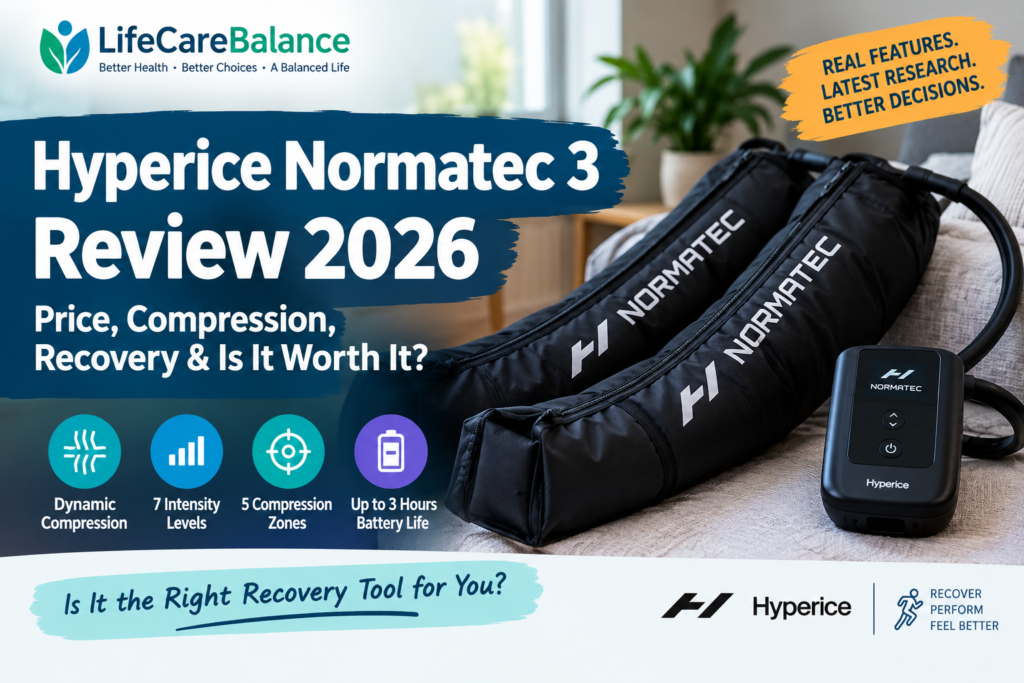
The Normatec 3 is a pneumatic compression device: a pair of inflatable boots (sleeves) connected by hoses to a control unit that pumps air into and out of the sleeves in a set pattern, squeezing the entire limb in sequence from the foot upward. This differs from a massage gun, which uses percussive vibration on the surface of a muscle rather than whole-limb compression.
Hyperice calls this “dynamic air compression” with patented Pulse technology across 5 overlapping, gapless compression zones per leg. “Gapless” means the zones transition into each other without a pressure gap, so compression feels like one continuous wave rather than five separate squeezes.
ZoneBoost lets you direct extra pressure to a specific zone — for example, adding more compression around tight calves or thighs — rather than applying uniform pressure to the whole leg.
Hyperice Normatec 3 Specifications
The specs below are Hyperice’s published manufacturer data for the Legs configuration. Lower Body and Full Body packages share the same control unit and compression technology but include additional attachments and cost more.
| Spec | Normatec 3 Legs |
|---|---|
| Price | $899 (regular price) |
| Control unit weight | Approx. 3.2 lb |
| Battery life | Up to 3 hours |
| Compression levels | 7 |
| Pressure range | 40–110 mmHg |
| Compression zones | 5, overlapping/gapless |
| Connectivity | Bluetooth |
| App | Hyperice App |
| Sizes | Short, Standard, Tall (based on inseam/height) |
| Attachments included | 2 leg attachments |
| Travel | TSA-friendly design |
| Warranty | 1-year manufacturer warranty (verify current terms at checkout) |
Because Hyperice periodically adjusts pricing and bundles seasonal promotions, treat the $899 figure as a reference point rather than a guarantee — always check the current price on Hyperice’s site or an authorized retailer before buying.
How Does the Normatec 3 Work?
The control unit inflates each of the 5 zones in sequence, starting at the foot and moving toward the hip, then releases pressure once the cycle completes — mimicking the body’s natural muscle pump that helps push blood back toward the heart during movement.
Hyperice’s marketing describes the device as supporting circulation and helping people “feel refreshed faster,” with some retail listings using stronger language like “clinically proven.” Independent research is more measured, as the next section covers. We also won’t describe this device as “flushing toxins” — that’s marketing language, not an established physiological mechanism.
Normatec 3 Compression Levels and ZoneBoost
The Normatec 3 offers 7 adjustable compression levels for scaling intensity from gentle to firm. Hyperice publishes an overall pressure range of 40–110 mmHg across the system but doesn’t break out an exact mmHg value per individual level, so we won’t invent figures that aren’t publicly confirmed — check the Hyperice app for level-specific guidance if you need it.
Most users are advised to start lower and work up, since jumping straight to level 7 can feel intense. ZoneBoost is useful for a specific trouble spot — tight calves after a long run, or sore quads after a heavy squat day — rather than needing maximum intensity across the whole leg.
What Does the Normatec 3 Feel Like?
LifeCareBalance has not conducted hands-on testing of this specific unit. The following reflects patterns commonly reported across independent consumer reviews rather than our own measured experience.
Tightness and pressure: Reviewers commonly describe the squeeze-and-release pattern as firmer than a massage gun, with a rhythmic, wave-like tightening rather than a vibrating one.
Comfort and noise: Most feedback describes the sleeves as comfortable for 20–30 minute sessions, though tolerance for higher levels (5–7) varies by person. The pump is generally described as audible but not disruptive.
Setup and sitting requirement: Unlike a massage gun, the Normatec 3 requires sitting or lying down for the full session since you’re tethered to the control unit by hoses — one of the more consistent complaints in user feedback, since it demands dedicated downtime rather than a quick session between tasks. The external hoses also add some bulk for storage and travel compared with fully wireless designs like the Normatec Elite.
Does the Normatec 3 Actually Help Muscle Recovery?
This is the section that matters most if you’re deciding whether to spend $899. The honest answer: the evidence is real but modest, and stronger for some outcomes than others.
Perceived soreness is where the evidence is most consistently favorable — multiple studies on intermittent pneumatic compression (IPC) after exercise report reduced perceived soreness compared with passive rest, at least in the hours immediately following treatment.
Muscular function and performance show a smaller effect. A 2024 systematic review and meta-analysis of lower-limb IPC for sports recovery (17 studies, 319 participants) found only a trivial-to-small benefit for muscular function, a trivial-to-moderate effect on pain and soreness, and a highly variable effect on muscle damage markers — concluding that IPC has potential for recovery, mainly by reducing perceived soreness, while still lacking strong overall scientific support.
Neuromuscular function and objective performance are the weakest links. Some smaller studies report modest improvements in blood lactate clearance or subjective fatigue scores; a randomized controlled trial on ultramarathon runners found pneumatic compression gave some immediate subjective relief but no meaningful difference in objective 400-meter run performance and no lasting benefit 1–7 days later versus passive rest.
Circulation is the best-understood mechanism — sequential inflation and deflation does promote venous return and short-term circulatory changes, the same principle used in medical-grade IPC for lymphedema and DVT prevention.
Bottom line: the Normatec 3 appears most reliably useful for making legs feel less sore and heavy shortly after use. Evidence for meaningfully faster objective recovery — better next-day performance, faster repair of muscle damage — is thinner and more inconsistent.
What Does the Research Say?
To keep this review evidence-based rather than promotional, here’s a summary of what’s currently published, separated from what Hyperice claims on its own product pages.
- Hyperice’s official product page describes the device with terms like “clinically proven to increase circulation and reduce soreness.” That’s manufacturer marketing language, and readers should weigh it against independent research below.
- A 2024 systematic review and meta-analysis on lower-limb IPC and sports recovery (17 studies, 319 participants) found trivial-to-small benefits for muscular function, trivial-to-moderate benefits for soreness and pain, and highly variable effects on muscle damage markers — concluding the technique “still lacks strong scientific support,” though it shows the most promise for reducing perceived soreness specifically.
- Randomized controlled trial research on pneumatic compression in endurance athletes has generally found short-term subjective relief in fatigue and soreness, without consistent evidence of improved objective performance days later.
- A broader review of intermittent pneumatic compression situates recreational recovery-boot use within the larger IPC field, which also includes well-established medical applications like reducing deep vein thrombosis risk in hospitalized patients — a different use case with much stronger supporting evidence than athletic recovery claims.
- Cleveland Clinic’s overview of IPC devices confirms the basic mechanism: sleeves inflate every 20 to 60 seconds then deflate, supporting circulation, feeling similar to a leg massage. Its guidance centers on the well-documented medical use of IPC for preventing blood clots — not athletic recovery — an important distinction to keep in mind.
Editorial takeaway: There’s a real physiological basis for what the Normatec 3 does, and legitimate evidence that it can reduce perceived soreness. But readers should be skeptical of claims that go beyond that — like implying it dramatically accelerates muscle repair or measurably boosts next-day performance. The current research doesn’t consistently support those stronger claims.
Normatec 3 for Runners
For runners training for long distances, calf and quad soreness after long runs is one of the most common complaints. A 20–30 minute post-run session is a common use case reported by consumers — a passive way to wind down after a hard effort, similar to how many runners use best recovery boots for athletes generally, ideally alongside hydration, sleep, and proper nutrition. The TSA-friendly design also lets runners pack the unit for race travel, though the hoses add some bulk versus the more compact Normatec Elite.
Normatec 3 for Gym and Strength Training
For lifters, leg-day soreness after high-volume squats and deadlifts is the most common trigger for reaching for a compression device. Based on the research above, the realistic expectation is reduced perceived soreness and a subjective sense of “fresher” legs — not faster strength gains or muscle growth. There’s no current evidence that pneumatic compression increases hypertrophy or strength adaptation; its role is passive recovery support, not a performance enhancer.
Normatec 3 vs. Massage Gun
These two tools solve different problems, and many serious athletes end up owning both rather than choosing one over the other.
| Factor | Normatec 3 | Massage Gun |
|---|---|---|
| Compression method | Sequential air compression across whole limb | Percussive vibration on localized muscle points |
| Target area | Full leg (or hips/arms with add-ons) | Any muscle group, spot-treatment |
| Portability | Moderate — hoses and external control unit | High — handheld, usable standing or walking |
| Active vs. passive | Passive — requires sitting/lying still | Active — self-directed, adjustable pressure by hand |
| Price | $899+ | Typically $150–$600 depending on model |
| Ease of use | Simple once set up, but requires downtime | Immediate, no setup, quick sessions possible |
| Best use case | Full-leg passive recovery, travel downtime, post-long-run sessions | Targeted knots, quick pre-workout activation, spot soreness |
If you’re deciding between the two or want to go deeper on which tool fits your training style, our massage gun buying guide and our roundup of the best massage guns for full-body recovery cover the massage-gun side of the comparison in more detail. For leg-specific percussive options, see our guide to massage guns for leg and calf recovery.
Normatec 3 vs. Normatec Elite
Hyperice’s newer Normatec Elite is built around one major change: it eliminates the external control unit and hoses entirely, integrating the pump directly into each boot for a fully wireless design.
| Factor | Normatec 3 | Normatec Elite |
|---|---|---|
| Controller | External unit connected via hose | Integrated into each boot |
| Weight | Control unit approx. 3.2 lb, plus sleeve weight | Approx. 3.2 lb per boot, no separate unit |
| Battery life | Up to 3 hours | Up to 4 hours |
| Compression levels | 7 | 7 |
| ZoneBoost | Yes | Yes |
| Attachments available | Legs, hips, and arms | Legs and hips |
| Travel convenience | TSA-friendly but bulkier setup | Designed specifically for travel and mobility |
| Typical price | $899 (Legs) | Around $1,099, depending on retailer and promotions |
The practical difference comes down to convenience versus cost and versatility. The Elite lets you walk around your house mid-charge and avoids dealing with hoses, which matters a lot if you travel frequently or dislike being tethered to an outlet. The Normatec 3, meanwhile, currently supports a wider range of attachments (including arms) and costs less. Neither is universally “better” — a frequent traveler who values a no-hose setup may prefer the Elite, while a primarily at-home user who wants the lowest entry price or plans to add hip and arm attachments later may prefer the Normatec 3.
Pros and Cons
Pros:
- 7 adjustable compression levels for customizable intensity
- 5-zone, gapless compression for full-leg coverage
- ZoneBoost lets you target a specific sore area
- Hyperice App adds Bluetooth control and customization
- Established product line with a long track record and broad attachment ecosystem (legs, hips, arms)
- Up to 3 hours of battery life
- Multiple size options (Short, Standard, Tall) for a better fit
Cons:
- High price relative to more affordable recovery options
- External control unit and hoses limit portability compared with wireless designs
- Bulkier setup than compression socks, foam rollers, or massage guns
- Requires sitting or lying down for the full session — no multitasking
- Evidence for meaningful performance or recovery improvement beyond reduced perceived soreness remains mixed
Who Should Buy the Normatec 3?
- Frequent runners doing regular long runs or marathon training blocks
- Serious gym-goers with high-volume leg training several times a week
- Endurance athletes who value structured, passive recovery time
- People who already have a recovery routine (sleep, nutrition, mobility work) and want to add a passive compression tool on top of it
- Buyers comfortable investing in premium recovery equipment and who will realistically use it multiple times per week, not occasionally
Who Should NOT Buy It?
- Casual exercisers who train once or twice a week and don’t experience significant soreness
- Anyone on a tight budget — a foam roller, compression socks, or an entry-level massage gun will cost a fraction of the price
- People who want something highly portable for daily carry, gym bags, or spontaneous use
- Buyers expecting dramatic, guaranteed performance improvements — the current evidence doesn’t support that expectation
- Anyone who will only use the device occasionally, since the cost-per-use only makes sense with consistent, regular usage
Safety and Important Considerations
Intermittent pneumatic compression has legitimate, well-established medical applications — for example, hospitals use IPC devices to help prevent deep vein thrombosis (DVT) in patients who are less mobile after surgery or illness. According to Cleveland Clinic, IPC sleeves inflate around the legs on a short cycle and support circulation, which is why they’re used in clinical settings to reduce clot risk.
That said, an athletic recovery boot like the Normatec 3 should not automatically be treated as equivalent to a clinical-grade medical device or a substitute for medical advice. If you have vascular disease, unexplained leg swelling, a recent surgery, a suspected blood clot, significant circulation problems, or any other relevant medical condition, talk with a qualified healthcare professional before using any compression device — athletic or otherwise. This is a straightforward safety precaution, not a reason to avoid the product for the average healthy user.
Is the Hyperice Normatec 3 Worth It in 2026?
There’s no single answer — it depends on how you’ll actually use it.
The price may make sense if: you train frequently, already value passive recovery time, and will use the device consistently rather than letting it sit after the first month.
A cheaper tool may be sufficient if: you exercise casually, manage only occasional soreness, or aren’t sure you’ll commit to 20–30 minutes of sitting still multiple times a week.
Frequency of use is the real deciding factor. At $899, the cost-per-session drops fast with three or four uses a week, but stays high as an occasional-use item — and being tethered to hoses can itself reduce how often you actually reach for it. It’s also worth staying clear-eyed on the evidence: feeling less sore after a session is well-supported, but that’s different from objectively recovering faster in a way that measurably improves your next workout or race. The research suggests the former is more reliable than the latter.
Final Takeaway
The Normatec 3 Legs system delivers a well-engineered, five-zone compression experience with genuine customization through its 7 intensity levels and ZoneBoost. Its strongest, best-supported benefit is reducing perceived soreness after exercise — evidence for broader performance or recovery-speed gains is real but modest and inconsistent.
Its biggest limitations are the price and the external control unit and hoses, which reduce portability compared with the wireless Normatec Elite. The ideal buyer trains frequently enough to use it several times a week and values a passive, sit-down recovery ritual — not someone seeking a guaranteed performance edge. If that fits your routine and budget, it’s a reasonable investment; if not, a massage gun, compression socks, or a solid sleep and mobility routine may deliver comparable subjective relief for a fraction of the cost.
Frequently Asked Questions
Is the Hyperice Normatec 3 worth it? It depends on how often you’ll use it. For frequent runners, gym-goers, and endurance athletes who train several times a week, the consistent reduction in perceived soreness can justify the cost. For casual exercisers, cheaper recovery tools may deliver similar subjective benefits.
How long should you use the Normatec 3? Most sessions run 20–30 minutes. Shorter sessions at lower intensity are commonly used before a workout, while longer sessions at higher intensity are more typical after training.
How often can you use the Normatec 3? The device is generally used daily or several times a week by regular users, though there’s no universal requirement — frequency should match your training load and personal comfort with the sensation.
What does the Normatec 3 actually do? It uses sequential air compression across 5 overlapping zones in each leg to squeeze and release the limb in a wave pattern, supporting circulation and helping reduce the feeling of tightness and soreness after exercise.
Does the Normatec 3 help muscle soreness? Current research suggests it can meaningfully reduce perceived soreness, with a trivial-to-moderate effect size reported in a 2024 systematic review. Its effect on objective markers of muscle damage and next-day performance is more inconsistent.
Is the Normatec 3 better than a massage gun? Neither is universally “better” — they solve different problems. The Normatec 3 offers passive, full-leg compression, while a massage gun offers active, targeted percussive relief you can use anywhere. Many athletes use both.
How much does the Normatec 3 cost? The Legs configuration has a regular price of $899. The Lower Body package (legs + hips) and Full Body package (legs + hips + arms) cost more. Prices can change, so verify the current price before purchasing.
What is the difference between the Normatec 3 and the Normatec Elite? The Elite integrates the control unit directly into each boot for a fully wireless design with up to 4 hours of battery life, while the Normatec 3 uses an external control unit and hoses but costs less and supports a wider range of attachments, including arms.
LifeCareBalance is an Amazon affiliate review site. This review is based on manufacturer specifications, independent published research, and publicly available reviewer feedback. LifeCareBalance has not personally hands-on tested this specific unit; subjective comfort and feel described above reflect commonly reported independent reviewer experiences, not first-party testing. This article is for informational purposes and is not medical advice — consult a healthcare professional regarding any medical condition before using a compression device.