
LifeCareBalance.com is reader-supported. When you buy through links on our site, we may earn an affiliate commission at no extra cost to you. As an Amazon Associate, we earn from qualifying purchases.
Shopping for a massage gun means wading through dozens of options, from bare-bones models under $50 to premium devices costing several hundred dollars. Product pages tend to lead with big RPM numbers, motor wattage and a dozen included heads. Those figures sound impressive but say little about how a device feels on your quads or whether it bogs down under pressure.
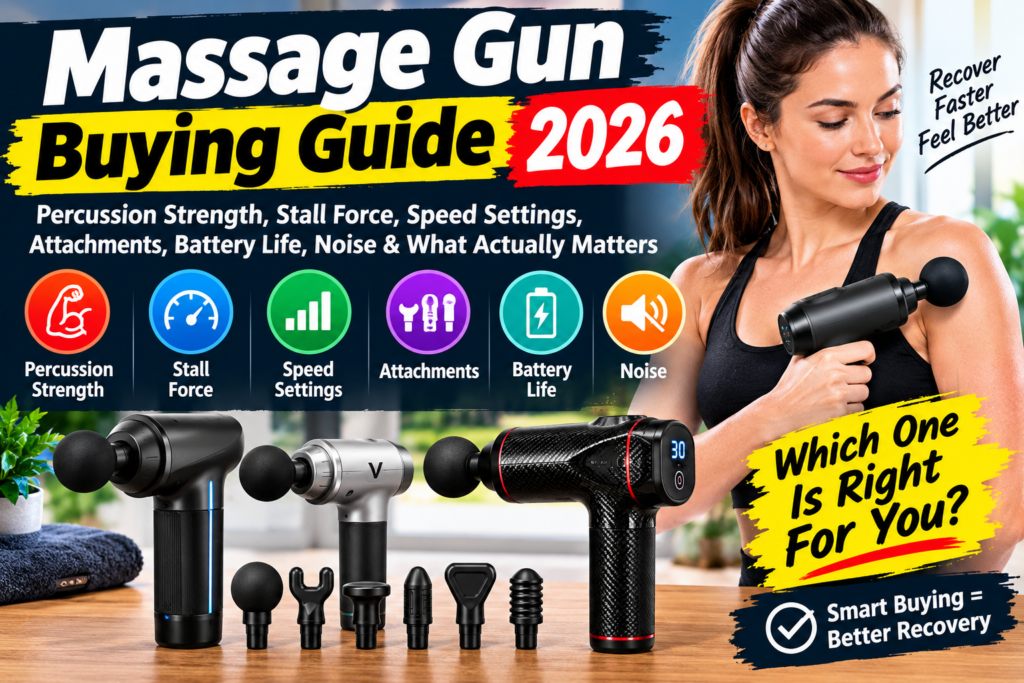
This massage gun buying guide explains which specifications actually deserve your attention: amplitude, stall force, speed range, attachments, battery, noise, weight, ergonomics, warranty and your real use case. It teaches you how to evaluate a device rather than ranking products. When you’re ready to compare specific models, see our roundup of the best massage guns of 2026.
Massage Gun Buying Guide: The Quick Answer
Match amplitude and stall force to your body and how you’ll use the device. Insist on a usable low-speed range. Treat maximum RPM and attachment count as tiebreakers, not headlines.
| Specification | Verdict | Why |
|---|---|---|
| Amplitude | Useful, depends on user | Changes how deep and firm each pulse feels |
| Stall force | Useful, verify independently | Test methods vary between brands |
| Low-end speed range | Useful | Lets you go gentle on sensitive areas |
| Maximum RPM/PPM | Mostly marketing | Higher speed doesn’t mean a better massage |
| Attachment count | Mostly marketing | A few well-chosen heads beat a box of duplicates |
| Battery runtime | Useful, depends on user | Quoted hours rarely reflect real pressure |
| Noise (dB) | Useful, depends on user | Matters in apartments and offices |
| Weight and grip | Useful | Determines whether you’ll actually use it |
| Brushless motor | Depends | Helpful, but not a guarantee of quality |
| Motor wattage, “professional-grade” | Mostly marketing | Rarely defined or comparable |
| Apps, screens, heat | Nice-to-have | Secondary to core specs |
| Warranty | Useful | A proxy for build confidence |
What Is a Massage Gun and How Does It Work?
A massage gun delivers percussive therapy. A motor drives a head in and out at high speed, pressing rapidly into soft tissue. That differs from an ordinary vibrating massager, which oscillates across a much shorter distance and feels more like a buzz on the surface. The head’s travel is what gives a massage gun its distinctive thumping sensation.
Most people use them for warming up, cooling down after workouts, or easing the feeling of tightness from sitting or training. Massage guns are recovery and wellness tools. They are not medical treatments, and you should not expect them to “flush toxins,” “break up scar tissue” or repair injuries. The research section below covers what the evidence actually supports.
The Most Important Massage Gun Specifications
1. Amplitude: How Deep Does the Head Travel?
Amplitude, also called stroke length or travel, is how far the head moves with each pulse, measured in millimeters. At the same speed, more travel produces a heavier, more pronounced thump. Less travel feels tighter and closer to vibration.
These ranges are practical shopping shorthand, not medically established thresholds:
| Amplitude | General feel | Often suits |
|---|---|---|
| 7–10 mm | Gentler, more vibration-like | Compact devices, sensitive areas, beginners, office use |
| 10–12 mm | Middle ground | General-purpose use |
| 14–16 mm | Deeper, firmer | Large muscles like glutes and quads, users who like strong pressure |
Deeper isn’t automatically better. A 16 mm device can feel harsh on forearms, calves or shoulders, and many people never use the depth they paid for. The authors of one systematic review noted that key parameters such as frequency and displacement are inconsistently reported in studies, so no evidence-based “ideal” amplitude exists. If a brand doesn’t publish amplitude, mark it “not publicly specified” and treat that as a question to ask.
Verdict: useful, depends on user.
2. Stall Force: What Does It Actually Mean?
Stall force is how much pressure you can apply before the motor slows or stops. Researchers describing these devices commonly list speed, depth in millimeters and stall force, the amount of force applied before the gun stalls. It matters most on large muscles, where you naturally press harder. ScienceDirect
A big number isn’t enough. Brands may measure stall force differently, and units vary between pounds and kilograms. Two devices with the same figure can also feel different depending on amplitude, speed tuning and motor design. As a rough editorial heuristic, not a scientific standard: figures in the 20s of pounds suggest light-duty use, the 30s–40s suggest mid-range, and 50+ suggests heavy-duty. If you use light pressure, a modest stall force is often fine. The same review suggested gentle pressure and a moderate pace anyway.
| Amplitude | Stall force | |
|---|---|---|
| Measures | How far the head travels | How much resistance the motor can handle |
| Unit | Millimeters | Pounds or kilograms |
| Affects | Depth and feel of each pulse | Whether speed holds up under pressure |
| Too low | Feels shallow or buzzy | Motor bogs down on large muscles |
| Too high | Harsh, uncomfortable | Usually just extra cost and weight |
| Check | Is it published? | Is the test method disclosed? |
Verdict: useful, but verify independently.
3. Speed Settings and PPM/RPM
Product pages use PPM (percussions per minute) and RPM almost interchangeably. Divide PPM by 60 to get hertz (Hz). Reviewers of the research noted that commercial devices offer roughly 17–53 Hz, about 1,000–3,200 PPM, and studies have commonly tested speeds up to around 60 Hz. A claim of 4,000+ PPM goes beyond what’s typically been studied. That isn’t proof of harm, but there is also no evidence that faster is better.
What matters more is the low end. A device that starts too strong can’t be used on sensitive areas. The tiers below are approximate:
| Speed tier | Approximate range | Typical use |
|---|---|---|
| Low | ~1,200–1,800 PPM | Warm-up, gentle use, sensitive areas |
| Medium | ~1,800–2,400 PPM | General recovery |
| Higher | ~2,400–3,200+ PPM | Large muscle groups, users who tolerate stronger percussion |
No specific speed is medically required. Three well-spaced speeds often serve you better than twenty tiny increments.
Verdict: low-end range is useful; maximum speed is mostly marketing.
Massage Gun Attachments Explained
| Head | Shape | General purpose | Avoid when | Do most buyers need it? |
|---|---|---|---|---|
| Standard ball | Round, medium | All-purpose on large muscles (quads, glutes, calves) | Directly on bone | Yes |
| Dampener/soft | Foam or cushioned | Gentler pressure, sensitive or bony-adjacent areas | Rarely a concern | Yes, especially beginners |
| Flat | Wide, flat face | Broad muscle groups, shoulders, chest | Bony areas | Often |
| Bullet/thumb | Small, pointed | Localized spots in dense muscle | Joints, bones, spine, neck | Optional; use lightly |
| Fork/U-shaped | Two prongs | Muscles alongside the spine, calves and Achilles area | Directly on spine; use gentle pressure | Optional |
| Wedge | Angled edge | Narrow spots, between muscles | Sensitive skin | Rarely |
| Micro-point/specialized | Very small | Hands, feet, small areas | Anywhere sensitive | Rarely |
More heads don’t make a better gun. A well-chosen set of four to six useful attachments beats a case of ten to fifteen near-duplicates. Ball-shaped tips were the most common choice in the studies covered by the 2023 systematic review.
Verdict: depends on user; attachment count is mostly marketing.
Battery Life: How Much Do You Really Need?
Quoted runtimes are usually measured at lower speeds with little pressure. Real-world use at higher speeds and firmer pressure typically drains the battery faster, and brands rarely disclose their test conditions. Quoted figures across the market run from around an hour on compact models to several hours on others.
- Occasional users: Battery matters little if you charge between uses.
- Regular users (a few times a week): Look for a device that comfortably covers a week of short sessions.
- Daily users: Prioritize reliable runtime and fast charging.
- Travel users: USB-C charging and compact size beat raw capacity.
Removable batteries let you swap in a spare and extend the device’s life. Integrated batteries are common and usually fine, but ask whether the manufacturer offers battery service or replacement. USB-C charging is convenient because you likely already own the cable.
Verdict: useful, depends on user. Verify claimed runtimes.
Noise: How Quiet Should a Massage Gun Be?
Noise is measured in decibels (dB), and the scale is logarithmic. A difference of about 10 dB is generally perceived as roughly twice as loud, so a “small” gap can be noticeable. Ordinary conversation sits around 60 dB.
Noise matters in apartments, offices, bedrooms and shared spaces. Manufacturer claims and independent measurements can differ because of measuring distance, speed setting and whether the device is pressed into a body or running in the air. Quiet also doesn’t mean weak. A quiet device may be well-engineered or simply less powerful, so weigh dB alongside stall force, amplitude and intended use.
Verdict: useful, depends on user. Verify claims.
Weight, Grip and Ergonomics Matter More Than People Think
A massage gun you avoid using isn’t helping anyone. Full-size models typically weigh roughly 2 to 3 pounds, and compact ones are often around 1 to 1.5 pounds. That gap becomes obvious during a longer session.
Consider:
- Balance. A top-heavy device tires your wrist faster.
- Handle shape. Angled or multi-grip handles make it easier to reach your back and hamstrings.
- Rotating arms. Useful for one-handed reach, but add moving parts.
- Fatigue. Ten minutes on your own calves is fine. Ten minutes reaching over your shoulder is not.
The most powerful gun may not be the most practical one, especially if you’re small-framed or plan to use it mainly on yourself.
Verdict: useful.
Full-Size vs Mini Massage Guns
| Feature | Full-size | Mini |
|---|---|---|
| Amplitude | Often 12–16 mm | Often shorter (frequently 7–12 mm) |
| Power/stall force | Generally higher | Generally lower |
| Weight | Heavier | Lighter |
| Portability | Bulkier | Pocket- or bag-friendly |
| Battery | Often longer | Often shorter |
| Noise | Varies; can be louder | Often quieter |
| Self-use comfort | Fine, heavier for long sessions | Easy to hold |
| Travel | Awkward | Excellent |
| Large muscle groups | Better suited | Can work with light pressure, may feel underpowered |
Full-size fits regular or heavy users, gym-goers and anyone wanting firm pressure on big muscles. Mini fits beginners, travelers, office workers and people who want a gentle, portable option. Specifications vary by brand, so check each model.
Brushless Motor vs Other Motor Designs
Brushless motors use electronic control instead of physical carbon brushes. That design generally offers efficiency, less mechanical wear and often quieter operation. But motor type alone doesn’t determine performance. Amplitude, stall force, gearing, housing quality and tuning all matter, and no reliable “lasts X times longer” rule exists. Treat brushless as a plus, not a guarantee.
Smart Features: Which Ones Are Actually Useful?
Useful for some users:
- Force or pressure indicators, since gentle, consistent pressure is often recommended
- Guided routines, if you’re new and unsure where to start
- A simple screen that shows the current speed
Nice-to-have:
- Bluetooth and companion apps
- OLED displays and automatic routines
- Heat or cold attachments (follow manufacturer instructions and avoid numb areas, where you may not feel overheating)
Smart features shouldn’t distract from core specifications. An app can’t compensate for a weak motor or an uncomfortable grip.
Massage Gun Price: What Changes as You Spend More?
Prices shift with sales, so treat these as approximate U.S. ranges:
| Tier | Approx. price | What you may gain | Watch for |
|---|---|---|---|
| Budget | Under ~$100 | Basic function, decent light-duty use | Inflated specs, weaker warranty, motor strain under pressure |
| Mid-range | ~$100–$250 | Better build, refined controls, quieter operation, stronger warranty | Feature bloat |
| Premium | ~$250–$600+ | Stronger motors, better ergonomics, more refined design, better support | Diminishing returns |
Moving up can buy improved build quality, a stronger motor, better ergonomics, a better battery, quieter operation, more refined controls and better warranty support. But returns diminish. A $400–$600 device is not automatically several times better than a $100–$200 one for your needs.
If you’re budget-conscious, see our guides to massage guns under $100 and massage guns under $50. If you’re weighing premium territory, our Theragun Pro review covers what the top tier offers.
What Specifications Are Mostly Marketing?
- Extremely high RPM claims. Higher speed isn’t better massage.
- Huge attachment counts. More heads often means more redundancy.
- Exaggerated “deep tissue” claims. Depth depends on amplitude and pressure, not a label.
- Motor wattage without context. Watts don’t tell you stall force or feel.
- “Professional-grade.” Rarely defined or verifiable.
- Unsupported medical claims. Be wary of any promise to cure or treat conditions.
- Enormous battery-hour claims with no stated test conditions.
| Instead of asking… | Ask… |
|---|---|
| What’s the highest RPM? | Does it offer a useful speed range and hold up under pressure? |
| How many heads are included? | Does it include the heads I’ll actually use? |
| How many watts is the motor? | Is stall force published, and how was it measured? |
| Is it “professional-grade”? | What do the amplitude, warranty and build actually say? |
How to Choose a Massage Gun Based on Your Use Case
| User | Prioritize | Can deprioritize |
|---|---|---|
| Beginners | Easy controls, moderate amplitude, low-speed control, comfortable weight, simple attachments | Premium tiers, apps |
| Gym users | Adequate stall force, stronger percussion, battery, durable build | Ultra-light designs |
| Runners | Portability, battery, calf/quad-friendly heads, easy handling | Maximum stall force |
| Office workers | Quiet operation, light weight, low-speed control, compact size | Deep-tissue power |
| Frequent/heavy users | Build quality, motor performance, stall force, ergonomics, warranty | Novelty features |
No product is universally best. For back use, prioritize reach and handle design, and remember you’re working the muscles beside the spine, not the spine itself. See our guide to massage guns for back pain. For upper-trap tension, a lighter device with softer heads and lower speeds is usually more comfortable. See massage guns for neck and shoulder tension.
Massage Gun Safety: Where Should You NOT Use It?
Use a massage gun on appropriate muscle areas, not directly over:
- Bones or joints
- The spine
- The front or sides of the neck, where sensitive structures lie
- Fresh injuries, bruises, open wounds or rashes
- Areas with unexplained severe pain
- Areas with numbness or tingling, unless medically cleared
The authors of a full-text PMC review also list clinical cautions, including recent fractures, bone conditions such as osteoporosis, blood-clotting concerns, diabetes-related numbness and prolonged, aggressive use on one area. They also flag pregnancy, pacemakers and other implanted devices, and several medical conditions. If any apply to you, ask a clinician first.
Stop using it if you feel sharp pain, numbness, tingling, unusual weakness, dizziness or worsening symptoms. For persistent, severe, unexplained or neurologic symptoms, see a healthcare professional. A massage gun can’t diagnose or treat these problems.
What Does the Research Say About Massage Guns?
The evidence is real but modest and mixed, and study protocols vary widely.
- Ferreira et al. (2023), a systematic review of 11 studies with 281 participants, mostly at moderate risk of bias. It found short-term improvements in flexibility, range of motion and some recovery-related outcomes. It found no improvement, or even declines, in strength, balance, agility and explosive tasks. The authors advised against use immediately before such activities.
- Sams et al. (2023), a systematic literature review, found 13 studies met inclusion criteria, all with limitations in methodological quality or reporting. Its authors concluded that a single application was associated with acute increases in strength and flexibility, while multiple treatments were associated with less musculoskeletal pain. That partly conflicts with Ferreira on strength, likely reflecting different inclusion criteria and interpretations. nihIjspt
- Leabeater et al. (2024), a controlled study of 65 active adults. A five-minute massage gun application after strenuous calf exercise had little effect on physical measures, and perceived soreness was slightly higher in the treated group for up to four hours. Monash University
- Zhu et al. (2026), a systematic review and meta-analysis of 12 randomized trials. Percussive therapy may improve countermovement jump recovery (low certainty) and reduce early creatine kinase levels (very low certainty). It did not clearly improve strength recovery or soreness. The authors say dose-related findings are preliminary and shouldn’t be treated as prescriptive thresholds.
Together, the research suggests possible short-term benefits for range of motion, flexibility and certain recovery measures, but no clear benefit for everyone. None of it establishes that any particular specification, whether amplitude, stall force or speed, produces better results. That’s another reason to choose on comfort, usability and fit rather than on claims.
Massage Gun vs Foam Roller vs Professional Massage
| Massage gun | Foam roller | Professional massage | |
|---|---|---|---|
| Targeted work | Good | Moderate | Excellent |
| Broad coverage | Moderate | Good | Excellent |
| Portability | Good | Moderate | None |
| Cost | One-time purchase (~$50–$600+) | Low one-time cost | Ongoing per session |
| Ease of self-use | Easy on reachable areas | Easy for legs and back | Someone else does it |
| Precision | Good with practice | Lower | Highest |
| Typical use | Warm-up, cool-down, spot work | Broad rolling, mobility routines | Deeper work, personalized assessment |
None of these universally replaces the others. If your legs feel worn out and you’d rather not use percussion, some people prefer compression instead. See our guide to recovery boots for athletes.
10 Mistakes to Avoid When Buying a Massage Gun
- Buying on RPM alone. Speed range and control matter more.
- Ignoring amplitude. It shapes how the device feels.
- Ignoring stall force. Or trusting it without checking how it’s measured.
- Paying for too many attachments. A few good heads are enough.
- Ignoring weight. You’ll feel it in every session.
- Ignoring noise. Especially for shared spaces.
- Trusting battery claims without context. Real use drains faster.
- Buying on brand alone. Check specs for the specific model.
- Ignoring the warranty. It signals build confidence and support.
- Assuming the most expensive device is the best fit. It may just be overbuilt for you.
Quick Massage Gun Buying Checklist
- ☐ Amplitude
- ☐ Stall force
- ☐ Useful speed range
- ☐ Appropriate attachments
- ☐ Battery
- ☐ Noise
- ☐ Weight
- ☐ Ergonomics
- ☐ Charging
- ☐ Warranty
- ☐ Price
- ☐ Intended use
Key Takeaways
- No single specification determines quality. Judge the whole package.
- Amplitude changes feel, and stall force shows resilience under pressure.
- A usable low-speed range beats a huge top speed.
- Choose attachments you’ll use, not the biggest set.
- Verify battery and noise claims, since test conditions vary.
- Weight and grip decide whether you’ll actually use the device.
- Evidence supports possible short-term benefits for range of motion and some recovery measures, but it’s limited and mixed.
- Use it only on suitable soft-tissue areas, and stop if something feels wrong.
FAQs
1. What is the most important specification on a massage gun?
There isn’t one. Amplitude and stall force shape how it feels and performs, but comfort, weight and low-speed control often decide day-to-day use.
2. Is higher amplitude always better?
No. Deeper strokes suit large muscles and users who like firm pressure. They can feel harsh on smaller or sensitive areas.
3. What is a good stall force for a massage gun?
There’s no evidence-based cutoff, and brands measure differently. As a loose editorial guide, the 20s in pounds suggests light-duty, the 30s–40s mid-range and 50+ heavy-duty. Consider published testing where it exists.
4. How many speed settings do I need?
Three well-spaced, usable speeds are often enough. What matters is a gentle low end and a comfortable high end.
5. How long should a massage gun battery last?
It depends on how you use it. Occasional users can get by with less, while daily or travel users benefit from longer runtime and USB-C charging. Treat claimed hours as best-case.
6. Are quieter massage guns less powerful?
Not necessarily. Some quiet models are well-engineered, and others are simply gentler. Check amplitude and stall force separately.
7. Are more massage gun attachments better?
No. Four to six heads you’ll actually use beat a large set of redundant ones.
8. Is a mini massage gun powerful enough?
For many people, yes, especially for light pressure, travel and office use. Full-size models are better for heavy pressure on large muscles.
9. Can you use a massage gun every day?
No evidence-based daily frequency exists. Studies generally used short applications, and the review authors caution against prolonged, aggressive use on one area. If soreness worsens, ease off.
10. Where should you not use a massage gun?
Avoid bones, joints, the spine, the front and sides of the neck, fresh injuries, and areas with severe unexplained pain, numbness or tingling. When in doubt, ask a healthcare professional.
Conclusion
The right massage gun depends on your intended use. For most shoppers, the important starting points are amplitude, stall-force capability, useful speed control, comfortable ergonomics, appropriate attachments, battery life, noise and warranty, not simply the highest RPM or largest number of attachments. Keep this massage gun buying guide handy as a checklist, then compare current models once you know which specs fit your needs. Use your device on suitable muscle areas, and check in with a healthcare professional if symptoms are persistent, severe or unexplained.