
LifeCareBalance.com is reader-supported. When you buy through links on our site, we may earn an affiliate commission at no extra cost to you. As an Amazon Associate, we earn from qualifying purchases.
Spending $400 on a massage gun feels different when a $60 model has similar buttons, similar heads, and a similar promise. So what does the extra money buy, and is it worth it for you?
That is the question this article answers. It is not a ranked list of products. It is a framework for comparing premium vs budget massage guns on the things that actually differ: specs, comfort, durability, features, support, and evidence.
Affiliate disclosure: LifeCareBalance.com is reader-supported. When you buy through links on our site, we may earn an affiliate commission at no extra cost to you.
The short answer: premium pricing often pays for refinement, meaning better ergonomics, build quality, support, and extras like apps and pressure sensors. It does not automatically pay for stronger recovery results. Past a certain point, each additional dollar buys less. If you want ranked product picks after reading this, see our best massage guns of 2026 roundup, and our massage gun buying guide covers the fundamentals.
How we label information here. We separate four kinds of information:
- Manufacturer specifications: claims from brands, which are not always measured the same way.
- Independent testing: measurements or reviews by third parties. Where we don’t have a reliable source, we say so.
- Published research and clinical sources: the five external sources linked in this article.
- LifeCareBalance editorial analysis: our interpretation and buying framework. This article does not describe hands-on LifeCareBalance testing.
Prices are approximate and change often, so check current pricing before you buy.
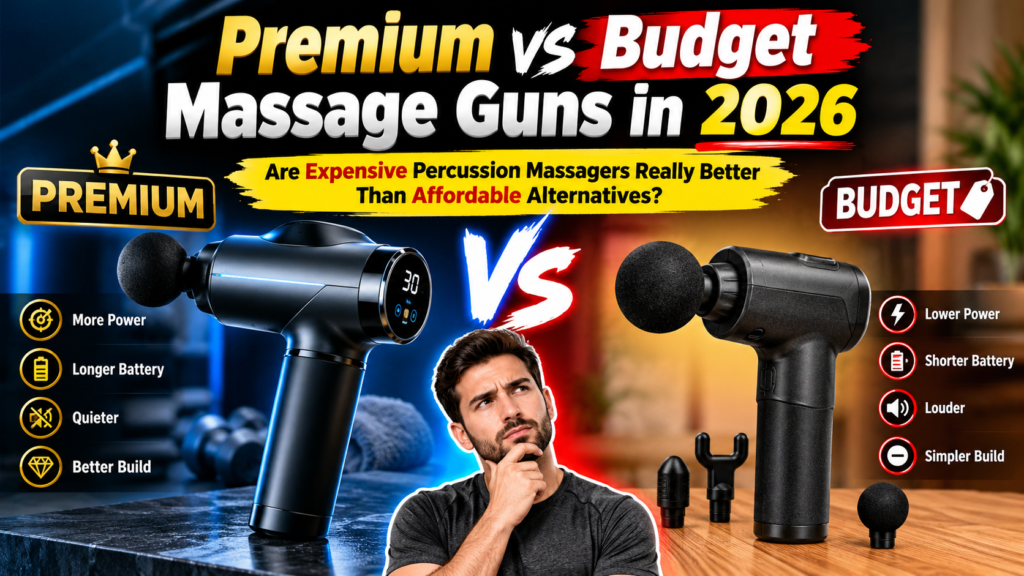
Premium vs Budget Massage Guns: Quick Comparison
The table below shows how the price tiers tend to differ. It is an editorial generalization, not a set of measured specs. Individual models vary a lot, and a cell describing a tendency is not a guarantee for any product.
| Price tier (approx.) | Amplitude | Stall force | Noise | Battery | Ergonomics | Attachments | Smart features | Warranty | Best suited for |
|---|---|---|---|---|---|---|---|---|---|
| Budget (~$40–$100) | Listed values vary widely | Frequently not published | Varies; rarely independently measured | Typically built-in; replaceable packs tend to cost more | Often a single fixed handle; weight varies | Usually a basic head set | Uncommon | Varies; verify terms | Beginners, occasional use, testing the category |
| Lower mid-range (~$100–$200) | Wider range of listed strokes | Sometimes published; methods differ | Some brushless-motor models; verify | Longer run times more common; check the spec sheet | More handle and grip variety | Often a larger set | Sometimes basic app or Bluetooth | Varies; verify terms | Regular users who want more comfort and control |
| Premium (~$200–$400) | Varies by model; not always deeper | Varies; not standardized | Some models are engineered for quieter operation; verify | Replaceable batteries on some models | Adjustable arms or multiple grips on some models | Often refined, purpose-designed heads | More common: apps, guided routines, sensors | Often positioned as a selling point; verify | Frequent users, comfort-focused buyers |
| Flagship ($400+) | Varies; check the spec sheet | Varies; not standardized | Varies; verify | Replaceable batteries, dual-battery kits on some models | Adjustable handles, premium materials on some models | Extensive sets | Apps, pressure feedback, heat/cold on some models | Verify | Heavy daily use, coaches, feature-focused buyers |
Where a spec isn’t published, it should read “Not publicly specified.” We don’t estimate missing numbers.
What Makes a Massage Gun “Premium”?
There is no official definition. In practice, a premium massage gun usually combines several of these:
- Refined build and materials. Tighter tolerances, better plastics, better coatings, and more durable heads.
- Ergonomic design. Handles built to reduce wrist strain and reach awkward areas.
- Motor engineering. Claims about holding speed under pressure and running smoothly.
- Ecosystem. Companion apps, accessories, replacement batteries, and brand support.
- Specialized features. Pressure sensors, heat or cold heads, and adjustable arms.
- Brand positioning. Some of the price is brand and marketing, not hardware.
The last point matters. A higher price can reflect real engineering, or it can reflect brand premium. The rest of this article helps you tell them apart.
For a concrete example of a flagship-class device, see our Theragun Pro review. It shows what the top of the market can look like, and it is a review of one model, not a rule for the whole tier.
What Budget Massage Guns Actually Do Well
Budget models get dismissed too quickly. At the core, a percussion massager is a motor, a head, and a handle. Affordable models can do the basic job.
- They deliver the core function. A moving head that applies rapid percussion to muscle tissue.
- They lower the cost of finding out. If you don’t know whether you’ll use a massage gun, a low-cost model limits the downside.
- They are good enough for simple routines. A couple of minutes on calves, quads, or shoulders after a walk or workout doesn’t demand a flagship.
- They cover the features most people use. Several speeds and a few heads are enough for most casual use.
The trade-offs tend to appear in comfort, noise, build consistency, support, and how the device feels after months of use. Quality also varies widely among budget models, so read reviews, check return policies, and verify warranty terms.
Our roundups of the best massage guns under $50 and the best massage guns under $100 cover specific options at these price points.
Amplitude: Does a Deeper Stroke Mean a Better Massage?
Amplitude is how far the massage head travels with each stroke, usually listed in millimeters. A longer stroke moves the head further into and out of the tissue.
Deeper is not automatically better:
- Longer strokes may suit larger muscle groups such as quads, glutes, and hamstrings, and users who prefer aggressive percussion.
- Shorter strokes may feel more comfortable on sensitive areas, smaller muscles, or for people new to percussion.
How intense a massage gun feels also depends on speed, head shape, and how much you press. Two guns with the same listed amplitude can feel different.
A higher-amplitude gun isn’t necessarily a premium gun, and a premium gun isn’t necessarily high-amplitude. It’s a spec to match to your preference, not a score to maximize.
Stall Force: How Much Does It Really Matter?
Stall force describes how much pressure you can apply before the motor bogs down or stops. It is usually given in pounds.
Two cautions apply:
- Numbers aren’t standardized. Brands can measure stall force under different conditions, at different speeds, and with different heads. Direct numerical comparisons across brands can be misleading. Where a brand doesn’t publish it, the answer is “Not publicly specified,” not a guess.
- More isn’t the goal. Health guidance for percussive massage generally advises letting the device do the work rather than pressing hard. Cleveland Clinic’s overview of percussive therapy notes that added pressure can cause harm instead of relief. A high stall force mainly tells you the motor is less likely to stall if you lean on it, which you generally shouldn’t be doing anyway.
For most casual and regular users, stall force is a secondary spec. It matters more if you want to use a heavier hand on large muscle groups, and even then it should be verified rather than assumed.
Motor Performance and Pressure Consistency
Motor consistency is how steadily a gun holds its speed and stroke as you press it into muscle. It’s one of the most plausible places for a premium gun to justify its price, because it affects how the massage feels in real use.
Real-world signs to look for in independent reviews:
- Does the speed hold when pressure is applied, or does it sag?
- Does the motor sound strained or change pitch under load?
- Does the device get hot during a longer session?
These qualities are difficult to read from a spec sheet and not always independently measured. Treat any “powerful motor” claim as marketing until an independent source backs it up. Cleveland Clinic also notes that a brushless motor may be worth considering if noise matters to you, though that is a feature to verify, not a guarantee of quiet.
Noise: Premium Guns vs Budget Guns
Noise matters more than spec sheets suggest. It affects:
- Apartments and shared walls. A loud gun limits when you can use it.
- Offices and shared spaces. A noisy device may not be usable at all.
- Shared bedrooms and TV time. If you use a gun in the evening, noise decides whether you do.
- Frequent daily use. A sound that’s tolerable once a week can wear on you at daily use.
Some premium guns are engineered for quieter operation, but premium price does not guarantee a quieter gun. We don’t claim any product is quieter unless a reliable published or independent measurement supports it. If noise matters, look for independent decibel measurements taken under the same conditions, and be cautious about “ultra-quiet” claims with no measurement behind them.
Battery Life and Charging
Battery differences are easy to understate. Cleveland Clinic notes that some massagers run for hours on a charge while others need recharging within about 90 minutes, and that massagers with replaceable rechargeable batteries tend to cost more but may save money over time.
What to compare:
- Run time per charge. Note whether it’s stated at a low speed or a typical one.
- Replaceable vs built-in batteries. Replaceable batteries extend a device’s useful life and let you carry a spare. Built-in batteries can end a device’s life when they degrade.
- Charging method. USB-C charging is convenient for travel if a model supports it. Check each spec sheet.
- Charge time. A gun that takes hours to charge is less convenient than one that charges quickly.
Battery life is one of the things premium doesn’t guarantee. A budget gun can have a longer run time than a premium one. Compare the spec, not the price tag.
Ergonomics, Weight and Grip
This is the factor buyers underrate most. If you’ll hold a massage gun for several minutes, comfort and control matter more than an extra speed setting.
Both UCLA Health and Cleveland Clinic suggest a weight in roughly the 2 to 4 pound range, because you may be holding the device for up to 10 minutes.
Ergonomic factors worth checking:
- Weight and balance. A heavy gun tires your hand and wrist.
- Handle shape and grip options. Some designs let you change hand position to reach your upper back, glutes, or calves.
- Reach. Self-massage on your back is hard with a fixed-angle handle. Adjustable arms or longer handles help.
- Control. A very powerful device is less useful if it’s heavy or hard to steer.
This is where premium designs can earn their price. Adjustable arms and multiple-grip handles are more common at higher tiers, though not exclusive to them. If you have a chance to hold a device before buying, do it, or choose a retailer with a straightforward return policy.
Attachments: Are Premium Head Sets Worth It?
Common head shapes include a large ball, a flat head, a bullet or cone, and a fork or spine-style head. Budget kits often include a variety of heads. Premium kits tend to offer purpose-designed heads and sometimes higher-quality materials.
Editorially, most people settle on two or three heads they like. More attachments don’t mean more benefit. What matters is whether the heads you’d actually use are comfortable, secure on the device, and easy to swap.
Check how heads attach, whether replacements are available, and whether the material feels durable.
Apps, Bluetooth and Smart Features
Premium and flagship guns often include a companion app, guided routines, or Bluetooth connectivity. Possible advantages:
- Guided routines that take the guesswork out of where and how long to use the device.
- Speed and settings control from your phone.
- Tracking your sessions.
Evidence that app guidance produces better recovery outcomes than simple self-directed use is limited. Treat apps as a convenience and learning aid, not a proven performance upgrade. If you’re comfortable with a basic routine, you may never miss the app.
Pressure feedback is a more practical smart feature. Since guidance for percussive massage generally advises against pressing hard, a sensor that shows how much force you’re applying can help new users. It’s a useful comfort and technique aid, not a medical feature.
Heat/cold heads and other specialized features are comfort options. We aren’t aware of strong evidence that a small heated or chilled head makes a percussion massage more effective, so weigh these on whether you’d enjoy them.
Build Quality and Warranty
Build quality is difficult to judge from a product page, which is one reason premium pricing can be rational. Things to compare:
- Materials and finish. Do the housing, head connectors, and buttons feel solid?
- Warranty length and coverage. Warranty terms vary by brand. Check how long coverage lasts and whether the battery is treated differently from the rest of the device.
- Support and claims. How easy is it to reach support and file a claim?
- Repair and replacement options. Replaceable batteries and spare heads help a device last.
A longer warranty and responsive support are among the more concrete things premium pricing can buy, but confirm the terms in writing rather than assuming.
What Are You Actually Paying Extra For?
This is the core of the price-versus-value question. Premium pricing may pay for:
- Better ergonomics and adjustable handles
- More refined motor performance and consistency
- More refined construction and premium materials
- Quieter operation on some models
- Longer warranty and stronger support
- App guidance and pressure sensors
- Heat/cold or other specialized features
- Advanced attachments
- Replaceable batteries
- Brand ecosystem and accessories
Premium pricing does not automatically guarantee:
- Greater amplitude. Some budget guns list long strokes.
- Greater stall force. Numbers vary, and testing methods differ.
- Quieter operation. This must be verified per model.
- Longer battery life. Compare the actual spec.
- Better recovery outcomes. No evidence links a higher price to better results.
Each of these must be evaluated model by model.
Diminishing returns: a practical buying framework
A $500 massage gun is not five times better than a $100 one because it costs five times more. Past a certain point, extra spending buys refinement rather than proportionally better function. Here is one practical way to think about it. It is an editorial framework, not a scientific rule.
- ~$40–$100: often enough for beginners and occasional users. You get the core function and a chance to learn how you like percussion.
- ~$100–$200: a potentially useful upgrade for regular users. This is where comfort, noise, run time, and build consistency can improve noticeably, though not guaranteed.
- ~$200–$400+: increasingly pays for refinement, ergonomics, ecosystem, and specialized features rather than proportional gains in recovery benefit.
Tier boundaries are fuzzy, and prices change frequently. Some sales bring premium models into lower tiers, and some budget models list at premium prices. Always check current pricing.
Do Premium Massage Guns Provide Better Recovery?
It helps to separate two questions:
- Do percussion massagers, as a category, help with recovery?
- Do premium percussion massagers help more than budget ones?
On the first question, the evidence is modest and still developing. Cleveland Clinic’s overview describes percussive therapy as generally safe and helpful for easing tightness and post-exercise soreness when used properly. It also states that research hasn’t shown these devices improve speed, power, or endurance, though they may improve range of motion and perceived fatigue.
A 2025 randomized controlled trial on percussion massage and delayed onset muscle soreness in physically active young men compared percussion sessions of different lengths with static stretching. The longer-percussion group reported lower soreness and better knee range of motion than the stretching group at a later follow-up point. It is one trial in one population, so it supports a cautious “may help” rather than a firm conclusion.
Broader context comes from a systematic review and meta-analysis of post-exercise recovery techniques. It found that massage was the most effective of the techniques compared for reducing soreness and perceived fatigue after exercise. That review covered massage in general and single sessions, not percussion devices specifically, so it supports the plausibility of massage-style recovery more than any particular gun.
On the second question, we are not aware of direct evidence showing that premium massage guns produce better recovery outcomes than budget ones. Any difference you notice is more likely about comfort, consistency, and whether you actually use the device. That is a real benefit, since the best massage gun is the one you’ll use regularly, but it is a usability argument, not a clinical one.
Massage guns are also not the only recovery tool. Some athletes pair them with compression or other methods, as in our guide to the best leg recovery boots for athletes.
Premium vs Budget by User Type
| User | Reasonable starting point | Why |
|---|---|---|
| First-time buyer | Budget | Low cost to learn whether you’ll use it |
| Occasional user | Budget | Basic function is likely enough |
| Desk worker | Budget to lower mid-range | Noise and grip comfort matter more than power |
| Home-gym user | Lower mid-range | More regular use rewards comfort and battery life |
| Runner | Budget to lower mid-range | Light, portable, easy-to-control models suit calves and quads |
| Strength athlete | Lower mid-range to premium | Large muscle groups may benefit from longer strokes and consistent motor performance |
| Frequent recovery user | Lower mid-range to premium | Daily use magnifies ergonomics, noise, and durability differences |
| Coach or therapist-style use | Premium to flagship | Heavy use favors build quality, replaceable batteries, and support |
| Traveler | Budget to premium mini | Portability and charging matter more than raw specs |
These are starting points, not rules. Two people in the same category can reasonably choose differently.
If you sit at a desk and mostly deal with tight upper-body muscles, see our guide to the best massage guns for neck and shoulder tension. Note that the front of the neck is an area to avoid entirely (see the safety section below).
When a Budget Massage Gun Makes More Sense
- You’re new to percussion massage and unsure you’ll keep using it.
- You’ll use it occasionally, not daily.
- You mainly want basic post-workout or end-of-day relief.
- You don’t need an app, sensors, or specialized heads.
- You’d rather spend the difference on other recovery habits, such as sleep, training structure, or a foam roller.
- You want a low-risk way to learn what speed and head you prefer before upgrading.
When Paying More May Make Sense
- You use a massage gun often. Small annoyances such as noise, weight, and awkward grip compound with daily use.
- You have hard-to-reach areas. Adjustable arms and better handle geometry can make self-massage on your back more practical.
- Noise matters. If you use it near others or while relaxing, quieter models can be worth paying for, once verified.
- You want replaceable batteries. They can extend a device’s life.
- Warranty and support matter to you. A clear, longer warranty is a tangible benefit.
- You’ll actually use extras. Pressure sensors or guided routines are only worth paying for if you’d use them.
- You’re using it professionally or in a shared setting. Heavier duty cycles favor sturdier builds.
When a Premium Massage Gun Is Probably Overkill
- You use it a couple of times a week for a few minutes.
- You’re buying primarily for specs you won’t notice, such as a slightly higher stall force.
- You want an app but wouldn’t open it after the first week.
- You’re paying more because of brand rather than a feature you need.
- You’re hoping a more expensive device will produce better recovery on its own. It won’t.
How Much Should You Actually Spend?
There’s no single correct price. Work through these questions:
- How often will you use it? Occasional use points to budget. Daily use points higher.
- What will it be used on? Small muscles and casual use are covered by simpler devices. Large muscle groups and heavy training may justify more.
- Do noise or shared spaces matter? If yes, favor models with independently verified quiet operation.
- Do you need reach? If you’ll work on your own back, ergonomics deserve a bigger share of your budget.
- How much do you value support and longevity? Replaceable batteries and stronger warranties are legitimate reasons to spend more.
- Would you use the extras? Count only features you’d realistically use.
A sensible path for many people is to start in the budget or lower mid-range tier and upgrade if you find yourself using the device often and hitting specific limits, such as weight, noise, or reach. Our massage gun buying guide walks through these decisions in more detail.
Safety: Who Should Be Careful With Massage Guns?
Massage guns are recovery tools, not medical treatments. They shouldn’t be used to treat the underlying cause of conditions such as sciatica, herniated discs, arthritis, nerve compression, or injuries.
Safe-use basics, drawn from Cleveland Clinic and UCLA Health guidance:
- Start on the lowest intensity.
- Let the device do the work. Don’t press down hard.
- Move slowly over muscle, not bone or joints.
- Keep sessions short. UCLA suggests limiting any single muscle group to about two minutes per session, and starting with 10 to 30 seconds when you’re new.
Areas and situations to avoid or approach carefully:
- Bones and joints. Skip bony areas such as the spine, the nape of the neck, and the knees.
- Front of the neck. Avoid it entirely.
- Open wounds, bruises, or irritated skin.
- Areas of sharp or unexplained pain.
- If you have a medical condition, are recovering from an injury, take blood thinners, or have a history of blood clots, check with your healthcare team first.
When to get medical advice. Persistent or severe pain deserves professional evaluation. Mayo Clinic’s page on back pain symptoms and causes advises contacting a healthcare professional for back pain that lasts longer than a few weeks, is severe and doesn’t improve with rest, spreads down one or both legs, or comes with weakness, numbness, or tingling. It also lists warning signs, such as new bowel or bladder problems, fever, or pain after a fall or injury, that call for immediate care.
If your main goal is back-related muscle tightness, our guide to massage guns for back pain relief covers device choices, and the Mayo Clinic page is a good starting point for understanding when a device isn’t the right tool.
Premium vs Budget Massage Gun FAQ
Are expensive massage guns actually better?
Sometimes, in specific ways. Premium models may offer better ergonomics, build quality, support, and features. They are not automatically stronger, quieter, or more effective for recovery. Evaluate each model on the factors that matter to you.
Is a $50 massage gun worth buying?
For many beginners and occasional users, yes, as a low-cost way to try percussion massage. Quality varies at this price, so check reviews, return policies, and warranty terms. See our roundup of budget picks under $50.
What is the biggest difference between cheap and expensive massage guns?
In practice, it’s usually comfort and refinement: handle design, weight, noise, motor consistency, build quality, and support. Core function, meaning a head that delivers percussion, is similar across tiers.
Does higher stall force mean better performance?
Not necessarily. Stall force numbers aren’t standardized across brands, so comparisons can mislead, and guidance for percussive massage generally advises against pressing hard. It’s more useful as a rough indicator of how a motor handles load than as a score.
Is 16mm amplitude necessary?
No. Longer strokes may suit larger muscles and users who like deep percussion, while shorter strokes can feel more comfortable on sensitive areas. It’s a preference, not a requirement.
How much should I spend on a massage gun?
It depends on how often you’ll use it and what you’ll use it for. Many casual users do fine in the budget or lower mid-range tiers. Frequent users may find extra comfort, noise, and battery features worth paying for.
Are premium massage guns quieter?
Some are designed to be, but price alone doesn’t guarantee it. Look for independent noise measurements rather than marketing claims.
How long should a good massage gun last?
There’s no reliable published lifespan that applies across models. Durability depends on build quality, usage, and battery health. Warranty terms and replaceable batteries are practical signals of a manufacturer’s confidence.
Is a budget massage gun good enough for athletes?
For many athletes, yes, especially for occasional post-workout use. Athletes who use a gun daily, work on large muscle groups, or want better reach and durability may benefit from a step up. The evidence doesn’t show that premium devices produce better recovery outcomes.
Can a massage gun replace professional massage?
Not fully. A massage gun can offer convenient self-care between sessions, but a trained professional can assess your body, adapt techniques, and identify issues a device can’t. Cleveland Clinic frames massage guns as a convenient option when regular professional massage isn’t feasible.
Final Buying Guide
Whether a premium massage gun is worth it depends on how you’ll use it. Use this summary as a starting point:
- Choose budget if you’re new, use it occasionally, or want a low-risk way to try percussion massage.
- Step up to lower mid-range if you use it regularly and want better comfort, run time, and control.
- Consider premium if you use it frequently, need reach or adjustability, care about noise and support, or would use features like pressure feedback.
- Consider flagship only if daily heavy use, replaceable batteries, or specialized features matter enough to justify diminishing returns.
Before buying, verify current pricing, warranty terms, return policy, and independent noise and battery information for the specific model. Match the device to your habits, not to the highest spec sheet.
For ranked picks across tiers, see our best massage guns of 2026, and for a deeper walkthrough of how to choose, read the massage gun buying guide.
This article is for general information and isn’t medical advice. Talk with a healthcare professional about pain, injuries, or medical conditions before using a massage gun.
Notes before you publish:
- Internal links: I couldn’t verify that the eight LifeCareBalance URLs are live, because the site blocks automated access. I used the URLs from your brief as given, so please check them. I left out the five extra cluster pages since no URLs were provided.
- Sources: I fetched the Cleveland Clinic, UCLA Health, PMC, and Mayo Clinic pages directly. PubMed blocked my fetch, so the trial description comes from its abstract and related records. Please skim it against the live page.
- Deliberately omitted: I left out the lactic-acid explanations in the Cleveland Clinic and UCLA pages, and I didn’t name specific models, prices, or specs beyond the Theragun Pro review link, since I have no verified 2026 figures for them.