
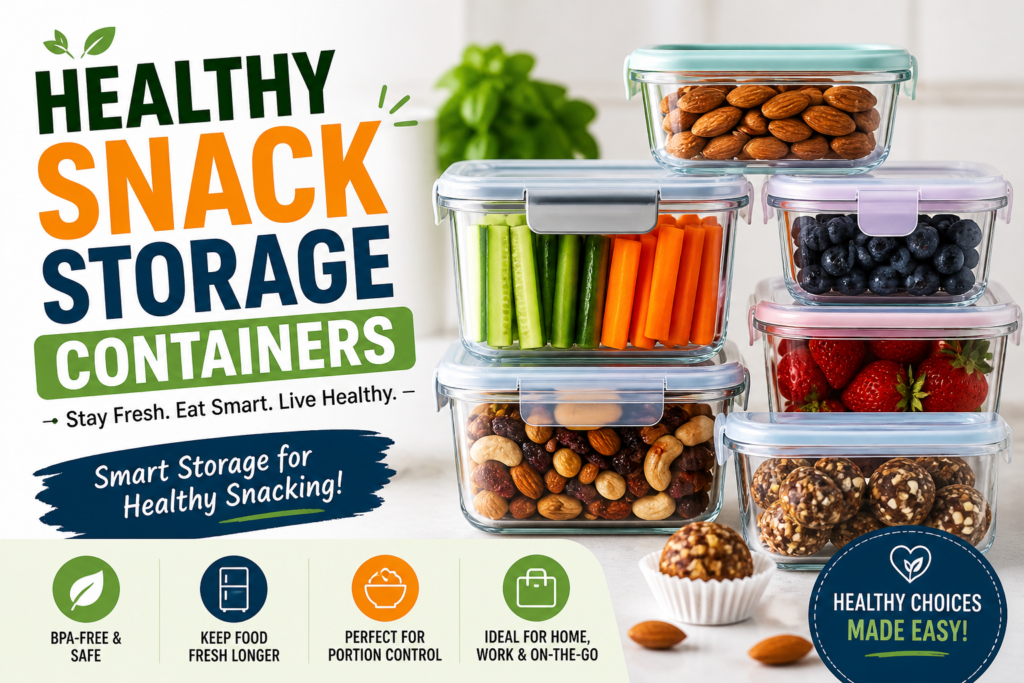
Compare the best healthy snack storage containers for 2026, including glass, plastic, silicone, divided, airtight, and portable options for meal prep and on-the-go snacks.
LifeCareBalance.com is reader-supported. When you buy through links on our site, we may earn an affiliate commission at no extra cost to you. As an Amazon Associate, we earn from qualifying purchases.
Healthy snacking becomes much easier when nutritious foods are prepared, portioned, and ready to grab. But the container you use matters more than it may seem.
A container that leaks into your work bag, stains after one meal, takes up too much refrigerator space, or is difficult to clean can quickly become more trouble than it is worth.
The best healthy snack storage containers should make everyday food storage easier. Depending on your routine, that may mean an airtight container for nuts and seeds, a divided container for fruit and protein, a reusable silicone bag for dry snacks, or a glass container that works well for refrigerated meal prep.
For 2026, current meal-prep and food-storage guides increasingly focus on practical features such as leak resistance, stackability, material, cleaning, portability, freezer and microwave compatibility, and space efficiency. Food Network, for example, separates its tested containers into categories such as best for snacks, best glass, best freezer-safe, best containers with dividers, and best overall.
This guide focuses specifically on healthy snack storage containers for home organization, meal prep, work, school, travel, and everyday on-the-go eating.
Quick Answer: What Are the Best Healthy Snack Storage Containers?
There is no single container that is perfect for every snack.
The right choice depends on what you normally store.
| Best For | Container Type | What to Look For |
|---|---|---|
| Everyday healthy snacks | Small reusable containers | Secure lids, easy cleaning |
| Fruit and vegetables | Vented or divided containers | Moisture management |
| Nuts and seeds | Airtight containers | Tight seal, compact size |
| Yogurt and wet snacks | Leak-resistant containers | Reliable gasket and lid |
| Meal-prep snacks | Divided containers | Multiple compartments |
| Freezer storage | Freezer-rated containers or silicone bags | Flexible, temperature-rated material |
| Work and school | Lightweight plastic or bento-style containers | Portability and secure closure |
| Long-term pantry snacks | Airtight pantry containers | Seal, visibility and stackability |
The goal is not to buy the largest set available. It is to choose containers that match the foods you actually eat.
What Makes a Healthy Snack Storage Container Worth Buying?
A container does not become “healthy” simply because it is marketed for healthy eating.
The more useful question is whether it helps you store food safely, conveniently, and consistently.
1. Food-Appropriate Materials
Common materials include:
- Glass
- BPA-free plastic
- Food-grade silicone
- Stainless steel
Glass can be useful for refrigerated food and reheating when the specific product is rated for those uses. Plastic is generally lighter and more convenient for carrying. Silicone is especially useful for reusable bags and flexible storage. Stainless steel can be durable, although it is not transparent and is not suitable for every microwave application.
Do not assume that every product made from a particular material has identical temperature or appliance ratings. Always check the manufacturer’s instructions.
2. A Reliable Seal
For dry snacks such as nuts, seeds, crackers, granola, or trail mix, an airtight lid can help protect the contents from moisture and keep the container organized.
For wet foods such as yogurt, cut fruit, hummus, or overnight oats, the quality of the seal becomes even more important.
A container described as “airtight” is not automatically leakproof in every situation. If you plan to put it inside a backpack, purse, lunch bag, or gym bag, look for a design specifically intended for leak-resistant or leakproof transport.
3. Easy Cleaning
A container that is difficult to clean can become annoying very quickly.
Look for:
- Dishwasher-safe construction when appropriate
- Removable seals or gaskets
- Wide openings
- Minimal small crevices
- Lids that can be cleaned thoroughly
This matters especially for containers used with yogurt, hummus, nut butter, sauces, or other sticky foods.
4. Stackability
If you prepare several snacks at once, stackability can save considerable refrigerator and pantry space.
Uniform shapes are usually easier to organize than a collection of unrelated containers.
Good storage design should make it easier to see what you have rather than create another cluttered cabinet.
Best Healthy Snack Storage Containers to Consider in 2026
1. Stasher Reusable Silicone Storage Bags — Best for Flexible Snack Storage

- 100% Airtight and Leak-Proof: Rubbermaid Brilliance Containers provide secure storage and transport by creating an airti…
- Customizable Trays: Comes with removable drop-in trays for organized, separate storage of multiple foods
- Lightweight and Durable: Crafted from BPA-free Tritan plastic for glass-like clarity without the weight or risk of shatt…
Stasher-style reusable silicone bags are particularly useful when flexibility and portability matter more than rigid container shape.
They can work well for snacks such as:
- Nuts
- Trail mix
- Pretzels
- Crackers
- Cut vegetables
- Fruit
- Granola
- Dry snack mixes
Food Network currently lists Stasher Bags as its category pick for snacks and highlights their dishwasher, freezer, microwave, and oven compatibility.
The major advantage is that the bag takes up less space than a rigid container when it is not full.
Why Consider It?
- Flexible construction
- Reusable alternative to disposable bags
- Useful for snacks and small food portions
- Convenient for travel
- Easy to store when empty
Best For
People who want a reusable snack-storage option that works especially well for portable snacks.
2. OXO Prep & Go Divided Container — Best for Balanced Snack Combinations

- Two compartments seal securely for leakproof meal prep and toting
- Watertight lid with clear windows, silicone gaskets, and two locking clips
- Divided 1-cup compartments keep ingredients separate
A divided container makes sense when you want to carry more than one snack without mixing everything together.
For example, you could use separate sections for:
- Apple slices and nuts
- Carrots and hummus
- Berries and Greek yogurt
- Crackers and cheese
- Fruit and a protein-rich snack
Food Network specifically includes OXO Prep & Go among its 2026 tested categories for containers with dividers.
This type of design is especially useful for people who prepare snacks in advance and want one container instead of several small containers.
Why Consider It?
- Multiple compartments
- Useful for separating foods
- Convenient for work or school
- Supports organized snack preparation
- More practical than carrying several loose containers
Best For
People who like balanced snack combinations and want separation between foods.
3. Rubbermaid Brilliance Food Storage Containers — Best for Everyday Organization

- 100% leak-proof and airtight: Airtight seal and secure latches prevent spills and leaks and help keep food fresh and sec…
- Stain-Resistant: Crystal clear 360° StainShield Plastic resists stains, keeping your containers looking like new.
- Odor-Resistant: StainShield plastic resists odors so containers stay smelling like new.
Rubbermaid Brilliance is a useful option for readers who want a more traditional reusable container system.
The design is particularly practical when your snack routine overlaps with general meal preparation.
You can use different sizes for:
- Nuts
- Fresh fruit
- Cut vegetables
- Leftover portions
- Protein snacks
- Prepared ingredients
Food Network currently highlights Rubbermaid Brilliance for prepared ingredients and notes its leakproof and airtight design, BPA-free construction, and stain- and odor-resistant characteristics.
Why Consider It?
- Multiple size options
- Useful beyond snack storage
- Suitable for meal-prep routines
- Easy to organize as a matching system
- Good choice for readers who want fewer mismatched containers
Best For
Households that want one storage system that can handle snacks and broader meal-prep needs.
4. OXO Smart Seal Glass Containers — Best Glass Option for Home Meal Prep

- Four locking tabs secure the foolproof, leakproof lids
- Durable borosilicate glass containers designed to go from freezer to oven
- Smart Seal glass containers nest and stack for convenient and compact storage
Glass is often attractive to shoppers who want a sturdy container for refrigerator storage and reheating.
OXO Smart Seal Glass containers are designed for multiple food-storage uses, and Food Network lists them in its 2026 tested guide as its glass-container pick. The guide notes their freezer, microwave, dishwasher, and oven compatibility according to the product specifications.
Glass is heavier than plastic, so it is not always the best choice for carrying around all day.
But for home snack preparation, it can be an excellent option.
Why Consider It?
- Glass construction
- Useful for refrigerated foods
- Suitable for meal prep
- Easy to see contents
- Can serve as both food-storage and meal-prep containers
Best For
People who primarily prepare snacks at home and want glass containers that can also serve broader meal-prep needs.
5. Stasher-Style Silicone Snack Storage — Best for Flexible Small-Space Storage

- CONTAINS: 2 Stasher Reusable Silicone Pocket Bags in the colors Clear + Aqua. The Pocket Bag holds 4 fl oz with the foll…
- BETTER SILICONE BAGS & BOWLS: Made with platinum food-grade silicone and a leak-free Pinch-Loc seal, these reusable food…
- REUSABLE, REWASHABLE CONTAINERS: Stasher silicone reusable storage bags make it easy to ditch single-use plastic and mee…
Reusable silicone bags deserve a separate category because they solve a different storage problem from rigid containers.
If your kitchen is already crowded with containers, flexible bags can reduce storage volume.
They are particularly useful for:
- Dry snacks
- Sandwich components
- Cut vegetables
- Fruit
- Freezer snacks
- Travel snacks
However, not every silicone bag has identical temperature ratings or sealing performance. Always check the specific manufacturer’s instructions before using one in a microwave, oven, freezer, or dishwasher.
Healthy Snack Containers vs Regular Food Storage Containers
The difference is usually not about the word “healthy” printed on the packaging.
A healthy snack storage setup is more about how the container fits your routine.
| Feature | Basic Food Container | Snack-Focused Container |
|---|---|---|
| Portion size | Often larger | Usually smaller |
| Portability | Varies | Usually important |
| Compartments | Sometimes | Often useful |
| Stackability | Important | Important |
| Leak resistance | Depends | Very important for wet snacks |
| Snack organization | General | Primary purpose |
| On-the-go use | Moderate | High |
A large container may be excellent for leftovers but unnecessarily bulky for a handful of almonds or sliced fruit.
Best Container Type for Different Healthy Snacks
Nuts and Seeds
Nuts and seeds generally work well in small airtight containers.
Look for:
- Tight-fitting lids
- Compact dimensions
- Easy opening
- Enough capacity for your normal serving
You do not need a huge container for a small snack.
Fresh Fruit
Fruit requires more attention to moisture and handling.
For berries and other delicate produce, a container designed to manage airflow or moisture can be more useful than a completely sealed container in every situation.
Food Network’s current food-storage guide includes produce-specific containers and identifies features such as airflow and moisture management as important considerations.
For cut fruit, use clean containers and refrigerate promptly.
Cut Vegetables
Carrots, cucumber, bell peppers, celery, and similar vegetables can work well in compact containers.
A divided container can be useful when you want to add hummus or another dip without letting it spread across the entire container.
Yogurt
Yogurt requires a container with a secure lid.
If you are transporting it, a container specifically designed for leak resistance is preferable to a loose-fitting storage container.
Hummus and Dips
Small containers with secure lids are ideal.
Avoid filling them completely to the top because spills become more likely when there is no room for movement.
Granola and Dry Snack Mixes
Dry snacks generally benefit from airtight storage.
Examples include:
- Granola
- Trail mix
- Pretzels
- Whole-grain crackers
- Roasted chickpeas
- Nuts
- Seeds
For pantry storage, larger airtight containers may make more sense than portable snack containers.
For more pantry organization ideas, see our guide to Kitchen Pantry Storage Containers for Organization.
Glass vs Plastic vs Silicone vs Stainless Steel
Choosing the material is one of the most important decisions.
Glass
Advantages
- Does not generally absorb food odors as readily as many plastics
- Easy to see contents
- Useful for home meal prep
- Can be suitable for reheating when properly rated
Disadvantages
- Heavier
- Can break
- Less convenient for carrying
Glass is generally better suited to home or office meal prep than hiking or commuting.
Plastic
Advantages
- Lightweight
- Convenient for transportation
- Often less expensive
- Available in many shapes and sizes
Disadvantages
- Quality varies considerably
- Some plastics can stain or retain odors
- Not every plastic container is suitable for every appliance
Look for clear manufacturer information about food-contact use, temperature limits, dishwasher use, microwave use, and freezer use.
Silicone
Advantages
- Flexible
- Lightweight
- Excellent for bags
- Easy to store
- Useful for travel
Disadvantages
- Can be harder to stack
- Soft construction may not protect delicate food
- Temperature ratings vary by product
Stainless Steel
Advantages
- Durable
- Lightweight compared with glass
- Good for portable snacks
- Does not have the same breakage concern as glass
Disadvantages
- Not transparent
- Generally unsuitable for microwave use
- Can make it harder to see how much food remains
How to Choose the Right Healthy Snack Storage Container
Before buying, answer these seven questions.
1. What snacks will you actually store?
A container for nuts does not need the same design as a container for yogurt.
2. Will you carry it outside the house?
If yes, prioritize:
- Secure lid
- Leak resistance
- Lightweight construction
- Compact dimensions
3. Do you need compartments?
If you regularly combine fruit, protein, vegetables, or dips, compartments can be very useful.
4. Do you need microwave compatibility?
If you plan to reheat food, verify the manufacturer’s microwave instructions.
Never assume a container is microwave-safe simply because it is made of plastic or glass.
5. Do you use a dishwasher?
Dishwasher compatibility can make a major difference for daily use.
Check whether the container, lid, gasket, and removable components all have the same dishwasher rating.
6. Do you have limited kitchen space?
Prioritize nesting and stackability.
A beautiful 20-piece set is not necessarily useful if half of it remains unused.
7. Are you buying for one snack or an entire routine?
If you prepare several snacks each week, a coordinated system may be more practical than buying individual containers randomly.
Food Safety Matters More Than the Container Label
A high-quality container cannot make unsafe food safe.
The USDA recommends covering leftovers with airtight packaging or storage containers and refrigerating or freezing them promptly. USDA guidance also states that refrigerated leftovers are generally kept for about 3 to 4 days.
The FDA similarly recommends refrigerating or freezing perishable foods promptly, keeping the refrigerator at 40°F or below, and keeping foods covered in sealed containers or storage bags.
That means a good snack-storage routine should include:
- Clean containers
- Clean hands
- Proper refrigeration
- Appropriate food temperatures
- Correct storage times
- Secure lids
- Regular container cleaning
Do not use a container’s “airtight” label as a substitute for proper food handling.
How Long Should Prepared Snacks Be Stored?
Storage time depends on the food.
For perishable foods, refrigeration is important.
According to USDA guidance, many cooked leftovers should be refrigerated within two hours and used within 3 to 4 days.
For example, a prepared container of cooked chicken and vegetables should not simply be packed into a lunch bag and left at room temperature for an entire day.
The container helps with storage and transport. It does not eliminate the need for temperature control.
For foods that require refrigeration, consider using an insulated lunch bag and appropriate cold packs when transporting them.
How to Build a Healthy Snack Storage System
You do not need dozens of containers.
A practical system might include:
Small Containers
For:
- Nuts
- Seeds
- Dips
- Berries
- Small portions
Medium Containers
For:
- Cut fruit
- Vegetables
- Yogurt
- Granola
- Larger snack combinations
Divided Containers
For:
- Fruit + nuts
- Vegetables + hummus
- Protein + carbohydrate combinations
- Work lunches
Flexible Silicone Bags
For:
- Dry snacks
- Travel snacks
- Freezer storage
- Sandwiches
- Irregularly shaped foods
Larger Glass Containers
For:
- Meal prep
- Refrigerated snacks
- Leftovers
- Overnight oats
This approach prevents you from buying one huge set when you really need several different sizes.
Healthy Snack Storage and Portion Control
Storage containers can make portions easier to organize, but the container itself does not determine the correct amount of food for every person.
A useful strategy is to prepare snacks in advance so you are not repeatedly eating directly from a large package.
For readers interested in portion-focused meal organization, our guide to Adjustable Portion Control Plates for Weight Loss covers visual portion guidance and meal organization in greater detail.
The important distinction is that snack containers should support organization rather than promise automatic weight loss.
How Snack Storage Fits Into a Healthier Kitchen
Container organization works best as part of a larger kitchen system.
If healthy snacks are prepared and visible, they can become easier to reach when you are hungry.
Our Design a Kitchen That Supports Your Health Goals guide covers kitchen organization, meal-prep zones, pantry setup, refrigerator organization, and making healthier choices more convenient.
A simple setup might look like this:
Pantry: nuts, seeds, whole-grain crackers, granola
Refrigerator: berries, yogurt, cut vegetables, prepared snacks
Grab-and-go area: clean reusable containers and silicone bags
Meal-prep area: larger containers for preparing several days of food
This reduces the amount of daily decision-making required.
5 Common Mistakes When Buying Snack Storage Containers
Mistake 1: Buying Too Many Containers
A giant set can look like a bargain, but unused containers eventually become cabinet clutter.
Buy according to your actual routine.
Mistake 2: Choosing Size Instead of Function
The biggest container is not necessarily the most useful.
Small snacks usually need small containers.
Mistake 3: Assuming Every Lid Is Leakproof
A snap-on lid may work well for dry snacks but not for yogurt or liquid foods.
Look for a product specifically designed for leak-resistant storage when needed.
Mistake 4: Ignoring Cleaning
Complicated lids can become frustrating if they are difficult to wash properly.
Mistake 5: Assuming “BPA-Free” Means Every Feature Is Safe
BPA-free does not automatically mean a container is microwave-safe, freezer-safe, oven-safe, leakproof, or dishwasher-safe.
Each feature needs to be verified separately.
What Current Top-Ranking Competitors Are Doing Better
We analyzed the current SERP format around meal-prep and food-storage containers and found several repeated patterns.
Food Network
Its 2026 guide separates products into specific use cases including snacks, glass, freezer storage, dividers, lunches, and microwave use rather than treating every container as interchangeable.
Good Housekeeping
Its 2026 guide emphasizes extensive testing, including leaks and stains, and presents food-storage recommendations through a product-testing framework.
Serious Eats
Its meal-prep testing focuses on practical performance such as durability, leakproof construction, convenience, and different materials.
Today Meal Prep
Its current guide emphasizes repeated dishwasher, microwave, freezer, and drop testing as practical failure points.
FitnessVolt
Its 2026 guide approaches meal-prep containers from a fitness and meal-preparation perspective and compares materials, capacity, lid style, and use cases.
The Gap We Are Targeting
The opportunity for LifeCareBalance is not to create another generic “best food containers” list.
The stronger angle is:
healthy snack storage + meal prep + portability + practical food-safety considerations + product buying guide.
That keeps this page more focused than a general food-storage article while giving it enough commercial depth to compete.
Five LifeCareBalance Articles to Explore
For readers who want to build a broader healthy-home routine, these related LifeCareBalance guides are useful:
- Kitchen Pantry Storage Containers for Organization — pantry and dry-food organization.
- Design a Kitchen That Supports Your Health Goals — kitchen organization and meal-prep workflow.
- Adjustable Portion Control Plates for Weight Loss — portion-focused meal organization.
- Best Wellness Products for 2026 — broader wellness product-buying context.
- Fitness and Movement Products for 2026 — broader lifestyle and fitness equipment guidance.
The first three are the strongest contextual links for this article; the final two broaden the site’s wellness ecosystem without forcing an unrelated product link into the main discussion.
5 Useful External Resources
For food-storage and safety information, these are stronger supporting sources than generic blogs:
- USDA FSIS — Leftovers and Food Safety — storage containers, refrigeration and leftover storage times.
- USDA FSIS — Food Safety Basics — refrigeration, shallow containers and safe storage temperatures.
- FDA — Are You Storing Food Safely? — refrigerator/freezer temperatures and covered food storage.
- Food Network — Best Meal Prep Containers of 2026 — current product categories and tested-use cases.
- Good Housekeeping — Food Storage Containers Tested in 2026 — leak/stain testing and product evaluation framework.
Healthy Snack Storage Container Buying Checklist
Before buying, check:
- Food-contact material is clearly identified
- Container size matches your normal snack portions
- Lid closes securely
- Leak resistance is appropriate for the foods you carry
- Dishwasher compatibility is clearly stated
- Microwave compatibility is clearly stated if needed
- Freezer compatibility is clearly stated if needed
- Containers stack or nest efficiently
- Seals and removable parts can be cleaned
- The container is practical for your daily routine
- You are not buying more pieces than you will use
FAQ: Healthy Snack Storage Containers
What are the best containers for healthy snacks?
The best container depends on the snack. Small airtight containers work well for nuts and seeds, divided containers are useful for mixed snacks, glass containers work well for home meal prep, and reusable silicone bags are convenient for flexible portable storage.
Are glass containers better than plastic for healthy snacks?
Not necessarily. Glass is heavier but can be useful for home storage and reheating when the product is rated for those uses. Plastic is generally lighter and more convenient for transportation. The best choice depends on how you use the container.
Are silicone bags good for snack storage?
Yes. Reusable silicone bags can be convenient for dry snacks, fruit, vegetables, sandwiches, and some freezer applications. Check the manufacturer’s temperature and appliance instructions for the specific product.
What container is best for nuts and seeds?
A small airtight container is usually practical because nuts and seeds do not require a large storage footprint for everyday portions.
What container is best for fruit?
For whole or cut fruit, choose a clean container appropriate for the type of produce. Delicate produce may benefit from containers designed to manage moisture and airflow rather than simply maximizing airtightness.
Can I put hot food in a plastic container?
Only if the manufacturer specifically states that the container is appropriate for hot food or the intended heating method. Do not assume all plastic containers have identical heat ratings.
Can healthy snack containers go in the freezer?
Some can, but freezer compatibility varies by product. Check the manufacturer’s instructions before freezing.
How long can prepared snacks stay in the refrigerator?
Storage time depends on the food. USDA guidance says many cooked leftovers should be refrigerated promptly and generally used within 3 to 4 days.
Do BPA-free containers make food storage automatically safe?
No. BPA-free is only one material characteristic. You should still check the container’s temperature ratings, intended use, cleaning instructions, seal design, and manufacturer’s guidance.
Are divided containers useful for healthy eating?
They can make it easier to organize different foods in one container. However, the container itself does not guarantee balanced nutrition or weight loss. It is simply a practical organization tool.
Final Verdict
The best healthy snack storage container is not necessarily the most expensive, largest, or most heavily marketed option.
For everyday use, prioritize appropriate size, reliable closure, easy cleaning, portability, stackability, and clearly stated material and temperature specifications.
For dry snacks, compact airtight containers are often enough.
For mixed snacks, divided containers can be more convenient.
For home meal prep, glass or high-quality plastic containers can provide greater versatility.
For flexible storage and travel, reusable silicone bags can reduce bulk and make packing easier.
Most importantly, remember that food storage containers are tools. They can make healthy food preparation more organized and convenient, but they do not replace proper food handling, refrigeration, balanced nutrition, or a consistent healthy routine.
A simple system of clean, reusable, appropriately sized containers can make it much easier to prepare healthy snacks ahead of time—and actually have them ready when you need them.