
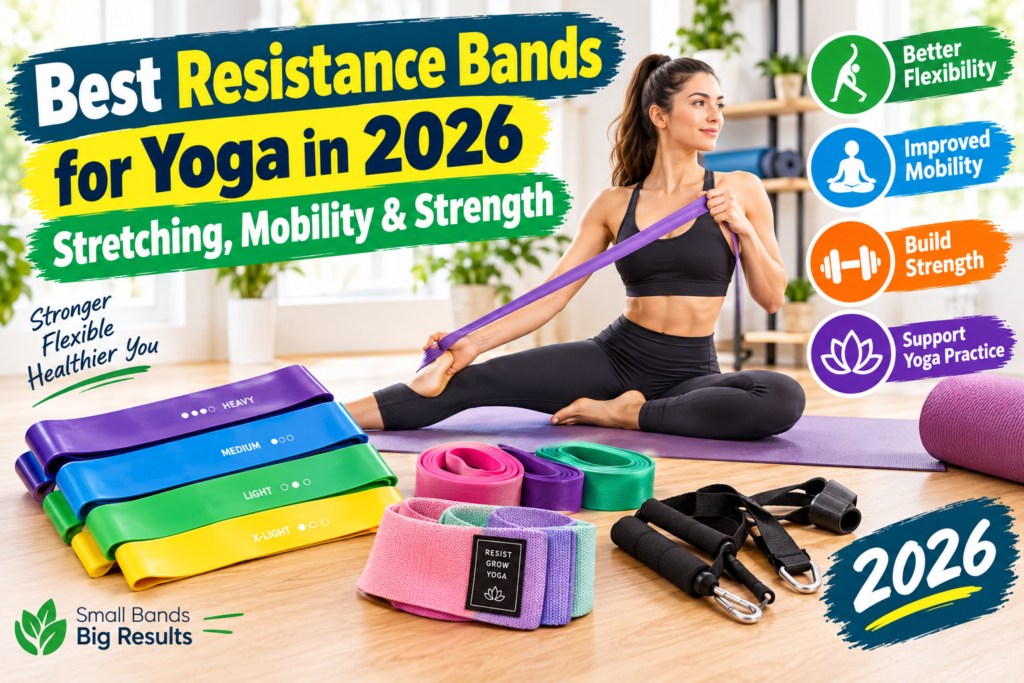
Discover the best resistance bands for yoga in 2026, including loop, fabric, and flat bands for stretching, mobility, Pilates, beginners, and home workouts.
LifeCareBalance.com is reader-supported. When you buy through links on our site, we may earn an affiliate commission at no extra cost to you. As an Amazon Associate, we earn from qualifying purchases.
Resistance bands can make a yoga routine more versatile without turning your home practice into a full strength-training session. The right band can add gentle resistance to mobility work, help you build control during certain movements, and provide an easy way to progress from basic stretching to light strength training.
But not every resistance band is a good match for yoga.
Heavy power bands designed for pull-ups are very different from light flat bands or comfortable fabric loops used for mobility and lower-body work. Some bands roll, some provide too much tension, and some products use resistance labels that are difficult to compare across brands.
That is why the best resistance band for yoga depends on how you actually practice.
For most beginners, a light-to-medium loop or flat resistance band is a better starting point than an extra-heavy strength band. If you want to combine yoga with strength training, a multi-level set gives you more room to progress.
This guide compares the best resistance-band types for yoga, stretching, mobility, Pilates-style movements, warm-ups, and light strength training while explaining what to look for before buying.
Quick answer: For most people practicing yoga at home, look for a comfortable light-to-medium resistance band that stays in place, provides controlled tension, and is easy to carry. Fabric loop bands are especially useful for lower-body work, while flat latex bands offer more flexibility for stretching and mobility exercises.
Best Resistance Bands for Yoga in 2026
| Product | Best For | Band Type | Why Consider It |
|---|---|---|---|
| Bala Bands | Yoga, Pilates & lower-body work | Fabric loop | Comfortable, non-slip design |
| Fit Simplify Resistance Loop Bands | Beginners & general yoga | Mini loop | Multiple resistance levels |
| THERABAND Resistance Bands | Mobility & gentle resistance | Flat band | Easy to adjust tension |
| Renoj Fabric Loop Bands | Yoga, Pilates & travel | Fabric loop | Portable and comfortable |
| Bodylastics Stackable Bands | Yoga + strength training | Tube system | Better for users wanting heavier resistance |
Best Overall for Yoga: Bala Bands
Bala Bands are particularly interesting for yoga and Pilates-style workouts because they use a fabric construction designed to stay in place during movement.
Verywell Fit currently lists Bala Bands as its best overall loop-band pick after testing resistance bands for quality, ease of use, grip, portability, and value. Its testers specifically noted the bands’ ability to stay in place on bare skin and workout clothing.
They are best suited to users who want to add resistance to:
- Glute bridges
- Clamshells
- Leg extensions
- Side steps
- Lower-body mobility work
- Pilates-style movements
- Light strength exercises
One limitation is that Bala does not publish resistance levels in pounds, so they are less convenient if you want to track progression using exact resistance numbers.
Best for: Yoga and Pilates users who prioritize comfort and grip.
Best Budget-Friendly Beginner Option: Fit Simplify Resistance Loop Bands
Fit Simplify loop bands are one of the most common entry-level resistance-band choices because a single set provides several resistance levels in a compact package.
Current independent coverage continues to highlight Fit Simplify as a strong budget option. Consumer Reports also lists Fit Simplify among its mini-loop resistance-band products, while current 2026 market data shows strong demand for the brand.
A multi-level loop set can be useful if you are not sure how much resistance you need.
Use a lighter band for:
- Shoulder mobility
- Warm-ups
- Gentle leg movements
- Beginner exercises
- Controlled stretching-related movements
Move toward stronger bands when you want more resistance during strength-focused exercises.
The main advantage is flexibility: instead of buying one band and discovering that it is too light or too heavy, a multi-level set gives you several options.
Best for: Beginners who want one affordable set for yoga, mobility, and general fitness.
Best for Mobility and Stretching: THERABAND Resistance Bands
Flat resistance bands are particularly useful when your goal is controlled movement rather than maximum resistance.
THERABAND is a long-established option in this category and is commonly used for mobility, rehabilitation-oriented exercises, and progressive resistance work.
Flat bands allow you to change tension by adjusting your hand position. You can shorten the working length to increase tension or use a wider grip to make an exercise easier.
This makes them useful for movements such as:
- Shoulder mobility drills
- Gentle upper-body activation
- Assisted stretching
- Band pull-aparts
- Warm-ups
- Controlled resistance exercises
Healthline similarly recommends starting with lighter resistance, focusing on controlled movement, and checking bands for tears or damage before use.
Best for: Users who want resistance bands primarily for mobility, stretching, warm-ups, and controlled exercise.
Best Fabric Option for Yoga and Travel: Renoj Fabric Loop Bands
Fabric resistance bands are worth considering if you dislike the feeling of thin latex bands against your skin.
They can also be useful for yoga and Pilates-inspired lower-body movements where keeping the band in place matters.
A five-level fabric loop system gives you the ability to use lighter resistance for warm-ups and mobility and heavier resistance for lower-body strengthening.
The main trade-off is that fabric bands are not automatically better for every exercise. A flat latex band can be much more versatile for upper-body mobility and stretching.
Best for: Travelers and users who prefer wider, softer-feeling loop bands.
Best for Yoga Plus Strength Training: Bodylastics Stackable Resistance Bands
If yoga is only one part of your fitness routine, a stackable tube-band system may make more sense.
Bodylastics-style systems use multiple bands that can be combined to create higher resistance. They are better suited to users who want to move from mobility and light training into exercises such as:
- Rows
- Chest presses
- Curls
- Triceps exercises
- Squats
- Lower-body strength work
However, this type of system is not necessary for someone who only wants a simple yoga accessory.
For a yoga-focused buyer, a light loop or flat band is usually easier to carry and faster to use.
Best for: People building a compact home gym that combines yoga with resistance training.
Why Use Resistance Bands With Yoga?
Yoga already provides resistance through body position, gravity, balance, and controlled movement. Adding an elastic band introduces another form of external resistance.
The goal should not be to make every yoga pose harder.
Instead, a band can be used strategically to add challenge or feedback to selected movements.
Research comparing resistance-band training and yoga has found improvements in strength and flexibility from both approaches, although the outcomes differed between the two methods. That reinforces an important point: yoga and resistance training are complementary tools rather than identical forms of exercise.
Resistance bands can be particularly useful when you want to:
- Add light resistance
- Improve movement control
- Strengthen supporting muscles
- Make a home routine more varied
- Add mobility drills to a workout
- Combine flexibility and strength training
Resistance Bands vs. Yoga Straps
Resistance bands and yoga straps may look similar, but they serve different purposes.
A yoga strap is generally used as a flexibility and positioning aid. It does not normally provide meaningful elastic resistance.
A resistance band actively pushes back against the movement.
Yoga Strap
Best for:
- Reaching the feet
- Assisted stretching
- Alignment
- Flexibility exercises
- Extending reach
Resistance Band
Best for:
- Strength
- Mobility
- Muscle activation
- Controlled resistance
- Warm-ups
- Progressive training
If your goal is simply to improve your reach during yoga poses, a strap may be more appropriate.
If you want to add resistance to your movement, choose a resistance band.
Which Resistance Band Type Is Best for Yoga?
There is no single band style that works perfectly for everyone.
1. Flat Resistance Bands
Flat bands are excellent for:
- Mobility
- Stretching
- Shoulder exercises
- Warm-ups
- Upper-body movements
They are also easy to adjust by changing your hand position.
2. Mini Loop Bands
Mini loops work particularly well for:
- Glute bridges
- Lateral walks
- Hip exercises
- Lower-body activation
- Pilates-style movements
They are small and easy to travel with.
3. Fabric Loop Bands
Fabric loops can be more comfortable for some users and are often less likely to roll during lower-body movements.
They are a strong option for yoga and Pilates users who dislike traditional latex loops.
4. Long Loop Bands
Long loop bands are more versatile but can be too strong for a yoga beginner.
They are better for people who want to combine mobility with strength training.
5. Tube Bands With Handles
Tube bands with handles are primarily designed for resistance training rather than traditional yoga.
They become useful when you want to build a more complete home gym.
How Much Resistance Should You Use for Yoga?
This is one of the most important questions to answer before buying.
For yoga and mobility work, more resistance is not automatically better.
A band that is too strong can change your movement pattern and make it difficult to maintain control.
Start with light resistance if:
- You are new to bands
- You mainly practice yoga
- You are using the band for mobility
- You are learning a new movement
- You want gentle activation
Move to medium resistance when:
- Light resistance no longer challenges you
- Your form remains controlled
- You are combining yoga with strength training
- You want more lower-body resistance
Heavy resistance is generally more appropriate for strength-focused exercises than for basic yoga mobility.
Consumer Reports recommends selecting resistance that allows an appropriate range of motion and progressing gradually rather than starting with the heaviest band available.
How to Choose the Best Resistance Bands for Yoga
Before buying, look at more than the number of bands in the package.
1. Material
Common materials include:
- Natural latex
- Synthetic rubber
- Thermoplastic materials
- Fabric-covered elastic
Latex is common because it is elastic and affordable, but people with latex sensitivities may prefer another material.
2. Comfort
Comfort matters more in yoga than many buyers realize.
A band that digs into your skin, rolls constantly, or feels difficult to grip may end up sitting unused.
3. Resistance Levels
A single resistance level can be enough for experienced users who know exactly what they need.
For beginners, a multi-level set is usually more practical.
4. Grip
If you are using a loop band around the legs, look for a design that stays in place.
Verywell Fit’s 2026 testing specifically considered grip and ease of use among its evaluation criteria.
5. Portability
One of the biggest advantages of resistance bands is portability.
A good yoga band should fit easily into:
- A gym bag
- Backpack
- Suitcase
- Desk drawer
- Small home workout storage area
6. Durability
Inspect the band before each workout.
Look for:
- Small tears
- Cracks
- Thinning
- Brittle areas
- Surface damage
- Loss of elasticity
Healthline also recommends checking bands for damage before use because a damaged elastic band can fail under tension.
7 Resistance-Band Exercises to Add to a Yoga Routine
Resistance bands should complement your practice rather than turn every yoga session into a strength workout.
1. Banded Glute Bridge
Place a mini band above your knees.
Lie on your back with your knees bent and feet planted.
Press gently outward against the band while lifting your hips.
This can add resistance to a familiar movement.
2. Lateral Band Walk
Place a loop band above your knees or around your ankles depending on your experience.
Take controlled steps sideways while keeping your knees aligned.
Avoid letting the band pull your knees inward.
3. Seated Band Pull-Apart
Hold a light band with both hands.
Keep your arms controlled and gently pull the band apart.
This can be useful as a shoulder and upper-back activation exercise.
4. Standing Shoulder Mobility
Use a very light band and keep your grip wide.
Move slowly through a comfortable range rather than forcing your shoulders into an extreme position.
5. Banded Clamshell
Lie on your side with a mini band above your knees.
Keep your feet together and gently rotate the top knee upward.
Do not force the movement.
6. Resistance-Assisted Mobility Drill
A long, light band can provide assistance during selected mobility exercises.
The goal is controlled movement, not maximum stretch.
7. Banded Squat
Place a loop band above your knees and perform a controlled squat.
Use a resistance level that lets you maintain normal form.
Resistance Bands for Yoga vs. Traditional Weights
Resistance bands and dumbbells can both support strength training, but they solve different problems.
| Feature | Resistance Bands | Dumbbells |
|---|---|---|
| Portability | Excellent | Limited |
| Storage | Very easy | Requires more space |
| Yoga integration | Excellent | Limited |
| Mobility work | Excellent | Moderate |
| Progressive resistance | Good | Excellent |
| Heavy strength training | Limited compared with weights | Excellent |
| Travel | Excellent | Poor |
| Cost | Usually lower | Varies widely |
If your primary goal is yoga, mobility, stretching, and light strengthening, bands are often more convenient.
If your main goal is progressive strength training with heavier loads, dumbbells may be the better primary tool.
For readers who want to combine bands with traditional home strength equipment, see our guide to Best Adjustable Dumbbells for Beginners in 2026.
Common Mistakes When Using Resistance Bands With Yoga
Using Too Much Resistance
The biggest mistake is assuming that a stronger band produces a better workout.
For yoga and mobility, excessive resistance can interfere with control and range of motion.
Stretching the Band Too Far
Every band has a practical stretch limit.
Do not aggressively overstretch it.
Ignoring Wear and Tear
A tiny crack can become a larger tear under tension.
Inspect bands regularly.
Using the Wrong Band for the Exercise
A heavy power band may be useful for assisted pull-ups but unnecessary for gentle shoulder mobility.
Match the band to the movement.
Treating Resistance Bands as a Replacement for Every Type of Training
Bands are versatile, but they are not magic.
A balanced routine may include:
- Walking or cardio
- Resistance training
- Mobility
- Flexibility work
- Recovery
- Rest
Our broader Fitness and Movement Products guide for 2026 covers how resistance tools fit into a larger home-fitness setup.
Are Resistance Bands Good for Beginners?
Yes, provided the beginner starts with manageable resistance and learns proper movement technique.
One advantage is that bands are inexpensive and require very little space.
A beginner does not need a large collection.
A simple setup could be:
- One light band
- One medium band
- One yoga mat
- A basic workout space
As your fitness level develops, you can add more resistance or a different band style.
For broader beginner home-fitness equipment ideas, see Best Wellness Products for 2026.
Are Resistance Bands Good for Flexibility?
Resistance bands can be useful during mobility and flexibility routines, but they should not be treated as a guaranteed shortcut to flexibility.
The best results depend on how the band is being used and whether the movement is appropriate for your current mobility.
Current ACE guidance emphasizes that stretching can improve range of motion, but it should not be oversold as the only way to improve mobility.
This distinction matters because mobility and flexibility are related but not identical.
Flexibility generally describes the available range of motion, while mobility also involves your ability to actively control movement through that range. ACE’s 2026 guidance highlights this distinction.
Resistance Bands for Yoga at Home
One reason bands work well for home yoga is their small footprint.
You do not need:
- A weight rack
- Large machines
- A workout bench
- A dedicated gym room
A small area with a yoga mat and a few resistance bands can support a wide range of movement sessions.
Our Resistance Bands Set with Handles and Door Anchor guide covers the more complete resistance-band systems for readers who want to move beyond simple yoga and mobility work.
For more advanced strength training, our Heavy Duty Resistance Bands Set for Professionals covers higher-resistance systems and their different use cases.
When Should You Choose a Heavy Resistance Band?
A heavy band makes sense when your primary objective is strength training.
You may want heavier resistance if you regularly perform:
- Squats
- Rows
- Chest presses
- Deadlift variations
- Assisted pull-ups
- Strong lower-body exercises
You probably do not need heavy resistance if your main goal is:
- Gentle yoga
- Stretching
- Beginner mobility
- Warm-ups
- Light Pilates
- Travel workouts
Choosing the strongest product in the store is not the same as choosing the best product.
How to Store Resistance Bands
Proper storage can help protect elastic materials.
Keep bands:
- Away from direct sunlight
- Away from excessive heat
- Clean and dry
- Away from sharp objects
- Untangled
- Off the floor where they can be stepped on
Consumer Reports recommends storing resistance bands in a cool, dry location away from sunlight and heat and inspecting them for signs of deterioration.
Never continue using a band that has obvious cracks, tears, thinning, or other significant damage.
Who Should Buy Resistance Bands for Yoga?
Resistance bands are a particularly good choice for:
- Yoga practitioners
- Pilates users
- Beginners
- Frequent travelers
- Apartment dwellers
- Home-workout users
- People with limited storage space
- Anyone who wants mobility and strength equipment in one small package
They may be less appropriate as the primary training tool for someone whose main objective is maximal strength development.
Who Should Skip Resistance Bands?
You may want a different primary tool if you:
- Need very heavy resistance
- Prefer fixed loads
- Train primarily for maximal strength
- Need precise weight increments
- Already have a complete strength-training setup
In that situation, resistance bands can still be useful as a secondary mobility or warm-up tool.
Safety Tips for Resistance-Band Yoga
Before every session:
- Inspect the band.
- Start with light resistance.
- Maintain controlled movement.
- Avoid painful ranges.
- Do not overstretch the band.
- Keep the band away from sharp surfaces.
- Replace damaged bands.
- Use extra caution when anchoring bands.
If you are recovering from an injury, have a medical condition, or are unsure whether a particular movement is appropriate for you, consult an appropriately qualified healthcare professional or physical therapist.
Resistance bands should support good movement—not force your body into positions it cannot comfortably control.
What the Best Resistance-Band Guides Get Right—and What They Miss
Our research into current 2025–2026 resistance-band content shows several useful patterns.
Verywell Fit stands out because it explains a real testing process and evaluates quality, ease of use, grip, portability, and value.
Consumer Reports adds another valuable layer by examining consistency, uniformity, exercise range, and safety issues.
Women’s Health uses expert input and long-term editorial testing while separating bands by style, resistance, material, and intended use.
Healthline does a good job covering basic types, exercises, safety, benefits, and buying considerations.
Tom’s Guide provides useful product differentiation based on testing, strength, usability, value, and versatility.
The biggest opportunity for this LifeCareBalance article is to narrow the intent.
Instead of trying to become another generic “10 Best Resistance Bands” article, this guide focuses specifically on the intersection of:
Yoga + mobility + stretching + light strength + portability.
That gives the page a clearer reason to exist and reduces unnecessary overlap with broad resistance-band buying guides.
Final Verdict
The best resistance bands for yoga are not necessarily the strongest or most expensive bands.
For most yoga practitioners, comfortable light-to-medium resistance, good grip, portability, and controlled tension matter more than maximum resistance.
Our recommendations:
Best Overall for Yoga: Bala Bands
Best Beginner Set: Fit Simplify Resistance Loop Bands
Best for Mobility & Stretching: THERABAND Resistance Bands
Best Fabric Option: Renoj Fabric Loop Bands
Best for Yoga + Strength Training: Bodylastics Stackable Resistance Bands
If yoga is your main activity, start simple. A small set of light-to-medium bands can add useful variety without taking over your workout space.
If you want a more complete home gym, choose a multi-level system that can grow with your strength.
The goal is not to make every yoga movement harder. The goal is to choose a resistance level and band style that help you move with better control while keeping the equipment simple enough that you will actually use it.
Frequently Asked Questions
What is the best resistance band for yoga?
For most users, a comfortable light-to-medium loop or flat resistance band is the best starting point. Bala Bands are particularly well suited to yoga and Pilates-style lower-body movements because of their fabric construction and grip.
Are resistance bands better than yoga straps?
They serve different purposes. Yoga straps primarily assist flexibility and positioning, while resistance bands add elastic resistance. If you want to make a movement more challenging, a resistance band is usually the better choice.
What resistance level should beginners use?
Beginners should generally start with light resistance and focus on controlled movement. Once the band no longer provides enough challenge while maintaining good form, move to a stronger level.
Can resistance bands improve flexibility?
They can be useful in mobility and flexibility routines, but they are not a guaranteed shortcut to flexibility. Proper movement, consistency, range of motion, and appropriate exercise selection matter more than simply using a stronger band.
Are fabric resistance bands good for yoga?
Yes. Fabric bands can be particularly comfortable for lower-body yoga, Pilates, and mobility exercises. They may also stay in place better than some thin latex bands.
Can I use resistance bands every day?
It depends on the type and intensity of your training. Gentle mobility work may be performed more frequently, while harder resistance workouts require appropriate recovery. Avoid training through pain.
How long do resistance bands last?
Lifespan varies with material, usage, storage, and exposure to heat or sunlight. Regularly inspect bands for cracks, thinning, tears, or loss of elasticity and replace damaged equipment.
Are resistance bands safe?
They can be safe when used correctly, but any elastic equipment can fail if it is damaged, overstretched, or used improperly. Inspect the band before each workout and start with manageable resistance.
Can resistance bands replace weights?
They can replace weights for many exercises, particularly when portability and space are priorities. However, people focused on heavier progressive strength training may benefit from dumbbells or other resistance equipment as well.
What is the best resistance band for travel?
A compact loop or flat resistance-band set is generally the easiest option for travel because it takes very little space and does not require a large setup.