
LifeCareBalance.com is reader-supported. When you buy through links on our site, we may earn an affiliate commission at no extra cost to you. As an Amazon Associate, we earn from qualifying purchases.
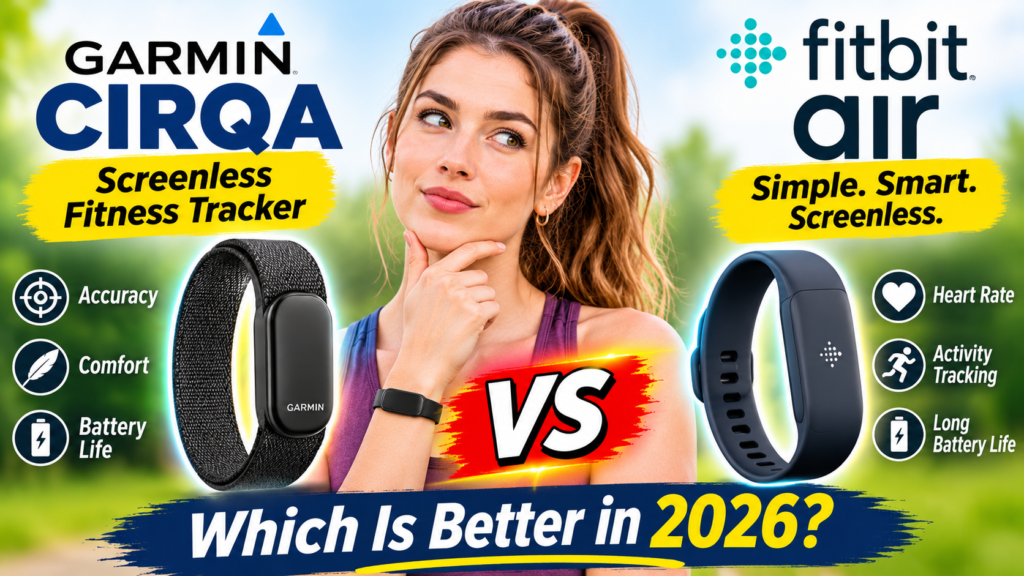
Choosing between the Garmin CIRQA and Fitbit Air comes down to what you want from a screenless fitness tracker. Both are designed for people who want to monitor their health, sleep, and daily activity without wearing a traditional smartwatch. However, they take different approaches to fitness insights, recovery tracking, pricing, and subscriptions.
The Garmin CIRQA Smart Band costs $199.99 in the US and offers up to 10 days of battery life without requiring a subscription for its core tracking features. Google Fitbit Air starts at $99.99 and offers up to seven days of battery life, with Google Health Coach and other premium insights tied to Google Health Premium.
For buyers focused on training readiness, recovery metrics, and the Garmin Connect ecosystem, CIRQA may be the stronger option. For shoppers seeking a lower-cost screenless tracker with Google’s health-coaching ecosystem, Fitbit Air may be the better value.
This comparison uses published manufacturer specifications and product information, not hands-on testing. Features, prices, subscriptions, and availability can change, so confirm the current details before purchasing.
Quick Answer: Garmin CIRQA vs Fitbit Air
| Feature | Garmin CIRQA | Google Fitbit Air |
|---|---|---|
| US starting price | $199.99 | $99.99 |
| Design | Screenless smart band | Screenless fitness band |
| Advertised battery life | Up to 10 days | Up to 7 days |
| Core tracking without a paid subscription | Yes | Check the current feature breakdown; advanced coaching requires Premium |
| Sleep tracking | Sleep stages, sleep score, sleep coaching, HRV and more | Sleep stages, sleep duration, HRV and related insights |
| Recovery features | Body Battery, training readiness, training status and recovery time | Personalized insights and coaching through Google Health |
| Heart monitoring | Wrist-based heart rate, high/low heart-rate alerts and other wellness metrics | Heart rate and heart-rhythm monitoring features, including AFib alerts where supported |
| Phone compatibility | Compatible iPhone and Android phones | Compatible iPhone and Android phones |
| App ecosystem | Garmin Connect | Google Health |
| Best fit | Training and recovery-focused users | Budget-conscious buyers interested in Google Health Coach |
Sources: Garmin CIRQA official product page and Google Fitbit Air official product page.
Our preliminary verdict: Fitbit Air has the lower entry price, while Garmin CIRQA offers a stronger set of explicitly listed training and recovery metrics without requiring a paid subscription for its core tracking functions. The right choice depends on which features you will actually use.
1. Price and Long-Term Cost
Price is one of the biggest differences between these two screenless fitness trackers.
Garmin CIRQA:

- Screenless design minimizes distraction while offering comfort with a soft fabric band for all-day and all-night wear
- Up to 10 days of battery life means you don’t need to constantly take off your device to charge
- CIRQA Smart Band health and fitness tracker does not require a subscription for use — enabling you to make improvements …
Garmin lists CIRQA at $199.99 in the United States. Its core health and fitness tracking does not require a Garmin Connect+ subscription. You can use the Garmin Connect app to view your tracked data and access supported features.
Some additional Garmin Connect+ services, including certain coaching and workout features, require a paid plan. Therefore, it is important to distinguish the tracker’s core features from optional premium services.
Official source: Garmin CIRQA Smart Band.
Fitbit Air:

- Google Fitbit Air is the unbelievably comfortable, exceptionally smart way to transform your health[1]; and Google Healt…
- Unlock more with Google Health Premium: With a premium membership, get personalized coaching that’s built with Gemini an…
- Comfortable fit – One Size Tracker (130-210 mm): The lightweight, micro-adjustable fit sits comfortably and quietly, so …
Google lists Fitbit Air starting at $99.99. The standard model includes a three-month Google Health Premium trial under the announced offer, while the Stephen Curry Special Edition was listed at $129.99 at launch.
Google Health Premium is advertised at $9.99 per month or $99 per year. After an eligible trial, the subscription may renew automatically unless canceled. Check the terms displayed at checkout.
Official sources: Google Fitbit Air and Google Health Coach pricing information.
Which is cheaper over time?
Fitbit Air has a $100 lower starting price. That is a meaningful difference for someone who mainly wants basic daily activity and sleep tracking.
However, buyers should consider whether they want Google’s premium coaching features. If you keep a $9.99 monthly subscription for three years, that would add $359.64 to the cost, before taxes or price changes. A yearly plan at $99 would total $297 over three years.
Those figures are examples of subscription cost, not a prediction of what every buyer will pay. Trial eligibility and renewal terms vary.
Garmin CIRQA has the higher upfront cost, but its core tracking functions do not require a subscription. Optional Garmin Connect+ features can still add to the long-term cost if you choose to use them.
Price verdict: Fitbit Air is the better choice for a lower initial purchase price. Garmin CIRQA may appeal more to buyers who want its core training and recovery features without needing a recurring membership.
2. Design, Comfort, and Everyday Wear
Both trackers are designed to reduce the distractions associated with a screen.
Neither requires you to check a display on your wrist to see every measurement. Instead, you review your data through a compatible smartphone app.
Garmin CIRQA design
Garmin describes CIRQA as a discreet, screenless band designed for all-day and overnight use. Its fabric band is intended to support comfortable wear, and Garmin says the device can be worn on the wrist or as an arm band with a compatible accessory.
The tracker can monitor health and activity throughout the day and collect sleep-related data overnight. Its design may suit people who already use Garmin watches, cycling computers, or other devices in the Garmin ecosystem.
Fitbit Air design
Fitbit Air uses a small screenless tracking module that fits into a compatible band. Google offers several band styles, including Performance Loop, Active Loop, and Elevated options, depending on availability.
This interchangeable-band approach may appeal to buyers who want a tracker that fits different daily situations, from sleep to workouts and ordinary wear.
Which is more comfortable?
Comfort is personal. Wrist size, sleeping position, skin sensitivity, band material, and how tightly a tracker is worn can all affect the experience.
Neither manufacturer’s published specifications prove that its product will be more comfortable for every person. If possible, review the return policy and choose a size or band style that fits your wrist.
Design verdict: Both are worth considering if you dislike screens. Choose based on the band style, fit, accessory options, and which device you can comfortably wear for long periods.
3. Battery Life and Charging
Battery life matters when you want continuous tracking, especially overnight. Frequent charging can interrupt sleep records or make it harder to wear a device consistently.
Garmin CIRQA battery life
Garmin advertises up to 10 days of battery life between charges. Actual results will vary with use, settings, and other factors. CIRQA uses a proprietary Garmin charging connection, so keep the supplied charging cable accessible.
Fitbit Air battery life
Google advertises up to seven days of battery life for Fitbit Air. Google also states that fast charging can provide up to a full day of power after five minutes of charging, under its specified conditions.
Actual battery life depends on enabled features, use, environment, and battery age.
Official specifications: Garmin CIRQA and Fitbit Air battery and technical specifications.
Which lasts longer?
On advertised maximum battery life, Garmin CIRQA leads by approximately three days: up to 10 days compared with Fitbit Air’s up to seven days.
That does not mean every user will achieve those numbers. Your settings, use of sensors, and charging habits will affect real-world performance.
Battery verdict: Garmin CIRQA has the longer advertised battery life. Fitbit Air’s fast-charging feature may be more useful to people who frequently forget to charge their devices.
4. Sleep Tracking: Which One Should You Choose?
Sleep tracking is a major reason to buy a screenless wearable. Both devices are designed to collect overnight information, but their software ecosystems present that information differently.
Garmin CIRQA sleep features
Garmin lists the following sleep-related features for CIRQA:
- Sleep duration and estimated sleep stages
- Sleep score
- Personalized sleep coaching
- Heart rate variability (HRV) status
- Respiration information
- Nap detection
- Skin-temperature trends
- Sleep alignment and sleep consistency information
Garmin also offers other wellness metrics that can help users view sleep alongside stress and daily recovery information.
Fitbit Air sleep features
Google describes Fitbit Air as a tracker for continuous health monitoring, including sleep stages and duration, heart rate, resting heart rate, and HRV. The Google Health app provides the associated data, while Google Health Coach adds personalized recommendations and coaching through the relevant premium service.
Google also promotes Fitbit Air as a discreet option for overnight wear.
Are either of them perfectly accurate?
No consumer wearable should be treated as a perfect measurement of sleep stages. Both devices use sensors and software to estimate sleep information; they do not replace a clinical sleep study.
Sleep duration, sleep consistency, and trends over time can be useful, but individual estimates of light, deep, or REM sleep may vary. Avoid making health decisions based only on a single score or one night’s readings.
For a deeper explanation of sleep metrics and how to compare devices, read the LifeCareBalance Sleep Tracker Buying Guide 2026.
Sleep verdict: Garmin CIRQA is appealing if you want sleep information integrated with training and recovery metrics. Fitbit Air is worth considering if you prefer Google’s health app and personalized coaching approach.
5. Fitness Tracking and Workout Support
A screenless band is not necessarily limited to counting steps. Both products support activity tracking, but Garmin provides a particularly extensive list of training-related features.
Garmin CIRQA workout features
According to Garmin, CIRQA supports more than 80 activity types, including walking, running, cycling, strength training, yoga, swimming, and several other activities.
It can automatically detect a variety of activities, and users can review or edit them in Garmin Connect. The band also supports connected GPS, which uses a compatible smartphone’s GPS for outdoor activities.
Its listed fitness and performance features include:
- Training readiness
- Training status
- VO2 max estimates
- Workout benefit and recovery time
- Heart-rate monitoring
- Body Battery energy monitoring
- Activity and intensity tracking
Feature availability can vary by activity, settings, software, and region.
Fitbit Air workout features
Google says Fitbit Air can automatically detect common activities and send workout summaries to the Google Health app. Users can also start workouts through the app and access coach-recommended workouts with Google Health Coach.
The experience is designed around activity tracking combined with personalized guidance rather than a screen on the wrist.
Which is better for athletes?
Garmin CIRQA is the stronger candidate for people who specifically want Garmin’s training readiness, training status, VO2 max, and recovery-related metrics in a screenless wearable.
Fitbit Air may be more attractive to casual exercisers who prefer a simpler tracker and Google’s coaching experience.
Neither device should be assumed to provide the same functionality as a dedicated sports watch. If you need live workout data on your wrist, detailed navigation, or advanced sport-specific controls, compare full-featured sports watches before buying.
Fitness verdict: Garmin CIRQA has the advantage for buyers who prioritize a broad set of named training metrics. Fitbit Air is a reasonable alternative for people who want everyday activity tracking and app-based guidance.
6. Health Monitoring and Heart-Rate Features
Both devices monitor health-related measurements, but their feature sets are not identical.
Garmin CIRQA
Garmin lists wrist-based heart rate, high and low heart-rate alerts, stress tracking, Pulse Ox, respiration, skin temperature, and women’s health tracking among CIRQA’s features. It also provides Body Battery, which summarizes estimated energy levels, and other wellness metrics.
Some features may not be available in every country or may depend on settings and compatible services.
Fitbit Air
Google describes Fitbit Air as tracking 24/7 heart rate, resting heart rate, HRV, SpO2, sleep stages, and heart-rhythm information, including AFib alerts where supported.
Feature availability and eligibility requirements can vary by region and software. Buyers should check the current specifications for their country before purchasing.
Important health limitation
These devices are consumer wellness products, not universal diagnostic tools. A heart-rate alert, SpO2 estimate, sleep score, or other wearable measurement does not by itself establish a medical diagnosis.
If you have symptoms or concerns about a heart rhythm, breathing, sleep, or another health issue, consult a qualified healthcare professional. Do not delay care because a wearable reports a normal result.
Health-monitoring verdict: The best choice depends on which metrics matter to you and whether those features are available in your region. Compare the exact features you will use rather than choosing based on the number of sensors listed.
7. App Experience: Garmin Connect vs Google Health
The app is central to both devices because neither has a conventional screen for reviewing detailed information on the band.
Garmin Connect
Garmin Connect brings CIRQA’s health and fitness information together with supported Garmin devices and services. This can be useful if you already use a Garmin watch, cycling computer, or other compatible product.
Its main advantage for this comparison is the way Garmin combines daily wellness data with performance-oriented metrics such as training readiness, training status, and recovery time.
Some advanced features are part of Garmin Connect+, so check which services are included without a subscription.
Google Health
Fitbit Air works with Google’s Health app. Google positions the app and Google Health Coach as a way to connect wearable data with personalized recommendations.
The subscription distinction matters: Google Health Premium is required for Google Health Coach and certain advanced features. The device includes a promotional trial under the advertised offer, but users should verify the current terms and renewal date.
Which app is better?
There is no universal winner. If you already use Garmin products and value performance metrics, Garmin Connect may be the more natural fit. If you prefer Google’s health platform and want coaching recommendations, Fitbit Air may fit your routine better.
Before buying either tracker, consider how clearly the app presents trends and whether you are comfortable with the company’s data practices.
8. Subscription Requirements: A Key Difference
Subscription cost can change the value of a fitness tracker significantly.
Garmin CIRQA
Garmin states that a subscription is not required to use CIRQA’s core tracking features. Garmin Connect+ is optional, although some additional features and coaching services require it.
Fitbit Air
Fitbit Air is designed to work with the Google Health app. Google Health Premium unlocks Google Health Coach and certain premium insights. The advertised purchase offer includes a three-month trial for eligible buyers, with the subscription renewing under the terms provided at signup unless canceled.
Which is better without a subscription?
Garmin CIRQA is the clearer choice if your priority is accessing its core health, sleep, and training metrics without paying for an ongoing membership.
With Fitbit Air, review the current feature list carefully to understand what remains available without Premium and what requires the paid plan. Do not assume that every feature shown in advertising is included indefinitely in the purchase price.
For a wider look at how subscriptions affect sleep and recovery devices, see the LifeCareBalance Sleep Tracking and Recovery Guide.
9. Phone Compatibility and Ecosystem
Both products are designed to work with compatible iPhone and Android phones. However, compatibility alone does not guarantee that every feature works identically across devices or regions.
Before purchasing, confirm:
- Your phone’s operating-system version
- Whether the required app is available in your country
- Which health metrics are supported in your region
- Whether the features you want require a subscription
- Whether the tracker integrates with your existing health and fitness apps
Garmin CIRQA is especially appealing if you already use compatible Garmin devices. Fitbit Air is a more natural option for someone who wants to use Google’s Health app and its coaching services.
If you are still comparing wearable categories, LifeCareBalance’s Best Sleep Trackers in 2026 guide can help you compare different form factors and tracking priorities.
10. Pros and Cons
Garmin CIRQA: Pros
- Up to 10 days of advertised battery life
- Core tracking does not require a subscription
- Broad list of training and recovery metrics
- Sleep score and sleep coaching
- Works with the Garmin Connect ecosystem
- Supports many activity types
- Screenless design for people who prefer fewer distractions
Garmin CIRQA: Cons
- Higher starting price than Fitbit Air
- Some advanced Garmin Connect features require Garmin Connect+
- Detailed results depend on the smartphone app
- No conventional screen for viewing metrics directly on the band
- Some features may vary by country
Fitbit Air: Pros
- Lower starting price of $99.99
- Up to seven days of advertised battery life
- Screenless design for everyday and overnight wear
- Works with compatible iPhone and Android phones
- Integrates with the Google Health app
- Fast charging can provide a day of power in five minutes under specified conditions
- Google Health Coach offers personalized guidance through the applicable premium service
Fitbit Air: Cons
- Advanced coaching features require Google Health Premium
- Advertised battery life is shorter than CIRQA’s
- Some features depend on regional availability and eligibility
- Long-term subscription costs can increase total ownership cost
- No screen for checking detailed data directly on the band
11. Which Should You Buy?
The better purchase depends on your budget and priorities.
Buy Garmin CIRQA if:
- You want Garmin’s training and recovery metrics.
- You care about training readiness, training status, and VO2 max estimates.
- You prefer up to 10 days of advertised battery life.
- You want core tracking without a required subscription.
- You already use Garmin Connect or other compatible Garmin devices.
- You want a screenless band that supports a wide range of activities.
Buy Fitbit Air if:
- You want to spend less upfront.
- You prefer the Google Health app and coaching ecosystem.
- You value fast charging.
- You want a screenless tracker for daily activity and sleep.
- You are comfortable checking which advanced features require Google Health Premium.
- You prefer Fitbit Air’s available band styles.
Consider another tracker if:
- You want live workout statistics on your wrist.
- You need advanced navigation or detailed sports-watch controls.
- You want to compare ring-based sleep tracking with screenless bands.
- You need a specific health feature that is not confirmed for your region.
For readers considering a smart ring instead, the LifeCareBalance Personalized Wellness Guide offers a broader look at choosing health technology based on personal goals and everyday routines.
Frequently Asked Questions
Is Garmin CIRQA better than Fitbit Air?
Garmin CIRQA is a stronger fit for users who prioritize Garmin’s training and recovery features and want core tracking without a required subscription. Fitbit Air is cheaper upfront and may suit users who prefer Google’s health-coaching ecosystem.
Which is cheaper, Garmin CIRQA or Fitbit Air?
Fitbit Air starts at $99.99, while Garmin CIRQA is listed at $199.99 in the US. Fitbit Air has the lower initial cost, although premium subscriptions can increase its long-term cost.
Does Garmin CIRQA require a subscription?
No subscription is required for CIRQA’s core tracking features. Some additional services, including certain coaching and workout features, require Garmin Connect+.
Does Fitbit Air require a subscription?
Fitbit Air works with the Google Health app, but Google Health Coach and certain premium insights require Google Health Premium. Check the current plan details before buying.
Which has better battery life?
Garmin advertises up to 10 days for CIRQA, compared with up to seven days for Fitbit Air. Actual battery life varies with settings and use.
Can Garmin CIRQA and Fitbit Air track sleep?
Both are designed to track sleep and provide related information through their companion apps. Sleep stages and scores are estimates, not clinical measurements.
Which is better for workouts?
Garmin CIRQA lists more than 80 activity types and provides features such as training readiness, training status, VO2 max estimates, and recovery time. Fitbit Air supports automatic activity tracking and app-based workout guidance.
Do these trackers diagnose health conditions?
No. Consumer wearable measurements are not a substitute for medical diagnosis. Consult a qualified healthcare professional if you have health concerns.
Do both work with iPhones and Android phones?
Both are designed for compatible iPhone and Android devices. Confirm your phone’s operating-system requirements and regional feature availability before buying.
Is Fitbit Air worth buying in 2026?
It may be worth considering if you want a lower-cost screenless tracker and value Google’s app and coaching features. Check the subscription requirements and make sure the included features match your expectations.
Final Verdict: Garmin CIRQA vs Fitbit Air
For buyers who want a screenless fitness tracker with a broad set of training and recovery metrics, Garmin CIRQA is the stronger option on paper. It offers up to 10 days of advertised battery life and does not require a subscription for its core tracking features.
Fitbit Air is the more affordable entry point, starting at $99.99. Its screenless design, advertised week-long battery life, fast charging, and Google Health ecosystem may appeal to people who want a simpler daily wellness tracker.
Neither is automatically the best choice for everyone. Compare the features you will use, the apps you prefer, the subscription costs you are willing to pay, and the fit you can comfortably wear every day.
Bottom line: Choose Garmin CIRQA for Garmin’s training and recovery ecosystem; choose Fitbit Air if lower upfront cost and Google Health Coach are your priorities.
Prices and features may change. Review the manufacturers’ current product pages and subscription terms before purchasing. Consumer wearables provide wellness estimates and are not substitutes for medical diagnosis or treatment.
Sources
- Garmin CIRQA Smart Band — official specifications and pricing
- Garmin’s CIRQA announcement
- Google Fitbit Air — official product page
- Google’s Fitbit Air announcement
- Google Fitbit Air — technical specifications and battery life
Affiliate disclosure: LifeCareBalance may earn a commission from qualifying purchases made through affiliate links, at no additional cost to the reader.