
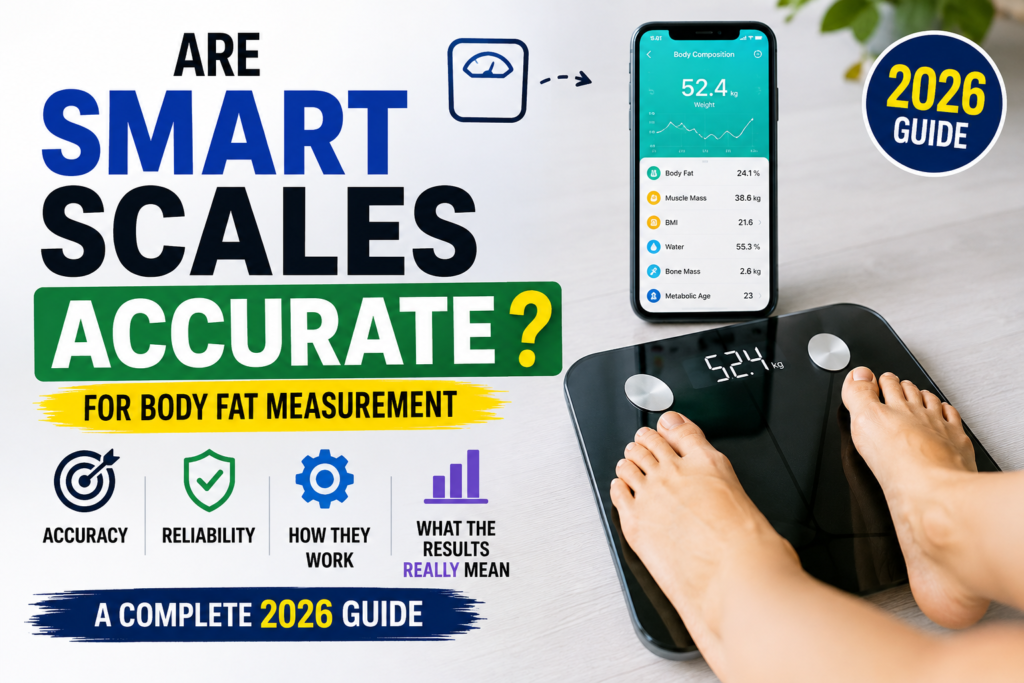
Are smart scales accurate for body fat? Learn how BIA works, how readings compare with DXA, why results fluctuate, and how to track progress.
LifeCareBalance.com is reader-supported. When you buy through links on our site, we may earn an affiliate commission at no extra cost to you. As an Amazon Associate, we earn from qualifying purchases.
If you have ever stepped on a smart scale twice in one morning and received two different body-fat percentages, you already know why the answer is not a simple yes or no.
Quick Answer: Smart scales are generally more dependable for measuring body weight than estimating body-fat percentage. Most consumer body-composition scales use bioelectrical impedance analysis (BIA), which measures electrical impedance and combines the result with personal information to estimate body composition. Research shows that some BIA devices perform reasonably well, but accuracy varies considerably between models and individuals. A smart scale can provide useful information for monitoring progress, but its body-fat reading should not be treated as an exact measurement.
Bottom line: Use your smart scale primarily for consistent weight tracking. Treat body-fat percentage and muscle-mass readings as estimates, and avoid making health or fitness decisions based on one measurement alone.
This guide explains how smart scales estimate body fat, what research says about their accuracy, why readings fluctuate, and how to interpret the numbers more responsibly.
This article is for educational purposes only and is not a substitute for professional medical advice.
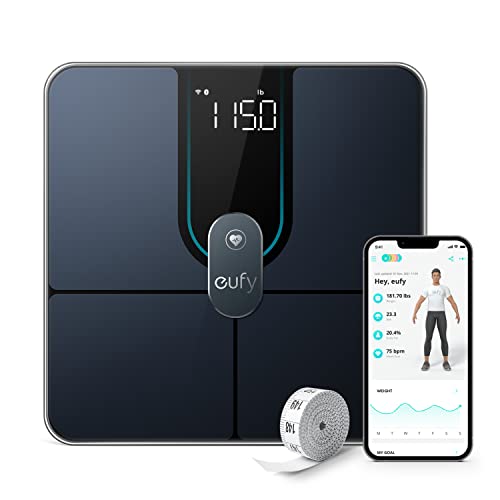
- FULL BODY COMPOSITION ANALYSIS: Track your daily progress and monitor 16 detailed measurements of your body including we…
- ADVANCED TECHNOLOGY FOR HIGH ACCURACY: The sensitive ITO-coating technology on Smart Scale P2 Pro allows you to step on …
- 3D VIRTUAL MODEL: Watch your body’s progress throughout your fitness journey with a virtual, U-Body 3D model, featuring …
Are Smart Scales Accurate for Body Fat?
Smart scales can be useful, but their body-fat accuracy depends on the specific device, its measurement technology, the algorithm it uses, and the conditions under which you measure.
Weight and body composition are two different measurements.
A digital scale measures your total body weight using sensors called load cells. Body-fat percentage, however, is generally estimated using an electrical signal and a mathematical model. The scale does not directly see or count fat tissue.
A study published in the British Journal of Nutrition evaluated 15 bioelectrical impedance analysis devices against a laboratory four-compartment reference model. The researchers found substantial variation in cross-sectional accuracy, with the devices showing different levels of agreement with the reference method. Although some devices performed better than others, the results did not support treating every consumer BIA scale as equally accurate.
You can read the research on the reliability and validity of 15 BIA devices for the detailed findings.
This distinction matters because a scale can repeatedly display a similar number without that number being close to your actual body-fat percentage.
For example, a scale might consistently estimate your body fat at 27%. That consistency can help you compare readings over time, but it does not establish that your true body-fat percentage is exactly 27%.
What the Research Means for Everyday Users
The evidence supports three practical conclusions:
- Body weight: Usually the most dependable measurement provided by a consumer smart scale when the device is used correctly.
- Body-fat percentage: An estimate that can differ from a reference method by a meaningful amount.
- Long-term trends: Potentially useful, but the usefulness depends on the device and whether changes in the readings reflect actual changes in body composition.
Consumer Reports also explains that smart-scale connectivity does not automatically make a scale more accurate. Its bathroom scale buying guide discusses the limitations of body-composition measurements and the difference between connected features and measurement performance.
How Do Smart Scales Measure Body Fat?
What Is Bioelectrical Impedance Analysis?
Bioelectrical impedance analysis, commonly called BIA, estimates body composition by measuring how an electrical current passes through the body.
Most foot-to-foot smart scales have metal electrodes on their platforms. When you stand barefoot on the scale, a small electrical current travels through the lower body. The device measures impedance, which describes how strongly the body resists the current.
Body tissues conduct electricity differently, partly because of differences in their water content and composition. The scale uses the impedance measurement to estimate body composition.
The electrical current used by typical consumer BIA scales is very small and generally imperceptible. However, people with implanted electronic medical devices should follow the scale manufacturer’s specific safety instructions before using a BIA feature.
How the Scale Calculates Body-Fat Percentage
The raw impedance reading does not directly equal a body-fat percentage.
The scale’s algorithm typically combines the impedance data with information such as:
- Body weight
- Height
- Age
- Sex, as requested by the device
- Other profile information or activity settings, depending on the model
The manufacturer uses a mathematical prediction equation to turn these inputs into estimated body composition.
Different manufacturers can use different equations, electrode arrangements, frequencies, and assumptions. This explains why two brands can report different body-fat percentages for the same person.
The exact formulas are not always publicly available, making it difficult for consumers to independently evaluate how a particular model calculates its results.
Why BIA Is an Estimate, Not a Direct Measurement
The most important limitation is that BIA estimates body composition from electrical properties. It does not directly measure fat tissue, count muscle fibers, or image your organs.
Other metrics displayed by a smart scale may also be calculated from the same underlying information.
For example, fat-free mass may be calculated after estimating fat mass. Muscle mass may then be estimated using additional assumptions. Visceral-fat ratings are often proprietary scores rather than direct measurements of the fat surrounding your internal organs.
A scale displaying 20 different metrics is not necessarily providing 20 independent measurements. Many results are derived from the same underlying data.
Smart Scale vs. DEXA: Which Is More Accurate?
DEXA, also called DXA, stands for dual-energy X-ray absorptiometry. It uses X-rays at two energy levels to estimate fat mass, lean soft tissue, and bone mineral content.
DXA is widely used in body-composition research and can provide a more detailed assessment than a basic foot-to-foot smart scale. However, DXA is not a perfect ground truth. Results can vary with equipment, software, scanning procedures, and other factors.
A study comparing consumer bioelectrical impedance devices with DXA and whole-body MRI found that agreement varied between devices. Some performed better than others, while certain foot-to-foot devices showed wider limits of agreement for body-fat estimates.
The original research is available in this comparison of consumer BIA devices with MRI and DXA.
Body-Fat Measurement Methods Compared
| Method | How It Works | Main Advantage | Main Limitation |
|---|---|---|---|
| Foot-to-foot smart scale | Estimates composition using electrical impedance through the lower body | Convenient and inexpensive for home use | May not represent whole-body composition accurately for every individual |
| Hand-to-foot BIA | Uses electrodes on the hands and feet to measure a broader electrical pathway | Can provide more comprehensive body-composition estimates | Still depends on prediction equations and measurement conditions |
| Multi-frequency BIA | Uses multiple electrical frequencies to estimate body-water and composition characteristics | Provides additional information about electrical properties | More advanced technology does not guarantee accurate individual results |
| DXA scan | Uses two X-ray energy levels to estimate body composition | Detailed assessment in clinical or research settings | Requires specialized equipment and may involve cost and access limitations |
| Skinfold calipers | Measures the thickness of skinfolds at selected sites | Affordable when performed by a trained professional | Results depend heavily on technique and prediction equations |
Should You Get a DXA Scan Instead?
Not everyone needs a DXA scan.
For someone who wants to monitor ordinary weight changes at home, a good digital scale may be sufficient. If you want a more detailed body-composition assessment for a specific fitness or clinical purpose, a qualified healthcare professional can help determine whether DXA or another method is appropriate.
The important point is to compare measurements from the same method when tracking changes. Switching between a smart scale and a DXA scan can create differences that reflect the measurement methods rather than actual changes in your body.
Why Does Smart Scale Body Fat Change Every Day?
Body-fat readings can fluctuate even when your actual fat mass has not changed meaningfully. BIA is affected by body water and other conditions that influence electrical impedance.
1. Hydration
Hydration is one of the most important factors to consider.
Drinking a large amount of fluid, becoming dehydrated, or recovering from fluid loss can change impedance and affect the algorithm’s estimate. The direction and size of the change depend on the device and circumstances.
A study examining acute hydration found that consuming water changed body-composition estimates from both single-frequency and multi-frequency BIA devices. Some estimates of body-fat percentage increased after water consumption, demonstrating that a higher reading does not automatically mean a person gained fat.
See the study on acute hydration and BIA body-composition estimates for more detail.
What to do: Measure under similar everyday conditions. Do not deliberately restrict water or dehydrate yourself to obtain a preferred reading.
2. Food and Drinks
Food and drinks temporarily affect body weight and can influence impedance-based estimates.
A reading taken after breakfast is not directly comparable with one taken before breakfast. The difference may reflect food in the digestive system, fluid intake, and changes in body water rather than a meaningful change in fat mass.
What to do: If you want consistent comparisons, measure before eating or drinking when practical, while maintaining normal hydration.
3. Exercise
Exercise can affect fluid distribution, skin temperature, blood flow, and hydration. A reading taken immediately after an intense workout may therefore differ from a reading taken while rested.
Sweat loss can also change body weight temporarily.
What to do: Avoid comparing a post-workout measurement with a rested morning measurement. Follow your manufacturer’s instructions about when to test.
4. Time of Day
Body weight and hydration naturally change throughout the day. Meals, drinks, activity, and bathroom visits all influence readings.
What to do: Choose a repeatable time, such as the morning after using the bathroom and before breakfast, if that fits your routine.
5. Foot Placement and Skin Contact
Foot-to-foot scales depend on contact between bare skin and the electrodes. Socks, lotion, wet feet, inconsistent placement, or movement during the reading may interfere with measurement.
What to do: Use clean, dry, bare feet and follow the device’s placement instructions.
6. Body Shape and Muscle Mass
BIA prediction equations are developed using particular populations and assumptions. Someone with unusually high muscle mass, a different body-fat distribution, or body proportions unlike those represented in the model may receive less accurate estimates.
This does not mean all athletes or people with larger bodies will receive inaccurate readings. It means individual performance cannot be assumed from a device’s average results alone.
7. Different Brands and Algorithms
Two smart scales can produce different estimates for the same person because their hardware, electrode configuration, and calculation methods differ.
A result from one brand should not be directly compared with a result from another brand as though the numbers were interchangeable.
If you are choosing a device, our Withings vs. Eufy smart scale comparison discusses differences in product features and app experiences. It should not be interpreted as proof that one brand’s body-fat estimates are clinically more accurate than the other’s.
How to Get More Consistent Body-Fat Readings
You cannot eliminate every source of measurement error, but you can make your readings more comparable.
- Use the same scale. Different models may use different algorithms.
- Measure at a consistent time. Morning measurements before breakfast are a practical option for many people.
- Use a hard, level surface. Avoid carpet and uneven flooring.
- Follow the instructions. Use the recommended foot or hand placement and enter your profile details accurately.
- Keep hydration normal. Do not intentionally drink excessive water or restrict fluids to influence the reading.
- Avoid comparing very different conditions. A measurement after exercise is not directly comparable with one taken while rested.
- Look at trends rather than isolated results. Evaluate changes over several weeks instead of reacting to every daily fluctuation.
- Use other indicators of progress. Depending on your goal, these might include body weight, waist measurements, exercise performance, clothing fit, or advice from a qualified professional.
A Simple Tracking Example
Imagine that your scale reports body-fat estimates of 27.2%, 26.6%, and 27.5% over three consecutive mornings.
Those readings do not establish that you gained and lost fat overnight. They may reflect normal variability in the measurement conditions.
Instead of reacting to every value, record the results and consider the pattern over several weeks. If the readings move in one direction consistently, that may provide useful context—but it still does not prove the exact amount of fat gained or lost.
If daily measurements create anxiety or encourage restrictive behavior, it may be better to measure less frequently or focus on other progress indicators.
What Do Smart Scale Metrics Actually Mean?
Smart scales often display more than body-fat percentage. Understanding the limitations of each metric can help you avoid overinterpreting the results.
| Metric | What It Represents | How to Interpret It |
|---|---|---|
| Body weight | Total mass at the time of measurement | Generally the most dependable scale measurement |
| Body-fat percentage | Estimated percentage of weight attributed to fat | Treat as an estimate, not an exact value |
| Fat mass | Estimated mass attributed to fat | Depends on the body-fat calculation |
| Fat-free mass | Estimated mass of everything other than fat | Includes water, organs, bone, and muscle |
| Muscle mass | Model-based estimate of muscle-related mass | Not a direct measurement of muscle tissue |
| BMI | Weight relative to height squared | Does not distinguish fat from muscle |
| Water percentage | Estimated proportion attributed to body water | Not a clinical hydration assessment |
| Visceral-fat score | A brand-specific estimate or rating | Do not assume scores are comparable between brands |
| Bone mass | Estimated bone-related mass on many consumer scales | Not equivalent to a DXA bone-density assessment |
| Metabolic age or BMR | Formula-derived estimates | Not a direct measurement of metabolism or biological age |
Can a Smart Scale Measure Visceral Fat?
Most household smart scales do not directly measure the amount of visceral fat surrounding internal organs. They typically provide an estimate or proprietary score based on their algorithms.
A high or low score should not be treated as a diagnosis. If you have concerns about abdominal fat or metabolic health, discuss them with a qualified healthcare professional rather than relying on a smart-scale rating alone.
Can a Smart Scale Accurately Measure Muscle Mass?
A smart scale can estimate muscle-related metrics, but these values depend on the underlying BIA model. Hydration changes can affect the results, and an apparent increase in muscle mass may partly reflect changes in body water.
For strength-training progress, consider combining scale trends with practical measures such as training performance, recovery, and consistent body measurements.
Are More Expensive Smart Scales More Accurate?
Not necessarily.
Higher-priced models may offer hand electrodes, multi-frequency measurements, segmental estimates, better apps, automatic syncing, and more user profiles. These features may be useful for some people, but a higher price does not guarantee that the reported body-fat percentage is closer to a reference measurement.
When comparing models, consider the following:
- Does the scale measure weight consistently on a hard, level floor?
- Is the app easy to use?
- Can you view and export historical data?
- Does it support the health platform you already use?
- Does it support separate household profiles?
- Does the manufacturer explain the limitations of its body-composition estimates?
- Are the privacy policy and account requirements acceptable to you?
For help matching features to your needs, see our Smart Scale Buying Guide 2026.
If you are considering specific models, our Eufy Smart Scale P2 Pro review and Withings Body Smart review provide additional product-focused information. Check current availability, features, and compatibility before purchasing.
Who Should Be Especially Careful With Body-Composition Readings?
Smart-scale estimates may require extra caution for people whose circumstances differ from the conditions under which a device was designed or validated.
Examples include:
- People experiencing significant fluid shifts or fluid retention
- Athletes with unusually high muscle mass
- People undergoing rapid weight changes
- People whose body characteristics differ from the population used to develop a device’s prediction equation
- People who are pregnant, for whom ordinary BIA body-composition estimates may not be appropriate
If you are pregnant, have an implanted electronic medical device, or have a medical condition that affects fluid balance, check the manufacturer’s instructions and consult a qualified healthcare professional when appropriate. Do not assume that all BIA devices have the same safety instructions.
Smart scales are consumer tracking tools, not substitutes for medical assessment. For a broader approach to building sustainable health habits, explore our Personalized Wellness Guide.
Frequently Asked Questions
Are smart scales accurate for body fat?
They estimate body-fat percentage using BIA rather than measuring fat directly. Research shows that performance varies across devices and individuals, so the result is best treated as an estimate.
How far off can a smart scale’s body-fat reading be?
There is no single error margin that applies to every scale. Studies have found substantial variation in agreement with reference methods, depending on the device and the population tested.
Are smart scales accurate for weight?
Weight is generally the most dependable measurement provided by consumer smart scales, assuming the device is used correctly on a hard, level surface.
Why does my body-fat percentage change every day?
Hydration, meals, exercise, time of day, skin contact, and other factors can affect impedance-based estimates. Short-term fluctuations do not necessarily represent changes in body fat.
Does drinking water affect body-fat readings?
Yes. Research has found that acute fluid intake can change BIA body-composition estimates. Keep hydration normal and try to measure under similar conditions each time.
Is DEXA more accurate than a smart scale?
DXA provides a more detailed body-composition assessment and is widely used in research. It also has limitations, so the best method depends on your purpose and the guidance of an appropriate professional.
Are expensive smart scales worth buying?
They may be worth it for better connectivity, app features, or additional electrodes. A higher price alone does not guarantee more accurate body-fat estimates.
Can smart scales measure muscle mass?
They generally estimate muscle mass using BIA data and prediction equations. These readings can provide context, but they are not direct measurements of muscle tissue.
How often should I check body fat on a smart scale?
There is no universal schedule. A few consistent measurements per week may be sufficient for people who find tracking helpful. Choose a frequency that supports your goals without creating unnecessary stress.
Should I stop using my smart scale if the readings seem wrong?
Not necessarily. First check the device setup, placement, and measurement conditions. If weight readings are inconsistent despite correct use, consult the manufacturer’s troubleshooting guidance. If body-composition numbers conflict with other information, remember that they are estimates and seek professional advice if the results affect a health decision.
Final Verdict: Are Smart Scales Worth Using?
Smart scales can be useful for monitoring body weight and collecting body-composition estimates at home. Their main advantage is convenience: they make it easy to record measurements and review patterns over time.
However, body-fat percentage, muscle mass, visceral-fat scores, and similar metrics should not be treated as exact measurements. Research shows that BIA devices differ in how well they agree with reference methods, and ordinary changes in hydration and measurement conditions can affect the results.
For most home users, the sensible approach is to choose a scale that measures weight consistently, use it under similar conditions, and focus on longer-term patterns rather than daily changes. If you need a more detailed assessment for a medical or performance-related reason, ask a qualified professional which measurement method is appropriate.
The key takeaway: A smart scale can help you observe trends, but it cannot tell your complete health story from one number.
This article is for educational purposes only and is not a substitute for professional medical advice.