
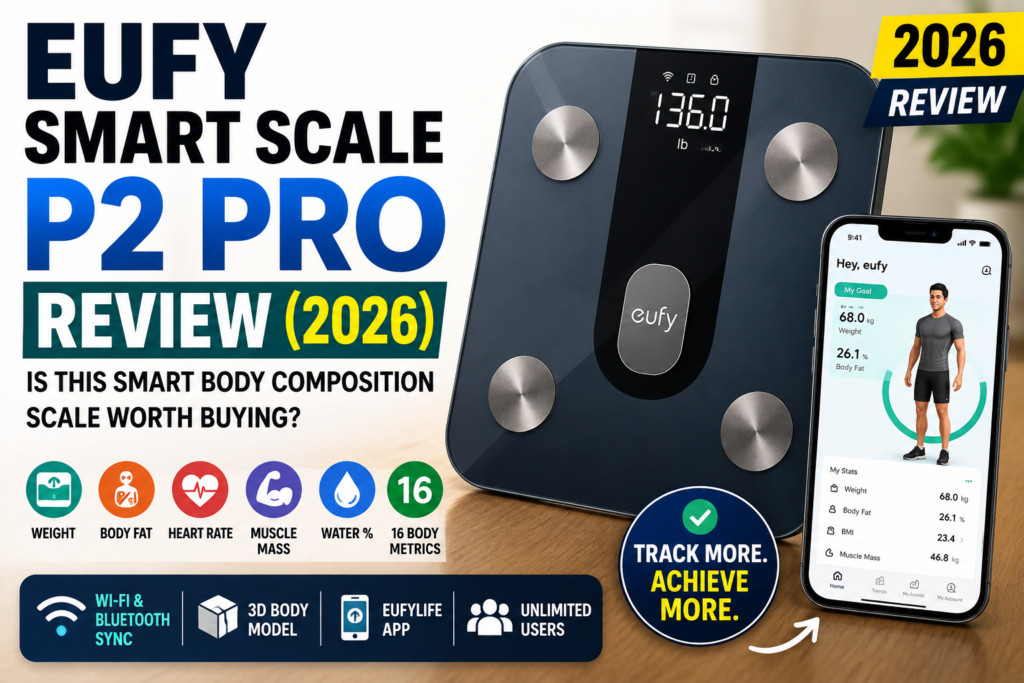
Eufy Smart Scale P2 Pro Review 2026: discover its accuracy, body fat, BMI, muscle mass, heart rate, app features, weight-loss tracking, pros, cons, and value.
LifeCareBalance.com is reader-supported. When you buy through links on our site, we may earn an affiliate commission at no extra cost to you. As an Amazon Associate, we earn from qualifying purchases.
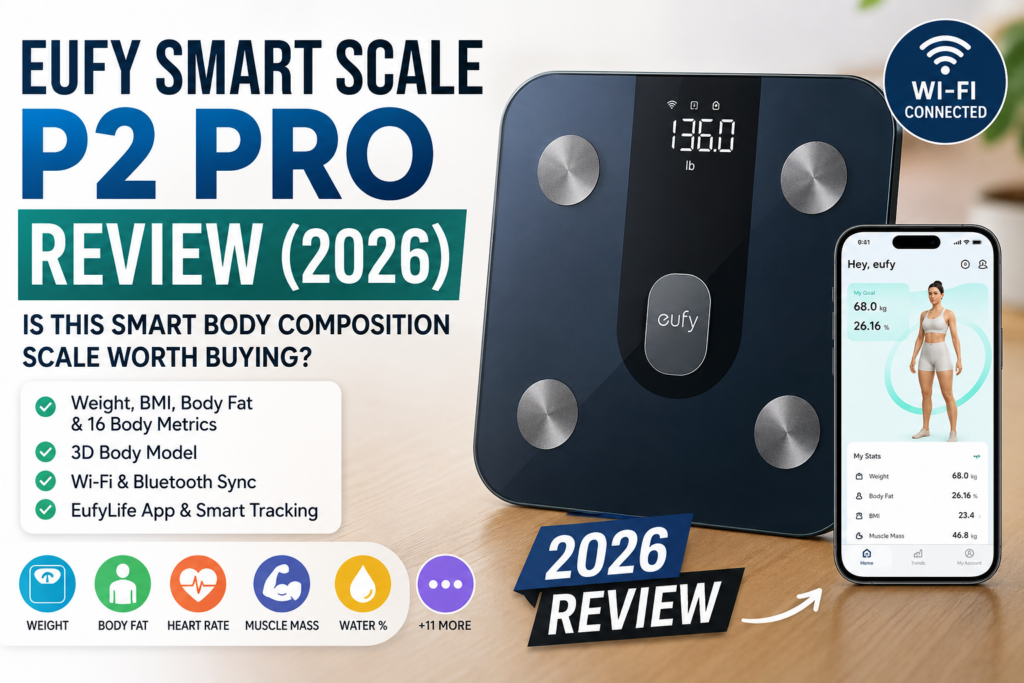
The Eufy Smart Scale P2 Pro is a Wi-Fi and Bluetooth-connected bathroom scale that estimates 16 body metrics — including weight, body fat percentage, BMI, muscle mass, bone mass, visceral fat, and heart rate — and syncs them to the EufyLife app. It’s made by Eufy, the smart-home division of Anker, and it sits in the mid-range of the smart scale market: more capable than a $20–30 Bluetooth-only scale, but simpler and cheaper than premium “health station” scales that cost several hundred dollars.
It’s designed for people who want more than a single weight number: home fitness users tracking body composition trends, multi-person households that want individual profiles, and anyone who wants their weigh-ins to sync automatically into Apple Health, Google Fit, or Fitbit without opening an app every time.
Its biggest strengths are its price-to-feature ratio, dual Wi-Fi/Bluetooth connectivity, and an unusually deep set of tracked metrics for the price. Its biggest limitations are ones shared by every consumer bioelectrical impedance analysis (BIA) scale: body-fat, visceral-fat, and similar readings are estimates, not diagnostic-grade measurements, and its display and design are a step behind more expensive competitors like the Withings Body Smart scale.
This review will help you decide whether the P2 Pro’s combination of price, features, and accuracy limitations makes sense for your goals in 2026, or whether you’d be better served by a cheaper or pricier alternative.
Quick Verdict
Best for: Budget-conscious buyers, multi-person households, and anyone who wants Wi-Fi background syncing and a broad set of trend metrics without paying premium-scale prices.
Biggest advantage: A strong feature set — Wi-Fi, Bluetooth, 16 tracked metrics, unlimited user profiles, and third-party app syncing — at a mid-range price point.
Biggest weakness: Like all consumer BIA scales, its body-fat and body-composition estimates are not clinically validated and can drift meaningfully from lab-grade methods such as DEXA.
Worth buying in 2026? Yes, for buyers who want a full-featured, moderately priced scale and understand that body-composition numbers are trend indicators, not medical measurements. Weight tracking is generally reliable; treat body-fat, visceral-fat, and similar readings as directional.
Who should consider alternatives: People who want segmental (arm/leg/trunk) analysis, clinical-grade precision, or a more polished display should look at premium options like Withings’ higher-end scales, while people who just want a basic number at the lowest possible price may prefer an entry-level Bluetooth-only scale.
Eufy Smart Scale P2 Pro at a Glance
| Spec | Details |
|---|---|
| Product type | Wi-Fi + Bluetooth smart body composition scale |
| Weight capacity | 0.2–397 lb / 0.1–180 kg |
| Weight resolution | 50 g / 0.1 lb |
| Body composition metrics | 16 total: weight, body fat %, heart rate, BMI, muscle mass, bone mass, water %, protein, BMR, visceral fat, body fat mass, lean body mass, body age, body type, skeletal muscle mass, subcutaneous fat |
| Heart rate | Yes, measured during weigh-in via BIA electrodes |
| Connectivity | Wi-Fi (2.4GHz) and Bluetooth, dual-mode |
| App | EufyLife (iOS 10.0+, Android 5.0+) |
| Third-party syncing | Apple Health, Google Fit, Fitbit |
| Power | 4x AAA batteries (included) |
| Waterproof rating | IPX5 (splash-resistant; avoid stepping on with wet feet) |
| Surface | Tempered glass with ITO (indium tin oxide) electrode technology |
| 3D body model | Yes, opt-in with user-entered measurements |
| User profiles | Unlimited users supported |
| Baby / pet modes | Yes (per official Eufy product listings) |
| Dimensions | Approx. 11 x 11 in (280 x 280 x 26 mm) |
| Weight of unit | Approx. 1.7 kg / 3.7 lb |
| Units | kg, lb, st |
| Price | Roughly $50–$70 depending on retailer and promotions |
Always check the official Eufy product page or your retailer listing for the most current price and in-box contents before buying, since pricing and bundled accessories can change.
Key Features
1. 16 Body Measurements
Eufy markets the P2 Pro on its “16 measurements,” but a long list of numbers is only useful if you understand what each one actually tells you. Here’s a practical breakdown.
| Metric | What It Means | How Useful Is It for Tracking? |
|---|---|---|
| Weight | Total body mass | Highly useful; the most reliable number on the scale |
| BMI | Weight-to-height ratio | Useful as a rough population-level screening tool, not a body-composition measure |
| Body fat % | Estimated proportion of body mass that is fat | Useful as a trend over weeks/months; individual readings can fluctuate |
| Muscle mass | Estimated total muscle weight | Useful for tracking strength-training progress over time |
| Skeletal muscle mass | Estimated muscle attached to bone | Similar use case to muscle mass; watch the trend, not the daily number |
| Bone mass | Estimated mineral content of bones | Low day-to-day usefulness; changes very slowly |
| Water % | Estimated body hydration | Highly variable; more useful as a hydration-consistency check than a health metric |
| Visceral fat | Estimated fat surrounding internal organs | Directional indicator only; not a diagnostic measurement |
| Protein % | Estimated protein content of body mass | Niche metric; most users can safely ignore day-to-day |
| BMR | Estimated calories burned at rest | Useful as a rough guide for calorie planning |
| Body fat mass | Body fat % converted to a weight | Useful alongside body fat % for context |
| Lean body mass | Total weight minus fat mass | Useful for tracking muscle-preservation during weight loss |
| Body age | An estimated “metabolic age” based on other metrics | Motivational, not medically meaningful |
| Body type | A categorization (e.g., “muscular,” “lean”) based on BMI and body fat | Simplified summary; not a substitute for the underlying numbers |
| Subcutaneous fat | Estimated fat just beneath the skin | Directional indicator only |
| Heart rate | Pulse reading taken via the scale’s electrodes | Reasonable snapshot, but not a substitute for a dedicated heart-rate monitor |
The important theme across this table: weight is measured directly, while everything else is estimated using bioelectrical impedance analysis and mathematical models. That distinction matters throughout this review.
2. Weight Tracking
The scale measures weight in 50 g / 0.1 lb increments, which is precise enough to catch small week-to-week changes. That said, your weight naturally fluctuates by a pound or two (or more) throughout the day due to food, fluids, and bathroom habits. To get a meaningful trend:
- Weigh yourself at the same time of day, ideally first thing in the morning
- Use similar clothing conditions each time
- Look at your 7-day rolling average in the EufyLife app rather than reacting to any single reading
- Expect noise — a single up or down day rarely means anything on its own
3. Body Fat Percentage
This is one of the most searched-for features, and it deserves a careful explanation.
How BIA estimates body fat: The scale sends a very low, imperceptible electrical current through your feet and up through your body. Fat, muscle, and water conduct electricity differently, so the scale measures resistance (impedance) and plugs it into an algorithm — along with your age, sex, and height — to estimate body fat percentage.
Why BIA differs from DEXA: Dual-energy X-ray absorptiometry (DEXA) is a clinical imaging method that directly measures bone, fat, and lean tissue. BIA is an indirect estimate based on electrical resistance and population-based formulas. Independent testing of consumer BIA scales has generally found that they can track in the right direction but may diverge from DEXA results by a meaningful margin, particularly at higher body-fat percentages. We did not conduct our own DEXA comparison for the P2 Pro, and readers should treat any specific accuracy percentage they see online with caution unless it comes from a transparent, methodologically sound source.
Why readings vary: Body-fat readings from any consumer BIA scale can shift based on:
- Hydration level (dehydration tends to inflate body-fat readings)
- Recent exercise
- Food and drink consumed
- Time of day
- Whether your feet are dry and properly placed on the electrodes
- Measurement consistency (same time, same conditions)
Bottom line: Treat the P2 Pro’s body-fat percentage as a trend indicator you track over weeks and months, not a definitive medical measurement of your day-to-day body composition.
4. BMI Tracking
BMI (body mass index) is calculated from your height and weight and displayed automatically in the app. It’s a widely used population-level screening tool that can flag whether someone falls into underweight, normal, overweight, or obese weight ranges relative to height.
What BMI can tell you: a general, easy-to-calculate reference point that correlates with health risk across large populations.
What BMI cannot tell you: how much of your weight is muscle versus fat. This is why muscular or highly athletic people can register as “overweight” or “obese” by BMI despite having low body fat — BMI has no way to distinguish muscle mass from fat mass. If you strength train regularly, treat your BMI number with that limitation in mind and lean more on your body-fat and lean-mass trends.
5. Muscle Mass and Skeletal Muscle
Both figures estimate how much of your body weight comes from muscle tissue. For most home users, the practical value isn’t the exact number but the direction it moves. If you’re strength training and dieting at the same time, watching muscle mass hold steady (or only dip slightly) while body fat drops is a good sign you’re preserving muscle during weight loss — a genuinely useful piece of context that a basic scale can’t give you.
6. Visceral Fat
Visceral fat surrounds internal organs and is associated with higher metabolic risk when elevated. The P2 Pro reports an estimated visceral-fat score, but this is a BIA-derived approximation, not a clinical assessment (which would typically require imaging). Don’t treat a smart-scale visceral-fat number as a diagnosis — use it as one more data point to discuss with a healthcare provider if you have concerns, and watch the trend over time rather than fixating on a single reading.
7. Heart Rate
The scale takes a pulse reading through the same electrodes used for body composition, giving you a quick heart-rate snapshot at the moment you weigh in. This can be a nice bonus data point, but it’s a single-moment reading, not a substitute for a dedicated heart-rate monitor or wearable, and it shouldn’t be used to diagnose cardiovascular conditions.
8. 3D Body Model
The EufyLife app includes an optional 3D avatar feature. Users manually enter measurements (height, waist, and other body dimensions), and the app generates a rough visual model intended to represent body shape changes over time.
Is it useful? It can be a motivating visual for some users who want to see progress rather than just read numbers, especially early in a fitness journey. Is it a gimmick? For users who don’t enter accurate manual measurements, the avatar can be more novelty than useful data — and some reviewers have noted that avatar proportions don’t always feel precisely representative. The good news: the 3D model is entirely optional. If you find it inaccurate or unhelpful, you can simply ignore it and rely on the numeric metrics and trend charts instead, which is where the scale’s real tracking value lives.
How Accurate Is the Eufy Smart Scale P2 Pro?
Weight Accuracy
Based on its published 50 g / 0.1 lb resolution and its widespread use as a straightforward weight scale, weight measurement is the P2 Pro’s strongest and most trustworthy function. As with any bathroom scale, place it on a hard, level, non-carpeted surface for the most consistent readings.
Body Composition Accuracy
Body fat, muscle mass, visceral fat, water percentage, and similar metrics are all derived from the same BIA electrical-resistance measurement. This is a general limitation of the entire BIA scale category, not something unique to Eufy. We have not seen a rigorous, transparent independent lab comparison (such as a peer-reviewed or clearly documented DEXA study) for the P2 Pro specifically, so we won’t cite a specific accuracy percentage. If you come across a review citing precise error margins against DEXA, check whether the source discloses its sample size, testing conditions, and methodology before trusting the number.
What Can Affect Readings?
- Hydration: Dehydration and overhydration both skew BIA readings
- Exercise: Recent activity changes blood flow and hydration, affecting impedance
- Meals and drinks: Eating or drinking shortly before weighing in adds noise
- Time of day: Body water distribution shifts throughout the day
- Bare, dry feet: Wet feet, socks, or improper foot placement on the electrodes can produce errors or failed readings
- Scale position: An uneven or soft surface can affect weight accuracy
- User profile selection: Using the wrong profile (or no profile) means the scale calculates metrics with incorrect age/sex/height inputs
Is the Eufy P2 Pro Good for Weight Loss?
Used correctly, the P2 Pro can be a genuinely helpful weight-loss tool — not because any single reading is precise, but because consistent tracking reveals trends that matter more than any one number.
- Establish a baseline. Weigh in for the first week without judgment, just to see your starting trend and normal fluctuation range.
- Weigh under consistent conditions. Same time of day, similar clothing, ideally first thing in the morning before eating or drinking.
- Track weekly averages, not daily numbers. A single day’s weight can swing due to sodium, water, or digestion. The 7-day average smooths that noise out.
- Monitor body-fat trends cautiously. Look for a gradual downward trend over 4–8+ weeks rather than reacting to daily body-fat swings.
- Watch muscle trends while dieting. If you’re in a calorie deficit and strength training, a stable or only slightly declining muscle-mass trend suggests you’re preserving lean tissue.
- Use BMI as a secondary reference, not a primary target — especially if you strength train.
- Combine scale data with other measures: waist circumference, how clothes fit, and fitness performance (strength, endurance) often tell a more complete story than the scale alone, particularly during recomposition phases where weight may stay flat while body composition improves.
A single daily number should never be the sole verdict on whether your diet or training plan is working. Scale data is most useful as one input alongside how you feel, how you perform, and how your body looks and measures over time.
EufyLife App Review
The EufyLife app is the interface for everything the P2 Pro measures. Based on official Eufy documentation and available app information:
- Setup is done through the EufyLife app, pairing the scale via Bluetooth first and then optionally configuring Wi-Fi for background syncing
- Dashboard displays your most recent weigh-in along with historical charts for each of the 16 metrics
- Historical trends and charts let you view data over custom time ranges, which is the most useful feature for spotting real progress instead of daily noise
- Goals can be set for weight or other tracked metrics
- User profiles allow each household member to have separate historical data
- Data syncing happens automatically over Wi-Fi, or via Bluetooth when your phone is nearby
- Third-party integration supports Apple Health, Google Fit, and Fitbit, according to Eufy’s official support documentation
- Ease of use is generally considered a strength of Eufy’s smart scale app lineup, though as with any companion app, occasional sync hiccups are possible and are usually resolved by restarting the app or the scale
Wi-Fi vs Bluetooth: How Does the P2 Pro Work?
The P2 Pro is a dual-mode device, and understanding the difference matters for day-to-day use:
- With Wi-Fi connected: Once you’re on the scale’s network, your weigh-in data is automatically uploaded to Eufy’s servers as soon as the measurement finishes. You don’t need your phone nearby — you can check the app later and your data will already be there.
- Without Wi-Fi (Bluetooth only): The scale stores your measurement and transmits it via Bluetooth. According to Eufy’s official documentation, Bluetooth stays active while the scale is on and for a window of time (around 10 minutes) after use, so your phone needs to be within range and the app open (or backgrounded appropriately) to capture the sync.
- Network requirements: The scale connects to 2.4GHz Wi-Fi networks, which is a common requirement for smart-home devices and something to check if your router primarily broadcasts 5GHz.
If you weigh in without your phone in the bathroom — which is common — Wi-Fi is the feature that ensures you don’t lose that data point.
Setup Guide
- Install the EufyLife app from the App Store or Google Play
- Add the scale through the app’s device-pairing flow
- Add a user profile with your height, age, sex, and other details the algorithms need
- Connect via Bluetooth first, since this is required for initial pairing
- Configure Wi-Fi in the app if you want automatic background syncing
- Step on the scale with bare, dry feet and stand still until the reading completes
- Confirm your measurement and check that it’s attributed to the correct user profile
- Check app synchronization to confirm your data has appeared in your history and, if enabled, in Apple Health, Google Fit, or Fitbit
Family, Baby and Pet Use
The P2 Pro officially supports unlimited user profiles, according to Eufy’s product listings, which makes it a practical option for larger households. A few practical notes:
- User identification on BIA scales, including this one, is generally not automatic — you typically select your profile in the app before or after stepping on, rather than the scale recognizing you by weight alone. If two family members have similar weights, double-check you’re logging data under the correct profile.
- Baby Mode and Pet Mode are listed among the scale’s features on official Eufy marketing pages, intended to make weighing infants or pets more practical than a standard adult-focused reading.
- Practical tip: In larger households, get everyone into the habit of confirming their profile in the app after each weigh-in to avoid mixed-up historical data, especially early on.
Design and Build Quality
The P2 Pro uses a square tempered-glass platform with ITO (indium tin oxide) electrode technology, which allows the metal contact points to be nearly invisible and blended into the glass surface for a cleaner look. Based on hands-on impressions from independent reviewers:
- The glass surface is comfortable underfoot even for larger shoe sizes
- It’s rated IPX5 for splash resistance, making it reasonable for bathroom use, though official guidance still advises against stepping on it with wet feet
- The display is functional but basic compared to premium competitors, and some reviewers have noted it can be harder to read in bright light
- Glass surfaces show fingerprints and require occasional wiping to stay looking clean
- The battery compartment is straightforward to access for AAA battery replacement
Battery Life and Maintenance
The P2 Pro runs on 4 AAA batteries, which are included in the box. Eufy does not publish a specific guaranteed battery-life figure that we can independently verify, so we won’t cite a specific number of months here — expect battery life to vary based on how often the scale is used and whether Wi-Fi syncing is active, since wireless transmission draws more power than Bluetooth-only use.
Maintenance tips:
- Wipe the glass surface with a soft, dry cloth; avoid harsh chemical cleaners
- Keep the scale on a hard, flat, level surface rather than carpet for both comfort and weight-reading accuracy
- Store spare AAA batteries on hand since the scale will stop syncing once batteries run low
- Avoid leaving the scale in standing water or exposing it to prolonged moisture despite its IPX5 rating
Pros and Cons
Pros
- Wide range of tracked metrics (16 total) for a mid-range price
- Dual Wi-Fi and Bluetooth connectivity, including background syncing without your phone present
- Unlimited user profiles, useful for families
- Syncs with Apple Health, Google Fit, and Fitbit
- Precise weight resolution (0.1 lb / 50 g)
- Optional 3D body model for users who want a visual progress reference
- Baby and pet modes for household versatility
Cons
- Body-fat, visceral-fat, and similar composition metrics are BIA estimates, not clinical-grade measurements
- No automatic user recognition — profile selection is manual
- Display and overall build feel a step behind premium competitors
- 3D avatar accuracy depends heavily on manually entered measurements and may not satisfy users wanting precise visual tracking
- Requires a 2.4GHz Wi-Fi network for full background-sync functionality
Eufy Smart Scale P2 Pro vs Competitors
| Feature | Eufy Smart Scale P2 Pro | Withings Body Smart | RENPHO Smart Scale (entry models) |
|---|---|---|---|
| Approx. price | ~$50–$70 | ~$100–$130 (frequently discounted) | ~$20–$35 |
| Weight tracking | Strong, 0.1 lb resolution | Strong, well-regarded for accuracy | Solid for the price, 0.2 lb resolution |
| Body composition metrics | 16 metrics, broad coverage | Includes visceral fat, hydration; some advanced scores are subscription-gated | 13 metrics on entry models |
| Wi-Fi | Yes | Yes | Varies by model; many entry models are Bluetooth-only |
| Bluetooth | Yes | Yes | Yes |
| App ecosystem | EufyLife; syncs to Apple Health, Google Fit, Fitbit | Health Mate; widely praised app, some features subscription-locked | Renpho Health app; syncs to Apple Health, Google Fit, Fitbit, Samsung Health |
| 3D body model | Yes, opt-in | No dedicated 3D avatar | No |
| User profiles | Unlimited | Up to 8 users on Body Smart | Multiple profiles supported |
| Display | Basic LED, functional | More polished, well-reviewed display | Basic, price-appropriate |
| Best for | Feature-rich tracking at a mid-range price | Buyers wanting the most polished all-around experience and willing to pay more | Buyers who want the lowest-cost entry into body composition tracking |
For a full breakdown of that higher-end option, see our detailed Withings Body Smart scale review, which covers its subscription-gated features and premium app experience in depth.
Eufy also sells a newer Smart Scale P3 in its current lineup. If you specifically want the latest generation of Eufy’s scale technology rather than the P2 Pro, it’s worth comparing current specs and pricing on Eufy’s official site before you decide, since features and pricing between the two models can shift.
There’s no single “winner” across every category — the right pick depends on whether you prioritize price, app polish, or the specific mix of metrics and connectivity you want.
Who Should Buy the Eufy P2 Pro?
- Weight-loss beginners who want more context than a basic scale but don’t need clinical-grade precision
- Home fitness users tracking body composition trends alongside a training program
- Families and multi-person households that want individual profiles without paying per-user fees
- Buyers who want Wi-Fi syncing so data captures automatically even without a phone nearby
- Budget-conscious smart-scale shoppers who still want a broad metric set
- People who want lots of metrics to review over time, understanding that several are directional estimates rather than clinical measurements
Who Should NOT Buy It?
- Users who want advanced segmental analysis (arm, leg, and trunk-specific breakdowns), which is more common on premium multi-electrode scales
- Users who need highly precise, clinical-grade body-composition testing — no consumer BIA scale, including this one, is a substitute for DEXA or an in-clinic assessment
- Users who prefer a more advanced or higher-resolution display may prefer pricier competitors
- Users who specifically want the newest generation of Eufy’s scale technology, who may prefer to compare against the current Eufy Smart Scale P3 before purchasing
Eufy P2 Pro vs a Basic Bathroom Scale
A basic mechanical or digital bathroom scale costs a fraction of the P2 Pro’s price and does one thing: shows your weight. The P2 Pro’s premium buys you automatic historical tracking, trend charts, multi-user support, health-app integration, and a broader (if estimate-based) picture of body composition. If all you want is a weight number with no app, no syncing, and no body-composition estimates, a basic scale is genuinely sufficient and cheaper. If you want to actually track trends over time, sync automatically to a health ecosystem, or get a rough sense of body composition alongside weight, the added cost of a smart scale like the P2 Pro buys real, usable functionality rather than just marketing flourish.
Is Eufy Smart Scale P2 Pro Worth Buying in 2026?
Is it still competitive? Yes, within its price bracket. The core feature set — dual connectivity, 16 metrics, unlimited profiles, third-party syncing — remains a strong value proposition against both budget-tier and premium-tier alternatives.
Who gets the most value? Multi-person households and everyday fitness trackers who want more insight than a basic scale but don’t need clinical-grade precision or a $300+ health station.
Strongest reasons to buy: The combination of price, connectivity, and metric breadth is hard to match at this tier, and reliable weight tracking alone justifies the purchase for many buyers.
Biggest reasons not to buy: If you specifically need clinically precise body composition data, or you want the most polished app and display experience regardless of cost, a premium scale will serve you better.
When to choose a newer competitor instead: If budget isn’t a major constraint and you want segmental analysis, more advanced hydration/cardiovascular metrics, or a more refined display and app, it’s worth comparing against options like the Withings Body Smart or Eufy’s own newer P3 model before you commit.
FAQs
Is the Eufy Smart Scale P2 Pro accurate? Weight accuracy is generally reliable given its 0.1 lb / 50 g resolution. Body-composition metrics like body fat and visceral fat are BIA-based estimates and should be treated as trend indicators rather than precise measurements.
Is Eufy P2 Pro good for weight loss? Yes, when used consistently and interpreted through weekly trends rather than single daily readings. It’s a helpful tracking tool, not a diagnostic device.
Does Eufy P2 Pro measure body fat? Yes, using bioelectrical impedance analysis (BIA), the same underlying technology used by most consumer smart scales.
How accurate is Eufy P2 Pro body fat measurement? We are not aware of a transparent, independently verified accuracy study specific to this model, so we won’t cite a precise error margin. As a general BIA limitation, body-fat estimates can vary based on hydration, food intake, and other factors, and may diverge from clinical methods like DEXA.
Does Eufy P2 Pro measure BMI? Yes, BMI is calculated automatically from your height and weight and displayed in the EufyLife app.
Does Eufy P2 Pro work without Wi-Fi? Yes. Without Wi-Fi, the scale syncs data via Bluetooth when your phone is nearby and the app is open.
Does Eufy P2 Pro use Bluetooth? Yes, it’s a dual-mode Wi-Fi and Bluetooth scale.
How many users can use Eufy P2 Pro? Eufy’s official product listings state unlimited user profiles are supported.
Does Eufy P2 Pro work with Apple Health? Yes, according to Eufy’s official support documentation, the EufyLife app can sync with Apple Health, along with Google Fit and Fitbit.
Is Eufy P2 Pro better than RENPHO? It depends on your priorities. Eufy’s P2 Pro generally offers more consistent Wi-Fi connectivity and a broader metric set, while entry-level RENPHO scales are typically cheaper but may lack Wi-Fi on base models. Neither is “more accurate” in a verified, published sense for body composition — both use similar BIA technology.
Is Eufy P2 Pro better than Withings Body Smart? The Withings Body Smart generally offers a more polished app and display and is well-regarded by independent testers, but costs more and locks some advanced scoring features behind a subscription. The P2 Pro offers a comparable metric set and full Wi-Fi/Bluetooth connectivity at a lower price. Read our full Withings Body Smart scale review for a deeper comparison.
Is Eufy P2 Pro worth buying in 2026? For most buyers who want a feature-rich, mid-range smart scale and understand the general limitations of consumer BIA technology, yes. Buyers wanting clinical-grade precision or the most premium app experience should consider a pricier alternative.
FINAL VERDICT
The Eufy Smart Scale P2 Pro earns its spot as a genuinely useful mid-range smart scale in 2026. The best reason to buy it is the sheer breadth of what you get for the price: reliable weight tracking, dual Wi-Fi/Bluetooth connectivity, 16 body metrics, unlimited user profiles, and syncing with the major health app ecosystems. Its biggest limitation is one it shares with every consumer BIA scale on the market — body-fat, visceral-fat, and related composition numbers are estimates that should be read as trends, not medical facts.
It’s the best type of buy for weight-loss beginners, home fitness trackers, and families who want more insight than a basic scale without paying premium-scale prices. If you’re chasing lab-grade precision, segmental body analysis, or the most polished display and app experience money can buy, a higher-end scale like the Withings Body Smart is worth the extra cost. For everyone else looking for a well-rounded, dependable smart scale that won’t break the budget, the Eufy Smart Scale P2 Pro remains a solid, worthwhile pick in 2026.
If you’re building out a complete home recovery and fitness setup alongside your body-composition tracking, our guides on choosing the right massage gun and the benefits of massage guns for athletes — including our head-to-head Theragun Pro vs. Hypervolt 2 Pro comparison and our Hypervolt 2 Pro review — can help round out your routine.;https://lifecarebalance.com/