
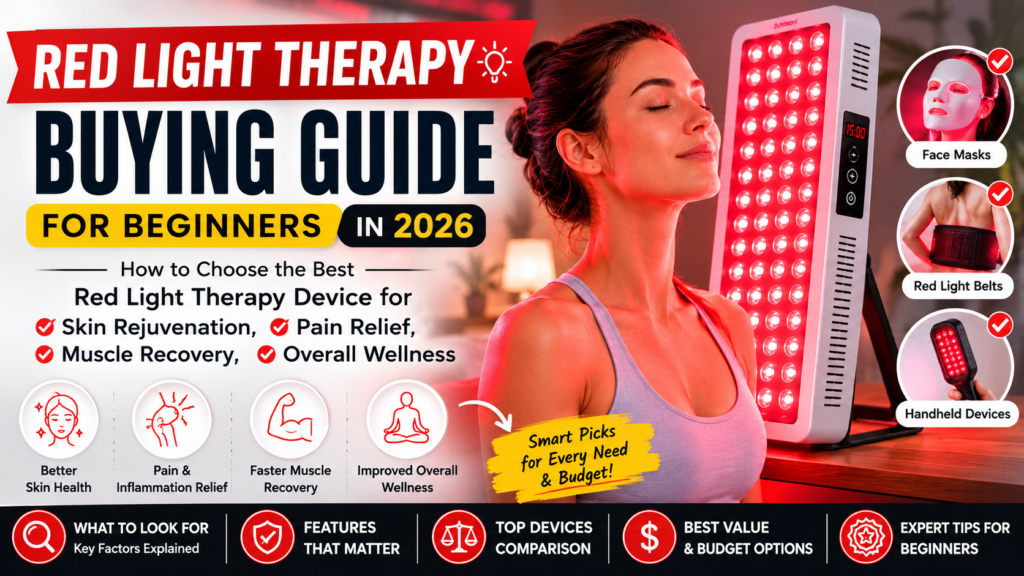
Learn how to choose a red light therapy device in 2026. Compare panels, LED masks, belts, wavelengths, safety features, costs, and FDA claims.
LifeCareBalance.com is reader-supported. When you buy through links on our site, we may earn an affiliate commission at no extra cost to you. As an Amazon Associate, we earn from qualifying purchases.
Red light therapy has moved from professional clinics into American homes, but choosing a device has become increasingly confusing. Online marketplaces offer LED face masks, handheld wands, flexible wraps, and large panels at prices ranging from inexpensive entry-level options to equipment costing well over $1,000. Product listings may use similar language even when the devices differ in treatment area, light output, instructions, and intended use.
This red light therapy buying guide explains what beginners should know before spending money. You will learn how photobiomodulation works, how to compare device types, which specifications matter, how to evaluate safety claims, and when a lower-cost device may be more practical than a premium model.
The goal is not to promise dramatic results. It is to help you choose a device that fits your specific purpose, budget, space, and willingness to use it consistently.
Quick Answer: How Should a Beginner Choose a Red Light Therapy Device?
Start with the area you want to treat—not the brand name or the number of LEDs.
- Facial skin concerns: Compare purpose-built LED face masks intended for your specific concern.
- Larger body areas: Consider a panel if its instructions support your intended use and you have suitable space.
- A small, localized area: A handheld device or targeted wrap may be more convenient.
- A limited budget: Prioritize clear specifications, credible safety information, a usable return policy, and warranty support over extra features.
- A medical condition: Ask a qualified healthcare professional whether light therapy is appropriate for your situation.
Three practical checks should guide your comparison: the device’s intended use, the manufacturer’s treatment instructions, and the evidence supporting the specific benefit you want. Wavelength and irradiance can help you understand a product, but neither number alone proves that a device will deliver better results.
1. What Is Red Light Therapy?
Red light therapy is commonly used as a consumer term for light-based treatments that may also be described as photobiomodulation (PBM). These treatments use selected wavelengths of red or near-infrared light delivered by LEDs or, in some applications, lasers.
Unlike ultraviolet (UV) light used in tanning, red and near-infrared light occupy different parts of the electromagnetic spectrum. However, being non-UV does not mean every device is risk-free or that every marketing claim is accurate.
Photobiomodulation has been studied for several clinical and cosmetic purposes. The evidence varies by condition, treatment protocol, light source, and outcome measured. Results from one clinical device or research protocol should not automatically be assumed to apply to every consumer product.
For a helpful overview of what dermatologists say about benefits, limitations, and safety, read the American Academy of Dermatology’s red light therapy guidance.
The practical takeaway: Red light therapy is a technology with legitimate areas of research, but the label alone does not tell you whether a particular device is suitable for your goal.
2. What Can Red Light Therapy Help With?
The possible benefit depends on the condition being studied and the device and protocol used. Research in photobiomodulation includes skin-related outcomes, selected types of pain, wound-related applications, and other clinical uses. The strength of evidence is not identical across these areas.
Skin appearance
Some studies have reported improvements in aspects of skin appearance, such as fine lines or texture. However, study designs and devices differ, and results are not guaranteed. A consumer device should not be presented as a replacement for sun protection, evidence-based skincare, or dermatological treatment.
Acne
Certain light-based devices combine red and blue light and are marketed for acne. Red light and blue light are not interchangeable, and a device intended for one concern may not be suitable for another. If acne is persistent, painful, or scarring, consult a dermatologist instead of relying solely on a home device.
Muscle soreness and recovery
Photobiomodulation has been studied in sports and exercise settings, but findings depend on factors such as the treated area, timing, dose, and study design. Evidence from localized treatment should not automatically be used to claim that a whole-body panel improves athletic performance or speeds recovery for everyone.
A systematic review of whole-body photobiomodulation for exercise performance and recovery illustrates why this area needs careful interpretation: research on a particular protocol is not proof that all consumer panels provide the same outcome. Read the PubMed review on whole-body photobiomodulation and exercise recovery.
Joint discomfort and other medical concerns
Some devices are marketed for temporary relief of specific types of pain, while other applications are still being investigated. A general wellness panel should not be assumed to have the same regulatory status or evidence as a device cleared for a defined medical use.
Red light therapy should not replace evaluation of unexplained pain, a significant injury, a changing skin lesion, or another potentially serious condition.
3. Compare the Main Types of Red Light Therapy Devices
The device format determines how much of the body you can treat conveniently, how you position the light source, and how easy it may be to follow the instructions.
| Device type | Best fit for | Main advantage | Main limitation |
|---|---|---|---|
| LED face mask | Facial skincare | Purpose-built facial fit and simple positioning | Limited treatment area |
| Red light panel | Larger body areas, depending on instructions | Flexible positioning and broader coverage | Requires space and consistent positioning |
| Handheld device | Small, targeted areas | Portable and easy to store | Requires manual positioning |
| Belt or wrap | Selected body areas | Contoured fit around the intended area | Coverage and output may be limited |
| Professional system | Provider-directed treatment | May offer a supervised, condition-specific protocol | Higher cost and potential appointments |
No category is automatically the most effective. The right choice depends on the intended use, the specific product’s design, and whether its treatment instructions fit your routine.
If you are choosing specifically for facial skincare, see our guide to the best LED face masks of 2026. If you are deciding between a face mask and a panel, our LED face mask vs. red light therapy panel comparison covers the practical differences.
4. Panels vs. Masks vs. Belts vs. Handheld Devices
A panel is often appealing because it can be repositioned for different body areas. But a larger panel is not automatically a better purchase. It may cost more, take up more space, and require careful positioning at the distance specified by its manufacturer.
A face mask is designed for facial use. Its fit and built-in treatment duration may make it easier to use consistently, but it is not a substitute for a device intended to treat a larger area.
A belt or wrap can be convenient for a particular body region. Before buying one for discomfort, check whether the device is intended for that use and whether its instructions address your circumstances. Do not assume that flexibility or close contact guarantees a more effective dose.
Handheld devices can be a reasonable option for targeted use, especially when storage space is limited. Their main drawback is that treating several large areas can become time-consuming.
A useful rule: Buy for the area you realistically plan to treat. Do not pay for full-body coverage if your actual goal is a short facial skincare routine.
5. Understanding Wavelengths: What Do 630nm, 660nm, 830nm, and 850nm Mean?
Wavelength is measured in nanometers (nm). It describes a property of the light emitted by a device, but it does not independently establish the device’s effectiveness.
Consumer red light products commonly advertise red wavelengths in the approximate 630–660nm range and near-infrared wavelengths in ranges such as 810–850nm. Some devices use other wavelengths or combine multiple light sources.
Red light is visible. Near-infrared light is not visible to the human eye in the same way, but its presence should still be verified from the product specifications rather than inferred from how the device looks.
A few important cautions:
- Do not assume 660nm is best for every skin concern. The appropriate wavelength depends on the intended use and the evidence for the specific treatment.
- Do not assume 850nm automatically reaches a therapeutic target. Tissue exposure also depends on device output, distance, tissue characteristics, and the treatment protocol.
- Do not buy solely because a product lists more wavelengths. A longer specification list is not proof of better clinical results.
- Check the manufacturer’s documentation. A clear specification is more useful than vague phrases such as “medical-grade light” without supporting details.
If the wavelength information is missing or unclear, ask the manufacturer before purchasing. If the company cannot explain the intended use and basic specifications, consider a more transparent alternative.
6. Irradiance, Dose, and Treatment Distance
Irradiance is a measure of optical power reaching a given area, commonly expressed in milliwatts per square centimeter (mW/cm²). It can help with comparisons, but only when the measurement conditions are understood.
A figure without a stated distance, measurement method, or explanation may not be useful for comparing two devices. Manufacturer-reported values may also be obtained using different methods, so figures from separate listings should not automatically be treated as directly comparable.
What about total dose?
Dose is related to the amount of light delivered over time. It is influenced by irradiance and exposure duration, but the biological response is not necessarily a simple “more is better” relationship. Appropriate treatment parameters depend on the intended use and the device.
Why distance matters
Panels are typically used at a specified distance. Moving farther away may change the amount of light reaching the treatment area. Moving closer does not guarantee better results and may conflict with the manufacturer’s instructions.
Masks and wraps have different positioning because their light sources sit close to the treatment area. Do not apply a panel’s recommended distance or treatment schedule to a mask—or vice versa.
Before buying, look for these details:
- The device’s specified wavelength or wavelengths.
- Irradiance data, if provided, with the measurement distance and conditions.
- The recommended treatment distance or fit.
- Session duration and frequency in the manual.
- A clearly stated intended use and relevant safety precautions.
If a seller promotes a high irradiance number as proof that its device is superior, ask what that measurement means in practical use.
7. How Long Should You Use a Red Light Therapy Device?
There is no single treatment schedule that is appropriate for every red light device or every goal. Protocols used in studies vary, and a research protocol cannot automatically be transferred to an unrelated consumer product.
Some consumer masks prescribe short sessions, while panels and other devices may have different instructions. Follow the specific manual rather than using a generic internet schedule.
Avoid these common mistakes:
- Extending sessions because you assume longer exposure must work better.
- Increasing frequency without checking the manufacturer’s guidance.
- Using several devices on the same area without understanding their combined exposure.
- Judging a product after one session when the intended outcome, if supported at all, may require repeated use.
- Continuing despite persistent irritation, discomfort, or unexpected symptoms.
Consistency matters only when the device is appropriate and used correctly. It is not a reason to ignore adverse effects or to keep using a product that is not helping.
8. Safety Features and Precautions
A well-documented device should explain how to use it, what to avoid, and when to seek professional advice. Do not treat a timer, a cooling fan, or a list of certifications as a substitute for clear safety instructions.
Before purchasing, check for:
- Clear treatment and positioning instructions.
- Eye-safety guidance specific to the device.
- A timer or automatic shutoff where appropriate.
- Instructions for cleaning, storage, and charging.
- Contact information for customer support.
- Relevant electrical safety information for the US market.
- A return policy and written warranty.
Eye safety
Follow the manufacturer’s eye-safety instructions, especially for bright or high-output devices. Closing your eyes should not be assumed to provide adequate protection for every device. Use specified protective eyewear when required, and avoid looking directly into a bright light source.
Skin sensitivity and medication
Talk with a dermatologist or other qualified clinician before use if you have a condition that makes you sensitive to light, take medication that may increase photosensitivity, or are receiving treatment that could interact with light exposure. People with darker skin tones may also benefit from personalized dermatological guidance, as the American Academy of Dermatology notes.
Stop using the device if it causes persistent irritation, pain, unexpected skin changes, or visual symptoms, and seek appropriate medical advice.
Pregnancy, implanted devices, and chronic conditions
Do not assume every person in these groups faces the same risk, but do not assume a consumer device is appropriate either. Check the product’s contraindications and consult a clinician who understands your circumstances. If the manufacturer does not provide clear guidance for a relevant medical concern, that uncertainty is a reason to pause before buying.
9. FDA Registration vs. FDA Clearance vs. FDA Approval
This distinction matters because product listings sometimes use regulatory language loosely.
FDA registration or device listing is not the same as FDA clearance. Registration and listing are administrative requirements that may apply to establishments and devices. They should not be interpreted as proof that the FDA has evaluated a product’s effectiveness for a particular claim.
FDA clearance commonly refers to a specific regulatory pathway, such as 510(k), in which the agency determines that a device is substantially equivalent to a legally marketed device for its intended use. Clearance is not a blanket endorsement of every claim a seller makes.
FDA approval refers to a different and more demanding pathway used for certain medical devices. The relevant regulatory pathway depends on the product and its intended use.
To check a specific device, search the official FDA 510(k) database and the FDA’s medical device databases resource. Search by the manufacturer’s name, device name, or relevant submission number where available.
Make sure the record actually matches the model you intend to buy. A clearance associated with one model or use should not be assumed to cover every product sold by the same brand.
If a product page says “FDA registered,” do not rewrite that as “FDA approved.” If it claims clearance, look for the specific device record and intended use. When you cannot verify the claim, do not rely on it as a purchasing advantage.
10. Build Quality, Warranty, and Return Policy
A device can have an impressive specification sheet but still be inconvenient to use. Build quality and customer support matter because a device only offers practical value if it works reliably and fits your routine.
Check:
- Housing and materials: Look for a design that appears durable and appropriate for repeated home use.
- Mounting and positioning: A panel may require a stable stand, wall mount, or other suitable support.
- Heat management: Check the manual for operating limits and ventilation requirements.
- Power supply and cables: Confirm that the supplied accessories are suitable for the US market and the intended setup.
- Warranty: Read what is covered, the duration, exclusions, and who handles claims.
- Returns: Check the return window, restocking fees, hygiene restrictions, and whether return shipping is the buyer’s responsibility.
- Support: Confirm that the manufacturer provides a usable support channel and instructions.
A longer warranty can be helpful, but it does not prove better clinical performance. Likewise, a premium price does not guarantee better results. Compare the written terms rather than relying on a marketing label such as “professional quality.”
11. How Much Should You Spend?
Prices vary by format, size, accessories, brand, and the intended use. The following ranges are broad shopping estimates rather than verified quotes for individual products.
| Budget | Common options | What to prioritize |
|---|---|---|
| Under $100 | Some handhelds and lower-cost masks | Clear product identity, safety instructions, realistic claims, and return terms |
| $100–$300 | Selected masks, targeted devices, and smaller panels | Fit, coverage, published specifications, and warranty |
| $300–$600 | Some premium masks and mid-sized panels | Intended use, usability, support, and the value of included features |
| $600–$1,200+ | Larger panels and selected premium systems | Whether added coverage and features justify the space and cost |
These ranges overlap. A low price does not automatically mean poor quality, and a high price does not guarantee superior results.
If you are considering a facial device, our LED face mask buying guide explains the features worth comparing. Budget-conscious shoppers can also review LED face masks under $100 before deciding whether a lower-cost format meets their needs.
12. Product Examples to Compare Before Buying
The products below are examples of recognizable device formats, not a ranked list or a claim that we tested them hands-on. Confirm the current model, intended use, specifications, price, warranty, and regulatory status before choosing one.
Hooga HG300 — compact panel category

- RED & NEAR-INFRARED LIGHT FOR DAILY WELLNESS – The Hooga HG300 features 60 LEDs delivering 660nm red light and 850nm nea…
- COMPACT PANEL, TARGETED SESSIONS – Designed for convenient, targeted use on smaller areas of the body. The HG300 is idea…
- HIGH-OUTPUT PERFORMANCE IN A SMALL FOOTPRINT – Delivers over 73 mW/cm² irradiance at 6 inches, with high-quality 5W LEDs…
Consider this type of panel if you want a small unit for targeted use and have a suitable place to position it. Check the current manufacturer’s specifications, recommended distance, mounting arrangements, and treatment instructions. A compact panel may be easier to store, but it will not provide the same physical coverage as a large panel in one position.
Mito Red MitoPRO series — panel category
This is an example of a panel-focused product line to compare if you are researching larger-area devices. Check the exact model name and generation rather than relying on a family name. Compare its dimensions, listed wavelengths, irradiance measurement conditions, controls, warranty, and return terms against other panels in the same size category.
PlatinumLED BioMax series — larger panel category
A larger panel may be relevant if you want to cover more than one body area and have enough space for a safe setup. Before paying a premium, determine whether the larger treatment area and additional features actually match your needs. More LEDs, more wavelengths, or a higher price should not be treated as independent proof of better clinical outcomes.
Omnilux Contour Face — facial mask category
This is an example to consider if your primary interest is facial skincare rather than body coverage. Check the exact mask model, intended cosmetic use, treatment schedule, eye-safety guidance, and regulatory documentation. Do not assume that evidence for one LED mask applies to every mask.
CurrentBody Skin LED Mask Series 2 — facial mask category

- Enhanced collagen production capability significantly reduces fine lines, wrinkles and redness, for younger-looking skin…
- Upgraded light coverage provides our famous instant glow, for a healthier, brighter and smoother complexion.
- An all-new, exclusive layout of 236 LED bulbs emits three clinically recognised wavelengths: red (633nm), near-infrared …
This is another example for a face-focused comparison. Check the precise model and current manufacturer information, including any included accessories, wavelength claims, treatment duration, and return conditions. Compare it with other masks based on fit and instructions rather than assuming that a higher price or more advertised wavelengths means better results.
Important buying note: These examples are not independently verified product rankings. Prices, model generations, specifications, and availability can change. Do not publish an Amazon ASIN or attach an affiliate link until the exact US listing and variant have been checked.
For a narrower comparison focused on facial aging concerns, see our best LED face masks for anti-aging guide.
13. Common Mistakes Beginners Should Avoid
Buying by LED count alone
LED count does not tell you the complete optical output, delivered dose, or clinical effectiveness of a device. Treat it as one specification, not a final verdict.
Assuming the highest irradiance is best
A higher reported figure is not automatically better for every intended use. Measurement distance, protocol, and the quality of the underlying evidence all matter.
Choosing the wrong format
A face mask is not designed to replace a large panel for broad body coverage. A panel may be unnecessarily bulky if you only want a convenient facial routine.
Trusting every “FDA-approved” label
Check the exact model and intended use in the relevant FDA records. Registration, clearance, and approval are not interchangeable terms.
Expecting guaranteed results
Outcomes vary. Avoid product pages promising to erase wrinkles, cure disease, eliminate pain, or guarantee recovery within a fixed period.
Ignoring instructions and contraindications
Do not copy a treatment schedule from another product. Read the manual and ask a qualified professional if your circumstances create uncertainty.
Paying for features you will not use
A large panel, several light modes, or a premium stand may be unnecessary if your intended use is narrow. Practical fit and regular, correct use are more useful than buying the most expensive model available.
14. Who Should Seek Professional Advice Before Use?
Ask a qualified healthcare professional before starting if you have a condition that causes light sensitivity, take photosensitizing medication, have a skin condition that may worsen with light exposure, or are receiving treatment that could interact with the device.
Seek advice for unexplained pain, a changing skin lesion, persistent acne, a wound that is not healing, or another medical concern rather than trying to self-treat it with a general wellness device.
If you experience persistent irritation, discomfort, or visual symptoms during use, stop and seek appropriate advice. Follow the product’s instructions and do not use it in ways the manufacturer prohibits.
This guide is for general educational purposes and does not replace personalized medical advice.
15. Frequently Asked Questions
What is the best red light therapy device for beginners?
The best device depends on the intended treatment area. A face mask may suit someone focused on facial skincare, while a panel may be more practical for larger areas. Compare the specific model’s instructions, specifications, safety information, warranty, and intended use before buying.
Is a red light panel better than an LED face mask?
Not universally. Panels generally offer more flexible coverage, while masks are designed for facial use and can simplify positioning. Choose according to your goal rather than assuming one format is inherently more effective.
Are 660nm and 850nm the only wavelengths worth considering?
No. They are common in consumer products, but wavelength choice depends on the intended use and supporting evidence. A product should be evaluated as a complete device, not by one wavelength number.
Does higher irradiance mean better results?
Not necessarily. Irradiance figures must be interpreted in context, including measurement distance and conditions. More output is not proof of better clinical results for every purpose.
How often should I use red light therapy?
Follow the instructions for your specific device. Treatment schedules differ by model and intended use, so a universal schedule may be inappropriate.
Is red light therapy FDA-approved?
Do not assume that every consumer product is FDA-approved. Some devices may be cleared for specific intended uses, while registration and listing are different regulatory concepts. Verify the exact model and its regulatory record.
Is red light therapy safe for everyone?
No single answer applies to everyone. It appears to be low-risk for many people when used appropriately, but light sensitivity, medications, skin conditions, eye-safety considerations, and individual circumstances may require professional guidance.
Do I need eye protection?
Follow the device-specific instructions. Some devices require or recommend protective eyewear, and closing your eyes should not be assumed to be adequate for every product.
Should I buy a cheap device or a premium panel?
Neither price tier is automatically best. Start with your goal, then compare product documentation, safety information, usable coverage, warranty, return policy, and verified specifications. Do not pay more solely for a larger LED count or more marketing claims.
Can red light therapy replace medical treatment?
No. It should not be used as a substitute for diagnosis or established treatment for a medical condition. Speak with a qualified healthcare professional about concerns that need evaluation.
Final Buying Advice
A good first purchase begins with a clear goal. Decide whether you want facial skincare, targeted treatment, or broader coverage. Then compare devices that are actually designed for that purpose.
Before paying, verify the exact model, read its instructions, check its wavelength and irradiance information where available, review eye-safety precautions, and understand the warranty and return policy. Verify any FDA claim against the specific device rather than trusting a general statement on a sales page.
Do not assume that the most expensive product, the largest panel, the highest irradiance number, or the greatest number of wavelengths must deliver the best result. The value of a device depends on how well its documented features match your needs and whether the evidence supports the intended use.
Bottom line: Choose the right format first, verify the specific device second, and set realistic expectations. A transparent product with clear instructions and a suitable return policy is a better starting point than a device built around impressive-sounding claims.