
LifeCareBalance.com is reader-supported. When you buy through links on our site, we may earn an affiliate commission at no extra cost to you. As an Amazon Associate, we earn from qualifying purchases.
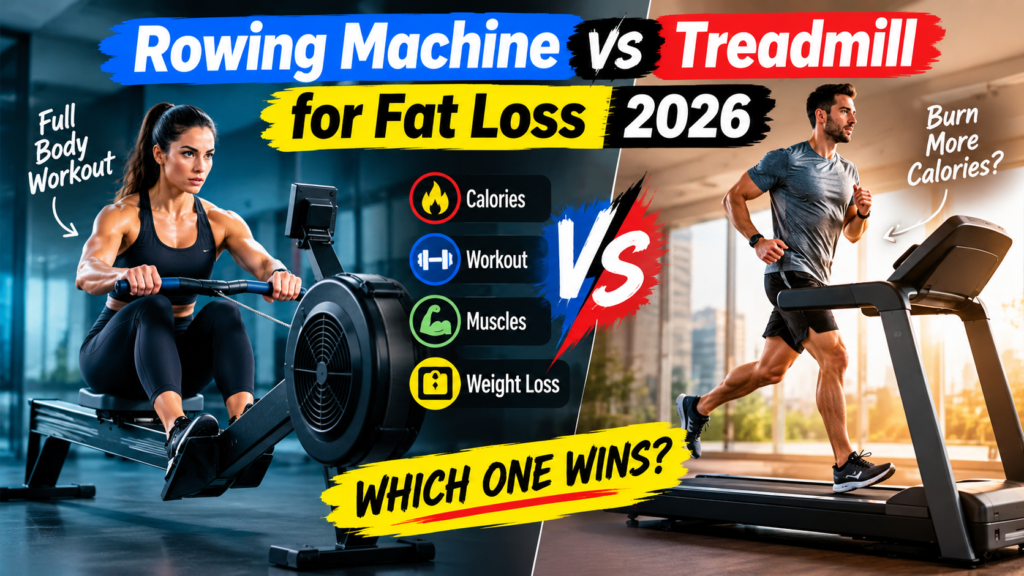
Both the rowing machine and the treadmill can support fat loss, but they do it in different ways. Neither one is a universal winner — the “better” choice depends on your intensity, session length, consistency, fitness level, joint health, and which workout you’ll actually stick with. This guide breaks down the evidence so you can match the machine to your situation rather than chasing a one-size-fits-all answer.
Rowing Machine vs Treadmill for Fat Loss — Quick Comparison
| Factor | Rowing Machine | Treadmill |
|---|---|---|
| Calorie expenditure | Depends heavily on stroke power and pace | Generally trends higher in comparative lab studies |
| Fat oxidation (single session) | Lower peak fat-oxidation rate in comparative research | Higher peak fat-oxidation rate in comparative research |
| Muscles worked | Full-body: legs, back, core, arms | Primarily lower body, with core stabilization |
| Impact on joints | Non-weight-bearing, seated | Weight-bearing (varies by walk vs. run) |
| Cardio conditioning | Strong, especially with intervals | Strong, especially with running or incline |
| HIIT suitability | Excellent — natural interval format | Excellent — sprint/incline intervals |
| Steady-state suitability | Good, technique-dependent | Very good, intuitive pacing |
| Beginner-friendliness | Moderate — technique takes practice | High — walking is intuitive |
| Noise | Generally quieter | Can be louder, especially at running speeds |
| Space | Long footprint, but many fold flat/vertical | Wide footprint, folding varies by model |
| Learning curve | Moderate | Low |
| Best use case | Full-body conditioning, low-impact cardio | Beginner-friendly, running-specific training |
Which Burns More Calories: Rowing Machine or Treadmill?
There’s no fixed calorie number that applies to everyone on either machine. Calorie expenditure during rowing or treadmill exercise depends on:
- Body weight — heavier individuals burn more calories doing the same activity
- Intensity — rowing pace/resistance or treadmill speed and incline
- Duration — longer sessions burn more total calories, up to a point
- Individual fitness level — trained individuals often move at higher output for the same perceived effort
A 2024 comparative study in Frontiers in Sports and Active Living measured energy expenditure across seven indoor cardio machines in recreationally active middle-aged men. Researchers compared energy expenditure, oxygen consumption, and heart rate during 12-minute bouts at both a hard perceived-exertion level and maximum intensity across machines including a rowing machine and a treadmill. Across the group, the treadmill produced the highest energy expenditure, oxygen consumption, and heart rate, with the rowing machine ranking lower in this particular sample.
That doesn’t mean rowing is a weak calorie-burner — it means that, in this specific study population and protocol, treadmill exercise elicited higher output on average. The researchers themselves noted that promoting exercise that participants genuinely enjoy matters for adherence and long-term health benefits, which is arguably more important than the calorie gap itself. Someone who rows hard with strong technique for 30 minutes can burn more than someone walking slowly on a treadmill for the same time — intensity and duration matter more than the machine label alone. nih
Rowing Machine vs Treadmill for Fat Burning
It’s important to separate two different concepts that often get conflated in fitness marketing: fat oxidation (the rate at which your body uses fat as fuel during a workout) and fat loss (the reduction of stored body fat over time). Burning more fat as a fuel source in a single session does not automatically translate into losing more body fat over weeks and months — that outcome depends on your total energy balance across days, not the fuel mix of one workout.
A frequently cited 2021 study published in the Journal of Sports Science & Medicine examined this directly. Researchers investigated the effects of treadmill, elliptical, and rowing exercise on fat oxidation in nine healthy male participants, using indirect calorimetry during peak oxygen consumption testing. While overall oxygen consumption was similar across the three modalities, maximal fat oxidation rates were higher on the treadmill than on both the elliptical and the rowing ergometer, and the exercise intensity at which maximal fat oxidation occurred was also significantly higher on the treadmill. nihnih
This is a small, single-sex, lab-based study (nine participants), so it shouldn’t be generalized as “treadmill training causes more fat loss than rowing.” It tells us that treadmill exercise elicited a higher rate of fat oxidation during the specific testing protocol used — not that treadmill users lose more body fat in the real world. Real-world fat loss depends on total weekly calorie expenditure, dietary intake, sleep, and consistency, none of which this type of lab study measures.
Rowing Machine vs Treadmill — Which Works More Muscles?
Muscles Used During Rowing
Rowing is a full-body movement performed in a repeating drive-and-recovery sequence. Each stroke engages:
- Quadriceps, hamstrings and glutes — the leg drive generates most of the power
- Back muscles (lats, rhomboids, erector spinae) — for the pulling phase
- Shoulders and arms (biceps, forearms) — for the finish of the stroke
- Core — stabilizes the trunk throughout the entire sequence
Because rowing recruits both upper and lower body in a coordinated pattern, it tends to demand more total muscle mass per stroke than walking or running on a treadmill.
Muscles Used During Treadmill Training
Treadmill workouts are primarily lower-body dominant:
- Calves, quadriceps, hamstrings, and glutes — drive walking or running propulsion
- Core — stabilizes posture, especially at higher speeds or inclines
Adding incline significantly increases glute and hamstring activation compared with flat walking, and running recruits muscles more dynamically than walking due to higher force and impact demands. Treadmill training doesn’t meaningfully engage the upper body unless you add arm swing resistance or incorporate incline sprints.
If full-body muscle engagement is a priority, rowing has a structural edge. If your priority is running-specific conditioning or lower-body endurance, the treadmill is the more specific tool.
Rowing vs Treadmill for a 30-Minute Workout
A 30-minute session can look very different depending on intensity:
- Beginner steady-state: Easy-paced rowing at low resistance, or a brisk treadmill walk (3–3.5 mph) — both keep effort in a sustainable, conversational range.
- Moderate workout: Rowing at a controlled, consistent pace with moderate resistance, or treadmill jogging with light incline — both raise heart rate into a moderate-intensity zone.
- Interval workout: Alternating rowing sprints with recovery strokes, or treadmill intervals alternating jogging/running with walking recovery — both structures elevate average intensity.
We won’t promise a specific calorie total for either machine, because the number depends on your body weight, effort level, and fitness — the CDC notes that physical activity increases the number of calories your body uses for energy, and combining that calorie burn with mindful eating creates the calorie deficit associated with weight loss. The relevant question for a 30-minute session isn’t “which machine burns an exact number of calories” — it’s which one you can sustain at a real, repeatable effort level. unt
Rowing vs Treadmill for HIIT
Both machines adapt well to high-intensity interval training (HIIT), but the experience differs:
- Rowing HIIT naturally breaks into discrete strokes, making it easy to structure intervals by stroke count, time, or distance. It’s low-impact, so joint stress during hard efforts is minimal, but poor technique under fatigue can reduce power output and increase injury risk in the lower back.
- Treadmill HIIT (sprint intervals, incline intervals) delivers a high cardiovascular and neuromuscular demand and closely mirrors real-world running performance. It’s weight-bearing, so impact stress accumulates faster during repeated hard efforts.
Rowing HIIT may suit people who want intensity without joint impact. Treadmill HIIT may suit people training for running events or who prefer a familiar, intuitive movement pattern under fatigue.
Rowing vs Treadmill for Steady-State Cardio
Steady-state cardio — sustained effort at a moderate, consistent pace — can be done on either machine:
- Treadmill options range from walking to incline walking to jogging or running.
- Rowing steady-state involves holding a consistent stroke rate and pace for an extended period.
The exercise you find easier to sustain matters more than which one is theoretically “better,” because weekly activity volume — not any single session — drives long-term results. If incline walking on a treadmill feels effortless to repeat five days a week, that consistency likely outweighs a harder, less sustainable rowing session you only manage twice.
Which Is Better for Beginners?
Treadmill
- Walking is an intuitive movement most people already know
- Speed and incline adjust with simple controls
- Low technical learning curve
- Easy to start slow and build gradually
Rowing Machine
- Non-weight-bearing, which can feel easier on joints for some beginners
- Full-body engagement from the first session
- Requires learning proper stroke sequence (legs–core–arms, then arms–core–legs on the return)
- Poor form (rowing with the arms too early, rounding the back) reduces efficiency and can increase strain
Neither is universally easier — treadmill walking has a lower barrier to entry, while rowing has a slightly steeper technique curve but rewards patience with an efficient, low-impact full-body workout.
Which Is Easier on the Joints?
Rowing is performed seated, in a non-weight-bearing position, so there’s no impact-loading through the knees, hips, or ankles during the stroke. Treadmill exercise is weight-bearing, and impact load varies significantly by activity: walking produces relatively low impact forces, while jogging and running produce substantially higher ground-reaction forces with each stride.
This means “treadmill” isn’t one uniform impact category — a brisk walk and a fast run are very different for your joints. If you have existing joint pain, a chronic condition, or are recovering from injury, talk with a physician or physical therapist before starting either machine, since individual joint tolerance varies.
Which Is Better for Weight Loss Long Term?
The machine that best supports long-term fat loss is generally the one you’ll use consistently. The CDC’s guidance on physical activity and weight emphasizes that creating a calorie deficit — through a combination of increased activity and reduced calorie intake — is what supports weight loss, not any single type of equipment. unt
Sustainable results depend on:
- Frequency — how many sessions per week you actually complete
- Duration — total minutes of activity accumulated over time
- Progressive intensity — gradually increasing effort as fitness improves
- Recovery — allowing adequate rest to avoid burnout or injury
- Nutrition — matching activity with an appropriate calorie intake
- Sleep — supporting recovery and appetite regulation
- Consistency — showing up regularly, even on lower-motivation days
A rowing machine used four times a week for months will likely outperform a treadmill used twice a month at maximum effort, and vice versa. The equipment matters less than the habit.
Rowing Machine vs Treadmill for Small Spaces
- Footprint: Treadmills typically have a wide, fixed footprint; rowing machines are long but narrow, and many fold at the hinge or store vertically against a wall.
- Folding: Most home treadmills fold upward; most rowing machines fold in half or disassemble into two pieces.
- Portability: Rowing machines are generally lighter and easier for one person to move; treadmills are heavier and often need wheels to reposition.
- Ceiling clearance: Folding treadmills need vertical clearance when upright; rowers stored vertically need similar clearance but a smaller overall footprint.
- Noise: Rowing machines (especially magnetic or hydraulic resistance types) tend to run quieter than treadmill motors, particularly at running speeds.
Exact dimensions vary significantly by model, so always check manufacturer specs against your available space before buying. For apartment-friendly cardio setups, see our guide to compact cardio equipment for home.
Rowing vs Treadmill for Home Gyms
For a dedicated home gym space, consider:
- Budget: Entry-level machines exist in both categories; higher-end smart consoles increase cost on either side.
- Available space: A permanent gym room accommodates a treadmill’s footprint more easily than a shared living space.
- Workout goals: Runners training for races benefit more from treadmill access; those wanting full-body conditioning may prefer rowing.
- Family use: Walking on a treadmill is generally more accessible across fitness levels within a household than rowing technique.
- Noise and maintenance: Treadmills need belt lubrication and motor upkeep; rowers (especially air or magnetic resistance) typically need less maintenance.
If your home gym is walking-focused, our best walking equipment for home workouts roundup can help narrow options.
Rowing Machine vs Treadmill for Different Goals
- Fat-loss focused: Either works if intensity and consistency are high — pick the one you’ll use most.
- Beginner: Treadmill walking offers the gentlest learning curve.
- Experienced cardio user: Both scale well with added intensity or interval structure.
- Full-body workout: Rowing has the clear edge.
- Running training: Treadmill is directly specific to running mechanics.
- Low-impact cardio: Rowing is non-weight-bearing; treadmill walking is a lower-impact alternative to running.
- HIIT: Both are strong options; choose based on joint tolerance and preference.
- Steady-state cardio: Both work; treadmill pacing is more intuitive for many.
- Small apartment: Depends on specific model dimensions and folding design.
- Home gym: Either fits, based on space and training goals.
- Users who dislike running: Rowing offers an alternative cardio stimulus without running mechanics.
Common Fat-Loss Mistakes
- Assuming more sweat equals more fat loss — sweat reflects thermoregulation, not fat burned.
- Confusing fat oxidation with body-fat loss — a workout’s fuel mix isn’t the same as long-term fat reduction.
- Relying only on exercise — activity alone rarely creates a large enough calorie deficit without dietary awareness.
- Ignoring calorie intake — a calorie surplus from food can offset even hard training sessions.
- Doing workouts too intense to sustain — burnout and injury interrupt consistency.
- Ignoring recovery — inadequate rest impairs performance and adherence.
- Treating machine calorie estimates as exact — console readouts are rough approximations, not precise measurements.
- Changing workouts too frequently — constant switching prevents progressive adaptation.
- Ignoring consistency — sporadic, unpredictable training limits results.
- Expecting spot reduction — no machine or exercise can selectively burn fat from one body area.
How to Use a Rowing Machine for Fat Loss
A general example weekly structure (not individualized medical advice):
- Day 1: Steady-state rowing, moderate pace, 25–35 minutes
- Day 2: Rest or light movement (walking, stretching)
- Day 3: Rowing intervals (e.g., 30 seconds hard / 60–90 seconds easy, repeated)
- Day 4: Strength training or a walk
- Day 5: Steady-state rowing
- Weekend: Optional longer cardio session or walking
How to Use a Treadmill for Fat Loss
Progress intensity gradually across a week:
- Brisk walking sessions to build a consistent base
- Incline walking to raise intensity without adding impact
- Jogging as fitness allows
- Running intervals for advanced conditioning
- Steady-state sessions at a sustainable pace for longer-duration cardio
Can You Combine Rowing and Treadmill Training?
Yes. Alternating modalities can add training variety, reduce repetitive strain on any single movement pattern, and keep workouts engaging — which supports long-term adherence. An example combined week: rowing intervals on Monday, a treadmill incline walk on Wednesday, steady-state rowing on Friday, and an easy treadmill jog or walk on the weekend.
Frequently Asked Questions
Is rowing or treadmill better for fat loss?
Neither is universally better — both can support fat loss when paired with a calorie deficit and used consistently. The right choice depends on your intensity, preferences, and joint tolerance.
Does rowing burn more calories than walking?
Moderate-to-vigorous rowing generally burns more calories than casual walking, but a fast-paced or inclined walk can close that gap depending on individual body weight and effort.
Does running burn more calories than rowing?
Running at higher intensities typically demands more energy expenditure than moderate rowing, but hard, high-resistance rowing can rival or exceed easy jogging.
Which burns more fat, rowing or treadmill?
Comparative lab research has found higher fat-oxidation rates during treadmill exercise than rowing in tested protocols, but this reflects fuel use during a single session, not overall long-term fat loss.
Is rowing good for losing belly fat?
Rowing can contribute to overall fat loss as part of a calorie deficit, but it cannot target fat loss specifically from the belly — spot reduction isn’t physiologically possible with any cardio machine.
Is treadmill walking good for fat loss?
Yes, consistent treadmill walking can contribute meaningfully to weekly activity and calorie expenditure, especially when combined with an appropriate diet.
Which is better for beginners?
Treadmill walking has a lower learning curve; rowing takes more technique practice but offers a low-impact, full-body alternative.
Which is lower impact?
Rowing is non-weight-bearing and generally lower impact than treadmill running, though treadmill walking is also a low-impact option.
Can I lose weight using only a rowing machine?
Yes, if your total weekly energy expenditure combined with dietary intake creates a sustained calorie deficit.
Can I lose weight using only a treadmill?
Yes, under the same condition — consistent activity paired with appropriate calorie intake over time.