
LifeCareBalance.com is reader-supported. When you buy through links on our site, we may earn an affiliate commission at no extra cost to you. As an Amazon Associate, we earn from qualifying purchases.
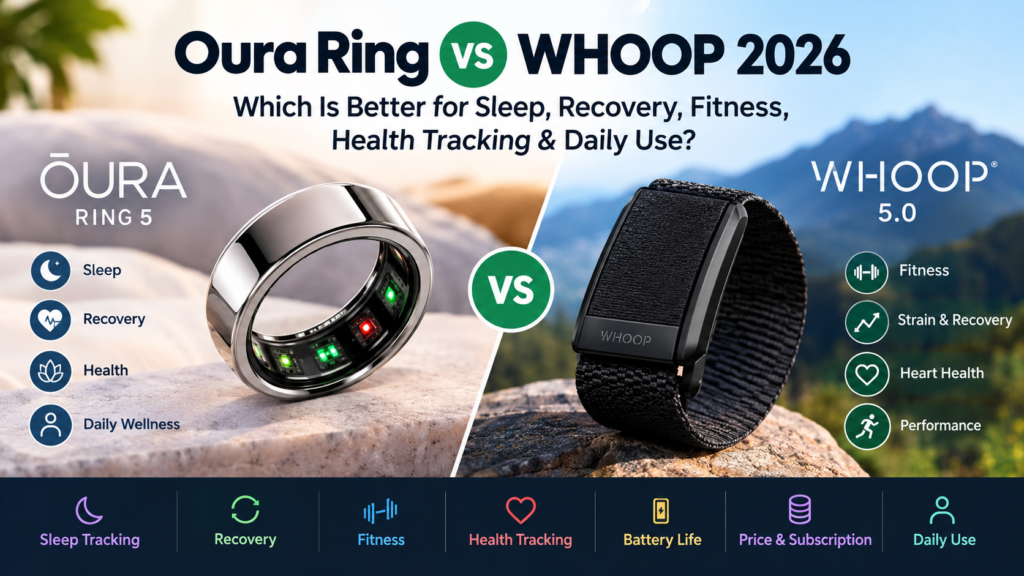
Oura and WHOOP are the two names that keep coming up whenever someone asks how to get more out of their sleep and recovery data. Both companies released new flagship hardware in 2026 — the Oura Ring 5 and the WHOOP 5.0 — and both took very different paths to get there. One is a titanium ring you barely notice on your finger. The other is a screen-free band built around continuous fitness and recovery coaching.
This guide compares Oura Ring vs WHOOP for 2026 using verified manufacturer specifications, current membership pricing, and what each platform actually measures — not just marketing claims. If you’re deciding between the Oura Ring 5 and WHOOP 5.0, here’s what separates them for sleep, recovery, training, and everyday wear.
Oura Ring 5 vs WHOOP 5.0: Quick Comparison Table
| Feature | Oura Ring 5 | WHOOP 5.0 |
|---|---|---|
| Device type | Titanium smart ring, no screen | Screen-free wrist/body-worn strap |
| Display | None (data lives in the app) | None (data lives in the app) |
| Weight/form | From 2g, 2.28mm thick, 40% smaller than Ring 4 | 7% smaller than WHOOP 4.0; wrist, bicep, or AnyWear apparel placement |
| Battery life | 6–9 days typical | 14+ days (up to ~1 month with Wireless PowerPack) |
| Charging | Dock charger, ~20–80 min; optional $99 charging case | Basic corded charger or Wireless PowerPack; can be worn while charging |
| Sleep tracking | Sleep stages, sleep score, nap detection, sleep debt | Sleep stages, Sleep Coach, sleep need, sleep debt, sleep consistency |
| Recovery/readiness | Daily Readiness score | Daily Recovery score (color-coded) |
| Resting heart rate & HRV | Tracked nightly | Tracked nightly |
| Respiratory rate | Tracked | Tracked |
| Body temperature | Tracked, with trend deviation alerts | Skin temperature tracked |
| SpO2 (blood oxygen) | Tracked overnight | Tracked overnight |
| Activity/workout tracking | Automatic activity detection, HR zones | 145+ activities, Strain score (0–21), Muscular Strain for lifting |
| VO2 Max | Yes | Yes |
| Strength training tools | Basic activity logging | Strength Trainer with rep/load-aware Muscular Strain |
| Stress tracking | Daytime Stress, Stress Resilience | Stress Monitor (Peak and Life tiers) |
| Women’s health | Cycle Insights, pregnancy and menopause insights | Hormonal Insights, Natural Cycles integration |
| ECG / blood pressure | Blood Pressure Signals (wellness feature, not diagnostic) | On-demand ECG and Blood Pressure Insights on WHOOP Life (MG hardware) only |
| App compatibility | iOS and Android | iOS and Android |
| Subscription | $5.99/month or $69.99/year | $199–$359/year, hardware bundled in |
| Warranty | Generally 1 year in the US (varies by region) | Lifetime warranty while membership is active |
| Best suited for | Discreet 24/7 wear, sleep- and wellness-first users | Athletes and people who want deep training/recovery guidance |
The Fundamental Difference: A Ring vs. a Screen-Free Band
Before comparing individual metrics, it helps to understand what each device is actually trying to be.
Oura is built around discreet, passive health and sleep monitoring. It’s a piece of jewelry first — something you forget you’re wearing — that happens to gather research-grade biometric data around the clock. Its software leans into proactive wellness: sleep, readiness, stress, women’s health, and increasingly, broader health signals like blood pressure trend detection.
WHOOP takes the opposite design approach but still avoids a screen. It’s a dedicated performance and recovery band meant to be worn on the wrist, bicep, or elsewhere on the body via its AnyWear apparel line, with all interaction happening through the phone app. WHOOP leans harder into continuous fitness coaching — Strain, workout-specific training load, and a tiered membership system that unlocks progressively deeper health features. If you check the Oura Ring Review 2026 on LifeCareBalance, you’ll see this same theme: Oura optimizes for comfort and consistency, while WHOOP optimizes for training depth.
Neither device is a medical instrument. Oura explicitly states its ring is not intended to diagnose, treat, or monitor medical conditions, and WHOOP applies similar limitations to features like Blood Pressure Insights. Keep that in mind throughout this comparison — every score discussed below is a wellness estimate, not a clinical measurement.
Oura Ring vs WHOOP for Sleep
Sleep tracking is where both companies built their reputations, and it remains the strongest category for each.
Oura Ring 5 produces a nightly Sleep Score built from sleep stages (light, REM, deep, and awake time), efficiency, timing, and how well your sleep matches your body’s typical patterns. It also tracks nap detection and sleep debt, and factors overnight HRV, resting heart rate, respiratory rate, and body temperature into its broader Readiness score the next morning. Oura’s finger-based sensor placement benefits from a stronger, cleaner pulse signal than wrist-worn devices typically pick up, which is part of why the ring has built a strong reputation specifically for overnight measurement.
WHOOP 5.0 takes a more instructional approach to sleep. Its Sleep Coach doesn’t just report what happened last night — it calculates your personal Sleep Need based on your recent sleep debt, the strain from your day, and your stated performance goals, then recommends a bedtime to hit that target. WHOOP tracks the same four sleep stages (light, REM, slow-wave/deep, and awake), plus disturbances, sleep consistency, and respiratory rate.
In practice, the two platforms answer slightly different questions. Oura tells you how well you slept and how ready your body is as a result. WHOOP tells you how well you slept and exactly how much you should be sleeping tonight to hit a specific performance goal tomorrow. Readers comparing dedicated devices for this purpose may also want to check LifeCareBalance’s Best Sleep Trackers in 2026 roundup, which covers non-wearable options like under-mattress sensors alongside wearables.
Oura Ring vs WHOOP for Recovery
Both platforms distill a night of physiological data into a single daily number, but they build it differently.
Oura Readiness blends sleep quality, HRV, resting heart rate, body temperature deviation, recent activity load, and behavioral factors like alcohol or illness logging into a 0–100 score, along with plain-language contributors explaining what pulled the score up or down.
WHOOP Recovery is calculated primarily from HRV, resting heart rate, respiratory rate, and sleep performance, then presented as a green/yellow/red percentage alongside the day’s recommended Strain target. WHOOP explicitly ties Recovery to how hard you should train that day, which reflects the platform’s fitness-first orientation.
Neither score is a diagnostic measurement. Both companies frame them as wellness guidance — directional signals to inform decisions like whether to push a hard workout or prioritize rest — rather than medical assessments of your physiological state.
Oura Ring vs WHOOP for Fitness and Workout Tracking
This is where the two devices diverge most clearly, and it’s often the deciding factor for people choosing between them.
Oura Ring 5 added Live Activity Tracking in 2026, letting members start a workout from the app and follow pace, distance, and connected heart rate data in real time, with automatic activity detection improved for low-motion exercises like pilates. It also reports VO2 Max, Cardiovascular Age, and heart rate zone trends. Still, Oura has no built-in GPS and no dedicated strength-training analysis — it’s tracking activity as one input into your broader recovery picture, not building a training program around it.
WHOOP 5.0 is the more fitness-oriented device by design. It calculates a daily Strain score (0–21) based on cardiovascular load rather than steps, supports 145+ recognized activities, and includes a Strength Trainer feature that accounts for muscular load during resistance training rather than relying on heart rate alone. WHOOP also tracks VO2 Max and provides heart-rate-zone-based training guidance tied to your daily Recovery score.
For athletes who want granular training-load data and post-workout guidance, WHOOP’s toolset goes deeper. For people who exercise but don’t need workout-by-workout coaching, Oura’s lighter-touch activity tracking may be all they need.
Oura Ring vs WHOOP for Health Tracking
Both platforms have expanded well beyond basic fitness tracking into broader health signals, though each has real limitations worth understanding.
Oura’s 2026 Health Radar introduces Blood Pressure Signals and Nighttime Breathing, designed to flag patterns — like blood pressure not dipping overnight as expected, or increased breathing disturbances — that may warrant a conversation with a healthcare provider. Oura is explicit that these are pattern-detection features, not blood pressure measurements or sleep-apnea diagnoses. The ring also offers GLP-1 Insights for people managing weight-loss medications and, in the US, optional on-demand care through a Counsel Health partnership.
WHOOP’s most clinically-oriented features are gated behind its top membership tier. WHOOP Life (which ships with WHOOP MG hardware) includes an FDA-cleared on-demand ECG for detecting signs of atrial fibrillation, Irregular Heart Rhythm Notifications, and Blood Pressure Insights currently in beta. These features carry real regulatory limitations: they’re restricted to users 22 and older, aren’t intended for people with a diagnosed arrhythmia other than AFib, and aren’t recommended for pacemaker or ICD wearers. Standard WHOOP 5.0 hardware does not include ECG or blood pressure sensing at all — those require the MG-specific hardware sold with WHOOP Life.
Both companies also offer optional paid blood testing: WHOOP Advanced Labs ($200 add-on, 65 biomarkers) and Oura’s Lab Uploads feature, which lets members import existing lab results into the app alongside biometric trends. If broader home health-tracking accuracy is a concern for you, LifeCareBalance’s guide on Smart Scale Body-Fat Accuracy 2026 covers similar measurement-limitation questions for another popular category of health device.
Oura vs WHOOP Subscription Cost in 2026
Subscription structure is one of the biggest practical differences between these two products, and it’s worth working through the actual numbers.
Oura Ring 5 separates hardware and membership. The ring itself costs $399 (Silver or Black finishes) or $499 (Gold, Stealth, Brushed Silver, or Deep Rose), and Oura Membership costs $5.99 per month or $69.99 per year. First-year cost works out to roughly $469–$569 depending on finish and whether you pay the membership monthly or annually, then about $70 per year afterward if you keep the ring.
WHOOP 5.0 bundles the device into the membership price, so there’s no separate hardware purchase:
- WHOOP One — $199/year: includes WHOOP 5.0 hardware, a CoreKnit band, and a corded Basic Charger. Covers core sleep, recovery, and strain tracking.
- WHOOP Peak — $239/year: includes WHOOP 5.0 hardware, a SuperKnit band, and a Wireless PowerPack. Adds Healthspan (WHOOP Age and Pace of Aging), Stress Monitor, and live in-app heart rate.
- WHOOP Life — $359/year: includes WHOOP MG hardware, a SuperKnit Luxe band with ECG-compatible metal contacts, and a Wireless PowerPack. Adds on-demand ECG, Irregular Heart Rhythm Notifications, and beta Blood Pressure Insights.
So a WHOOP One first-year cost ($199) actually undercuts Oura’s first year, since there’s no separate device fee. But over three to five years, the math shifts: Oura’s ongoing cost is a flat $69.99 per year once you own the ring, while WHOOP’s annual fee never drops and includes a fresh device with every renewal. Which one is more expensive long-term depends entirely on your time horizon and which WHOOP tier you’d choose. Buyers weighing this against other connected health devices may also find LifeCareBalance’s Best Wellness Products 2026 guide useful for comparing total cost of ownership across categories.
Oura Ring vs WHOOP Battery Life
WHOOP has a clear, verified advantage here. WHOOP 5.0 delivers 14+ days on a single charge, roughly double Oura’s typical range, and pairing it with the optional Wireless PowerPack (included with Peak and Life memberships) extends that to close to a month without a dedicated charging session. WHOOP’s charging accessories also clip onto the band, so you can keep wearing the device — and keep collecting data — while it tops up.
Oura Ring 5 is rated for 6–9 days per charge, a modest improvement over the Ring 4’s 5–8 days despite the ring being 40% smaller. A full charge takes about 20–80 minutes depending on starting battery level, and the ring must come off the finger to charge on its dock. Oura’s optional $99 Charging Case adds up to five additional charges on the go, effectively extending untethered use to about a month for travelers.
Neither company discloses exact battery chemistry capacity figures, so exact runtime will vary by usage, firmware, and enabled features on both devices.
Comfort: Ring vs. Wrist/Arm Strap
Comfort is inherently more subjective than the specs above, so this section separates manufacturer claims from what independent reviewers have generally reported, rather than asserting a universal winner.
Oura’s ring form factor is designed to disappear into daily life — no strap to catch on gloves, no band to remove for a shower, sauna, or swim (it’s IP68-rated to 100 meters). The tradeoff some wearers report is fit consistency: because Oura Ring 5 is 40% smaller than its predecessor, the company explicitly recommends re-sizing even for existing Ring 4 owners, and grip-heavy activities like weightlifting or racquet sports can shift a ring on the finger in ways a wrist strap generally doesn’t.
WHOOP’s strap-based design distributes across a larger wrist or bicep surface, which some reviewers have found more secure during high-intensity training, and the band comes off less often since you can leave it in place through the wireless charging process. The tradeoff is that a strap is inherently more noticeable during office wear, formal settings, or activities requiring you to keep wrists clear, and some early WHOOP generations drew comments about strap comfort during overnight wear — something the 5.0’s smaller, 7%-lighter housing was specifically designed to address, according to WHOOP.
Neither company has published independent, peer-reviewed comfort studies, so these observations should be read as general reviewer consensus rather than lab-verified claims.
App Experience
Oura’s app centers on three headline scores — Sleep, Activity, and Readiness — presented with a clean, low-clutter dashboard and Oura Advisor, an AI layer that surfaces personalized suggestions based on your trends. Reviewers have generally described it as easier to scan at a glance, which fits Oura’s passive-wellness positioning.
WHOOP’s app is built around Sleep, Recovery, and Strain, with considerably more granular data available for people who want to dig in — journal entries correlating lifestyle factors with recovery, detailed workout breakdowns, and (on Peak and Life) Healthspan and Stress Monitor views. That depth comes with more screens and more tapping to find specific data points, which some users find valuable and others find like information overload.
Both apps integrate with third-party platforms — Oura connects with 100+ apps including Strava and Natural Cycles, while WHOOP supports its own ecosystem plus a 2026 integration with the Natural Cycles birth control app for eligible members.
Accuracy: What the Evidence Actually Shows
It’s worth being direct about a common misconception: consumer wearables don’t directly measure most of the metrics they report. Sleep stages, recovery scores, and strain are all derived estimates built from raw signals like heart rate, movement, and skin temperature, run through proprietary algorithms. That means accuracy claims should be evaluated device-by-device and metric-by-metric, not treated as a blanket “which brand is more accurate” question.
The most relevant available evidence comes from a peer-reviewed validation study published via the National Center for Biotechnology Information (NCBI/PMC), which compared five consumer wearables — including Oura Generation 3, Oura Generation 4, and WHOOP 4.0 — against an ECG reference across 536 nights of sleep from 13 adults. The study found Oura’s Gen 3 and Gen 4 rings showed the strongest agreement with the ECG reference for both resting heart rate and HRV, while WHOOP’s 4.0 device showed moderate agreement on both measures. It’s important to note this study used the prior-generation Oura Ring 4 and WHOOP 4.0 hardware, not the Ring 5 or WHOOP 5.0 — both companies say their newest sensors and algorithms are more accurate than these predecessors, but that hasn’t yet been independently validated in published research as of this writing. Available evidence at the finger-vs-wrist level generally supports Oura’s positioning around signal strength, but neither company’s current-generation device has independent, peer-reviewed accuracy validation published yet.
Use-Case Comparison: Which One Actually Fits You?
Rather than declaring an overall winner, it’s more useful to match the device to how you’ll actually use it.
Best for sleep-focused users: Oura Ring 5’s ring form factor and dedicated Sleep Score, sleep debt, and nap detection make it a strong fit if sleep is your primary reason for buying a wearable.
Best for recovery-focused users: Both platforms perform well here; Oura’s Readiness score pulls in a slightly broader mix of behavioral inputs, while WHOOP’s Recovery score ties more directly into same-day training recommendations.
Best for athletes: WHOOP 5.0’s Strain scoring, Strength Trainer, and 145+ supported activities give it an edge for people actively managing a training load week to week.
Best for everyday wellness: Oura Ring 5 fits people who want passive, low-effort health tracking without checking an app constantly for training targets.
Best for people who dislike screens: Both devices are screen-free, so this comes down to form factor rather than display.
Best for people who want a ring instead of a wrist strap: Oura is the only option in this comparison, though rings from other brands also exist.
Best for people who want detailed training/recovery data: WHOOP’s deeper metric set and tiered features (especially Peak and Life) suit people who want to dig into the numbers.
Best for beginners: Oura’s simpler three-score dashboard is generally easier to interpret without a learning curve; WHOOP’s Strain/Recovery relationship takes a bit longer to understand fully.
Best for people concerned about subscription cost: Oura’s flat $69.99/year after the initial ring purchase is the more predictable long-term cost; WHOOP One at $199/year is cheaper to start but never drops below that annual fee.
Oura Ring 5: Pros and Cons
Pros
- Discreet, screen-free ring form factor suited to 24/7 wear
- Finger-based sensing benefits from a stronger, cleaner pulse signal than wrist placement
- New Health Radar features (Blood Pressure Signals, Nighttime Breathing) add proactive health signals
- Flat, predictable $69.99/year membership cost after purchase
- IP68-rated to 100 meters; safe for showering, swimming, and sauna use
Cons
- Shorter battery life (6–9 days) than WHOOP’s 14+ days
- Must be resized from previous generations due to the 40% smaller build
- No built-in GPS and limited dedicated strength-training analysis
- Most advanced features (Health Radar, GLP-1 Insights, on-demand care) are US-only at launch
- Warranty is generally shorter (around 1 year in most markets) than WHOOP’s membership-length coverage
WHOOP 5.0: Pros and Cons
Pros
- Best-in-class battery life at 14+ days, extendable to about a month with the Wireless PowerPack
- Can be worn continuously through charging thanks to clip-on battery packs
- Deeper fitness and strength-training tools, including Muscular Strain tracking
- Hardware is bundled into membership, so there’s no separate upfront device cost
- Lifetime warranty for as long as membership stays active
Cons
- No separate hardware purchase — canceling membership means losing the ability to renew the same tier without resubscribing
- Advanced medical-style features (ECG, Blood Pressure Insights) require the pricier WHOOP Life tier and MG-specific hardware
- Annual cost never drops below $199 and can reach $359/year for the top tier
- App is more feature-dense and can take longer to learn than Oura’s
- Strap-based design is more visible during formal or office settings than a ring
Frequently Asked Questions
Is Oura better than WHOOP for sleep? Both are strong for sleep tracking. Oura’s finger-based sensing and Sleep Score are well suited to passive tracking, while WHOOP’s Sleep Coach is built to actively recommend a bedtime based on your sleep debt and next-day goals. Neither is universally “better” — it depends on whether you want a report card or a nightly action plan.
Is WHOOP better than Oura for fitness? For structured training and strength work, generally yes — WHOOP’s Strain scoring, Strength Trainer, and 145+ supported activities give it more depth for athletes than Oura’s lighter activity tracking.
What is the difference between Oura Readiness and WHOOP Recovery? Oura Readiness blends sleep, HRV, resting heart rate, temperature, and behavioral logging into a broader wellness score. WHOOP Recovery focuses more tightly on HRV, resting heart rate, respiratory rate, and sleep performance, and ties directly into a recommended daily Strain target.
Is Oura or WHOOP better for recovery? Both provide research-informed recovery estimates rather than medical measurements. Choose based on whether you want Oura’s broader daily wellness view or WHOOP’s training-focused recovery-to-strain pipeline.
Does WHOOP track sleep? Yes. WHOOP 5.0 tracks all four sleep stages (light, REM, deep/slow-wave, and awake), sleep consistency, disturbances, and respiratory rate, and uses that data to calculate your personal Sleep Need.
Does Oura track workouts? Yes, through Automatic Activity Detection and the newer Live Activity Tracking feature, which shows real-time pace, distance, and connected heart rate data. It lacks built-in GPS and dedicated strength-training analysis, however.
Which has better battery life, Oura or WHOOP? WHOOP 5.0, with 14+ days per charge compared to Oura Ring 5’s typical 6–9 days.
How much does Oura cost per year? Oura Membership costs $69.99 per year (or $5.99 monthly) on top of the one-time ring purchase of $399–$499.
How much does WHOOP cost per year? WHOOP membership ranges from $199/year (One) to $239/year (Peak) to $359/year (Life), with hardware included in each tier.
Can you use Oura without a subscription? Not for full functionality. Without an active membership, Oura Ring access is limited to basic daily scores, without the detailed metrics and insights membership unlocks.
Can you use WHOOP without a membership? No. WHOOP’s hardware is sold bundled with membership, so an active subscription is required to use the device at all.
Is Oura or WHOOP more comfortable for sleeping? This varies by individual. Oura’s ring form factor has no strap to shift during sleep, while WHOOP’s smaller, lighter 5.0 housing was specifically redesigned to improve overnight comfort compared to earlier generations. Independent, large-scale comfort testing hasn’t been published for either current-generation device.
Conclusion
The Oura Ring 5 and WHOOP 5.0 solve overlapping problems with genuinely different tools. Oura’s strength is its discreet, ring-based form factor and its passive approach to sleep, readiness, and emerging health signals like blood pressure trend detection — a strong fit for people who want thorough tracking without thinking about their wearable during the day. WHOOP’s strength is its training depth, best-in-class battery life, and tiered membership that scales from core recovery tracking up to medical-grade heart monitoring on WHOOP Life.
If your priority is comfortable 24/7 wear and sleep- and wellness-first tracking, Oura Ring 5 is likely the better fit. If you’re actively training and want detailed strain, recovery, and strength data with the longest battery life in this comparison, WHOOP 5.0 has the edge. Either way, both are membership-dependent wellness tools — not medical devices — so weigh the ongoing subscription cost alongside the features that actually matter for your goals before you buy.
Sources: Oura Ring 5 official specifications · WHOOP 5.0 and MG launch announcement and membership pricing · WHOOP 5.0 hardware details · WHOOP sleep tracking features · Validation study of wearable HRV and resting heart rate accuracy, NCBI/PMC