
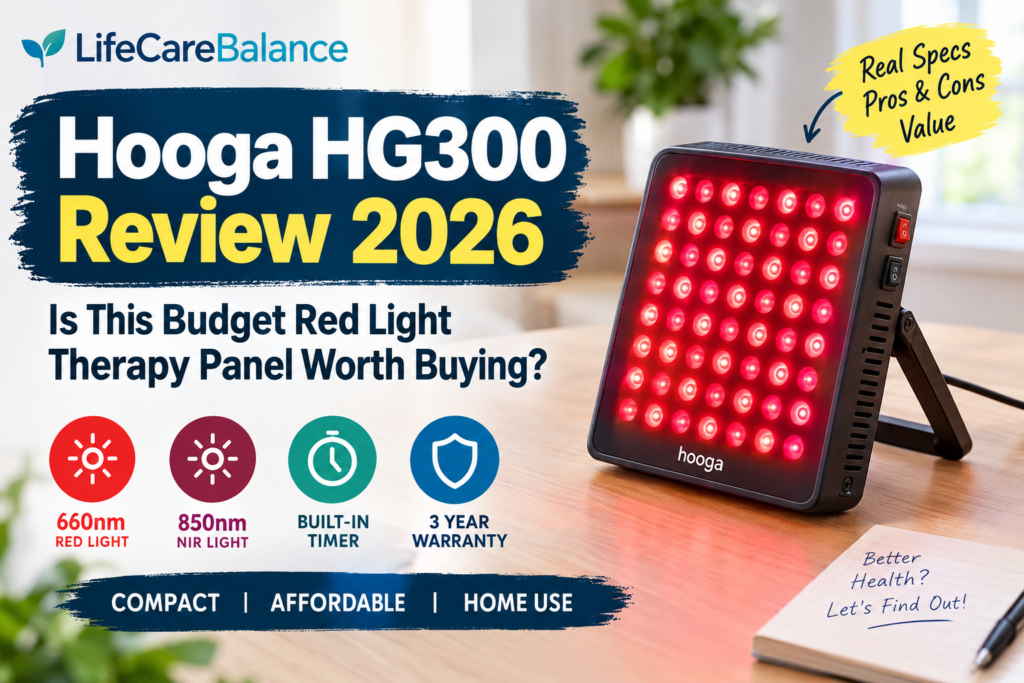
Read our Hooga HG300 review for 2026. Compare specs, irradiance, price, safety, pros and cons, and see whether this compact red light therapy panel is right for you.
LifeCareBalance.com is reader-supported. When you buy through links on our site, we may earn an affiliate commission at no extra cost to you. As an Amazon Associate, we earn from qualifying purchases.
The Hooga HG300 is a compact red light therapy panel designed for people who want to explore at-home photobiomodulation without spending several hundred dollars on a larger system. It combines 660nm red light and 850nm near-infrared light in a tabletop device with a built-in timer, a foldable stand, and a three-year warranty.
But an affordable price and promising specifications do not automatically make a device the right choice for everyone.
In this Hooga HG300 review, we examine its published specifications, practical advantages, limitations, scientific context, and value compared with the Hooga PRO300. We also explain what buyers should verify before purchasing and why expectations matter when evaluating red light therapy.
Quick Answer: Is the Hooga HG300 Worth It?
The Hooga HG300 is worth considering if you want an affordable, compact panel for targeted home use. Its main strengths are its dual wavelengths, simple operation, relatively small footprint, and lower price than many larger panels.
However, its coverage is limited compared with full-body devices. It does not offer the advanced controls found on some premium panels, and research on photobiomodulation does not prove that this specific device will deliver a particular medical or cosmetic result.
At the time of our research, Hooga listed the HG300 at approximately $199 on its official website. Prices, promotions, availability, and product specifications can change, so check the manufacturer’s official HG300 product page before ordering.
Best suited for: Budget-conscious buyers, beginners, and people who want to treat relatively small areas at home.
Consider another option if: You need broad body coverage, want app-based controls, or prefer a device with independently documented performance testing.
What Is the Hooga HG300?
The Hooga HG300 is a tabletop LED panel that delivers red and near-infrared light. These wavelengths are commonly used in photobiomodulation research, a field that investigates how particular light exposures interact with biological tissue.
Unlike a wearable LED face mask, the HG300 is positioned in front of the area you want to treat. You can adjust its placement and distance, but you must position it appropriately for each treatment area.
Its compact design makes it suitable for a desk, countertop, or other stable surface. The built-in stand reduces setup effort, while the timer helps users manage session duration.
The key distinction is that the HG300 is a light-delivery device, not a guaranteed treatment for pain, acne, wrinkles, or sleep problems. Outcomes depend on the condition being studied, the treatment protocol, and the individual.
Hooga HG300 Specifications
The following specifications are based primarily on the manufacturer’s published information.
| Feature | Published specification |
|---|---|
| Product type | Tabletop red light therapy panel |
| Red wavelength | 660nm |
| Near-infrared wavelength | 850nm |
| LED configuration | 60 single-chip LEDs |
| Irradiance | Approximately 73 mW/cm² at 6 inches, according to the HG300 specification |
| Dimensions | Approximately 12.2 × 8.2 × 2.5 inches |
| Weight | Approximately 6 pounds |
| Controls | Separate red and near-infrared switches |
| Timer | Built-in timer |
| Stand | Foldable tabletop stand |
| Cooling | Internal cooling fan |
| Warranty | 3 years |
| Return period | 60 days, subject to the manufacturer’s terms |
| Listed price | Approximately $199 at the time of research |
Specifications and measurements should be checked against the current product listing and manual. In particular, irradiance figures can vary with measurement distance, instrument, measurement method, and testing conditions.
The manufacturer’s stated 300W product class should not be confused with its actual electrical power consumption. Hooga lists power consumption of approximately 80W for this model.
Understanding 660nm Red Light and 850nm Near-Infrared Light
One reason the HG300 attracts attention is its use of two commonly studied wavelength ranges.
660nm red light
Red light is used in photobiomodulation research involving skin-related outcomes. Some studies have investigated changes in skin appearance, fine lines, and tissue responses.
However, the presence of a 660nm LED does not establish that a particular device will reduce wrinkles or increase collagen production by a measurable amount. The delivered dose, treatment schedule, study design, and device characteristics all matter.
850nm near-infrared light
Near-infrared light is used in research involving a range of tissue-related outcomes, including some pain and rehabilitation applications.
Although near-infrared light is generally discussed as penetrating farther into tissue than visible red light, penetration and biological response depend on several factors. It is not appropriate to assume that a home panel can reach a specific joint or produce a therapeutic effect simply because it uses 850nm light.
What does the evidence actually show?
A 2025 evidence-based consensus review in the Journal of the American Academy of Dermatology identified particular clinical applications for photobiomodulation, including selected wound-related conditions, peripheral neuropathy, and acute radiation dermatitis.
A separate 2025 umbrella review of randomized-trial meta-analyses found moderate-certainty evidence for some outcomes, but many other outcomes had low or very low certainty.
These findings support a measured conclusion: photobiomodulation has promising evidence for certain applications, but results cannot automatically be transferred to every device or condition.
Read the research:
- Evidence-based consensus on the clinical application of photobiomodulation — PubMed
- Effects of photobiomodulation on multiple health outcomes — PubMed
What Can You Realistically Expect From the HG300?
Skin appearance and fine lines
Some red-light therapy studies have investigated visible changes in skin texture and fine lines. The HG300 may appeal to people interested in exploring this type of home treatment.
However, do not expect guaranteed wrinkle reduction, dramatic rejuvenation, or results within a fixed number of days. Evidence from clinical studies involving other devices does not establish the effectiveness of the HG300 for a specific cosmetic outcome.
If your primary goal is facial skincare, compare the panel with purpose-built devices in our guide to the best LED face masks of 2026.
Acne and skin clarity
Red light has been studied for some inflammatory skin applications, but acne treatment depends on the type and severity of acne and the device’s intended use.
Red light alone should not be presented as a substitute for established acne treatment. Blue light is used in some acne-focused devices, and different light technologies have different intended applications.
The HG300 should not be marketed as a proven standalone acne treatment without appropriate device-specific evidence.
Muscle recovery and localized discomfort
Photobiomodulation research includes some musculoskeletal and pain-related applications. Nevertheless, the evidence varies by condition, protocol, and outcome.
The HG300 may interest people who want to explore localized light exposure after exercise, but it should not be described as a proven way to eliminate soreness, cure arthritis, or accelerate recovery for every user.
Persistent pain, swelling, weakness, or an unexplained injury warrants appropriate medical assessment.
Sleep and energy
Claims that red light panels improve sleep, increase energy, or regulate melatonin require particular caution. Evidence for one light exposure or treatment protocol cannot establish that the HG300 improves sleep quality.
If better sleep is your primary objective, consider established sleep habits and environmental changes first. Our guide to top-rated white noise machines for babies and adults provides a starting point for exploring sound-based sleep aids. Choose the relevant published article on the site before using this link in the final live post.
Wound healing
Photobiomodulation has been investigated for selected wound-related applications. However, that does not mean the HG300 is an approved wound-treatment device or that it should be used on open wounds without clinical guidance.
Do not delay appropriate wound care, infection assessment, or prescribed treatment to try a home light panel.
Irradiance: What Does 73 mW/cm² Mean?
Irradiance describes the amount of optical power reaching a given area, usually expressed in milliwatts per square centimeter.
Hooga publishes an irradiance figure of approximately 73 mW/cm² at six inches for the HG300. That is a manufacturer-reported specification, not an independent measurement performed for this review.
When comparing panels, check whether measurements were taken at the same distance and under comparable conditions. A result measured close to a panel cannot be fairly compared with one measured farther away.
It is also important to distinguish irradiance from total electrical power. A device with a higher advertised wattage does not necessarily deliver a more appropriate light dose to the intended treatment area.
Why dose matters
Light dose is often expressed in joules per square centimeter. In simplified calculations, dose depends on irradiance and exposure time.
For example, a constant irradiance of 73 mW/cm² over five minutes would mathematically correspond to 21.9 J/cm² at the measurement point. This is a calculation, not a recommendation for an HG300 treatment session. Actual exposure at the skin can differ, and a suitable dose depends on the intended use and evidence-based protocol.
More exposure is not automatically better. Avoid inventing treatment schedules based solely on an irradiance number.
Hooga HG300 Pros and Cons
Pros
- Relatively affordable: The published price is lower than that of many large-format panels.
- Two commonly studied wavelengths: It combines 660nm red light with 850nm near-infrared light.
- Compact design: The tabletop format is easier to accommodate in a small home.
- Simple operation: A built-in timer and stand reduce setup complexity.
- Warranty support: The manufacturer advertises a three-year warranty.
- Return window: The manufacturer advertises a 60-day return period, subject to its terms.
Cons
- Limited coverage: Larger body areas may require repositioning.
- No advanced app controls: Users seeking connected routines or smart features may prefer another model.
- Audible cooling fan: Fan noise may be noticeable in a quiet room.
- Performance claims need context: Manufacturer-reported irradiance is not equivalent to independent testing.
- Results are uncertain: Clinical evidence for photobiomodulation does not guarantee results from this specific panel.
- Not a substitute for medical care: It should not replace diagnosis or treatment of a health condition.
Hooga HG300 vs. Hooga PRO300
The PRO300 is a relevant alternative for buyers who want to compare a compact panel with a higher-output model from the same manufacturer.
| Feature | Hooga HG300 | Hooga PRO300 |
|---|---|---|
| Wavelengths | 660nm + 850nm | 660nm + 850nm |
| LED type | Single-chip | Dual-chip |
| Published irradiance at 6 inches | Approximately 73 mW/cm² | Approximately 109 mW/cm² |
| Form factor | Compact tabletop panel | Compact tabletop panel |
| Main advantage | Lower entry price | Higher published irradiance |
| Best reason to choose | Budget and targeted use | Preference for higher output and additional features |
These figures reflect manufacturer-published specifications, not a standardized independent comparison conducted for this article. Confirm current specifications and prices for both models before purchasing.
Which model should you choose?
Choose the HG300 if your priorities are a lower initial cost, a compact form factor, and straightforward operation.
Consider the PRO300 if you are willing to pay more for its higher published irradiance and additional convenience features.
Neither model should be considered universally better. The right choice depends on your intended use, the area you want to cover, your budget, and the reliability of the available performance evidence.
For a broader overview of panel sizes and buying criteria, read our red light therapy buying guide for beginners.
Who Should Buy the Hooga HG300?
The HG300 may be worth considering for:
- First-time buyers who want a relatively inexpensive panel.
- People who prefer a tabletop device rather than a wearable mask.
- Users interested in targeted exposure to red and near-infrared light.
- Buyers who value a simple timer and foldable stand.
- People who understand that results are not guaranteed and are willing to evaluate the device realistically.
It may be less suitable for people who want full-body treatment in one position, expect guaranteed medical benefits, or need a device specifically cleared for a particular medical indication.
If broad coverage is your priority, compare larger panels and their actual coverage specifications before deciding that the HG300 offers the best value.
Safety and Responsible Use
Always follow the current product manual for setup, distance, session duration, and other safety instructions. Do not assume that longer or more frequent exposure will produce better results.
Keep the panel stable and use it in accordance with the manufacturer’s guidance. Follow its eye-safety instructions, particularly when treating areas near the face. If you have a photosensitive condition, take medications that increase light sensitivity, have an eye condition, or are unsure whether light exposure is appropriate for you, consult a qualified healthcare professional.
People with persistent symptoms, unexplained pain, significant skin changes, or wounds that are not healing should seek appropriate medical care rather than relying on a consumer panel.
Also distinguish FDA registration from FDA clearance or approval. The FDA explains that establishment registration and device listing do not, by themselves, mean that a device has been approved or cleared. Do not assume that the HG300 is FDA-cleared for a particular treatment unless that status and intended use can be independently verified.
See the FDA’s guidance on how to check whether a medical device has been cleared for marketing.
Price, Warranty, and Overall Value
At the time of research, the HG300 was listed at approximately $199 on Hooga’s official website. That places it in a more accessible price range than many large-format panels.
However, value is not determined by price alone. Buyers should consider the treatment area, the device’s controls, the return policy, warranty coverage, and whether the available evidence matches their intended use.
Hooga advertises a three-year warranty and a 60-day return period. Review the current terms carefully, including return-shipping costs, exclusions, and the process for making a warranty claim.
Before buying, compare the total cost with a larger panel if you expect to treat multiple body areas regularly. A lower-priced device may be a good entry point, but it is not necessarily the most economical option for every routine.
Frequently Asked Questions
Is the Hooga HG300 worth buying in 2026?
It may be worth buying if you want a compact, relatively affordable panel for targeted use. Its value depends on your goals, the current price, and your expectations. It is not a guaranteed treatment for any medical condition.
What wavelengths does the HG300 use?
Hooga lists 660nm red light and 850nm near-infrared light. Both wavelength ranges have been investigated in photobiomodulation research, but their presence alone does not prove a particular clinical benefit from this device.
How long should I use the HG300?
Follow the latest manufacturer instructions for the intended application, distance, and session duration. Do not treat a general online recommendation as a personalized treatment protocol.
Can I use the HG300 every day?
Frequency should follow the current manual and the intended use. Daily use should not be described as universally necessary or risk-free for everyone. Consult a healthcare professional if you have a relevant medical condition or take photosensitizing medication.
Does the HG300 treat arthritis?
Research has investigated photobiomodulation for certain pain-related conditions, but that does not establish the HG300 as an arthritis treatment. It should not replace medical assessment or prescribed treatment.
Is the HG300 better than the PRO300?
The HG300 has a lower published price, while the PRO300 has a higher published irradiance figure and additional features. Choose according to your budget, coverage requirements, and preferences rather than assuming that higher output guarantees better results.
Is the Hooga HG300 FDA-approved?
Do not assume that it is FDA-approved or cleared for a specific medical use. Verify the exact model and intended indication in official FDA records if regulatory status is important to your purchase decision.
Does the HG300 come with a warranty?
Hooga advertises a three-year warranty. Confirm the current warranty terms and exclusions directly with the manufacturer before ordering.
Can the HG300 replace professional treatment?
No. A consumer light panel should not replace appropriate diagnosis or treatment. Seek professional advice for persistent pain, significant skin conditions, wounds, or other ongoing health concerns.
Final Verdict: Should You Buy the Hooga HG300?
The Hooga HG300 is a reasonable option to investigate if you want a compact red light therapy panel at a relatively accessible price. Its 660nm and 850nm wavelengths, built-in timer, foldable stand, and published warranty make it a practical product to compare with other home panels.
Its limitations are equally important: coverage is restricted, the controls are basic, and the scientific evidence for photobiomodulation cannot be treated as proof that this exact device will deliver specific cosmetic or medical outcomes.
Our recommendation: Consider the HG300 if price, simplicity, and targeted use are your priorities. Compare the PRO300 or a larger panel if you need greater coverage or want additional features. Check current specifications, warranty terms, and return conditions before making your final decision.
The most sensible purchase is the one that fits your intended use and budget without relying on exaggerated promises.
External Resources
- Hooga HG300 — Official product specifications
- Evidence-based consensus on photobiomodulation — PubMed
- Photobiomodulation outcomes: Umbrella review — PubMed
- Photobiomodulation in chronic pain: Systematic review
- FDA guidance on medical device clearance
Affiliate disclosure: LifeCareBalance may earn a commission from qualifying purchases made through affiliate links, at no additional cost to the reader. Recommendations should be based on relevance, specifications, and value rather than commission rates.